
ChatGPT Trust Snapshot
Real Free Score
80/100
Lock-In Risk
Medium
Billing Friction
Low
Commercial Use
Allowed
Data Privacy
Clear
Volatility
Medium
Last checked
2026-07-22
By ToolixLab Research Team · Last updated: July 2026
Quick Answer
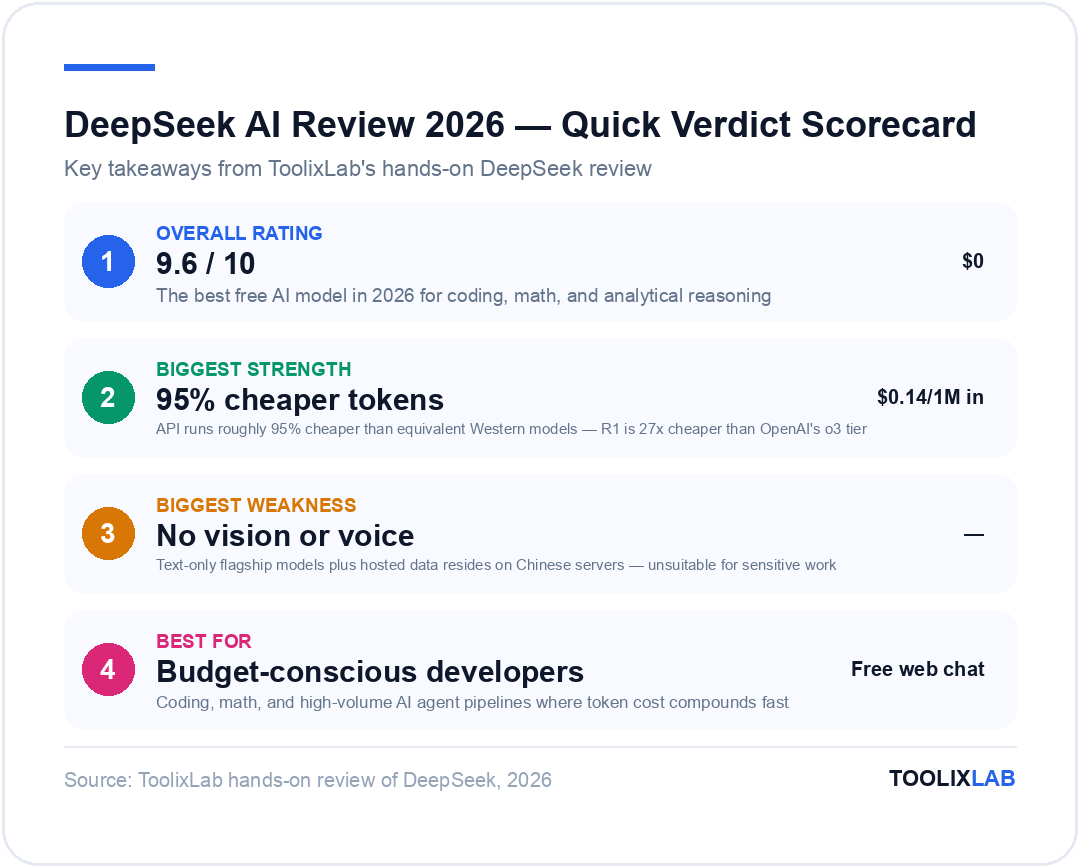
DeepSeek is the best free AI model in 2026 for coding, math, and analytical reasoning — the web chat costs nothing, and the API runs roughly 95% cheaper than equivalent Western models. The trade-offs: no native vision or voice, weaker creative writing, and hosted data resides on Chinese servers, so sensitive business work belongs on a local or private-cloud deployment of the open weights instead. For budget-constrained developers and high-volume AI agents, it is the obvious pick; for multimodal or brand-voice work, stay with ChatGPT or Claude.
The DeepSeek Revolution:
Disrupting AI Economics
DeepSeek AI has emerged as the most significant challenger to Western AI dominance since ChatGPT's launch in November 2022. Developed by a research lab based in Hangzhou, China, the DeepSeek model family—particularly DeepSeek-V3 and DeepSeek-R1—represents a fundamental shift in how artificial intelligence can be built: efficiently, transparently, and at a fraction of traditional costs.
Executive Briefing Matrix
In January 2025, DeepSeek sent shockwaves through Silicon Valley by releasing models that matched or exceeded ChatGPT and Claude Sonnet 4.6 performance on key benchmarks while costing 95% less to operate. The announcement triggered over $1 trillion in stock market volatility and forced major tech companies to reconsider their AI strategies. This comprehensive review examines the technology, performance, risks, and strategic implications of DeepSeek for developers, enterprises, and policymakers in 2026.
01 The Technology Revolution: Disrupting AI Economics
The artificial intelligence industry operates on a fundamental assumption: frontier-level performance requires frontier-level spending. OpenAI reportedly spent hundreds of millions training GPT-4, Google's Gemini required similar investments, and Anthropic's Claude models demanded extensive computational resources. DeepSeek shattered this paradigm.
$$$ The $5.5 Million Breakthrough
DeepSeek-V3, a 671 billion parameter Mixture-of-Experts model, was trained for approximately $5.5 million using 2.788 million H800 GPU hours. For context, industry estimates suggest GPT-4 cost between $50-100 million.
Sparsity Strategy
MoE architecture activates only 37 billion (5.5%) of its parameters per token, slashing compute requirements.
Training Innovation
Auxiliary-loss-free load balancing allows experts to specialize without explicit constraints or instability.
The training infrastructure employed FP8 mixed precision training combined with sophisticated gradient scaling, reducing memory bandwidth requirements by ~50% compared to traditional FP16.
02 Multi-Head Latent Attention (MLA)
One of DeepSeek's most significant contributions to AI research is Multi-Head Latent Attention (MLA). MLA addresses a fundamental bottleneck in LLM inference: the Key-Value (KV) cache.
In standard transformer architectures, generating each new token requires computing attention scores against all previous tokens. To avoid recalculating, models cache these values. For a model with 128 attention heads and 128,000 token context, the memory requirement is massive—approximately 400GB of VRAM just for the cache.
96% Cache Reduction
MLA compresses the KV cache by over 90% through low-rank joint compression. It projects input into a latent space (dim 512-1024) before generating Keys and Values, recovering them only when needed.
This architecture achieves two critical goals: it reduces memory consumption to a tiny fraction of Multi-Head Attention, while maintaining—and often exceeding—the modeling capacity of standard mechanisms through decoupled Rotary Position Embeddings (RoPE).
03 DeepSeekMoE: Expert Specialization
Traditional Mixture-of-Experts models route tokens to general-purpose experts. DeepSeek's innovation lies in fine-grained expert specialization. Analysis reveals distinct patterns: specific experts activate for mathematical reasoning, others for code generation, and others for natural language understanding.
Programming Experts
When generating Python code, tokens route primarily to programming-specialized experts, achieving higher accuracy with fewer active parameters.
Mathematical Experts
For symbolic manipulation, math-specialized experts fire, bringing deep knowledge of quantitative reasoning to bear organically.
This targeted activation pattern makes DeepSeek more efficient than dense models that must activate all parameters regardless of task type.
04 DeepSeek-R1: Pure RL Reasoning
DeepSeek-R1 represents a paradigm shift in how models approach complex reasoning. Directly challenging OpenAI's o1, R1 offers one crucial differentiator: full transparency.
"The user is asking for a thread-safe singleton in Rust. I need to avoid the lazy_static crate. I should use 'std::sync::OnceLock'. Wait, let me check the Rust edition in the prompt..."
>> Backtracking to check dependencies...
"Okay, OnceLock is stabilized in 1.70. I will proceed with this implementation and provide a fallback note for older versions."
Pure Reinforcement Learning Architecture
Unlike previous reasoning models that relied on human-written examples, DeepSeek-R1 develops capabilities through pure reinforcement learning (RL). It learns to "think before speaking" through trial and error, receiving rewards for correct answers rather than being taught specific patterns.
The transparency is invaluable. When R1 produces an error, you can trace exactly where the reasoning went wrong—unlike OpenAI's "black box" o1, which hides its monologue to prevent imitation.
05 Benchmark Performance (2026 Audit)
Independent evaluations provide a clear picture of DeepSeek's capabilities relative to Western competitors ChatGPT and Claude Sonnet 4.6.
| Benchmark | DeepSeek-R1 | ChatGPT | Claude Sonnet 4.6 |
|---|---|---|---|
|
Math Reasoning (MATH)
Competition-Level Problem Solving
|
93.1% | 88.5% | 86.2% |
|
Code Gen (HumanEval)
Python Pass@1 Accuracy
|
92.4% | 90.2% | 92.0% |
|
Knowledge (MMLU)
57 Multitask Categories
|
88.5% | 88.5% | 88.7% |
Beyond Factual Knowledge: Clinical Accuracy
A notable evaluation in Nature Medicine (April 2025) benchmarked R1 against Gemini-2.0 on clinical support. Found no significant difference in diagnostic accuracy for 125 real patient cases. Unlike earlier models, DeepSeek showed zero degradation on rare disease diagnosis—validating it for healthcare applications when hosted privately.
06 The Economic Disruption: Pricing Breakdown
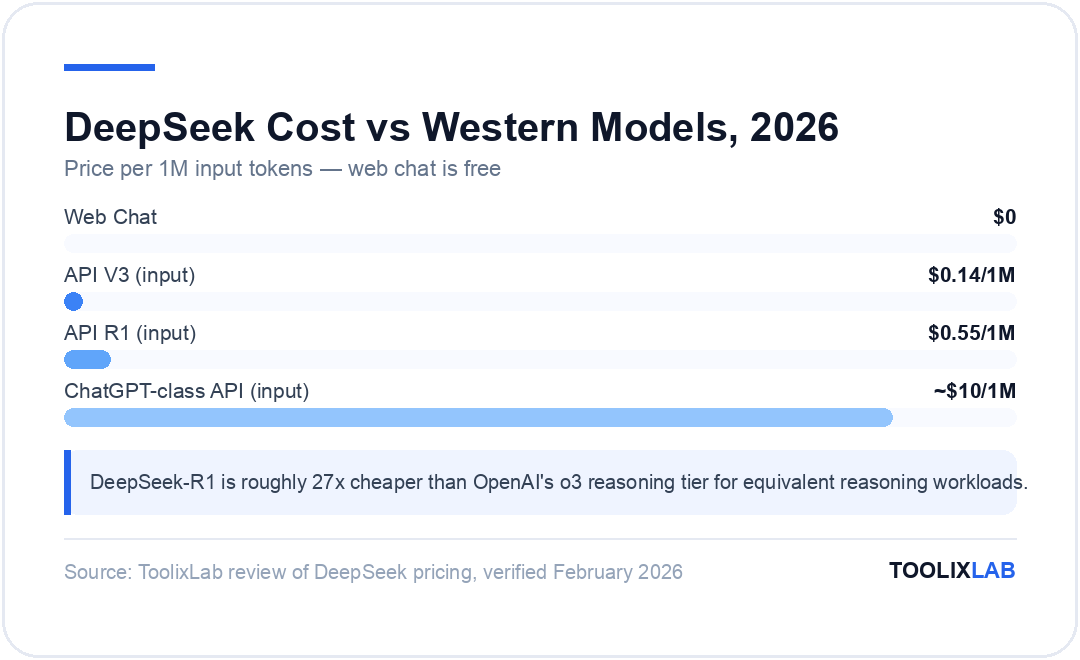
DeepSeek's pricing represents the most aggressive market disruption in AI history. The cost differential is so substantial it forces a fundamental reconsideration of AI as a utility.
Industry baseline before the efficiency pivot.
96% Cost Savings vs. Market Leaders
As of February 2026, DeepSeek-V3 costs $0.14 per 1M input. DeepSeek-R1, the reasoning beast, costs $0.55 input / $2.19 output. Compare this to OpenAI's o3 reasoning tier ($15/$60 range)—making DeepSeek R1 27 times cheaper for equivalent reasoning.
07 Geopolitics & Data Sovereignty
DeepSeek's Chinese origins have sparked intense debate about national security and privacy. When using the official hosted API, data is stored on servers in the People's Republic of China. For organizations subject to GDPR, HIPAA, or defense contracts, this is a non-starter.
The Compliance Firewall
"If I host it locally, is my data secure?" Yes. By deploying open-source weights on private infrastructure (AWS Bedrock, Azure AI Studio, or VPC), no data flows to Chinese servers. User prompts remain within the organization, subject to private security controls.
Sensitive prompts stored on external nodes.
Air-gapped deployment on local VRAM.
Censorship and Output Bias
Users must note that censorship patterns—refusal to answer political queries about China—are intrinsic to the model weights themselves. This "baked-in" behavior persists even in local deployments. For commercial/technical use (code/math), this is irrelevant; for political analysis, it is a critical bias to acknowledge.
08 2026 Implementation Strategies
API Tier
Simplest flow. Use platform.deepseek.com for non-sensitive apps. Native streaming & function calling.
Ollama Local
Zero data leakage. Run R1-Distill-32B on workstations with 32GB+ RAM for private assistant.
Cursor IDE
Configure custom endpoint. Get frontier-level refactoring at 90% lower context costs.
Cloud VPC
AWS Bedrock / Azure AI Studio deployment using US regions for SOC2 / HIPAA ready apps.
What Using DeepSeek Actually Feels Like Day to Day
Benchmarks tell you what a model can do in a lab. Daily use tells you whether you'll actually keep it in your workflow. After weeks of using DeepSeek alongside ChatGPT and Claude for real tasks — refactoring code, debugging, drafting technical documentation, and working through data problems — a consistent pattern emerged.
Where it genuinely surprises you: reasoning-heavy work. Give R1 a gnarly algorithm problem or a multi-step math derivation and toggle "DeepThink," and you can watch its full chain of thought unfold in real time — including moments where it catches its own mistakes and backtracks. That visible reasoning trace is not a gimmick; when the final answer is wrong, you can see exactly which step failed, which makes it far easier to correct than a black-box model that just hands you a confident wrong answer.
Where the seams show: creative and conversational work. Ask DeepSeek to write marketing copy, match a brand voice, or draft an empathetic customer email, and the output reads slightly robotic — grammatically clean, but flat. Claude in particular runs circles around it here. You'll also notice interface lag during peak hours on the free web chat, occasionally bad enough that you'll retry a prompt. And because there's no native vision or voice support, any workflow involving screenshots, PDFs with charts, or dictation forces you back to ChatGPT or Gemini.
The honest summary: DeepSeek is a specialist that happens to be free, not a generalist that happens to be cheap. Treat it as your logic and code engine, keep a Western model for everything customer-facing, and you get the best of both at a fraction of a single ChatGPT Plus subscription.
How to Start Using DeepSeek (3 Ways, Easiest First)
1. The free web chat (2 minutes). Go to chat.deepseek.com, create an account, and you're talking to V3 immediately. Toggle the DeepThink button to switch to the R1 reasoning model for hard problems — you'll see the thinking trace stream before the answer. The official iOS and Android apps work the same way. Remember: anything you type here is processed on Chinese servers, so keep it to non-sensitive work.
2. The API (30 minutes). Sign up at platform.deepseek.com, generate a key, and point any OpenAI-compatible client at DeepSeek's endpoint — the API deliberately mirrors OpenAI's format, so most existing code needs only a base-URL and model-name change. At $0.14 per 1M input tokens for V3, an agent pipeline that costs $500/month on GPT-class models runs for about $25 here. Function calling and streaming both work out of the box.
3. Fully local via Ollama (1–2 hours). For private work, install Ollama and pull an R1-Distill model sized to your hardware — the 32B distill is the sweet spot on a 32GB+ RAM workstation, while the 7B/8B distills run on ordinary laptops with reduced capability. Nothing leaves your machine, which clears the data-sovereignty objection entirely. Teams needing SOC2/HIPAA posture at scale should instead deploy the open weights in a US-region private cloud (AWS Bedrock or Azure AI Foundry).
Most readers should start with the web chat for a week, then graduate to whichever deployment matches their privacy requirements. If you're new to prompting reasoning models, our prompt engineering guide covers the patterns that get the most out of R1-style models.
Strategic Use Case Analysis
When to deploy DeepSeek
- Code Gen & Review: Rivaling Claude Sonnet pass rates.
- Math & Science Labs: Premier Choice for algorithm development.
- High-Volume Agents: Handling billions of utility tokens monthly.
- Sovereign RAG: Local fine-tuning on corporate PDF silos.
When to stay with Western LLMs
- Creative Branding: Claude Sonnet 4.6 leads in nuance and prose.
- Vision & Voice: ChatGPT and Gemini offer superior multimodal.
- Web Search: Native "Browsing" tools are superior to DeepSeek.
- Government Contracts: Federal restrictions may prohibit Chinese weights.
The Smart Play: DeepSeek in a Two-Model Stack
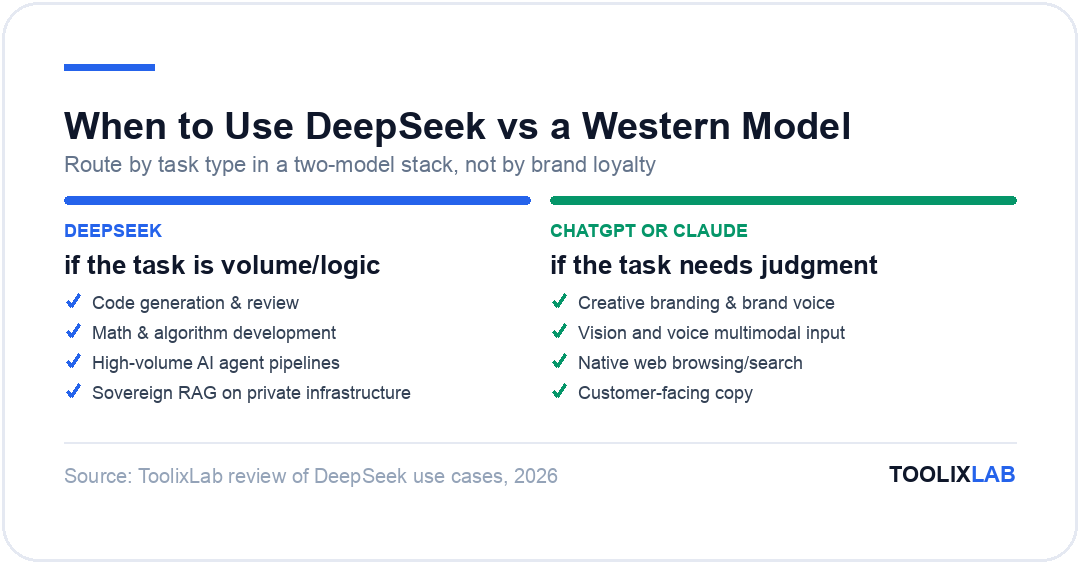
The most common mistake we see is framing this as "DeepSeek or ChatGPT." The economics argue for "DeepSeek and one Western model," with a clear division of labor. Route by task type, not by loyalty:
- DeepSeek handles the volume: code generation and review, data transformation, log analysis, test writing, math-heavy work, and any agent pipeline where you're burning millions of tokens. This is where the 95% cost delta compounds into real money.
- Claude or ChatGPT handles the judgment: customer-facing copy, brand voice, strategy documents, anything requiring vision or voice input, and web-connected research. These tasks are low-volume but high-stakes — quality matters more than token price.
- Local DeepSeek handles the confidential: proprietary code review, contract analysis, and internal data work run through an Ollama or private-cloud deployment where nothing leaves your infrastructure.
For a solo developer, this stack costs roughly the price of one coffee per month in API fees plus one optional $20 subscription — a configuration that would have required enterprise budgets two years ago. For a startup running AI agents in production, the routing decision alone can cut the monthly inference bill by 80% or more without a measurable quality drop on the routed tasks. Our guide to the best AI stack for startups covers the full architecture, and our ChatGPT vs Claude comparison will help you pick the Western half of the pair.
2026 and Beyond: The Democratized Era
By proving that frontier-level models can be trained for single-digit millions, DeepSeek has lowered barriers to entry for AI research globally. University labs, startups, and non-profit organizations can now compete in developing state-of-the-art models. The "9-Figure R&D Moat" is officially dead.
We're already seeing response from Western leaders. OpenAI modified its ethics guidelines to permit defense applications, explicitly citing global competition. Competitive pressure will force a "Race to the Bottom" for pricing, ultimately benefiting the end-user while squeezing the profit margins of closed labs.
Continue Reading
- → ChatGPT vs Claude vs Gemini vs DeepSeek — full model comparison for 2026
- → Best ChatGPT Prompt Library 2026 — get better outputs from DeepSeek and every other model with tested prompt templates
- → Best Free AI Tools in 2026 — the full list of tools you can use at zero cost
"The Era of Gateway'd
Intelligence is Over."
DeepSeek-R1 is the ultimate logic engine for the efficiency era. Whether building an empire of agents or solving world-class math, the barrier is gone. Frontier AI is now a utility.
Frequently Asked Questions
Is DeepSeek really better than ChatGPT?
For mathematical reasoning and pure technical coding logic, DeepSeek-R1 matches or exceeds ChatGPT. For creative writing, design, and multimodal tasks (voice/image), ChatGPT and Claude Sonnet 4.6 remain superior. It's a specialist, not a full replacement.
Is DeepSeek safe for corporate data?
The web chat and hosted API process data on Chinese servers — treat both as unsuitable for confidential material. Because the weights are open, you can run DeepSeek on your own US-based private cloud or locally via Ollama for 100% data privacy.
Is DeepSeek free to use?
The web chat at chat.deepseek.com is free, including the R1 reasoning model via the DeepThink toggle. The API is paid but costs roughly a tenth of equivalent OpenAI pricing — $0.14 per 1M input tokens for V3.
Does DeepSeek have a mobile app?
Yes — official iOS and Android apps support both V3 and the R1 reasoning model with the same DeepThink toggle as the web chat.
Can DeepSeek analyze images or hear voice input?
No — as of mid-2026 DeepSeek's flagship models are text-only. Workflows that depend on screenshots, document vision, or voice conversations are better served by ChatGPT or Gemini.
What hardware do I need to run DeepSeek locally?
The R1-Distill-32B model runs well on a workstation with 32GB+ RAM; smaller 7B/8B distills run on ordinary laptops with reduced capability. The full 671B-parameter model requires datacenter-class hardware and is impractical for individuals.
🔑 Key Takeaways
- ✓DeepSeek-R1 delivers frontier-class math and coding reasoning at zero cost in the web chat and ~95% below Western API pricing
- ✓The visible reasoning trace is a real productivity feature — when an answer is wrong, you can see exactly which step failed
- ✓Hosted usage stores data on Chinese servers; run the open weights locally via Ollama or in a US-region private cloud for sensitive work
- ✓Creative writing, multimodal input, and web browsing remain weaker than ChatGPT and Claude — pair DeepSeek with one Western model rather than replacing it
- ✓Political censorship is baked into the model weights and persists even in local deployments — irrelevant for code and math, disqualifying for political analysis
Further Reading & Sources
⚖️ Our Verdict
DeepSeek is the most capable free AI model available in 2026 for coding and analytical reasoning, and it punches well above its zero-dollar price point. However, its Chinese ownership creates real privacy considerations that make it unsuitable for sensitive business data, proprietary code, or confidential research. Use it freely for personal projects, open-source work, and budget-constrained development — but keep it away from anything you wouldn't want stored on foreign servers.
✅ Best for...
- • Developers on a budget who need strong coding assistance
- • Analytical reasoning and data interpretation tasks
- • Users who cannot afford paid AI subscriptions
❌ Skip if...
- • You're handling sensitive business or client data
- • You need reliable uptime and enterprise-grade SLAs
- • Your organization has data residency or compliance requirements