
Quick Verdict: The SMB Starter Pack (2026)
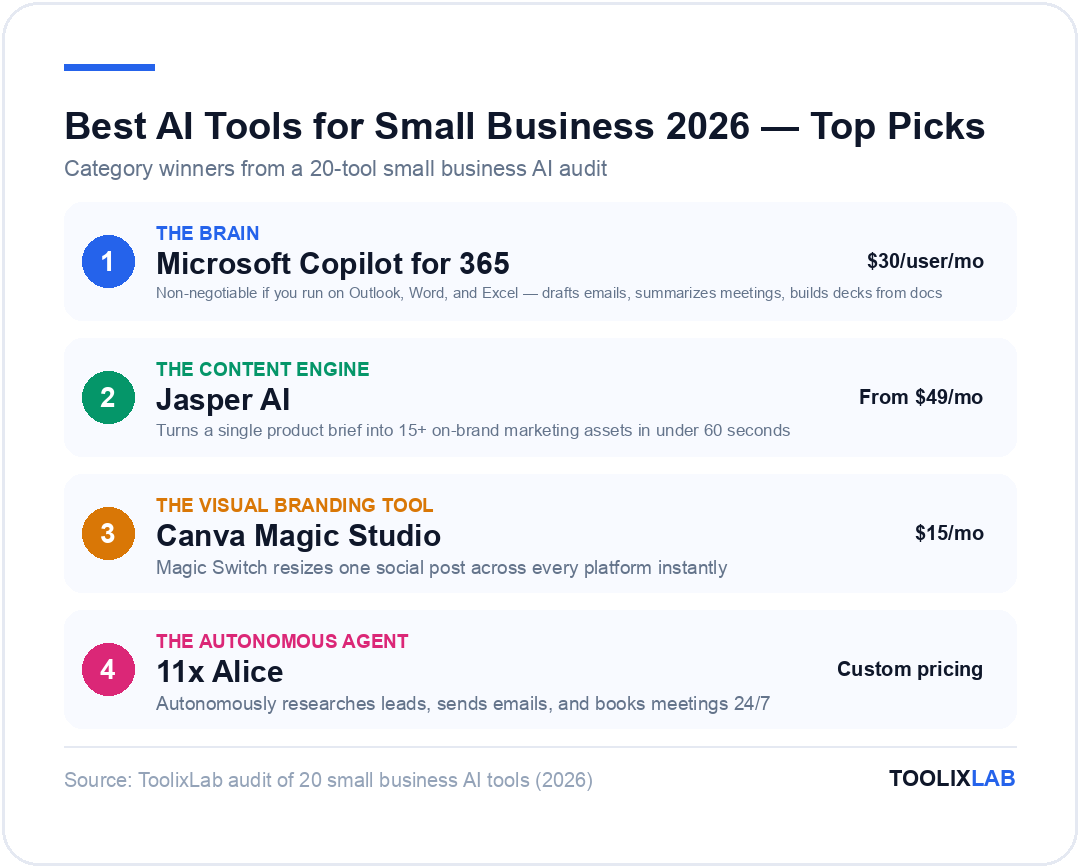
- THE BRAIN Microsoft Copilot / Gemini - The essential "Office OS" that lives inside your email and docs.
- THE WORKER Claude Sonnet 4.6 - For high-converting marketing copy and complex business reasoning.
- THE AGENT 11x Alice - An autonomous AI sales rep that finds leads and books meetings while you sleep.
Running a small business in 2026 is an exercise in extreme competition. You are no longer just competing with the shop across the street; you are competing with global entities and automated startups that have virtually zero overhead. The right AI tools for small business are the only way a small team can punch with the weight of a multinational corporation.
We've moved past the "experimental" phase of AI. In 2026, AI is a utility, like electricity or the internet. If you aren't using it, you are simply paying a "latency tax" on every task you perform. This guide is designed to help you stop paying that tax. We've audited and ranked the 20 best AI tools for small businesses across every major department.

1. The Essentials: Your "Everyday" AI
Before you buy specialized tools, you need a general-purpose "Brain" integrated into your daily workflow. These are the operating systems of the modern SMB.
1. Microsoft Copilot for 365
Best For: Teams already on Office 365
If your business runs on Outlook, Word, and Excel, Copilot is non-negotiable. It drafts emails based on thread history, summarizes Teams meetings instantly, and creates PowerPoint decks from Word documents. It’s not just a chatbot; it has context on all your files.
2. Gemini for Google Workspace
Best For: Google Workspace Power Users
The Google equivalent. It lives in your Docs, Sheets, and Gmail. Its "Help me write" feature in Gmail is a lifesaver for clearing inboxes. It shines in Google Sheets, where it can classify data and generate formulas from plain English instructions.
3. ChatGPT Team
While Copilot and Gemini are great for documents, ChatGPT Team remains the king of general reasoning and creative brainstorming. The "Team" plan ensures your data is private (excluded from training) and allows you to build custom GPTs for your specific business processes (e.g., "The Onboarding Bot" or "The SOP Writer"). To skip the learning curve, use a ready-made ChatGPT prompt library — they cut time-to-value from weeks to hours.
2. Marketing & Content Generation (The ROI Leader)
Marketing is usually the biggest expense for a small business. AI reduces the cost of "creation" to near zero, allowing you to focus on strategy.
4. Jasper AI (The Content Engine)
Primary Use: Multi-channel Campaigns
Jasper isn't just a chatbot; it's a campaign manager. It learns your Brand Voice from your website and style guide. In 2026, its "Campaign Mode" allows you to turn a single product brief into 15+ assets (social posts, ad copy, emails) in under 60 seconds, all perfectly on-brand.
5. Canva Magic Studio
Primary Use: Instant Visual Branding
Canva has evolved into a full-spectrum AI design suite. The "Magic Switch" feature is the standout: create one Instagram post, and with one click, resize it for LinkedIn, Facebook, and a Presentation. It saves hours of manual resizing work.
6. Opus Clip (Short-Form Video Automation)
In 2026, video is the only way to reach new audiences on social. Opus Clip uses AI to "watch" your long-form videos (YouTube, Webinars) and identify the most viral-worthy moments. It automatically adds dynamic captions, emojis, and face-tracking for TikTok and Reels. One hour of filming becomes 30 days of social content.
3. Sales Intelligence & Growth
Sales is about timing and personalization. These tools ensure you never miss a lead.
7. Apollo.io (The Sales Prospecting Bible)
Apollo has built an AI layer on top of the world's largest B2B database. Its AI agent "ghostwrites" personalized emails to prospects by analyzing their LinkedIn activity and company news. Instead of sending 100 generic emails, you send 10 highly targeted ones.
8. Chatbase (Your 24/7 AI Salesman)
Chatbase allows you to build a custom GPT code-free chatbot trained *only* on your website data. If a customer asks, "Do you have this in blue?" or "What's your refund policy?", Chatbase answers instantly. It captures leads while you sleep.
9. 11x (Alice) - The Autonomous Sales Rep
Alice isn't a tool; she's a "Digital Worker". Alice autonomously researches leads, sends emails, handles objections, and books meetings on your calendar. She works 24/7 and doesn't take coffee breaks. Perfect for scaling outbound without hiring more SDRs.
4. Operations & Personal Productivity
Operations is the "boring" part of business that takes up 80% of your time. These tools move you faster.
10. Notion AI (The Central Brain)
Notion is your company's long-term memory. Its Q&A feature lets you ask, "What were the notes from the client call last Tuesday?" or "Who is responsible for the SEO migration?", scanning thousands of docs to give you an answer. It eliminates the "Where did we save that?" conversation.
11. Motion (The AI Executive Assistant)
Motion uses AI to rebuild your calendar schedule every time it changes. If a client cancels a 4 PM meeting, Motion immediately drags your "Most Important Task" into that slot. It acts like a high-end EA, ensuring you work on what matters.
12. Fireflies.ai (The Meeting Historian)
Never take another meeting note. Fireflies joins your calls, transcribes them with 98% accuracy, and generates a "Sentiment Analysis" and "Action Item List." You can even "ask" your meetings questions later: "Did the client agree to the budget increase?"

5. Finance, Legal & Compliance
13. QuickBooks Intuit Assist
Finance has moved from "What happened?" to "What will happen?". Intuit's AI assistant now forecasts your cash flow for the next 90 days, warning you of potential cash crunches before they happen.
14. LegalZoom DocAssist
Before signing any vendor contract, upload it here. It highlights "hidden" renewal clauses, indemnity traps, and non-recordable terms in seconds. Essential for the 90% of daily legal work that usually goes unvetted.
15. Deel (Global HR)
Hiring globally is hard; international contracting is a compliance nightmare. Deel uses AI to handle tax laws in 150+ countries, ensuring your international contractors are legally compliant.
6. The Specialists (Hidden Gems)
These tools solve very specific, high-friction problems.
16. Gamma App
Presentations
Type a sentence, get a 10-slide pitch deck. It's the end of PowerPoint as we know it.
17. ElevenLabs
Voiceover
Indistinguishable human voice generation for training videos and marketing.
18. Perplexity Pro
Research
Replaces Google for competitive research. Direct answers with real-time citations.
19. Descript
Video/Podcast
Edit video by editing the transcript text. Remove "ums" and "ahs" automatically.
20. Zapier Central
AI Agents
Build AI bots that can do things across 8,000+ apps. "Email my best leads every Monday."
DeepSeek-V3
Data Analysis
The high-value logic engine. Perfect for analyzing heavy CSV exports and finding patterns.
7. Agentic AI: The Next Frontier
The buzzword for 2026 is "Agentic AI." This refers to AI that doesn't just talk (like a chatbot) but does. Tools like 11x Alice and Zapier Central are leading this charge. They can log in to your apps, click buttons, move data, and make decisions within parameters you set. For a small business, this is equivalent to hiring digital interns effectively for free.
📖 Read Also:
Not sure if you need the full business stack? Start with our step-by-step guide on how to use ChatGPT for your business, then explore the 15 Best ChatGPT Alternatives to find your primary AI driver. Or compare automation platforms in our Zapier vs Make vs n8n showdown.
8. ROI Calculator: Comparing Human vs. AI Agency Costs
| Category | Traditional Labor (Monthly) | AI Stack (Monthly) | Savings |
|---|---|---|---|
| Content Creation | $2,500 (Agency) | $39 (Jasper) | 98% |
| Customer Support | $1,800 (Part-time) | $19 (Chatbase) | 99% |
| Ops & Scheduling | $3,500 (Secretary) | $19 (Motion) | 99% |
| Lead Generation | $1,200 (Outbound) | $49 (Apollo) | 95% |
Recommended Stacks by Business Type
Twenty tools is a menu, not a plan. Here's what we'd actually deploy for four common small-business profiles, keeping each stack to three tools and under $100/month:
Local service business (plumber, salon, clinic): Microsoft Copilot or Gemini for email and quotes, Chatbase on the website to answer "are you open / do you do X / what does it cost" around the clock, and Canva Magic Studio for social posts and promotions. Most of your AI value is in never missing an after-hours lead — the chatbot typically pays for the entire stack.
E-commerce store: Claude or ChatGPT Team for product descriptions and ad copy, Canva Magic Studio for creative, and Chatbase for pre-sales questions. Once you pass a few hundred support tickets a month, graduate to the dedicated stack in our e-commerce AI tools guide.
B2B services / agency: ChatGPT Team with custom GPTs for proposals and SOPs, Apollo.io for outbound prospecting, and Jasper if content marketing is your growth channel. This is the profile where the autonomous-agent tier (11x's Alice) becomes worth evaluating once outbound volume justifies it.
Solo founder / freelancer: One brain (Claude or ChatGPT paid tier), Canva's free-or-cheap tier, and nothing else until something hurts. Your constraint is attention, not tooling — our freelancer AI guide covers this profile in depth.
9. Your First 30 Days: A Realistic AI Adoption Roadmap
The single biggest predictor of whether AI actually saves a small business money is not which tools you pick — it's how you roll them out. Teams that adopt one tool at a time, tied to one painful process, keep using AI a year later. Teams that buy five subscriptions in a burst of enthusiasm cancel most of them by month three. Here's the sequence we recommend after watching both patterns play out repeatedly:
Week 1 — Pick your single biggest time drain. Not the most exciting AI use case; the most boring one. For most small businesses this is either email (quoting, follow-ups, customer questions) or content creation. Write down how many hours per week it currently costs you. This number is your baseline, and without it you'll never know whether the tool is paying for itself.
Week 2 — Deploy one "brain" tool against that drain. If the drain is email and documents, start with Microsoft Copilot or Gemini inside the office suite you already pay for. If it's content, start with Claude or ChatGPT Team plus your brand guidelines pasted into a reusable project. Resist adding anything else yet. The goal this week is that every person on the team uses the tool on real work at least once a day.
Week 3 — Systematize with templates. The productivity jump doesn't come from ad-hoc prompting; it comes from saved, repeatable prompts your whole team shares — a quote-response template, a social-post generator with your voice baked in, a meeting-summary format. Build five. Our free AI workflow templates give you a head start, and a good prompt library covers the rest.
Week 4 — Measure, then expand or kill. Compare hours spent against your Week 1 baseline. If the tool saved less than two hours per person per week, fix your process or kill the subscription — don't let it linger as shelf-ware. If it cleared the bar, now add your second tool from the category with the next biggest drain: Canva Magic Studio for design, Apollo for outbound, or Chatbase for support.
What This Costs: Realistic Monthly Budgets
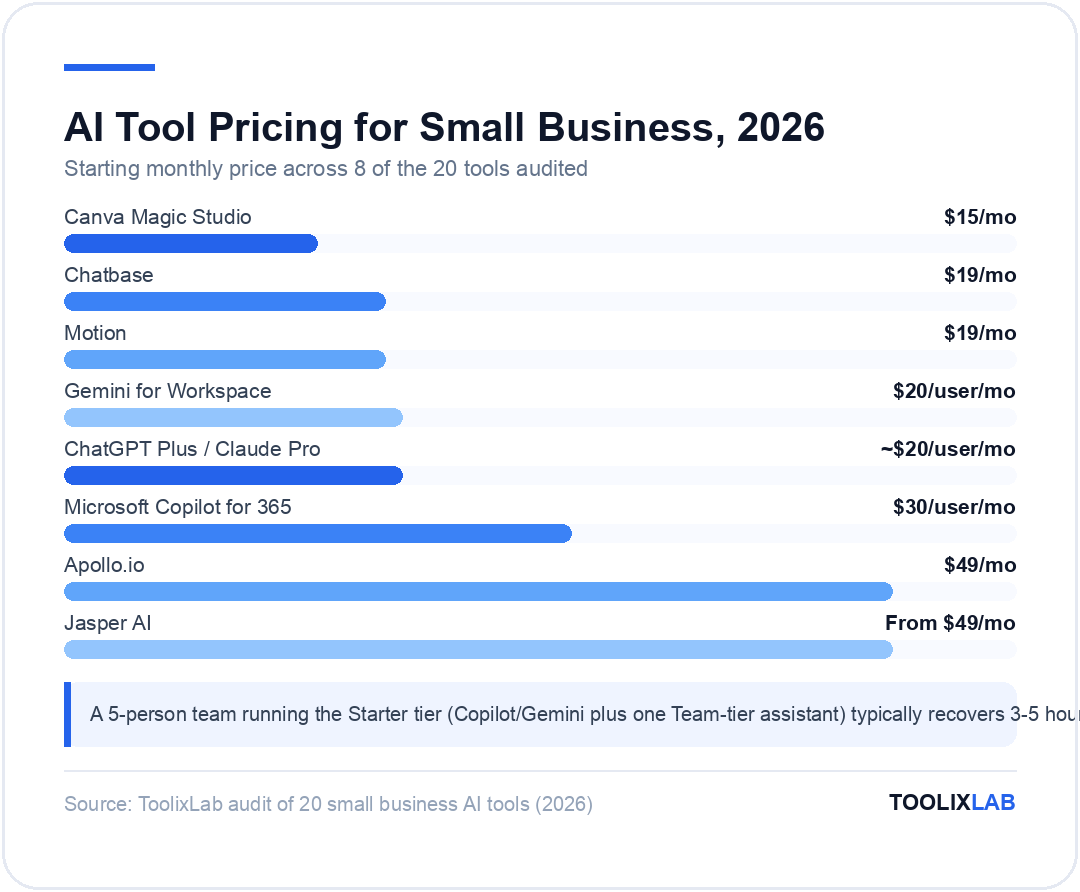
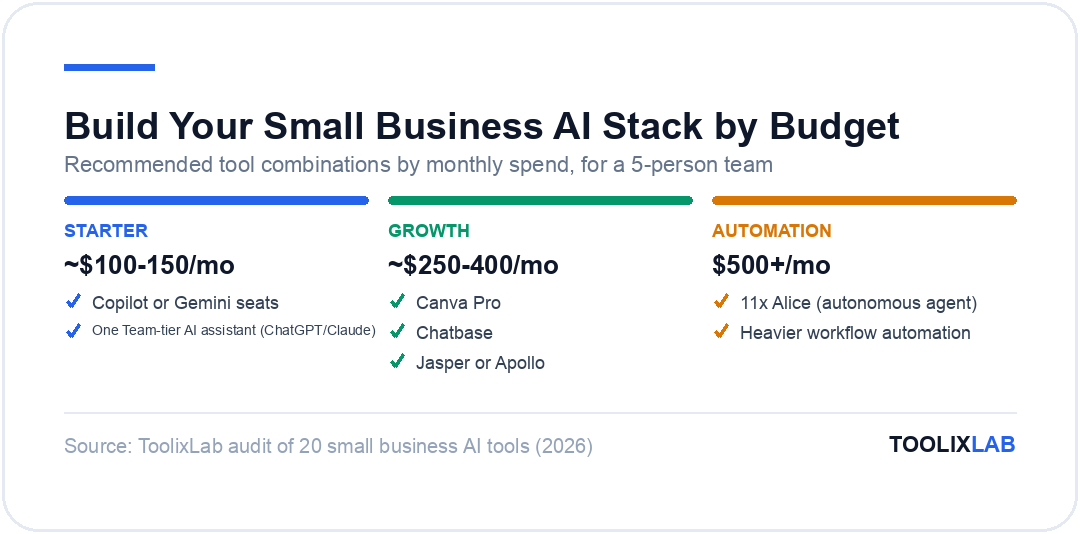
To make the numbers concrete, here's what the stacks above actually cost at 2026 pricing, assuming a five-person team. Starter tier (~$100–150/month): Copilot or Gemini seats on your existing office suite plus one Team-tier AI assistant. This alone typically recovers 3–5 hours per person per week on email, documents, and first drafts — at even $30/hour of labor value, that's $1,800–3,000 of recovered time against a $150 spend. Growth tier (~$250–400/month): add Canva Pro, Chatbase, and either Jasper or Apollo depending on whether content or outbound drives your growth. Automation tier ($500+/month): autonomous agents like Alice and heavier workflow automation — only worth it once the manual version of the process is already working and measurably constrained by human hours.
The pattern worth internalizing: AI spend should follow proven bottlenecks, not precede them. Every tier upgrade should be triggered by a measurement from your Week 4 review showing a specific process is out of capacity — never by a product launch announcement.
10. The Five Mistakes That Waste SMB AI Budgets
1. Buying tools before defining the job. A subscription without an assigned process becomes shelf-ware within weeks. Every tool on this list should map to a named, recurring task — "Jasper writes the Tuesday newsletter," not "we have Jasper."
2. Letting every employee freelance with personal accounts. Free personal ChatGPT accounts mean your customer data is scattered across accounts you don't control and may be used for model training. Team plans exist precisely to fix this — the data privacy alone justifies the upgrade.
3. Publishing AI output without a human pass. AI drafts, humans approve. The businesses that get burned are the ones that pipe generated content straight to customers. Ten minutes of review preserves the 90% time saving while catching the one hallucinated claim that could cost you a client.
4. Ignoring the tools already bundled in your stack. Before buying anything new, check what your existing subscriptions now include: Microsoft 365, Google Workspace, Canva, QuickBooks, and Shopify have all shipped substantial AI features into plans you may already pay for.
5. Automating a broken process. AI accelerates whatever you point it at — including chaos. If your quoting process is inconsistent, AI will produce inconsistent quotes faster. Fix the process on paper first, then automate the fixed version. Our guide on how to build an AI workflow walks through this properly.
Verdict: The Small Business Future is Automated
AI is not a replacement for your team. It's a superpower for them.
The small businesses that win in the next five years aren't the ones with the most employees; they are the ones with the most efficient output per person. By offloading the "low-value" work to AI, you free your human team to build relationships, close deals, and innovate.
🔬 How We Test AI Tools at ToolixLab
Every recommendation in this guide comes from hands-on evaluation, not spec-sheet comparison. Our process for this category:
- Real-task testing: we run each tool through the actual workflows this guide covers — the same tasks you'd use it for — and compare outputs side by side.
- Verified pricing: every price is checked against the vendor's official pricing page at review time, and re-checked on our refresh cycle.
- Free-tier reality check: we test the free tier limits ourselves so "free" claims reflect what you actually get.
- Ongoing re-evaluation: AI tools change monthly; posts carry a visible "Last updated" date and stale recommendations get replaced.
ToolixLab is reader-supported: some links may earn us a commission, which never affects rankings — several tools we rank highest have no affiliate program at all.
Frequently Asked Questions
What are the best free AI tools for small businesses in 2026? ▾
The top free AI tools for small businesses include ChatGPT Free (emails, content drafts), Google Gemini (integrated with Google Workspace), Canva AI (marketing graphics), HubSpot AI CRM (free tier with AI email tools), and Zapier's free plan (100 automated tasks/month). Start with one tool, use it for 2–3 weeks, then expand — trying 10 tools at once is the fastest way to see zero ROI. For nonprofits and mission-driven organizations, see our dedicated guide to the best AI tools for nonprofits in 2026 — many tools offer free or deeply discounted nonprofit plans.
How much should a small business budget for AI tools in 2026? ▾
A practical AI stack for a team of 5–10 runs $150–$350/month: one AI assistant like ChatGPT Plus or Claude Pro (~$20/user), an AI writing tool (~$49–$99/month), and a workflow automation platform like Make.com or Zapier (~$30–$80/month). The ROI typically pays back within the first month — a 5-person team each saving 2 hours/week generates $1,000–$2,000/month in recovered time at average professional rates.
Which AI tool is easiest for small business owners with no tech background? ▾
ChatGPT is the most accessible starting point — describe what you need in plain English and it delivers. For visual design, Canva AI is drag-and-drop. For automations without coding, Zapier uses a step-by-step wizard. The golden rule: pick one tool, use it daily for three weeks before adding the next. Businesses that master two tools outperform those dabbling with ten.
What AI tools do successful small businesses use most in 2026? ▾
Usage data consistently shows the most widely adopted AI tools among profitable small businesses are: ChatGPT/Claude (communications, content), Canva AI (social media content), Zapier or Make.com (workflow automation), HubSpot AI (CRM, email sequences), and Grammarly Business (writing polish). The pattern: businesses automating even 3–4 repetitive workflows see the fastest ROI, typically within 60 days.
Will AI replace employees at small businesses? ▾
In practice, AI replaces tasks, not entire roles. A well-equipped 3-person team often matches the output of a 5–7 person team — meaning AI prevents new hires rather than eliminating existing ones. Tasks most at risk: repetitive data entry, templated customer service responses, basic content formatting. Roles involving relationships, creative judgment, and strategy are augmented rather than replaced. The real risk is for businesses that neither adopt AI nor adjust expectations accordingly.