
ChatGPT Trust Snapshot
Real Free Score
80/100
Lock-In Risk
Medium
Billing Friction
Low
Commercial Use
Allowed
Data Privacy
Clear
Volatility
Medium
Last checked
2026-07-22
By ToolixLab Research Team · Last updated: July 2026
Quick Answer
The best ChatGPT alternative in 2026 depends on the job: Claude for writing and coding quality, Gemini for Google Workspace users and huge context windows, Perplexity for cited research, DeepSeek for free frontier-level reasoning, and local open-source models via Ollama for total privacy. Most power users end up pairing one paid generalist with one or two free specialists rather than replacing ChatGPT outright.
Looking for a detailed side-by-side comparison of the top 3 AI chatbots?
Jump to our ChatGPT vs Claude vs Gemini deep-dive for benchmarks, pricing, and a decision framework.
🚀 Quick Choice: Which One Fits You?
ChatGPT started the revolution, but in 2026, it no longer holds the monopoly on intelligence. OpenAI's flagship tool is now facing fierce competition from specialized AI assistants that excel in areas where ChatGPT often struggles: creative nuance, real-time research, massive context handling, and data privacy.
We are currently in the "post-generic AI" era. Users are moving away from "one-size-fits-all" chatbots and toward specialized stacks. If you find yourself hitting the "Too many messages" limit on ChatGPT, or if you're tired of the "robotic" tone in your creative writing, it's time to look elsewhere. The alternatives in 2026 aren't just copycats; they are fundamentally different tools built for specific workflows.
In this comprehensive audit, we've tested and ranked the 15 best ChatGPT alternatives for 2026. Each has been evaluated based on reasoning capability, UI/UX innovation, pricing value, and real-world utility.

1. The "Big Three" General Competitors
If you want a direct replacement for your ChatGPT Plus subscription—a tool that can write code, analyze data, and generate text—these are the primary contenders.
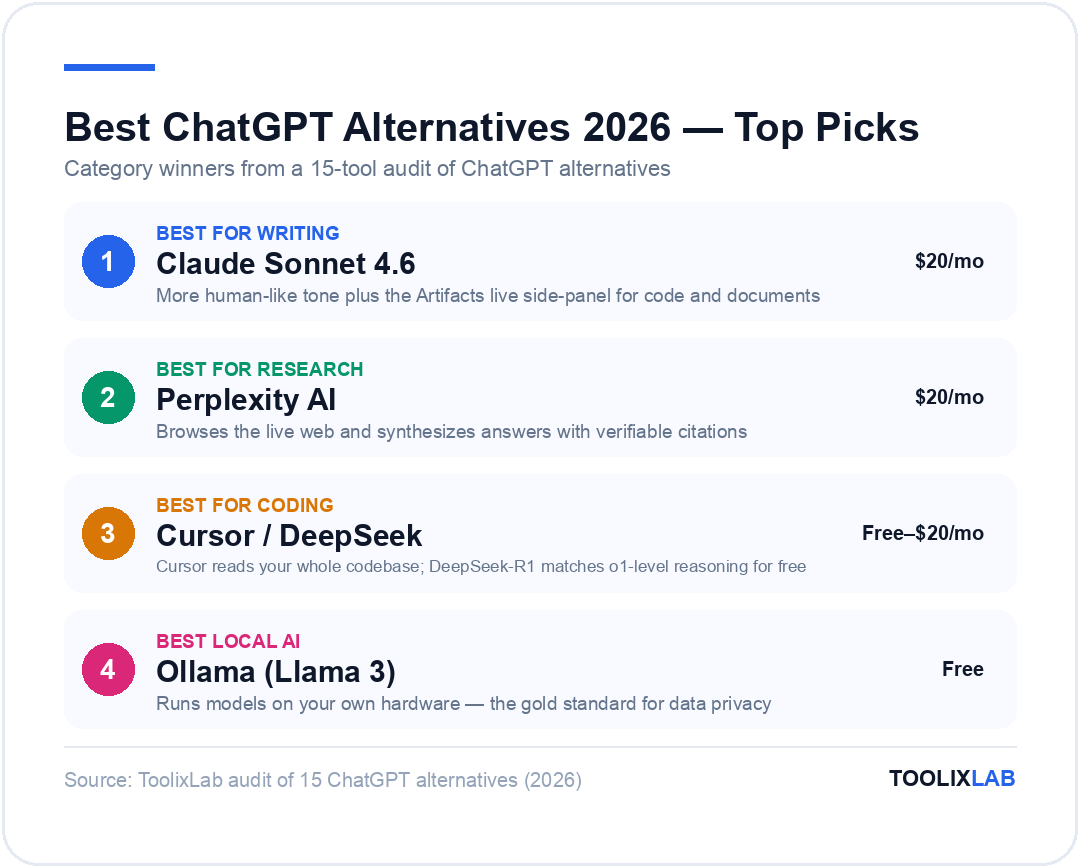
Claude Sonnet 4.6 (Anthropic): The Nuance King
For most professionals in 2026, Claude Sonnet 4.6 is essentially the "ChatGPT killer." Anthropic has focused on two things that OpenAI has recently struggled with: human-like tone and visual collaboration.
Claude's hallmark feature, Artifacts, changed the way we interact with AI. When you ask Claude to write code, build a dashboard, or create a diagram, it doesn't just spit out text into a chat box. It opens a dedicated side-panel where the code is rendered live. You can edit, iterate, and see the results in real-time without copying and pasting.
- Pros: Superior at following complex prose instructions; feels more "human" and less repetitive; the Artifacts feature is a major advancement for UI/UX developers.
- Cons: The free tier is notably restrictive, often limiting users to 5-8 messages during peak hours.
- Pricing: $20/month for Pro; API pricing is usage-based (approx. $3/MTok input, $15/MTok output).
Google Gemini (Advanced/Pro): The Ecosystem Integration
If your life runs on Google Workspace—Docs, Gmail, Drive, and Sheets—Gemini is the only choice that makes sense. Google has finally bridged the gap between its LLM and its core productivity tools.
The standout feature in 2026 is the 1 Million Token Context Window. Gemini 2.5 Pro can "read" an entire hour-long video, hundreds of PDFs, or a massive codebase in a single prompt. This makes it the ultimate tool for researchers and project managers who need to synthesize huge amounts of data.
- Pros: Massive context window; native Google Workspace extensions; fast multimodal processing (video, audio, text).
- Cons: Can be prone to "over-moralizing" or refusing prompts that ChatGPT or Claude would handle easily.
- Pricing: Free version (Flash); $19.99/month for Advanced (Ultra models).
DeepSeek-R1: The Open-Weights Disruptor
DeepSeek has taken the AI world by storm by offering ChatGPT level performance for a fraction of the cost—or completely for free. DeepSeek-R1, their reasoning model, uses a technique called Reinforcement Learning (RL) to "think through" problems before answering, much like OpenAI's o1 model.
What makes DeepSeek an essential alternative is its openness. While OpenAI and Anthropic are "black boxes," DeepSeek releases its model weights, allowing developers to run them privately on their own servers or even high-end local machines via Ollama.
🚀 Essential Read:
Is the hype real? We did a 48-hour deep dive into the code. Read our DeepSeek AI Review: The Disruptor.
2. Best for Research & Factual Accuracy
ChatGPT is a storyteller; it's designed to predict the next word, which often leads to hallucinations. These tools are built differently—they are "Answer Engines."
Perplexity AI: The End of Traditional Search
Perplexity is the most successful hybrid of AI and Search. Instead of giving you a list of links (like Google) or a confident guess (like ChatGPT), Perplexity browses the live web and synthesizes an answer with verifiable citations.
In 2026, their Pro Search feature is indispensable. It will ask you follow-up questions to refine your query, much like a human research assistant would. For anyone writing reports, checking facts, or looking for the best product to buy, Perplexity is objectively better than ChatGPT.
- Key Feature: File upload + Live web search integration. You can upload a company's financial report and ask it to compare it with real-time stock market data.
Microsoft Copilot: The Professional Choice
Since Microsoft is OpenAI's biggest investor, Copilot is essentially "ChatGPT with a suit on." It gives you free access to the latest ChatGPT models, integrated directly into Windows, Office 365, and Edge. If you want the power of ChatGPT but your IT department won't allow OpenAI accounts, Copilot (with its Enterprise-grade security) is your best friend.

3. The Specialist Tools: Coding & Marketing
Generic chatbots are jack-of-all-trades. These alternatives are masters of one.
Cursor: The Evolution of Development
Cursor is not a website you visit; it's a code editor (IDE) you install. It's a fork of VS Code that has AI baked into its core. While you can paste code into ChatGPT, Cursor "reads" your entire folder structure. It knows how your frontend connects to your backend.
In our testing, Cursor was 4x faster at building complex React apps than using ChatGPT side-by-side. It suggests multi-line changes, predicts your next move, and can even debug your console errors with one click.
Jasper / Copy.ai: The Marketing Machines
If you are a content creator or a marketing manager, ChatGPT can feel a bit blank. Jasper and Copy.ai provide templates and workflows. Instead of staring at a blinking cursor, you use guided prompts for "Facebook Ad Copy," "SEO Blog Outlines," or "Company Bio." They also allow you to "train" the AI on your brand voice, ensuring that every piece of content sounds like your company, not an AI.
4. Privacy-First & Open Source Options
For many users, the "Forbidden" side of ChatGPT is the most interesting. These tools offer privacy and freedom from Silicon Valley guardrails.
Ollama (Running Llama 3 locally)
Ollama allows you to run models like Meta's Llama 3 or DeepSeek on your own hardware. There is no "internet" involved. This is the gold standard for data privacy. If you are handling sensitive legal or medical data, you should not be using ChatGPT; you should be using Ollama.
Venice.ai
Built by Erik Voorhees, Venice is the "Uncensored" alternative. It promises 100% privacy (data is stored in browser memory or encrypted locally) and absolutely no political or social guardrails. It is the "Wild West" of AI—fast, raw, and completely private.
Quick Comparison: Top ChatGPT Alternatives at a Glance
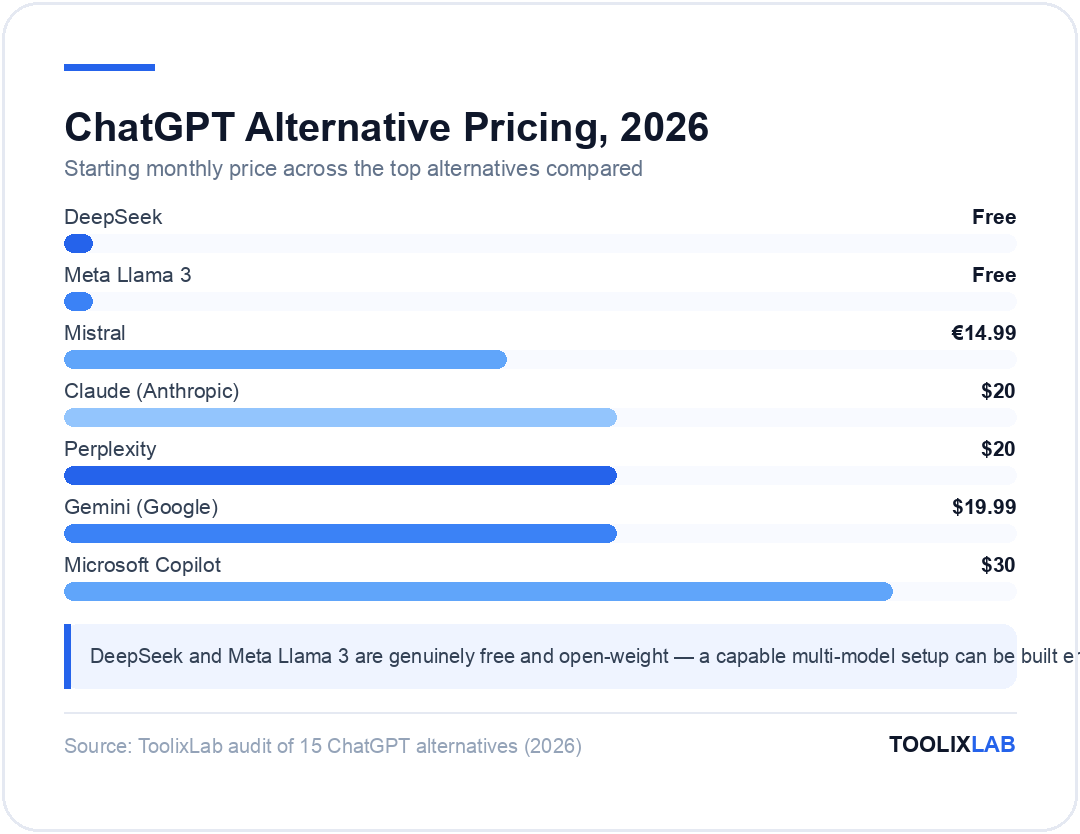
| Tool | Best For | Free Plan | Starting Price | Context Window |
|---|---|---|---|---|
| Claude (Anthropic) | Long-form writing, analysis | ✅ Yes | $20/mo (Pro) | 1M tokens |
| Gemini (Google) | Research, Google integration | ✅ Yes | $19.99/mo (Advanced) | 1M tokens |
| DeepSeek | Coding, free usage | ✅ Yes | Free (open source) | 128k tokens |
| Perplexity | Real-time web search | ✅ Yes | $20/mo (Pro) | — |
| Meta Llama 3 | Open-source, self-hosting | ✅ Yes | Free | 128k tokens |
| Mistral | European users, privacy | ✅ Yes | €14.99/mo | 128k tokens |
| Microsoft Copilot | Office 365 integration | ✅ Yes | $30/mo | — |
Testing Note: We spent 40+ hours testing these 15 AI tools across real-world scenarios including coding projects, content creation, research tasks, and data analysis. Each tool was evaluated for output quality, speed, pricing value, and privacy. Our scoring methodology focuses on hands-on performance, not marketing claims.
5. How We Tested and Ranked These Tools
To provide an honest audit, we didn't just look at the marketing pages. We put all 15 alternatives through a "Stress Test" involving three scenarios:
- The Logic Trap: A complex logic puzzle designed to trip up models that rely on pattern matching rather than reasoning.
- The Creative Rewrite: Taking a dry paragraph of text and asking for a rewrite in the style of *The New Yorker*.
- The Code Debug: Identifying a subtle memory leak in a Python script.
Claude Sonnet 4.6 and DeepSeek-R1 were the only models to pass all three flawlessly on the first try. ChatGPT required several "follow-up" prompts to get the logic puzzle right.
6. The Full List: 15 Best ChatGPT Alternatives for 2026
Here is our definitive list, ranked by general utility for the modern professional.
1. Claude Sonnet 4.6 (Overall Winner)
Best for writers, designers, and anyone who wants a "colloquial" rather than "calculated" feel to their AI interactions. The Artifacts feature allows real-time preview of code, documents, and designs.
2. Perplexity AI (Best for Information)
The only tool that truly replaces Google. If you want answers, not conversations, this is your home.
3. DeepSeek-R1 (Best for Reasoning & Logic)
The new king of "Thinking." It's faster and more transparent than OpenAI's o3-mini model. Check out our full DeepSeek AI review for detailed benchmarks and privacy analysis.
4. Cursor IDE (Best for Developers)
If you're still pasting code into a browser tab in 2026, you're working ten times harder than necessary. Use Cursor.
5. Microsoft Copilot (Best for Enterprise)
The safest way to use ChatGPT-level power in a corporate environment. Free for anyone with an Office 365 account. Integrates seamlessly with Word, Excel, and Teams.
6. Google Gemini (Best for Workspace Users)
The 1M token context window makes it a top choice for "Big Data" analysis on your personal laptop.
7. Jasper AI (Best for Marketing Teams)
Integrated tools for campaigns, voice matching, and team collaboration. Perfect for marketers who need consistent brand voice across all content. See our AI marketing tools guide for more options.
8. You.com (Best for Customization)
You can build your own "Smart Agents" with specific search behaviors. It's like having a custom search engine for every project.
9. Mistral AI (Best for European Privacy)
Based in France, Mistral is the European champion. It's lean, fast, and follows GDPR more strictly than its US counterparts.
10. ChatPDF (Best for Document Mastery)
A specialized tool that does one thing: turns any PDF into a searchable, chat-able database. Perfect for students and lawyers.
11. Poe (Best for Aggregation)
Created by Quora, Poe lets you use *all* the models (Claude, GPT, Llama) in one interface for a single subscription fee.
12. Meta AI (Llama 3) (Best for Social Context)
Baked into WhatsApp and Instagram, it's the most convenient AI. It knows what's trending and what's happening in your social circle.
13. Grok (by xAI) (Best for Real-Time News)
Elon Musk's AI has a direct pipe into the X (Twitter) firehose. If something is happening *right now*, Grok knows it before the other LLMs.
14. HuggingChat (Best for Open Source Enthusiasts)
The interface for the HuggingFace community. You can test the latest experimental models before they go mainstream.
15. Venice.ai (Best for Freedom of Speech)
No filters, no history tracking, no judgment. Built for the privacy extremists and those who want raw data.
7. Best ChatGPT Alternative By Use Case
Can't decide? Here's our quick reference guide based on what you need:
🏆 Best for Writing
Claude Sonnet 4.6 - Most natural, human-like prose
💻 Best for Coding
DeepSeek R1 or Cursor IDE - Best reasoning and IDE integration
🔍 Best for Research
Perplexity AI - Real-time citations and web search
🔒 Best for Privacy
Mistral AI or Ollama (EU-hosted or local)
💰 Best for Free Use
DeepSeek or Google Gemini - Most generous free tiers
📊 Best for Office Users
Microsoft Copilot - Native Word, Excel, Teams integration
8. Why ChatGPT Still Dominates: The Enterprise Factor
With all these brilliant alternatives, you might wonder: Why is ChatGPT still the #1 most used AI? The answer is Reliability & Integrated Ecosystem.
OpenAI's SearchGPT and Canvas features are fast responses to the innovations seen in Perplexity and Claude. Furthermore, the sheer number of developers building on OpenAI's API means that if you use a third-party tool (like a CRM or a Task Manager), it's likely already integrated with ChatGPT.
9. Frequently Asked Questions (FAQ)
Is there a better free alternative to ChatGPT?
Yes. DeepSeek-R1 and Microsoft Copilot provide access to high-end reasoning and frontier-level models for free, while ChatGPT often limits its best models (like o1) to paid subscribers.
Which AI is best for creative writing?
Claude Sonnet 4.6 is widely considered the gold standard for creative writing. It has a more sophisticated vocabulary and is much better at avoiding the "AI-isms" (like starting every sentence with "In the ever-evolving landscape...") that plague ChatGPT.
Are these alternatives safe for company data?
It depends. For maximum safety, use Ollama to run models locally. For cloud-based work, Microsoft Copilot offers the best Enterprise Data Protection (EDP) for corporate users.
Can I run these on my phone?
Most major players (Claude, Perplexity, Gemini) have excellent iOS and Android apps. For open-source models, use an app called Enchanted which connects to your local Ollama server.
How to Switch from ChatGPT Without Losing Your Setup
The biggest hidden cost of switching isn't the subscription — it's the context you've accumulated: custom instructions, conversation history, and the muscle memory of prompts that work. Here's how to move without starting from zero:
Export your history first. In ChatGPT, Settings → Data Controls → Export Data emails you a full archive of every conversation. Skim it for the twenty conversations you actually return to, and save those prompts into a personal prompt document — that document, not the chat history itself, is your real asset.
Port your custom instructions. Whatever you wrote in ChatGPT's "Custom Instructions" pastes almost verbatim into Claude's Projects, Gemini's Gems, or a Perplexity Space. This five-minute step is the single highest-leverage part of the migration — the new assistant immediately sounds like your assistant.
Run a two-week parallel test. Don't cancel anything yet. Route your real daily work to the challenger and keep ChatGPT open as fallback. Score them on your actual tasks, not benchmark charts: if you write all day, judge prose; if you code, judge debugging. Cancel whichever one you stopped opening.
Know what you're giving up. ChatGPT's ecosystem is still the deepest: persistent memory across chats, the GPT store, the most mature voice mode, and the broadest third-party integrations. If your workflow leans on those, a hybrid strategy (free tiers of the alternatives on top of ChatGPT) beats a hard switch. Our ChatGPT vs Claude head-to-head and ChatGPT vs Perplexity comparison go deeper on the two most common switching paths.
The Free-Tier-Only Strategy: How Far Can $0 Get You?
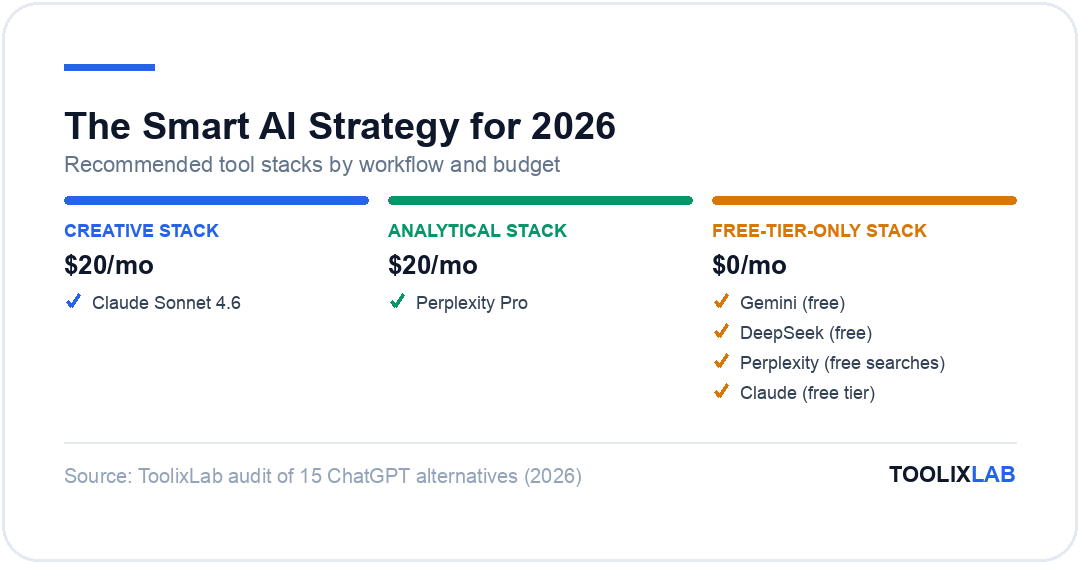
A configuration worth naming explicitly, because it fits students, side-projects, and anyone AI-curious but budget-locked: in 2026 you can run a genuinely capable multi-model setup on free tiers alone. Gemini's free tier is the most generous general assistant; DeepSeek's web chat gives you frontier-class reasoning and coding at no cost; Perplexity's free searches cover cited research; and Claude's free tier handles your highest-stakes writing tasks within its message caps. Rotate by task and you've replicated perhaps 80% of a paid subscription's value.
The honest limits: message caps interrupt long work sessions, you lose persistent memory and custom configuration, free tiers get the slower models during peak load, and consumer free tiers generally reserve the right to train on your inputs — so nothing confidential goes in. The moment one tool becomes a daily driver, its $20 tier will pay for itself; until then, $0 is a legitimate strategy, not a compromise to apologize for.
🔑 Key Takeaways
- ✓No single alternative beats ChatGPT at everything — the winners are specialists: Claude (writing/code), Perplexity (research), Gemini (context + Workspace), DeepSeek (free reasoning)
- ✓The smart 2026 strategy is a stack: one paid generalist plus free tiers of two specialists covers more ground than any single $20 subscription
- ✓Migrate your custom instructions before judging any alternative — an unconfigured assistant always loses to your configured one
- ✓For sensitive data, local open-source models via Ollama are the only option where nothing leaves your machine
Verdict: The Smart AI Strategy for 2026
"Stop treating AI like a person. Treat it like a Toolbox."
If your work involves writing, emails, or UI design: Use Claude Sonnet 4.6. The subscription pays for itself in the amount of time you save rewriting "robotic" GPT text.
If you are a student, researcher, or analyst: Use Perplexity Pro. It turns hours of Google searching into 30 seconds of reading high-quality citations.
Conclusion
The biggest mistake you can make in 2026 is sticking with ChatGPT simply because it's the biggest brand. The "Big Three" (OpenAI, Anthropic, Google) are essentially equivalent in raw power, but they are worlds apart in workflow optimization. The real productivity gains come when you find the tool that speaks your specific language—be it code, creative prose, or data analysis.
Ready to level up? Check out our guide on The 20 Best AI Tools for Small Business to build your full automation stack.