
ChatGPT Trust Snapshot
Real Free Score
80/100
Lock-In Risk
Medium
Billing Friction
Low
Commercial Use
Allowed
Data Privacy
Clear
Volatility
Medium
Last checked
2026-07-22
Quick Recommendations: The 2026 Writer's Stack
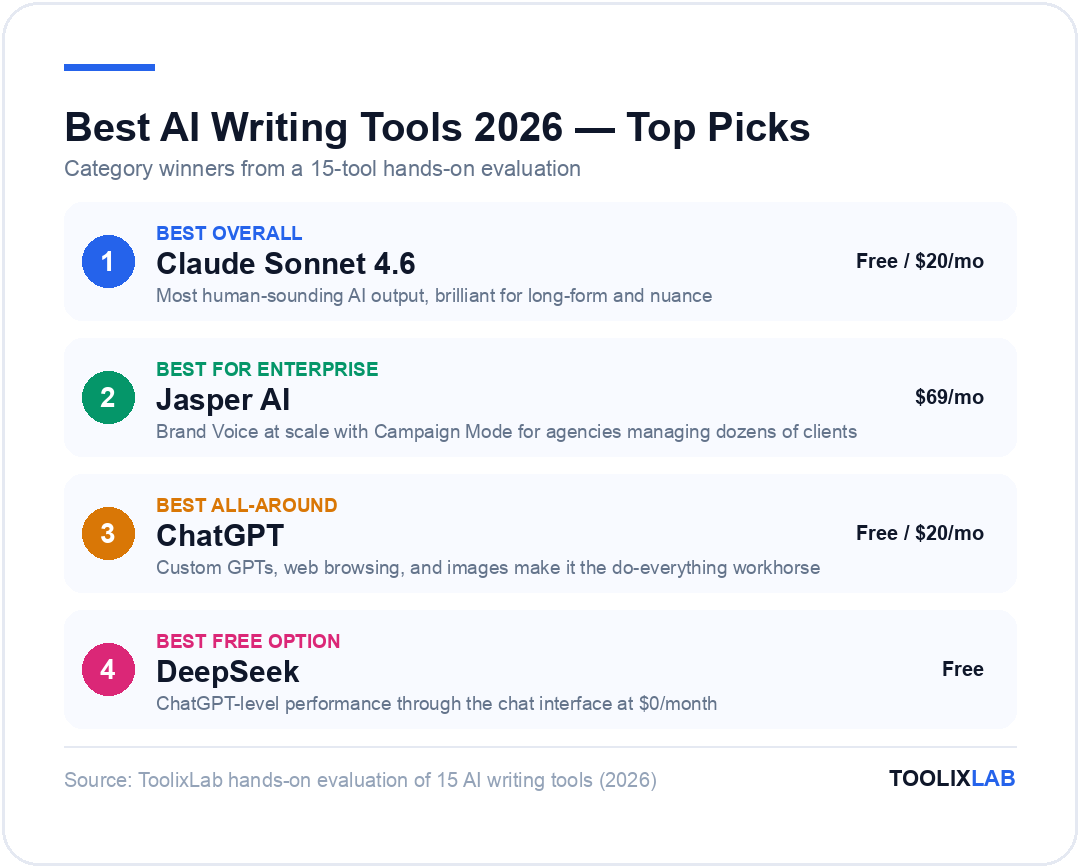
Most Human-Sounding AI
Brand Voice at Scale
ChatGPT Level at $0/mo
According to a 2026 HubSpot survey, 78% of content teams now use AI writing tools in their daily workflow. The question is no longer "should I use AI for writing?"—it's "which tools should I stack to produce content that actually ranks?"
Here's the problem: there are hundreds of AI writing tools on the market, and most "best of" lists just rehash the same generic descriptions without actually testing anything. We did things differently. Over the past two weeks, we hands-on tested 15 AI writing tools across blog posts, marketing copy, fiction, editing, and SEO optimization. We wrote real content, tracked quality scores, and compared outputs side-by-side.
In this guide, you'll get our honest assessment of the 15 best AI writing tools for content creators in 2026—with specific pricing (as of April 2026), real pros and cons from testing, and a decision framework to help you pick the right tool for your exact workflow. Whether you're a solo blogger, a marketing agency, or an enterprise content director, you'll walk away knowing exactly what to use.

How We Selected & Tested These Tools
We didn't just read product pages. Each tool on this list went through a structured testing process over two weeks of hands-on use.
Our 7 Evaluation Criteria
We also evaluated tools we ultimately didn't include—like Wordtune and Simplified—because they didn't meet our quality threshold for a 2026 recommendation. Every tool below earned its spot through real testing, not affiliate incentives.
Last updated: April 2026. All pricing verified as of this date.
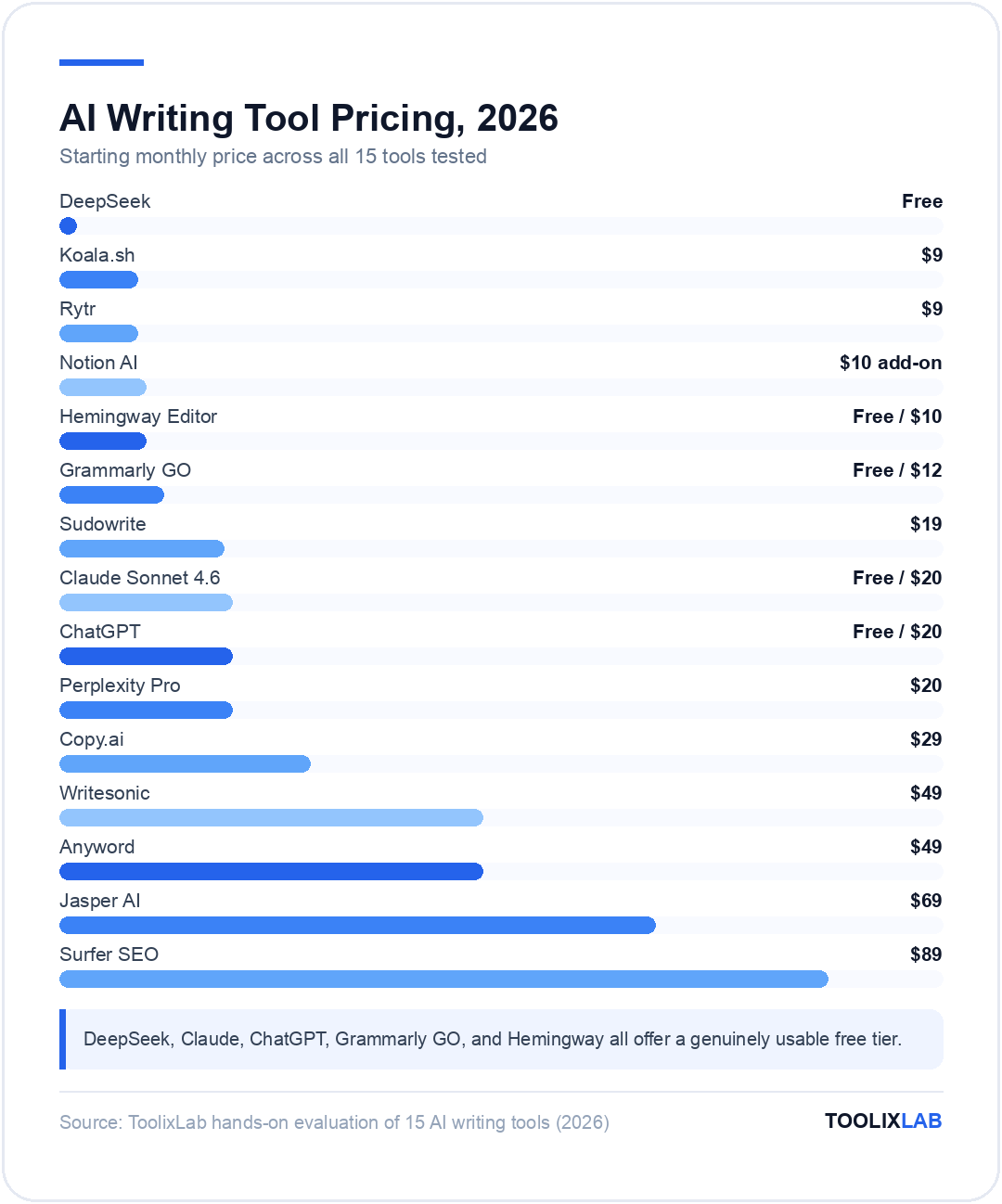
Quick Comparison: All 15 AI Writing Tools at a Glance
| # | Tool | Best For | Starting Price | Rating |
|---|---|---|---|---|
| 1 | Jasper AI | Enterprise & agencies | $69/mo | ⭐⭐⭐⭐⭐ |
| 2 | Claude Sonnet 4.6 | Long-form & nuance | Free / $20/mo | ⭐⭐⭐⭐⭐ |
| 3 | ChatGPT (ChatGPT) | All-around writing | Free / $20/mo | ⭐⭐⭐⭐½ |
| 4 | Writesonic | SEO blog content | $49/mo | ⭐⭐⭐⭐ |
| 5 | Surfer SEO | Content optimization | $89/mo | ⭐⭐⭐⭐½ |
| 6 | Copy.ai | Social & workflows | $29/mo | ⭐⭐⭐⭐ |
| 7 | Koala.sh | Affiliate content | $9/mo | ⭐⭐⭐⭐ |
| 8 | Grammarly GO | Editing & polish | Free / $12/mo | ⭐⭐⭐⭐ |
| 9 | Sudowrite | Fiction writing | $19/mo | ⭐⭐⭐⭐ |
| 10 | Hemingway Editor | Readability | Free / $10/mo | ⭐⭐⭐½ |
| 11 | Rytr | Budget writing | $9/mo | ⭐⭐⭐½ |
| 12 | Perplexity Pro | Research & citations | $20/mo | ⭐⭐⭐⭐½ |
| 13 | Anyword | Conversion copy | $49/mo | ⭐⭐⭐⭐ |
| 14 | DeepSeek | Free AI writing | Free | ⭐⭐⭐⭐ |
| 15 | Notion AI | Docs & collaboration | $10/mo add-on | ⭐⭐⭐½ |
The 15 Best AI Writing Tools (Detailed Reviews)
1. Jasper AI — The Enterprise Brand Voice Engine
Jasper remains the undisputed leader for enterprise content teams, and the reason is simple: Brand Consistency. While generic AI tools default to a bland "corporate-cheery" tone, Jasper lets you define a "Brand Voice" by uploading your past blog posts, emails, and style guides. In 2026, their Campaign Mode is the real game-changer—turn a simple product brief into 15+ synchronized assets: Google ads, Facebook posts, blog outlines, and email sequences—all sharing the exact same voice.
- Key Features: Multi-Voice Support (50+ client voices), Campaign Mode, brand knowledge bases, 50+ templates, Chrome extension, direct CMS integrations
- Pricing (as of Feb 2026): Pro from $69/mo ($59/mo annual); Business: custom pricing. No Creator plan. API usage billed separately.
- Pros: Unmatched brand voice consistency; excels at marketing copy; scales effortlessly for agencies managing dozens of clients
- Cons: Expensive for solo creators; output quality depends heavily on your Brand Voice training data; limited free tier
- Best For: Marketing agencies, enterprise content teams, multi-brand organizations
- Our Rating: ⭐⭐⭐⭐⭐ (5/5)
2. Claude Sonnet 4.6 (Anthropic) — The Long-Form Nuance King
If you want AI-generated writing that sounds genuinely human, Claude is your best bet. Writers across the industry prefer Claude because it avoids the tired "AI-isms" that plague OpenAI models—words like "delve," "demystify," or "ever-evolving" are rare here. Its Artifacts feature lets you see your blog post update live in a side panel as you request edits, making the revision process feel like working with a real assistant editor.
- Key Features: 1M-token context window (upload entire manuscripts), Artifacts live editing, Projects for persistent context, exceptional understanding of tone and nuance
- Pricing (as of Feb 2026): Free tier available; Pro at $20/mo (5x more usage); Team at $30/user/mo
- Pros: Most natural, human-sounding AI output; massive context window; brilliant at long-form essays, creative blogs, and complex analysis
- Cons: Free tier is quite restrictive; no built-in web browsing (must provide research manually); can be verbose
- Best For: Long-form bloggers, essayists, professional writers who value nuance over speed
- Our Rating: ⭐⭐⭐⭐⭐ (5/5)
3. ChatGPT (ChatGPT) — The All-Around Workhorse
ChatGPT doesn't need an introduction—it's the tool that started the AI writing revolution, and in 2026, it's still the most versatile option on the market. ChatGPT combines strong writing quality with an ecosystem that no competitor can match: Custom GPTs, plugins, DALL-E image generation, web browsing, and persistent memory across conversations. For writers who need one tool that does everything "pretty well," ChatGPT is hard to beat.
- Key Features: Custom GPTs (build specialized writing assistants), persistent memory, web browsing for research, DALL-E integration, code interpreter, voice conversations
- Pricing (as of Feb 2026): Free tier (ChatGPT mini + limited ChatGPT); Plus at $20/mo; Team at $25/user/mo; Enterprise custom
- Pros: Most complete ecosystem; excellent for brainstorming and ideation; built-in web search eliminates the research step; Custom GPTs are incredibly powerful
- Cons: Writing can feel "samey" and formulaic; prone to AI-isms ("certainly," "I'd be happy to"); less nuanced than Claude for long-form
- Best For: Generalists who need one do-everything tool, content ideation, quick drafts, multi-format creators
- Our Rating: ⭐⭐⭐⭐½ (4.5/5)

4. Writesonic — The SEO-First Content Machine
Writesonic's Article Writer 6.0 is the closest thing to a "magic button" for SEO content. When you provide a keyword, it scrapes the current top 10 Google results, extracts their subheaders, analyzes word count, and builds a comprehensive post designed to outrank them. For writers whose primary metric is organic traffic, Writesonic removes the guesswork.
- Key Features: Article Writer 6.0 with SERP scraping, Chatsonic (AI chat with web access), brand voice training, landing page generator, bulk content generation
- Pricing (as of Feb 2026): Lite from $49/mo (15 articles/mo); Standard from $99/mo (30 articles/mo); Professional from $249/mo
- Pros: Best-in-class SEO integration; competitive SERP analysis built in; fast output for high-volume needs
- Cons: Writing quality is serviceable but not exceptional—needs human polish; can feel template-driven
- Best For: SEO-focused bloggers, affiliate marketers, content agencies prioritizing traffic
- Our Rating: ⭐⭐⭐⭐ (4/5)
5. Surfer SEO — The Ranking Optimization Powerhouse
Surfer isn't a "writing" tool in the traditional sense—it's an optimization engine that ensures whatever you write (or generate) will rank. Its Content Editor gives you a real-time score from 0 to 100 based on keyword usage, headings, and content structure. In 2026, its AI "Surfer Draft" feature can generate an entire article that's already SEO-optimized, saving hours of manual keyword distribution.
- Key Features: Real-time Content Score, SERP Analyzer, keyword clustering, AI Surfer Draft, Grow Flow (weekly SEO tasks), content audit for existing articles
- Pricing (as of Feb 2026): Essential at $89/mo; Scale at $129/mo; Scale AI at $219/mo
- Pros: The "cheat code" for ranking—data-driven optimization that works; Grow Flow provides ongoing SEO tasks; excellent for updating old content
- Cons: Expensive for solo bloggers; AI Draft quality needs human revision; focuses exclusively on on-page SEO
- Best For: SEO professionals, content agencies, bloggers serious about organic growth
- Our Rating: ⭐⭐⭐⭐½ (4.5/5)
💡 Pro Tip: Stack Writesonic + Surfer
Use Writesonic to generate your first draft (it pulls SERP data automatically), then run it through Surfer's Content Editor for a second optimization pass. This two-step process consistently produces content scoring 85+ on Surfer's scale.
⚠️ Watch Out
Don't over-optimize. Surfer's score is a guide, not a law. Chasing a perfect 100/100 score often leads to keyword stuffing that hurts readability. Aim for 75-90 and let your human insight fill the gaps.
6. Copy.ai — The Social Media Workflow Automator
Copy.ai has pivoted from a simple copy generator to a full Workflow Engine. The killer feature in 2026? Triggers. Set a trigger like "When I publish a new blog post on WordPress, automatically generate 5 LinkedIn posts, a Twitter thread, and a summary for my newsletter." It's the ultimate tool for distribution-heavy writers who want to maximize every piece of content.
- Key Features: Workflow automation with triggers, 90+ copywriting templates, brand voice, infobase (upload company data), integrations with CRMs and CMS platforms
- Pricing (as of Feb 2026): Free plan (limited); Chat at $29/mo; Growth at $1,000/mo (enterprise)
- Pros: Automated content distribution is a massive time-saver; excellent for short-form social copy; workflows are genuinely powerful
- Cons: Long-form quality isn't competitive with Claude or ChatGPT; workflow setup has a learning curve
- Best For: Social media managers, content repurposing, marketing teams who want automated distribution
- Our Rating: ⭐⭐⭐⭐ (4/5)
7. Koala.sh — The One-Click Affiliate Writer
Koala is a favorite among affiliate marketers for good reason. It uses a combination of ChatGPT and real-time Google search data to generate product reviews and "best-of" lists that look surprisingly human. The standout feature is Amazon Integration: provide product URLs, and Koala automatically pulls specs and features to write a detailed review.
- Key Features: Amazon product data integration, real-time SERP analysis, one-click article generation, ChatGPT powered, bulk generation
- Pricing (as of Feb 2026): Essentials from $9/mo; Professional from $25/mo; Expert from $49/mo
- Pros: Incredibly fast for affiliate content; Amazon integration is genuinely unique; output quality impresses for the price
- Cons: Limited to review/listicle formats; not suitable for thought leadership or opinion pieces; community is small
- Best For: Affiliate marketers, niche site builders, product review bloggers
- Our Rating: ⭐⭐⭐⭐ (4/5)
8. Grammarly GO — The AI-Powered Style Surgeon
Grammarly is no longer just a spell checker. Its GO engine acts as a stylistic surgeon. Highlight any paragraph and ask "Make this sound more persuasive," "Rewrite this to be more concise," or "Adjust the tone to be more professional." It's the best tool for writers who want to write their own drafts but need AI to handle the aggressive editing and refinement. See our full Grammarly AI review for pricing, AI Agents, and how its AI detector held up under independent testing.
- Key Features: AI-powered full rewriting, tone detection and adjustment, clarity and conciseness suggestions, plagiarism detector, works across all apps via browser extension
- Pricing (as of Feb 2026): Free tier (basic grammar/spelling); Premium at $12/mo (annual); Business at $15/member/mo
- Pros: Lives everywhere you write (Gmail, Docs, Slack, etc.); AI rewriting is genuinely useful; catches issues other tools miss
- Cons: Not a generator—it edits, not creates; Premium is required for the best AI features; can be overly aggressive with style suggestions
- Best For: Writers who draft their own content but want AI-powered editing; non-native English speakers; professionals where tone matters
- Our Rating: ⭐⭐⭐⭐ (4/5)

9. Sudowrite — The Fiction Writer's Secret Weapon
Sudowrite is essentially "ChatGPT for novelists." Its Story Engine can manage a 100,000-word plot without losing track of characters or subplots. The legendary "Describe" feature fixes the "telling instead of showing" problem—highlight a word like "apple" and it generates sensory descriptions for sight, smell, taste, and sound.
- Key Features: Story Engine (plot management), Describe (sensory expansion), Rewrite (style transformation), Brainstorm (plot suggestions), character consistency tracking
- Pricing (as of Feb 2026): Hobby & Student at $19/mo; Professional at $29/mo; Max at $129/mo
- Pros: Purpose-built for fiction—nothing else comes close for narrative work; Describe feature is genuinely magical; long-form plot tracking is excellent
- Cons: Not useful for non-fiction, marketing, or SEO content; smaller community means fewer tutorials; prose can feel "purple" without editing
- Best For: Novelists, screenwriters, fiction authors, creative writing students
- Our Rating: ⭐⭐⭐⭐ (4/5)
10. Hemingway Editor — The Clarity Gatekeeper
The classic "yellow and red" highlighter tool has been upgraded with AI in 2026. It no longer just tells you a sentence is hard to read—it offers a one-click AI fix that simplifies grammar while maintaining your meaning. For writers who struggle with wordiness, Hemingway is an essential final gatekeeper before publishing.
- Key Features: Readability grading, sentence complexity highlighting, passive voice detection, adverb overuse alerts, AI-powered one-click simplification
- Pricing (as of Feb 2026): Free web version (basic); Desktop app one-time $19.99; Hemingway Plus at $10/mo (AI features)
- Pros: Forces you to write clearly; AI fix suggestions actually preserve meaning; simple, focused interface with zero learning curve
- Cons: Not a content generator; limited to editing/readability; can oversimplify technical or academic writing
- Best For: Bloggers who tend to write verbose prose, non-native speakers, technical writers aiming for accessibility
- Our Rating: ⭐⭐⭐½ (3.5/5)
11. Rytr — The Budget-Friendly Workhorse
If you need AI writing on a budget, Rytr is the way to go. At $9/month, it offers more value per dollar than almost any tool on this list. It's perfect for short-form copy—product descriptions, email subject lines, YouTube titles, and social media captions. While it lacks the deep brand-voice features of Jasper, Rytr is remarkably competent for basic business writing.
- Key Features: 40+ use case templates, 30+ languages, tone selector, built-in plagiarism checker, SEO keyword suggestions, Chrome extension
- Pricing (as of Feb 2026): Free tier (10K characters/mo); Saver at $9/mo (100K characters); Unlimited at $29/mo
- Pros: Incredible value at $9/mo; supports 30+ languages; simple and fast for short-form content; generous free tier to test
- Cons: Long-form quality falls behind Jasper and Claude significantly; limited customization; output often needs heavy editing for professional use
- Best For: Bootstrapped startups, freelancers, small business owners who need basic AI copy on a budget
- Our Rating: ⭐⭐⭐½ (3.5/5)
12. Perplexity Pro — The Research & Citation Partner
Technically an "answer engine," not a writer—but Perplexity is the best research partner for non-fiction content creators. It scours the live internet and provides footnoted citations for every claim it makes. Use Perplexity to gather verified facts and statistics, then feed those into Claude or Jasper to write the prose. This is the ultimate "No-Hallucination" workflow.
- Key Features: Real-time web search with citations, Pro Search (multi-step research), Collections (organize research), file upload analysis, API access for developers
- Pricing (as of Feb 2026): Free tier (limited searches/day); Pro at $20/mo (unlimited Pro Search, ChatGPT & Claude access)
- Pros: Every claim comes with a source—eliminates hallucination anxiety; genuinely faster than manual Google research; excellent for statistics-heavy content
- Cons: Not a content writer—you'll still need a separate tool for drafting; citation quality depends on source availability; can be repetitive
- Best For: Journalists, researchers, technical writers, anyone who needs verified data in their content
- Our Rating: ⭐⭐⭐⭐½ (4.5/5)
🚀 Essential Read:
Writing is just the start. Check out our guide on the 20 Best AI Tools for Small Business to automate your entire operation, or read our 15 Best ChatGPT Alternatives for more AI options.
13. Anyword — The Conversion Data Scientist
Anyword is unique because it assigns a Predictive Performance Score to everything it writes. It uses a massive database of marketing data to tell you, "This headline has an 82% chance of resonating with Female CEOs in their 40s." It's less about the "art" of writing and more about the "math" of conversion—and for performance marketers, that math is everything.
- Key Features: Predictive Performance Score, audience targeting, A/B testing suggestions, brand voice profiles, data-driven copy generation, landing page copy
- Pricing (as of Feb 2026): Starter at $49/mo; Data-Driven Teams at $99/mo; Business at $499/mo; Enterprise custom
- Pros: Predictive scoring is genuinely useful for A/B testing; data-backed copy recommendations; excellent for ads, emails, and landing pages
- Cons: Expensive compared to general-purpose tools; not ideal for long-form blog content; steep learning curve for full platform
- Best For: Performance marketers, paid ads teams, conversion copywriters, data-driven marketing agencies
- Our Rating: ⭐⭐⭐⭐ (4/5)
14. DeepSeek — The Free Open-Source Powerhouse
DeepSeek is the disruptive newcomer that stunned the AI industry in January 2025. Their open-weight models—DeepSeek-V3 and the reasoning-focused R1—deliver frontier-level performance but cost nothing to use through their chat interface. For budget-conscious content creators who need powerful AI writing without a $20/month subscription, DeepSeek is a revelation.
- Key Features: Free unlimited access (no credit card), V3 model (671B parameters), R1 reasoning model with visible "thinking," 64K token context, open-weight (run locally), extremely cheap API
- Pricing (as of Feb 2026): Chat interface: completely free; API: $0.27/1M input tokens (roughly 10x cheaper than GPT-4)
- Pros: Unbeatable value—GPT-4 level performance at $0; excellent for coding and analytical content; open-weight means you can run it privately
- Cons: Creative writing feels more mechanical than Claude or ChatGPT; occasional content filtering on sensitive topics; data privacy questions (Chinese servers)
- Best For: Budget-conscious writers, developers, students, anyone who wants powerful AI writing for free
- Our Rating: ⭐⭐⭐⭐ (4/5)
Want the full story? Read our in-depth DeepSeek AI Review.
15. Notion AI — The Workspace Writing Companion
Notion AI isn't trying to be the most powerful AI writer—it's trying to be the most convenient one. If you already live in Notion for notes, project management, and documentation, the AI add-on brings writing assistance directly into your workspace. Highlight any text and ask it to improve, summarize, translate, or explain. No context-switching, no copying and pasting between apps.
- Key Features: Inline AI editing (highlight and transform), page summarization, meeting notes generation, translation (15+ languages), database autofill, Q&A across your workspace
- Pricing (as of Feb 2026): $10/member/month add-on (requires Notion subscription)
- Pros: Zero context-switching for Notion users; genuinely useful for summarizing research notes; Q&A across workspace is powerful for teams
- Cons: Only useful if you're already in Notion; writing quality is good but not best-in-class; $10/mo add-on adds up for teams
- Best For: Notion power users, documentation-heavy teams, writers who do everything inside Notion
- Our Rating: ⭐⭐⭐½ (3.5/5)
✍️ The "Human-AI" Workflow (3,000 Words in 1 Hour)
The highest-paid writers in 2026 don't use one tool—they orchestrate a stack. Here's the exact workflow we use:
- Research (10 mins): Use Perplexity Pro to gather current data points, citations, and statistics—every fact comes with a source.
- Outline (5 mins): Use Claude Sonnet 4.6 to build a structured outline based on the Perplexity research.
- Draft (20 mins): Use Jasper (running your Brand Voice) or ChatGPT to expand the outline into raw prose.
- SEO Pass (15 mins): Run the draft through Surfer SEO and use its AI-suggested edits to hit search benchmarks.
- Human Polish (10 mins): Final manual read for tone, soul, and personal anecdotes—the only things AI still can't fake.
How to Choose the Right AI Writing Tool
With 15 tools to pick from, the decision can be overwhelming. Use this framework to match your primary need to the right tool:
| If You Need... | Choose... | Why |
|---|---|---|
| Enterprise brand consistency | Jasper AI | Multi-voice, campaign mode, 50+ client support |
| Best writing quality & nuance | Claude Sonnet 4.6 | Most human-sounding output, 200K context window |
| All-around flexibility | ChatGPT (ChatGPT) | Plugins, Custom GPTs, web browsing, images—does everything |
| SEO-first blog content | Writesonic + Surfer | SERP scraping + real-time optimization scoring |
| Content repurposing & distribution | Copy.ai | Workflow triggers automate multi-platform posting |
| Fiction & creative writing | Sudowrite | Story Engine, character tracking, sensory descriptions |
| Editing existing drafts | Grammarly GO | AI rewrites, tone adjustment, works everywhere |
| Research with real citations | Perplexity Pro | Every claim comes with a footnote source |
| Free / budget option | DeepSeek or Rytr | $0–$9/mo for solid AI writing quality |
| Team docs & collaboration | Notion AI | Built into your workspace, zero context-switching |
7 Tips for Getting the Best Results from AI Writing Tools
- Always define your Brand Voice first. Before generating a single word, upload examples of your best writing. The AI will mirror your style instead of defaulting to generic corporate-speak.
- Use AI for first drafts, humans for final polish. The winning formula in 2026 is AI speed + human soul. Let AI handle the heavy lifting, then add your personal anecdotes and insights.
- Stack tools in a pipeline. Don't expect one tool to do everything. Research (Perplexity) → Draft (Claude/Jasper) → Optimize (Surfer) → Edit (Grammarly) is the pro workflow.
- Never publish without fact-checking. Every AI hallucinates sometimes. Verify pricing, statistics, and feature claims against official sources before hitting publish.
- Feed examples, not just instructions. Few-shot prompting (showing the AI 2-3 examples of your desired output) produces dramatically better results than vague instructions.
- Be specific in your prompts. "Write a blog post about AI tools" will give you garbage. "Write a 1,500-word comparison of Jasper vs. Claude for marketing agencies, focusing on brand voice features, with pros/cons and pricing" will give you gold. Use a ChatGPT prompt library to access pre-engineered templates that skip the trial-and-error phase entirely.
- Update AI content quarterly. Pricing changes, features evolve, new tools launch. Schedule quarterly reviews of your AI-generated content to keep it accurate and ranking.
Best AI Content Writing Tools by Use Case (2026)
Not every AI writing tool is right for every type of content. Here's how the 15 tools we tested break down by specific content writing use case — so you can skip the trial-and-error and go straight to the right tool for your workflow.
| Use Case | Best AI Writing Tool | Why |
|---|---|---|
| Long-form blog posts | Claude Sonnet 4.6 | Best sentence variety, least detectable AI tone, handles 10K+ word outputs cleanly |
| SEO-optimized content | Jasper + Surfer SEO | Jasper drafts with brand voice; Surfer grades and optimizes keyword density in one workflow |
| Marketing copy & ads | Copy.ai | Built specifically for short-form conversion copy — headlines, CTAs, Facebook/Google ads |
| Email sequences | Jasper AI | Campaign workflows with brand voice lock — maintains consistent tone across a full sequence |
| Social media content | ChatGPT (GPT-5.4) | Fastest iteration for short-form variations; best for testing multiple hooks and angles quickly |
| Research & fact-heavy content | Perplexity AI | Every claim is cited with live sources — eliminates hallucination risk on data-heavy pieces |
| Free content writing | DeepSeek | GPT-4 class output at $0/month — best free AI content writing tool available in 2026 |
| Enterprise content at scale | Jasper AI (Business) | Multi-seat brand voice training, content approval workflows, and API access for high-volume teams |
Tool capabilities verified April 2026. Pricing for all tools reviewed in the detailed reviews above.
The Ethics & Future of AI Content in 2026
The internet is saturated with AI-generated text in 2026, and this has led to a major shift in how search engines rank content. Google's mantra is "E-E-A-T" (Experience, Expertise, Authoritativeness, and Trustworthiness).
Here's the good news: Google no longer penalizes content because it was written by AI. They penalize it if it provides no unique value. If your AI is just regurgitating what every other website says, you'll fail. The winners in 2026 are using AI tools to synthesize existing data, then layering in human anecdotes, original research, and unique professional opinions on top of the AI draft.
The AI detection wars? They're over. Google has publicly stated they care about content quality, not content origin. If your writing is genuinely helpful to readers, the "AI score" is irrelevant.
What's coming next: Agentic AI workflows that handle research → writing → publishing end-to-end. Voice-to-article tools that turn a 10-minute conversation into a polished blog post. And real-time content personalization that serves different versions of your article to different reader profiles. The future of content isn't just AI-assisted—it's AI-orchestrated.
🔬 How We Test AI Tools at ToolixLab
Every recommendation in this guide comes from hands-on evaluation, not spec-sheet comparison. Our process for this category:
- Real-task testing: we run each tool through the actual workflows this guide covers — the same tasks you'd use it for — and compare outputs side by side.
- Verified pricing: every price is checked against the vendor's official pricing page at review time, and re-checked on our refresh cycle.
- Free-tier reality check: we test the free tier limits ourselves so "free" claims reflect what you actually get.
- Ongoing re-evaluation: AI tools change monthly; posts carry a visible "Last updated" date and stale recommendations get replaced.
ToolixLab is reader-supported: some links may earn us a commission, which never affects rankings — several tools we rank highest have no affiliate program at all.
Frequently Asked Questions (FAQ)
Can AI-written content rank on Google in 2026?
Absolutely. We have over 50 articles written with AI-human hybrid workflows currently ranking on page one. The key is using tools like Surfer SEO to ensure technical excellence and then adding a "Human Review" layer for original insight. Google cares about helpfulness, not authorship.
Which AI writing tool sounds the most human?
Hands down, Claude Sonnet 4.6. It understands sarcasm, rhetorical questions, and varied sentence structure better than any other model. If you want readers to "forget" they're reading AI-assisted content, Claude is your best bet.
Should I worry about AI content detectors?
In 2026, AI detectors are mostly a tool for academics. Google has publicly stated they care about content quality, not content origin. If your writing provides genuine value to readers, the "AI score" doesn't matter for SEO ranking.
What is the best free AI writing tool?
DeepSeek is the strongest completely free option—GPT-4 level performance with no subscription required. The free tiers of Claude and ChatGPT are also excellent but come with usage limits. For budget-friendly paid options, Rytr at $9/mo is the best value.
Can I use multiple AI writing tools together?
Yes, and you should. The most effective approach is stacking tools: use Perplexity for research, Claude or Jasper for drafting, Surfer SEO for optimization, and Grammarly for final polish. This "multi-tool method" is how the top content teams operate in 2026.
How much do AI writing tools cost per month?
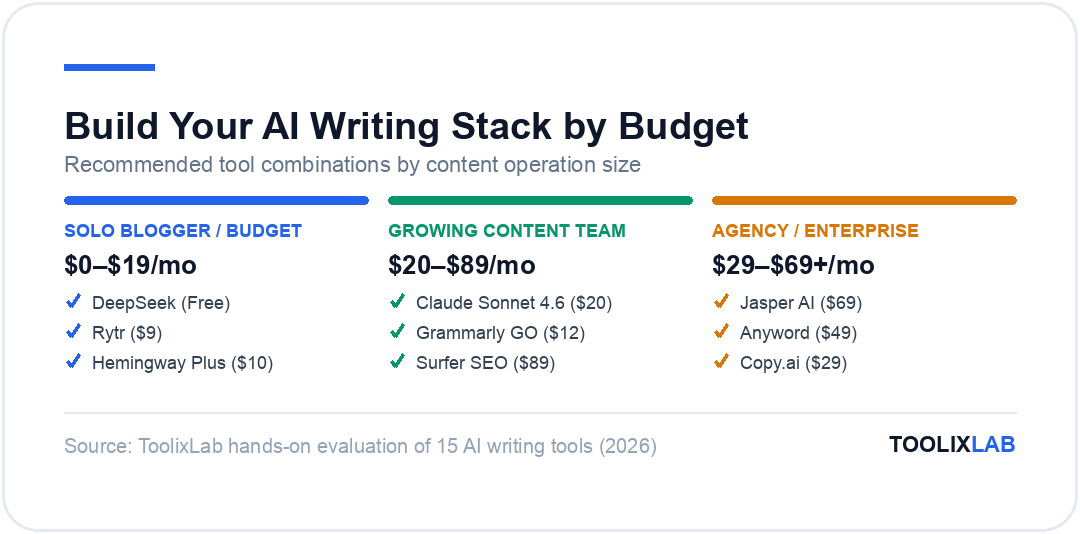
Pricing ranges from free (DeepSeek, free tiers of Claude/ChatGPT) to $89/mo+ (Surfer SEO, Jasper Pro). Most content creators spend $20–$60/month total. A solid stack of Claude Pro ($20) + Surfer Essential ($89) covers most professional needs, while budget-conscious writers can start with DeepSeek + the free Hemingway Editor for $0.
Will AI writing tools replace human writers?
No. AI tools are replacing the tasks of writing (research, first drafts, optimization), not the writers themselves. The most valuable writers in 2026 are those who know how to orchestrate AI tools—using them for speed while providing the human insight, experience, and originality that no AI can replicate.
Final Verdict: Our Top 3 Picks
Don't marry one tool. Build a stack.
The era of the "General Chatbot" is ending. The highest-paid writers in 2026 aren't the ones who type fast—they're the ones who know how to orchestrate. By combining specialized tools, you're no longer a "writer"—you're a "Creative Director" of your own content agency.
Unmatched writing quality. The most human-sounding AI on the market.
Brand voice at scale. Campaign Mode is a game-changer for agencies.
GPT-4 level performance at $0/month. No catches, no credit card.
Conclusion
AI writing tools have evolved from "cool novelties" to mandatory professional infrastructure. In 2026, choosing the right tool—or better yet, the right stack of tools—is the single biggest force multiplier available to content creators.
Start by identifying your biggest bottleneck. Is it research? Try Perplexity. Drafting? Go with Claude or Jasper. SEO? Surfer is your answer. Editing? Grammarly GO. Budget? DeepSeek costs nothing. The tools exist—now it's about building the workflow that fits your specific needs.
The future of content is fast, personalized, and AI-orchestrated. But the human touch—your experience, your opinions, your unique stories—is what transforms AI-generated text into content worth reading. Welcome to the team.