
ChatGPT Trust Snapshot
Real Free Score
80/100
Lock-In Risk
Medium
Billing Friction
Low
Commercial Use
Allowed
Data Privacy
Clear
Volatility
Medium
Last checked
2026-07-22
By ToolixLab Research Team · Last updated: July 2026
Quick Answer
Claude wins for coding, long documents, and writing that needs to sound human. ChatGPT wins for versatility: multimodal features, persistent memory, custom GPTs, and the deepest ecosystem. If you write or code for a living, pick Claude; if you want one assistant for everything from voice chat to image work, pick ChatGPT. Both have capable free tiers, so the zero-risk answer is to run your real tasks through each for a week before paying for either.
Want to see all 15 ChatGPT alternatives?
Check out our complete ChatGPT alternatives guide for a broader view of the AI landscape.
⚡ What You'll Learn
- 1 Which AI wins in coding, writing, research, and productivity — with real test results
- 2 The 2026 model lineup: ChatGPT vs Claude Sonnet 4.6 vs Gemini 2.5 Pro
- 3 Agentic AI showdown: Claude Code vs ChatGPT Agents vs Gemini Code Assist
- 4 Privacy & pricing compared side-by-side so you can pick the right plan
- 5 A clear decision framework to choose the best AI for YOUR workflow
The "AI Summer" of 2024 has turned into a permanent three-way war. In 2026, the question isn't which AI is "better" — it's which AI fits your specific workflow.
OpenAI's ChatGPT, Anthropic's Claude, and Google's Gemini have each carved out distinct strengths. ChatGPT dominates versatility. Claude owns coding and writing quality. Gemini leverages Google's infrastructure for massive-scale processing. Choosing wrong could cost you hundreds of hours.
In this deep-dive comparison, we move past surface-level marketing. We're auditing these models on real-world coding, creative writing, research depth, and everyday productivity. If you're paying $20/month for a subscription, this guide will tell you exactly which one earns its keep.
Sonnet 4.6 · Opus 4.6
ChatGPT · o3 · o4-mini
2.5 Pro · 2.5 Flash
Meet the Contenders
Before we dive into head-to-head tests, let's understand what makes each AI fundamentally different. OpenAI, Anthropic, and Google have very different philosophies — and you can feel it in every response.
🟢 ChatGPT — The Multimodal Swiss Army Knife
OpenAI · Founded 2015 · Models: ChatGPT, o3, o4-mini
OpenAI's goal is to build an autonomous agent that does everything. ChatGPT can see (Vision), hear and speak (Voice Mode), generate images (DALL-E), browse the web, run code, and remember your preferences across conversations. It's the best choice if you want one app to handle your entire digital life.
🟣 Claude — The Developer's Choice
Anthropic · Founded 2021 · Models: Sonnet 4.6, Opus 4.6, Haiku
Anthropic builds Claude for reliable, safety-oriented intelligence. Claude lacks some of ChatGPT's bells and whistles (no image generation, limited voice), but it compensates with a 1M-token context window, the most human-like writing style in the industry, and code quality that makes developers switch allegiance. Claude doesn't just answer — it explains its reasoning with nuance that other models miss.
🔵 Gemini — The Ecosystem Powerhouse
Google DeepMind · Founded 2023 · Models: 2.5 Pro, 2.5 Flash
Google's Gemini leverages massive infrastructure and data advantages. With a 1-million-token context window (enough to process entire books), native Google Workspace integration, and Veo 3 video generation, Gemini is the go-to choice for enterprise users embedded in Google's ecosystem. It's also the most cost-effective option at the API level.
Writing Style
ChatGPT: Methodical, list-heavy, sometimes robotic.
Claude: Narrative, nuanced, avoids "AI-isms."
Gemini: Factual, Google-flavored, occasionally stiff.
Context Window
ChatGPT: 1M tokens.
Claude: 1M tokens. Best retrieval accuracy.
Gemini: 1M tokens. Advanced multimodal processing.
Multimodal
ChatGPT: Voice + Vision + Image Gen + Web.
Claude: Vision + Text only. No image gen.
Gemini: Voice + Vision + Image + Video Gen.
Coding Capabilities — The Developer Decider
For developers, AI coding assistants have become as essential as IDEs. We tested each model with a complex React build, debugging scenarios, and real-world refactoring tasks.
The Test: Building a Full-Featured Tetris Game
Prompt: "Create a full-featured Tetris game with beautiful graphics, score tracking, next-piece preview, and smooth controls."
Claude Sonnet 4.6 (9.5/10)
- ★ Built a gorgeous, fully functional game
- ★ Included score tracking, level progression
- ★ Clean, well-commented React code
- ★ Exceptional UI logic and visual polish
ChatGPT (ChatGPT) (8/10)
- ✓ Created a functional Tetris clone
- ✓ Solid code structure
- − Lacked visual polish
- − Required extra prompting for styling
Gemini 2.5 Pro (7.5/10)
- ✓ Working game with solid mechanics
- ✓ Handled complex logic well
- − Not as visually polished
- − Required more guidance on styling
Code Explanation & Debugging
When presented with a buggy Python script containing subtle edge cases, Claude excelled at identifying root causes, explaining logic flaws, and suggesting architectural improvements. ChatGPT fixed bugs quickly but sometimes offered "band-aid" solutions. Gemini provided comprehensive explanations but occasionally missed nuanced edge cases.
Agentic Coding: The 2026 Game-Changer
The biggest shift in 2026 is agentic coding — AI that doesn't just write code, but autonomously plans, executes, tests, and iterates on entire projects.
Claude Code
Anthropic's terminal-based agent reads your entire codebase, creates branches, writes tests, and submits pull requests. SWE-Bench score: 72.5%. The gold standard for professional developers.
ChatGPT Canvas
OpenAI's collaborative editor for code and documents. Edit alongside ChatGPT, highlight sections for changes, and run code inline. More accessible but less autonomous than Claude Code.
Gemini Code Assist
Google's IDE-integrated assistant works inside VS Code, JetBrains, and Android Studio. Deep integration with Google Cloud makes it strong for GCP-native projects.
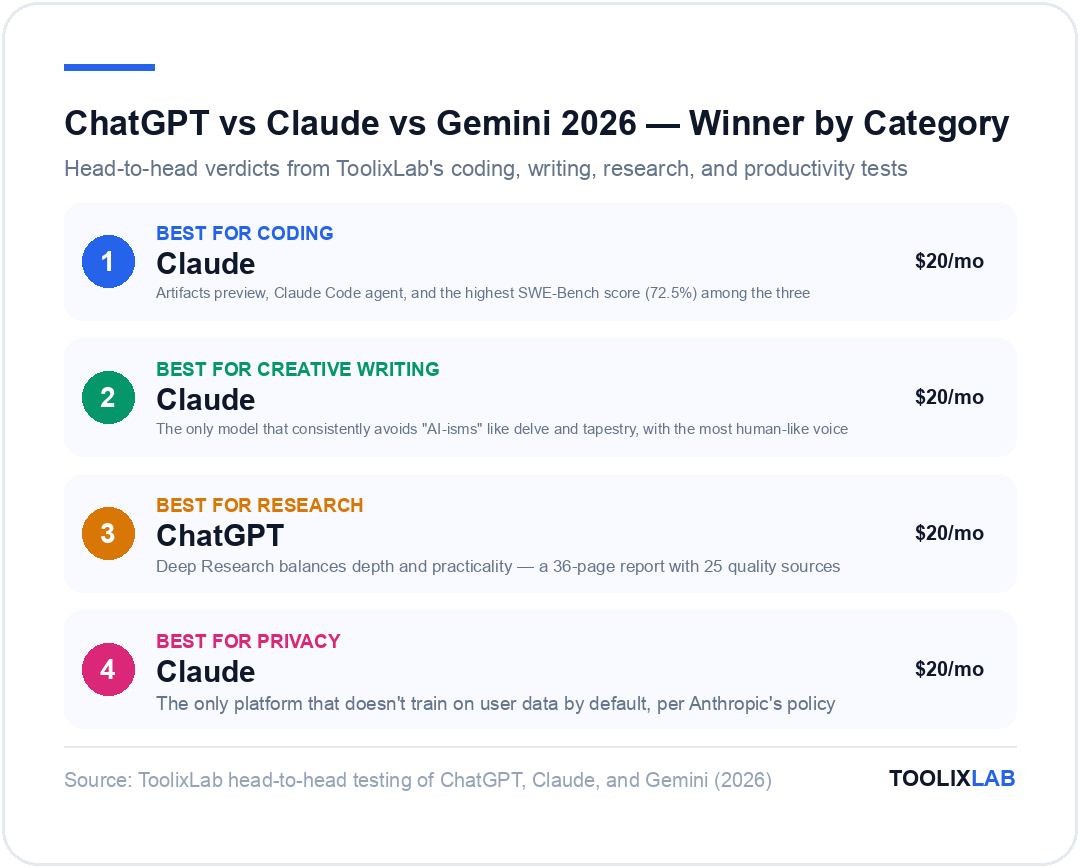
Claude's combination of code quality, architectural thinking, Artifacts preview, and the powerful Claude Code agent makes it the top choice for developers.
Creative Writing — The Voice Test
AI writing has moved beyond generic blog posts to sophisticated brand voice matching and persuasive copywriting. We tested marketing copy, long-form content, and tone adaptation.
Marketing Copy Test
Prompt: "Write a LinkedIn post introducing a new data transformation feature for marketing analytics professionals. Focus on user value, emphasize control and time savings, and end with a clear CTA."
Claude Sonnet 4.6 (9/10)
- ★ Prioritized benefits over features naturally
- ★ Incorporated social proof seamlessly
- ★ Professional yet conversational tone
- ★ Publication-ready with minimal editing
ChatGPT (ChatGPT) (8/10)
- ✓ Solid structure and flow
- ✓ Professional polish
- − Occasional "cutting-edge" generic phrases
- − Minor tweaking needed for brand voice
Gemini 2.5 Pro (6/10)
- ✓ Technically correct
- − Stiff, corporate language
- − Overused buzzwords
- − Required significant rewriting
The "AI-isms" Problem
Ask any AI to write a blog post and you'll get words like "delve," "tapestry," and "unleash." These are hallmarks of ChatGPT's training data. Claude is the only model that consistently avoids these patterns, uses varied sentence lengths, and shows a "theory of mind" that makes its writing genuinely persuasive.
💡 The Hybrid Writing Strategy
Use both models for maximum quality:
- Research (ChatGPT): Use ChatGPT's web search to gather data, trends, and citations. It browses faster and more comprehensively than Claude.
- Drafting (Claude): Feed that research to Claude Sonnet 4.6. Ask it to "synthesize this into a narrative that avoids common AI writing tropes."
- SEO Polish (ChatGPT): Do a final pass in ChatGPT Canvas for keyword optimization and formatting.
Claude's ability to understand not just what to say, but why someone would care, gives it the edge. It captures nuance, maintains voice consistency, and produces publication-ready copy.
Research & Analysis — The Knowledge Test
All three platforms now offer deep research capabilities, but they approach the task very differently.
Prompt: "Research the AI coding market and analyze Bolt's competitive strategy."
ChatGPT Deep Research (9/10)
- ★ 36-page report with 25 quality sources
- ★ Specific, actionable recommendations
- ★ Balanced depth with readability
- ★ Sweet spot for practical research
Claude Web Search (8.5/10)
- ✓ 7-page report with 427 sources cited
- ✓ Excellent synthesis and insight
- − Recommendations slightly generic
- ✓ Superior citation transparency
Gemini Deep Research (7/10)
- ✓ 48-page report with 100 sources
- − Overly verbose at times
- − Corporate-style conclusions
- ✓ Strongest for enterprise research
ChatGPT hits the sweet spot of depth and practicality. For enterprise users needing to blend internal Google Workspace data with external research, Gemini is unbeatable.
Everyday Productivity
Email Drafting
- ChatGPT: Excels at quick, professional emails with tone adjustment. The best "daily driver."
- Claude: Better for sensitive communications requiring nuance and empathy.
- Gemini: Seamless Gmail integration but occasionally too formal.
Memory & Persistent Context
Critical Differentiator: ChatGPT is the only model with true persistent memory across conversations. It remembers your preferences, past projects, and personal details. Claude resets context with each new conversation (though Projects help maintain long-term context within workspaces). Gemini uses Google account signals but lacks explicit memory management.
Workspace Integrations
- ChatGPT: Connects to Google Calendar, Gmail, Notion, Slack, and 50+ apps via plugins and integrations.
- Claude: MCP (Model Context Protocol) connections to developer tools, GitHub, databases. More technical setup.
- Gemini: Native Gmail, Docs, Drive, Sheets, Calendar integration. Zero setup for Google Workspace users.
💡 Pro Tip: Hybrid Workflow
Use Gemini Flash (Free) for bulk processing large documents, then paste the summary into Claude Sonnet 4.6 for high-level analysis. This saves $20/mo while getting the best of both worlds.
The combination of persistent memory, versatile capabilities, and the broadest integration ecosystem makes ChatGPT the best daily driver for most users.
Multimodal Features — Beyond Text
If you need anything beyond text and code, the feature gap between these platforms becomes massive.
| Feature | ChatGPT | Claude | Gemini |
|---|---|---|---|
| Voice Mode | ✓ Advanced (emotion-aware) | ✗ Not available | ✓ Live (Gemini Live) |
| Vision / Image Analysis | ✓ Excellent OCR | ✓ Good | ✓ Good |
| Image Generation | ✓ DALL-E (built-in) | ✗ Not available | ✓ Imagen 3 |
| Video Generation | ✓ Sora | ✗ Not available | ✓ Veo 3 (with audio) |
| Web Browsing | ✓ Real-time | ✓ Web search | ✓ Google Search native |
| Code Execution | ✓ Python sandbox | ✓ Artifacts preview | ✓ Python sandbox |
| Custom Assistants | ✓ GPTs + Store | ◐ Projects only | ◐ Gems |
ChatGPT offers the broadest feature set. Gemini wins specifically for video generation with Veo 3's text-to-video with sound capabilities.
Context Window & Long Documents
Context window — how much "memory" the AI has within a single conversation — is the most critical metric for enterprise users processing large documents or codebases.
GPT-5.4 with 1M token context window
99%+ retrieval accuracy across the full window
Process entire books or codebases in one go
The "Needle in a Haystack" test puts a specific fact inside a massive document and asks the AI to find it. All three models now offer 1M token context windows. Claude maintains the highest retrieval accuracy across the full window. GPT-5.4 and Gemini 2.5 Pro are competitive but Claude's precision on long-document tasks remains its standout strength.
GPT-5.4, Claude Sonnet 4.6, and Gemini 2.5 Pro all offer 1M token context windows. Claude maintains the highest retrieval accuracy for precise long-document tasks.
Privacy & Data Handling
How each platform handles your data is increasingly important — especially for business use.
| Policy | ChatGPT | Claude | Gemini |
|---|---|---|---|
| Trains on your data? | Opt-out available | No (by default) | Opt-out available |
| Enterprise data isolation | ✓ Team/Enterprise | ✓ Team/Enterprise | ✓ Business/Enterprise |
| Temporary/private chat | ✓ Temporary Chat | ✗ Not available | ✗ Not available |
| Safety philosophy | Balanced guardrails | Constitutional AI (strictest) | Google policy alignment |
| Data retention | 30 days (API) | 90 days (API) | Up to 18 months (free tier) |
⚠️ Important for Business Users
On free and consumer plans, both ChatGPT and Gemini may use your conversations to train future models. Claude is the only platform that doesn't train on user data by default. For maximum privacy on any platform, use Team or Enterprise tiers.
Pricing Breakdown
| Plan | ChatGPT | Claude | Gemini |
|---|---|---|---|
| Free Tier | ChatGPT (limited), DALL-E, web browse | Sonnet 4.6 (tight limits) | 2.5 Flash (generous limits) |
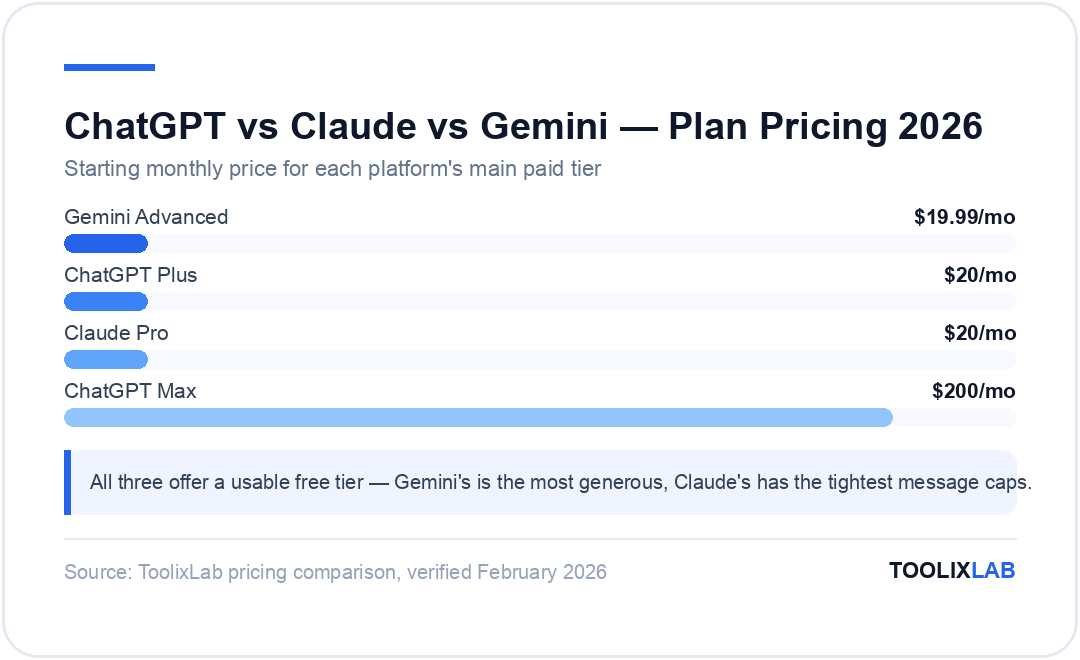
| Pro / Plus | $20/month | $20/month | $19.99/month |
| Team / Business | $25/user/month | $25/user/month | $30/user/month |
| Max / Ultra | $200/month | — | — |
Pricing verified February 2026. Visit each platform's pricing page for current rates.
💡 Value Analysis
- Best Free Tier: Gemini (most generous message limits)
- Best Pro Value: ChatGPT Plus (broadest feature set for $20)
- Best for Heavy Coding: Claude Pro (worth it for code quality alone)
- Best Budget Option: Gemini 2.5 Flash — excellent performance at the lowest cost
💰 The Smart Move: Pick one primary AI based on your main use case. Cancel the rest and use their free tiers for specific tasks.
Decision Framework — When to Use Each
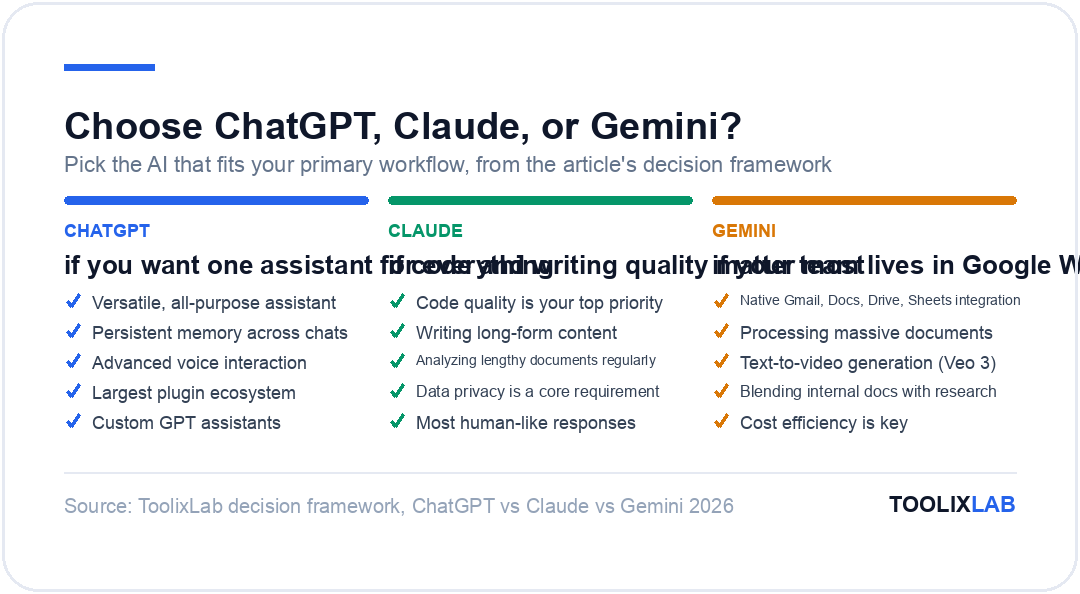
🟢 Use ChatGPT When:
- → You need a versatile, all-purpose assistant
- → Persistent memory across chats matters
- → You want advanced voice interaction
- → You value the largest plugin ecosystem
- → You're creating custom GPT assistants
🟣 Use Claude When:
- → Code quality is your top priority
- → You're writing long-form content
- → You analyze lengthy documents regularly
- → Data privacy is a core requirement
- → You want the most human-like responses
🔵 Use Gemini When:
- → Your team lives in Google Workspace
- → You need to process massive documents
- → You want text-to-video generation
- → You blend internal docs with research
- → Cost efficiency is key
Head-to-Head Benchmarks (2026)
| Benchmark | ChatGPT (GPT-5.4) | Claude Sonnet 4.6 | Gemini 2.5 Pro |
|---|---|---|---|
| MMLU (Knowledge) | 88.7% | 88.2% | 87.8% |
| HumanEval (Coding) | 87.1% | 86.4% | 74.4% |
| Context Window | 1M tokens | 1M tokens | 1M tokens |
| Free Tier | ✓ Available | ✓ Available | ✓ Available |
| Starting Price | $20/mo | $20/mo | $19.99/mo |
Source: Official benchmark disclosures, February 2026. Actual performance may vary by use case.
⚡ What About DeepSeek?
DeepSeek-R1 matches or exceeds these models on reasoning tasks at 1/10th the cost. See our full DeepSeek review for benchmarks, pricing, and privacy analysis.
Frequently Asked Questions
Is ChatGPT better than Claude?
What is the best AI for coding in 2026?
Is Gemini better than ChatGPT?
Which AI is best for writing?
Can I use all three AI assistants for free?
Which AI is safest for sensitive data?
What about DeepSeek and other alternatives?
🔑 Key Takeaways
- ✓Claude leads where depth matters: coding, long-document analysis, and prose that doesn't read like AI wrote it
- ✓ChatGPT leads where breadth matters: voice, images, memory across chats, custom GPTs, and third-party integrations
- ✓Benchmarks are close enough that your specific daily tasks — not leaderboards — should decide; test both free tiers on real work for a week
- ✓Power users increasingly run both: one paid subscription for the primary workload, the other's free tier for its specialty
Conclusion: The Smart Choice
The AI market in 2026 offers no single "perfect" tool — each has carved out distinct, defensible strengths. Here's the final scorecard:
| Category | Winner | Key Reason |
|---|---|---|
| Coding | Claude | Artifacts + Claude Code + highest SWE-Bench |
| Creative Writing | Claude | Human-like voice, no "AI-isms" |
| Research | ChatGPT | Deep Research balances depth + practicality |
| Productivity | ChatGPT | Persistent memory + broadest integrations |
| Multimodal | ChatGPT | Voice + Vision + Image Gen + Web |
| Context Window | Gemini | 2M tokens — process entire books |
| Privacy | Claude | No training on data by default |
| Value for Money | Gemini | Most generous free tier + cheapest API |
"The professionals winning with AI aren't using all three — they've identified their primary use case and committed to mastering one tool."
🎯 Our Recommendation
- • Start with ChatGPT Plus for one month to establish your baseline needs. It's the most versatile starting point.
- • Switch to Claude if you find yourself frustrated with coding output or writing quality.
- • Try Gemini Advanced if you're drowning in Google Workspace documents or need massive context processing.
- • Use all three free tiers to test before committing to any paid plan.
Ready to work smarter, not harder? Pick your AI champion and start creating.
Once you've picked your tool, get more from it faster with the best ChatGPT prompt libraries in 2026 — tested templates for writing, coding, marketing, and research.
Further Reading & Sources
⚖️ Our Verdict
Both ChatGPT and Claude are excellent, and most power users benefit from having access to both — but they have distinct strengths worth matching to your work. Claude edges ChatGPT for long documents, nuanced instruction-following, and writing that requires precise tone, while ChatGPT leads on plugin breadth, image generation integration, and ecosystem depth. Choose based on your primary workflow, not hype.
✅ Choose ChatGPT if...
- • You rely on third-party integrations and plugins
- • Image generation (DALL-E) is part of your regular workflow
- • You want the broadest AI ecosystem and app integrations
✅ Choose Claude if...
- • You work with long documents, contracts, or research papers
- • Precise instruction-following and nuanced writing matter
- • Safety-conscious use cases or sensitive content are a priority