
ChatGPT Trust Snapshot
Real Free Score
80/100
Lock-In Risk
Medium
Billing Friction
Low
Commercial Use
Allowed
Data Privacy
Clear
Volatility
Medium
Last checked
2026-07-22
AI has quietly become one of the most powerful tools in an SEO professional's stack — not because it replaces strategic thinking, but because it accelerates the grunt work that used to take hours. Keyword clustering, meta description drafts, schema markup generation, content gap analysis, internal link strategies — the right prompt turns a 90-minute task into a 4-minute one.
The catch? Most AI SEO prompts circulating online are shallow. They produce generic output because they give the model nothing to work with. The difference between a prompt that returns boilerplate and one that returns immediately usable work is specificity: context about your niche, target audience, competitors, and the exact output format you need.
These 50 best AI SEO prompts for 2026 are built for practitioners — intermediate to advanced SEOs who want to move faster without sacrificing quality. Every prompt is copy-paste ready and designed to work with ChatGPT (GPT-5.4), Claude Sonnet 4.6, or Gemini Advanced. Replace the [BRACKETED VARIABLES] with your own details for best results.
⚡ Quick Summary
10 categories covered: Keyword Research · Content Strategy · On-Page SEO · Technical SEO · Link Building · Local SEO · Content Optimisation · Competitor Analysis · E-E-A-T & Schema · Reporting
Works with: ChatGPT (GPT-5.4), Claude Sonnet 4.6, Gemini Advanced
Format: All prompts include context variables — replace [BRACKETS] with your own data
Jump to: Keyword Research · Content Strategy · On-Page SEO · Technical SEO · Link Building
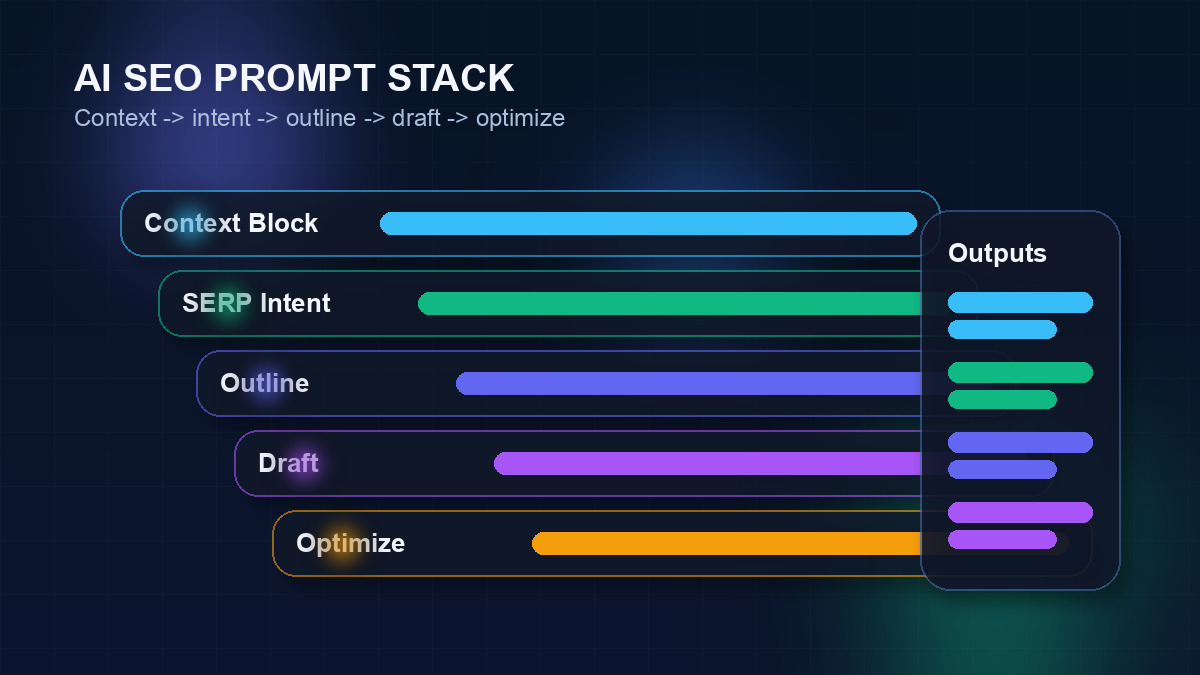
This article is a prompt library for SEO workflows. It complements, rather than replaces, our tool reviews. Use this page when you need copy-paste instructions. Use best AI SEO tools in 2026 when you need software selection.
How to Get the Best Results from AI SEO Prompts
Before diving into the prompts, a few principles that separate expert use from average use:
- →Give context up front. Start every session with a context block: your niche, target audience, main competitors, and geographic focus. The model can't produce specific output without specific input.
- →Specify output format. "Give me a table", "output as a numbered list", "return in JSON", "use H2/H3 heading structure" — explicit format instructions consistently produce more usable output.
- →Iterate, don't regenerate. After an initial response, refine with follow-up instructions: "make the tone less formal", "add search intent column to the table", "expand point 4 with examples". Multi-turn prompting produces far better output than single shots.
- →Fact-check volume and difficulty data. AI models cannot access live keyword data. Use these prompts to generate ideas, frameworks, and copy — then validate metrics in Ahrefs, SEMrush, or Google Search Console before making decisions.
- →Use the right model for the task. GPT-5.4 and Claude Sonnet 4.6 are best for nuanced strategic thinking and long-form content. Gemini is strong for Google ecosystem integration. For prompt accuracy and structured output, GPT-5.4 with structured outputs or Claude with XML instructions tends to be most reliable.
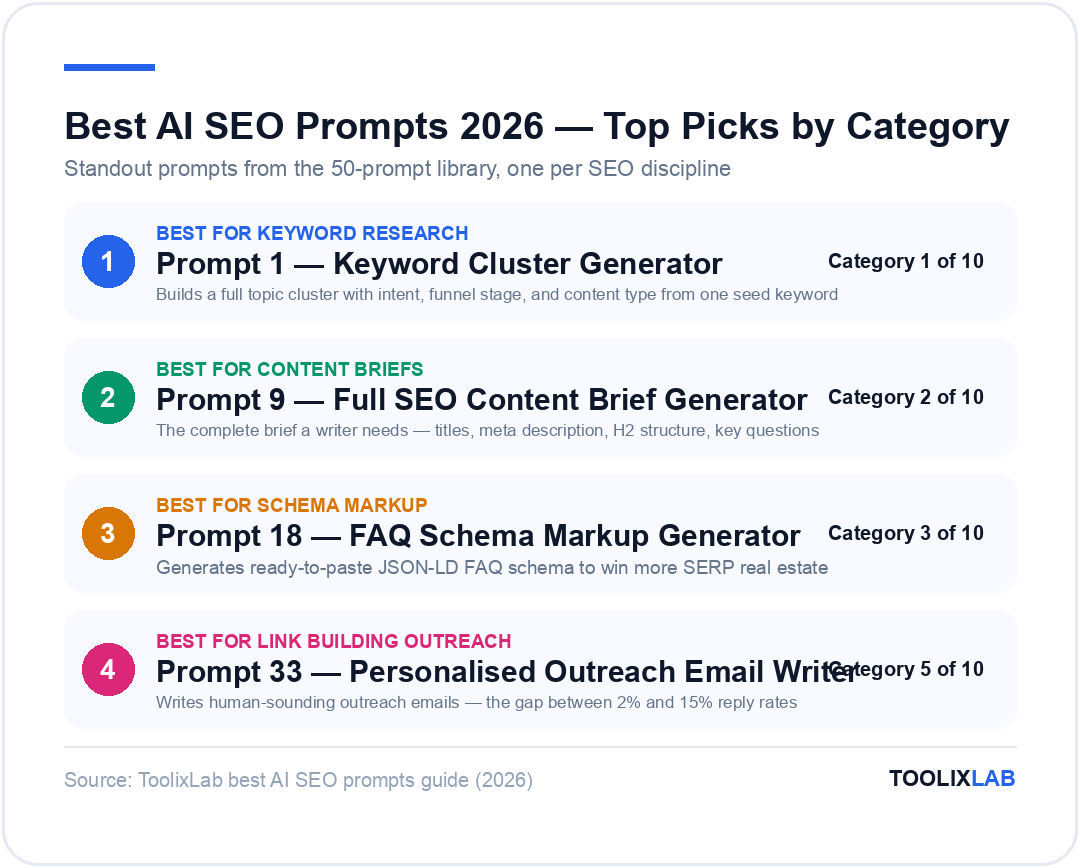
📊 Keyword Research Prompts (1–8)
For generating keyword ideas, clustering, intent mapping, and topical coverage planning
Prompt 1 — Keyword Cluster Generator
Keyword ResearchUse this to build a full topic cluster from a seed keyword. Feed the output into your content calendar.
Generate a keyword cluster for this topic. Output a table with five columns: Keyword, Search Intent (Informational / Commercial / Transactional / Navigational), Funnel Stage (ToFu / MoFu / BoFu), Suggested Content Type (blog post / landing page / comparison / guide), and a brief note on what the searcher actually wants.
Include: the seed keyword, 5 informational variations, 3 commercial investigation terms, 3 long-tail transactional terms, and 3 question-format keywords suitable for featured snippets. Aim for a mix of head terms and specific long-tail variations.
💡 Follow up with: "Now group these into pillar page and cluster page structure" or "Which 3 should I prioritise first based on likely lower competition?"
Prompt 2 — Search Intent Classifier
Keyword ResearchPaste in a raw keyword list from Ahrefs/SEMrush and get it classified by intent instantly.
Also flag any keywords that likely indicate the searcher is close to a purchase decision — mark these with [HIGH COMMERCIAL VALUE].
Keywords:
[PASTE YOUR KEYWORD LIST HERE — one per line]
Output as a table: Keyword | Intent | Page Type | Commercial Value Note
💡 Works best with 20–50 keywords at a time. For larger lists, process in batches.
Prompt 3 — Long-Tail Question Keyword Expansion
Keyword ResearchSurface the specific questions your audience is asking — excellent for FAQ content and featured snippet targeting.
Organise them into these five question types: Who, What, When, Where, Why/How. For each question, specify: (a) the likely search intent, (b) whether it's suitable for a featured snippet answer, and (c) the ideal answer format (paragraph, list, table, or step-by-step).
Focus on questions that indicate genuine user problems or decision points — not generic curiosity queries. Target audience: [DESCRIBE YOUR AUDIENCE].
Prompt 4 — Semantic Keyword Expansion (LSI/NLP Terms)
Keyword ResearchBuild the semantic vocabulary a page should include to rank for a target keyword — useful for content briefs.
Organise the output into four groups:
1. Core synonyms and keyword variations (direct keyword variants)
2. Related entities (people, tools, brands, places relevant to this topic)
3. Contextual terms (concepts and sub-topics Google associates with this keyword)
4. User-intent phrases (terms reflecting what the searcher wants to DO or KNOW)
This is for a [PAGE TYPE] targeting [AUDIENCE]. The goal is topical depth and semantic coverage, not keyword stuffing.
Prompt 5 — Keyword Gap Analysis from Competitor URLs
Keyword ResearchReverse-engineer a competitor's content to find gaps you should target.
1. The primary and secondary keywords this page appears to be targeting
2. Subtopics and questions it covers that I should also cover
3. Subtopics and questions it DOESN'T cover that I could cover to differentiate
4. The content format and structure this page uses
5. Any obvious weaknesses in the content I could exploit (thin sections, outdated info, missing data)
My site covers [YOUR NICHE]. My target audience is [DESCRIBE AUDIENCE]. I want to create a page that outranks this one.
Competitor content:
[PASTE COMPETITOR PAGE CONTENT HERE]
💡 Use with a web scraper or simply copy-paste the text content from a competitor's page.
Prompt 6 — Topical Authority Map
Keyword ResearchBuild the full content map needed to establish topical authority in a niche — turns into a 3-6 month content plan.
Create a topical authority map that includes:
1. One pillar page topic (broad, high-volume, umbrella term)
2. 5–7 cluster page topics (each covering a specific subtopic that supports the pillar)
3. 3–5 supporting articles for each cluster page (specific, long-tail, question-based)
For each piece, suggest: the target keyword, estimated word count, content type, and how it internally links to the pillar. Present as a structured outline I can paste into a content calendar spreadsheet.
Prompt 7 — SERP Feature Opportunity Finder
Keyword ResearchIdentify which keywords in your niche are most likely to surface SERP features and optimise accordingly.
For each keyword, specify:
- Most likely SERP feature type
- The content format most likely to win that feature (paragraph, list, table, numbered steps, video)
- Estimated query modifier that triggers the feature (e.g., "how to", "what is", "best", "vs")
My site is [DESCRIBE SITE]. Include a mix of features I should prioritise short-term vs. longer-term.
Prompt 8 — Keyword Cannibalisation Audit
Keyword ResearchIdentify and resolve pages competing for the same keywords on your own site.
For each cannibalisation issue found, recommend one of these solutions: consolidate (merge the pages), differentiate (reposition the pages to target distinct intent), 301 redirect (keep strongest page, redirect the weaker), or no-index (if one page has no search value).
Explain your recommendation with reasoning. Also flag any borderline cases where cannibalisation risk is low but worth monitoring.
Pages and keywords:
[PASTE YOUR PAGE LIST: URL | Target Keyword — one per line]
✍️ Content Strategy Prompts (9–16)
For content briefs, outlines, content gap filling, and editorial planning
Prompt 9 — Full SEO Content Brief Generator
Content StrategyThe complete brief a writer needs to produce a high-ranking piece — ready to hand to a freelancer or feed into your AI writing workflow.
Include the following sections in the brief:
1. Target keyword + 3–5 secondary keywords to include naturally
2. Search intent summary (what is the searcher trying to do/know?)
3. Suggested title (H1) — 2 options, both under 65 characters
4. Meta description — 2 options, 150–160 characters each
5. Recommended word count range
6. Suggested H2 structure (minimum 5 H2s with brief notes on what each section should cover)
7. Key questions the content MUST answer
8. Entities and terms to include for semantic coverage
9. Suggested internal links (I'll fill in the actual URLs)
10. Tone and voice guidance for: [DESCRIBE YOUR BRAND VOICE]
Target audience: [DESCRIBE AUDIENCE]. Website: [DESCRIBE SITE/NICHE].
Prompt 10 — Content Refresh Prioritisation
Content StrategyTell you which existing posts to update first for the fastest ranking gains — strategic use of your content audit data.
For each post, I'll provide: URL, primary keyword, current ranking position, monthly organic traffic, last published date, and a brief note on content quality.
Prioritise based on: content that ranks positions 4–20 (best refresh ROI), content with declining traffic, content covering topics where SERPs have changed, and content that is 18+ months old.
Output: a prioritised refresh list with recommended action for each (minor update, major rewrite, redirect and consolidate, or leave as-is) and a one-line reason for each recommendation.
Post data:
[PASTE YOUR CONTENT AUDIT DATA HERE]
Prompt 11 — Competing Content Outline Improver
Content StrategyAnalyse the top-ranking content for a keyword and create a clearly better outline — the basis of a "skyscraper" approach.
Page 1 headings: [PASTE H1, H2, H3 LIST]
Page 2 headings: [PASTE H1, H2, H3 LIST]
Page 3 headings: [PASTE H1, H2, H3 LIST]
Analyse these outlines and create a superior content structure that:
1. Covers everything the top 3 pages cover
2. Addresses gaps and questions they miss
3. Adds unique sections that would differentiate my content
4. Is structured for featured snippet eligibility where possible
5. Has a clear, logical reading flow
My site's angle/POV on this topic: [DESCRIBE YOUR UNIQUE PERSPECTIVE OR AUDIENCE FOCUS]
Prompt 12 — Content Repurposing Plan
Content StrategyExtract maximum value from your best-performing content by turning it into additional SEO assets.
Create a repurposing plan that turns this single post into additional SEO-valuable assets. For each repurposed format, specify: the format, target keyword or topic variation, SEO value it adds (new keyword coverage, link acquisition potential, featured snippet opportunity, etc.), and estimated production effort (Low / Medium / High).
Consider formats including: FAQ page, data/statistics roundup, comparison page, tool or calculator, video script, infographic concept, email series, social thread series, and podcast outline. Prioritise the 3 highest-ROI repurposing options.
Prompt 13 — Internal Linking Strategy Builder
Content StrategyBuild a systematic internal linking plan that passes PageRank efficiently to your most important pages.
Important/priority pages:
[LIST YOUR PRIORITY PAGES: URL | Target Keyword]
Supporting content pages:
[LIST YOUR SUPPORTING PAGES: URL | Topic]
Create an internal linking plan that: (1) identifies which supporting pages should link to which priority pages, (2) suggests the anchor text for each link (natural variation, not exact match), and (3) flags any priority pages that are currently orphaned or under-linked.
Also suggest any missing content that would logically link to my priority pages if it existed.
Prompt 14 — Blog Post Title Generator (SEO-Optimised)
Content StrategyGenerate CTR-optimised title options that include the target keyword and a compelling hook.
Requirements for each title:
- Under 65 characters (hard limit for full SERP display)
- Include the primary keyword as close to the start as possible
- Use a power word or number where appropriate (e.g., "15", "Complete", "Step-by-Step", "Tested")
- Avoid clickbait — must accurately represent the content
- Aim for high CTR by addressing a clear benefit or solving a specific problem
My audience: [DESCRIBE AUDIENCE]. Competitors' title formats to differentiate from: [LIST 2–3 COMPETITOR TITLES].
Prompt 15 — E-E-A-T Content Enhancement
Content StrategyStrengthen Experience, Expertise, Authoritativeness, and Trustworthiness signals across a piece of content.
For each of the four E-E-A-T dimensions, provide:
- Current score (Weak / Adequate / Strong) with brief reasoning
- Specific changes to make the signal stronger
Focus on: adding first-person experience signals, citing authoritative external sources, demonstrating depth of expertise through specific details, and adding trust signals (author credentials, last updated date, methodology notes, data sources).
Also flag any YMYL (Your Money Your Life) red flags if this topic touches health, finance, or safety — and recommend how to handle them.
Content to review:
[PASTE YOUR DRAFT CONTENT HERE]
Prompt 16 — Content Brief for Commercial Landing Page
Content StrategyBrief a high-converting SEO landing page — balancing search optimisation with conversion intent.
The page is for: [DESCRIBE PRODUCT/SERVICE]. Target audience: [DESCRIBE AUDIENCE]. Key USPs: [LIST 3–5 USPs]. Competitors ranking for this keyword: [LIST 2–3 COMPETITORS].
The brief should include: target keyword + secondary keywords, recommended page structure with H1/H2 suggestions, above-the-fold messaging recommendations, trust signals to include, CTA placement and copy options, FAQ section for schema markup, and word count recommendation. Balance SEO content requirements with conversion rate optimisation — this page needs to rank AND sell.
🎯 On-Page SEO Prompts (17–24)
For meta tags, structured data, page optimisation, and copy refinement
Prompt 17 — Bulk Meta Description Writer
On-Page SEOGenerate SEO-optimised meta descriptions at scale — give it a list of page URLs and topics.
- Exactly 150–160 characters (hard limit — do not exceed)
- Include the target keyword naturally within the first 60 characters
- Include a clear value proposition and a soft CTA
- Do not use "Welcome to...", "In this post...", or other filler openings
- Match the search intent of the keyword (informational / commercial / transactional)
Pages:
[PAGE 1 — Title: [TITLE] | Keyword: [KEYWORD] | Page type: [BLOG/LANDING/PRODUCT]]
[PAGE 2 — Title: [TITLE] | Keyword: [KEYWORD] | Page type: [BLOG/LANDING/PRODUCT]]
[Continue for each page]
Brand voice: [DESCRIBE TONE — e.g., authoritative, friendly, professional]
💡 Can process 10–20 pages in a single prompt. Always check character counts — AI sometimes drifts over the 160-character limit.
Prompt 18 — FAQ Schema Markup Generator
On-Page SEOGenerate FAQ schema markup ready to paste into a page — boosts SERP real estate with People Also Ask expansion.
Create 6 FAQ entries. Requirements for each:
- The question should mirror real user search queries (how, what, why, when, can I, is it)
- The answer should be 40–60 words — concise enough for a SERP snippet, substantive enough to be useful
- Each answer should naturally include a related keyword where it fits
- Answers should not start with "Yes" or "No" alone — always include the actual answer immediately
Output as complete, valid JSON-LD wrapped in <script type="application/ld+json"> tags, ready to paste into the page <head>.
Prompt 19 — Page Content Optimisation Review
On-Page SEOAudit an existing page's on-page SEO and get a prioritised list of improvements.
Evaluate the content across these dimensions and give a score (1–10) with specific improvement recommendations for each:
1. Keyword placement (H1, first paragraph, H2s, last paragraph)
2. Semantic coverage (related terms and entities included)
3. Content depth and completeness vs. search intent
4. Readability and structure (subheadings, paragraph length, lists)
5. E-E-A-T signals
6. Internal linking opportunities
7. Featured snippet eligibility
Prioritise your recommendations by impact. Be specific — don't just say "add more keywords"; tell me exactly where and which ones.
Content:
[PASTE YOUR CONTENT HERE]
Prompt 20 — HowTo & Article Schema Generator
On-Page SEOGenerate structured data markup for how-to content to qualify for rich results in Google.
The guide has these steps:
[STEP 1: Name and brief description]
[STEP 2: Name and brief description]
[Continue for all steps]
Also include: estimated total time (PT format), tools/supplies required if applicable, and the URL of the page. Output as complete, valid JSON-LD in <script type="application/ld+json"> tags. Follow Google's HowTo schema guidelines — each step should have a clear "name" and "text" property.
Prompt 21 — Image Alt Text Generator at Scale
On-Page SEOGenerate descriptive, keyword-aware alt text for a batch of images — particularly useful during content audits.
For each image, write alt text that:
- Describes the image content accurately (screen reader accessibility first)
- Includes a relevant keyword naturally where it genuinely fits the image
- Is 10–15 words maximum
- Does not start with "Image of" or "Picture of"
- Does not keyword-stuff multiple variations
Images:
Image 1: [DESCRIBE WHAT THE IMAGE SHOWS]
Image 2: [DESCRIBE WHAT THE IMAGE SHOWS]
[Continue for each image]
Prompt 22 — Introduction Paragraph Rewriter (Hook + Keyword)
On-Page SEOFix weak introductions — include the target keyword early and open with a compelling hook that reduces bounce rate.
Requirements:
- Include the exact target keyword within the first 100 words
- Open with a hook: a surprising statistic, a direct problem statement, or a provocative question
- Clearly state what the reader will learn or gain from reading
- 100–150 words maximum
- Tone: [DESCRIBE YOUR BRAND VOICE]
- Do NOT start with "In this article" or "Welcome to" — get straight to the value
Current introduction:
[PASTE CURRENT INTRO HERE]
Prompt 23 — URL Slug Optimiser
On-Page SEOGenerate clean, keyword-focused URL slugs for new pages or during a site migration.
- Use lowercase letters and hyphens only (no underscores, no special characters)
- Include the primary keyword in the slug
- Remove stop words (the, a, an, in, for, of, etc.) unless they are part of the keyword
- Keep under 5 words where possible
- Do not include the year unless the topic is specifically time-sensitive
Page titles:
[PASTE YOUR PAGE TITLES — one per line]
Also flag any current slugs that should be updated (if I provide them) and note whether a 301 redirect would be needed.
Prompt 24 — Product Page SEO Copy Generator
On-Page SEOWrite ecommerce product page copy that ranks and converts — not the thin descriptions that get filtered out.
Product details: [PASTE PRODUCT SPECS/FEATURES]
Target customer: [DESCRIBE YOUR BUYER PERSONA]
Key benefits (not just features): [LIST 3–5 BENEFITS]
Competitors' product pages to differentiate from: [LIST COMPETITORS]
Write:
1. H1 product title (keyword-optimised, under 70 characters)
2. Short description (50–80 words, for above-the-fold placement, includes primary keyword)
3. Long description (200–300 words, addresses buyer questions, includes secondary keywords naturally)
4. 5 bullet-point features/benefits (for quick scanning)
5. Meta title and description
Tone: [DESCRIBE BRAND VOICE]. Do not use superlatives without evidence (best, cheapest, etc.).
⚙️ Technical SEO Prompts (25–31)
For audits, structured data, robots.txt, redirects, and crawl issues
Prompt 25 — Technical SEO Audit Checklist Generator
Technical SEOGenerate a customised technical audit checklist for a specific site type and situation.
Organise the checklist into these categories: Crawlability & Indexation · Site Architecture · Page Speed & Core Web Vitals · Mobile Usability · Structured Data · HTTPS & Security · International/Hreflang (if applicable) · Duplicate Content.
For each checklist item, include: what to check, how to check it (tool or method), what a pass/fail looks like, and priority level (Critical / High / Medium / Low).
Focus especially on issues common for [SITE TYPE] — include platform-specific gotchas.
Prompt 26 — Robots.txt Review & Generator
Technical SEOAudit your robots.txt for crawl budget issues and generate an optimised version.
After reviewing, generate an optimised robots.txt for my [SITE TYPE] site on [PLATFORM e.g. WordPress/Shopify/custom]. My site has these URL patterns that should NOT be crawled: [DESCRIBE ANY ADMIN, PARAM, OR DUPLICATE URL PATTERNS].
Current robots.txt:
[PASTE YOUR ROBOTS.TXT CONTENT]
Explain each directive you add or change and why it improves crawl efficiency or prevents indexation of low-value content.
Prompt 27 — Redirect Mapping for Site Migration
Technical SEOCreate a systematic redirect strategy for a URL restructuring or platform migration to preserve link equity.
Here are my old URLs and their new equivalents (where known):
[PASTE URL MAPPING LIST: old URL → new URL, or "TBD"]
For each URL, confirm whether a 301 redirect is appropriate, flag any where a different approach may be needed (canonical, consolidation, no-index), and identify any patterns in the URL structure that could be handled with a single rewrite rule rather than individual redirects.
Also flag: any high-traffic/high-authority old URLs where losing equity would be most damaging, and recommend the order of priority for implementing these redirects.
Prompt 28 — Core Web Vitals Diagnosis Helper
Technical SEOTurn raw CWV scores into a prioritised list of actionable fixes, matched to your site's platform.
LCP (Largest Contentful Paint): [VALUE] ms
INP (Interaction to Next Paint): [VALUE] ms
CLS (Cumulative Layout Shift): [VALUE]
FCP (First Contentful Paint): [VALUE] ms
TTFB (Time to First Byte): [VALUE] ms
My site runs on [PLATFORM] and uses [HOSTING TYPE]. Theme/stack: [DESCRIBE].
Based on these scores, provide a prioritised list of specific technical fixes. For each fix, state: what the problem likely is, how to fix it (with implementation specifics for my platform), the expected improvement, and effort level (Low / Medium / High). Start with the changes that will move the metrics from Poor to Needs Improvement — don't chase perfection.
Prompt 29 — Hreflang Tag Generator for International SEO
Technical SEOGenerate correct hreflang markup for multi-language or multi-region sites — one of the most error-prone areas of technical SEO.
[LANGUAGE/REGION 1]: [URL]
[LANGUAGE/REGION 2]: [URL]
[Add all language/region versions]
Use correct ISO 639-1 language codes and ISO 3166-1 alpha-2 region codes (e.g., en-GB, en-US, fr-FR, de-DE). Include the x-default tag pointing to [DEFAULT URL].
Output as HTML link tags to paste in the <head> section AND as the equivalent XML sitemap format. Flag any common hreflang mistakes I should watch for in my implementation.
Prompt 30 — Crawl Error Triage
Technical SEOTurn a messy crawl error report into a prioritised action plan.
Issues found:
[PASTE YOUR CRAWL ERROR LIST — categorised by error type if possible]
For each issue type, tell me: (1) how critical it is for SEO (Critical / High / Medium / Low / Ignore), (2) the most likely cause, (3) the recommended fix, and (4) whether it should be fixed immediately or can be batched.
My site is [DESCRIBE SITE SIZE AND TYPE]. Prioritise fixes that affect ranking pages first.
Prompt 31 — Structured Data Strategy for a Site
Technical SEOPlan which schema types to implement across your site for maximum rich result eligibility.
For each page type on my site, recommend the most appropriate schema type(s), explain which SERP rich results they make me eligible for, and note any specific required or recommended properties I must include.
Page types on my site include:
[LIST YOUR PAGE TYPES: homepage, blog posts, product pages, category pages, about page, etc.]
Prioritise the schema types that are most likely to generate visible SERP enhancements (rich snippets, review stars, FAQs, breadcrumbs, sitelinks) for my specific site type. Flag any schema types that Google has recently deprecated or reduced support for.
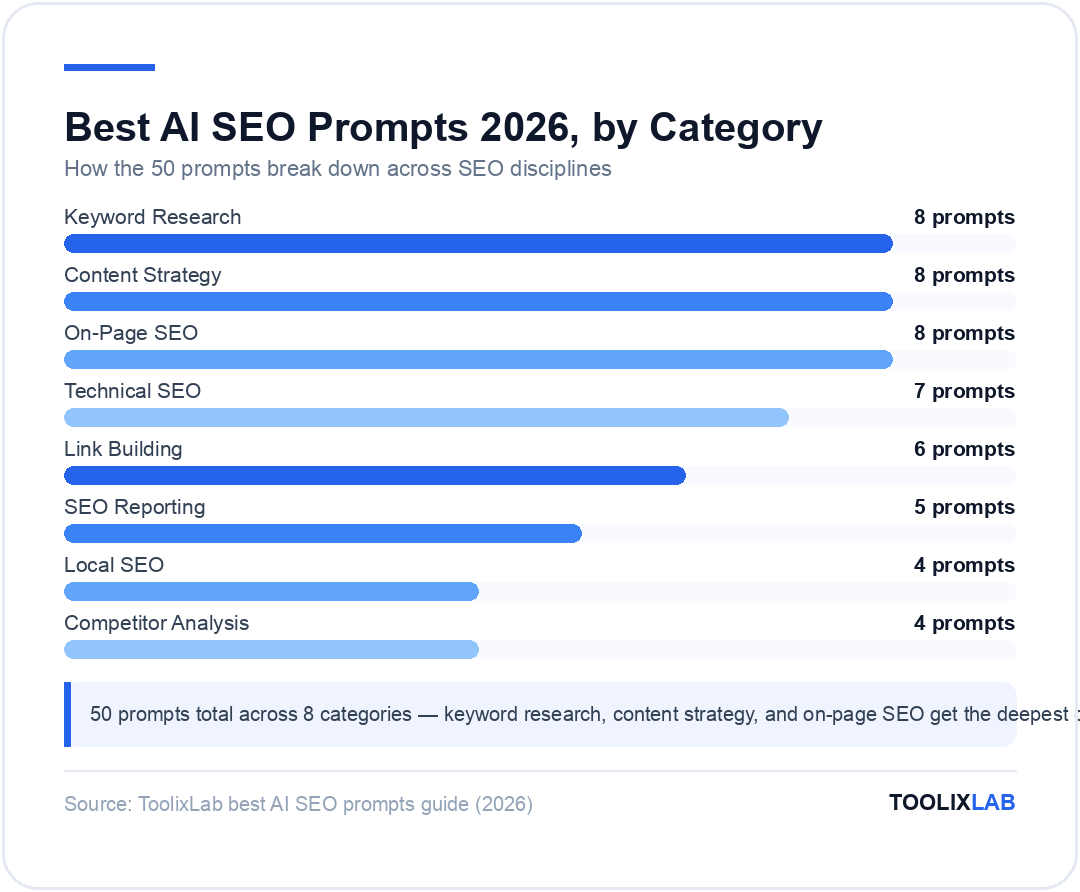
🔗 Link Building Prompts (32–37)
For prospecting, outreach copy, digital PR, and broken link building
Prompt 32 — Link Prospect List Generator
Link BuildingGenerate targeted link prospecting search operators and site categories for your niche.
Generate:
1. 10 Google search operators I can use to find relevant link prospects (using site:, intitle:, inurl: combinations)
2. 8 types of websites in my niche that would logically link to this content (e.g., resource pages, industry blogs, association directories, tool roundups)
3. The most relevant "resource page" search queries to find pages that aggregate useful links in my topic area
4. Any specific types of publications or websites that regularly cover [TOPIC] and might find this content newsworthy
My geographic target: [GEOGRAPHY]. My site's domain: [YOUR DOMAIN].
Prompt 33 — Personalised Outreach Email Writer
Link BuildingWrite outreach emails that don't sound like templates — the difference between 2% and 15% reply rates.
Context:
- My name / brand: [YOUR NAME / BRAND]
- The page I want a link to: [YOUR URL + brief description of content]
- The prospect's website: [PROSPECT DOMAIN]
- The specific page or post on their site where I want the link placed: [PROSPECT PAGE URL]
- Why a link to my page would genuinely benefit their readers: [EXPLAIN THE VALUE]
- Something specific I noticed about their site/content to personalise the opening: [PERSONAL NOTE]
Requirements: Subject line under 7 words. No "I hope this email finds you well". No "I came across your website". Under 120 words total. End with a specific, low-friction ask.
Prompt 34 — Digital PR / Data Story Ideator
Link BuildingGenerate linkable asset and data story ideas that journalists and bloggers in your niche would actually cover.
Generate 10 linkable asset ideas — original data studies, surveys, tools, or reports — that would genuinely interest journalists in my niche and be likely to earn natural backlinks. For each idea, provide:
- Asset concept (1–2 sentences)
- Why journalists/bloggers would cover it (news angle)
- Data source or methodology needed to produce it
- Estimated difficulty to produce (Low / Medium / High)
- Potential publications and journalists who would cover it
Focus on ideas that are data-driven, counterintuitive, or reveal something surprising about [NICHE].
Prompt 35 — Guest Post Pitch Generator
Link BuildingCreate a compelling guest post pitch with three article angle options tailored to the target publication.
Target publication: [PUBLICATION NAME] covering [THEIR TOPICS], audience: [THEIR AUDIENCE]
My expertise and credentials: [DESCRIBE YOUR BACKGROUND]
My website: [YOUR SITE]
Any previous published work to reference: [LINKS TO YOUR WORK IF ANY]
For each of the three article ideas, provide: a compelling headline, a 2–3 sentence pitch (what it covers, why their audience will value it, your unique angle), and the key data/insight I can share that their team probably hasn't covered.
Tone: professional but personable. Under 200 words total. No generic "I'd love to contribute to your blog" openings.
Prompt 36 — Broken Link Building Opportunity Finder
Link BuildingSystematise broken link building — identify the types of content to create that replace dead links in your niche.
Broken link context:
- Site with broken link: [DOMAIN]
- Anchor text of broken link: [ANCHOR TEXT]
- Original URL (now dead): [DEAD URL if known]
- Surrounding context on the linking page: [PASTE THE PARAGRAPH CONTAINING THE BROKEN LINK]
Based on this context, suggest: (1) what the dead resource likely contained (so I can replicate it), (2) an improved version I could create, and (3) a short replacement pitch email I can send to the linking site's owner explaining what I've created and why it's a natural replacement.
Prompt 37 — Backlink Profile Analysis & Disavow Prioritisation
Link BuildingAnalyse a backlink profile for toxic links and prioritise what to disavow — with reasoning.
For each link or pattern, classify as: Disavow (high-risk), Monitor (low-risk but watch), or Keep (no action needed). Explain the reasoning for Disavow classifications.
Warning: do not recommend disavowing links based on low DA/DR alone — focus on actual toxicity signals: link farms, PBN patterns, irrelevant foreign language spam, unnatural anchor text concentration, hacked site links.
Backlink data:
[PASTE YOUR BACKLINK SAMPLE: Source URL | Anchor Text | Link type (dofollow/nofollow) | Any other data you have]
📍 Local SEO Prompts (38–41)
For Google Business Profile, local content, and multi-location SEO
Prompt 38 — Google Business Profile Description Writer
Local SEOWrite a keyword-optimised GBP description that stands out and includes local search terms naturally.
Business name: [NAME]
Business type / category: [CATEGORY]
Location(s): [CITY, REGION]
Key services/products: [LIST MAIN OFFERINGS]
USPs / what makes them different: [DESCRIBE]
Primary local keyword to include: "[LOCAL KEYWORD, e.g., 'accountant in Manchester']"
Secondary local keywords to include naturally: [2–3 KEYWORDS]
Write in third person. Include the city name at least twice. Include a subtle call to action at the end. Do not use all-caps or excessive punctuation.
Prompt 39 — Local Landing Page Content Generator
Local SEOGenerate unique, locally-relevant content for service area pages — avoiding the thin, duplicate content that kills local SEO.
This page must NOT be a thin, template-filled city page. It needs genuine local relevance. Include:
1. An introduction that references the specific area (local landmarks, neighbourhoods, or context)
2. Why local customers in [CITY] specifically would benefit from this service
3. Any local regulations, requirements, or conditions relevant to this service in [CITY]
4. Social proof framing for a local audience
5. LocalBusiness schema-compatible content structure
Word count: 400–600 words. Do not just swap city names into a generic template — the content should feel written for [CITY] residents specifically.
Prompt 40 — GBP Post / Update Writer
Local SEOWrite a month's worth of Google Business Profile posts — keeps your profile active and improves local visibility signals.
- Be 150–300 characters (GBP shows the first ~100 chars before "read more")
- Include one local keyword naturally
- End with a clear call to action (call, visit, book, learn more)
- Vary the topic: Week 1 (service/product highlight), Week 2 (tip or educational), Week 3 (offer or event if applicable), Week 4 (customer result or social proof angle)
Business details: [DESCRIBE BUSINESS AND KEY SERVICES]
Tone: [DESCRIBE BRAND VOICE]
Any current promotions or seasonal angles: [DESCRIBE IF ANY]
Prompt 41 — Review Response Templates (Positive & Negative)
Local SEOWrite review responses that include local keywords naturally while maintaining a professional, human tone.
1. Three positive review responses (for 4–5 star reviews) — each should: thank the reviewer by first name placeholder [NAME], mention the specific service received, include the business name and city naturally, and encourage a return visit
2. Two negative review responses (for 1–2 star reviews) — each should: acknowledge the concern without admitting liability, show empathy, invite them to contact us directly to resolve (include a contact method placeholder), and be under 80 words
The responses should NOT all sound identical. Vary the opening phrases. Business name: [NAME]. Location: [CITY]. Main service: [SERVICE].
🔍 Competitor Analysis Prompts (42–45)
For SERP gap analysis, content differentiation, and competitive positioning
Prompt 42 — Competitor SEO Strategy Summary
Competitor AnalysisReverse-engineer a competitor's overall SEO strategy from observable data.
Competitor: [DOMAIN]
Their top organic pages (by traffic): [LIST TOP PAGES + ESTIMATED TRAFFIC]
Their top ranking keywords: [LIST TOP KEYWORDS + POSITIONS]
Their backlink profile summary: [DR/DA, number of linking domains, notable links]
Content publishing frequency: [APPROXIMATE POSTS PER MONTH]
Content types they focus on: [DESCRIBE: blog, landing pages, tools, etc.]
Analyse: What content themes are working for them? Where do they have topical gaps? What keywords are they ranking for that I'm not? Where do they seem to be investing most of their SEO effort?
My site: [YOUR DOMAIN + BRIEF DESCRIPTION]
Prompt 43 — SERP Differentiation Strategy
Competitor AnalysisFigure out how to rank for a competitive keyword without just replicating what's already there.
Result 1: [URL — brief description of content angle]
Result 2: [URL — brief description of content angle]
Result 3: [URL — brief description of content angle]
Result 4: [URL — brief description of content angle]
Result 5: [URL — brief description of content angle]
My site covers [YOUR NICHE/ANGLE]. My unique perspective or data on this topic: [DESCRIBE IF ANY].
Recommend a differentiated content angle that: (1) still targets the same search intent, (2) covers everything the current top results cover, and (3) has a genuinely different POV or structure that could earn a position without just being a copy of what exists. Also identify the specific content type that would differentiate most strongly.
Prompt 44 — Featured Snippet Optimisation for a Ranking Page
Competitor AnalysisOptimise a page that's ranking on page 1 to steal the featured snippet from the current holder.
The current featured snippet shows: [DESCRIBE WHAT IT SAYS — paragraph / list / table]
Analyse my page content below and tell me: (1) exactly what to add or change to make my content more likely to win the featured snippet, (2) the optimal format for this specific query (paragraph/list/table/steps), (3) the ideal word count for the snippet answer (featured snippets typically show 40–60 words for paragraphs), and (4) where in the page structure this answer should appear.
My current page content:
[PASTE RELEVANT SECTION OF YOUR CONTENT]
Prompt 45 — AI Overview (SGE) Optimisation Strategy
Competitor AnalysisOptimise content to appear as a cited source in Google's AI Overviews — the emerging opportunity in 2026 SEO.
Current AI Overview answer for this query: [DESCRIBE OR PASTE WHAT THE AI OVERVIEW SAYS]
My page on this topic: [URL + brief description]
Recommend specific content changes that make my page more likely to be cited by Google's AI Overview, including: how to structure the direct answer, what factual claims or data points to include, how to format content for AI citation eligibility, and what signals (author credentials, citations, structured data) strengthen AI Overview inclusion likelihood.
📈 SEO Reporting & Analysis Prompts (46–50)
For GSC data interpretation, reporting, and communicating SEO wins to stakeholders
Prompt 46 — Google Search Console Data Interpreter
SEO ReportingTurn raw GSC export data into actionable insights and a prioritised list of opportunities.
Data covers: [DATE RANGE]. My site: [DESCRIBE SITE].
Look for and report on:
1. Keywords with high impressions but low CTR (below [X]%) — likely title/description issues
2. Keywords ranking positions 4–15 with significant impression volume — quick win opportunities
3. Pages with declining clicks MoM or YoY — need investigation
4. Pages with high CTR but low impressions — potential to increase visibility
5. Any unusual patterns (traffic spikes/drops, query cannibalisation signals)
Output as a prioritised action list with reasoning for each recommendation.
GSC data:
[PASTE YOUR GSC EXPORT DATA]
Prompt 47 — Monthly SEO Report Builder (for Clients/Stakeholders)
SEO ReportingTurn raw metrics into a narrative-driven report that non-SEOs can understand and act on.
Performance data:
- Organic traffic: [THIS MONTH] vs [LAST MONTH] vs [SAME MONTH LAST YEAR]
- Organic conversions/leads: [DATA]
- Top pages by traffic: [LIST]
- Top ranking movements (gains): [LIST KEYWORDS + POSITION CHANGE]
- Notable drops: [LIST IF ANY]
- Work completed this month: [LIST ACTIONS TAKEN]
- Technical issues resolved: [LIST]
Structure the report as: Executive Summary (3–4 sentences) → What Went Well → What Needs Attention → Actions Taken This Month → Planned Actions Next Month → Key Metrics Table. Keep it under 500 words. Audience: non-technical marketing stakeholder.
Prompt 48 — Traffic Drop Investigation Framework
SEO ReportingSystematically diagnose the cause of an organic traffic drop using a structured diagnostic process.
What I know:
- Traffic drop: [% drop] starting approximately [DATE]
- Site: [DESCRIBE SITE TYPE AND NICHE]
- Platform: [CMS/HOSTING]
- Recent changes made before the drop: [DESCRIBE ANY CHANGES — site updates, redirects, content changes, plugin updates]
- Google algorithm updates around this date: [NOTE ANY CONFIRMED UPDATES IF KNOWN]
- The drop affects: [All pages / specific page types / specific sections / specific device/country]
Provide a structured investigation checklist, in order of likelihood based on the information above. For each potential cause, tell me: how to confirm or rule it out, what tools to use, and what to do if confirmed.
Prompt 49 — SEO ROI Calculator Framework
SEO ReportingBuild the business case for SEO investment — translate rankings and traffic into revenue impact for stakeholders.
My inputs:
- Current monthly organic traffic: [NUMBER]
- Organic conversion rate: [%]
- Average order value / lead value: [£/$ VALUE]
- Monthly SEO investment (tools + time + agency if applicable): [£/$ VALUE]
- Target traffic increase over 12 months: [%]
- Primary keywords I'm targeting and their estimated monthly search volumes: [LIST]
Build a simple ROI model that shows: current SEO revenue contribution, projected revenue impact of achieving target traffic growth, cost-per-acquisition from organic vs. paid (if I provide PPC data), and break-even timeline. Keep the maths transparent and the assumptions clearly stated. Format as a structured table I can paste into a presentation.
Prompt 50 — Annual SEO Strategy Document Outline
SEO ReportingBuild a full-year SEO strategy framework — the skeleton of a document you'd present to a client or internal team.
Context:
- Current organic traffic: [MONTHLY FIGURE]
- Primary business goal for organic: [LEADS / REVENUE / BRAND AWARENESS]
- Current strengths: [DESCRIBE — e.g., strong domain authority, good technical foundation]
- Current weaknesses: [DESCRIBE — e.g., thin content, poor mobile speed, few backlinks]
- Main competitors: [LIST 3–4]
- Budget available for SEO (monthly): [RANGE OR SPECIFIC FIGURE]
The strategy document should include: Situation Analysis · Annual Goals (with measurable KPIs) · Keyword and Topic Strategy · Content Plan (by quarter) · Technical SEO Roadmap · Link Building Approach · Measurement and Reporting Plan · Resource Requirements. Output as a full document outline with headings and bullet points for each section — detailed enough to hand to a team and start executing.
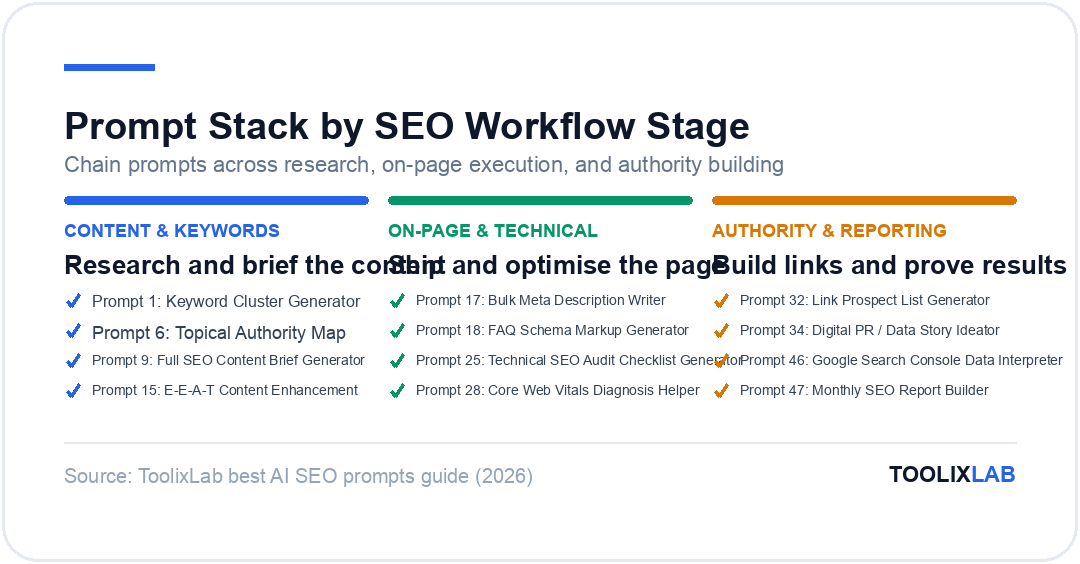
How to Use These Prompts with Different AI Tools
Not all AI tools perform equally across these task types. Here's how to match the prompt to the right model for best results, based on our testing. For a broader guide to AI tooling for marketers, see our post on the best AI tools for marketing in 2026.
| Task Type | Best Tool | Why |
|---|---|---|
| Keyword clustering & strategy | Claude Sonnet 4.6 / GPT-5.4 | Strongest at structured reasoning and table output |
| Long-form content briefs | Claude Sonnet 4.6 | Best at following multi-part, complex instructions |
| JSON-LD / Schema markup | GPT-5.4 | Highest accuracy on structured code output |
| Outreach copy & persuasive writing | GPT-5.4 / Claude | Both strong; Claude slightly more natural tone |
| Competitor SERP analysis | GPT-5.4 with Browse | Web access allows real-time SERP checking |
| Technical SEO diagnosis | Claude Sonnet 4.6 | Strong at nuanced reasoning and prioritisation |
| Bulk meta descriptions (20+) | Claude Sonnet 4.6 (1M context) | Largest context window handles massive batches cleanly |
| Data analysis (GSC exports) | GPT-5.4 with Code Interpreter | Can process CSV data and run calculations natively |
🔑 Key Takeaways
- ✓ Specificity is the single biggest factor separating good AI SEO output from generic output — always include niche, audience, geography, and competitors in your prompts
- ✓ Always validate keyword volume, difficulty, and ranking data in Ahrefs, SEMrush, or Google Search Console — AI cannot access live data
- ✓ Multi-turn iteration consistently beats single-shot prompting — use initial output as a starting point, then refine with follow-up instructions
- ✓ Claude Sonnet 4.6 handles long, multi-part briefs and large context batches best (1M token context); GPT-5.4 excels at structured code output (schema, robots.txt) and data analysis via Code Interpreter
- ✓ For competitor SERP analysis, use GPT-5.4 with Browse or pair any model with your own manual SERP research for accurate data
- ✓ Prompts 9, 19, and 50 (Content Brief, On-Page Review, Annual Strategy) deliver the highest time savings — prioritise these if you're just starting with AI SEO workflows
Conclusion
These 50 AI SEO prompts cover the full workflow — from first keyword idea to annual strategy document. The real productivity gains come from integrating them into standard processes: every content brief goes through Prompt 9, every new page batch goes through Prompt 17, every monthly report goes through Prompt 47. Once these become habits, the time savings compound rapidly.
The best AI tools for executing these workflows are covered in our guide to the best AI SEO tools in 2026. For content creation workflows that build on these prompts end-to-end, see our AI content creation workflow guide. If you want a broader collection of tested prompts beyond SEO — covering coding, marketing, writing, and research — see our roundup of the best ChatGPT prompt libraries in 2026.
Frequently Asked Questions
Can I use ChatGPT for SEO keyword research?
Yes — but not for volume and difficulty data. ChatGPT (and Claude/Gemini) are excellent at generating keyword ideas, clustering, intent classification, and identifying semantic relationships between terms. They cannot provide accurate search volume, keyword difficulty, or traffic data — that still requires tools like Ahrefs, SEMrush, or Google Keyword Planner. Use AI to ideate and structure, then validate the data in your SEO tool of choice.
Which AI tool is best for SEO tasks in 2026?
For most SEO writing and strategy tasks, Claude Sonnet 4.6 and GPT-5.4 are both excellent. Claude Sonnet 4.6 has a 1M-token context window, making it better for processing long content, large keyword lists, or full site audits in one session. GPT-5.4's Code Interpreter handles CSV data analysis from GSC or Ahrefs exports. For tasks requiring real-time SERP data, use GPT-5.4 with Browse enabled. Gemini Advanced is worth using if you're deeply integrated in the Google Workspace ecosystem.
Will using AI for SEO content hurt my Google rankings?
Google's official position is that it rewards high-quality, helpful content — regardless of how it's produced. AI-generated content that is accurate, well-structured, demonstrates genuine expertise, and satisfies searcher intent can rank well. AI content that is generic, unedited, factually shallow, or obviously mass-produced performs poorly because it fails to meet quality standards — not because it was AI-generated. The practical rule: use AI to accelerate quality work, not to replace it.
How do I make AI SEO prompts produce better output?
Five things consistently improve AI SEO output: (1) Start with a context block giving the model your niche, audience, geography, and competitors. (2) Specify the exact output format you want (table, numbered list, JSON, etc.). (3) Set word count constraints. (4) Give examples of the quality level you expect. (5) Iterate — use follow-up instructions to refine the initial output rather than regenerating from scratch. The more specific your input, the more specific and usable the output.
What SEO tasks are AI best suited for?
AI delivers the highest ROI on: content brief creation, bulk meta description and title writing, keyword clustering and intent classification, schema markup generation, content gap analysis, outreach email drafting, internal link planning, on-page copy optimisation, and SEO report writing. Tasks where AI is less reliable: anything requiring real-time data (search volumes, live rankings), highly nuanced technical diagnosis without specific site data, and creative strategy that needs deep domain expertise. Use AI for acceleration, not as a substitute for expertise.
How can I use AI to prepare for Google's AI Overviews (SGE)?
Google's AI Overviews cite pages that provide clear, direct, factually accurate answers to queries — structured in a way that's easy for Google's models to extract. To optimise for AI Overview inclusion: structure content with clear question-and-answer sections, provide concise factual answers (40–60 words) near the top of the page, include strong E-E-A-T signals (author credentials, cited sources, expertise markers), use structured data markup, and ensure your content is fresher and more accurate than competitors. Use Prompt 45 above specifically for this task.
Can AI generate valid JSON-LD schema markup?
Yes — AI is excellent at generating JSON-LD schema markup, and it's one of the highest-value AI SEO applications. GPT-5.4 is particularly reliable for structured code output. After generating schema with AI, always validate it using Google's Rich Results Test (search.google.com/test/rich-results) and Schema.org's validator before deploying. For FAQ, HowTo, Article, Product, and LocalBusiness schema types, AI can produce deployment-ready code with a well-specified prompt like those in Prompts 18, 20, and 31 above.