50 Best ChatGPT Prompts for Sales Teams 2026 (Copy-Paste Templates)
50 copy-paste ChatGPT prompts for sales teams in 2026 — covering prospecting, cold email, objection handling, negotiation, CRM admin, and LinkedIn outreach. Ready to use, no AI experience required.
Listen to this article
50 Best ChatGPT Prompts for Sales Teams 2026 (Copy-Paste Templates)
The best ChatGPT prompts for sales teams in 2026 aren't one-line requests — they're structured instructions that turn the model into a specialist: a prospecting researcher, a cold email copywriter, an objection-handling coach, a CRM note-taker. The difference between a rep wasting 10 minutes on a vague prompt and one who gets a polished outreach sequence in 90 seconds comes down entirely to prompt quality.
Sales is one of the highest-ROI applications for ChatGPT in 2026. The typical rep spends 65% of their week on non-selling activities — research, writing, CRM updates, follow-up drafts, internal reporting. AI can compress most of that to minutes. But the productivity gains only materialise when prompts give ChatGPT the context it needs: who you are, who you're selling to, what you're selling, and what the output should look like.
This guide gives you 50 copy-paste ChatGPT prompts for every stage of the sales process: prospecting, cold email, discovery, demos, objection handling, negotiation, follow-up, CRM admin, LinkedIn outreach, and pipeline strategy. Each prompt is ready to use — just fill in the bracketed placeholders.
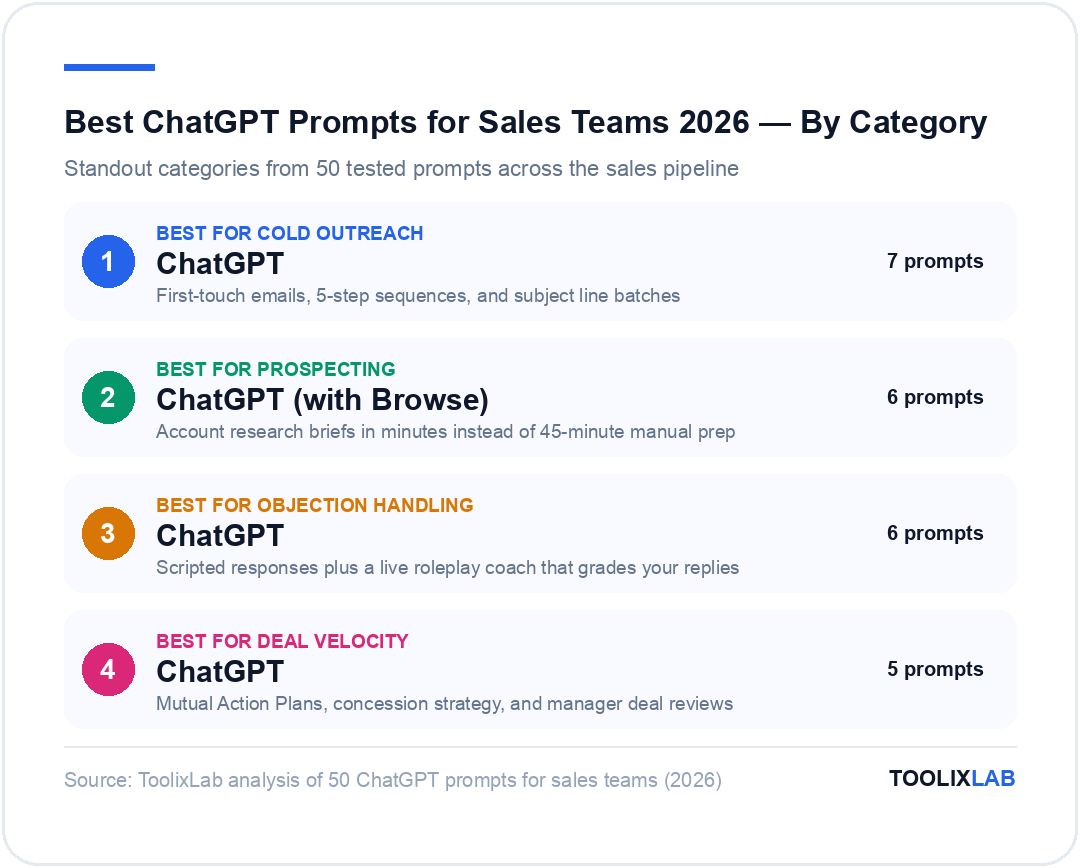
The highest-ROI sales prompts mirror the pipeline itself, from account research and outreach to proposal drafting and negotiation.Standout categories from ToolixLab's 50 tested ChatGPT prompts for sales teams.
The Sales Prompt Formula: Why Most Reps Get Bad Output
Sales reps who get mediocre ChatGPT output almost always have the same problem: the prompt is too short. "Write me a cold email for [company]" gives you something generic. "You are a senior B2B sales rep selling [product] to [ICP], write a 3-sentence cold email using the following trigger event..." gives you something a rep could actually send.
Every high-performing sales prompt has five components:
1. Role assignment: Tell ChatGPT what kind of seller it is. "You are a senior enterprise SaaS AE with 8 years closing $100K+ deals" calibrates the output to that experience level.
2. Product and ICP context: What you sell, who you sell to, and the primary business pain you solve. The more specific, the better.
3. The trigger or scenario: What's the specific situation? A funding announcement, a job posting, a stalled deal? Trigger context separates personalised outreach from spray-and-pray.
4. Deliverable specification: Number of variants, word count, tone, structure. "3 email variants, each under 100 words, tone: direct and peer-to-peer, no buzzwords."
5. Constraints: What to avoid. "No adjectives like 'cutting-edge'. No more than one question per email. Do not pitch the product — pitch a conversation."
💡 System Prompt Shortcut
Paste this at the top of every new ChatGPT session: "You are [NAME], a [ROLE] at [COMPANY]. We sell [PRODUCT] to [ICP]. Our main value proposition is [VALUE PROP]. Tone: [direct/consultative/friendly]. Never use corporate jargon." This eliminates re-explaining context on every prompt.
Part 1: ChatGPT Prompts for Sales Prospecting & Account Research
Prospecting research is the highest-leverage area for ChatGPT in sales. A rep who used to spend 45 minutes building an account brief before a call can now get a structured summary in under 3 minutes. Pair these with the best AI sales tools in 2026 for maximum prospecting velocity.
Prompt #1 — Account Research Brief
Best for: AEs, SDRs before discovery calls | Model: GPT-5.4 with Browse
You are a senior B2B sales researcher. Build a pre-call account brief for [COMPANY NAME] in the [INDUSTRY] space. Include: (1) company overview — size, revenue estimate, business model, (2) recent news and trigger events from the last 90 days, (3) likely tech stack, (4) 3 business challenges typical companies of this type face, (5) key stakeholders and decision-making structure, (6) 3 personalized talking points I can use to open a discovery call as a rep selling [YOUR PRODUCT]. Format as a structured brief I can scan in 2 minutes before dialing.
Prompt #2 — ICP Definition Builder
Best for: Sales leaders, RevOps, SDR managers | Model: GPT-5.4
You are a B2B revenue strategy consultant. Help me define the Ideal Customer Profile for [PRODUCT/COMPANY]. Here are our 5 best customers: [LIST]. Analyze these accounts and output: (1) firmographic fit criteria (industry, company size, revenue range, geography), (2) technographic indicators (tools they likely use), (3) psychographic triggers (business events that predict need — funding, hiring surges, M&A), (4) the single job-to-be-done that makes them buy, (5) 3 disqualifying signals that indicate poor fit. Format as a structured ICP document I can share with my SDR team.
Prompt #3 — Trigger Event Signal Generator
Best for: SDRs, outbound AEs | Model: GPT-5.4 with Browse
I sell [PRODUCT] to [ICP]. List 15 specific trigger events that signal a prospect is likely entering the buying window for a product like mine. For each trigger, provide: (1) the event type (hiring, funding, expansion, pain signal, etc.), (2) where to find it (LinkedIn, job boards, press releases, G2 reviews), (3) a one-sentence outreach hook I could use when the trigger fires. Prioritise triggers by conversion likelihood — highest at the top.
Prompt #4 — Lead Qualification Scorecard
Best for: SDR managers, RevOps | Model: GPT-5.4
Create a lead qualification scorecard for [COMPANY/PRODUCT]. Our ICP is [ICP DESCRIPTION]. We sell at an average deal size of [ACV]. Build a scoring matrix with: (1) 5 firmographic criteria (each worth 1–3 points), (2) 3 intent/behavioural signals (each worth 2–4 points), (3) 3 disqualifiers that score -5 (automatic deprioritize), (4) a scoring key: MQL threshold (book a meeting), SQL threshold (AE handoff), and below-threshold action (nurture). Format as a table an SDR can use in 60 seconds per lead.
Prompt #5 — Competitor Customer Poaching Strategy
Best for: AEs, competitive sales | Model: GPT-5.4 with Browse
I compete against [COMPETITOR] and want to target their unhappy customers. Search recent G2, Capterra, and Trustpilot reviews for [COMPETITOR] from the last 12 months. Identify: (1) the 5 most common complaints, (2) the customer segments complaining most, (3) specific feature gaps or service failures mentioned, (4) a positioning statement I can use in outreach that addresses each pain without naming the competitor. Output as a table: Pain Point | Affected Segment | Our Counter-Positioning.
Prompt #6 — Buying Committee Map
Best for: Enterprise AEs | Model: GPT-5.4
I'm selling [PRODUCT] to a [COMPANY SIZE] company in [INDUSTRY]. Map the likely buying committee. For each stakeholder type, provide: (1) their title and role in the buying process (champion, economic buyer, technical evaluator, legal/procurement, end user), (2) their primary concern and success metric, (3) the objection they're most likely to raise, (4) the message that resonates with them specifically, (5) how to identify them on LinkedIn. Output as a buying committee matrix for multi-threading strategy.
Part 2: ChatGPT Prompts for Cold Email & Outreach Sequences
Cold email is where prompt quality has the most direct commercial impact. A well-crafted prompt can produce a first-touch email, a full 5-step sequence, and 10 subject line variants in under 5 minutes. For teams automating the send layer too, see our guide to automating email with AI.
You are a senior B2B SDR writing a first-touch cold email. Prospect: [NAME], [TITLE] at [COMPANY]. Trigger event: [E.G., JUST RAISED SERIES B / POSTED 5 SALES ENGINEER JOBS]. I sell [PRODUCT] to [ICP]. Core value: [VALUE PROP IN ONE SENTENCE]. Write a cold email that: (1) opens with the trigger event in the first sentence, (2) bridges from trigger to a business pain we solve, (3) makes one low-friction ask (a 15-minute call), (4) is under 80 words total, (5) has zero buzzwords. Subject line: 5 variants — 3 lowercase, 2 question format.
Prompt #8 — 5-Step Email Sequence Builder
Best for: SDR managers, outbound teams | Model: GPT-5.4
Build a 5-email cold outreach sequence for [ICP] targeting [TITLE]. I sell [PRODUCT]. Top value props: [LIST 3]. Each email must use a different hook: Email 1 (Day 1): Trigger/news hook. Email 2 (Day 4): Pain-point hook. Email 3 (Day 8): Social proof hook. Email 4 (Day 14): Content/insight hook. Email 5 (Day 21): Breakup email. Rules: each email under 100 words, one CTA per email, no attachments. Subject lines escalate curiosity across the sequence. Output all 5 ready to paste into a sequencer.
Prompt #9 — Subject Line Batch Generator
Best for: SDRs, A/B testing | Model: GPT-5.4
Generate 20 cold email subject lines for an email to [TITLE] at [COMPANY TYPE] about [TOPIC/VALUE PROP]. Write 4 in each style: (1) curiosity gap, (2) direct benefit, (3) name-drop/social proof, (4) question format, (5) lowercase casual. Flag your top 5 for highest open rate and explain why.
Prompt #10 — Personalisation at Scale
Best for: SDR teams, outbound at volume | Model: GPT-5.4
I have a list of [N] prospects. For each I'll give you their name, company, title, and one piece of public information (LinkedIn headline, recent post, or company news). Write a personalised 2-sentence email opener for each that references their specific context and bridges to [PAIN POINT]. Format: [PROSPECT NAME] | [OPENER] | [BRIDGE]. Each opener under 40 words. Vary sentence structure so openers don't pattern-match. List: [PASTE CSV OR LIST]
Prompt #11 — LinkedIn InMail Template
Best for: SDRs, AEs doing social selling | Model: GPT-5.4
Write a LinkedIn InMail to [NAME], [TITLE] at [COMPANY]. Context: [1-2 SENTENCES ABOUT THEIR BACKGROUND OR RECENT ACTIVITY]. I sell [PRODUCT] to [ICP]. Must: (1) open with something specific to them, (2) make a relevant value observation in 1 sentence, (3) ask one yes/no question to invite a reply, (4) be under 150 words, (5) sound like a peer — not a pitch. No buzzwords. No "I hope this message finds you well." Output 2 variants: one direct, one warmer.
Prompt #12 — Re-Engagement Email for Cold Prospects
Best for: AEs managing older pipeline | Model: GPT-5.4
Write a re-engagement email to [NAME] at [COMPANY]. We spoke [TIMEFRAME] ago about [TOPIC] and they went cold after [LAST INTERACTION]. Since then: [NEW DEVELOPMENT — new feature, customer win in their industry, relevant stat]. Must: (1) acknowledge the gap without over-apologizing, (2) lead with the new development as the reason to reconnect, (3) make it easy to say yes or no, (4) be under 80 words. Don't use "circling back," "touching base," or "following up." Include 1 subject line that implies news.
Prompt #13 — Referral Ask Email
Best for: AEs working existing customer base | Model: GPT-5.4
Write a referral ask email to [CUSTOMER NAME], a happy customer who recently [POSITIVE OUTCOME — "hit 2x ROI," "gave NPS of 9"]. I want to ask them to refer 1-2 contacts in similar companies. Must: (1) open by acknowledging their specific result, (2) make the referral ask feel natural and low-pressure, (3) explain what happens next (I send a brief intro email — I take it from there), (4) be under 100 words. Tone: warm, genuine. Include incentive if applicable: [INCENTIVE OR REMOVE].
Part 3: ChatGPT Prompts for Discovery Calls & Qualification
Discovery is where deals are won or lost. The best reps go in with a hypothesis about the prospect's pain and a set of questions designed to surface, validate, and deepen it. These prompts help you prepare discovery frameworks, MEDDIC criteria, and call agendas before the conversation starts.
Prompt #14 — Discovery Call Question Framework
Best for: AEs, SDRs | Model: GPT-5.4
You are an expert sales coach. I sell [PRODUCT] to [ICP]. My hypothesis about this prospect's pain is: [HYPOTHESIS]. Build a 30-minute discovery call structure: (1) 2-min opening that sets agenda and rapport, (2) 5 situation questions (current state, existing process, team setup), (3) 4 problem questions (pain surfaces, frequency, impact), (4) 3 implication questions (what happens if not solved?), (5) 2 need-payoff questions (what would success look like?), (6) MEDDIC checkpoints woven in naturally, (7) a close that earns the next step. Flag mandatory vs. nice-to-have for a 20-minute version.
Prompt #15 — Pain Mapping Matrix
Best for: Enterprise AEs | Model: GPT-5.4
Create a pain mapping matrix for selling [PRODUCT] to [COMPANY TYPE]. I speak with [LIST PERSONAS: e.g., VP Sales, RevOps, CFO]. For each persona, map: (1) top 3 business pains related to [PROBLEM AREA], (2) the metric they use to measure success, (3) the emotional fear driving urgency, (4) the question that will surface this pain in discovery, (5) the capability in my product that addresses it. Output as matrix: Persona | Pain | Metric | Fear | Discovery Question | Our Solution.
Prompt #16 — MEDDIC Qualification Checklist
Best for: SDRs, sales managers | Model: GPT-5.4
Build a MEDDIC qualification checklist for a [DEAL SIZE] deal in [INDUSTRY]. For each MEDDIC component, provide: (1) the 2 best questions to qualify it, (2) a red-flag answer that signals unqualified, (3) a green-flag answer that confirms qualification, (4) the action to take if unqualified. Format as a checklist an SDR can complete during a 15-minute qualifying call and hand off to AE with a confidence score.
Prompt #17 — Discovery Call Debrief for CRM
Best for: AEs after discovery calls | Model: GPT-5.4
I just completed a discovery call with [NAME], [TITLE] at [COMPANY]. Raw notes: [PASTE NOTES]. Turn these into a structured CRM debrief: (1) Pain summary (2-3 sentences), (2) MEDDIC status — confirmed vs. gaps, (3) Key stakeholders and their stance, (4) Agreed next step + date, (5) Deal risks, (6) Recommended actions before next call. Format for direct paste into Salesforce/HubSpot. Flag any MEDDIC gaps I need to address before moving to proposal stage.
Prompt #18 — Pre-Discovery Priming Email
Best for: Enterprise AEs | Model: GPT-5.4
Write a pre-discovery email to send 24 hours before our call with [PROSPECT NAME]. Include: (1) confirm agenda (30 min, focus on [TOPIC]), (2) 1-2 diagnostic questions they can think about in advance to make better use of our time, (3) link to one relevant piece of social proof in their industry, (4) easy way to reschedule. Under 100 words. Professional but not stiff. No "looking forward to connecting."
Part 4: ChatGPT Prompts for Demos, Proposals & Business Cases
The gap between a great discovery call and a won deal is often the proposal. These prompts help you build tailored demo agendas, ROI calculators, and executive business cases that speak the prospect's language — not yours.
Prompt #19 — Tailored Demo Agenda Builder
Best for: AEs building demos | Model: GPT-5.4
Build a tailored 45-minute demo agenda for [COMPANY NAME]. From discovery: Primary pain: [PAIN]. Personas attending: [LIST]. Success metric they care about: [METRIC]. Current solution: [CURRENT PROCESS]. Structure: (1) 5-min recap of what we heard in discovery, (2) 20-min product walkthrough organised around their pain — not features, (3) 10-min ROI moment with their numbers, (4) 5-min social proof from a similar customer, (5) 5-min next step and mutual action plan. For each section, write the exact opening talking point.
Prompt #20 — ROI Calculator Script
Best for: AEs, presales | Model: GPT-5.4
Build an ROI calculation for [PRODUCT] sold to [COMPANY TYPE]. Inputs from prospect: Team size: [N]. Current time spent on [TASK]: [X hrs/week]. Cost of [PROBLEM]: [$Y/year]. Improvement from our product: [CLAIMED OUTCOME]. Calculate: (1) annual hours saved, (2) dollar value of time saved (use [AVG SALARY]), (3) cost avoidance from [RISK REDUCED], (4) revenue impact: [REVENUE METRIC], (5) payback period at [$PRICE/year]. Build a table I can show on screen. Round conservatively. Add conservative / moderate / optimistic scenario rows.
Prompt #21 — Executive Business Case
Best for: Enterprise AEs, champion enablement | Model: GPT-5.4
Write a 1-page executive business case for [CHAMPION NAME] to present to their CFO/CEO for approving [PRODUCT] at [$PRICE/year]. Context: Problem: [PROBLEM]. Key discovery metrics: [LIST]. ROI model: [SUMMARY]. Timeline to value: [TIMEFRAME]. Structure: (1) Executive Summary (3 sentences — problem, solution, financial return), (2) Current State vs. Future State table, (3) Financial ROI bullets with numbers, (4) Implementation risk and mitigation, (5) Recommended next step with specific date. Tone: board-room credible, no buzzwords, no adjectives without evidence.
Prompt #22 — Proposal Cover Email
Best for: AEs sending proposals | Model: GPT-5.4
Write the email to send with a proposal to [NAME] at [COMPANY]. Main option: [OPTION + PRICE]. Secondary option: [OPTION 2 + PRICE]. Top pain we're solving: [PAIN]. ROI figure: [ROI]. Next step: [REVIEW CALL DATE]. Must: (1) reference something specific they said in discovery, (2) summarise the two options in 2 sentences each, (3) lead with the ROI number, (4) confirm review call or ask for one, (5) be under 150 words. No "please find attached."
Prompt #23 — Competitive Battlecard
Best for: AEs in competitive deals | Model: GPT-5.4 with Browse
Build a competitive battlecard for [OUR PRODUCT] vs. [COMPETITOR]. Provide: (1) their top 3 strengths (honest), (2) top 3 weaknesses/gaps (with evidence from reviews), (3) segments where they typically win vs. where we win, (4) 5 landmine discovery questions to expose their weaknesses without naming them, (5) our 3 strongest differentiation points with proof, (6) how to handle "but [COMPETITOR] is cheaper." One-page card I can reference in a live call.
Part 5: ChatGPT Prompts for Objection Handling
Objection handling is the most trainable sales skill — and ChatGPT is a genuinely excellent coach for it. These prompts give you scripted responses to the most common objections, roleplay scenarios for practice, and reframe techniques for the hardest late-stage pushback.
Prompt #24 — Price Objection Response Script
Best for: All AEs | Model: GPT-5.4
Write 3 response scripts for: "Your price is too high / this is more than we budgeted." Our product: [$PRICE/year]. Prospect's alternative: [STATUS QUO / COMPETITOR]. Our ROI: [ROI FIGURE]. Response 1: Reframe price to cost of inaction. Response 2: Diagnose what "too high" actually means using a question. Response 3: Stepped or phased commercial option. For each: exact words, what reaction to listen for, follow-up question. Under 60 seconds of spoken word each.
Prompt #25 — "Not the Right Time" Objection Handler
Model: GPT-5.4
Prospect says: "We're interested but the timing isn't right — let's revisit in [TIMEFRAME]." Help me respond in a way that: (1) respects the concern without just accepting the delay, (2) surfaces whether it's budget, internal politics, or genuine timing, (3) gets commitment to a specific next step so the deal doesn't die in the queue, (4) leaves me positioned to follow up with value — not "just checking in." 2 variants: one more direct, one consultative. Include the exact follow-up question for 4–6 weeks later.
Prompt #26 — "We'll Build It Internally" Objection
Model: GPT-5.4
Prospect says: "We think we could build this internally." I sell [PRODUCT]. Write a response that: (1) validates their engineering capability without condescending, (2) breaks down the full cost of building vs. buying (time, talent, maintenance, opportunity cost), (3) uses the "what else could that engineering capacity be working on?" angle, (4) offers a POC to compare effort vs. outcome, (5) never says "we've seen companies try that." Under 90 seconds spoken. Then write a follow-up email version in under 100 words.
Prompt #27 — Competitor Comparison Objection
Model: GPT-5.4
Prospect says: "We're also looking at [COMPETITOR] — they seem to do the same thing." Write a response that: (1) acknowledges the comparison without getting defensive, (2) asks 2–3 diagnostic questions about what they've actually seen, (3) reframes around the outcome they care about most: [OUTCOME], (4) tells a brief customer story from a win over that competitor (use placeholders), (5) doesn't trash the competitor. Spoken response under 75 seconds, plus 1-paragraph email version.
Prompt #28 — "Need Internal Buy-In" Objection
Model: GPT-5.4
Prospect says: "I need to get buy-in from [CFO / IT / CEO]." Write a champion enablement strategy: (1) talk track for coaching the champion to sell internally, (2) leave-behind document for their internal meeting, (3) the 3 most likely objections their stakeholder will raise + prepared answers, (4) email I can send the champion that makes their internal pitch easier. Goal: win the deal in the room I'm not in.
Prompt #29 — Objection Roleplay Coach
Best for: Sales training, rep onboarding | Model: GPT-5.4
You are a tough but fair sales coach. Roleplay as a skeptical [TITLE] at a [COMPANY TYPE] evaluating [PRODUCT] with reservations about [SPECIFIC OBJECTION]. I will respond as the rep. After each response, grade me 1–5 on: (1) acknowledging without conceding, (2) diagnosing the root cause, (3) reframing to value. Give specific written feedback after each exchange. After 5 turns, give an overall assessment and the 2 things to work on. Start by raising the objection naturally.
Part 6: ChatGPT Prompts for Negotiation & Closing
These prompts help you build negotiation strategies, structure deal summaries for internal approvals, and craft closing language that creates urgency without pressure tactics.
Prompt #30 — Mutual Action Plan (MAP)
Best for: Enterprise AEs | Model: GPT-5.4
Build a Mutual Action Plan to close [COMPANY NAME] by [TARGET DATE]. Their go-live goal: [DATE]. Milestones: legal review, security review, contract sign, implementation start. Their key stakeholders: [LIST]. Ours: [LIST]. Create a week-by-week timeline with: (1) each milestone + owner (us or them), (2) dependencies, (3) risk flag if this step typically causes delays, (4) the email language to use when proposing this MAP to the prospect. Format as a shareable table.
Prompt #31 — Negotiation Concession Strategy
Best for: AEs in late-stage deals | Model: GPT-5.4
I'm negotiating with [COMPANY]. Original proposal: [$PRICE]. They want: [DISCOUNT OR CONCESSION]. Our BATNA: [MINIMUM ACCEPTABLE]. Build a 3-move strategy: Move 1: counter with [X] + justify with value reason. Move 2: offer [SECONDARY CONCESSION — e.g., implementation credit, extended term] in exchange for accelerated sign date. Move 3: final position with deadline. For each move, write exact email or spoken language. Flag what I should never concede. Remind me to get commitment in return for every concession.
Prompt #32 — Deal Review Memo for Manager
Best for: AEs preparing forecast calls | Model: GPT-5.4
Write a deal review memo for my manager for [COMPANY NAME]. Deal size: [$ACV]. Stage: [STAGE]. Expected close: [DATE]. Champion: [NAME/TITLE]. Economic buyer: [NAME — confirmed/unconfirmed]. My notes: [PASTE NOTES]. Summarise as: (1) Why we should win (2-3 strongest reasons), (2) Why we might lose (honest risks), (3) MEDDIC status — green/amber/red per component, (4) The one action to move this forward, (5) My confidence score out of 10 with 1-sentence rationale. Be direct. Flag any gaps I may be glossing over.
Prompt #33 — Urgency Creation Without Pressure
Best for: AEs with stalled deals | Model: GPT-5.4
Write a closing email creating legitimate urgency for [COMPANY] to sign by [DATE]. Stalled at [STAGE] for [TIMEFRAME]. Urgency levers: [LIST — e.g., end-of-quarter pricing, implementation slot, product update post-sign]. Rules: (1) urgency must be real, not manufactured, (2) never say "I don't want you to miss out," (3) frame around their cost of delay — not my quota, (4) include a specific yes/no ask, (5) under 100 words. If no legitimate levers exist, tell me honestly what to do instead.
Prompt #34 — Contract Redline Response Prep
Best for: AEs navigating legal/procurement | Model: GPT-5.4
The prospect's legal team redlined our contract. Their asks: [LIST 3–5 REDLINES]. For each: (1) explain in plain English what they're asking for, (2) flag whether it's common/low-risk, needs legal check, or a dealbreaker pattern, (3) draft a professional response for our legal team, (4) suggest a compromise position if we can't accept as-is, (5) flag the one most likely to delay the deal. Note: Final legal decisions should always involve our actual legal team.
Part 7: ChatGPT Prompts for Follow-Up & Deal Nurture
Most deals are lost not because the prospect said no — but because they went quiet and the rep ran out of ways to re-engage. These prompts give you value-based follow-up sequences, ghost recovery strategies, and nurture frameworks that keep deals alive without becoming annoying.
Prompt #35 — Ghost Recovery Sequence (3 Emails)
Best for: AEs with stalled pipeline | Model: GPT-5.4
Write a 3-email ghost recovery sequence for [NAME] at [COMPANY], who went silent after [LAST INTERACTION — e.g., "we sent the proposal 3 weeks ago"]. Email 1 (Day 1): Value-add touch — share a relevant insight. No direct ask. Email 2 (Day 7): Soft re-engagement — yes/no question about their situation. Email 3 (Day 14): Honest breakup — stop reaching out, give easy way to re-engage if timing changes. Rules: Never use "just checking in." Each email under 75 words. Each uses a different reason to reach out. 3 subject line options per email.
Prompt #36 — Post-Demo Follow-Up Email
Best for: AEs within 2 hours of a demo | Model: GPT-5.4
Write a post-demo follow-up email to [NAME] to send within 2 hours of our call. They reacted positively to: [WHAT RESONATED]. Questions they raised: [LIST]. Agreed next step: [NEXT STEP + DATE]. Structure: (1) 1-sentence recap of what resonated most, (2) brief answers to 2–3 questions raised, (3) recap of next step + calendar link, (4) attach ROI summary if ready. Under 150 words. No "hope you enjoyed the demo."
Prompt #37 — Long-Nurture Series (Quarterly)
Best for: Long-cycle pipeline | Model: GPT-5.4
Build a 4-email quarterly nurture sequence for [NAME], not ready to buy for [TIMEFRAME]. Their pain: [PAIN]. Status: [EVALUATING / USING COMPETITOR / BUDGET FROZEN]. Design 4 emails spaced 6–8 weeks apart, each a different touchpoint type: Email 1: Industry insight relevant to their pain. Email 2: Customer story with measurable result. Email 3: New product capability. Email 4: Re-qualification (has anything changed?). Each under 100 words. Goal: stay top of mind without being annoying. Subject line for each.
Prompt #38 — Meeting Recap Email
Best for: All reps after any deal conversation | Model: GPT-5.4
Turn these meeting notes into a professional recap email to all attendees within 1 hour of our call. Notes: [PASTE]. Structure: (1) What we discussed (3–5 bullets), (2) What we agreed on, (3) Next steps — who, what, by when (both sides), (4) Open questions to resolve. Under 200 words, bullet format for actions. Subject: "Recap: [COMPANY] x [OUR COMPANY] — [DATE]".
Prompt #39 — Lost Deal Win-Back Campaign
Best for: AEs, customer success | Model: GPT-5.4
Build a 3-touch win-back campaign for [COMPANY] who chose [COMPETITOR] [TIMEFRAME] ago. Why they chose competitor: [REASON]. What has changed: [CHANGE — competitor raised prices, new feature, contract up for renewal]. Touch 1 (Email): Acknowledge decision respectfully, introduce the change, ask for 15-minute catch-up. Touch 2 (LinkedIn DM, 2 weeks): Informal re-engagement. Touch 3 (Email, 4 weeks): Final outreach with specific low-risk CTA. Each under 75 words. No "we were hoping to hear from you."
Part 8: ChatGPT Prompts for CRM Updates & Sales Admin
Sales admin is the biggest time drain for modern reps. These prompts turn raw meeting notes into polished CRM documentation in under 2 minutes. Combined with an AI lead generation workflow, they can eliminate most non-selling overhead from a rep's week.
Prompt #40 — Call Notes to CRM Opportunity Update
Best for: All reps after every call | Model: GPT-5.4
Convert raw call notes into a structured CRM update: [PASTE NOTES]. Output: (1) Deal Stage, (2) Call summary (3 sentences max), (3) Pain confirmed — yes/no + description, (4) Next step + owner + due date, (5) Risks/blockers, (6) MEDDIC status update — which components advanced, (7) Confidence score change with reason. Format for direct paste into Salesforce or HubSpot. Plain, factual language — no fluff.
Prompt #41 — Weekly Pipeline Report for Manager
Best for: AEs on weekly forecast calls | Model: GPT-5.4
Turn my current deals into a weekly pipeline report. Deals: [PASTE — COMPANY | STAGE | AMOUNT | CLOSE DATE | LAST ACTIVITY]. Create: (1) Total pipeline + weighted pipeline by stage, (2) Deals most likely to close this month (with confidence %), (3) At-risk deals needing manager attention, (4) Top 3 actions I'm taking this week to move deals, (5) Ask for manager: [E.G., executive sponsor intro, pricing exception]. Format for a 5-minute forecast call. Highlight the most important thing for my manager to know.
Prompt #42 — Sales Email Cleanup (Improve This Draft)
Best for: Any rep before sending | Model: GPT-5.4
Review and improve this sales email: [PASTE EMAIL]. Evaluate: (1) Does the subject line earn an open? (2) Is the opening about them or about me? (3) Is the value prop clear in the first 2 sentences? (4) Is the ask clear and low-friction? (5) Is it under 100 words? Flag each issue, then rewrite with all improvements. Give 3 alternative subject lines ranked by open rate potential. Keep my voice — don't make it sound like someone else wrote it.
Prompt #43 — Post-Call Action Item Summary
Best for: All reps | Model: GPT-5.4
I just ended a call with [NAME]. Raw notes: [PASTE]. Extract: (1) What they committed to do (with timeline), (2) What I committed to do (with timeline), (3) The 1 open question before we can move forward, (4) The most important thing they said to remember. Format as a 5-bullet internal memo for Slack + CRM. Then write the 3-sentence follow-up email to the prospect summarising the same actions.
Part 9: ChatGPT Prompts for LinkedIn & Social Selling
LinkedIn is where most B2B deals now start. Reps who post consistently and send well-crafted messages build pipeline passively. For a broader AI-powered go-to-market strategy, see our guide to the best AI tools for marketing teams.
Write 5 LinkedIn connection request messages to [NAME], [TITLE] at [COMPANY]. Context: [WHAT I KNOW — they posted about X, we share a mutual connection, they recently changed roles]. Rules: Under 300 characters. No pitch. No "I'd love to connect." Each must give a reason to accept — shared insight, relevant observation, or specific compliment. Flag the one most likely to get accepted and why.
Prompt #45 — LinkedIn Post for Thought Leadership
Best for: AEs, sales leaders building pipeline | Model: GPT-5.4
Write a LinkedIn post for me as a [TITLE] selling [PRODUCT] to [ICP]. Topic: [TOPIC — lesson learned, stat, customer story, common mistake]. Format: scroll-stopping hook (counterintuitive or specific). 3-5 short paragraphs, one idea each. End with a question for replies. 1 CTA: invite DMs to discuss. Under 1,200 characters. No corporate-speak. First person. Max 2 hashtags at the end. 2 variants: one data-driven, one story-driven.
Prompt #46 — LinkedIn DM After Content Engagement
Best for: Social sellers turning engagement into meetings | Model: GPT-5.4
Write a LinkedIn DM to [NAME] who liked/commented on my post about [TOPIC]. They are [TITLE] at [COMPANY] — a good fit for what I sell. Must: (1) reference what they engaged with specifically, (2) continue the conversation — don't pivot to pitch immediately, (3) ask one question to assess their relevance as a prospect, (4) be under 100 characters if possible. 2 variants: one opens with a comment on their reaction, one opens with a follow-up question from the post.
Prompt #47 — LinkedIn Comment Strategy
Best for: Reps building social presence | Model: GPT-5.4
I want to show up consistently in the feeds of [TARGET PERSONA] by commenting on their posts. Give me: (1) the 10 most common post topics [PERSONA] write about on LinkedIn, (2) a comment framework for each that adds perspective without being promotional (pattern: acknowledge → add insight → ask question), (3) 3 example comments for each of the top 5 topics in a [DIRECT/CONVERSATIONAL/ANALYTICAL] voice, (4) a 15-minute daily LinkedIn routine 5 days/week to stay visible with 20 target accounts.
Part 10: ChatGPT Prompts for Sales Strategy, Coaching & Onboarding
These prompts are for sales leaders and enablement teams who want to use ChatGPT not just for individual tasks — but for building territory plans, training new hires, and running structured deal reviews. For related content on AI-powered marketing prompts, see our 50 best ChatGPT prompts for marketers.
Prompt #48 — Territory Plan Builder
Best for: AEs, regional sales managers | Model: GPT-5.4
Help me build a 90-day territory plan for [TERRITORY]. I sell [PRODUCT]. Quota: [$AMOUNT]. Current pipeline: [$AMOUNT]. ICP: [ICP]. Include: (1) Account tiering: Tier 1 (5–10 must-wins), Tier 2 (20 to develop), Tier 3 (research/monitor), (2) Weekly activity targets to hit quota (calls, emails, meetings booked, proposals out), (3) Top 3 GTM plays for this territory, (4) Key risks and mitigation, (5) Progress checkpoints at Day 30, 60, and 90. One-page format for VP presentation.
Prompt #49 — New Rep Onboarding Plan
Best for: Sales managers, enablement leads | Model: GPT-5.4
Build a 30-60-90 day onboarding plan for a new [SDR/AE] selling [PRODUCT] to [ICP]. Average deal size: [$ACV]. Sales cycle: [LENGTH]. For each phase: (1) Learning priorities (product, market, personas, objections), (2) Activity targets that ramp, (3) Skills to master, (4) Resources to complete (recordings, battlecards, roleplays), (5) Manager sign-off metrics. Also generate a "First Week in 5 Days" schedule: Day 1–5 with exact activities and goals each day.
Prompt #50 — Win/Loss Deal Analysis
Best for: Sales managers, AEs after every closed deal | Model: GPT-5.4
Conduct a structured win/loss analysis for a deal I just [WON/LOST]. Company: [COMPANY]. Deal size: [$ACV]. Cycle length: [DURATION]. Why they [bought/went elsewhere]: [REASON]. Full deal history: [PASTE CRM NOTES]. Analyse: (1) 3 things we did well, (2) 2–3 things we should have done differently, (3) The earliest warning sign we missed, (4) What this tells us about our ICP or process, (5) The one thing I'll do differently next time. Direct, honest scorecard format I can use consistently for every debrief.
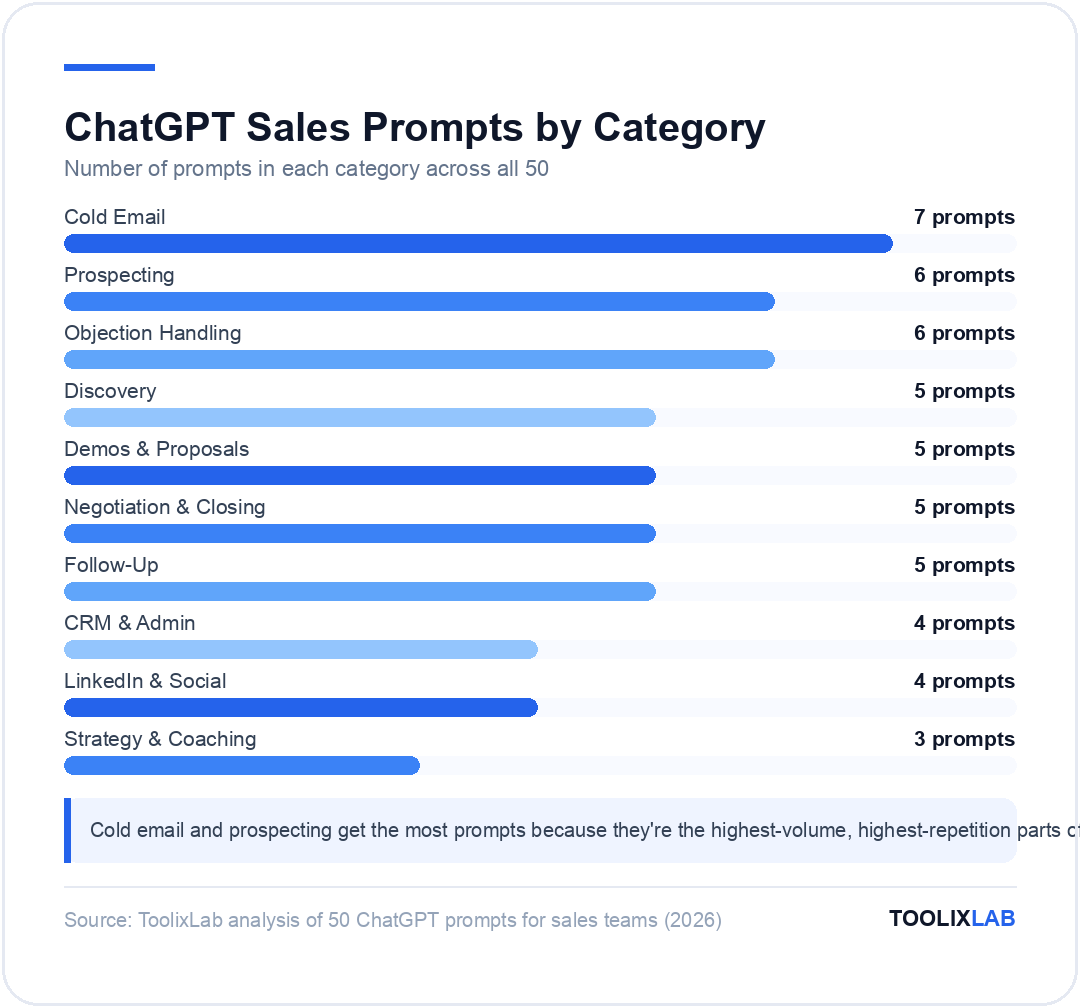
Number of prompts per category across all 50. Source: ToolixLab, 2026.
Quick Reference: All 50 ChatGPT Prompts for Sales Teams
#
Prompt Name
Category
Best For
1
Account Research Brief
Prospecting
Pre-call prep
2
ICP Definition Builder
Prospecting
Sales leaders, RevOps
3
Trigger Event Generator
Prospecting
Outbound SDRs
4
Lead Qualification Scorecard
Prospecting
SDR managers
5
Competitor Poaching Strategy
Prospecting
Competitive AEs
6
Buying Committee Map
Prospecting
Enterprise multi-threading
7
First-Touch Cold Email
Cold Email
All outbound reps
8
5-Step Email Sequence
Cold Email
SDR managers
9
Subject Line Batch
Cold Email
A/B testing
10
Personalisation at Scale
Cold Email
High-volume outbound
11
LinkedIn InMail Template
Cold Email
Social selling reps
12
Re-Engagement Email
Cold Email
Older pipeline reactivation
13
Referral Ask Email
Cold Email
Customer base expansion
14
Discovery Call Framework
Discovery
Pre-call prep
15
Pain Mapping Matrix
Discovery
Multi-stakeholder deals
16
MEDDIC Qualification Checklist
Discovery
SDR-to-AE handoff
17
Call Debrief for CRM
Discovery
Post-call CRM updates
18
Pre-Discovery Priming Email
Discovery
Enterprise call prep
19
Tailored Demo Agenda
Demo & Proposal
AEs building demos
20
ROI Calculator Script
Demo & Proposal
Pre-sales, solutions engineers
21
Executive Business Case
Demo & Proposal
Champion enablement
22
Proposal Cover Email
Demo & Proposal
AEs sending proposals
23
Competitive Battlecard
Demo & Proposal
Competitive situations
24
Price Objection Script
Objections
All AEs
25
Timing Objection Handler
Objections
Stalled deals
26
Build vs. Buy Objection
Objections
Technical prospects
27
Competitor Comparison Response
Objections
Competitive deals
28
Internal Buy-In Objection
Objections
Enterprise multi-stakeholder
29
Objection Roleplay Coach
Objections
Training, onboarding
30
Mutual Action Plan
Closing
Enterprise late-stage
31
Concession Strategy
Closing
Active negotiation
32
Deal Review for Manager
Closing
Forecast calls
33
Urgency Creation Email
Closing
End-of-period deals
34
Contract Redline Prep
Closing
Legal/procurement stage
35
Ghost Recovery Sequence
Follow-Up
Stalled pipeline
36
Post-Demo Follow-Up
Follow-Up
Within 2 hours of demo
37
Quarterly Nurture Series
Follow-Up
Long-cycle pipeline
38
Meeting Recap Email
Follow-Up
All meeting types
39
Lost Deal Win-Back
Follow-Up
AEs, customer success
40
Call Notes to CRM Update
CRM & Admin
All reps after every call
41
Weekly Pipeline Report
CRM & Admin
Forecast calls
42
Email Cleanup / Improve Draft
CRM & Admin
Before any email send
43
Post-Call Action Summary
CRM & Admin
CRM + Slack reporting
44
LinkedIn Connection Request
LinkedIn
All outbound reps
45
LinkedIn Thought Leadership Post
LinkedIn
Passive pipeline building
46
DM After Content Engagement
LinkedIn
Social sellers
47
LinkedIn Comment Strategy
LinkedIn
Presence building
48
Territory Plan Builder
Strategy
AEs, regional managers
49
New Rep Onboarding Plan
Strategy
Sales managers, enablement
50
Win/Loss Deal Analysis
Strategy
After every closed deal
How to Get 10x Better Output from These Prompts
Build a Sales Context Block
Create a reusable paragraph you paste at the top of every ChatGPT session: your name, role, what you sell, your ICP, top 3 value props, and tone of voice. This takes 90 seconds to set up and makes every subsequent prompt 30% better without changing a single word.
Iterate, Don't Regenerate
When you get output that's 70% right, don't hit regenerate — tell ChatGPT exactly what to fix. "The second paragraph is too long. Cut it to 2 sentences and make the ask more direct." One targeted follow-up almost always beats a full regeneration.
Enable Browse for Research Prompts
Prompts #1, #3, #5, and #23 require current information. Always enable web browsing for account research, competitor intelligence, and trigger event lookups — otherwise you'll get outdated or hallucinated data.
Save Your Best Outputs as Templates
When a prompt produces an email that consistently books meetings, save the output as a permanent template in your sequencer — not the prompt. The prompt got you there; the output is the asset. Build a library of your best outputs over 4–6 weeks and you'll have a playbook that compounds.
For the full picture on which AI tools to pair with these prompts — from Apollo for prospecting to Gong for call intelligence — see our guide to the best AI sales tools in 2026. For teams that want to automate outreach itself, not just write better emails, read our guide to building an AI lead generation workflow.
AI Prompts for Deal Qualification
Deal qualification is where the biggest time-wasting happens in sales. These prompts help you qualify deals faster using MEDDIC, BANT, or SPICED frameworks so you concentrate effort on the deals most likely to close.
You are a senior sales strategist. I have an active deal: [COMPANY], [DEAL SIZE], [STAGE]. The prospect is [TITLE] and their stated pain is [PAIN POINT]. Using MEDDIC, give me: (1) the 3 most important qualification gaps I need to close before advancing this deal, (2) a specific question to ask for each gap, (3) a red flag answer that means I should disqualify, (4) a green flag answer that confirms I should advance. Format as a table.
I'm on a discovery call with [ROLE] at [COMPANY TYPE]. They've told me [WHAT THEY SAID]. Score this deal on BANT (Budget, Authority, Need, Timeline) from 1–5 for each dimension. Then give me the single best question to ask next to resolve the biggest qualification uncertainty. Under 150 words.
These AI prompts for deal qualification work best when you paste actual call notes or CRM data into the context before running them. More specific inputs = more accurate qualification output. Pair with a ChatGPT prompt library to build a reusable qualification playbook your whole team can use.
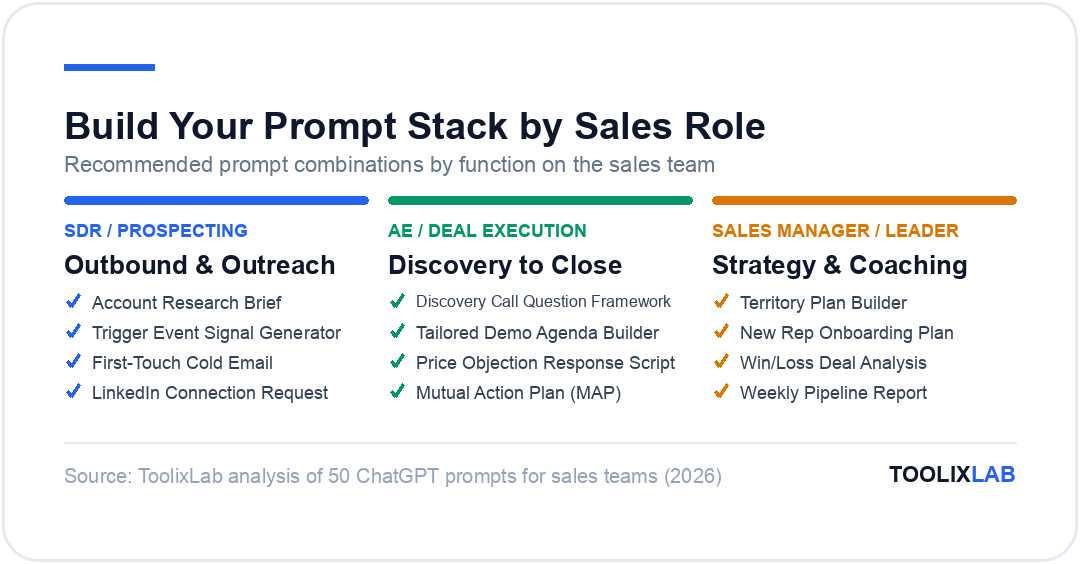
How to build a ChatGPT prompt stack by role on the sales team.
Q:What are the best ChatGPT prompts for sales teams in 2026?
A:
The highest-value ChatGPT prompts for sales teams are role-based templates with full context: trigger-based cold emails, MEDDIC discovery frameworks, ROI calculator scripts, objection handling responses, ghost recovery sequences, and CRM update automators. The best prompts include product context, ICP description, specific deliverable specs, and constraints like word count and tone.
Q:Which ChatGPT model should sales reps use in 2026?
A:
GPT-5.4 is the best default for most sales tasks — it handles long context well and produces high-quality writing. Enable Browse for any research-heavy prompt (account briefs, competitor intelligence, trigger event lookups). For complex strategic prompts like territory planning or deal review memos, GPT-5.4 with reasoning mode gives more structured output.
Q:Can ChatGPT write cold emails that actually get replies?
A:
Yes, when prompts include a specific trigger event, ICP context, a clear value proposition in one sentence, a word count constraint (under 80 words), and explicit constraints like "no buzzwords" and "pitch a conversation not the product." Generic one-line prompts produce generic emails. The prompts in this guide are structured to produce first-draft emails that SDRs can send with minor personalisation.
Q:How should sales teams organise ChatGPT prompts?
A:
Organise prompts by sales stage: prospecting, outreach, discovery, demo/proposal, objection handling, closing, follow-up, and admin. Build a shared document or Notion database where the team stores the prompts that produce the best outputs. Add a reusable brand-context block at the top of each prompt and document which model works best for each use case.
Q:Can ChatGPT help with MEDDIC qualification?
A:
Yes. ChatGPT can generate MEDDIC qualification checklists, convert raw call notes into structured MEDDIC summaries, build discovery question frameworks that hit each MEDDIC component, and score deal confidence based on which components are confirmed. Prompts #16 and #17 in this guide cover both the checklist and the post-call CRM debrief workflow.
Q:Is using ChatGPT for sales outreach ethical?
A:
Using AI to draft and improve sales communication is standard practice in 2026 and widely accepted. The ethical line is personalisation accuracy — do not fabricate company-specific facts or fake social proof. Use AI to compress writing time and improve quality, not to deceive. The prompts in this guide are designed for genuine, relevant outreach based on real context you provide.
T
Written by ToolixLab Research Team
Research Team
The ToolixLab Research Team tests and reviews AI tools, automation workflows, and productivity software so you can make informed decisions without wasting time or money.
Comments
Join the discussion and share your thoughts
We Value Your Privacy
We use cookies to enhance your browsing experience, serve personalized ads or content, and analyze our traffic. By clicking "Accept All", you consent to our use of cookies. or read our Privacy Policy.