ChatGPT Trust Snapshot
Real Free Score
80/100
Lock-In Risk
Medium
Billing Friction
Low
Commercial Use
Allowed
Data Privacy
Clear
Volatility
Medium
Last checked
2026-07-22
The average job seeker spends 11 hours per week on job search activities — writing resumes, crafting cover letters, prepping for interviews, and networking. Most of that time is wasted on tasks that ChatGPT can do in under two minutes with the right prompt. The difference between a generic result and a genuinely useful one is not the AI — it's the instruction you give it.
In 2026, job seekers who use AI strategically are not just saving time — they are landing interviews at higher rates. A well-prompted resume tailored to a specific job description outperforms a generic one by a significant margin on ATS screening. A cover letter that mirrors the language in the job posting gets noticed. An interview prep session with ChatGPT is more targeted than any YouTube video.
This guide gives you 50 ready-to-use ChatGPT prompts for every stage of the job search: resume writing, cover letters, interview prep, LinkedIn optimization, salary negotiation, career pivots, and networking. Every prompt is copy-paste ready — just swap in your details and run it.
Quick Summary: 50 ChatGPT Prompts for Job Seekers
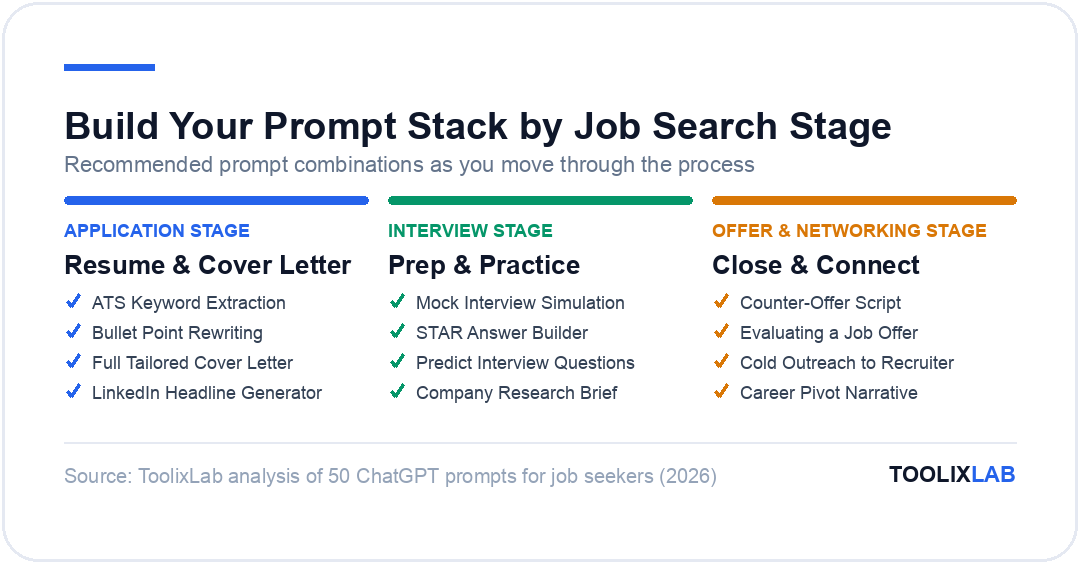
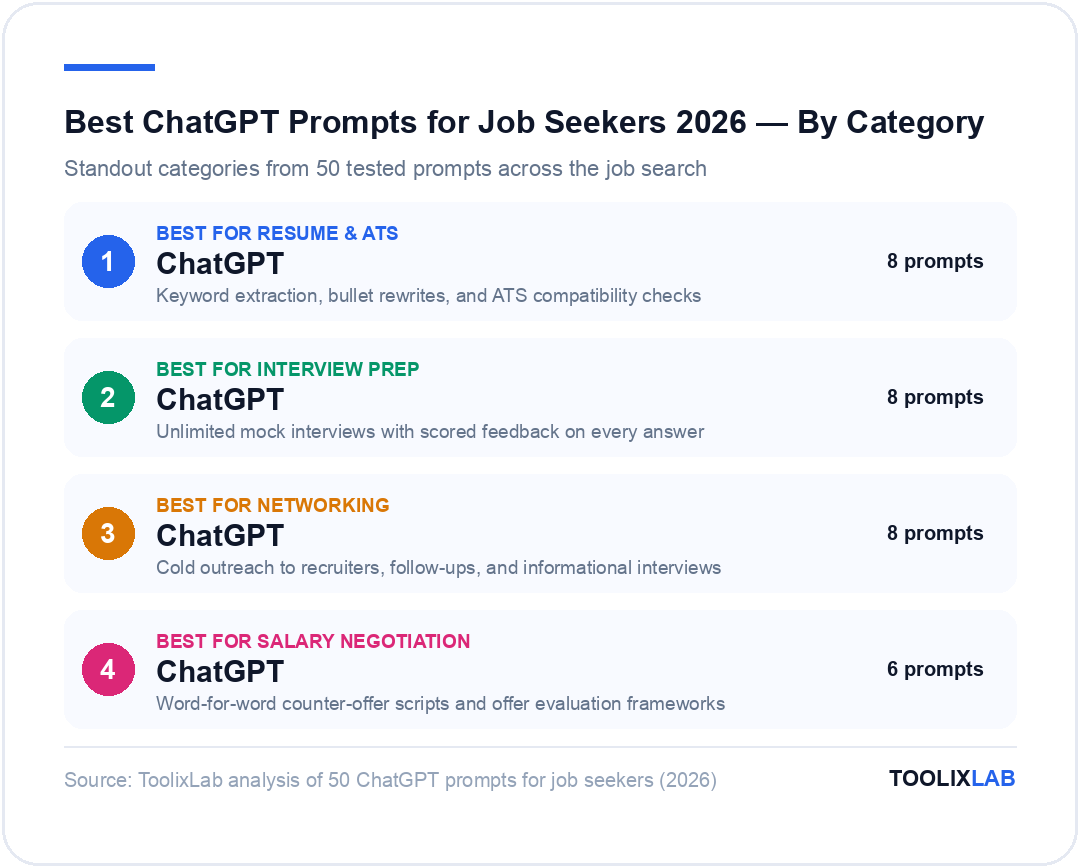
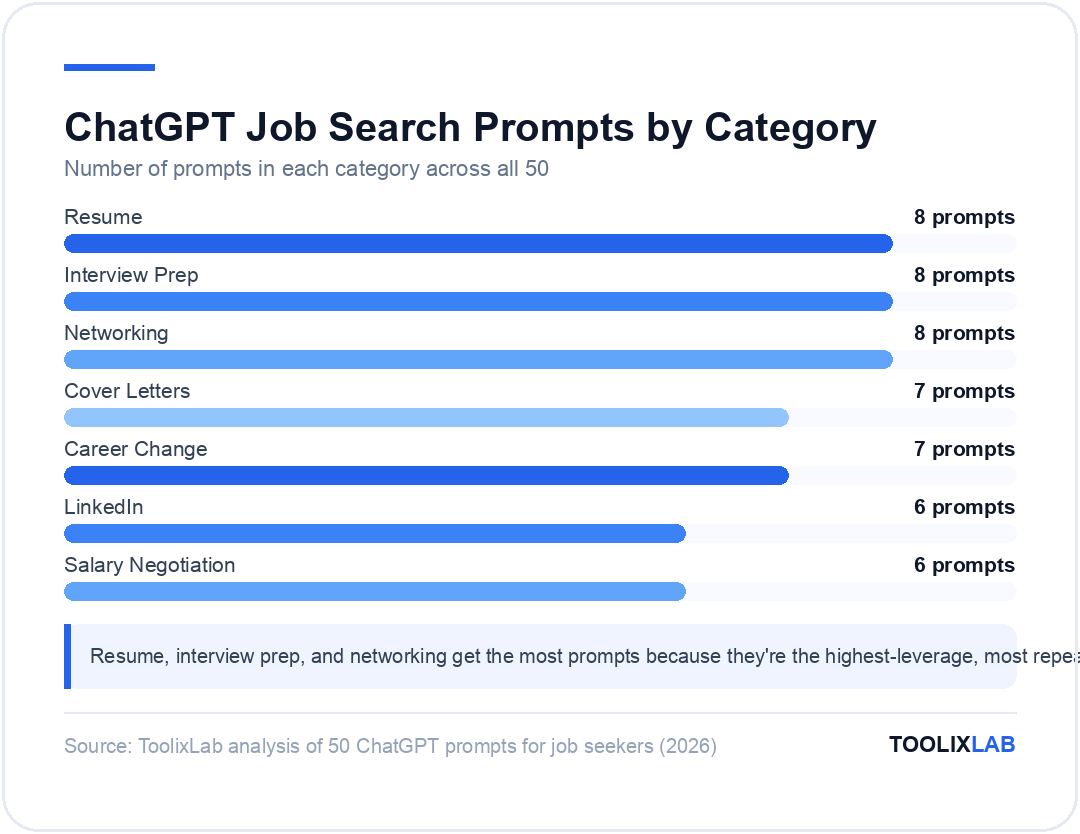
Resume (8 prompts): ATS optimization, keyword matching, bullet points
Cover Letters (7 prompts): Tailored, compelling, concise
Interview Prep (8 prompts): STAR answers, tough questions, mock interviews
LinkedIn (6 prompts): Headline, About section, connection requests
Salary Negotiation (6 prompts): Counter-offers, scripts, research
Career Change (7 prompts): Skills translation, pivot narratives
Networking (8 prompts): Cold outreach, follow-ups, informational interviews
Jump to: Prompt Formula | Resume | Cover Letters | Interview | Quick Reference | FAQ
Why ChatGPT Is a Job Seeker's Secret Weapon in 2026
The job market in 2026 is more competitive — and more AI-assisted — than at any point in history. Hiring teams use AI to screen resumes before a human ever reads them. Applicant tracking systems (ATS) reject up to 75% of applications before they reach a recruiter. Meanwhile, the average corporate job opening receives 250+ applications.
ChatGPT does not level this playing field — it tilts it in your favour, but only if you know how to use it. Here is what it can do that most job seekers overlook:
- ATS keyword matching: Paste a job description and your resume, ask ChatGPT to identify missing keywords, and rewrite your bullets to include them naturally.
- Tailored cover letters in 90 seconds: Not a template — an actual letter that mirrors the company's language and connects your specific experience to their specific need.
- Unlimited mock interview practice: ChatGPT will ask you tough interview questions, evaluate your STAR answers, and give feedback — as many times as you need, for free.
- LinkedIn profile that gets found: Most LinkedIn profiles are written for human readers. ChatGPT can rewrite yours for algorithmic visibility too.
- Salary negotiation scripts: Most people leave 10-20% on the table because they do not know how to negotiate. ChatGPT can write the exact words to say.
The key caveat: ChatGPT output requires your oversight. It does not know your actual experience — you have to provide that. It does not know the company culture — you have to research that. Think of it as a very fast, very capable writing assistant that needs your facts, your voice, and your judgement to produce something genuinely useful. If you want to understand how to get better outputs from any AI model, our AI Prompt Engineering Guide 2026 covers the principles in depth.
The Job Seeker Prompt Formula: Why Vague Prompts Get Vague Results
The single biggest mistake job seekers make with ChatGPT is using prompts like "write me a cover letter" or "help with my resume." These prompts produce generic, mediocre output because ChatGPT has no idea who you are, what role you are applying for, or what makes you a strong candidate. Garbage in, garbage out.
Every prompt in this guide follows a 4-part structure. Once you internalize it, you can write your own high-performing prompts for any job search task:
| Element | What It Does | Example |
|---|---|---|
| Role | Sets the AI's expertise frame | "Act as a senior recruiter at a B2B SaaS company..." |
| Context | Gives your specific situation | "I have 5 years in marketing and am applying for [Role] at [Company]..." |
| Task | States exactly what you need | "Rewrite my resume bullet points using these 5 keywords..." |
| Format | Specifies the output shape | "Output as 6 bullet points, each starting with a strong action verb, under 20 words each." |
Pro Tip: System Prompt for Job Search
Start every new ChatGPT conversation with this: "I am a [your job title/background] with [X years] of experience in [field]. I am currently job searching for [target role] in [industry]. My key strengths are [3 skills]. Tone should be professional but conversational." Paste this before every prompt in this guide and outputs will be significantly more personalised from the first draft.
ChatGPT Prompts for Resume Writing and ATS Optimization
Your resume has two audiences: an ATS algorithm and a human recruiter. The ATS scans for keyword matches to the job description. The human reads what the ATS passes through. ChatGPT can help you write for both — as long as you feed it both your experience and the job description.
You are an ATS optimization specialist. Below is a job description and my current resume. Identify the 10 most important keywords and phrases from the job description that are missing from my resume. For each keyword, suggest how I could naturally incorporate it into an existing bullet point without fabricating experience.
[PASTE JOB DESCRIPTION]
[PASTE YOUR RESUME]
Rewrite these resume bullet points to be stronger, more impact-focused, and ATS-friendly for a [Job Title] role at a [company type, e.g. Series B SaaS startup]. Use the formula: [Action Verb] + [What You Did] + [Measurable Result]. Keep each bullet under 20 words. Return 6 rewritten bullets.
[PASTE YOUR EXISTING BULLETS]
Write a professional resume summary for a [your current title] with [X years] of experience in [field/industry] who is targeting [target role]. Highlight these 3 strengths: [strength 1], [strength 2], [strength 3]. Keep it to 3-4 sentences, use first-person implied voice (no "I"), and include these keywords naturally: [keyword 1], [keyword 2], [keyword 3].
I have these resume bullet points that describe what I did but do not include measurable results. For each bullet, give me 3 questions I should ask myself to uncover specific numbers, percentages, or timeframes I could add. Then rewrite each bullet showing how it would look with example metrics filled in.
[PASTE YOUR VAGUE BULLETS]
I have a [X month/year] employment gap in my resume between [date] and [date] due to [brief honest reason: e.g. caregiving, health, layoff, travel, upskilling]. Write a brief, professional one-sentence description I can add to my resume to address this gap proactively. Also write a 2-3 sentence verbal explanation I can use in interviews. Keep the tone positive and forward-focused.
Based on this job description for a [Job Title] role, what hard skills and technical skills should I prioritize in my resume skills section? Separate into: (1) must-have skills mentioned explicitly in the JD, (2) implied skills common in this role, (3) differentiating skills that would make a candidate stand out. Format as a clean skills list I can paste into my resume.
[PASTE JOB DESCRIPTION]
Here is my master resume and a job description I want to tailor it for. Identify: (1) which of my experiences are most relevant to this specific role, (2) which bullets should be moved up for visibility, (3) which bullets should be dropped or shortened, and (4) what new language from the JD I should weave in. Give me a prioritized editing plan.
[PASTE MASTER RESUME]
[PASTE JOB DESCRIPTION]
Review this resume as if you are an ATS system scanning for a [Job Title] role. Identify: (1) formatting issues that could cause parsing errors (e.g. tables, headers, graphics), (2) missing keywords from a typical [industry] job description, (3) sections that are unclear or non-standard. Give me a list of specific fixes ranked by impact.
[PASTE YOUR RESUME TEXT]
Important
Never fabricate experience or metrics ChatGPT suggests as examples — only use numbers and achievements you can truthfully claim. AI can help you express your real experience more powerfully, not invent it. Recruiters and reference checks will verify.
ChatGPT Prompts for Cover Letters
Most cover letters are ignored because they are generic. The recruiter has already read "I am excited to apply for this position at your esteemed organisation" 200 times today. A cover letter that gets read is one that immediately signals: I know your company, I understand this specific role, and here is exactly why I am the right person for it. ChatGPT can help you write that letter — in under two minutes — if you give it the right input.
Write a tailored cover letter for this job application. Keep it to 3 short paragraphs (under 300 words total). Paragraph 1: Hook — start with a specific, compelling reason I want this exact role at this exact company (not generic excitement). Paragraph 2: Evidence — connect 2-3 specific achievements from my background directly to the top requirements in the job description. Paragraph 3: Close — clear call to action, confident tone, no cliches like "I would be a great fit".
My background: [2-3 sentences about your experience]
Company: [Company name + 1 sentence about what they do]
Role: [Job title]
Key job requirements: [paste 3-5 bullet points from JD]
Why this company specifically: [1 sentence — be specific]
Write 5 different opening sentences for a cover letter for a [Job Title] role at [Company]. Each opening should be unique, immediately engaging, and avoid cliches like "I am writing to express my interest." Options should include: one that leads with a specific achievement, one that leads with a shared value or mission, one that leads with industry insight, one that leads with a bold statement, and one that leads with a problem/solution framing for the company.
Write a cover letter for someone making a career change from [current industry/role] to [target industry/role]. Address the career change directly and reframe it as a strength, not a gap. Use a "transferable skills bridge" in paragraph 2: connect 3 skills from my current background to 3 requirements in the new role. Do not be defensive about the change — be enthusiastic and strategic.
Current background: [summary]
Target role: [role + company]
Key transferable skills: [list 3]
Specific JD requirements: [paste from JD]
Review this cover letter as a senior recruiter who receives 200 applications per day. Give me: (1) an honest rating out of 10 with reasoning, (2) the 3 weakest sentences and why, (3) specific rewrites for those sentences, (4) any red flags a recruiter would notice, (5) one thing that would make this letter genuinely memorable. Be direct — I want honest feedback, not encouragement.
[PASTE YOUR COVER LETTER]
Write a compelling cover letter for a [Job Title] entry-level role when I have no direct professional experience in this field. Instead of experience, lead with: relevant academic projects, volunteer work, self-directed learning, or transferable skills from [adjacent background]. Make it enthusiastic and specific — show I understand the role and have already taken initiative to prepare for it.
My relevant non-work experience: [list projects, coursework, or self-learning]
Target company and role: [details]
What draws me to this field: [1-2 sentences — be genuine]
Write a brief email cover letter body (not a formal letter) for a [Job Title] role at [Company]. This is to go in the body of an email alongside my attached resume. Keep it to 4-5 sentences maximum. The tone should be professional but direct — not overly formal. End with a clear next-step ask. Do not include "Dear Hiring Manager" (I will add that) or a sign-off (I will add that too).
Write a post-interview thank-you email for a [Job Title] interview at [Company]. The email should: reference one specific thing discussed during the interview to show I was engaged, reinforce my enthusiasm for the role and one key qualification, and include a brief sentence addressing a concern the interviewer raised (if any). Keep it to 3 short paragraphs, warm but professional tone.
Specific topic discussed: [what you talked about]
My key qualification to reinforce: [1 skill or experience]
Concern raised (if any): [optional]
Interviewer name and title: [details]
ChatGPT Prompts for Interview Preparation
Interview preparation is where ChatGPT delivers its most underused value. You can do unlimited mock interviews, get feedback on your STAR answers, practice answering the hardest questions for your specific role, and stress-test your answers for logical consistency — all before you walk into the room. Most candidates wing it. You do not have to.
You are a senior hiring manager interviewing a candidate for a [Job Title] role at a [company type] company. Conduct a mock interview with me. Ask me one question at a time — wait for my answer before asking the next. After I answer all questions, give me a score out of 10 for each answer and specific feedback on what was strong, what was weak, and how I could improve. Start with a warm opening, then ask 5 behavioural questions and 3 role-specific technical questions.
Help me build a STAR answer for this behavioural interview question: "[interview question]". I will give you the raw experience and you structure it into a tight STAR format (Situation, Task, Action, Result). Keep the total answer to 90-120 seconds when spoken (roughly 200-250 words). Emphasize the Action section (what I specifically did) and end with a quantified Result if possible.
My raw experience: [describe what happened in 3-5 sentences]
Based on this job description and my resume, predict the 10 most likely interview questions I will be asked — including both behavioural and technical questions specific to this role. For each question, explain why a recruiter would ask it and what a strong answer needs to demonstrate. Prioritize questions that probe the specific requirements and skills listed in the job description.
[PASTE JOB DESCRIPTION]
[PASTE YOUR RESUME]
Write a compelling "Tell me about yourself" answer for a [Job Title] interview. Use the Present-Past-Future structure: (1) current role and key achievement, (2) relevant past experience that builds credibility, (3) why I am excited about this specific role and what I want to achieve. Keep it to 60-90 seconds when spoken (about 150-200 words). Do not start with "I was born in..." or list my entire career history. Make it a compelling narrative, not a resume recitation.
My background: [2-3 sentences]
Biggest career achievement: [1 example]
Why this role: [1 sentence]
Help me craft a genuine, non-cliched answer to "What is your greatest weakness?" that is honest without being disqualifying. My actual weakness is [describe it honestly]. Write an answer that: acknowledges the weakness genuinely, shows I am aware of how it has impacted my work, describes a specific concrete step I have taken to improve it, and demonstrates measurable progress. Do not use "I work too hard" or "I am a perfectionist" — I want a real, thoughtful answer.
Generate 10 intelligent questions I could ask a hiring manager at the end of a [Job Title] interview at [Company]. Questions should: demonstrate genuine interest in the role, show I have researched the company, probe for information I actually need to evaluate the job, and position me as a thoughtful professional. Include questions about team dynamics, success metrics, growth opportunities, and company direction. Avoid generic questions like "What does a typical day look like?"
I am preparing for a [Job Title] interview. Give me the 5 most difficult or uncomfortable questions a skilled interviewer might ask someone with my background, and explain what the interviewer is really testing with each question. Then help me craft honest, confident answers to each one. Do not give me easy questions — I want the ones that trip candidates up.
My background: [2-3 sentences]
Potential vulnerabilities in my candidacy: [e.g. career gap, no direct industry experience, left last job quickly]
I have an interview tomorrow at [Company] for a [Job Title] role. Based on what you know about [Company], create a pre-interview research brief covering: (1) company mission and recent strategic focus, (2) key products or services and their differentiators, (3) recent news or announcements I should know, (4) the competitive landscape, (5) likely challenges the company faces that my role would help address. Format as a scannable brief I can review the night before.
Note: Always verify facts ChatGPT provides here against the company website and recent press coverage before your interview.
ChatGPT Prompts for LinkedIn Profile Optimization
LinkedIn is both a search engine and a social proof platform. Your profile needs to rank in recruiter searches (keyword-dependent) and convert those views into connection requests, messages, and interview invitations (copy-dependent). Most profiles do neither well. ChatGPT can help you write a profile that does both.
Write 5 LinkedIn headline options for a [current/target job title] with expertise in [2-3 key skills or areas]. Headlines should be under 220 characters, keyword-rich for recruiter searches, and value-focused rather than job-title-only. Include at least one that uses a results-focused format, one that uses an audience-focused format ("I help X do Y"), and one that leads with a differentiator. I am [actively job searching / open to opportunities / building my professional brand].
Write a LinkedIn About section for a [professional background] targeting [target role/industry]. Structure: Hook (first 2 lines must stand alone as the preview before "see more"), Story (2-3 sentences on my professional journey and approach), Proof (2-3 key achievements with numbers), Value (what I bring to an employer or team), and CTA (invite connections or recruiters to reach out). Keep the entire section to 300-350 words, written in first person, conversational but professional tone.
My background: [2-3 sentences]
Key achievements: [3 examples with numbers if possible]
What I am looking for: [type of roles or companies]
Write 3 LinkedIn connection request messages (max 300 characters each) for different scenarios: (1) connecting with a recruiter at a company I want to work at, (2) connecting with someone in my target role to learn about their career path, (3) connecting with a hiring manager after finding their job posting. Each message should be personal, concise, and give a specific reason for connecting. Do not use "I would like to add you to my network."
Rewrite my LinkedIn job experience descriptions for [job title] at [company]. Unlike a resume, LinkedIn allows a slightly more narrative, keyword-rich format. Write 3-4 bullet points that are results-focused, include searchable keywords for my target role of [target role], and work as standalone achievements a recruiter could skim. Bullet 1 should be the highest-impact achievement. Format: start each with a strong action verb, include a metric or outcome in at least 2 bullets.
What I actually did in this role: [describe responsibilities and achievements]
Write a LinkedIn post announcing that I am open to new opportunities as a [Job Title] in [industry/field]. The post should: not sound desperate, share something valuable about my expertise or approach, clearly state the type of role and company I am looking for, and invite my network to connect me with opportunities or relevant people. Keep it to 150-200 words. Tone: confident, professional, warm. End with a question to drive engagement.
I want my LinkedIn profile to appear in recruiter searches for [target role]. List the 15 most important keywords a recruiter would use to search for this role, ranked by search frequency. Then review my About section and current experience descriptions and tell me which keywords I am missing, which I have, and where I should add the missing ones most naturally.
[PASTE YOUR LINKEDIN ABOUT AND EXPERIENCE TEXT]
ChatGPT Prompts for Salary Negotiation
Research consistently shows that candidates who negotiate their salary earn significantly more over their careers — yet most people do not negotiate because they do not know what to say. The moment of negotiation is awkward, high-stakes, and easy to fumble without preparation. ChatGPT can give you word-for-word scripts that are professional, confident, and effective. You just need to practice them out loud before the call.
Write a professional counter-offer script for a salary negotiation phone call. The company offered [offered salary]. I want to negotiate to [target salary] based on [market data / competing offer / specific experience]. The script should: express genuine enthusiasm for the offer and the role first, present my counter professionally using one clear justification, and avoid ultimatums or desperation. Include a version for email too. Tone: confident, collaborative, not adversarial.
I am about to negotiate salary for a [Job Title] role at a [company size, e.g. 500-person Series C startup] in [city/region]. Based on your knowledge, what is a reasonable salary range for this role? What factors should I research on Glassdoor and LinkedIn Salary to build my case? What non-salary compensation elements (equity, bonus, PTO, remote flexibility) should I negotiate alongside base pay? Help me build a full compensation negotiation strategy.
Note: Always verify salary benchmarks through current sources — Glassdoor, LinkedIn Salary, Levels.fyi for tech roles — before your negotiation.
The company cannot increase my base salary but I want to negotiate other benefits. Write a professional email negotiating these specific items: [e.g. additional PTO days, signing bonus, remote work flexibility, earlier performance review, professional development budget, equity refresh]. Frame each ask with a brief rationale. Tone: appreciative of their constraints, focused on finding a mutual solution. Keep the email to under 200 words.
Write 3 different responses to "What are your salary expectations?" that I can use at different stages of the process. Version 1: early in the process when I want to defer. Version 2: mid-process when I need to give a range without anchoring too low. Version 3: after I have an offer and want to respond to their number. For each version, give me the actual words to say — not just strategy — along with a note on when to use it.
Help me evaluate this job offer. Create a structured framework I should use to assess whether to accept, negotiate, or decline. Cover: total compensation (base, bonus, equity, benefits), career growth trajectory, company stability indicators, work-life balance signals, role-specific factors, and alignment with my 3-5 year career goals. Then apply the framework to my specific offer below and tell me what you would flag as strong, concerning, or worth negotiating.
Offer details: [paste or describe the offer]
My career goals: [1-2 sentences]
Write a professional email declining a job offer from [Company] for a [Job Title] role. Reason for declining: [accepted another offer / role not right fit / personal reasons — choose one]. The email should: express genuine appreciation for the time and offer, decline clearly without over-explaining, and leave the door open for future opportunities. Keep it to 4-5 sentences. I may want to work with this company or person again, so the tone must be warm and gracious.
ChatGPT Prompts for Career Change and Pivoting
Career pivots are one of the hardest job search challenges because you are competing against candidates with direct experience you do not have. ChatGPT can help you identify your transferable skills, build a narrative around your pivot, create a targeted learning plan to close skill gaps, and craft materials that position your diverse background as a strength — not a liability.
I am transitioning from [current role/industry] to [target role/industry]. Create a transferable skills map: for each of the top 8 requirements in the target role, identify which skills from my current background apply and how. For skills where I have a gap, suggest the fastest way to close each gap (course, project, certification, or portfolio work). Output as a table: Requirement | My Transferable Skill | Gap (if any) | How to Close Gap.
My current background: [describe role and key skills]
Target role requirements: [paste from a job description or describe]
Write a career pivot narrative I can use in interviews, my LinkedIn About section, and cover letters. The narrative should answer "Why are you switching careers?" in a way that is: (1) honest and genuine, (2) forward-focused not backward-explaining, (3) connects my previous experience as an asset to the new role, not a liability. Frame it as a logical evolution, not an escape. Keep it to 3-4 sentences for use in conversation, and a 100-word paragraph for written use.
From: [current role/industry + why you are leaving]
To: [target role/industry + why you are drawn to it]
The bridge: [any skills, experiences, or moments that connect the two]
I want to transition into [target role] in [X months]. Based on the key skills required for this role, create a structured 90-day learning plan that would make me credibly competitive. Prioritize skills by: (1) most commonly required in job postings, (2) fastest to acquire with proof, (3) most demonstrable in a portfolio or project. Include specific free or low-cost resources for each skill. Format as a week-by-week plan with clear milestones.
My current skills: [list]
Skills I need: [list from JDs you have researched]
Time available per week: [hours]
I want to transition into [target industry/role] but lack direct experience. What are the 5 most realistic entry-point roles I should target that: (a) value my transferable background from [current field], (b) build the experience I need for my target role within 1-2 years, and (c) are actually hiring people making this kind of career switch? For each role, explain why it is a good pivot step and what companies or industries typically hire career changers into it.
I am transitioning into [target role] and need portfolio projects to demonstrate skills I have not yet used professionally. Suggest 5 specific, realistic portfolio projects that: (1) directly demonstrate the skills hiring managers look for in entry-level [target role] candidates, (2) can be completed in 1-4 weeks with no budget or minimal tools, and (3) would be genuinely interesting to review in a hiring context — not toy examples. For each project, give a brief description, the skills it demonstrates, and how I would present it.
Write a response to the "You seem overqualified for this role — why would you want to take a step down?" objection. My situation: I am a [current level] in [field] applying for a [lower level or different role] in [target field/company] because [genuine reason — e.g. career change, family relocation, company mission alignment, wanting to re-specialise]. The response should be direct, honest, and address the interviewer's real concern (that I will leave quickly) head-on. Keep it to 60-90 seconds spoken.
I have been freelancing or consulting as a [role] for [X years] and want to transition back to full-time employment as a [target role]. Help me: (1) reframe my freelance experience on my resume to look like structured professional experience, (2) anticipate and address the "Why are you going back to full-time?" question honestly, and (3) identify which freelance projects or client types would be most impressive to highlight for this transition.
My freelance work summary: [describe clients and work]
ChatGPT Prompts for Networking and Cold Outreach
Approximately 70-85% of jobs are filled through networking — not job boards. Most job seekers know this and still do not network effectively, because cold outreach feels awkward and they do not know how to start a conversation that does not feel transactional. ChatGPT can help you write outreach messages that are genuine, specific, and give the recipient a reason to respond.
Write a cold LinkedIn message to an internal recruiter at [Company] for a [Job Title] role I found on their careers page. The message should: be under 150 words, mention one specific thing about the company or role that genuinely interests me, briefly establish my credibility with one specific achievement or background fact, and make a clear, low-pressure ask (e.g. a brief call or whether they are actively hiring). Do not be generic — it should be clear I wrote this for this company, not copied a template.
One genuine thing about the company I find interesting: [be specific]
My key credential: [1 sentence]
Write an email requesting a 20-minute informational interview with [person's name/title] at [Company]. I want to learn about their career path from [their background] to [their current role] because I am considering a similar transition. The email should: be genuine (not obviously a job-fishing email), mention something specific about their work or career I genuinely find interesting, make the ask small and specific ("20 minutes over Zoom"), and make it easy to say yes. Under 150 words.
Generate 15 genuinely useful questions to ask during an informational interview with someone who works as a [target role] at a [company type]. Questions should: be genuinely curious (not just complimentary), help me understand the day-to-day reality of the role, reveal what skills or experience matter most for success, give me insight into the hiring process, and help me understand whether this is the right path for me. Avoid questions I could answer with a Google search.
Write a follow-up email to send after an informational interview with [person] at [Company]. The email should: thank them for their time with a specific reference to something they said, share one thing I am going to do based on their advice (to show I took it seriously), provide a brief update on my job search if relevant, and leave the door open for future contact without asking for anything. Keep it to 4-5 sentences — warm, genuine, and brief.
What they specifically shared that was useful: [1-2 sentences]
Action I am taking based on their advice: [1 sentence]
Write a message I can send to a former colleague or manager asking for a job referral at their company. They work at [Company] as [their role]. I am applying for [specific role]. The message should: be direct about what I am asking (do not bury the ask), acknowledge that I am asking for a favour and make it easy for them to say yes or no, briefly explain why I am excited about this role in 2 sentences, and include everything they need to refer me. Keep it under 200 words.
Write a professional follow-up email to check on the status of my application for a [Job Title] role at [Company]. I applied [X days/weeks] ago and have not heard back. The email should: be brief (3-4 sentences), reiterate my enthusiasm without sounding desperate, gently check if they need any additional information from me, and not pressure or guilt the recruiter. Subject line included.
Write a message to re-establish contact with someone I worked with [2-5 years] ago. We have not been in regular contact. I want to reconnect genuinely — not just because I need something — but I am also currently in an active job search. The message should: reference something genuine from our time working together, show authentic interest in what they have been up to, and only mention my job search softly (not as the lead). Platform: [LinkedIn / email — specify]. Under 150 words.
Review my job search strategy and identify weaknesses. Here is what I am currently doing: [describe your current activity — number of applications per week, channels you are using, networking activity, interview rate, offer rate]. Based on this, tell me: (1) where the bottleneck in my funnel is, (2) what I should change about my approach, (3) what I should stop doing, and (4) what one thing, if I focused on it for the next two weeks, would have the highest impact on getting more interviews.
Quick Reference: All 50 Prompts at a Glance
Bookmark this table to find the right prompt quickly during your job search.
| # | Prompt | Category | Best For |
|---|---|---|---|
| 1 | ATS Keyword Extraction | Resume | Finding missing keywords |
| 2 | Bullet Point Rewriting | Resume | Impact-focused bullets |
| 3 | Resume Summary | Resume | Professional summary section |
| 4 | Quantify Achievements | Resume | Adding metrics to vague bullets |
| 5 | Gap Explanation | Resume | Employment gaps |
| 6 | Skills Section Optimization | Resume | Prioritizing skills for role |
| 7 | Resume Tailoring | Resume | Customizing per application |
| 8 | ATS Compatibility Check | Resume | Catching formatting errors |
| 9 | Full Tailored Cover Letter | Cover Letter | Complete cover letter draft |
| 10 | Opening Line Generator | Cover Letter | Avoiding generic openers |
| 11 | Career Changer Cover Letter | Cover Letter | Pivoting industries |
| 12 | Cover Letter Review | Cover Letter | Honest feedback and improvement |
| 13 | No-Experience Cover Letter | Cover Letter | Entry-level applications |
| 14 | Email Cover Letter | Cover Letter | Short-form email applications |
| 15 | Post-Interview Thank You | Cover Letter | Following up after interview |
| 16 | Mock Interview | Interview | Full practice session |
| 17 | STAR Answer Builder | Interview | Behavioural questions |
| 18 | Predict Questions | Interview | Anticipating what you will be asked |
| 19 | Tell Me About Yourself | Interview | The first question every time |
| 20 | Weakness Answer | Interview | Answering authentically |
| 21 | Questions to Ask | Interview | End of interview questions |
| 22 | Difficult Questions | Interview | Hard and uncomfortable questions |
| 23 | Company Research Brief | Interview | Pre-interview research |
| 24 | LinkedIn Headline | Keyword-rich headlines | |
| 25 | LinkedIn About Section | Full About rewrite | |
| 26 | Connection Request | Cold connection requests | |
| 27 | Experience Descriptions | Job history sections | |
| 28 | Open to Work Post | Announcing job search | |
| 29 | Keyword Audit | Recruiter search visibility | |
| 30 | Counter-Offer Script | Salary | Negotiating base salary |
| 31 | Market Rate Research | Salary | Building the salary case |
| 32 | Non-Salary Benefits | Salary | When salary is fixed |
| 33 | Expectations Question | Salary | Deflecting early salary asks |
| 34 | Evaluating Job Offer | Salary | Accept / negotiate / decline |
| 35 | Declining an Offer | Salary | Graceful rejection |
| 36 | Transferable Skills Map | Career Change | Cross-industry pivots |
| 37 | Career Pivot Narrative | Career Change | Explaining why you are switching |
| 38 | Skill Gap Learning Plan | Career Change | Closing gaps before applying |
| 39 | Entry Points for Pivot | Career Change | Finding bridge roles |
| 40 | Portfolio Project Ideas | Career Change | Building proof of new skills |
| 41 | Overqualified Response | Career Change | Addressing seniority concerns |
| 42 | Freelance to FT Pivot | Career Change | Returning to employment |
| 43 | Cold Outreach to Recruiter | Networking | Reaching out before applying |
| 44 | Informational Interview Request | Networking | Learning before applying |
| 45 | Informational Questions | Networking | Making the most of conversations |
| 46 | Post-Networking Follow Up | Networking | After informational interviews |
| 47 | Asking for Referrals | Networking | Internal referral requests |
| 48 | Application Follow-Up | Networking | Chasing up applications |
| 49 | Reconnecting with Contacts | Networking | Warming cold relationships |
| 50 | Job Search Strategy Review | Networking | Diagnosing funnel problems |
How to Get the Most Out of These Prompts
Always Give ChatGPT the Raw Materials
Every prompt in this guide works better when you feed it real context: your actual job description, your actual resume, your actual experience. The more specific the input, the more specific and usable the output. Do not run a prompt cold — paste in the relevant documents first.
Iterate on the First Draft
The first output from any prompt is a starting point. Follow up with: "Make the tone more conversational," "The second paragraph is too generic — rewrite it to focus more on [X]," or "Give me 3 alternative versions of the opening paragraph." ChatGPT improves significantly with follow-up instructions. If you want to understand the principles behind prompts that iterate effectively, our AI Prompt Engineering Guide covers this in depth.
Verify Factual Claims
ChatGPT can hallucinate — particularly when asked about company-specific facts, salary data, or industry trends. Always verify company information against the company website. Cross-check salary data with Glassdoor, LinkedIn Salary, or role-specific benchmarks. Do not submit anything to an employer that contains a factual claim you have not personally confirmed.
Maintain Your Voice
AI-generated writing has recognizable patterns. Before sending anything, read it aloud. If it does not sound like you, edit it until it does. Recruiters who know you from a phone call and then read your cover letter should recognize the same person.
The Free Tier Is Enough
All 50 prompts in this guide work with the free tier of ChatGPT. You do not need ChatGPT Plus to use them. If you are building a broader AI toolkit for your job search, our guide to best free AI tools in 2026 covers additional options without the cost. For students and recent graduates, our best AI tools for students guide covers tools specifically useful for career-launching.
Related Guides
- AI Prompt Engineering Guide 2026 — Master the art of writing prompts that get useful outputs every time
- Best ChatGPT Prompts for Marketers 2026 — 50 copy-paste prompts for marketing teams
- Best ChatGPT Prompt Libraries — AIPRM, FlowGPT, PromptBase and more
- How to Use ChatGPT: Complete Guide — Start here if you are new to ChatGPT
- Best Free AI Tools 2026 — Build your job search AI stack without paying