50 Best ChatGPT Prompts for Marketers in 2026 (Copy-Paste Templates)
50 copy-paste ChatGPT prompts for marketers covering SEO, email, social media, PPC, research, and strategy. Use these templates to get better output faster.
Listen to this article
50 Best ChatGPT Prompts for Marketers in 2026 (Copy-Paste Templates)
The best ChatGPT prompts for marketers in 2026 aren't the generic one-liners you'll find on most "top prompts" lists. They're structured, context-rich instructions that treat ChatGPT like a specialist — not a search engine. Done right, a single well-crafted prompt can replace an hour of writing, research, or analysis work.
ChatGPT is now used by over 85% of marketing teams in some capacity. But most marketers are leaving serious productivity gains on the table by using vague prompts and accepting mediocre outputs. The difference between a 30-second generic result and a genuinely useful one almost always comes down to prompt quality — specifically, how much context, role framing, and formatting instruction you give the model upfront.
This guide collects 50 of the best ChatGPT prompts for marketers across every major channel: content, SEO, email, social media, paid ads, competitor research, customer personas, and campaign planning. Each prompt is ready to copy, customise, and use — no AI experience required. We've also included guidance on how to write your own high-converting prompts and which ChatGPT model to use for each task in 2026.
This guide is for ready-to-use marketing prompts. If you want prompt marketplaces, browser extensions, and libraries like AIPRM, FlowGPT, and PromptBase instead, read our
best ChatGPT prompt libraries guide.
⚡ Quick Summary
Best for content: Prompts 1–8 — blog outlines, repurposing, headlines, case studies
Best for SEO: Prompts 9–16 — keyword clusters, meta descriptions, featured snippets, E-E-A-T
Best for email: Prompts 17–23 — welcome sequences, subject lines, re-engagement, promos
Best for social: Prompts 24–31 — LinkedIn, Instagram, TikTok scripts, content calendars
Best for ads: Prompts 32–37 — Google Ads headlines, A/B copy variants, landing pages
Best for research: Prompts 38–50 — SWOT, personas, buyer journey, campaign analysis
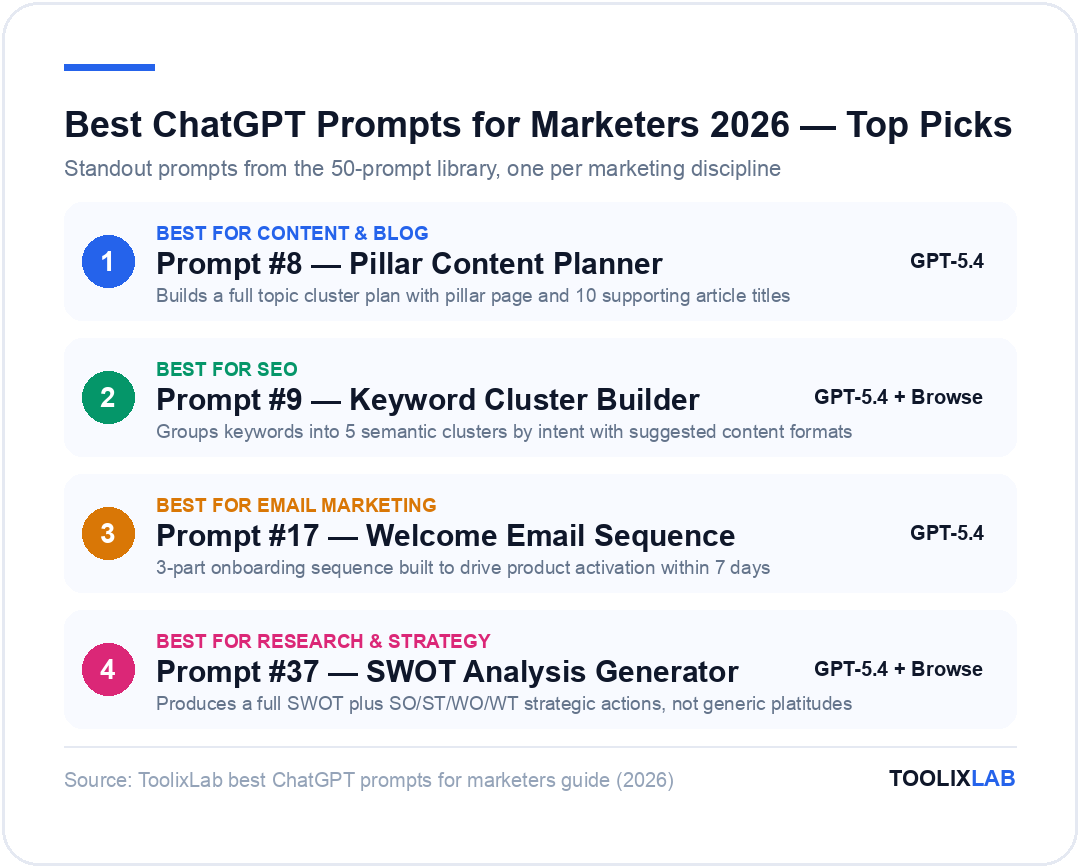
Standout prompts from ToolixLab's 50-prompt marketing prompt library.
The Marketing Prompt Formula: Why Most Prompts Fail
Before diving into the prompts themselves, it's worth understanding why most marketers get underwhelming ChatGPT output. The root cause is almost always the same: the prompt is too short, too vague, or missing critical context. ChatGPT is not a mind reader — it will produce exactly as much useful output as the quality of your input.
Every high-performing marketing prompt includes five elements:
1. A role assignment: Tell ChatGPT who it is. "You are a senior performance marketer with 10 years of experience in B2B SaaS" produces very different output than "write me some marketing copy."
2. Context about your product and audience: Include what you sell, who buys it, and what problem it solves. The more specific, the better.
3. The specific task: Be explicit. Not "write an email" but "write a 3-part welcome sequence for new free-trial users, focused on driving product activation within 7 days."
4. Format instructions: Specify length, structure, tone, and output format. Do you want bullets? A table? 3 variants? JSON? Say it.
5. Constraints and guardrails: What should it avoid? "Don't use corporate jargon." "Avoid making medical claims." "Keep it under 150 characters." These constraints dramatically improve first-draft quality.
💡 Pro Tip
Start every new chat session with a "system prompt" — a paragraph describing your brand, audience, tone of voice, and writing style. Paste it at the top before your actual request. This eliminates the need to re-explain context on every prompt and makes all output more on-brand from the first try.
Part 1: Best ChatGPT Prompts for Content Marketing & Blog Writing
Content creation is where most marketers start with ChatGPT, and for good reason — it dramatically compresses the time from brief to first draft. These prompts cover the full content workflow: ideation, outlines, introductions, repurposing, and conversion-focused copy. They're among the best ChatGPT prompts for marketers who publish at scale.
Prompt #1 — SEO Blog Outline Generator
Best for: Content strategists, SEO writers | Model: GPT-5.4 or o3
You are a senior SEO content strategist. Create a detailed blog post outline for the keyword "[TARGET KEYWORD]". The article should be [WORD COUNT] words and target [AUDIENCE]. Include: (1) an H1 title with the exact keyword, (2) 6-8 H2 sections with descriptive subheadings, (3) 2-3 H3 subsections under the most complex H2s, (4) a "Key Takeaways" bullet list, and (5) 6 FAQ questions based on People Also Ask for this topic. For each H2, write 1-2 sentences describing what the section should cover. Format as a structured markdown outline.
Prompt #2 — Hook & Introduction Writer
Best for: Blog writers, content teams | Model: GPT-5.4
Write 3 alternative introductions (150-200 words each) for a blog post titled "[ARTICLE TITLE]" targeting the keyword "[KEYWORD]". Each introduction should use a different hook style: (1) a surprising statistic, (2) a provocative question, (3) a relatable pain-point scenario. Each intro must include the primary keyword in the first 100 words and end with a clear statement of what the reader will learn. Tone: [conversational/authoritative/technical]. Target reader: [AUDIENCE DESCRIPTION].
Prompt #3 — Content Repurposing Engine
Best for: Content managers, social teams | Model: GPT-5.4
I have a [WORD COUNT]-word blog post about [TOPIC]. Repurpose its key ideas into the following 5 formats: (1) A 280-character tweet thread opener with 3 follow-up tweets, (2) A 1,200-character LinkedIn post with a hook, 3 value points, and a CTA, (3) 5 Instagram caption ideas with relevant hashtags, (4) A 5-bullet email newsletter summary for existing subscribers, (5) A YouTube video script outline (title + 5 talking points + CTA). Here is the blog post content: [PASTE ARTICLE TEXT]
Prompt #4 — Headline Optimizer (10 Variants)
Best for: Editors, PPC teams, A/B testing | Model: GPT-5.4
Generate 10 headline variants for a piece of content about [TOPIC]. For each headline, use a different copywriting formula: curiosity gap, number-based list, "how to" promise, question, benefit-driven, negative angle, authority statement, urgency, controversy, and comparison. Include the keyword "[KEYWORD]" in at least 6 of the 10 headlines. Keep each under 65 characters for SEO. After the 10 headlines, recommend the top 3 for: (a) highest CTR, (b) best for SEO, (c) best for social sharing — and explain why.
Prompt #5 — Product Description Writer
Best for: E-commerce, SaaS marketers | Model: GPT-5.4
You are a conversion copywriter. Write 3 product description variants for [PRODUCT NAME]. Product: [BRIEF DESCRIPTION]. Key features: [LIST 3-5 FEATURES]. Target customer: [AUDIENCE]. Primary pain point it solves: [PAIN POINT]. Each variant should be 80-120 words, lead with a benefit (not a feature), use active voice, and end with a soft CTA. Variant 1: benefit-focused. Variant 2: problem-solution format. Variant 3: social proof angle ("customers who use this say..."). Avoid jargon. Do not start any sentence with "We".
Prompt #6 — Case Study Template Generator
Best for: B2B marketers, demand gen | Model: GPT-5.4
Write a 600-word B2B case study using the following data: Client: [COMPANY TYPE/SIZE]. Challenge they faced: [PROBLEM]. Solution we provided: [SOLUTION SUMMARY]. Results achieved: [KEY METRICS — e.g., 40% increase in leads, 3x ROI]. Timeframe: [DURATION]. Structure it as: (1) 2-sentence executive summary with the headline result, (2) The Challenge section (150w), (3) The Solution section (200w), (4) Results section with bullet-point metrics prominently displayed, (5) A direct quote from the client [use placeholder if needed], (6) CTA: "See how we can do the same for your business." Tone: professional, evidence-led, not promotional.
Prompt #7 — FAQ Content Block Generator
Best for: SEO, product pages | Model: GPT-5.4
Generate 8 FAQ questions and answers for a page about [TOPIC/PRODUCT]. The questions should reflect the real questions people type into Google — use People Also Ask phrasing. Each answer should be 60-100 words, factual, and optimised for featured snippet selection (start with a direct answer to the question, then add supporting detail). Include at least 2 questions that address common objections or doubts. Include the keyword "[PRIMARY KEYWORD]" naturally in at least 3 answers. Format as Q&A pairs ready for structured data markup.
Prompt #8 — Pillar Content Planner
Best for: Content strategists, SEO leads | Model: GPT-5.4 or o3
You are a content strategist. I want to build a topic cluster around the pillar keyword "[PILLAR KEYWORD]". Generate: (1) A recommended title and H1 for the pillar page (3,500-5,000 words), (2) 10 cluster article titles targeting long-tail variants and subtopics of the pillar keyword, (3) For each cluster article: the target keyword, estimated search intent (informational/transactional/navigational), and 3 internal link anchor text suggestions from the cluster article back to the pillar page. Present this as a structured content cluster plan in a table format.
Jasper AI — AI Writing Built for Marketing Teams
Jasper's marketing-specific templates, brand voice memory, and campaign workflows go far beyond what ChatGPT can do out of the box. Ideal for teams producing content at scale.
ChatGPT can dramatically accelerate SEO work — from keyword clustering to meta copy to on-page audits — but only if you prompt it with the right level of precision. These best ChatGPT prompts for marketers cover the full SEO workflow, from initial research to E-E-A-T optimisation.
Prompt #9 — Keyword Cluster Builder
Best for: SEO strategists, content planners | Model: GPT-5.4 with Browse
Generate a keyword cluster for the seed keyword "[SEED KEYWORD]". Group the keywords into 5 semantic clusters based on search intent. For each cluster: (1) name the cluster and state the primary intent (informational, transactional, commercial, navigational), (2) list 8-10 long-tail keyword variants, (3) suggest the best content format to target the cluster (listicle, how-to guide, comparison, landing page, etc.), (4) estimate the content length needed. Output as a structured table with columns: Cluster Name | Intent | Keyword Variant | Suggested Format | Estimated Length.
Prompt #10 — Meta Title & Description Batch Generator
Best for: SEO teams, e-commerce | Model: GPT-5.4
Write 3 meta title variants (55-60 characters each) and 3 meta description variants (150-158 characters each) for a page about [PAGE TOPIC]. Primary keyword: [KEYWORD]. USP: [WHAT MAKES THIS PAGE UNIQUELY VALUABLE]. For meta titles: include the keyword, a power word, and the year. For meta descriptions: include the keyword naturally, a specific value proposition, and a soft CTA ("find out", "see how", "compare now"). Flag which variant is likely to have the highest CTR and why.
Prompt #11 — Long-Tail Keyword Generator for a Niche
Best for: SEO, PPC, content | Model: GPT-5.4
Generate 30 long-tail keyword ideas for a [INDUSTRY/NICHE] business targeting [AUDIENCE]. Include a mix of: (1) question-based keywords (how, what, why, which), (2) comparison keywords ("[product] vs [product]", "best [X] for [use case]"), (3) location-specific variants if relevant, (4) problem-aware keywords describing pain points, (5) solution-aware keywords for buyers closer to conversion. For each keyword, classify the intent (informational/commercial/transactional) and suggest whether it's better suited for a blog post or a landing page.
Prompt #12 — Competitor Content Gap Finder
Best for: SEO strategists | Model: GPT-5.4 with Browse
I'm going to paste the URLs of 3 competitor blog posts that rank in the top 3 for "[TARGET KEYWORD]". Analyse the content of these pages and identify: (1) topics and subtopics all 3 cover (common ground), (2) topics only 1-2 cover (partial gap), (3) angles, examples, or data points none of them address (full content gap), (4) questions from People Also Ask that none of the pages answer well, (5) 3 specific ways I could write a more comprehensive article that outranks all 3. URLs: [URL 1] [URL 2] [URL 3]
Prompt #13 — Internal Linking Anchor Text Suggester
Best for: SEO, editors | Model: GPT-5.4
I have a blog post about [TOPIC A] and I want to add internal links to the following pages on my site: [PAGE 1 TITLE + URL], [PAGE 2 TITLE + URL], [PAGE 3 TITLE + URL]. For each target page, suggest 3 natural anchor text options (not exact-match keyword stuffing) that would fit naturally into a blog post about [TOPIC A]. Also suggest where in the article structure (intro, middle, conclusion) the link placement would be most natural and valuable for the reader. Avoid "click here" or "read more" anchors.
Prompt #14 — Featured Snippet Optimiser
Best for: SEO writers | Model: GPT-5.4
Write a featured snippet-optimised answer for the question "[TARGET QUESTION]". The answer should: (1) start with a direct, 40-60 word definition or answer paragraph that directly addresses the question, (2) follow with a bulleted list of 4-6 items if the question is "how to" or "what are", (3) avoid the phrase "In this article" or "In this post", (4) include the exact question keyword phrase naturally in the first sentence, (5) be factually accurate and written at a reading level suitable for [AUDIENCE]. This answer will be placed under an H2 heading that matches the exact question.
Prompt #15 — Schema Markup Advisor
Best for: Technical SEO, developers | Model: GPT-5.4
I have a blog post about [TOPIC] on [SITE URL]. Recommend the most appropriate schema markup types for this page from schema.org. For each schema type: (1) explain why it applies to this content, (2) list the required and recommended properties, (3) show a minimal valid JSON-LD example I can paste into the page head. Also flag any rich result types this schema could unlock in Google Search (e.g., FAQ rich results, How-To cards, Review stars, etc.). Prioritise the schemas that have the highest potential for SERP visibility improvement.
Prompt #16 — E-E-A-T Content Improver
Best for: SEO writers, content leads | Model: GPT-5.4
Review the following blog post section and suggest specific improvements to strengthen Google's E-E-A-T signals (Experience, Expertise, Authoritativeness, Trustworthiness). For each E-E-A-T dimension, suggest: (1) what's currently missing or weak, (2) a specific rewrite or addition that improves it (e.g., adding first-person experience, citing a specific study, adding a data point, adding a credentials statement). Do not rewrite the entire section — provide targeted improvements with before/after examples. Content: [PASTE SECTION TEXT]
Part 3: Best ChatGPT Prompts for Email Marketing
Email remains one of the highest-ROI marketing channels, and ChatGPT is exceptional at generating first drafts of sequences, subject line variants, and personalised copy. These prompts are optimised for platforms like Mailchimp and ActiveCampaign.
Prompt #17 — Welcome Email Sequence (3-Part)
Best for: Email marketers, SaaS onboarding | Model: GPT-5.4
Write a 3-part welcome email sequence for new subscribers of [BRAND/PRODUCT]. Product: [WHAT IT DOES]. Subscriber's goal: [WHAT THEY SIGNED UP TO ACHIEVE]. Email 1 (sent immediately): warm welcome, confirm what they'll get, one quick win they can act on today. Email 2 (sent Day 3): feature/benefit spotlight — one capability that surprises new users + social proof quote. Email 3 (sent Day 7): soft conversion email — invite them to [DESIRED ACTION: upgrade/book a call/join community]. Each email: subject line, preview text, 200-word body, and clear CTA button text. Tone: friendly, helpful, not salesy.
Prompt #18 — Subject Line Generator (20 Variants)
Best for: Email marketing, A/B testing | Model: GPT-5.4
Generate 20 email subject line variants for an email about [EMAIL TOPIC]. The email goal is [CLICK/OPEN/CONVERSION]. Generate 4 subject lines in each of these 5 styles: (1) curiosity gap, (2) urgency/scarcity, (3) personal/conversational, (4) benefit-driven, (5) number-based. Keep each under 50 characters for mobile. Avoid spam trigger words (free, guaranteed, act now). Flag the top 5 with highest predicted open rate and explain why. Also suggest a preview text (35-50 characters) for each of the top 5.
Prompt #19 — Abandoned Cart Email Sequence
Best for: E-commerce marketers | Model: GPT-5.4
Write a 3-email abandoned cart recovery sequence for [PRODUCT TYPE] with average order value of $[AOV]. Email 1 (1 hour after abandonment): gentle reminder, no discount, highlight product benefit and scarcity ("only X left"). Email 2 (24 hours): address common objections (returns policy, security, social proof). Email 3 (48 hours): final nudge with a [X]% discount or free shipping offer. For each email: subject line, preview text, hero line (bold opening), 150-word body, CTA. Tone: helpful not pushy. Include a placeholder for the customer's first name and the abandoned product name.
Prompt #20 — Newsletter Template Builder
Best for: Newsletter creators, content marketers | Model: GPT-5.4
Create a reusable weekly newsletter template for a [NICHE] audience. The newsletter should have a consistent 5-section structure: (1) "This Week in [NICHE]" — 3 curated news items with 1-sentence commentary, (2) "Deep Dive" — 200-word original insight on [WEEKLY TOPIC], (3) "Tool Spotlight" — 80-word feature on one recommended tool or resource, (4) "Ask the Community" — one discussion question for replies, (5) "One Quick Win" — a single actionable tip. Write one complete example issue on the topic of [TOPIC]. Tone: [BRAND VOICE]. Include subject line and preview text for this issue.
Prompt #21 — Re-engagement Campaign for Cold Subscribers
Best for: Email list management | Model: GPT-5.4
Write a 2-email re-engagement campaign for subscribers who have not opened any emails in the past 90 days. Product/brand: [BRAND]. Email 1: Break the silence — acknowledge the silence humorously, highlight what's changed or new since they last engaged, give them a reason to stay (new content, features, community). Email 2 (sent 5 days later if no open): final notice — tell them they'll be removed, offer an easy opt-down (less frequent emails), and make the keep-or-leave CTA very clear. Each email: subject line, 120-word body, 2 CTA options (stay subscribed / unsubscribe). Tone: honest, human, zero guilt-tripping.
Prompt #22 — Promotional Email with Urgency & Scarcity
Best for: Campaigns, product launches | Model: GPT-5.4
Write a promotional email for [OFFER: sale/launch/event]. Offer details: [WHAT IT IS, DISCOUNT OR VALUE, DEADLINE]. Audience: existing customers vs cold subscribers [SPECIFY]. The email should: open with the most compelling benefit (not the discount itself), build desire before revealing the offer, use social proof (number of users, testimonial, or rating), and create genuine urgency around the deadline. Subject line options: provide 3. CTA button text: provide 3 options. Length: 200 words max. Do not start with "Exciting news" or "We're thrilled to announce." Make the reader feel they're missing out, not being sold to.
Prompt #23 — Transactional Email Humaniser
Best for: E-commerce, SaaS | Model: GPT-5.4
Rewrite the following transactional email to be warmer, more human, and on-brand — without losing any of the required functional information. Original email: [PASTE EMAIL]. Brand voice: [DESCRIBE TONE — e.g., "friendly and direct, like a knowledgeable friend, never corporate"]. Constraints: (1) keep all order/account details exactly as-is, (2) add a single value-reinforcing sentence that reminds the customer why they made a great choice, (3) end with a genuine offer of help (not a generic "contact support"), (4) do not add upsells or discounts — this is a service email, not a sales email.
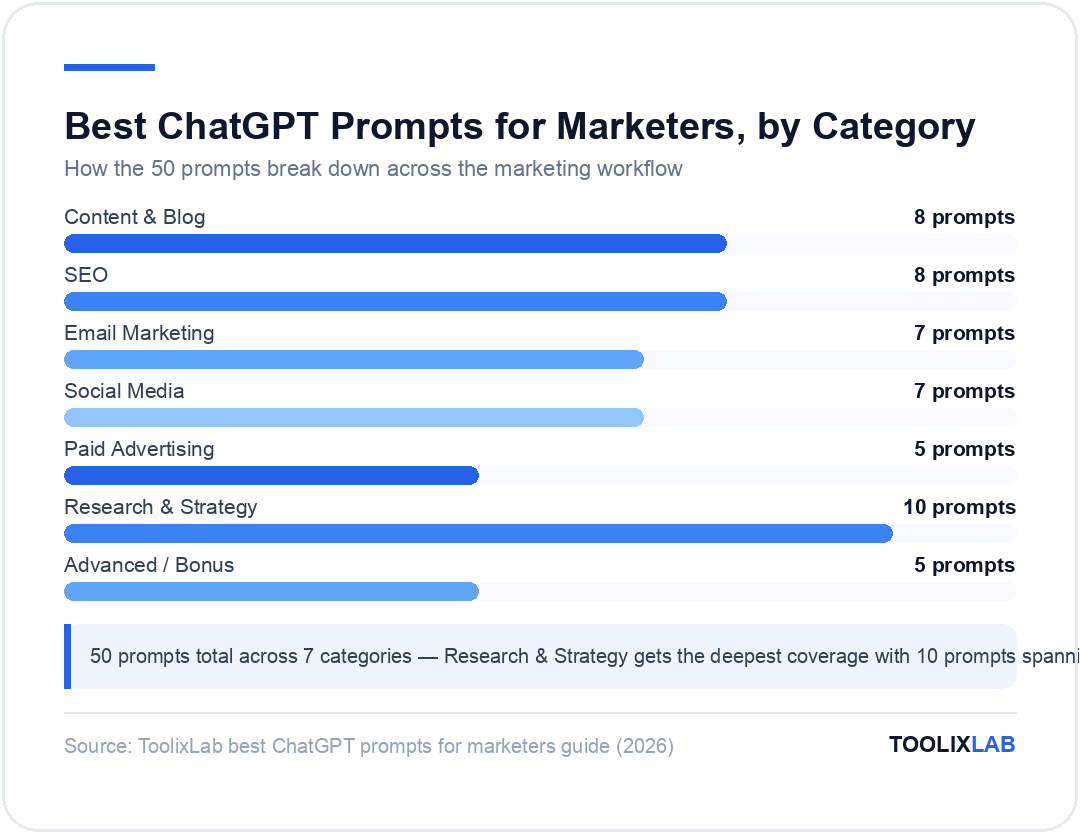
How the 50 marketing prompts break down by category. Source: ToolixLab, 2026.
Part 4: Best ChatGPT Prompts for Social Media Marketing
Social media is where ChatGPT prompt quality varies most dramatically. The best prompts here are platform-specific — what works on LinkedIn is actively wrong for TikTok. These prompts treat each platform as distinct, and are among the best ChatGPT prompts for marketers looking to automate social media with AI without losing authenticity.
Prompt #24 — LinkedIn Thought Leadership Post
Best for: B2B marketers, founders | Model: GPT-5.4
Write a LinkedIn post about [TOPIC/INSIGHT]. My role: [JOB TITLE]. My perspective: [YOUR OPINION OR EXPERIENCE WITH THIS TOPIC]. The post should: open with a scroll-stopping first line (no "I'm excited to share"), share a genuine insight or contrarian take from personal experience, use the "1 line - break - 1 line" LinkedIn formatting style (short punchy sentences with white space), include 3-5 specific, practical points rather than vague advice, end with a question to drive comments. Max 1,300 characters. No hashtags in the body — add 3-5 relevant ones at the very end. Tone: direct, confident, human.
Prompt #25 — Instagram Caption & Hashtag Set
Best for: Social media managers | Model: GPT-5.4
Write 3 Instagram caption variants for a post about [POST TOPIC]. Image/content description: [DESCRIBE VISUAL]. Brand: [BRAND NAME, NICHE, TONE]. Each caption should: (1) hook in the first sentence (displayed before the "more" cut), (2) be 150-250 characters for optimal engagement, (3) end with a CTA (save this, share with a friend, comment below, link in bio). After the 3 captions, provide a hashtag strategy: 5 high-volume hashtags (1M+ posts), 5 medium hashtags (100k-1M), 5 niche hashtags (under 100k). Explain the mix strategy in 1 sentence.
Prompt #26 — Twitter/X Thread Builder
Best for: Founders, marketers with personal brands | Model: GPT-5.4
Write a 10-tweet X (Twitter) thread about [TOPIC]. Thread goal: [EDUCATE/DRIVE CLICKS/BUILD FOLLOWERS]. Tweet 1: a hook that makes someone stop scrolling — use a bold claim, surprising stat, or counter-intuitive statement. Tweets 2-9: one clear point per tweet, building a logical progression. Each tweet max 280 characters. Tweet 10: summary + CTA (follow for more / link to resource / share if useful). Format each tweet numbered (1/, 2/ etc). Include 1-2 relevant emojis per tweet where natural. Do NOT use filler phrases like "let's dive in" or "buckle up".
Prompt #27 — TikTok / Reels Script Generator
Best for: Short-form video creators | Model: GPT-5.4
Write a 60-second TikTok/Reels video script about [TOPIC]. Target audience: [AUDIENCE]. Goal: [EDUCATE/ENTERTAIN/SELL]. Format the script with: (1) Hook (0-3 seconds): a single sentence that creates immediate curiosity or value — this is the first thing seen and heard. (2) Body (4-50 seconds): 4-5 punchy points, each 1-2 sentences. Use pattern interrupts every 10-15 seconds (ask a question, change camera angle cue, show text overlay). (3) CTA (51-60 seconds): one clear action — follow, save, link in bio. Include [B-ROLL] notes and text overlay suggestions in brackets. Write spoken words only, no filler words like "um" or "so".
Prompt #28 — 30-Day Social Media Content Calendar
Best for: Social media managers, agencies | Model: GPT-5.4
Create a 30-day social media content calendar for [BRAND/PRODUCT] targeting [AUDIENCE]. Platforms: [LIST — e.g., LinkedIn, Instagram, X]. Posting frequency: [POSTS PER WEEK PER PLATFORM]. Use a balanced content mix: 40% educational, 25% entertaining/relatable, 20% promotional, 15% user engagement (polls, questions, reposts). For each day, provide: date, platform, content type, post topic (one sentence), and a suggested hook line. Group content around [THEME/CAMPAIGN] for the month. Output as a table: Date | Platform | Type | Topic | Hook. Include 3 "hero" content days with bigger ideas flagged in bold.
Prompt #29 — Viral Hook Generator (15 Variants)
Best for: Content creators, social teams | Model: GPT-5.4
Generate 15 scroll-stopping hook lines for content about [TOPIC]. Audience: [TARGET AUDIENCE]. Use these 5 hook formulas (3 variants each): (1) Contrarian take ("Most people believe X. They're wrong."), (2) Surprising statistic ("[Number]% of [audience] don't know that..."), (3) Relatable pain point ("If you've ever struggled with [problem], this is for you"), (4) Bold promise ("In the next 60 seconds, you'll learn exactly how to [outcome]"), (5) Story opener ("Last [timeframe], I [did something that led to surprising result]"). Each hook must be under 25 words. Flag the top 3 most likely to perform on video (TikTok/Reels) vs written (Twitter/LinkedIn).
Prompt #30 — Community Engagement Post Templates
Best for: Community managers, brand social | Model: GPT-5.4
Generate 10 social media engagement posts for a [NICHE] brand that drive comments, saves, or shares — not just likes. Include: 2 this-or-that polls, 2 fill-in-the-blank prompts, 2 "what's your take?" opinion questions, 2 "spot the mistake" or challenge posts, and 2 community shout-out templates. Each post should feel organic and human — not like a brand trying to game the algorithm. Include the post text and a note on which platform each format works best on. Tone: [BRAND VOICE].
Part 5: Best ChatGPT Prompts for Paid Advertising & PPC
Paid advertising copy requires a different discipline from content writing — every word competes for attention against a cluttered feed or SERP. These prompts are designed for conversion-first copywriting on Google, Meta, and LinkedIn. For a deeper look at AI tools that pair with these workflows, see our guide to the best AI tools for marketing in 2026.
Prompt #31 — Google Ads Responsive Search Ad Generator
Best for: PPC managers, SEM teams | Model: GPT-5.4
Generate RSA (Responsive Search Ad) assets for Google Ads for the keyword "[TARGET KEYWORD]". Product/service: [DESCRIPTION]. Landing page offer: [OFFER]. Provide: 15 headline variants (max 30 characters each), 4 description variants (max 90 characters each). Headline requirements: include exact keyword in at least 3, include a USP in 3, include a CTA in 3, include a number/stat in 2, include brand name in 1. Description requirements: at least 2 must include a specific benefit + CTA. Flag "Pinned" suggestions — which headlines should be pinned to Position 1 or 2 and why. Do not use exclamation marks unless essential.
Prompt #32 — Meta/Facebook Ad Copy Set (3 Angles)
Best for: Social media advertisers | Model: GPT-5.4
Write 3 Facebook/Instagram ad copy variants for [PRODUCT/SERVICE] targeting [AUDIENCE PERSONA]. Each variant should use a different angle: (1) Problem-Agitation-Solution — open with the pain, agitate it, then present the product as the relief, (2) Social Proof — lead with a specific result, customer quote, or usage statistic, (3) Direct Benefit — lead immediately with the #1 outcome the customer gets. For each: primary text (125 words max), headline (40 characters max), CTA button choice from Meta's options. Flag which format is best for cold audiences vs warm retargeting. Avoid "click here", "shop now" at the start, and anything that would trigger Meta's ad policies.
Prompt #33 — A/B Test Ad Copy Generator
Best for: CRO, paid media teams | Model: GPT-5.4
I want to A/B test different elements of this ad: [PASTE CURRENT AD COPY]. Create 4 test variants that isolate one variable per test: Test A: same copy but rewrite the hook/first line only. Test B: same copy but change the CTA (button text and closing line only). Test C: same copy but rewrite to lead with emotion vs the original's rational angle. Test D: same copy but add a specific number, stat, or named social proof element. For each variant, explain the hypothesis being tested and what a positive result would tell us about this audience. This follows the "one variable at a time" testing methodology.
Prompt #34 — Landing Page Headline & CTA Variants
Best for: CRO, growth teams | Model: GPT-5.4
Generate 8 landing page headline variants for [PRODUCT/OFFER] targeting [AUDIENCE]. Current headline: "[CURRENT HEADLINE]". For each variant use a different formula: outcome-focused, time-to-result, risk-removal, social proof, curiosity, question, "before and after", and specificity (include a concrete number). After the headlines, generate 10 CTA button text variants that go beyond "Sign Up" and "Get Started" — be specific about what happens when clicked and the value exchanged. Mark the top 3 headlines and top 3 CTA variants you'd recommend for initial A/B testing, with brief reasoning.
Prompt #35 — Retargeting Ad Copy Generator
Best for: Performance marketers | Model: GPT-5.4
Write retargeting ad copy for people who visited [PAGE/PRODUCT] but did not convert. Product: [PRODUCT NAME AND OFFER]. Write 3 ad variants targeting 3 distinct non-conversion reasons: (1) price objection — acknowledge cost, reframe value, offer incentive, (2) trust/credibility concern — lead with social proof, guarantee, or risk-reversal, (3) timing/didn't get around to it — light urgency, remind them of the benefit they're missing. Each ad: headline (6 words max), body copy (50 words max), and CTA. Make the reader feel remembered, not stalked. Tone: helpful and low-pressure, not desperate.
Part 6: Research, Strategy & Campaign Planning Prompts
The best ChatGPT prompts for marketers doing research and strategy work leverage the model's ability to synthesise large volumes of information, generate structured frameworks, and spot patterns. These prompts are especially powerful when combined with web browsing enabled. For more on building complete AI-powered marketing workflows, see our AI content creation workflow guide.
Prompt #36 — Customer Persona Builder
Best for: Strategists, product marketers | Model: GPT-5.4
Build a detailed B2B/B2C customer persona for a buyer of [PRODUCT/SERVICE]. Use this data about our real customers: [PASTE ANY DATA YOU HAVE — demographics, survey answers, support tickets, reviews]. If data is unavailable for a field, use your knowledge of [INDUSTRY] buyers to fill in plausible details. Persona should include: name and photo description, job title/role, company size (B2B) or lifestyle (B2C), primary goals, top 3 pain points, objections to buying [PRODUCT], content they consume, preferred channels, buying trigger, and decision-making authority. End with: 3 messages that would resonate with this persona and 1 message that would immediately repel them.
Prompt #37 — SWOT Analysis Generator
Best for: Brand strategists, CMOs | Model: GPT-5.4 with Browse
Conduct a SWOT analysis for [BRAND/PRODUCT] competing in the [MARKET] space. Our product: [BRIEF DESCRIPTION]. Top 3 competitors: [LIST THEM]. For each SWOT quadrant, provide 5 specific, concrete points — not generic platitudes like "strong team" or "competitive market." After the SWOT, generate a strategic SO (Strengths + Opportunities) action it supports, a ST (Strengths + Threats) action, a WO (Weaknesses + Opportunities) action, and a WT (Weaknesses + Threats) risk to mitigate. Present as a formatted table, then the strategic actions as bullet points with 1-sentence rationale each.
Best for: Brand strategists, startups | Model: GPT-5.4
Generate 5 positioning statement variants for [BRAND/PRODUCT] using the format: "For [target customer] who [has this need], [Brand] is the [category] that [key benefit] because [reason to believe]." Also generate 5 one-sentence USP statements that could be used as a homepage tagline or elevator pitch — each emphasising a different competitive differentiator. Our key differentiators: [LIST 2-3]. Competitors we need to differentiate from: [COMPETITOR 1, COMPETITOR 2]. Flag the 2 positioning statements and 2 USPs you would recommend testing first, and explain your reasoning.
Prompt #39 — Buyer Objection Handler
Best for: Sales, content, product marketing | Model: GPT-5.4
List the 8 most common objections a potential customer would raise before buying [PRODUCT/SERVICE] at [PRICE POINT]. For each objection: (1) write the exact words a skeptical customer might say, (2) identify the underlying fear or belief driving the objection, (3) write a 3-sentence response that acknowledges the concern, reframes it, and provides evidence (social proof, data, guarantee, or feature) to resolve it. Output format: Objection | Underlying Fear | Response. This will be used to: train a sales team, write FAQ page answers, and brief ad copy to pre-emptively address objections.
Prompt #40 — Campaign Brief Generator
Best for: Marketing managers, agencies | Model: GPT-5.4
Create a one-page campaign brief for a [TYPE: product launch / seasonal sale / brand awareness / lead gen] campaign. Campaign details: [PRODUCT/OFFER], target audience: [AUDIENCE], budget range: [BUDGET], timeline: [START DATE to END DATE], primary KPI: [KPI]. The brief should include: campaign objective (one SMART statement), target audience profile (3 sentences), key message (one sentence), creative territories (3 conceptual directions), channel plan (recommended mix with budget allocation percentages), success metrics (3 KPIs with targets), and a risk/dependency flag. Format as a structured one-pager that could be handed to a creative team on Monday morning.
Prompt #41 — Voice of Customer (VoC) Extractor
Best for: Product marketing, CRO | Model: GPT-5.4
Analyse the following customer reviews/testimonials and extract Voice of Customer insights. Reviews: [PASTE 10-20 REVIEWS OR SUPPORT TICKETS]. Extract and categorise: (1) Most common praise — exact phrases customers use to describe the benefit, (2) Most common complaints or frustrations, (3) Surprising use cases or outcomes customers mention that weren't in the original marketing, (4) Specific words and phrases customers use that should be mirrored in ad copy and web copy, (5) The #1 reason people buy, and the #1 reason people hesitate or churn. Present findings as actionable bullets a copywriter can use immediately.
Prompt #42 — Competitor Messaging Analyser
Best for: Competitive intelligence | Model: GPT-5.4 with Browse
Analyse the homepage messaging of these [NUMBER] competitors: [LIST URLS OR PASTE HEADLINE + SUBHEADLINE from each]. For each competitor: identify their target customer, primary value proposition, tone of voice, and the emotion they're trying to trigger in visitors. Then: (1) identify messaging patterns all competitors share (the category clichés to avoid), (2) identify a positioning gap — an angle, audience segment, or benefit none of them address, (3) suggest 3 ways our brand could differentiate its messaging based on this analysis. Present as a table: Competitor | Target Customer | Core Claim | Tone | Gap Identified.
Prompt #43 — A/B Test Hypothesis Builder
Best for: CRO specialists, growth teams | Model: GPT-5.4
Generate 10 A/B test hypotheses for improving conversion rate on [PAGE TYPE: homepage / product page / checkout / email]. Current conversion rate: [X%]. Known friction points: [LIST ANY YOU'RE AWARE OF]. For each hypothesis follow the format: "We believe that [CHANGING X] for [AUDIENCE SEGMENT] will result in [METRIC CHANGE] because [REASON BASED ON PSYCHOLOGY/DATA/UX PRINCIPLE]." Prioritise hypotheses by effort (Low/Med/High) and potential impact (Low/Med/High). Flag the 3 with the best effort-to-impact ratio as quick wins. Reference relevant CRO principles (Fogg Behaviour Model, friction reduction, social proof, etc.) where applicable.
Prompt #44 — Buyer Journey Content Mapper
Best for: Content and demand gen teams | Model: GPT-5.4
Map a full-funnel content plan for [PRODUCT/SERVICE] targeting [BUYER PERSONA]. Create a content matrix covering 3 funnel stages: Awareness (problem-aware, not solution-aware), Consideration (evaluating options), Decision (ready to buy). For each stage: list the buyer's mental state, top 3 questions they're asking, and recommended content formats (blog post, comparison page, case study, webinar, etc.). Then suggest 2 specific content titles for each stage with their target keyword. Output as a table: Stage | Buyer State | Top Questions | Content Formats | Suggested Titles.
Best for: Marketing managers, analysts | Model: GPT-5.4
Write a post-campaign analysis report structure for a [CAMPAIGN TYPE] campaign that ran from [DATES]. I'll provide the data below. Structure the report as: (1) Executive Summary — 3-bullet performance vs objective, (2) Results by Channel — table comparing planned vs actual KPIs, (3) What Worked — top 3 performing assets/tactics with data, (4) What Didn't Work — honest assessment of underperformers with hypotheses, (5) Audience Insights — what we learned about who responded best, (6) 3 Recommendations for the next campaign based on learnings. Here is the campaign data: [PASTE METRICS]. Write the full report in this structure using the provided data.
Bonus: 5 Advanced ChatGPT Prompts for Marketers (46–50)
These five prompts go beyond standard marketing tasks into higher-level strategic and analytical work — the kind that typically requires a consultant or senior strategist.
Prompt #46 — Marketing Stack Audit
You are a senior martech consultant. Audit our current marketing technology stack: [LIST YOUR TOOLS AND MONTHLY COSTS]. Our team size: [N] people. Primary marketing goals: [GOALS]. For each tool: assess whether it's earning its cost (scale 1-5), flag any capability overlaps, and identify gaps. Recommend: (1) tools to remove or consolidate, (2) tools to replace with a better alternative, (3) tools missing from the stack that would address our goals. Prioritise recommendations by ROI impact. Output as a table then a priority action plan.
Prompt #47 — AI-Assisted Brand Voice Guide
Analyse these 5 pieces of our existing content and define our brand voice: [PASTE 5 SAMPLES — can be social posts, web copy, emails]. From the analysis, create a brand voice guide with: (1) 4 voice attributes (adjectives that describe our tone), (2) For each attribute: what it means in practice, a before/after writing example, and what it does NOT mean (the common mistake), (3) A "Would We Say This?" checklist of 10 example sentences: 5 on-brand, 5 off-brand, (4) A one-paragraph "Writer's Brief" that a freelancer could use to write on-brand content immediately. Format as a one-page PDF-ready document.
Prompt #48 — Influencer Outreach Email Sequence
Write a 2-email influencer outreach sequence for [BRAND] reaching out to [INFLUENCER TIER: micro/macro] influencers in the [NICHE] space. Email 1: cold introduction — personalised opening (include placeholder for specific observation about their content), brand intro, collab offer, and soft CTA (just "are you open to a conversation?"). Email 2 (follow-up if no reply after 5 days): lighter, friendly nudge — 4 sentences max. Both emails must feel like they were written by a human who actually follows the creator, not a mass outreach template. Avoid phrases like "I've been following your content for a while" or "I think there's a great opportunity here." Include a placeholder for their name and channel.
Prompt #49 — Marketing KPI Dashboard Brief
Design a marketing KPI dashboard for a [BUSINESS TYPE] with goals: [PRIMARY GOALS]. The dashboard should have 3 layers: (1) C-Suite View — 5 headline metrics the CEO cares about (revenue impact, pipeline, CAC, LTV, ROI), (2) Marketing Team View — 10 channel-specific performance metrics (broken down by channel: SEO, paid, email, social), (3) Campaign View — real-time metrics for in-flight campaigns. For each metric: define what it is, how it's calculated, what tool to pull it from, and what a "healthy" vs "warning" threshold looks like for our business size. Include recommended reporting cadence (daily/weekly/monthly) for each layer.
Prompt #50 — AI Prompt System for Your Team (Meta-Prompt)
You are a prompt engineering specialist. Help me build a reusable prompt template library for my marketing team of [N] people. We work on: [LIST YOUR TOP 5 MOST FREQUENT MARKETING TASKS]. For each task: (1) write a reusable prompt template with [BRACKETS] for the parts the team should customise each time, (2) include a "context block" at the top the team can save and paste at the start of every session (brand info, tone, audience), (3) rate the prompt by complexity (beginner / intermediate / advanced), (4) flag which ChatGPT model works best for that task (GPT-5.4 for most, o3 for complex reasoning, o1 for coding/analysis). Output as a formatted prompt library document the team can bookmark.
Quick Reference: All 50 Prompts by Category
Category
Prompts
Best Model
Use When
Content & Blog
#1–8
GPT-5.4
Publishing blog content, ideating, repurposing
SEO
#9–16
GPT-5.4 + Browse
Keyword research, meta copy, technical SEO
Email Marketing
#17–23
GPT-5.4
Sequences, subject lines, campaigns
Social Media
#24–30
GPT-5.4
Platform-specific content, calendars, hooks
Paid Advertising
#31–35
GPT-5.4
Google Ads, Meta ads, landing pages, A/B tests
Research & Strategy
#36–45
GPT-5.4 / o3
Personas, SWOT, campaigns, VoC, competitor research
Advanced / Bonus
#46–50
GPT-5.4 / o3
Stack audits, brand voice, KPIs, team prompt libraries
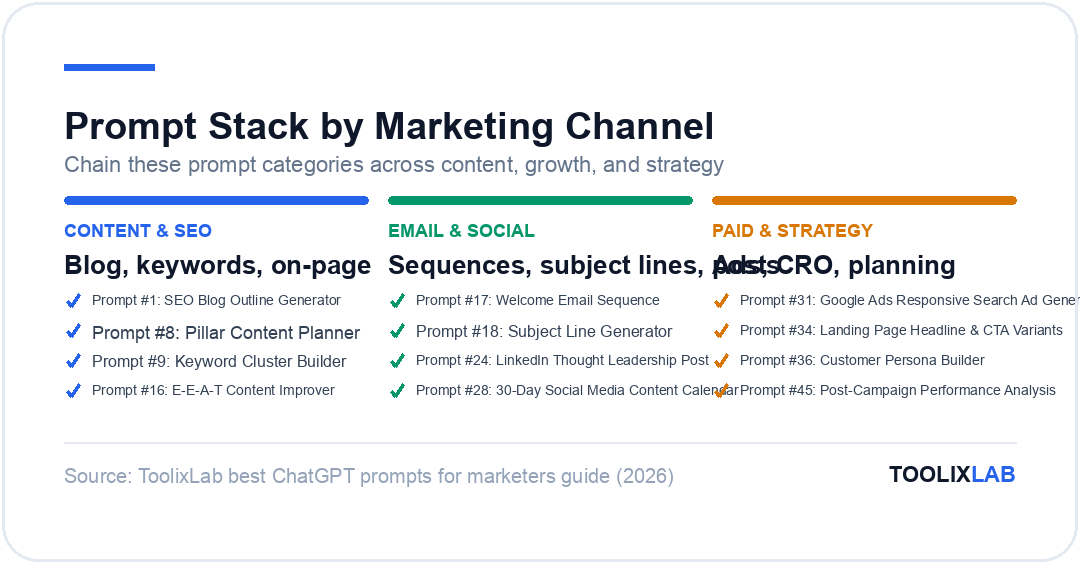
Chain these prompt categories across content, growth, and strategy.
Which ChatGPT Model Should Marketers Use in 2026?
With multiple models available inside ChatGPT, choosing the right one for the task matters for both quality and speed.
GPT-5.4 is the right choice for most marketing work — it's fast, handles nuance well, and manages long-context documents (like pasting an entire blog post) without performance degradation. Use it for all the prompts in this guide unless otherwise specified.
o3 (OpenAI's reasoning model) is genuinely better for strategic analysis — SWOT analyses, campaign brief generation, and competitive intelligence — because it "thinks before it answers." Use it when you need nuanced judgment, not just fast generation.
GPT-5.4 with Browse is essential for any prompt that requires current pricing, recent news, competitor analysis, or real-time data — like Prompts #12 and #42. Without Browse, the model works from training data that may be 6–12 months out of date.
💡 Pro Tip: Use Custom GPTs for Repeated Tasks
If you're running the same prompts regularly — like generating ad copy or weekly blog outlines — build a Custom GPT with your brand context pre-loaded. This eliminates the need to paste your system prompt each time and keeps outputs consistently on-brand. For a full AI-powered content workflow beyond just ChatGPT, see our guide on best AI SEO tools in 2026.
Copy.ai — Marketing Workflows Built Around Prompts
Copy.ai adds structured marketing workflows on top of AI models — so you get repeatable, brand-consistent outputs for email sequences, ad copy, and content without re-writing prompts every time.
✓ The best ChatGPT prompts for marketers always include role assignment, context, task specifics, format instructions, and constraints — vague prompts produce vague output
✓ GPT-5.4 works for most tasks; switch to o3 for complex strategy and reasoning, and enable Browse for any real-time or competitor research task
✓ Prompt #8 (pillar content planner) and Prompt #9 (keyword cluster builder) are the most high-leverage for SEO growth — use them before you write a single article
✓ Email prompts (#17-23) work best when you paste in actual customer data or existing copy for ChatGPT to build from, not when written in a vacuum
✓ Build a "system prompt" block with your brand voice, audience, and product details — paste it at the start of every session to eliminate context-setting repetition
✓ Save your 5-10 most frequently used prompts as Custom GPTs for instant, consistent, on-brand output without prompt engineering every time
What are the best ChatGPT prompts for marketers in 2026?
The best ChatGPT prompts for marketers in 2026 are structured, role-based prompts that include context about your brand, audience, and specific task. The most high-value categories are content creation (blog outlines, repurposing), SEO (keyword clusters, meta copy), email sequences (welcome flows, re-engagement), social media (platform-specific captions and scripts), and campaign strategy (SWOT, persona building, post-campaign analysis). All 50 prompts in this guide are ready to copy and customise.
Which ChatGPT model is best for marketing tasks in 2026?
GPT-5.4 is the best all-round model for most marketing tasks — it handles long-context content, generates copy quickly, and produces high-quality first drafts. Use o3 for complex strategic tasks like SWOT analyses, campaign briefs, and competitive intelligence where deeper reasoning improves output. Enable Browse mode (GPT-5.4 with Browse) for any task requiring current data like competitor pricing, recent news, or real-time SERP research.
How do I write better ChatGPT prompts for marketing?
Every high-performing marketing prompt needs five elements: a role assignment ("You are a senior conversion copywriter"), context about your product and audience, a specific task with clear deliverables, format instructions (length, structure, variants), and constraints (what to avoid). The single biggest improvement most marketers can make is creating a reusable "system prompt" with brand context to paste at the start of every session — this eliminates the need to re-explain your brand on every request.
Can ChatGPT replace a marketing copywriter?
ChatGPT cannot replace a skilled marketing copywriter in 2026 — but it can make one significantly more productive. The model excels at generating structural frameworks, first drafts, variant testing, and routine copy tasks. Where human copywriters still outperform AI is in genuine brand voice consistency, culturally nuanced humour, deeply original creative concepts, and copy that requires real product experience or emotional authenticity. The best marketing teams use ChatGPT to handle first-draft volume while human writers focus on refinement, strategy, and brand-differentiating creative.
Are ChatGPT prompts for marketing better than using Jasper or Copy.ai?
ChatGPT with structured prompts and Jasper/Copy.ai are suited for different workflows. ChatGPT gives maximum flexibility and is best for one-off, custom tasks where you write the prompt each time. Jasper and Copy.ai add marketing-specific templates, brand voice memory, and team collaboration on top of the underlying model — making them more efficient for teams running repeatable workflows at scale. For individual marketers, ChatGPT with well-crafted prompts often outperforms marketed AI tools. For teams needing consistent brand output across multiple users, a dedicated tool adds real value.
How do I use ChatGPT for SEO without getting penalised by Google?
Google's 2025 Helpful Content Update penalises AI content that is generic, unoriginal, or lacks genuine expertise — not AI content per se. The prompts in Part 2 of this guide are designed to produce genuinely useful, specific content rather than filler. Best practices for Google-safe AI-assisted SEO content: add first-person experience and original data, have a subject-matter expert review and edit, include specific examples and real use cases, and ensure the content satisfies search intent better than competitors. AI should be a research and drafting accelerant, not a replacement for genuine expertise.
What is prompt chaining and should marketers use it?
Prompt chaining means using the output of one ChatGPT prompt as the input to the next, creating a multi-step workflow. For marketing, a typical chain might be: Prompt 1 generates a keyword cluster → Prompt 2 creates an article outline for the top keyword → Prompt 3 writes the article introduction → Prompt 4 writes the FAQ section. This produces better results than one massive prompt because each step has a focused task. It's especially powerful for content workflows where quality control between stages matters.
How many of these prompts require a ChatGPT Plus subscription?
All 50 prompts in this guide will work with the free version of ChatGPT using GPT-3.5 or GPT-5.4 (free tier). However, for the best results — especially prompts requiring Browse (Prompts #12, #34, #37, #42) or the o3 reasoning model (complex strategy prompts) — a ChatGPT Plus subscription at $20/month is strongly recommended. The output quality difference between free and Plus is most pronounced on long, complex prompts like the campaign brief generator, persona builder, and competitive analysis prompts.
The ToolixLab Research Team tests and reviews AI tools, automation workflows, and productivity software so you can make informed decisions without wasting time or money.
Comments
Join the discussion and share your thoughts
We Value Your Privacy
We use cookies to enhance your browsing experience, serve personalized ads or content, and analyze our traffic. By clicking "Accept All", you consent to our use of cookies. or read our Privacy Policy.