
Companies using AI for lead generation report 50% more qualified leads at 33% lower cost per acquisition, according to a 2025 McKinsey study on B2B sales transformation. Yet most sales teams still spend 60–70% of their time on manual prospecting, data entry, and follow-up tasks that AI can handle in minutes.
⚡ TL;DR — AI Lead Generation in 2026
- Best for prospecting: Clay.com + Apollo.io
- Best AI lead scoring: HubSpot AI or Salesforce Einstein
- Best for cold outreach: Instantly.ai or Lemlist
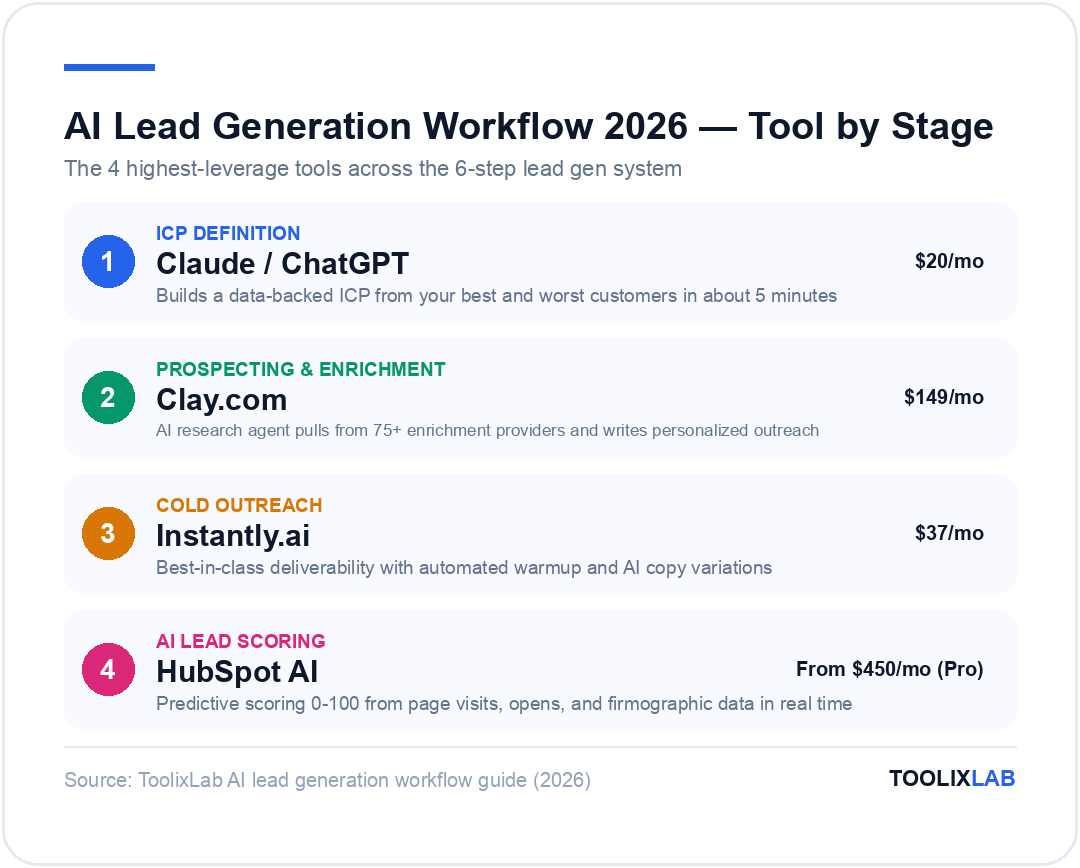
- Best for ICP definition: Claude or ChatGPT (GPT-5.4)
- Best for call intelligence: Gong or Chorus
- Best workflow connector: Clay → CRM → Instantly
- Time to build core system: 1–2 weeks
- Realistic time savings: 8–15 hours/week per rep
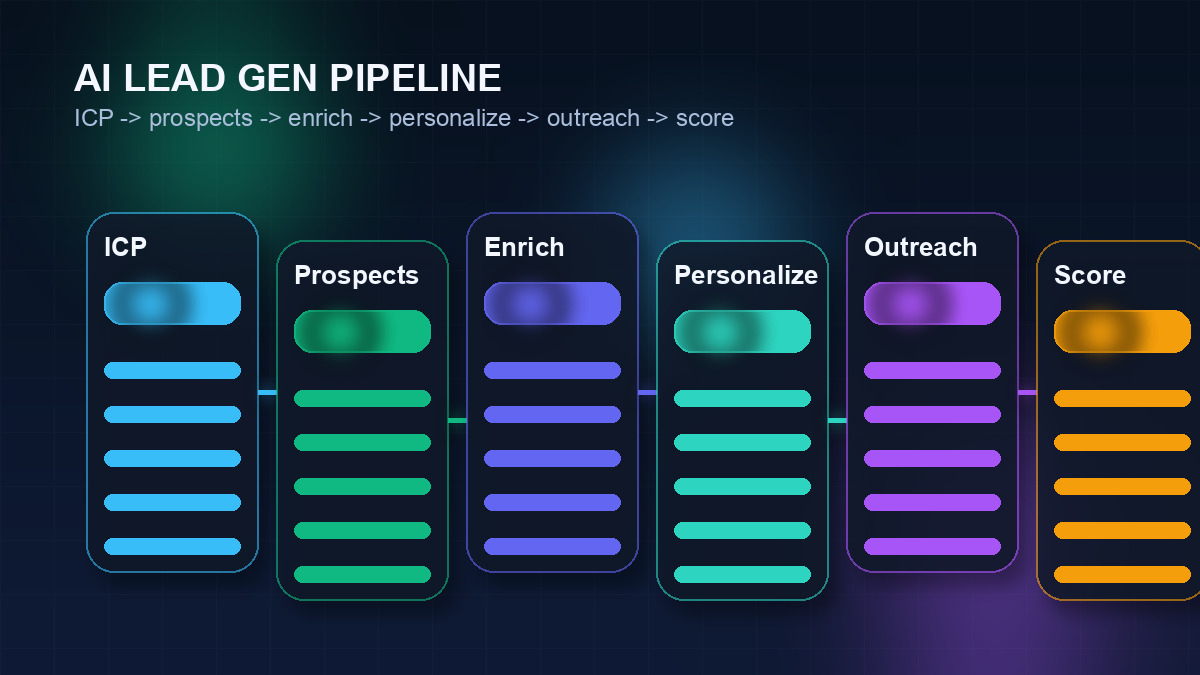
This guide walks you through a complete 6-step AI-powered lead generation system — from defining your ICP and building a prospect list to automated outreach, lead scoring, objection handling, and optimization. Whether you're a solo founder or leading a 20-person sales team, there's a version of this workflow you can implement today.
We'll cover the exact tools to use at each stage, include real prompts you can copy and adapt, and give you a B2B vs B2C stack comparison so you're not paying for tools you don't need.
🔗 Related reading: See our Best AI Tools for Sales for a full toolkit breakdown, and our AI Email Marketing Automation guide to connect your lead gen to a nurture system.
Why AI Is Transforming Lead Generation in 2026
Traditional lead generation has three massive inefficiencies: too much time spent finding the wrong leads, too much money spent on tools that don't talk to each other, and too much human effort on tasks with no strategic value.
In 2026, AI attacks all three problems simultaneously:
| Old Lead Gen (Manual) | AI-Powered Lead Gen (2026) |
|---|---|
| ICP defined by gut feel and job title | ICP defined by behavioral signals, intent data, and firmographic fit scores |
| Manual LinkedIn searches, 50 leads/day | Automated enrichment pipelines, 500–5,000 qualified leads/day |
| One-size-fits-all outreach templates | Hyper-personalized emails generated at scale with AI research |
| Lead scoring based on title + company size | Dynamic ML scoring using 50+ behavioral and firmographic signals |
| Sales reps write 30+ follow-ups per day | AI writes and sends follow-up sequences automatically |
| Monthly reporting from spreadsheets | Real-time attribution with AI-generated optimization recommendations |
The result: sales teams using AI-powered lead gen see a 2–3x increase in pipeline volume with the same headcount. Let's build that system step by step.
Step 1: Define Your Ideal Customer Profile (ICP) with AI
Every lead generation failure traces back to the same root cause: you're targeting the wrong people. Before touching any prospecting tool, you need a data-backed ICP — and AI is remarkable at helping you build one.
What Makes a Great ICP in 2026?
A good ICP goes beyond "VP of Marketing at a 50-person SaaS company." In 2026, a competitive ICP should include:
- ✓Firmographics: Industry, employee count, revenue range, tech stack, funding stage, growth rate
- ✓Psychographics: Pain points, goals, objections, buying triggers, internal pressures
- ✓Behavioral signals: Visited pricing page, downloaded a competitor comparison, attended a webinar
- ✓Negative ICP: Characteristics of companies that churn, never close, or create support burden
The AI-Assisted ICP Prompt
Open Claude or ChatGPT (GPT-5.4) and use this prompt to start building your ICP from your existing customer data:
PROMPT — ICP BUILDER
I run a [product/service] that helps [target market] achieve [outcome]. My 5 best customers are: [paste company names, sizes, industries, roles of buyers]. My 3 worst customers (who churned or were unprofitable) were: [paste details].
Based on this, help me: (1) Define a precise ICP with firmographic and psychographic attributes. (2) Identify 5 buying triggers I should watch for. (3) Create a negative ICP profile. (4) Suggest 3 LinkedIn search filters I should use to find more companies like my best customers.
The output typically takes 5 minutes and produces a document that would have taken a sales team 2–3 weeks to develop manually. Run this quarterly as your customer base evolves.
Validating Your ICP with Intent Data
Pair your AI-defined ICP with intent data from platforms like Bombora or G2 Buyer Intent. When a company matching your ICP is actively researching solutions in your category, they jump to the top of your prospecting list — that combination of fit + intent is the highest-converting segment in B2B sales.
Step 2: AI-Powered Prospecting and Data Enrichment
Once you have a clear ICP, the goal is to build a qualified prospect list at scale. In 2026, the best teams use a layered enrichment stack — not just one data provider.
Clay.com — The AI Prospecting Hub
Clay is the most powerful AI prospecting tool available in 2026. It functions as a "spreadsheet + AI researcher + data aggregator" that pulls from 75+ enrichment providers simultaneously, then uses Claude or GPT-5.4 to research each prospect and write personalized outreach.
A typical Clay workflow:
- Import a seed list — LinkedIn search export, domain list, or Apollo search
- Enrich with firmographics — employee count, revenue, tech stack, recent news, funding rounds
- Run AI research — Clay's AI agent visits each company's website and LinkedIn, extracts custom facts (e.g., "Is this company hiring salespeople?" or "Have they mentioned AI in any recent press releases?")
- Generate personalized first lines — AI writes a unique opening line for each prospect referencing a relevant company fact
- Push to your sequencer — Send enriched, personalized contacts directly to Instantly, Lemlist, or Apollo Sequences
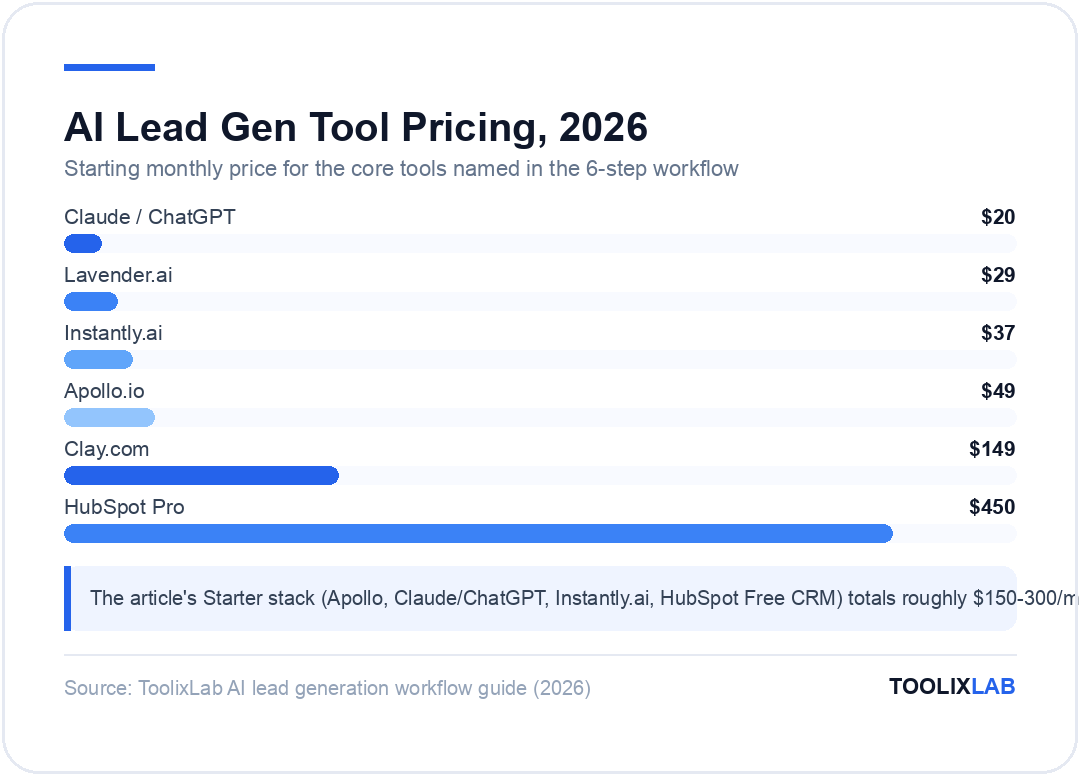
Clay's pricing starts at $149/month for 2,000 "credits" (enrichment actions). A full workflow with AI research typically uses 5–10 credits per contact, giving you 200–400 fully researched prospects per month at that tier.
Apollo.io — Prospecting + Outreach in One
Apollo.io is the most complete all-in-one solution: a database of 275+ million contacts, built-in email sequencing, call dialing, and AI writing tools. For teams that want a single platform rather than a multi-tool stack, Apollo is the best starting point.
Key AI features in 2026:
- AI Email Writer: Generates personalized sequences based on prospect data and your product description
- AI Lead Scoring: Scores every contact on fit and engagement likelihood
- Job Change Alerts: Notifies you when a contact moves to a new company — a top buying trigger
- Intent Data: Identifies contacts actively researching your category right now
Clearbit / Breeze Intelligence — Website Visitor De-Anonymization
Clearbit (now rebranded as Breeze Intelligence after being acquired by HubSpot) de-anonymizes your website traffic — it identifies which companies are visiting your site, what pages they viewed, and how many employees from that company came.
This is lead generation gold: these are companies already aware of you. Plug website visitor data into Clay for enrichment, score them against your ICP, and add them to a warm outreach sequence. Conversion rates from warm website visitors are typically 3–5x higher than cold outreach.
LinkedIn Sales Navigator + AI
Sales Navigator's AI-assisted account recommendations and "people also viewed" signals remain powerful in 2026. The key upgrade is pairing it with Clay or Phantom Buster to export searches and enrich them automatically, rather than doing manual outreach from within LinkedIn itself (which is slower and more restrictive).
💡 Pro tip: The best prospecting stack in 2026 is Apollo (find) → Clay (enrich + research) → Instantly (send). Apollo gives you the volume, Clay gives you the personalization signal, Instantly gets deliverability right. This three-tool stack can generate 50–200 qualified, personalized outreach emails per day.
Step 3: AI Lead Scoring That Actually Works
Not all leads deserve the same follow-up speed or effort. AI lead scoring lets you automatically rank every inbound and outbound lead so your team focuses on the 20% that drives 80% of revenue.
Traditional Scoring vs AI Scoring
| Traditional Lead Scoring | AI Lead Scoring (2026) |
|---|---|
| Static rules (title = VP? +20 points) | Dynamic ML model trained on your historical closed deals |
| 5–10 scoring attributes | 50+ attributes including behavioral, firmographic, and intent signals |
| Updated quarterly by a human | Updates automatically as new closed/lost data comes in |
| Treats all buyers at a company the same | Account-level intent + contact-level engagement scoring combined |
| Accuracy: ~60% | Accuracy: 80–90% (when trained on 500+ deals) |
Best AI Lead Scoring Tools in 2026
HubSpot AI Predictive Lead Scoring (available on Pro and Enterprise) analyzes every contact's behavior — pages visited, emails opened, forms filled, time on site — alongside firmographic data to produce a score from 0–100. The model updates in real time as contacts engage.
Salesforce Einstein Lead Scoring is the enterprise standard, using your historical CRM data to train a model specific to your sales motion. It works best with 1,000+ closed deals in your CRM — the more data, the better the predictions.
Apollo.io's built-in scoring is a good starting point if you're not yet on HubSpot or Salesforce. It's less customizable but requires zero setup and gives every contact a basic fit score out of the box.
Setting Up Score-Triggered Workflows
The real value of AI lead scoring is what happens after scoring. Build these three automated triggers:
- →Score 80+: Immediate SDR notification + task created + moved to hot sequence with 24-hour follow-up cadence
- →Score 50–79: Added to standard nurture sequence, SDR follows up within 48–72 hours
- →Score below 50: Stays in long-term nurture drip (monthly check-in) until score increases
Step 4: Automated Outreach Sequences with AI
This is where most teams either win big or waste their entire pipeline. AI-powered outreach is not about sending more emails — it's about sending relevant emails faster than any human team could manually.
The Anatomy of a High-Converting AI Outreach Sequence
A standard B2B cold outreach sequence in 2026 looks like this:
| Touch | Day | Channel | AI Role |
|---|---|---|---|
| Touch 1 | Day 1 | AI writes personalized first line referencing a company fact (recent hiring, tech stack, news) | |
| Touch 2 | Day 3 | LinkedIn connect | AI generates a connection note referencing shared industry context |
| Touch 3 | Day 7 | Email (follow-up) | AI writes a short value add (relevant case study or stat) based on their industry |
| Touch 4 | Day 14 | LinkedIn DM | Short, direct message with a soft ask (15-min call or demo link) |
| Touch 5 | Day 21 | Email (breakup) | AI writes a "last touch" email designed to elicit a response even if answer is no |
The AI Outreach Prompt That Works
Use this prompt in Claude or ChatGPT to generate the email copy for each touch point in your sequence:
PROMPT — COLD EMAIL GENERATOR
Write a cold email (under 100 words) from [my name] at [company] to [prospect name], [title] at [company name].
Context about their company: [paste 2–3 facts from Clay enrichment — e.g., "Series B SaaS, recently hired 3 SDRs, uses Salesforce and HubSpot"]
My product: [one sentence on what you do and for whom]
My goal: book a 15-minute discovery call
Tone: conversational, direct, no buzzwords, no "hope this finds you well"
End with a specific CTA — either a question or a Calendly link.
Best Outreach Automation Tools
Instantly.ai — Best-in-class for cold email deliverability. Handles unlimited sending accounts, automated email warmup, and AI-generated copy variations. Used by agencies that send millions of emails per month.
Lemlist — Strongest for multichannel sequences that combine email + LinkedIn + voice. Its AI writing assistant generates full sequences from a single prompt.
Apollo.io Sequences — Best if you want everything in one platform. Less flexible than Instantly for high-volume cold sending but sufficient for most teams under 1,000 contacts/month.
Smartlead.ai — A strong Instantly alternative with better AI personalization features built in natively, including variable enrichment from LinkedIn.
⚠️ Deliverability warning: AI-generated outreach at scale can destroy your domain reputation if done wrong. Always use dedicated sending domains (not your primary domain), warm up new inboxes for 2–3 weeks before sending, keep send volume under 50 emails/day per inbox initially, and monitor bounce rates closely. Tools like Instantly handle most of this automatically.
Step 5: AI for Objection Handling and Follow-Up
Getting a reply is only the first milestone. Converting that reply into a booked meeting — and converting that meeting into a closed deal — requires handling objections in real time. AI is now embedded in every step of this process.
Real-Time Email Reply Assistance
When a prospect replies with "we're not interested right now" or "we already use [competitor]," AI can suggest the best response in seconds. Tools like Lavender.ai sit inside Gmail and score your reply for clarity, tone, and effectiveness — then suggest improvements before you hit send.
Use this prompt to prepare objection-handling templates for your most common objections:
PROMPT — OBJECTION HANDLING TEMPLATES
I sell [product] to [target market]. Generate email reply templates for these 5 common objections:
1. "We're happy with our current solution" ([competitor name])
2. "Not the right time — check back in 6 months"
3. "We don't have the budget right now"
4. "I need to get buy-in from [executive/board]"
5. "Send me more information" (the non-committal reply)
Each reply should be under 80 words, acknowledge their concern genuinely, and reframe with a specific question or mini-offer to keep the conversation going.
Call Intelligence with Gong and Chorus
Gong and Chorus (by ZoomInfo) record and transcribe every sales call, then use AI to identify deal risks, talk/listen ratios, competitor mentions, and which topics correlate with won vs lost deals. The AI surfaces coaching recommendations after every call, suggesting what to do differently in the next conversation.
Teams using Gong report a 20–30% improvement in win rates within 90 days of adoption, primarily because reps stop repeating the same mistakes and start replicating the behaviors of top performers.
AI-Powered Meeting Preparation
Before every discovery call, use this prompt to prepare a personalized research brief:
PROMPT — PRE-CALL RESEARCH BRIEF
I have a discovery call tomorrow with [name], [title] at [company]. Research this company and give me:
1. A 3-sentence company overview (what they do, size, recent news)
2. Their likely pain points related to [your product category]
3. 5 discovery questions tailored to their situation
4. One genuine compliment or observation I can open with
5. Any red flags or risks in this deal based on what you know about this type of company
Step 6: Reporting, Optimization, and Attribution
An AI lead generation system that you don't measure and optimize will decay quickly. The final step is building a feedback loop that continuously improves every stage of the funnel.
The Metrics That Actually Matter
Don't track everything — track the metrics that have the highest leverage on revenue:
- ICP match rate: % of leads generated that match your ICP — should be 70%+ to avoid wasting outreach budget
- Reply rate by persona: Which ICP segments respond best to which outreach angles
- Meeting-to-close rate: If this is low, the problem is in discovery/qualification, not top-of-funnel
- Lead source attribution: Which channels and tools drive the most closed revenue (not just the most leads)
- Time from first touch to booked meeting: AI sequences should cut this significantly vs manual follow-up
AI-Generated Optimization Recommendations
Most CRM platforms now include AI-powered analytics that surface recommendations automatically. HubSpot's "Conversation Intelligence" identifies which call topics and email phrases correlate with deals that close. Salesforce Einstein Analytics flags pipeline deals that are at risk based on engagement patterns.
For teams not on enterprise CRM, export your sequence performance data into a spreadsheet and use this prompt monthly:
PROMPT — MONTHLY PIPELINE ANALYSIS
Here is my lead generation data for [month]: [paste table with sequences, reply rates, meeting rates, close rates by source].
Analyze this and give me: (1) The top 3 highest-performing channels or segments, (2) The 2 weakest areas dragging down overall conversion, (3) Three specific A/B tests I should run next month to improve performance, (4) An estimate of the revenue impact if I double down on the top channel.
B2B vs B2C AI Lead Gen Stack
The tools and tactics you use depend heavily on whether you're selling to businesses or consumers. Here's how the stacks differ:
| Stage | B2B Stack (2026) | B2C Stack (2026) |
|---|---|---|
| Prospecting | Apollo.io, Clay, LinkedIn Sales Nav | Meta Ads AI targeting, Google AI campaigns, TikTok Spark Ads |
| Enrichment | Clay, Clearbit/Breeze, Bombora intent | Klaviyo AI profiles, segment behavioral data |
| Lead Scoring | HubSpot AI or Salesforce Einstein | Klaviyo predictive CLV + churn scoring |
| Outreach | Instantly.ai, Lemlist, Apollo Sequences | Klaviyo/ActiveCampaign flows, SMS (Attentive, Postscript) |
| Objection Handling | Gong, Chorus, Lavender.ai | Intercom AI chatbot, Drift, Zendesk AI |
| Analytics | HubSpot, Salesforce, Gong Analytics | Klaviyo analytics, Google Analytics 4, Triple Whale (e-com) |
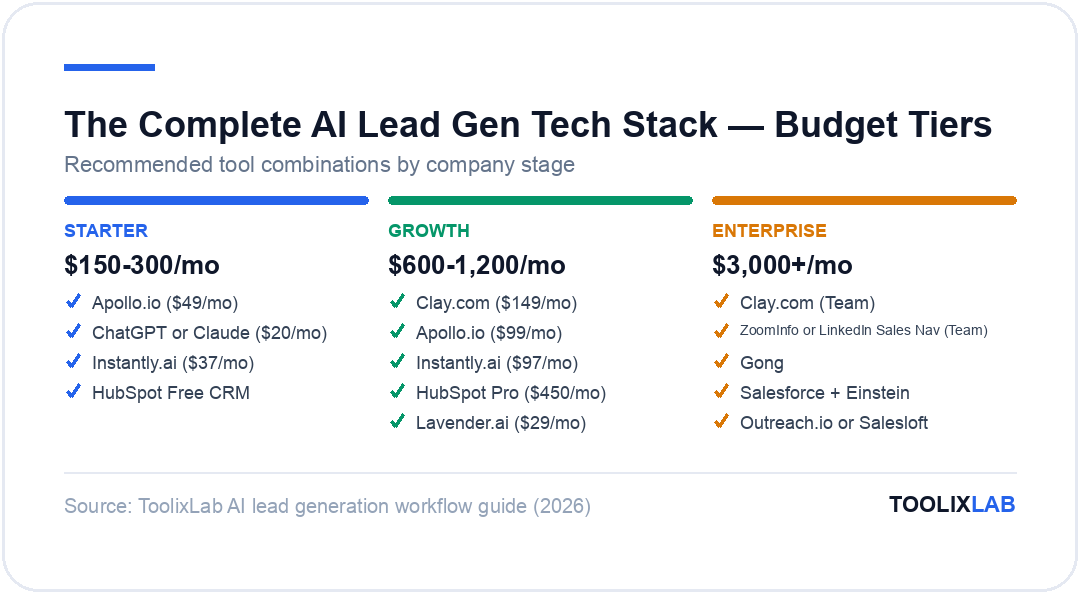
The Complete AI Lead Gen Tech Stack — Budget Tiers
Here's how to build your AI lead gen stack based on your current stage:
- ✓ Apollo.io ($49/mo) — prospecting + sequences
- ✓ ChatGPT or Claude ($20/mo) — ICP + copy
- ✓ Instantly.ai ($37/mo) — email sending
- ✓ HubSpot Free CRM — pipeline tracking
- ✓ Clay.com ($149/mo) — enrichment + AI research
- ✓ Apollo.io ($99/mo) — database + sequences
- ✓ Instantly.ai ($97/mo) — high-volume sending
- ✓ HubSpot Pro ($450/mo) — AI scoring + CRM
- ✓ Lavender.ai ($29/mo) — email optimization
- ✓ Clay.com (Team) — full enrichment pipeline
- ✓ ZoomInfo or LinkedIn Sales Nav (Team)
- ✓ Gong — call intelligence + coaching
- ✓ Salesforce + Einstein — AI scoring
- ✓ Outreach.io or Salesloft — sequences
Common AI Lead Gen Mistakes to Avoid
Teams that fail with AI lead generation usually make one of these mistakes:
1. Building the tech stack before the ICP. No amount of enrichment or outreach automation matters if you're targeting the wrong people. Define and validate your ICP first — everything else is downstream of this.
2. Sending volume before warming up domains. Starting with 200 emails/day from a fresh domain will get you blacklisted within a week. Start slow, build reputation, then scale.
3. Treating AI copy as final. AI-generated email copy is a starting point, not a finished product. Always review for accuracy (AI can hallucinate company-specific "facts"), brand voice alignment, and natural-sounding language. The goal is a draft in 30 seconds, not a template that goes out untouched.
4. Over-automating the first response. The highest-value moment in a sequence is when a prospect replies. Don't automate this response — have a human reply within minutes. Response time to inbound replies is one of the strongest predictors of conversion.
5. Ignoring attribution. If you don't know which channel, persona, or sequence is generating revenue (not just leads), you can't optimize. Track source-to-close attribution from day one, even if manually in a spreadsheet at first.
Related Reading
Getting Started: Your First 30 Days
Building an AI lead gen system can feel overwhelming. Here's a realistic 30-day implementation plan:
Week 1 — Foundation: Define your ICP using the AI prompt above. Set up your tech stack (start with Apollo + Instantly + HubSpot Free). Set up 3 sending domains and begin warm-up.
Week 2 — Build: Build your first prospect list using Apollo filters based on your ICP. Run enrichment (manual or via Clay if budget allows). Write 3 email sequence templates using the prompts above.
Week 3 — Launch: Launch your first sequence to 50–100 carefully selected prospects. Track reply rate daily. Don't automate replies — respond to every reply personally within the hour.
Week 4 — Optimize: Analyze what's working. Which subject lines get opens? Which email angles get replies? Which prospect profiles respond best? Double down on what's working, pause what isn't.
By the end of week 4, you'll have real data to guide your optimization decisions — and a system that gets measurably better every cycle.
The competitive advantage in 2026 isn't having access to AI tools — everyone does. It's building a system where AI amplifies your team's strategic judgment rather than replacing it. The companies that win at AI lead generation are the ones that use AI to do the repetitive work faster, so humans can focus on the conversations that actually close deals.