
HubSpot has been a CRM and marketing automation staple for over a decade — but in 2026, the real question is whether its AI layer, called Breeze, is genuinely useful or just a marketing rebrand of ChatGPT wrapped in an expensive subscription. We spent weeks stress-testing HubSpot's AI features across marketing, sales, and customer service to give you an honest verdict.
⚡ TL;DR — HubSpot AI Review 2026
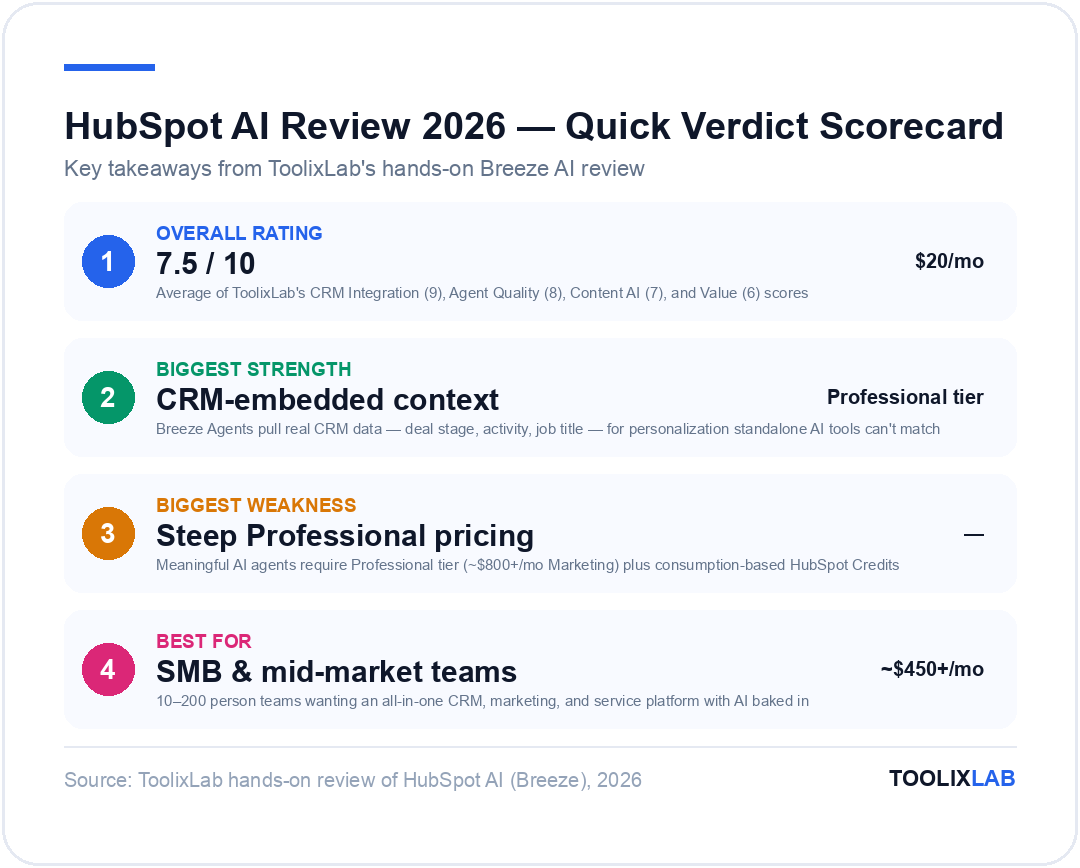
- ✦Best for: SMBs and mid-market teams wanting an all-in-one CRM with AI built in — not just bolted on
- ✦AI suite: Breeze — includes Breeze Assistant, Breeze Agents, and Breeze Intelligence (data enrichment)
- ✦Standout features: Prospecting Agent, Customer Agent, predictive lead scoring, AI email writer
- ✦Free CRM always available; AI agents require Professional or Enterprise tier + HubSpot Credits
- ✦Professional plans start high (~$800+/mo for Marketing Hub) — not cheap for small teams
- ✦AI quality is solid but not best-in-class for pure content generation vs. Jasper or Claude
- ✦Where HubSpot wins: AI deeply embedded in CRM data — context-aware in a way standalone AI tools can't match
- ✦Verdict: Best AI CRM on the market. Worth it if you need the whole platform — overkill if you just want AI writing.
What Is HubSpot AI (Breeze)? A 2026 Overview
HubSpot launched its unified AI strategy under the brand name Breeze in late 2024, consolidating its scattered AI features into a coherent product suite. Before Breeze, HubSpot had individual AI features sprinkled throughout — an AI email writer here, a content assistant there — but they didn't feel connected. Breeze changed that by creating a single umbrella for everything AI inside HubSpot.
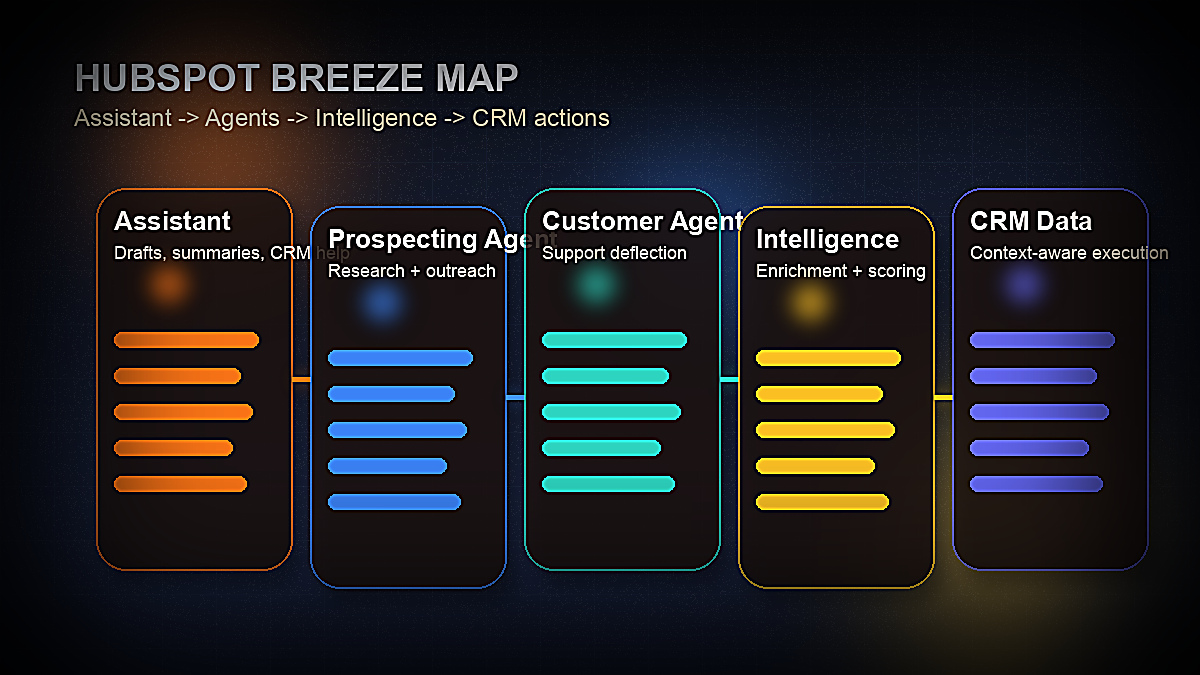
In 2026, Breeze consists of three core components that work together across the Marketing Hub, Sales Hub, and Service Hub:
- →Breeze Assistant — An AI companion embedded throughout the HubSpot platform. Unlike a generic chatbot, it understands your role, has access to your CRM data, and can act on context. It surfaces in the sidebar of most HubSpot screens, ready to draft content, summarize records, or pull insights from your contact database.
- →Breeze Agents — Autonomous AI teammates designed to handle specific, high-volume tasks without constant human oversight. These are the most powerful and differentiated part of HubSpot's AI story in 2026. Available agents include the Customer Agent, Prospecting Agent, Company Research Agent, Data Agent, and Customer Health Agent.
- →Breeze Intelligence — AI-powered data enrichment that automatically fills in missing company and contact details in your CRM. This sits in the background, continuously improving your data quality using web sources and HubSpot's proprietary business database.
On top of these three pillars, HubSpot has embedded AI into over 100 individual features across the platform — AI Blog Writer, AI Email Writer, Content Remix, Website Generator, Conversation Intelligence for call analysis, and predictive lead scoring built directly into the CRM pipeline view. If you're evaluating the best AI tools for marketing, HubSpot's depth of integration is hard to match from standalone tools.
The critical insight about Breeze that separates HubSpot from pure AI tools: its AI is context-aware at a CRM level. When the Prospecting Agent drafts an outreach email, it can pull the prospect's job title, company size, recent activity on your site, and their position in the funnel to personalize at a level that a standalone AI writing tool simply cannot achieve without the same data access. This is HubSpot's structural advantage — and it's why the platform makes more sense for growing teams than buying a separate CRM and a separate AI writing tool.
Breeze Agents: The Most Powerful Part of HubSpot AI
Breeze Agents are what makes HubSpot's AI story truly interesting in 2026. Rather than an AI assistant you have to prompt manually each time, these are autonomous agents that can handle entire workflow streams with minimal human involvement. Here's what each one does and how useful it actually is in practice:
Prospecting Agent
This is the standout agent for sales teams. The Prospecting Agent monitors your target accounts, automatically identifies new contacts that match your Ideal Customer Profile, researches them using web data and HubSpot's business database, and drafts personalized outreach sequences — including emails, call scripts, and LinkedIn message suggestions.
What separates this from a generic AI lead generation workflow is the CRM integration. The Prospecting Agent knows which accounts your reps are already working, which deals are in which stages, and what outreach has already been sent — so it doesn't suggest reaching out to a prospect your VP of Sales called yesterday. This context-awareness is genuinely valuable and reduces the awkward coordination issues you get when AI tools operate outside your CRM.
In our testing, the Prospecting Agent drafted outreach sequences that required 40–50% less editing than raw AI-generated copy, specifically because the personalization tokens pulled from CRM data were accurate and contextually relevant. It is available on Sales Hub Professional and Enterprise plans and consumes HubSpot Credits per contact researched.
Customer Agent
The Customer Agent is HubSpot's answer to the always-on support bot. It can resolve customer inquiries 24/7 by drawing on your knowledge base articles, past ticket resolutions, and product documentation. Unlike simple FAQ chatbots, it handles multi-turn conversations and escalates to human agents when it detects frustration, complexity, or revenue risk — a behavior rule you configure during setup.
For teams building an AI customer support system, the Customer Agent is compelling because it learns from your actual resolved tickets rather than being a generic GPT wrapper. Over time, its resolution rate improves as you feed it more product-specific knowledge. In practice, teams report 30–60% deflection rates for Tier 1 support questions within the first month of deployment — your results will vary significantly depending on how comprehensive your knowledge base is at the start.
Content Agent
The Content Agent handles multi-step content creation tasks: blog posts, landing pages, case studies, and social media copy. What distinguishes it from using Claude or ChatGPT directly is that it can reference your existing HubSpot content library, apply your brand voice settings, and publish directly to your CMS without copy-pasting. For marketing teams managing high content volume, the reduction in context-switching is a real time saver.
The output quality is good — better than what you'd get from a poorly-prompted generic AI, but not better than a skilled human working with a top-tier AI model and a strong brief. If you're comparing content AI specifically, check out our Jasper AI review — Jasper has a stronger content-only story with its Brand Voice feature. HubSpot's Content Agent wins on workflow integration; Jasper wins on output polish.
Data Agent and Company Research Agent
The Data Agent lets non-technical team members query their CRM data in plain English. Instead of building reports in HubSpot's report builder, you can ask "Which deals closed above $50K in Q1 where the rep made fewer than 5 touches?" and get an answer. For sales managers, this removes a significant barrier to data-driven decision-making — you no longer need a RevOps person to pull every ad-hoc report.
The Company Research Agent (currently in Beta) automatically generates company briefings for accounts in your CRM using public web data — pulling recent news, funding rounds, headcount changes, and product launches to give reps context before calls. In early testing, the quality of research is strong for well-documented companies but thin for smaller private firms with limited web presence.
HubSpot AI for Sales: Lead Scoring, Deal Intelligence & Pipeline AI
Beyond the Prospecting Agent, HubSpot has deeply embedded AI across the Sales Hub in ways that compound into meaningful time savings for reps and managers:
Predictive Lead Scoring
HubSpot's AI lead scoring model trains on your historical closed-won and closed-lost deals, building a predictive model that scores every lead on likelihood to convert. Unlike manual scoring rules (which require a RevOps team to maintain), predictive scoring updates automatically as your conversion patterns evolve. Each score is accompanied by the top factors driving it — "high engagement with pricing page," "company size matches ICP," "role matches typical buyer" — making it actionable rather than a black box.
For teams building an AI sales funnel workflow, lead scoring is one of the highest-ROI starting points. Reps who prioritize scored leads report 20–35% improvements in conversion rates compared to treating all leads equally — not because the AI is magic, but because it consistently surfaces the right contacts at the right time.
Conversation Intelligence
HubSpot's Conversation Intelligence transcribes and analyzes sales calls, flagging key moments — objections raised, competitors mentioned, pricing discussions, next steps committed to — and surfacing them directly in the deal record. Managers can review call quality across the team without listening to recordings, and reps get automatic call summaries with follow-up task suggestions pushed to their CRM immediately after a call ends.
This is not unique to HubSpot — Gong and Chorus have deeper conversation intelligence features specifically — but HubSpot's version is tightly integrated with the CRM, so there's no data sync to manage. For teams already on HubSpot, it's a significant upgrade over manual call logging with minimal setup friction.
Deal Intelligence & Forecast AI
HubSpot's AI forecasting analyzes deal velocity, engagement signals, and historical close patterns to generate pipeline predictions with confidence intervals. Instead of managers interrogating reps about deal health, the AI flags deals that are at risk based on inactivity, stalled stages, or missing next steps. This surfaces problems early enough to intervene — rather than discovering a missed quarter at the end of the month.
For sales teams evaluating the best AI tools, HubSpot's deal intelligence is most valuable when your CRM data is clean and consistently updated — garbage in, garbage out applies more here than anywhere else in the platform. Teams with strong CRM hygiene see the forecasting accuracy improve meaningfully within 6 months of training data.
HubSpot AI for Marketing: Content, SEO & Automation
HubSpot's Marketing Hub has accumulated over 100 AI-powered features in 2026. Here are the ones that actually move the needle for marketing teams:
AI Blog Writer and Content Remix
The AI Blog Writer in HubSpot's CMS generates long-form article drafts from a topic or keyword. In practice, it produces solid first drafts that need significant human editing for accuracy and depth — better than staring at a blank page, but not a replacement for human writers. Content Remix is more interesting: it takes an existing piece of long-form content (a webinar recording, a whitepaper, a blog post) and automatically generates social media posts, email copy, and short-form summaries adapted for each channel. For marketing teams repurposing content, this is a genuine time saver.
AI Email Writer & Subject Line Optimizer
The AI Email Writer drafts marketing emails from a brief — audience, goal, offer — and the subject line optimizer suggests alternatives ranked by predicted open rate based on HubSpot's performance data across its customer base. The subject line tool is particularly useful: rather than generic suggestions, it draws on actual benchmark data from HubSpot's massive email send volume to rank options by historical open rate patterns for your industry and audience size.
SEO Recommendations
HubSpot's content strategy tool uses AI to suggest topic clusters, identify content gaps, and score your pages for SEO optimization. It's not as deep as dedicated AI SEO tools like Surfer SEO or Clearscope, but for teams already in the HubSpot ecosystem who don't want to pay for a separate SEO tool, it provides enough guidance to inform a solid content calendar without adding another subscription.
Smart Sequences & Workflow AI
HubSpot's workflow builder now includes AI-powered sequence suggestions — given a contact's behavior and lifecycle stage, it recommends the next best action and can draft the communication for it. Smart Send Time optimization analyzes each contact's historical email engagement to schedule sends at the moment they're most likely to open. These small optimizations compound significantly over a large contact database — a 5% improvement in open rate across 100,000 monthly sends is meaningful.
HubSpot Pricing 2026: What Does It Actually Cost?
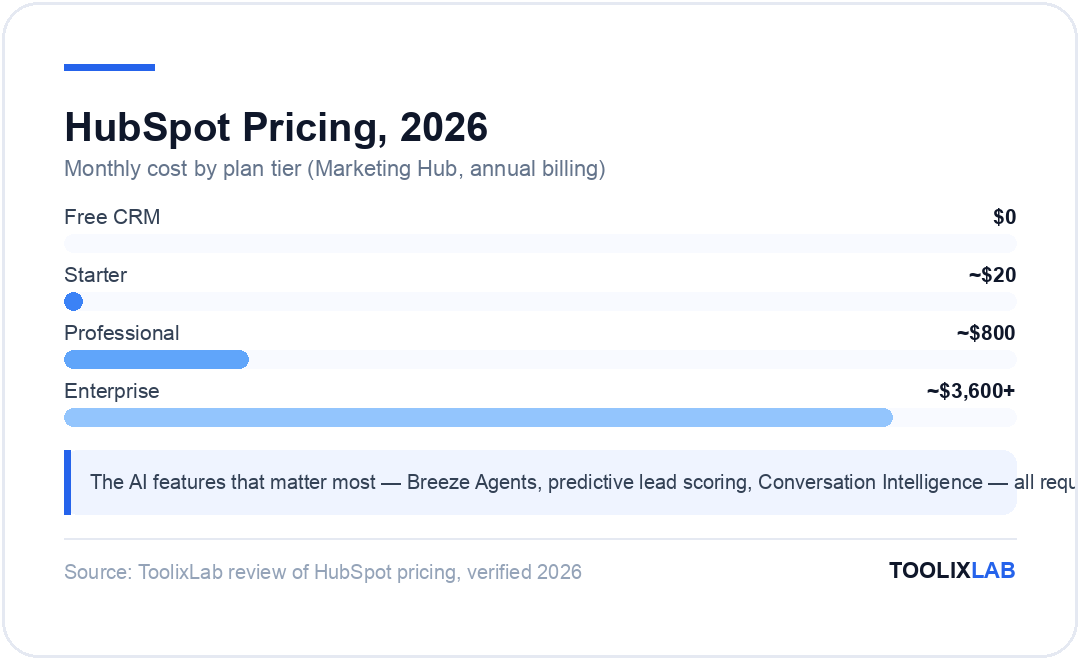
HubSpot's pricing is complex because it varies by Hub (Marketing, Sales, Service, CMS, Operations) and the number of users or contacts in your database. Here is a realistic breakdown of what teams pay in 2026 — always verify current pricing on HubSpot's pricing page before purchasing:
| Plan | Price (Annual) | AI Features Included | Best For |
|---|---|---|---|
| Free CRM | $0 forever | Breeze Assistant (limited), basic AI email suggestions, free contact enrichment (capped) | Solopreneurs, startups testing HubSpot |
| Starter | ~$20/mo (Marketing) / ~$20/mo (Sales) | Breeze Assistant, AI email writer, basic content tools | Small teams (2–5 people), basic marketing |
| Professional | ~$800–$890/mo (Marketing) / ~$450/mo (Sales, 5 users) | Predictive lead scoring, Conversation Intelligence, Content Agent, Prospecting Agent, smart sequences, SEO tools, Breeze Intelligence | Growing teams 10–50 people, active inbound marketing |
| Enterprise | ~$3,600+/mo (Marketing) / ~$1,500+/mo (Sales) | All Professional features + Customer Agent, Data Agent, Company Research Agent, Customer Health Agent, Breeze Studio (custom agents), advanced AI forecasting, custom AI objects | Large teams 50+ people, complex go-to-market motions |
The most important pricing reality: the AI features that matter most — Breeze Agents, predictive lead scoring, Conversation Intelligence — all require Professional tier or above. This means the "HubSpot has AI on a free plan" narrative is misleading for anyone expecting autonomous agents. The free and Starter plans give you Breeze Assistant for assisted drafting, but not the agentic AI that makes Breeze compelling.
Additionally, Breeze Agents consume HubSpot Credits — a consumption-based currency on top of your subscription. Credits are included in allotments by plan tier, but high-volume use of the Prospecting Agent or Customer Agent will exhaust them, requiring credit top-ups. Factor this into total cost projections before signing a contract.
For finance teams and operations leaders, see our review of the best AI tools for finance teams — HubSpot's CFO-level ROI case requires a full platform commitment, not a cherry-picked single hub.
HubSpot vs Competitors: How Does Breeze Stack Up?
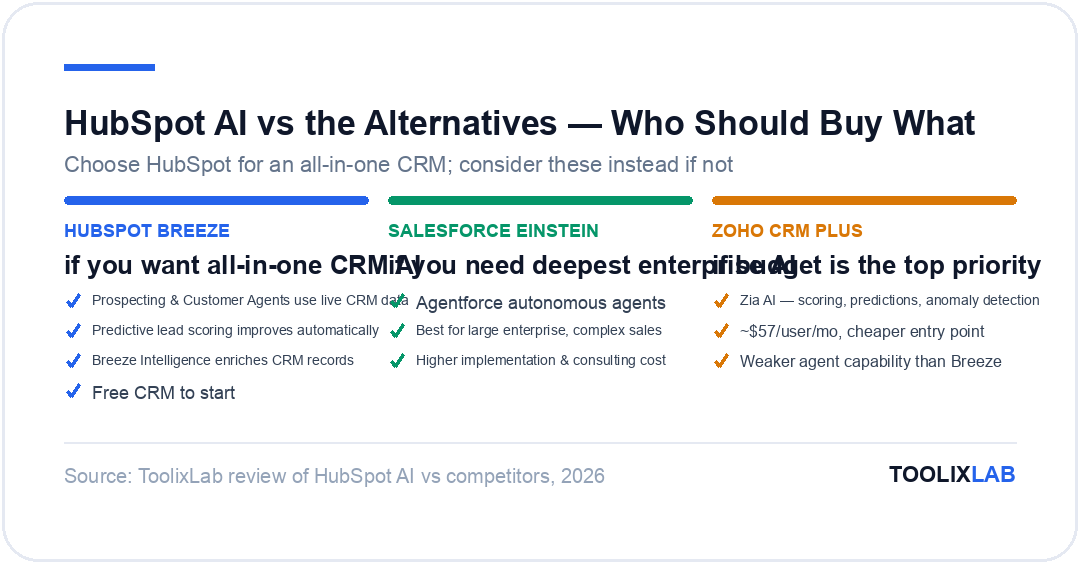
HubSpot does not exist in a vacuum. Here's how it compares to the most common alternatives buyers consider in 2026:
| Platform | AI Strength | Entry Price | Best For | Weakness vs HubSpot |
|---|---|---|---|---|
| HubSpot Breeze | CRM-embedded, context-aware agents | Free CRM; AI from ~$450/mo | SMB to mid-market all-in-one | — |
| Salesforce Einstein | Deepest enterprise AI, Agentforce autonomous agents | ~$25/user/mo base; AI adds $50+/user | Large enterprise, complex sales | Higher complexity, steeper implementation cost |
| Zoho CRM Plus | Zia AI — scoring, predictions, anomaly detection | ~$57/user/mo (CRM Plus) | Budget-conscious SMBs wanting AI CRM | Weaker agent capability, less mature AI |
| Pipedrive AI | AI sales assistant, email summarization, deal insights | ~$24/user/mo (Advanced) | Sales-only teams, pipeline focus | No marketing hub, weaker content AI |
| ActiveCampaign AI | Predictive sending, AI email builder, automation suggestions | ~$15/mo (Starter, 1k contacts) | Email-first marketing automation | No native CRM, no Breeze-level agents |
We have an in-depth head-to-head comparison in our HubSpot AI vs Salesforce Einstein 2026 review — the short version: HubSpot is easier to implement and better for SMBs and mid-market; Salesforce has deeper enterprise AI but requires significantly more investment in setup, admin, and consulting fees to realize that depth.
Breeze Intelligence: AI-Powered Data Enrichment
One of the less-discussed but practically valuable parts of Breeze is Breeze Intelligence — HubSpot's AI data enrichment layer. It solves a problem every CRM user faces: incomplete contact and company records. Sales reps don't always fill in all fields, form fills capture email but not company size or funding stage, and data ages quickly as people change roles.
Breeze Intelligence automatically fills in missing fields — company revenue, headcount, industry, technology stack, funding stage, location — using a combination of web crawling, HubSpot's proprietary business data network, and AI inference. It also flags contacts whose job titles or companies have changed, so your outreach doesn't go to someone who left a company nine months ago.
The practical impact is most visible in lead scoring and segmentation. When your CRM records are 80% complete vs. 40% complete, your lead scoring model has twice as much signal to work with — predictive accuracy improves accordingly. Teams that invest in Breeze Intelligence as a foundation typically see better results from every downstream AI feature built on that data. It's available as an add-on and as part of higher-tier plans.
Breeze Intelligence Pricing 2026
Breeze Intelligence is sold as a credit-based add-on. Credits are consumed when HubSpot enriches a contact or company record, or when you run a Buyer Intent signal check. Pricing tiers (annual billing, verified June 2026):
| Credit Pack | Credits / mo | Monthly Cost | Cost per Credit |
|---|---|---|---|
| Starter | 100 | ~$49/mo | ~$0.49 |
| Growth | 1,000 | ~$299/mo | ~$0.30 |
| Scale | 10,000 | ~$799/mo | ~$0.08 |
| Enterprise | Custom | Custom | Negotiated |
What consumes a credit? One enrichment credit is used each time Breeze Intelligence fills in data for a contact or company record. Buyer Intent credits are separate and used when the platform detects that a company is actively researching your product category (based on web signals). Credits roll over month-to-month within the plan year and don't expire mid-cycle.
Is Breeze Intelligence worth the add-on cost? For teams with large, incomplete CRM databases (10,000+ contacts with poor field completion), the Growth pack at $299/mo is often justified within the first month — a cleaner database means better lead scoring accuracy, fewer wasted outreach touches, and lower bounce rates on email sequences. For smaller teams actively managing under 500 contacts, the Starter tier covers routine enrichment without the additional overhead.
Who Should Use HubSpot AI in 2026?
HubSpot's AI makes the most sense in specific contexts. Here's an honest breakdown:
HubSpot AI is the right choice if:
- ✓You want an all-in-one CRM + marketing + service platform and don't want to stitch together separate tools. HubSpot's AI advantage is its depth of integration — marketing data flows into sales context flows into service history — in a way that buying separate AI tools cannot replicate.
- ✓You're an SMB or mid-market team (10–200 people) that has outgrown simple tools but doesn't need the complexity of a Salesforce implementation. HubSpot's Professional tier hits the sweet spot for this segment.
- ✓Your sales reps need AI-assisted prospecting without leaving the CRM. The Prospecting Agent is genuinely useful for teams doing account-based sales where context matters as much as volume.
- ✓You run an inbound marketing operation with a content-heavy strategy. The marketing hub's AI tools — email writer, content remix, SEO recommendations, workflow AI — compound into real efficiency gains for teams publishing regularly.
- ✓You're building a scalable AI stack for a small business and want to consolidate tooling. HubSpot replaces multiple separate tools (email platform, CRM, live chat, landing page builder, reporting) with one that has AI baked throughout.
HubSpot AI is probably not the right choice if:
- ✗You only want AI content generation. For pure writing quality, dedicated tools like Jasper or Claude API integrations produce better output at lower cost. HubSpot's content AI is good — not great.
- ✗You're a solo freelancer or very small team on a tight budget. HubSpot's meaningful AI features start at Professional pricing (~$450+/mo for Sales Hub with 5 users). That's not small business pricing by any definition.
- ✗You're an enterprise with complex multi-cloud data requirements. At the top end, Salesforce Einstein's AI runs deeper and has more mature enterprise governance features, especially for compliance-heavy industries.
- ✗You need best-in-class outbound sequence tooling. Outreach.io and Salesloft still lead for pure outbound sales engagement with AI coaching. The Prospecting Agent is good, but these specialized tools are better for high-volume cold outreach at scale.
HubSpot AI Pros and Cons: The Honest Assessment
Pros
- ✓AI is embedded in CRM context — uniquely powerful for personalization
- ✓100+ AI features across the platform — not just one or two AI add-ons
- ✓Breeze Agents (Prospecting, Customer, Content) are genuinely autonomous
- ✓Free CRM with basic Breeze access to start
- ✓Predictive lead scoring improves automatically as deal history grows
- ✓Breeze Studio lets you build custom agents without code (Beta)
- ✓Strong onboarding, extensive support documentation, large community
Cons
- ✗Professional tier pricing is steep for small teams (~$800+/mo for Marketing Hub)
- ✗Breeze Agents consume HubSpot Credits — unpredictable cost for high-volume use
- ✗Content AI quality lags behind dedicated writing tools
- ✗Some best AI agents (Company Research, Customer Health) still in Beta
- ✗Forecasting accuracy requires clean, consistent CRM data first
- ✗Enterprise AI features lag behind Salesforce for very complex orgs
- ✗Breeze Intelligence data enrichment is an additional cost add-on
Getting Started With HubSpot AI: What to Prioritize First
If you're starting with HubSpot AI or upgrading to Professional, here's the recommended prioritization sequence based on what delivers ROI fastest:
-
1
Set up Breeze Intelligence first.
Data quality is the foundation. Every AI feature — lead scoring, deal intelligence, the Prospecting Agent — performs better when your CRM data is complete. Configure Breeze Intelligence to enrich your existing database before relying on AI-powered predictions.
-
2
Enable predictive lead scoring.
Requires at least 100 closed deals in your CRM to train. Once trained, share the score criteria with your sales team so they understand why a lead is ranked high — transparency increases adoption dramatically.
-
3
Activate the Customer Agent for Tier 1 support.
Start by training it on your top 20 most-asked support questions. Measure deflection rate weekly and expand the knowledge base based on what the agent escalates. Don't try to automate everything on day one.
-
4
Deploy the Prospecting Agent for target account lists.
Define your ICP criteria carefully before activating — the agent's output quality is directly tied to the specificity of your targeting parameters. Test on a small account list (20–30 companies) before scaling to your full TAM.
-
5
Integrate Conversation Intelligence into your sales coaching.
Create a weekly ritual where managers review AI-flagged call moments — objections, competitor mentions, pricing discussions — rather than listening to full recordings. This creates a culture of data-driven coaching without adding significant manager time.
Final Verdict: Is HubSpot AI Worth It in 2026?
Yes — but only if you're committing to the platform. HubSpot's AI, branded as Breeze, is the most mature CRM-embedded AI suite available to SMBs and mid-market teams in 2026. The Prospecting Agent, Customer Agent, predictive lead scoring, and Conversation Intelligence are all genuinely useful — not demo-ware. The data enrichment layer via Breeze Intelligence is a practical differentiator that improves every other AI feature built on top of it.
The caveat is the cost model. You don't get the AI that matters on the free tier or Starter. The meaningful AI requires Professional (~$450–$890/month depending on hub) plus HubSpot Credits for agent usage. For teams already in the HubSpot ecosystem, upgrading to Professional to unlock Breeze is a straightforward ROI calculation. For teams starting from scratch and evaluating HubSpot for the first time, the total cost of ownership — subscription, credits, onboarding, and potentially a HubSpot-certified consultant — needs careful budgeting.
The teams who get the most out of HubSpot AI are those who treat it as a platform investment rather than a tool swap. They build clean CRM data, train the agents methodically, and let the AI compound over time. Teams who activate every Breeze feature in week one without that foundation are disappointed — and incorrectly blame the AI rather than the data quality underneath it.
For a head-to-head against the enterprise alternative, read our HubSpot AI vs Salesforce Einstein 2026 comparison to understand exactly where each platform wins and what size team each is designed for.