
⚡ TL;DR — Quick Verdict
Two platforms. One decision that shapes how your sales, marketing, and service teams operate for the next 3–5 years. HubSpot AI vs Salesforce Einstein is the CRM rivalry that every growing company eventually has to pick a side in — and in 2026, AI has made that decision significantly more complex.
HubSpot has rebranded its AI capabilities as Breeze — an umbrella covering Breeze Copilot (conversational AI assistant), Breeze Agents (autonomous AI workers for sales, marketing, and support), and Breeze Intelligence (data enrichment). Salesforce, meanwhile, has doubled down on Einstein and launched Agentforce — its autonomous AI agent platform that processes millions of conversations across its customer base.
Both platforms have genuinely impressive AI in 2026. The question isn't which one has better AI in the abstract — it's which one fits your team's size, technical capacity, budget, and growth trajectory. This comparison covers every major AI dimension to help you make that call.
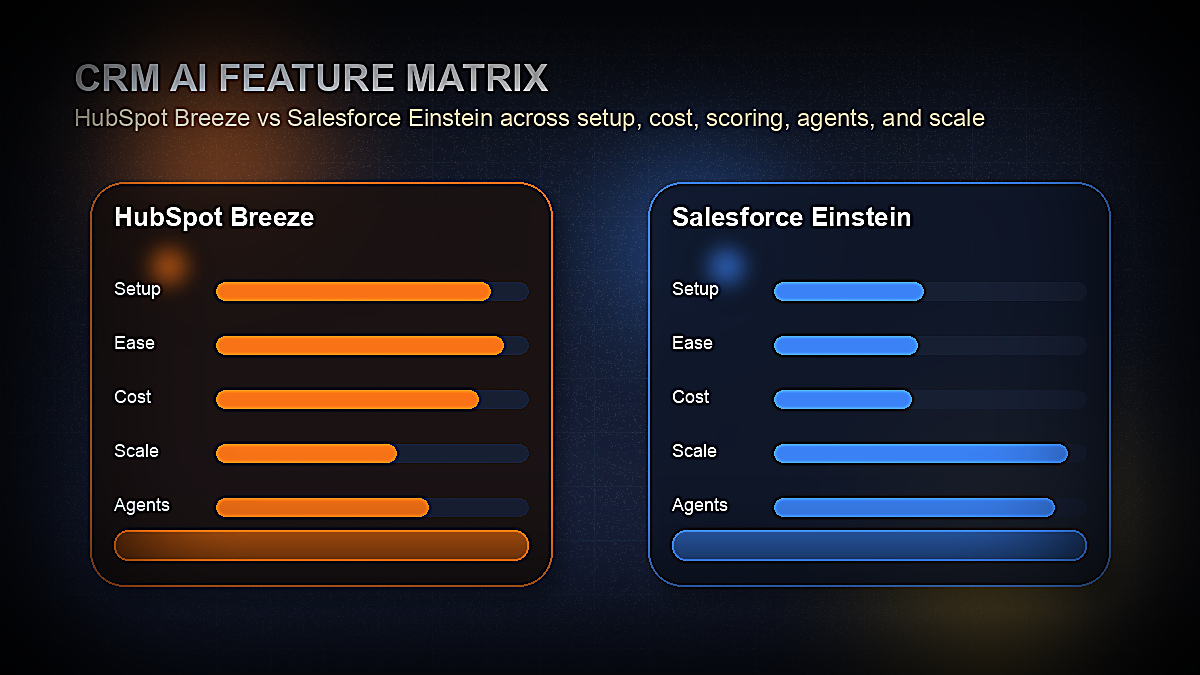
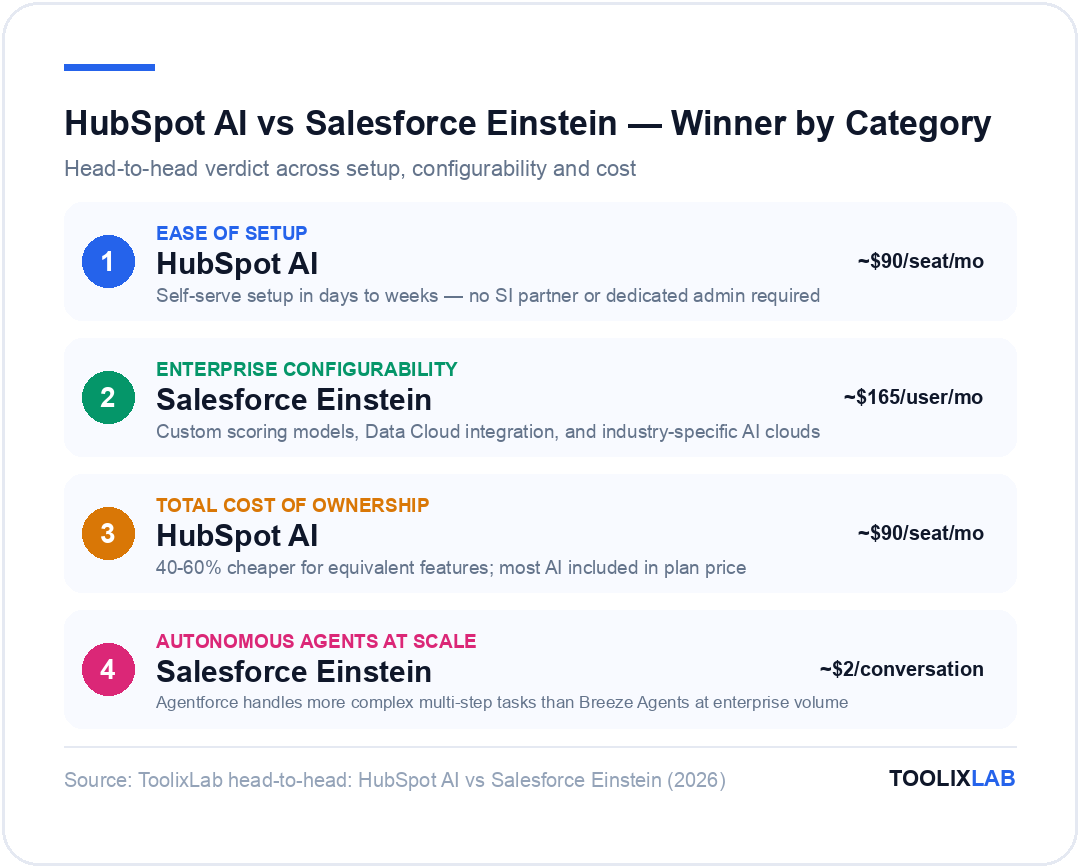
HubSpot AI vs Salesforce Einstein: Key Differences at a Glance
| Category | HubSpot AI (Breeze) | Salesforce Einstein |
|---|---|---|
| Best for | SMB to mid-market (10–500 employees) | Mid-market to enterprise (200+ employees) |
| AI brand | Breeze (Copilot + Agents + Intelligence) | Einstein (Copilot + Agentforce + Analytics) |
| Starting price | Free CRM; Pro from ~$90/seat/mo | Starter ~$25/user/mo; Enterprise ~$165/user/mo |
| AI included? | Most AI features included in paid plans | Some AI on Enterprise+; add-ons for full AI |
| Setup time | Days to weeks (self-serve) | Weeks to months (often requires SI partner) |
| Lead scoring AI | Predictive scoring (Pro+) | Einstein Lead Scoring (highly configurable) |
| Autonomous AI agents | Breeze Agents (sales, marketing, support) | Agentforce (more powerful, more configurable) |
| Ecosystem | 1,500+ integrations (broad) | 3,000+ apps on AppExchange (deeper enterprise) |
| Ease of use | ⭐⭐⭐⭐⭐ (industry best) | ⭐⭐⭐ (complex, training required) |
What Is HubSpot AI (Breeze)?
HubSpot launched its unified AI platform under the Breeze brand in late 2024, replacing the patchwork of individual AI features that had grown organically across Sales Hub, Marketing Hub, and Service Hub. In 2026, Breeze is mature, deeply integrated, and genuinely impressive for the size of company HubSpot targets.
Breeze breaks down into three layers:
- Breeze Copilot: An always-available AI assistant accessible from anywhere in HubSpot. Ask it to draft emails, summarize contact timelines, update deal records, pull reports, or research a company before a call. It understands your CRM context — it doesn't just answer generic questions, it answers questions about your specific deals, contacts, and pipeline.
- Breeze Agents: Autonomous AI workers that operate on their own. The Prospecting Agent researches target accounts and crafts personalized outreach. The Content Agent generates blog posts, landing pages, and social content using your brand guidelines. The Customer Agent handles support queries from your knowledge base 24/7. The Social Media Agent monitors conversations and schedules responses.
- Breeze Intelligence: Data enrichment that automatically fills in missing company and contact data — industry, headcount, revenue, tech stack — across your CRM using a database of 200M+ company profiles. Available as an add-on.
Beyond Breeze, HubSpot's AI touches every hub: predictive lead scoring ranks your prospects by likelihood to convert, AI email personalization generates tailored sequences, conversation intelligence transcribes and analyzes sales calls, and AI forecasting predicts deal close probability with more nuance than stage-based approaches.
The defining characteristic of HubSpot AI is that it works out of the box. You don't configure a model, you don't hire a Salesforce implementation partner, you don't spend months setting up data pipelines. Most features are live within the time it takes to connect your email and import your contacts. For a complete breakdown of every Breeze feature and real pricing, see our full HubSpot AI 2026 review.
What Is Salesforce Einstein?
Salesforce Einstein is the AI layer embedded across the entire Salesforce platform — Sales Cloud, Marketing Cloud, Service Cloud, Commerce Cloud, and the Einstein Analytics suite. Since launching in 2016, Einstein has evolved from a narrow predictive analytics tool into a comprehensive AI framework that covers everything from lead scoring to autonomous customer-facing agents.
In 2026, the Salesforce AI story has two main characters:
- Einstein Copilot: Salesforce's conversational AI assistant for sales, service, and marketing teams. Like HubSpot's Breeze Copilot, it understands your Salesforce data — but it also hooks into the broader Data Cloud (Salesforce's unified data platform) for deeper cross-object insights. Ask Einstein Copilot why a deal is stalling, and it can analyze communication patterns, deal history, competitive intelligence, and CRM activity simultaneously.
- Agentforce: Salesforce's most significant 2024–2026 bet. Agentforce lets you build and deploy autonomous AI agents that handle sales development tasks, tier-1 customer service, marketing campaign management, and commerce flows — without human intervention. Unlike basic chatbots, Agentforce agents reason through multi-step tasks using your Salesforce data and connected tools. Pricing is consumption-based (~$2 per conversation), which makes it highly scalable for enterprise volumes.
Einstein's underlying models are configurable — data scientists can tune them on your historical data, define custom scoring criteria, and build entirely custom AI flows using Salesforce Flow and Apex code. This power comes with a trade-off: Einstein requires significantly more setup, technical expertise, and ongoing administration than HubSpot AI. Most mid-market and enterprise companies using Einstein at full capability have either an internal Salesforce admin team or a certified implementation partner.
According to Salesforce's own research, Einstein processes over 1 trillion AI-powered predictions per week across its customer base — a scale that speaks to both the breadth of deployment and the depth of the underlying infrastructure.
AI Sales Features Compared
Sales is where AI has the most immediate impact on revenue — and where HubSpot and Salesforce diverge most sharply in their approach.
Lead Scoring
HubSpot Predictive Lead Scoring (available on Professional and Enterprise plans) uses machine learning trained on your historical contact and deal data to score leads from 0–100. It factors in demographic data, behavioral signals (email opens, page visits, form submissions), and firmographic data. Setup takes minutes — HubSpot builds the model automatically as soon as you have sufficient historical data (typically 100+ closed deals). The model retrains continuously as you close more deals.
Einstein Lead Scoring is more powerful and more configurable. Administrators can define custom scoring factors, weight specific fields, exclude certain segments, and run multiple simultaneous scoring models for different business units or product lines. Einstein can incorporate data from external systems (via Data Cloud) that HubSpot's model can't access. For companies with complex sales motions — multiple products, different ICP segments, long multi-touch cycles — Einstein's configurability delivers materially better accuracy. The trade-off: full configuration requires a Salesforce admin or consultant and takes days to weeks, not minutes.
Conversation Intelligence
Both platforms offer AI call recording and analysis. HubSpot's Conversation Intelligence (Sales Hub Enterprise) transcribes calls, identifies key moments (competitor mentions, objections, pricing discussions), tracks rep talk-to-listen ratios, and surfaces coaching opportunities. It's solid and native to the CRM.
Salesforce Einstein Conversation Insights does the same and goes further with deal risk signals — flagging deals where call patterns suggest stalling (declining engagement, competitor mentions increasing, key decision-maker going silent) and surfacing those warnings in deal records automatically. For enterprise sales teams managing complex cycles, this real-time deal intelligence is genuinely differentiated.
Sales Copilot / AI Assistant
Both Breeze Copilot and Einstein Copilot give reps an AI assistant that understands their pipeline context. The practical difference is depth: Breeze Copilot is faster to produce useful outputs for straightforward requests (draft a follow-up email, summarize this account, what deals are at risk this week). Einstein Copilot handles more complex multi-step requests and can reason across larger data sets — comparing pipeline performance across territories, identifying patterns across hundreds of closed-won deals, or generating account plans that incorporate third-party data from Data Cloud.
Autonomous Sales Agents
HubSpot's Prospecting Agent identifies target accounts matching your ICP, researches them using web data and Breeze Intelligence, and drafts personalized outreach sequences. It's effective for straightforward B2B outbound and significantly reduces SDR prep time.
Salesforce Agentforce for sales is more powerful and more flexible — agents can be configured to handle complex multi-step sales development tasks, follow branch logic based on CRM data, escalate appropriately, and learn from outcomes over time. For large SDR teams doing high-volume outbound at enterprise scale, Agentforce's depth justifies the higher configuration investment.
AI Marketing Features Compared
Marketing AI is where HubSpot has historically led, and Breeze extends that lead in 2026.
Content Generation
HubSpot's Content Agent (part of Breeze) generates blog posts, landing pages, email sequences, social media posts, and ad copy — all using your brand voice, target personas, and campaign goals as inputs. It integrates directly with HubSpot's CMS and email builder, so generated content goes straight into your production workflow without copy-pasting. The quality is strong for first drafts; most marketing teams report a 50–70% reduction in time-to-publish for standard content types.
Salesforce Marketing Cloud's generative AI (Einstein GPT for Marketing) covers similar ground but is geared more toward personalization at scale for large email programs — generating thousands of individually personalized subject lines, body variants, and CTAs rather than long-form content creation. For enterprise email marketers running millions of sends, this dynamic personalization AI is category-leading. For a 10-person marketing team needing a blog post and a nurture sequence, HubSpot is faster and simpler.
Campaign Intelligence & Attribution
HubSpot's AI Attribution models revenue back to marketing touchpoints using multi-touch models (first touch, last touch, linear, time-decay, and U-shaped). The AI highlights which channels and content pieces are actually driving pipeline, not just top-of-funnel traffic. For most B2B marketing teams, this level of attribution is more than sufficient.
Salesforce Einstein Attribution goes significantly deeper — incorporating cross-cloud data (combining Marketing Cloud, Sales Cloud, and Service Cloud data), third-party ad data, and offline touchpoints into a unified attribution model. For enterprise marketers running complex multi-channel programs with significant offline spend, Salesforce's attribution accuracy is superior. The caveat: it requires Marketing Cloud Advertising, Data Cloud, and proper tagging infrastructure — significant investment before you see meaningful data.
HubSpot — AI-Powered CRM With a Free Starting Point
HubSpot's free CRM includes contact management, deal pipeline, and basic email tools. Upgrade to unlock Breeze AI Copilot, predictive lead scoring, and AI content generation — without a six-figure implementation project.
🎁 Free forever plan — no credit card required to start
Try HubSpot Free →AI Customer Service Features Compared
Both platforms have invested heavily in AI for customer service — and both are competitive, though for different customer segments.
HubSpot's Customer Agent (Service Hub) handles Tier 1 support queries using your knowledge base, resolves common issues without human involvement, and escalates to human agents with full conversation context when needed. Setup is quick — connect your knowledge base, define escalation topics, and the agent is live within hours. CSAT data from HubSpot's own customer base suggests well-configured Customer Agents resolve 35–45% of incoming queries automatically.
Salesforce Agentforce for Service is more capable at scale. It handles higher query complexity, supports more sophisticated escalation logic, and integrates with the full Salesforce Service Cloud ecosystem (field service, case management, asset tracking). For companies managing enterprise service operations — multi-tier SLAs, complex case routing, integration with field service — Agentforce's depth is genuinely superior. The per-conversation pricing model ($2/conversation) makes cost predictable and scales efficiently at high volumes.
For deeper analysis of the best AI tools for customer service, check out our guide to the best AI tools for customer support in 2026, which covers both platforms alongside specialized alternatives like Intercom and Zendesk.
Ease of Use & Implementation Time
This is HubSpot's biggest competitive advantage — and Salesforce's biggest liability for the wrong customer.
HubSpot consistently tops ease-of-use rankings on G2 and Capterra by wide margins. The interface is clean, workflows are visual, and most AI features are self-serve — you don't need to understand data models or write code to get value. A marketing manager can configure an AI email sequence in an afternoon. A sales manager can set up predictive lead scoring without involving IT. The Breeze Copilot onboarding takes about 15 minutes. Implementation for a typical 20-person sales team: 1–2 weeks of self-serve setup.
Salesforce is powerful precisely because it's infinitely configurable — but that configurability comes with complexity. A basic Salesforce setup can be live in days, but getting Einstein to work well requires proper data quality, custom object configuration, and understanding of how Salesforce's data model works. According to Salesforce's own Trailhead learning platform, admins typically need 40–100+ hours of training to manage the platform competently. Most mid-market and enterprise deployments involve a certified implementation partner (Accenture, Deloitte Digital, local Salesforce VARs) — adding $15,000–$200,000+ to the total cost of implementation depending on scope.
The practical implication: if you have a dedicated Salesforce admin or a budget for implementation services, this gap matters less. If you don't, it's the most important factor in your decision.
HubSpot AI Pricing vs Salesforce Einstein Pricing
Pricing is where many companies are surprised — particularly by how rapidly Salesforce costs compound once you add Einstein features and user licenses.
HubSpot AI Pricing (2026)
Salesforce Einstein Pricing (2026)
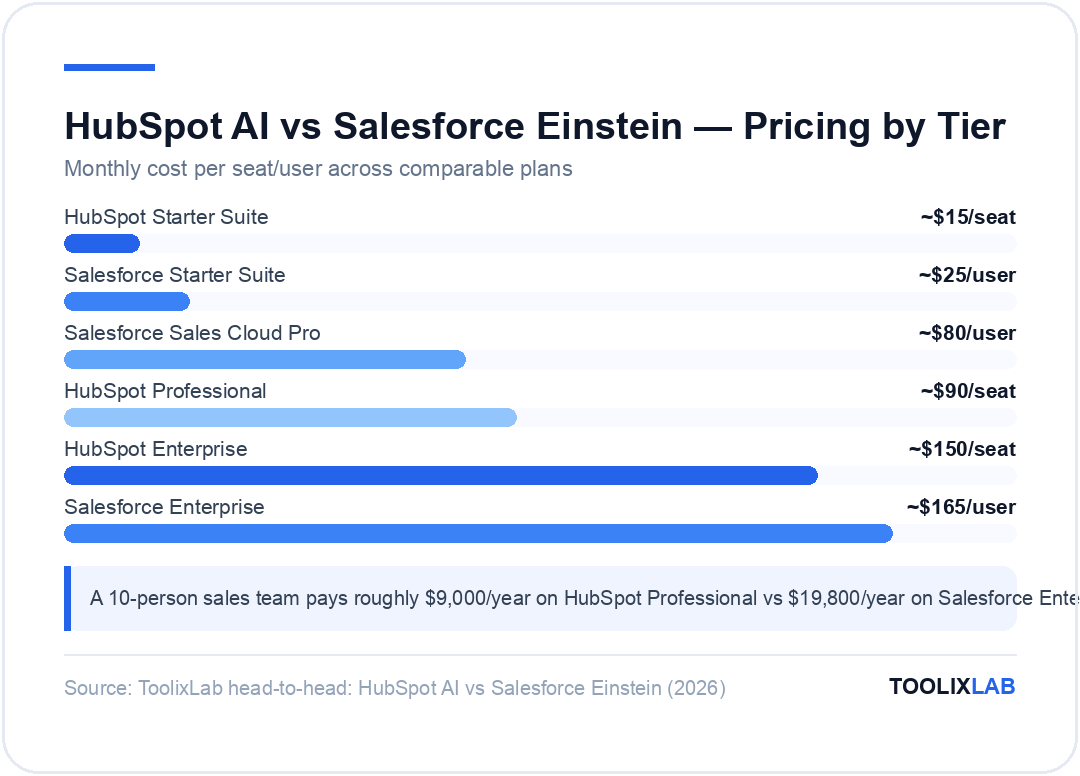
The cost reality: A 10-person sales team on HubSpot Professional pays roughly $9,000/year. The same team on Salesforce Enterprise pays $19,800/year — before any Einstein add-ons, implementation costs, or admin overhead. For a 50-person team with full AI features, the gap widens further: HubSpot Enterprise might run $90,000/year; Salesforce Enterprise with full Einstein and an admin could easily reach $200,000–$250,000/year total cost of ownership.
This doesn't mean Salesforce is overpriced — for companies where it's the right fit, the ROI on custom AI models, deep integrations, and enterprise-grade security easily justifies the premium. But going in eyes open about total cost is essential.
Note: All pricing figures are approximate as of April 2026. Verify current pricing on HubSpot's official pricing page and Salesforce's pricing page before making any purchase decisions.
Integrations & Ecosystem
HubSpot integrates with 1,500+ tools via its App Marketplace — covering the major SaaS categories: marketing automation, ecommerce, video conferencing, sales engagement, accounting, and more. Native integrations with Slack, Gmail, Outlook, Zoom, Shopify, and Stripe work well out of the box. For most SMB and mid-market tech stacks, HubSpot covers the integration bases without custom development.
Where HubSpot falls short: deep enterprise integrations. If your stack includes SAP, Oracle, legacy ERP systems, or custom internal tools, HubSpot's integration depth is limited compared to Salesforce. You can build custom integrations via HubSpot's API, but it requires engineering resources.
Salesforce's AppExchange has 3,000+ applications and decades of enterprise integration patterns. If you need to connect Salesforce to SAP S/4HANA, Oracle NetSuite, ServiceNow, or any major enterprise software, there's almost certainly a pre-built connector. Salesforce also offers MuleSoft (acquired in 2018) for complex enterprise data integration — enabling real-time data sync between Salesforce and virtually any system. For enterprise companies with complex data architectures, this ecosystem depth is unmatched.
If you're evaluating broader workflow automation alongside your CRM, our comparison of Zapier vs Make vs n8n covers the automation connectors that work across both HubSpot and Salesforce stacks.
HubSpot AI: Pros & Cons
✅ Pros
- • Dramatically faster to set up and learn
- • Most AI features included in plan price
- • Free CRM tier to start — no commitment
- • Excellent UX rated #1 for ease of use on G2
- • Breeze Agents quick to configure for SMBs
- • All-in-one: marketing, sales, and service in one platform
❌ Cons
- • AI scoring models less configurable than Einstein
- • Weaker for complex enterprise reporting
- • Limited depth for custom AI model tuning
- • Integration ecosystem thinner for enterprise systems
- • Price increases steeply at Enterprise tier
- • Less suitable for complex multi-org enterprise setups
Salesforce Einstein: Pros & Cons
✅ Pros
- • Most configurable AI scoring and automation in CRM
- • Agentforce is the most powerful autonomous agent in category
- • 3,000+ AppExchange integrations for enterprise stacks
- • Data Cloud enables AI across unified enterprise data
- • Industry-specific AI clouds (Financial Services, Health, etc.)
- • Unmatched enterprise security, compliance, and governance
❌ Cons
- • Steep learning curve — admin expertise required
- • High total cost of ownership (licenses + implementation)
- • Full AI features require Enterprise or Unlimited+ plan
- • Implementation often requires a paid SI partner
- • Overwhelming for small teams without a dedicated admin
- • UX complexity frustrates casual users
Which Should You Choose?
Our Verdict
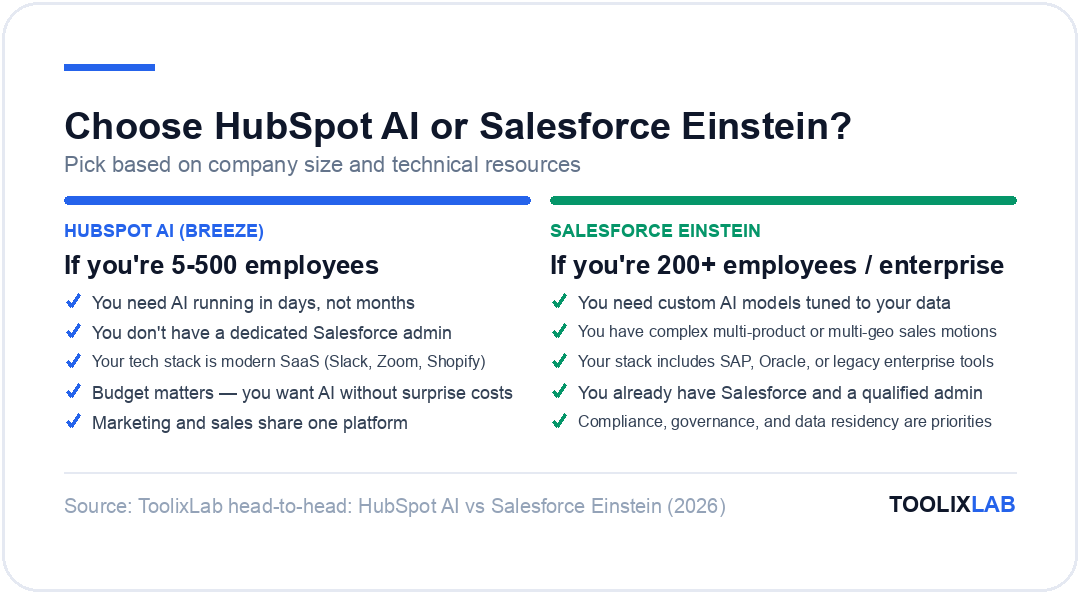
HubSpot AI wins for the vast majority of companies — those under 500 employees that want powerful AI without months of setup and a six-figure implementation budget. Salesforce Einstein wins for enterprise companies with complex sales processes, large teams, existing Salesforce infrastructure, and the resources to configure it properly. If you're on the fence, start with HubSpot. You can always migrate up; migrating down is messy.
✅ Choose HubSpot AI if...
- • You're a company with 5–500 employees
- • You need AI running in days, not months
- • You don't have a dedicated Salesforce admin
- • Your tech stack is modern SaaS (Slack, Zoom, Shopify)
- • Budget matters — you want AI without surprise costs
- • Marketing and sales share one platform
✅ Choose Salesforce Einstein if...
- • You're a 200+ employee company or enterprise
- • You need custom AI models tuned to your data
- • You have complex multi-product or multi-geo sales motions
- • Your stack includes SAP, Oracle, or legacy enterprise tools
- • You already have Salesforce and a qualified admin
- • Compliance, governance, and data residency are priorities
One more factor worth naming: switching costs. Moving from HubSpot to Salesforce is a significant undertaking — data migration, retraining, workflow rebuilds, integration work. Moving from Salesforce to HubSpot is slightly easier (HubSpot has good migration tools) but still disruptive. The right call is to be honest about your 3-year growth trajectory now. If you'll be 300 people with a complex enterprise sales motion in 18 months, start with Salesforce. If you'll still be 50 people focused on product-led growth, HubSpot will serve you better.
For the sales team perspective on AI tooling, see our guide to the best AI tools for sales teams in 2026, which covers both platforms alongside specialized sales engagement tools like Gong, Salesloft, and Apollo.
For the marketing side, our roundup of the best AI tools for marketing in 2026 compares HubSpot Marketing Hub against Marketo, ActiveCampaign, and other marketing automation platforms with AI features.
🔑 Key Takeaways
- ✓ HubSpot AI (Breeze) is the clear winner for SMB and mid-market — faster, cheaper, and easier to implement
- ✓ Salesforce Einstein and Agentforce lead on configurability, enterprise depth, and scale for large organizations
- ✓ Total cost gap is significant — HubSpot teams typically pay 40–60% less in combined license + implementation costs
- ✓ Both have capable AI copilots, lead scoring, and autonomous agents — but Einstein's versions are more powerful and configurable
- ✓ Choose based on company size and technical resources — not based on which demo looked more impressive
- ✓ If switching costs worry you, start with HubSpot — it's easier to grow into Salesforce than to retreat from it
Frequently Asked Questions
What is the difference between HubSpot AI and Salesforce Einstein?
HubSpot AI (branded as Breeze) is optimized for simplicity, speed of deployment, and SMB-to-mid-market use cases. Most AI features work out of the box with minimal configuration. Salesforce Einstein is optimized for configurability, enterprise scale, and complex sales and service operations. Einstein requires more setup but delivers more customized AI models, deeper data integrations, and more powerful autonomous agents via Agentforce. The practical difference: HubSpot gets you running in days; Salesforce gets you running in weeks-to-months with significantly more power at scale.
Is HubSpot AI better than Salesforce Einstein for small businesses?
Yes, decisively. HubSpot AI is better for small businesses on every dimension: lower cost (free CRM to start), faster implementation (days not months), no need for a dedicated admin or implementation partner, and AI features that work without technical configuration. Salesforce's power comes from deep customization that requires expertise most small businesses don't have internally — and paying an implementation partner on top of already higher license costs makes the total cost prohibitive for businesses under 50 employees.
What is Salesforce Agentforce and how does it compare to HubSpot Breeze Agents?
Salesforce Agentforce is Salesforce's autonomous AI agent platform, launched in late 2024. It allows companies to deploy AI agents that handle complex multi-step sales, service, and marketing tasks independently — with deep integration into Salesforce data and a consumption-based pricing model (~$2/conversation). HubSpot Breeze Agents covers similar ground (prospecting, content, customer support, social media) but with simpler configuration and less customizability. For SMBs, Breeze Agents are easier to deploy and sufficient for most use cases. For enterprises needing highly configured autonomous agents at scale, Agentforce is the more powerful option.
How much does Salesforce Einstein cost vs HubSpot AI?
HubSpot Professional (with core AI features) starts at approximately $90/seat/month. Salesforce Enterprise (the tier where Einstein AI features become meaningful) starts at approximately $165/user/month — before any Einstein add-ons, Data Cloud credits, or implementation costs. For a 10-person sales team, HubSpot Professional costs roughly $9,000/year in licenses; Salesforce Enterprise costs roughly $19,800/year before any extras. When you add implementation services (often required for Salesforce), the total first-year cost gap typically ranges from $20,000 to $100,000+. Always verify current pricing on official pricing pages before purchasing.
Can you use both HubSpot and Salesforce together?
Yes — HubSpot offers a native Salesforce integration that bi-directionally syncs contacts, companies, deals, and activities between the two platforms. This is commonly used by companies where the marketing team prefers HubSpot's marketing tools but the sales team is already embedded in Salesforce's Sales Cloud. The integration is reliable and well-documented, though it adds complexity: you're paying for two platforms, managing data sync, and training teams on separate tools. Most companies eventually consolidate onto one platform — typically whichever has higher adoption and deeper workflow integration.
Which has better AI lead scoring — HubSpot or Salesforce?
Salesforce Einstein Lead Scoring is more configurable and more powerful for complex sales environments — administrators can define custom scoring factors, weight specific signals, run multiple models for different segments, and incorporate external data from Data Cloud. HubSpot Predictive Lead Scoring is simpler and works automatically with minimal setup, making it more accessible for teams without data science resources. For most companies with under 500 deals in their historical pipeline, HubSpot's model delivers sufficient accuracy. For companies with complex multi-product sales motions and large data sets, Einstein's configurability produces materially better results.
Is Salesforce worth it for a company with under 100 employees?
For most companies under 100 employees, Salesforce is not worth the cost and complexity — unless you're in a specific vertical (financial services, healthcare) where Salesforce's industry clouds offer unique compliance features, or you have enterprise customers demanding Salesforce integration as a condition of doing business. The implementation overhead, higher license cost, and required admin expertise create a significant burden for small teams. HubSpot Professional delivers 80–90% of Salesforce's value at 40–50% of the cost with a fraction of the setup time. Start with HubSpot and revisit Salesforce when your team, deal complexity, and budget genuinely require it.
What is HubSpot Breeze Intelligence?
HubSpot Breeze Intelligence is HubSpot's AI-powered data enrichment layer, available as an add-on to any paid HubSpot plan. It automatically enriches contact and company records in your CRM with missing data — industry, company size, revenue range, tech stack, LinkedIn profile, and more — using a database of 200M+ company profiles. This means your CRM stays clean and complete without manual research. Breeze Intelligence also powers buyer intent signals, flagging which companies in your database are actively researching solutions like yours. It's particularly useful for outbound sales teams who need enriched prospect data before reaching out.