
We tested Perplexity AI across research, writing, and daily workflows. Here's the honest breakdown of features, pricing, limitations, and who should actually pay for it.
By ToolixLab Research Team | Senior AI Tools Researcher | February 2026
⚡ TL;DR — Perplexity AI in 30 Seconds
- What it is: An AI-powered answer engine that searches the web in real time and gives you cited, sourced answers — not just links
- Best for: Researchers, analysts, students, and professionals who need fast, verifiable facts
- Not great for: Creative writing, long-form content generation, or coding
- Free tier: Genuinely useful — unlimited quick searches, limited Pro Searches
- Pro ($20/month): Worth it if you research daily
- Max ($200/month): Overkill for most — built for power users and teams
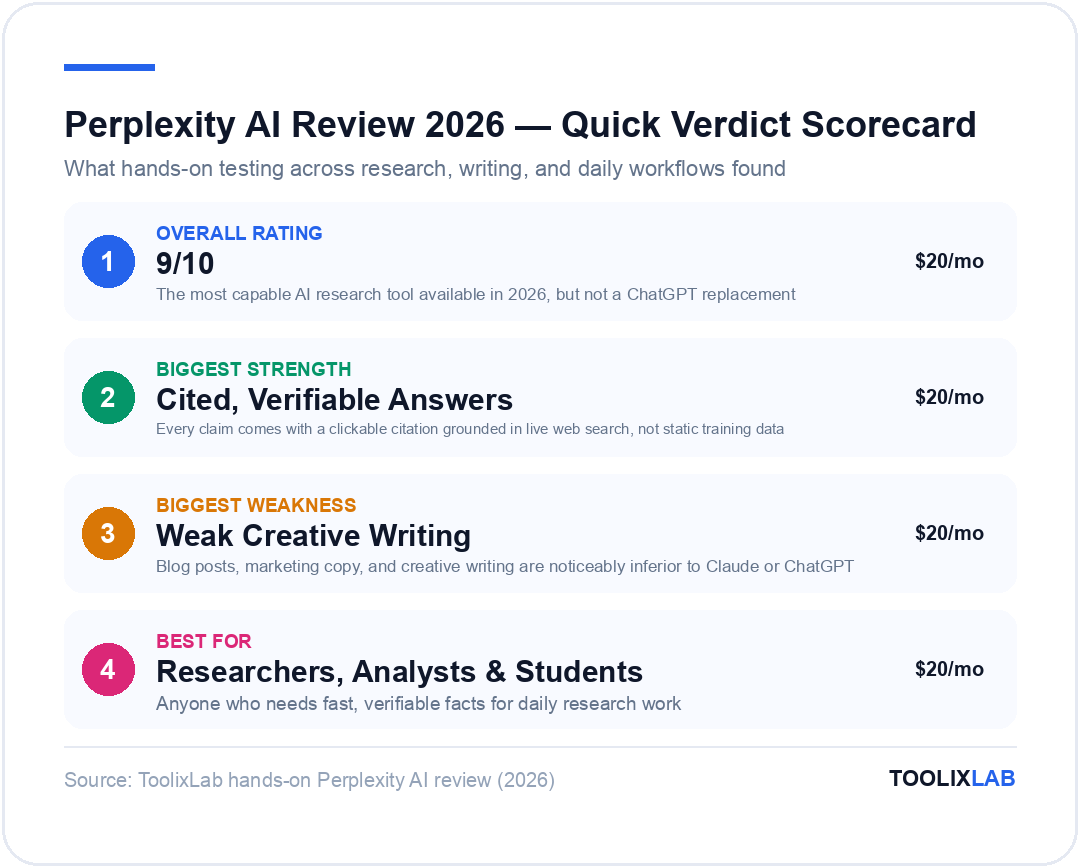
- Verdict: The best dedicated research AI available in 2026. Not a ChatGPT replacement — a different tool for a different job.
Introduction
Every AI tool claims to help you "work smarter." Most of them mean "generate text faster." Perplexity AI means something different.
While ChatGPT and Claude are fundamentally language models — trained on data with a knowledge cutoff — Perplexity is built around one core idea: search the internet first, answer second. Every response is grounded in live web results. Every claim comes with a numbered citation you can click to verify. It doesn't guess what was true in 2023 and hope it's still accurate; it reads the web right now and tells you what it finds.
That difference sounds simple. In practice, it changes everything about how useful an AI tool actually is for research.
In this review, we've put Perplexity through real-world tests across research tasks, competitive analysis, document analysis, and daily information work. We'll give you an honest verdict on where it excels, where it falls short, and — most importantly — whether the Pro or Max plan is worth paying for.
What Is Perplexity AI?
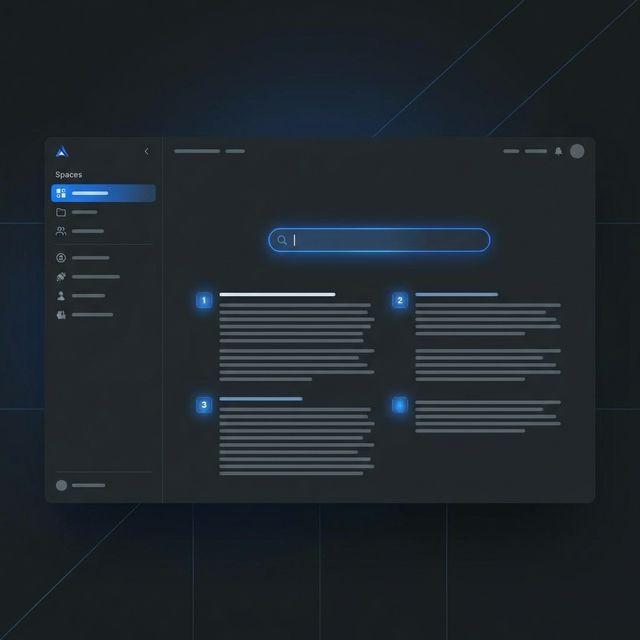
Perplexity AI is an AI-powered answer engine founded in 2022 by ex-OpenAI and ex-Google researchers. It's not a chatbot in the traditional sense — it's a research tool that combines large language models with real-time web search to deliver direct, sourced answers to complex questions.
The simplest way to understand it: Google gives you links. ChatGPT gives you answers. Perplexity gives you answers with receipts.
When you ask Perplexity a question, it doesn't draw on a static training dataset. It searches the web, reads multiple sources, synthesises the findings, and presents you with a structured response — alongside numbered citations for every key claim. You can click any citation to read the original source.
📊 Perplexity AI by the Numbers (February 2026)
- 780M+ monthly search queries (May 2025), estimated 1.2–1.5B by mid-2026
- 100M+ monthly website visitors
- Available in 46 languages across 238 countries
- Models available: Sonar (own), ChatGPT, Claude Sonnet 4.6, Claude Opus 4.6, Gemini, Grok, DeepSeek
- Founded: 2022 | Valuation: ~$14 billion (2025 funding round)
- Revenue: about $34M in 2024 | ARR reached about $80M by January 2025
The multi-model support is worth pausing on. Unlike ChatGPT (which only uses OpenAI models) or Claude (Anthropic only), Perplexity lets you choose which underlying AI model powers your answer — ChatGPT, Claude Sonnet 4.6, Gemini, DeepSeek, and more. Same interface, different engines. This is a significant advantage if you want to cross-check answers or use the best model for a specific task.
What Makes Perplexity Different from General-Purpose AI
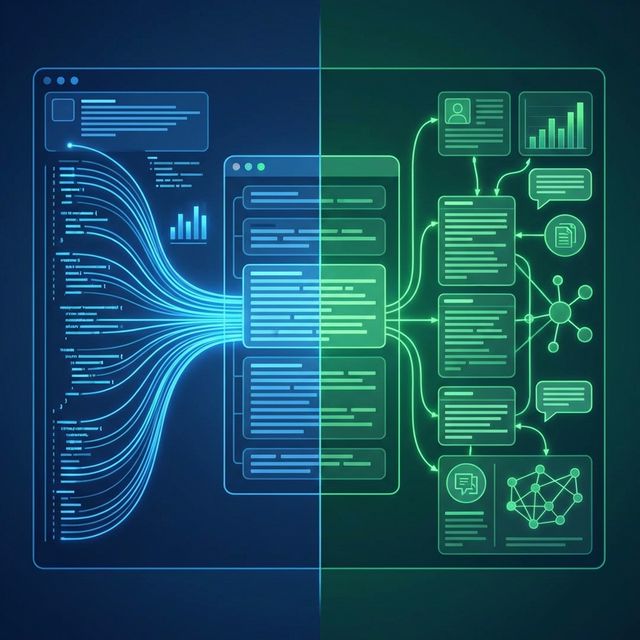
Before we get into features and pricing, it's worth being precise about what Perplexity is and isn't — because a lot of people try it expecting a ChatGPT alternative and come away disappointed.
Perplexity is NOT a general-purpose AI assistant. It won't write your novel, generate images, build a React app, or roleplay as a historical figure. For those tasks, Claude or ChatGPT are better tools.
Perplexity IS the best AI tool for information work. If your job involves researching, verifying facts, monitoring topics, synthesising reports, or understanding complex and fast-moving subjects, Perplexity is in a category of its own.
Here's the core structural difference:
| Traditional AI (Claude, ChatGPT) | Perplexity AI | |
|---|---|---|
| Knowledge source | Training data (knowledge cutoff) | Live web search, every query |
| Citations | Rare, sometimes fabricated | Always present, clickable |
| Best for | Writing, coding, reasoning, creation | Research, fact-finding, monitoring |
| Model flexibility | Locked to one provider | ChatGPT, Claude, Gemini, Grok, DeepSeek |
| Factual accuracy | Varies — can hallucinate | Higher — grounded in live sources |
| Creative tasks | Excellent | Poor |
The key insight: most serious AI users end up running both. Perplexity for research and fact-finding, Claude or ChatGPT for writing and creation. This isn't a weakness of Perplexity — it's the natural consequence of being purpose-built for one job and doing it exceptionally well.
For a full comparison of the general-purpose AI assistants, see our ChatGPT vs Claude vs Gemini guide.
Key Features
🔍 Pro Search — The Foundation
Every Perplexity answer starts with a search. Quick Search gives you a fast, direct answer from basic web results. Pro Search is the more powerful mode — it breaks your query into sub-questions, searches multiple sources in parallel, synthesises the findings, and presents a deeper, more comprehensive answer.
The difference in quality between Quick Search and Pro Search is significant for complex questions. Quick Search is fine for "what's the capital of Peru." Pro Search is what you want for "compare the arguments for and against four-day work weeks based on research published after 2023."
Free users get 3 Pro Searches per day. Pro plan subscribers get 300+ per day. In practice, this is the main reason most serious users upgrade.
🧪 Deep Research — Multi-Hour Work in Minutes
Deep Research is Perplexity's most impressive feature and the one that most clearly differentiates it from basic AI assistants.
When you trigger Deep Research, Perplexity doesn't just search once — it runs an iterative, multi-step research process that more closely resembles how a human researcher works. It reads dozens to hundreds of sources, identifies gaps in its knowledge, searches again to fill them, and synthesises everything into a structured, cited report. A task that would take a research analyst 3–4 hours takes Perplexity 2–4 minutes.
The benchmark results back this up: Deep Research scores 21.1% on Humanity's Last Exam — a comprehensive test of over 3,000 expert-level questions — significantly higher than Gemini Thinking, o3-mini, o1, and DeepSeek-R1. It also scores 93.9% on the SimpleQA benchmark, which tests factual accuracy across thousands of real-world questions.
When to use Deep Research:
- Competitive analysis before a product launch
- Market research for a new business area
- Due diligence on a company or individual
- Literature review for an academic paper
- Understanding a regulatory or legal landscape
Deep Research is available on Pro and Max plans.
💡 Pro tip: Be specific in your Deep Research prompt. Instead of "research AI tools for marketing," try "produce a comparative analysis of AI writing tools for B2B content marketing teams in 2026, covering pricing, output quality, and integration capabilities." The more context you give, the more targeted the report.
📁 Spaces — Organised Research Workspaces
Spaces are Perplexity's answer to persistent context. A Space is a shared workspace where you can organise searches, upload documents, invite collaborators, and build a collective knowledge base around a topic or project.
If your team regularly researches the same market, client, or competitive landscape, Spaces solves the "has anyone researched this?" problem. Every search, uploaded document, and saved thread lives in one place — accessible to everyone in the Space.
Practical use cases:
- A marketing team maintaining a running competitive intelligence Space
- A research team building a shared literature review Space
- A consultant creating a dedicated Space per client project
Spaces are available on all plans, but collaboration features (inviting teammates) require Pro or above.
📄 Pages — Turn Research Into Shareable Reports
Pages lets you convert any Perplexity research thread into a formatted, shareable document. Add sections, adjust formatting, generate images, and publish with a shareable link — or export to a document.
It's not a word processor, but it's a surprisingly effective way to turn a research session into a polished brief without copy-pasting everything into a separate tool.
Available on Pro and Max plans.
🔨 Labs (Create Files and Apps) — Build From Your Research
Labs (recently renamed "Create files and apps" in the interface) takes Perplexity beyond pure research into creation. Once you've generated research, you can ask Perplexity to turn it into a spreadsheet, dashboard, presentation, or simple web application — all within the same workflow.
The most powerful use case: run a Deep Research report on a market, then immediately ask Perplexity to turn the findings into a competitive matrix spreadsheet or an executive dashboard. No copy-pasting, no separate tools.
Pro users get a meaningful monthly Labs allocation. Max users get unlimited Labs usage — the primary reason most Max subscribers pay the premium.
🖥️ Comet — The AI-Native Browser
Comet is Perplexity's most ambitious 2026 product: a full AI-powered browser built on Chromium. Think of it as a browser where the AI assistant isn't a plugin bolted on — it's built into every page, every tab, every action.
With Comet, you can:
- Get instant summaries of any page you're viewing
- Ask questions about the content without leaving the browser
- Automate multi-step web workflows (filling forms, extracting data across sites)
- Manage tabs intelligently with session-level commands
Currently available for Mac and Android, with iPhone launching March 11, 2026. Comet is included with Max subscriptions and has been rolling out to some Pro users.
🤖 Model Council (Max Only)
Model Council is one of the more unique Max features: it runs your query through three frontier AI models simultaneously, then compares the outputs and synthesises a higher-confidence answer.
If you've ever wished you could cross-reference an AI answer across ChatGPT, Claude, and Gemini at the same time — Model Council does that automatically. It's particularly valuable for high-stakes research where you want the most accurate possible answer rather than the fastest one.
🧠 Memory
Perplexity now offers Memory — it remembers your past threads, preferences, and interests to personalise answers over time. Memory is currently available on Pro and Max users, with richer memory and better recall rolled out as a recent update.
Pricing & Plans

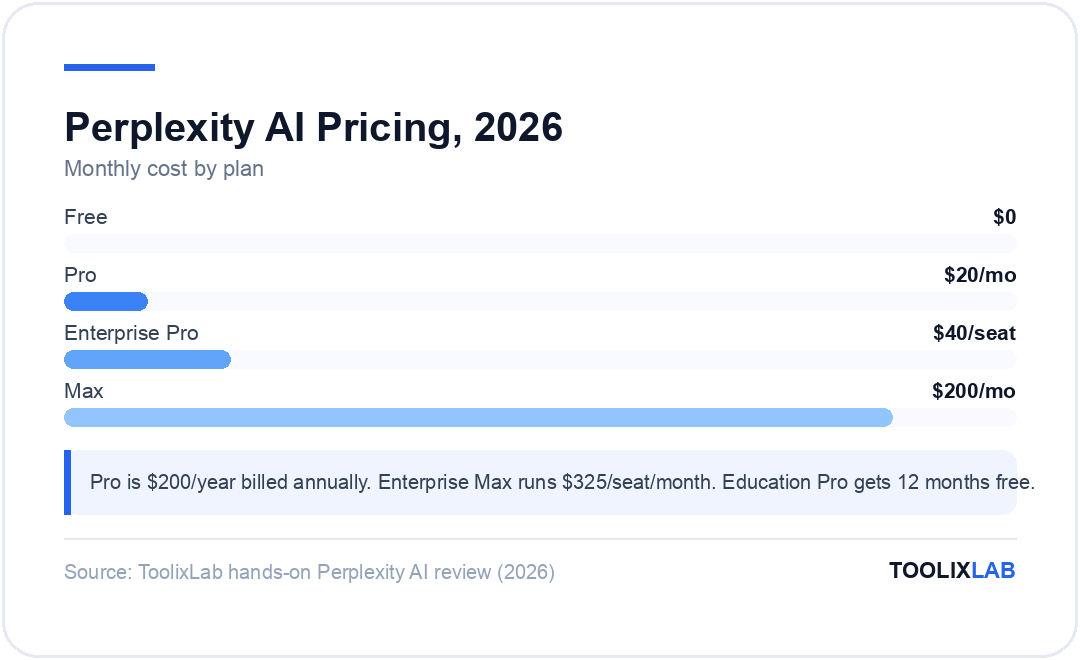
Here's exactly what each plan gives you, as of February 2026:
| Feature | Free | Pro ($20/mo) | Max ($200/mo) | Enterprise Pro ($40/seat/mo) |
|---|---|---|---|---|
| Quick Search | Unlimited | Unlimited | Unlimited | Unlimited |
| Pro Searches/day | 3 | 300+ | Unlimited | Unlimited |
| Deep Research | ✗ | ✓ | ✓ | ✓ |
| Premium models (ChatGPT, Claude, etc.) | ✗ | ✓ | ✓ | ✓ |
| File uploads | Limited | Unlimited | Unlimited | Unlimited |
| Spaces (personal) | ✓ | ✓ | ✓ | ✓ |
| Spaces (team collaboration) | ✗ | ✓ | ✓ | ✓ |
| Pages | ✗ | ✓ | ✓ | ✓ |
| Labs / Create Files & Apps | ✗ | Monthly limit | Unlimited | Monthly limit |
| Memory | ✓ (limited) | ✓ | ✓ | ✓ |
| Comet browser | ✗ | Rolling out | ✓ | ✗ |
| Model Council | ✗ | ✗ | ✓ | ✗ |
| Image generation | ✗ | ✓ | ✓ | ✓ |
| Admin controls | ✗ | ✗ | ✗ | ✓ |
| SSO & audit logs | ✗ | ✗ | ✗ | ✓ (50+ seats) |
| Data privacy | Standard | Standard | Standard | ✓ Enhanced |
Pro is $200/year billed annually. Enterprise Max is $325/seat/month. Education Pro: 12 months free. Pricing verified February 2026 — visit perplexity.ai/pricing for current rates.
💡 Which plan should you choose?
- Free: Good for occasional research. You'll hit the 3 Pro Search daily cap quickly if you use it seriously.
- Pro ($20/month): The right choice for anyone who researches regularly. Deep Research, 300+ Pro Searches, premium models, and file uploads — this is where Perplexity becomes genuinely transformative.
- Max ($200/month): For power users who live in Perplexity all day. Unlimited Labs, Model Council, Comet, and early access to new features justify the cost if you're doing high-volume research work.
- Enterprise Pro ($40/seat/month): For teams that need collaboration, admin controls, and data governance. The per-seat cost is high but reasonable for research-intensive organisations.
Our Testing Experience
Test 1: Competitive Research
Prompt: "Produce a competitive analysis of the top 5 AI writing tools for B2B content marketing teams in 2026. Include pricing, key features, and positioning."
Perplexity Pro Search returned a structured, 800-word analysis with 14 numbered citations within about 90 seconds. Every pricing figure linked to an official source. Every feature claim linked to a product page or review. The analysis was accurate, current, and immediately usable as a briefing document.
The same query in ChatGPT — without web browsing enabled — returned confident-sounding but outdated pricing information and features that had since changed. With browsing enabled, ChatGPT got closer, but the citations were less systematic and harder to verify.
Winner on this task: Perplexity — not close.
Test 2: Fact-Checking a Draft Article
Prompt: "Here is a draft article about AI regulation in the EU [paste text]. Identify any factual claims that may be inaccurate or outdated, with sources."
Perplexity flagged 4 claims in the draft that needed correction, each with a link to the correct current information. It identified a regulatory timeline that had shifted, a funding figure that had been updated, and two statistics whose original sources had since been revised.
This use case — using Perplexity as a fact-checking layer on top of AI-generated content — is one of the highest-value workflows for content teams. Write with Claude or ChatGPT, verify with Perplexity.
Test 3: Real-Time Monitoring
Prompt: "What has happened in the generative AI funding landscape in the past two weeks?"
Perplexity returned a structured summary of 6 recent funding announcements with dates, amounts, and links to original sources — all within 48 hours of the actual news. ChatGPT's training data had nothing on this. Claude acknowledged it couldn't answer. Gemini had some of it.
For anyone whose work requires staying current on a fast-moving topic, Perplexity has no real competitor.
Test 4: Document Analysis
Prompt: Upload a 60-page industry report PDF. "Summarise the key findings, identify the three most significant data points, and flag any claims that seem inconsistent with what you can find in current web sources."
Perplexity handled the PDF without issue, summarised accurately, and — crucially — cross-referenced the report's claims against live web data. It flagged two statistics in the report that had been superseded by more recent figures.
This cross-referencing of uploaded documents against live web data is something neither Claude nor ChatGPT does natively, and it's one of Perplexity's most underutilised capabilities.
Pros and Cons
Being honest matters here. Perplexity has real limitations, and knowing them upfront saves frustration.
Pros
✅ Excellent for citation-backed research Perplexity consistently returns sourced answers with clickable references, which makes verification fast and practical.
✅ Strong real-time information retrieval For fast-moving topics, Perplexity can surface updates and synthesize them quickly in a way static-knowledge tools cannot.
✅ High-value workflow fit for analysts and researchers Features like Deep Research, file analysis, and model choice create clear productivity gains for information-heavy work.
✅ Useful free tier and high-ROI Pro tier The free plan is meaningful for casual users, and Pro unlocks enough capability to justify cost for frequent research users.
Cons
❌ Creative writing is weak Ask Perplexity to write a blog post, marketing email, or creative piece and the output is noticeably inferior to Claude or ChatGPT. Perplexity is optimised for synthesis and accuracy, not voice and creative flow. Don't use it as a writing assistant.
❌ Coding support is limited Perplexity can answer coding questions and point you to documentation, but it can't match Claude's code generation quality or ChatGPT's Canvas coding environment. If you're building software, use Claude Code or ChatGPT.
❌ Free tier Pro Search cap is genuinely restrictive 3 Pro Searches per day sounds like enough until you use Perplexity seriously for even one afternoon. The cap exists to drive Pro upgrades and it does its job. If you plan to use Perplexity as a genuine research tool, budget $20/month.
❌ Max at $200/month is hard to justify for most individuals The jump from Pro ($20) to Max ($200) is steep. Unless you're doing research professionally at high volume or need Comet and Model Council specifically, Pro covers most needs. Max is built for power users who use Perplexity as a primary work tool, not a supplement.
❌ Answer quality varies by topic density Perplexity performs best on topics with a lot of high-quality web coverage. For niche, technical, or under-documented subjects, it can struggle to find good sources — and its answers reflect that. Always check the citations on niche topics.
Use Cases & Best For
Here are seven high-value use cases with prompts you can copy immediately:
Best For
- Researchers and analysts who need evidence-backed answers quickly
- Students and knowledge workers doing regular literature or market scans
- Teams that need fast fact-checking and current-event synthesis
Who Should Avoid It
- Users focused primarily on creative writing
- Developers needing deep code-generation workflows
- People wanting one assistant for every task instead of a research specialist
1. Morning briefing on your industry
"Summarise the most important news in [your industry] from the past 48 hours. Focus on funding, product launches, and regulatory developments."
2. Pre-meeting competitive research
"I'm meeting with [Company Name] tomorrow. Give me a brief on their recent announcements, product positioning, key leadership, and any notable recent news."
3. Fact-checking AI-generated content
"Review this [article/report] for factual accuracy. Flag any claims that are outdated, inaccurate, or unsupported by current sources: [paste text]"
4. Literature review shortcut
"What does current research say about [topic]? Summarise the main findings from studies published after 2023, with sources."
5. Due diligence on a company
"I'm evaluating a potential partnership with [Company]. Provide a brief covering their funding history, key products, market position, leadership, and any notable controversies."
6. Regulatory landscape scan
"What are the current regulatory requirements for [activity] in [region]? Focus on changes from the past 12 months."
7. Cross-referencing a document against current data
"Here is a [report/proposal/brief] from [date]. Identify any claims that may have been superseded by more recent developments: [paste document]"
How Does Perplexity Compare?
| Perplexity AI | ChatGPT | Claude | |
|---|---|---|---|
| Best use | Research & fact-finding | General tasks & creation | Writing & coding |
| Live web search | ✓ Always, every query | ✓ Optional | ✓ Optional |
| Citations | ✓ Always, clickable | Partial | Partial |
| Knowledge cutoff | None — always live | Exists (+ web browsing) | Exists (+ web browsing) |
| Image generation | ✓ (Pro+) | ✓ DALL-E | ✗ |
| Coding | Basic | Strong | Best |
| Creative writing | Weak | Good | Best |
| Multi-model support | ✓ GPT, Claude, Gemini, etc. | ✗ OpenAI only | ✗ Anthropic only |
| Free tier | Generous (Quick Search) | Moderate | Tight daily limits |
| Pro price | $20/month | $20/month | $20/month |
The verdict most experienced AI users reach: Perplexity is not a replacement for ChatGPT or Claude. It's a complement. Run both. Use Perplexity for research, use ChatGPT or Claude for creation.
If you're currently paying for one general-purpose AI and considering adding Perplexity, the question is whether your daily workflow involves significant research and fact-finding. If yes, the $20/month Pro plan has a clear ROI. If your AI use is mostly writing and coding, stick with what you have.
For our full breakdown of the major AI assistants, see ChatGPT vs Claude vs Gemini: Full 2026 Comparison. And for the full landscape of AI research tools, our 15 Best ChatGPT Alternatives covers the complete picture.
Is Perplexity Pro Worth $20/Month?
Let's be direct: yes, for most professionals who research daily.
Here's the practical value calculation. The Pro plan gives you:
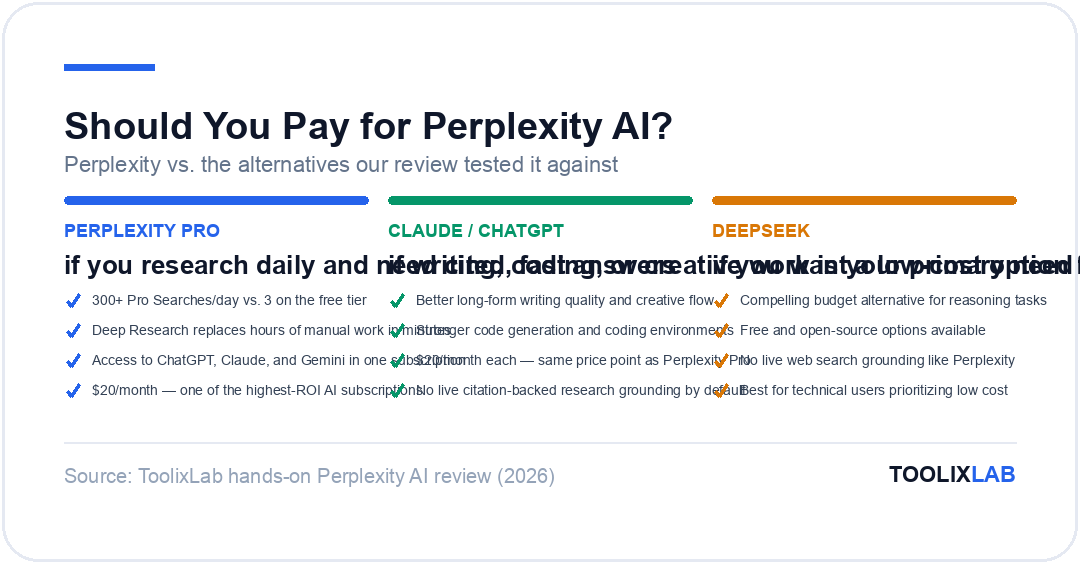
- 300+ Pro Searches per day (vs 3 on free) — this alone is the core unlock
- Deep Research — replaces hours of manual research per use
- Access to ChatGPT, Claude, Gemini, and other premium models — you're getting multi-model access in a single $20 subscription
- Unlimited file uploads for document cross-referencing
- Spaces collaboration for team research workflows
- Image generation via Seedream and other models
For context: you're paying $20/month to access ChatGPT, Claude Sonnet 4.6, and Gemini 2.5 — models that would cost $20/month each on their native platforms — plus Perplexity's own research infrastructure.
If you use Perplexity for even 2–3 significant research tasks per week, the time saved on a single Deep Research query likely justifies the monthly cost within days.
For whom it's NOT worth it:
- Casual users who only search occasionally (free tier is enough)
- Users whose primary AI needs are writing or coding (Claude Pro or ChatGPT Plus would serve them better)
- Individuals on a strict budget who already have one paid AI subscription — prioritise Claude or ChatGPT and use Perplexity's free tier
Alternatives to Consider
- Claude: Better for long-form writing quality, creative flow, and coding-heavy workflows.
- ChatGPT: Better all-rounder for mixed tasks, ideation, and creative output.
- Gemini: Strong ecosystem integration (especially Google Workspace) and broad multimodal capabilities.
- DeepSeek: Compelling budget option for reasoning and technical users who prioritize low cost.
If your workflow is creation-first, start with Claude or ChatGPT. If your workflow is research-first, Perplexity is usually the stronger fit.
🔬 How We Reviewed This Tool
This review is based on hands-on use, not a feature-list rewrite. Our process:
- Real workflows: we used the tool on genuine work tasks over an extended period and compared its output directly against its closest competitors.
- Verified claims: pricing, plan limits, and feature availability were checked against the vendor's official pages at the time of writing.
- Documented downsides: we report where the tool failed or frustrated us, not just where it shone — check the cons and "skip if" sections.
- Kept current: this review is re-verified on our refresh cycle; the "Last updated" date reflects the most recent check.
ToolixLab is reader-supported: some links may earn us a commission, which never affects our verdicts.
Frequently Asked Questions
Is Perplexity AI better than Google? For research questions requiring synthesis across multiple sources, yes — significantly. Google gives you links to read yourself. Perplexity reads them, summarises the findings, and shows you the sources. For simple factual lookups, Google is still fast and reliable. The tools serve different needs.
Can Perplexity replace ChatGPT? No — and it's not trying to. Perplexity is purpose-built for research and fact-finding. ChatGPT is better for writing, coding, creative tasks, and general conversation. They complement each other rather than compete. Many professionals use both.
Is the free tier actually useful? Yes, for casual use. Unlimited Quick Searches are genuinely capable. The limit of 3 Pro Searches per day is the main constraint — you'll hit it quickly if you use Perplexity for any real research work.
How accurate is Perplexity? More accurate than general-purpose AI assistants on factual questions, because its answers are grounded in live web sources rather than static training data. Its 93.9% score on the SimpleQA accuracy benchmark significantly outperforms comparable models. That said, it's not infallible — always verify important claims, especially for medical, legal, or financial decisions.
What is Perplexity Comet? Comet is Perplexity's AI-native browser, built on Chromium. It embeds an AI assistant directly into your browsing experience — summarising pages, helping you research while you browse, and automating multi-step web tasks. Currently available for Mac and Android, with iPhone launching March 11, 2026. Included with Max subscriptions.
Does Perplexity store my searches? Yes, by default your search history is stored and used to personalise future answers via Memory. You can manage this in settings. Enterprise plans offer enhanced data privacy and audit logs.
Can Perplexity analyse uploaded documents? Yes. Pro and Max users can upload PDFs, Word documents, spreadsheets, and presentations and ask questions about them. One of Perplexity's strongest features is its ability to cross-reference uploaded documents against live web data — finding claims in your document that may be outdated.
Conclusion: Should You Use Perplexity AI in 2026?
After thorough testing, the answer depends entirely on what you need AI for.
Use Perplexity if:
- You do regular research — market analysis, competitive intelligence, academic work, due diligence
- You need AI-generated answers you can actually verify and cite
- You want access to multiple frontier models (ChatGPT, Claude, Gemini) in one place
- You're already using Claude or ChatGPT for writing/creation and want a research complement
Skip Perplexity if:
- Your primary AI use case is writing, coding, or creative work
- You rarely need to verify facts or find current information
- You're looking for a single AI tool to do everything
For the free tier, the decision is easy — just use it. There's no reason not to. For Pro at $20/month, the question is how much research you do. If the answer is "regularly," it's one of the highest-ROI AI subscriptions available. For Max at $200/month, that's a professional power-user product, and most individuals should start with Pro.
Our overall rating: 9/10 for its intended use case. The most capable AI research tool available in 2026, with the clearest value proposition of any AI product we've reviewed — as long as you understand what it is and isn't built to do.
🚀 Get Started
- Free tier: perplexity.ai — no credit card required
- Pro trial: $20/month, cancel anytime
- If you're already a ChatGPT or Claude user, try Perplexity's free tier for one week of research tasks before deciding on Pro
Continue your AI journey:
- 🔗 ChatGPT vs Claude vs Gemini: Full 2026 Comparison — where Perplexity fits in the broader landscape
- 🔗 How to Use Claude AI in 2026 — the best AI for writing and coding
- 🔗 How to Use ChatGPT in 2026 — the most versatile general-purpose AI
- 🔗 15 Best ChatGPT Alternatives in 2026 — the full AI tool landscape
- 🔗 DeepSeek AI Review — the best free alternative for reasoning
Pricing and features verified February 2026. Visit perplexity.ai for current plans and rates.