
ChatGPT Trust Snapshot
Real Free Score
80/100
Lock-In Risk
Medium
Billing Friction
Low
Commercial Use
Allowed
Data Privacy
Clear
Volatility
Medium
Last checked
2026-07-22
We ran both tools through identical tasks — research, writing, fact-checking, brainstorming, and coding. Here's the honest verdict on which wins, when, and why most serious users end up running both.
By ToolixLab Research Team | Senior AI Tools Researcher | February 2026
⚡ Quick Verdict
- Perplexity wins: Real-time research, fact-checking, competitive intelligence, anything where you need verified, sourced, current answers
- ChatGPT wins: Writing, coding, brainstorming, creative tasks, long conversations, image generation
- The smart move: Use both — they solve fundamentally different problems and complement each other better than any single tool
You've probably used both at some point and noticed they feel completely different — even though on the surface, both seem to be "AI that answers questions."
That feeling is telling you something real. ChatGPT and Perplexity aren't competitors in the traditional sense. They're built on different architectural philosophies, optimised for different jobs, and used best in different parts of a workflow.
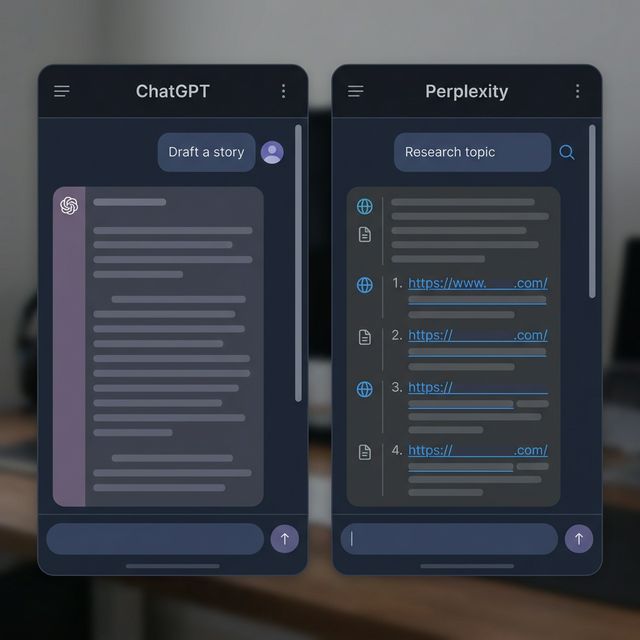
ChatGPT asks: "What do I know from my training that can help you?"
Perplexity asks: "What does the live web say about this right now — and here are the sources to prove it?"
Understanding that difference is the entire game. Once you do, the "which is better?" question dissolves into a much more useful one: "Which do I need right now, for this specific task?"
This comparison will give you a clear answer to that question across 8 real-world use cases, a head-to-head feature breakdown, and a practical decision framework you can apply immediately.
🔗 Want the full standalone breakdown of each tool? Read our Perplexity AI Review 2026 and How to Use ChatGPT in 2026 for deeper dives on each platform individually.
The Core Difference: Architecture First
Before comparing features, it's worth understanding why these tools behave differently. The difference isn't superficial — it's architectural.
ChatGPT is a language model. It generates responses based on a vast training dataset with a knowledge cutoff. It reasons, creates, codes, and converses from that learned knowledge. When web search is enabled, it can retrieve current information — but this is a feature layered on top of a generation-first model, not the core design.
Perplexity is an answer engine. Every single query triggers a live web search before a response is generated. It reads multiple sources simultaneously, synthesises the findings, and presents a structured answer with numbered, clickable citations. The model is search-first by default, not generation-first.
This architectural difference produces entirely different behaviour:
| ChatGPT | Perplexity AI | |
|---|---|---|
| Core design | Language model — generates from training data | Answer engine — searches web first, always |
| Knowledge | Training cutoff + optional web search | Live web, every query, no cutoff |
| Citations | Inconsistent — provided when browsing enabled | Always present, numbered, clickable |
| Multi-model | OpenAI models only | ChatGPT, Claude Sonnet 4.6, Gemini, Grok, DeepSeek |
| Hallucination risk | Higher on recent or niche facts | Lower — responses grounded in live sources |
| Creative output | Excellent | Weak |
| Coding | Excellent | Basic |
| Speed (factual queries) | Slower when browsing enabled | Faster by design |
| Free tier | Moderate limits | Generous (unlimited Quick Search) |
| Pro price | $20/month | $20/month |
One nuance worth flagging on multi-model support: Perplexity lets you choose which underlying AI powers your answer — ChatGPT, Claude Sonnet 4.6, Gemini 2.5, Grok, or Perplexity's own Sonar model. This means for $20/month, you're getting access to multiple frontier models in a single interface. ChatGPT is locked to OpenAI's ecosystem.
Head-to-Head: 8 Real-World Use Cases
We ran both tools through identical tasks across eight categories. Here's exactly what happened.
🔍 Use Case 1: Real-Time Research
The task: "What are the most significant AI funding rounds in the past two weeks? Include amounts, investors, and company descriptions."
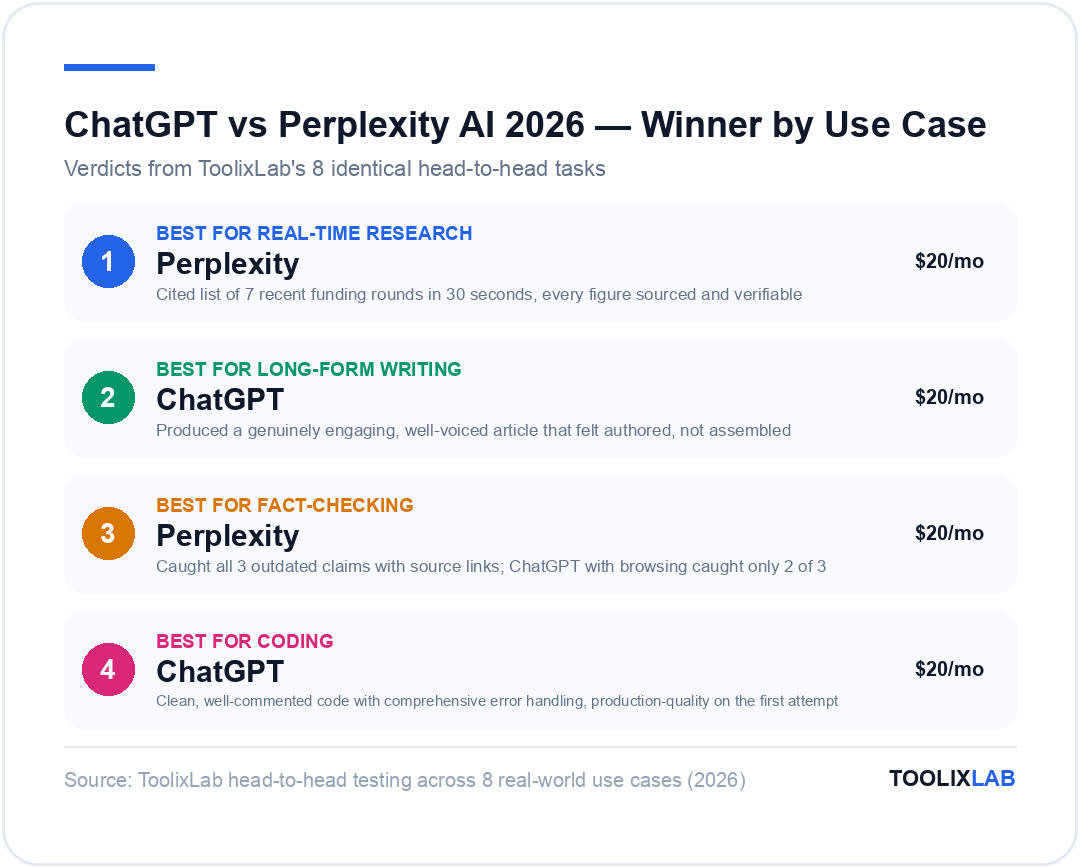
Perplexity: Returned a structured, cited list of 7 recent funding announcements within 30 seconds — each with the exact amount, lead investors, and a source link to the original news coverage. Every figure was current and verifiable.
ChatGPT (browsing enabled): Returned accurate results but was noticeably slower — it browses sources sequentially rather than in parallel, which means more waiting. Citation formatting was inconsistent; some claims linked to sources, others didn't.
ChatGPT (browsing disabled): No useful answer. The training data was weeks behind on several items.
Winner: Perplexity — clearly. Real-time information retrieval is Perplexity's core competency. For any question where the answer might have changed recently, Perplexity is faster, more reliable, and more transparent.
✍️ Use Case 2: Long-Form Writing
The task: "Write a 600-word thought leadership article about the future of remote work for a business audience. Professional but human tone."
Perplexity: Produced a competent, well-structured article — but it read like a synthesis of existing articles rather than original thought. The language was correct but flat. It would need significant editing before client submission.
ChatGPT: Produced a genuinely engaging, well-voiced article that felt authored rather than assembled. The argument was original, the transitions were smooth, and the tone was consistent throughout. Ready to publish with minor tweaks.
Winner: ChatGPT — not close. ChatGPT's language generation capabilities are in a different league for creative and long-form writing. Perplexity is research-first; writing quality reflects that.
✅ Use Case 3: Fact-Checking a Draft
The task: Paste a 500-word AI industry article containing 3 intentionally outdated claims. Ask each tool to identify any inaccuracies.
Perplexity: Identified all 3 outdated claims, each with a source link pointing to the correct current information. Response time: under 60 seconds. The citations made it trivially easy to verify the corrections.
ChatGPT (browsing enabled): Identified 2 of the 3 claims. Missed one nuanced pricing update that Perplexity caught. Citations were present but less consistently formatted.
Winner: Perplexity. For fact-checking AI-generated or externally sourced content before publication, Perplexity's live web search and citation system is the most reliable layer available. This use case — write with Claude or ChatGPT, verify with Perplexity — is one of the highest-value hybrid workflows for content professionals.
💻 Use Case 4: Coding Assistance
The task: "Write a Python script that reads a CSV, calculates the average of a specified column, and outputs the result with error handling for missing values."
Perplexity: Produced working code with basic error handling. The output was functional but lacked comments, didn't handle edge cases like empty columns, and the error messages weren't particularly descriptive.
ChatGPT: Produced clean, well-commented code with comprehensive error handling — missing values, empty columns, non-numeric data, file not found. Explained each function clearly. Production-quality on the first attempt.
Winner: ChatGPT — decisively. For any coding task beyond pointing to documentation, ChatGPT is the significantly stronger tool. Developers should use ChatGPT (or Claude) for coding and Perplexity for researching technical documentation or finding relevant Stack Overflow answers.
💡 Use Case 5: Brainstorming and Ideation
The task: "Give me 15 content marketing angles for a B2B SaaS company launching an AI-powered HR tool. Make them varied — some thought leadership, some tactical, some contrarian."
Perplexity: Returned 15 ideas, but most were search-synthesis outputs — topics it had seen covered, angles that already exist. Few felt genuinely fresh or contrarian.
ChatGPT: Returned 15 ideas with noticeably more originality, sharper angles, and better variety between the tone categories requested. Several were genuinely surprising and usable as-is.
Winner: ChatGPT. Ideation and creative brainstorming require generative thinking, not search synthesis. ChatGPT's language model architecture is fundamentally better suited to producing novel combinations of ideas.
🏢 Use Case 6: Competitive Intelligence
The task: "I'm meeting with [Company X] tomorrow. Give me a briefing on their recent product launches, funding, key executives, and positioning — from the past 90 days only."
Perplexity: Delivered a well-structured briefing with 11 sources, covering all four requested areas with current information. The 90-day constraint was respected. Every claim was linked.
ChatGPT (browsing enabled): Delivered a comparable briefing but with less precise sourcing. Some claims from beyond the 90-day window crept in, and it was harder to distinguish what was recent vs. historical.
Winner: Perplexity. For pre-meeting research, due diligence, or any competitive intelligence task with a recency requirement, Perplexity's architecture and citation system make it the clear choice.
📄 Use Case 7: Document Analysis
The task: Upload a 30-page industry report PDF. "Summarise the key findings and identify any claims that may be outdated based on current web sources."
Perplexity: Summarised accurately and, crucially, cross-referenced the report's claims against live web data — flagging two statistics that had since been updated. This cross-referencing capability is unique to Perplexity's architecture.
ChatGPT: Summarised well but worked only from the uploaded document — it did not cross-reference against live web data in the same systematic way. The summary was accurate for what the document said, but couldn't flag whether the document itself was now outdated.
Winner: Perplexity for documents that may contain time-sensitive claims. ChatGPT for documents that need deep analytical interpretation rather than currency checking.
🎙️ Use Case 8: Conversational Depth and Follow-Ups
The task: A multi-turn conversation exploring a complex strategic question, building on previous answers across 6 exchanges.
Perplexity: Handled early turns well but struggled to maintain a coherent thread across longer exchanges. Each response felt slightly reset — it kept reaching back to web sources rather than building on the developing conversation.
ChatGPT: Maintained full context across all 6 exchanges, building arguments progressively, referencing earlier points explicitly, and deepening the analysis with each turn. The conversation felt genuinely collaborative.
Winner: ChatGPT. For extended, iterative conversations — the kind of deep thinking dialogue that makes AI feel like a thinking partner — ChatGPT's conversational architecture is superior. Perplexity is built for queries, not dialogues.
Feature-by-Feature Comparison

Search and Citations
Perplexity searches the web on every single query, by default, always. Citations are numbered, inline, and clickable. The transparency is built into the product DNA.
ChatGPT has web browsing available, but it's optional and inconsistently deployed. When enabled, it browses sequentially and produces less structured citations. This isn't a flaw — it's a consequence of being a generation-first, not search-first, model.
Edge: Perplexity — significantly.
Model Access
ChatGPT offers ChatGPT, o3, o4-mini, and o1 — all OpenAI models. The diversity within OpenAI's lineup (fast models, reasoning models, mini models) is genuinely useful.
Perplexity offers ChatGPT, Claude Sonnet 4.6, Gemini 2.5, Grok, DeepSeek, and its own Sonar model — all from a single subscription. For users who want to cross-check answers across providers, this is a meaningful advantage.
Edge: Perplexity for multi-provider access. ChatGPT for depth within the OpenAI ecosystem.
Memory and Personalisation
ChatGPT has genuine persistent memory — it remembers your name, preferences, past projects, and writing style across all conversations. This creates a genuinely personalised experience over time.
Perplexity has Memory on Pro and Max plans, but it's less mature. Perplexity is primarily session-based — it's optimised for query resolution, not long-term relationship building.
Edge: ChatGPT.
Image and Multimedia Generation
ChatGPT generates images via DALL-E, videos via Sora (available on select plans), and supports advanced voice mode. It's a genuinely multimodal platform.
Perplexity offers image generation on Pro and Max plans (via Seedream and other models), but no voice or video generation. The core product remains text-based.
Edge: ChatGPT — significantly.
Free Tier Generosity
Perplexity offers unlimited Quick Searches for free — this is a genuinely useful free tier for basic lookups and casual research. The main free limit is 3 Pro Searches per day.
ChatGPT offers access to ChatGPT, DALL-E, and web browsing on the free tier, but with tighter overall message limits.
Edge: Perplexity for research-focused users. ChatGPT for multimedia and creative free-tier tasks.
Pricing
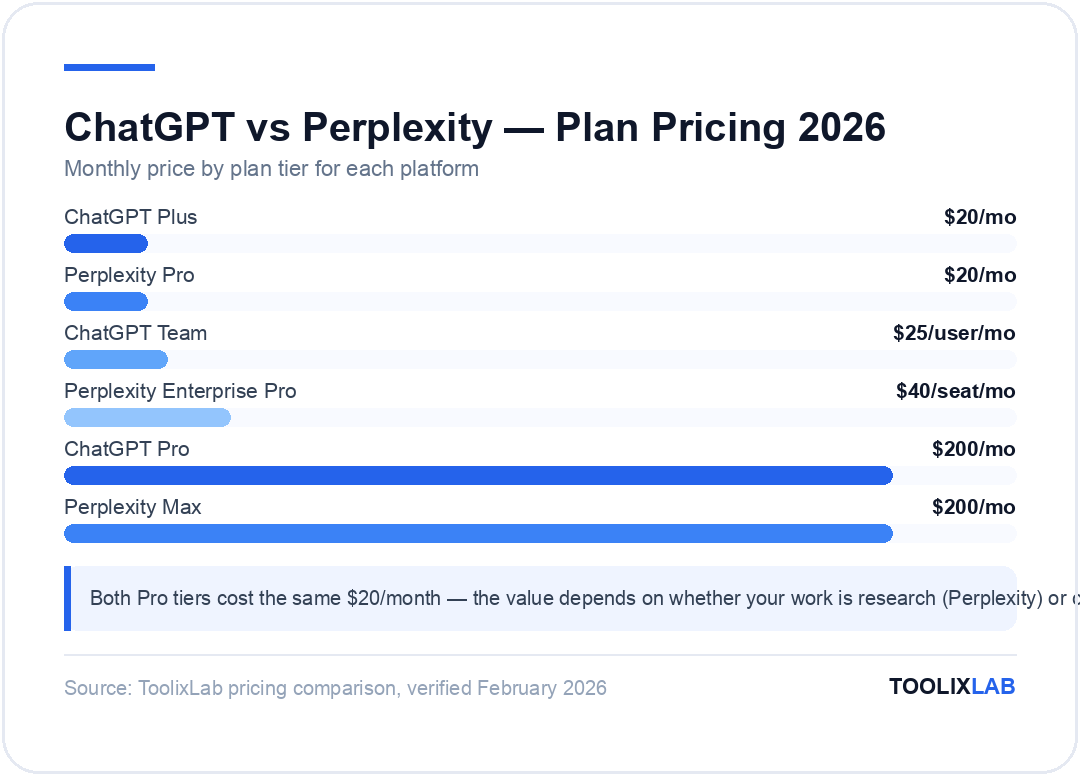
Both tools are $20/month for their Pro tiers. At identical prices, the value proposition depends entirely on your use case:
- $20/month on ChatGPT Plus = best-in-class general purpose AI with image generation, voice, and the broadest tool ecosystem
- $20/month on Perplexity Pro = best-in-class research AI with 300+ Pro Searches daily, Deep Research, access to ChatGPT + Claude + Gemini in one interface
If you can only afford one: choose based on whether your work is primarily creation (ChatGPT) or research (Perplexity).
The Hybrid Workflow: Why Most Serious Users Run Both
Here's the conclusion most experienced AI users eventually reach: ChatGPT and Perplexity aren't in competition — they're the two halves of a complete research-and-creation workflow.
The Hybrid Workflow looks like this:
Step 1 — Research (Perplexity): Use Perplexity to gather current information, verify facts, and understand the landscape. Every claim you collect is sourced and clickable.
Step 2 — Create (ChatGPT or Claude): Feed that research into ChatGPT or Claude as context, then use the generative power of a language model to write, structure, and refine your output.
Step 3 — Verify (Perplexity): Before publishing or submitting, run your draft back through Perplexity's fact-checking to catch any claims that have become outdated or inaccurate.
This three-step workflow produces better outputs than either tool alone — Perplexity's accuracy feeding ChatGPT's creativity, with a verification pass at the end.
💡 Practical example for content teams: Use Perplexity Pro Search to research your topic and collect 8–10 cited sources. Paste those sources as context into Claude or ChatGPT with your article brief. Generate the draft. Then paste the draft back into Perplexity and ask: "Fact-check this article. Flag any claims that are outdated or unsupported." The result is faster, more accurate, and more defensible than any single-tool workflow.
Decision Framework: Which One Do You Need?
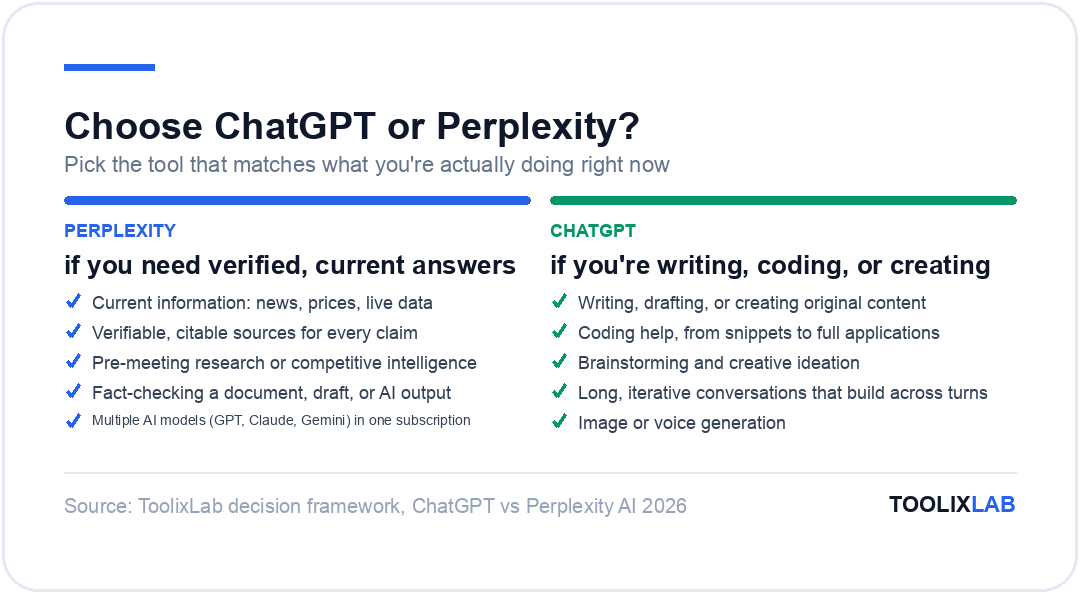
Use Perplexity when:
- → You need current information (news, prices, recent events, live data)
- → You need verifiable, citable sources for every claim
- → You're doing pre-meeting research or competitive intelligence
- → You're fact-checking a document, draft, or AI output
- → You want access to multiple AI models (GPT, Claude, Gemini) in one subscription
- → You need a faster, more transparent answer to a direct factual question
Use ChatGPT when:
- → You're writing, drafting, or creating any form of original content
- → You need coding help — from snippets to full applications
- → You're brainstorming, ideating, or exploring a problem creatively
- → You're having a long, iterative conversation that builds across turns
- → You need image or voice generation
- → You want persistent memory and personalisation across all your conversations
Use both when:
- → You're producing any content that requires both research accuracy and creative quality
- → You're a professional whose work spans research, writing, and creation daily
- → You want to cross-reference important AI answers across multiple providers
Pricing Summary
| Plan | ChatGPT | Perplexity |
|---|---|---|
| Free | ChatGPT (limited), DALL-E, web browse | Unlimited Quick Search, 3 Pro Searches/day |
| Pro | $20/month | $20/month |
| Pro includes | Higher limits, Deep Research, Canvas, DALL-E, Voice | 300+ Pro Searches, Deep Research, premium models (ChatGPT, Claude, Gemini), file uploads, Spaces, Pages |
| Power user | ChatGPT Pro $200/month | Perplexity Max $200/month |
| Team | $25/user/month | Enterprise Pro $40/seat/month |
Pricing verified February 2026. Visit each platform's pricing page for current rates.
The value case for running both: At $20/month each, you're spending $40/month total for access to the two best AI tools for their respective jobs — plus, through Perplexity's multi-model support, indirect access to Claude Sonnet 4.6, Gemini 2.5, ChatGPT, and Grok under one subscription.
Frequently Asked Questions
Is Perplexity more accurate than ChatGPT?
For factual questions requiring current information, yes — significantly. Perplexity's live web search and citation system grounds every answer in real sources, reducing the hallucination risk that affects ChatGPT on recent or niche topics. Academic research published in Frontiers in Digital Health (2025) found Perplexity achieved the highest matched accuracy rate among major AI chatbots at 67%. For creative or analytical tasks where "accuracy" means reasoning quality rather than factual currency, ChatGPT's performance is strong and comparable.
Can Perplexity replace ChatGPT?
No — and it's not trying to. Perplexity is built for research and information retrieval. ChatGPT is built for creation, conversation, and reasoning. Replacing one with the other would leave significant capability gaps in either direction. Most power users run both.
Which is better for students?
Perplexity is better for research — finding sources, verifying claims, and understanding current literature. ChatGPT is better for learning concepts, getting explanations, brainstorming paper arguments, and drafting. Students doing serious academic work benefit from both. Perplexity offers a free education Pro plan worth checking.
Does Perplexity use ChatGPT's technology?
Partly. Perplexity Pro users can select ChatGPT as their underlying model — so yes, ChatGPT's technology is one option within Perplexity's multi-model interface. But Perplexity also supports Claude, Gemini, Grok, DeepSeek, and its own proprietary Sonar model. The search infrastructure and answer engine are entirely Perplexity's own.
Which is better for SEO and content marketing?
Use both. Perplexity for keyword and topic research, competitor content analysis, and finding current statistics to cite. ChatGPT (or Claude) for drafting, outlining, and creating the actual content. Verify the final draft with Perplexity before publishing.
Is the $20/month Pro plan worth it for each?
For ChatGPT Plus: yes, if you use AI for writing, coding, or any creative work daily. The higher message limits, Deep Research, and image generation alone justify it. For Perplexity Pro: yes, if you do regular research. The jump from 3 to 300+ Pro Searches per day is transformative for research-intensive work. See our full Perplexity AI Review for a detailed breakdown of whether Pro is worth it.
What about Claude — where does it fit?
Claude is primarily a creation tool (like ChatGPT) but with strengths in long-form writing, complex document analysis, and coding quality that compete with or exceed ChatGPT in those specific areas. The most productive three-tool stack for knowledge workers is Perplexity for research, Claude for writing and analysis, and ChatGPT for coding and multimedia tasks. See our How to Use Claude AI guide for a full walkthrough.
Conclusion: Stop Choosing, Start Combining
The "ChatGPT vs Perplexity" framing suggests you have to pick one. You don't — and if you do pick just one, you're optimising for half your workflow and leaving the other half underserved.
ChatGPT is the most capable creative and conversational AI available. Perplexity is the most accurate and transparent research tool available. The professionals getting the most value from AI in 2026 are the ones who've stopped looking for a single tool that does everything adequately and started building a deliberate stack where each tool does one thing exceptionally.
Research with Perplexity. Create with ChatGPT or Claude. Verify with Perplexity again.
That three-step workflow beats any single-tool approach — every time.
🚀 Get Started
- Perplexity AI — Free tier, no credit card required
- ChatGPT — Free tier available
- Both Pro plans are $20/month — run them in parallel for one month and measure the productivity difference
Continue reading:
- 🔗 Perplexity AI Review 2026 — Full standalone breakdown of Perplexity's features and pricing
- 🔗 How to Use ChatGPT in 2026 — Step-by-step guide to getting the most from ChatGPT
- 🔗 How to Use Claude AI in 2026 — The best AI for writing and long-form content
- 🔗 ChatGPT vs Claude vs Gemini: Full Comparison — The complete three-way breakdown
- 🔗 15 Best ChatGPT Alternatives in 2026 — The full AI tool landscape
Pricing and features verified February 2026. Visit perplexity.ai and chatgpt.com for current plans.
⚖️ Our Verdict
ChatGPT and Perplexity are not really competitors — they solve fundamentally different problems, and the best users of both understand that. Perplexity is a research engine with citations; ChatGPT is a creation and reasoning assistant. Use Perplexity when you need to know something verifiable; use ChatGPT when you need to build, write, or automate something.
✅ Choose Perplexity if...
- • Your primary use is research and fact-finding with cited sources
- • You want to replace Google for professional or academic searches
- • Verifiable, sourced answers matter more than creative output
✅ Choose ChatGPT if...
- • Content creation, copywriting, or coding are your main use cases
- • You need extended multi-turn conversations and task automation
- • Plugin integrations or image generation are part of your workflow