
⚡ TL;DR — Key AI Statistics for 2026
Every week, another company announces an AI transformation. Every conference features a keynote about the AI revolution. But beneath the hype, what do the actual numbers say about how AI tools are being adopted, used, and — critically — whether they're delivering results?
We've compiled over 50 verified statistics on the state of AI tools in 2026, drawn from McKinsey, OpenAI, PwC, the Federal Reserve, DataReportal, CompTIA, and other primary sources. No inflated vendor claims. No cherry-picked success stories. Just the data — including the uncomfortable findings that most AI roundups quietly skip.
Whether you're deciding which tools to adopt, making a business case for AI investment, or simply trying to understand where the industry is headed, this is the most comprehensive AI statistics resource available for 2026.
1. The Big Picture: Global AI Market Statistics 2026
The AI industry is now large enough that its market size figures span hundreds of billions of dollars — and even the research firms can't agree on the exact number. Here's what the major analysts say about the state of the global AI market in 2026.
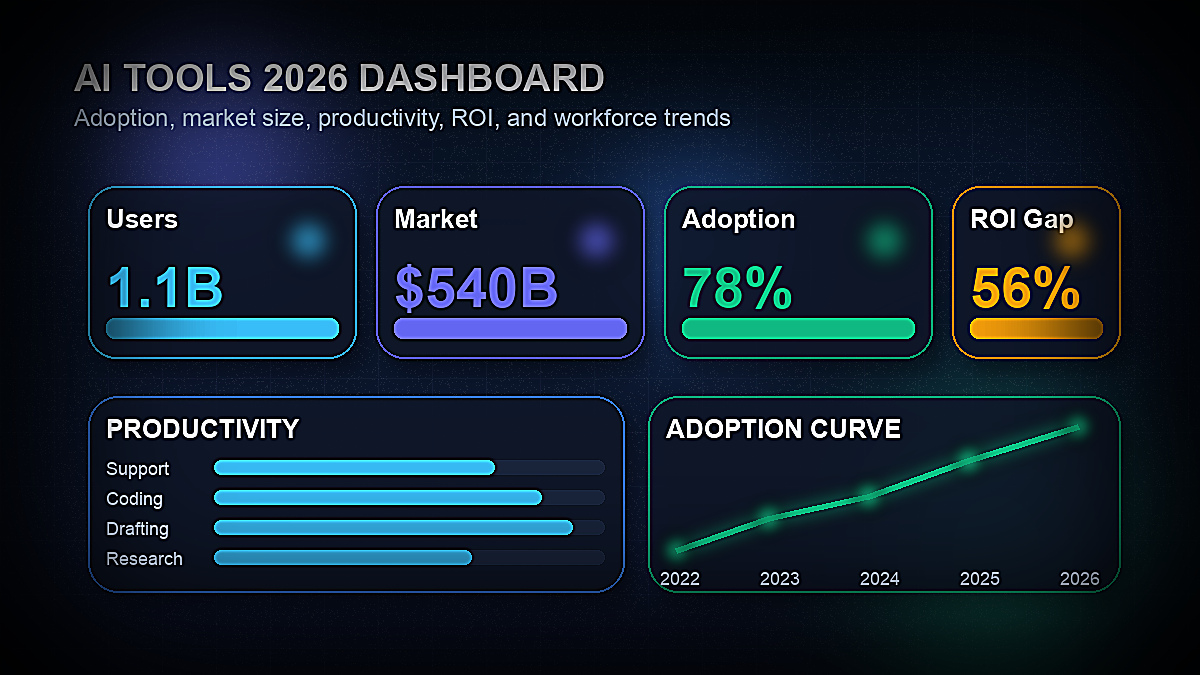
- 01The global AI market is projected to reach ~$540 billion in 2026, according to Grand View Research — though estimates range from $376B (Fortune Business Insights) to $622B (Business Research Insights) depending on methodology and market scope.
- 02The market is forecast to reach $3.5 trillion by 2033, expanding at a compound annual growth rate of 30.6% — making AI one of the fastest-growing sectors in the history of technology.
- 03McKinsey's baseline estimate puts generative AI's annual value potential at $2.6–$4.4 trillion across 63 use cases, with the highest value in customer operations, marketing and sales, software engineering, and R&D.
- 04North America leads with 35.5% of global AI market revenue, followed by Europe and Asia-Pacific. The US alone accounts for the majority of North American AI investment and deployment.
- 05The cumulative economic impact of generative AI adoption is projected to reach $19.9 trillion by 2030 — a figure that, if accurate, would represent one of the largest wealth creation events in economic history.
Why market size estimates vary so widely: Different analysts include different things. Some count only software AI tools; others include AI hardware, cloud AI services, and professional services. When comparing figures, always check what's included in the definition.
2. AI Adoption Statistics: How Many People and Companies Use AI?
Adoption figures tell us who's using AI — but they also reveal a more complex story about the gap between awareness and meaningful use.
| Metric | Figure | Source |
|---|---|---|
| Global active AI users | 1.1 billion | DataReportal / Resourcera 2026 |
| Companies using AI in ≥1 function | 78–88% | Multiple surveys (varies by definition) |
| Organizations regularly using gen AI | 71% | McKinsey State of AI 2025 |
| Knowledge workers using gen AI daily | 38% | Multiple workforce surveys 2026 |
| US adults who use AI | 60% | Omniflow / Various US surveys 2026 |
| Gen Z / Millennial share of AI users | 65% | Demographics surveys 2026 |
- 06DataReportal's Digital 2026 report found that more than 1 billion people globally use AI — the largest year-on-year user growth ever recorded, with 64 million new AI users added since 2024.
- 07McKinsey's 2025 State of AI survey found 71% of organizations regularly use generative AI in at least one business function, up from 65% in early 2024 — representing a meaningful acceleration even from an already-high baseline.
- 08Daily usage among knowledge workers has tripled: 38% now use generative AI tools daily, up from just 11% in 2024. The shift from "occasional experimentation" to embedded daily habit is the defining adoption story of 2025–2026.
- 09Younger workers are pulling the adoption curve upward. For under-30s, weekly AI usage climbed from 33% in 2023 → 43% in 2024 → 58% in 2025. Generational adoption patterns suggest this demographic will normalize AI use across entire industries.
- 10Approximately 65% of all AI tool users are Millennials or Gen Z, reflecting how digital-native generations are leading workplace AI adoption rather than following it.
3. ChatGPT and Leading AI Tool Statistics
ChatGPT remains the dominant AI tool by almost every measure. Its growth from 2022 to 2026 is one of the fastest consumer technology adoption stories ever recorded — and the numbers are genuinely staggering.
- 11OpenAI reported in February 2026 that ChatGPT has reached 900 million weekly active users — more than double the 400 million reported in February 2025. This represents one of the fastest user growth trajectories in tech history.
- 12ChatGPT records over 5.35 billion monthly visits and holds approximately 80.49% of the AI chatbot market, making it the undisputed category leader despite increasing competition from Claude, Gemini, and Perplexity.
- 13ChatGPT set the record for fastest consumer app to reach 1 million users — achieved in just 5 days after launch in November 2022. For context, Instagram took 2.5 months; Netflix took 3.5 years.
- 14Daily active ChatGPT usage sits at approximately 123.5 million users per day, representing consistent daily engagement well beyond casual experimentation.
- 15The broader AI tools market shows strong diversity beyond ChatGPT. ChatGPT alternatives including Claude, Gemini, and Perplexity have collectively gained significant ground in 2025–2026, with enterprise customers particularly diversifying their AI stacks.
4. AI Productivity Statistics: Time Saved and Output Gains
Productivity is where the AI hype meets reality — and the data reveals a more nuanced picture than most vendor marketing suggests. Yes, workers are saving time. But not as much as the headlines claim, and a significant portion of that time saving is offset by new work that AI creates.
- 1685% of workers report saving 1–7 hours per week using AI tools — a figure that looks impressive until you account for the rework problem (see stat 20).
- 17The Federal Reserve found that self-reported AI time savings translate to a 1.1% increase in aggregate productivity — meaning workers using AI are approximately 33% more productive in each hour they use it, even if they don't use it for every hour of the workday.
- 18Among small business workers, the average time saving is 5.6 hours per week. Managers see disproportionate gains — saving 7.2 hours per week on average compared to just 3.4 hours for individual contributors, suggesting AI is more immediately useful for coordination and synthesis tasks than execution tasks.
- 19In customer support specifically — one of the most AI-mature use cases — workers using AI resolved 14% more issues per hour on average. The gains were even larger for newer employees: 34% faster resolution times among those in their first year on the job.
- 20The rework problem is real and significant. Workday's 2026 research found that 37–40% of time "saved" by AI is consumed by reviewing, correcting, and verifying AI-generated output. Only 14% of employees consistently get clear, net-positive outcomes from AI without significant follow-up work.
- 21Even accounting for rework, the productivity math still favors AI adoption at scale. Workers who use AI effectively save a net approximately 2.2 hours per week (5.4% of a 40-hour week), translating to meaningful cumulative output gains across large teams.
📊 Productivity by Use Case: What AI Does Best
For a practical guide to building AI into your actual work processes, see our deep-dive on AI content creation workflows — which covers how to structure your toolset to minimize the rework problem.
5. AI ROI Statistics: What's the Actual Business Impact?
This is where the gap between the AI narrative and AI reality is most stark. The ROI data from 2025–2026 tells a sobering story: a minority of companies are seeing transformative results, while a majority are investing significantly and measuring little in return.
- 22PwC's 2026 Global CEO Survey — covering 4,454 CEOs across 95 countries — found that 56% say they've gotten "nothing out of" their AI investments. Only 12% reported that AI both grew revenues AND reduced costs simultaneously.
- 23McKinsey found that only 39% of organizations report any measurable EBIT impact from AI, and among those who do report impact, most say less than 5% of their organization's EBIT is attributable to AI use.
- 24Of 1,933 McKinsey survey respondents, only 109 — or about 5.6% — reported that more than 5% of their organization's EBIT is attributable to AI. McKinsey calls this the "high performer" segment that has genuinely rewired workflows around AI rather than just adopting tools.
- 25The single biggest predictor of AI ROI isn't the tools used — it's workflow redesign. McKinsey's data shows that organizations that redesigned their core workflows around AI see dramatically higher EBIT impact than those who simply added AI tools to existing processes.
- 26The picture is different for small and medium-sized businesses. 91% of SMBs reported a year-over-year return on their AI investments, and 93% of growing SMBs using AI saw revenue grow — suggesting smaller organizations may be capturing AI value more efficiently than large enterprises.
- 2783% of growing SMBs have adopted AI, compared to just 55% of declining businesses. The correlation between AI adoption and business growth is statistically meaningful — though it's worth noting that growing businesses also have more resources to invest in new tools.
The uncomfortable finding most AI guides won't tell you:
Most companies are not getting meaningful ROI from AI. The 5% of organizations capturing transformative value have one thing in common: they changed how work gets done, not just what tools they use. The tools are a commodity. The processes are the differentiator.
6. AI Usage Statistics by Profession and Industry
AI adoption isn't uniform across professions. Some fields have integrated AI deeply into daily workflows; others are still experimenting. Here's what the data shows for the professions most relevant to ToolixLab's readers.
| Profession | AI Usage Rate | Daily Users | Primary Use Case |
|---|---|---|---|
| Software Developers | 92% | 51% | Code generation, debugging, documentation |
| Students | 92% | ~60% | Brainstorming, grammar, concept explanation |
| HR Professionals | 62% | N/A | Recruitment, engagement monitoring, onboarding |
| Marketers | 37–58% | N/A | Content creation, campaign copy, analytics |
| Knowledge Workers (all) | 38% daily | 38% | Email, summarization, research, drafting |
Developers & Engineers
- 2892% of software developers use AI tools in some part of their workflow, making development the most AI-saturated professional category tracked. AI coding assistants are no longer an edge-case preference — they're the norm. See our roundup of the best AI tools for developers for the tools driving this adoption.
- 2951% of professional developers use AI tools every single day — the highest daily usage rate of any profession tracked. Code generation, debugging assistance, and documentation generation are the top three use cases.
Students
- 30AI usage among students has surged from 66% to 92% over the past two years. The three most common uses: brainstorming and ideation (49%), grammar and writing improvement (42%), and concept explanation (41%).
- 31Student AI adoption is outpacing institutional policy: most universities still lack clear, enforceable AI usage guidelines, creating significant friction between how students learn and how institutions assess them.
Marketing & Sales
- 32Marketing and sales is the highest-value gen AI use case by business impact according to McKinsey — not just by adoption rate but by measurable revenue attribution. Organizations reporting EBIT impact most commonly cite marketing and sales use cases as the driver.
- 3337% of marketing and advertising professionals report using AI in their regular tasks — a figure that likely understates actual usage given how many AI tools are embedded in platforms like HubSpot, Canva, and Mailchimp without users explicitly flagging "AI use." For AI tools specific to this role, see our guide to best AI marketing tools.
HR & Recruiting
- 3454% of HR departments use AI for talent acquisition, and 62% use AI tools to monitor employee engagement. AI adoption in HR has been particularly rapid in recruitment screening — where AI tools can improve candidate quality by up to 64% by surfacing higher-quality matches from large applicant pools.
7. AI and the Job Market: What the Data Actually Shows
Few topics generate more heat than AI's impact on employment. The actual data is more nuanced than either the "AI will destroy jobs" or "AI will only create jobs" camps suggest.
- 35In January 2026, there were over 275,000 active job postings requiring AI skills — up significantly from prior years. CompTIA estimates net tech employment will grow by 1.9% in 2026, creating approximately 185,499 new positions.
- 36The composition of job demand is shifting measurably. Since ChatGPT's launch, routine and automation-prone job postings have fallen 13%, while demand for analytical, technical, and creative roles has grown 20% — a structural shift that data scientists had predicted but that arrived faster than most models anticipated.
- 37There's a pronounced AI skills premium emerging in wages. Workers with documented AI skills earn approximately 4.5× higher wages and receive 4× more promotions than peers without AI skills. Only 5% of the current workforce has these skills — meaning the supply-demand gap is significant and likely to persist for several years.
- 38Entry-level workers face the greatest risk. 89% of 2026 graduates report worrying that AI will replace entry-level roles — up from 64% just one year earlier. This concern is directionally correct: routine, template-driven entry-level work is genuinely being automated, while roles requiring judgment, relationship-building, and strategic thinking are growing.
- 39The aggregate employment picture through 2026 remains roughly neutral — jobs lost to AI are approximately equal to jobs created by AI. After 2028, most economic models predict AI will begin creating more jobs than it displaces as entirely new categories of work emerge around managing, training, and auditing AI systems.
- 40Wages are rising in AI-exposed occupations for experienced workers. A Dallas Fed study found that AI exposure increases wages for workers with deep tacit knowledge and experience — the people who know what good output looks like and can direct AI toward it effectively.
8. AI for Small Business: The Numbers That Matter Most
Small businesses are often left out of the enterprise-focused AI narrative — but the SMB data is arguably the most encouraging of any segment tracked. Here's what it looks like when smaller teams adopt AI tools at full velocity.
- 4168% of US small businesses now use AI tools regularly in 2026, up from under 40% in 2024. AI investment among SMBs climbed to 57% in 2025 (from 42% in 2024 and 36% in 2023) — consistently accelerating adoption. For a full tool breakdown, our best AI tools for small business guide covers the most impactful options by budget.
- 42The average AI-adopting small business saves $500–$2,000 per month in operational costs, primarily in content production, customer service, and administrative tasks. Over a year, that's $6,000–$24,000 in savings — often more than the cost of the tools combined.
- 4378.6% of SMBs using AI report that it has reduced costs or improved efficiency — a very high satisfaction rate compared to most enterprise software categories. The narrower scope of SMB workflows may make AI gains easier to realize and measure than in large enterprises.
- 44There's a strong correlation between AI adoption and business health: 83% of growing small businesses use AI, while only 55% of declining businesses do. Even accounting for survivorship bias, this gap is notable and consistent across multiple surveys.
- 45Content marketing and generation is the #1 SMB AI use case, followed by customer service automation and email marketing. These are exactly the tasks where free AI tools can deliver value even before any paid investment.
9. What's Coming: AI Trends and Projections Beyond 2026
The statistics above capture where AI stands right now. These forward-looking projections — drawn from research firms, economic models, and technology analysts — describe where it's headed.
- 46Agentic AI is the next major commercial wave. AI agents that can take multi-step actions autonomously — browsing the web, writing code, sending emails, managing files — are moving from research demonstrations to mainstream products in 2026. This shift will likely create a second, larger wave of AI productivity gains than the current chatbot-based tools.
- 47The AI skills premium of 4.5× wages will compress as AI literacy becomes more common, but the window for capturing outsized value from AI skills is open right now. Early movers in most professional fields are still gaining advantage over AI-passive peers.
- 48The cumulative economic impact of AI adoption is projected to reach $19.9 trillion by 2030 — contingent on sustained adoption rates and meaningful workflow redesign at organizational scale. This is a compound projection and carries wide uncertainty bands.
- 49After 2028, AI is predicted to create more jobs than it destroys — primarily in AI operations, model supervision, AI safety, and entirely new professional categories we don't yet have names for. The transition period (now through ~2028) is where displacement risk is highest for routine work.
- 50The gap between AI leaders and AI laggards is widening faster than most organizations recognize. McKinsey's data shows that the top 5% of AI-adopting organizations are now pulling far ahead in both efficiency and revenue growth — creating competitive dynamics that will be difficult to reverse for slow-adopting competitors.
🔑 The State of AI Tools in 2026: Key Takeaways
Methodology and Sources
Every statistic in this article is drawn from a named primary source. We've prioritized independent research organizations over vendor-published data, and primary surveys over second-hand aggregations. Key sources include:
- • McKinsey State of AI 2025 — annual enterprise AI survey (n=1,933 respondents)
- • DataReportal Digital 2026 — global internet and AI usage data
- • Backlinko ChatGPT Statistics 2026 — aggregated ChatGPT usage data
- • PwC Global CEO Survey 2026 — 4,454 CEOs across 95 countries
- • CompTIA State of Tech Workforce 2026 — job market data
- • Federal Reserve Bank of St. Louis — productivity impact research
- • Workday Research 2026 — workplace AI productivity study
- • Grand View Research AI Market Report — market sizing
Statistics are verified as of April 2026. AI adoption data moves quickly — we update this article on a rolling basis as new primary research becomes available.
Further Reading: Category-Specific Statistics
- AI's Impact on SEO Rankings: 50+ Statistics for 2026 — how AI Overviews and zero-click search are reshaping organic traffic.
- AI Medical Diagnosis Accuracy Statistics 2026 — where AI already matches specialists, and where it still falls short.
- AI Water Usage Statistics 2026 — the sourced numbers behind AI's data center water footprint.
- AI CRM ROI Statistics 2026 — sourced data on AI-CRM productivity gains, deal-cycle impact, and adoption.
- Gen Z Trust in AI Statistics 2026 — sourced Gallup, Pew, and Deloitte data on the generational trust gap.
- AI Threat Detection Statistics 2026 — sourced IBM and Vectra AI data on detection speed, SOC automation, and the AI governance gap.
- AI GPU Cluster Deployment Statistics 2026 — sourced NVIDIA, Dell'Oro, and McKinsey data on infrastructure capex, power density, and the 2030 capacity gap.
- AI Job Displacement Statistics 2026 — sourced WEF, Goldman Sachs, Stanford HAI, and PwC data on measured layoffs and the two-track labor market.
- AI in Healthcare Statistics 2026 — sourced NVIDIA, FDA, AMA, and JAMA data on adoption, regulatory approvals, and what ambient scribes actually save.
- AI in Education Statistics 2026 — sourced Stanford HAI, Pew Research, CDT, and UNESCO data on student/teacher adoption and the AI-policy gap.
- Generative AI Statistics 2026 — sourced Stanford HAI, McKinsey, Gartner, and Graphite data on investment, adoption maturity, and AI-written content volume.
- AI Energy Consumption Statistics 2026 — sourced IEA, MIT Technology Review, and Goldman Sachs data on data center electricity demand, per-query energy cost, and rising emissions.
- AI Chatbot Statistics 2026 — sourced Pew Research, Statcounter, and Salesforce data on chatbot usage, market share, and enterprise resolution-rate claims.
- ChatGPT Usage Statistics 2026 — sourced OpenAI, Reuters/Sensor Tower, and Pew Research data on ChatGPT's user growth, demographics, and the market-share methodology gap.
- AI Marketing Statistics 2026 — sourced Salesforce, Gartner, and HubSpot data on adoption, AI budget allocation, and the readiness-vs-execution gap.