
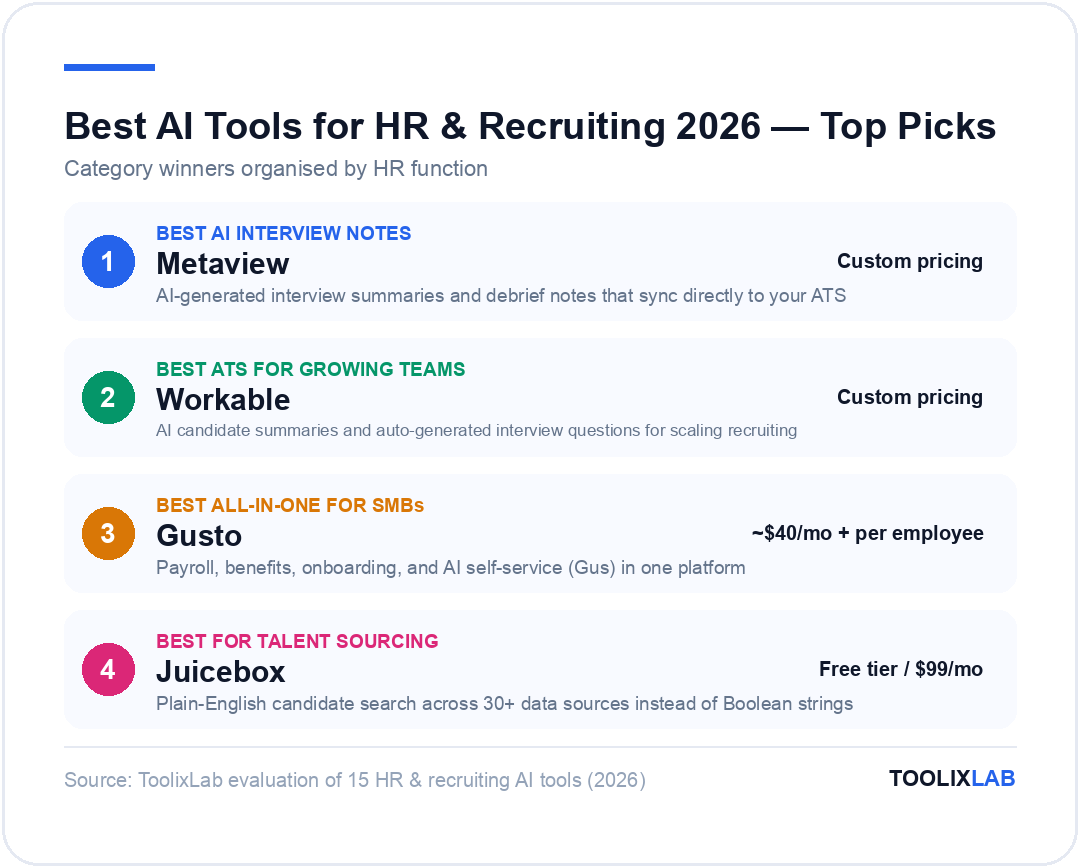
TL;DR: Top picks — Metaview (AI interview notes), Workable (all-round ATS for growing teams), Gusto (all-in-one for SMBs). This guide is organised by HR function so you can find the right tool for the specific stage that's slowing you down.
The average HR professional now handles more employee touchpoints, more compliance requirements, and more hiring volume than ever before — often with the same headcount as five years ago. AI tools for HR in 2026 aren't designed to replace your HR team. They're designed to take the admin off their plate so they can focus on what actually moves the needle.
The problem with most "best AI HR tools" roundups is that they give you a flat list of 15 products and leave you guessing which one applies to your situation. Are you trying to source better candidates? Speed up interviews? Reduce onboarding paperwork? Each of those problems needs a different tool.
This guide is organised by HR function. Find the stage of your workflow that's breaking down, pick the right tool for it, and use the stack-building framework at the end to see how it all fits together.

What Makes a Great AI HR Tool in 2026?
Before diving into the list, it's worth knowing what separates genuinely useful AI HR software from tools that just slapped "AI" on their marketing page.
AI-Native vs. AI-Bolted-On
There's a meaningful difference between a platform built around AI from the ground up and one that added an AI feature in a recent update. AI-native tools use machine learning throughout the entire workflow — not just in one or two screens. When evaluating any tool, ask the vendor: "Where specifically does AI touch the workflow, and how was the model trained?"
Must-Have Integrations
The best AI HR tool in the world is useless if it doesn't connect to the systems your team already uses. Look for native integrations with your ATS (Greenhouse, Lever, or Workday), your HRIS, Slack, Zoom or Teams, and your calendar. A tool that requires manual data entry between systems will cost you more time than it saves.
Compliance and Bias Safeguards
This is non-negotiable in 2026. Any AI tool making decisions about candidates or employees is operating in legally sensitive territory. EEOC guidelines in the US and AI Act compliance in the EU now require employers to be able to explain automated hiring decisions. Before committing to any tool, ask: Does the vendor provide an audit trail? Can you explain why the AI scored a candidate a certain way? Is there a human-in-the-loop at decision points?
Pro tip: If a vendor can't clearly explain how their model avoids demographic bias, treat that as a dealbreaker — not a minor concern.
Best AI Tools for Talent Sourcing
Sourcing is where most recruiters spend the most time and get the least leverage. The tools below flip that equation.
1. Juicebox (PeopleGPT) — Best for Plain-English Candidate Search
Juicebox lets you search for candidates using plain English — the way you'd describe an ideal hire to a colleague — instead of Boolean strings. Under the hood, it searches across 30+ data sources including LinkedIn, GitHub, and company databases to surface qualified candidates you wouldn't find with a standard ATS search.
- Key features: Natural language candidate search across 30+ data sources; AI-enriched profiles with skills, experience, and contact data; outreach sequences built into the platform; integrates with major ATS platforms
- Pros: Dramatically reduces sourcing time; accessible for non-technical recruiters; excellent candidate data enrichment
- Cons: Quality of results depends on how you phrase queries; smaller talent pools for niche technical roles
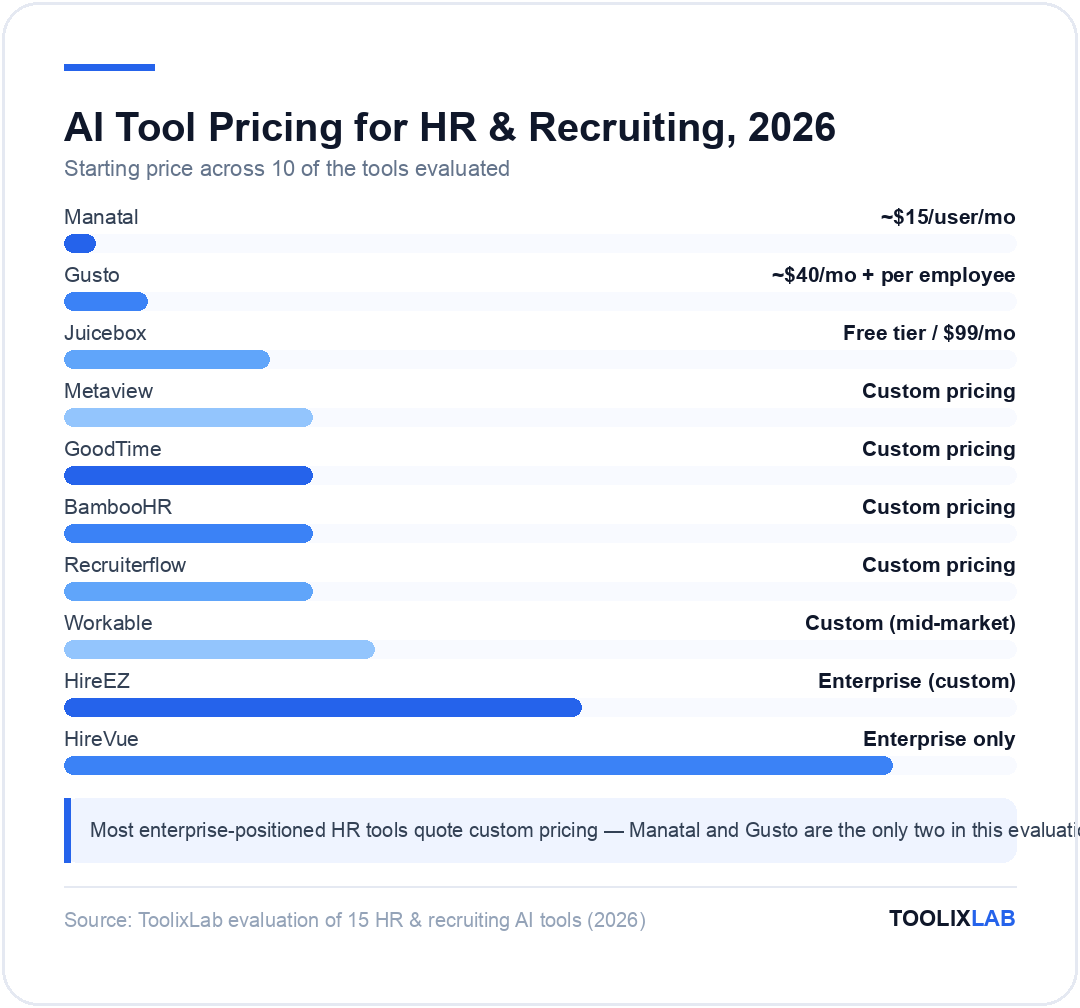
- Pricing: Free tier available; paid plans from $99/month — verify current pricing on juicebox.ai
- Best for: In-house recruiters and talent acquisition teams who want to ditch Boolean searching
Pro tip: The more specific your plain-English query, the better Juicebox performs. Instead of "marketing manager," try "B2B SaaS demand gen lead with ABM experience at a Series A or B startup."
2. HireEZ — Best for High-Volume Outbound Sourcing
HireEZ is an outbound recruiting platform that uses AI to search the open web — LinkedIn, GitHub, Indeed, Twitter/X, and more — and consolidates candidate profiles in one place. Its AI filters help narrow pools by skills, diversity criteria, and experience level.
- Key features: Multi-source open web sourcing; AI diversity filters for building balanced pipelines; automated outreach sequencing; CRM for nurturing passive candidates
- Pros: Broad sourcing coverage across multiple platforms; strong diversity hiring support; good analytics on outreach performance
- Cons: Can feel overwhelming for small teams; pricing reflects its enterprise positioning
- Best for: High-volume in-house recruiting teams and companies with active diversity hiring initiatives
Best AI Tools for Resume Screening & Candidate Assessment
The average corporate job posting receives over 250 applications. Manual screening at that volume is how good candidates get missed and bias creeps in.
3. Manatal — Best All-in-One ATS with AI Screening
Manatal combines an applicant tracking system with AI-powered candidate scoring, so you don't have to choose between managing your pipeline and screening intelligently. It enriches candidate profiles with social media data, scores applicants against your job criteria, and surfaces the best matches automatically.
- Key features: AI candidate scoring and ranking; social media profile enrichment; built-in job board posting to 2,500+ platforms; Kanban pipeline management; reports and analytics
- Pros: Genuinely useful AI scoring; one of the best value ATS + AI combos on the market; clean UX; strong onboarding support
- Cons: Best results require well-structured job descriptions; integration library is decent but not enterprise-grade
- Pricing: From approximately $15/user/month (Professional plan) — verify current pricing on manatal.com
- Best for: Recruitment agencies and HR departments that want ATS functionality and AI screening in one affordable platform
4. Workable — Best for Growing Businesses
Workable's AI Screening Assistant reads candidate profiles and generates plain-English summaries so hiring managers can quickly understand a candidate without reading every line of a CV. It also generates role-specific interview questions automatically — a genuine time-saver for managers who don't conduct interviews daily.
- Key features: AI candidate summaries; auto-generated interview questions by role and seniority; 270+ job board integrations; collaborative hiring with notes, scorecards, and approvals; reporting dashboard
- Pros: Excellent balance of features vs. ease of use; strong sourcing integrations; good for teams without a dedicated ATS admin
- Cons: AI features are newer additions — not as deep as dedicated screening tools; some users report customer support delays
- Best for: Growing businesses (20–500 employees) that need a flexible, scalable recruiting platform without a six-month implementation
Best AI Tools for Interviewing
Interviewing is where most recruiting processes slow down and where the most bias tends to enter. These tools solve both problems.
5. HireVue — Best for Enterprise Video Interviewing
HireVue is the market leader in AI-powered video interviewing. Candidates record responses to structured questions asynchronously, and HireVue's AI assesses responses based on content and structure. It's used by major enterprises including Unilever, Delta, and Walmart to handle high-volume interview stages that would otherwise require dozens of recruiters.
- Key features: Asynchronous and live video interviewing; AI-scored response assessment; game-based cognitive and personality assessments; interview guides and question libraries by role; ATS integrations
- Pros: Handles massive interview volumes efficiently; validated assessment methodology
- Cons: Some applicants find async video interviewing impersonal; AI assessment transparency has faced scrutiny; pricing is enterprise-only
- Pricing: Enterprise pricing — contact HireVue directly for a quote
- Best for: Large enterprises running high-volume hiring at scale — graduate recruitment, retail, logistics, and financial services
Watch out for: HireVue has faced criticism over the fairness of AI-based assessment. If you use it, ensure your team reviews AI scores as one signal — not the final word.
6. Metaview — Best AI Interview Notetaker
Metaview is purpose-built for talent acquisition teams who are drowning in interview notes. It joins your Zoom or Teams calls, records and transcribes the conversation, and generates structured summaries — including key candidate responses, follow-up questions worth asking, and readiness signals — delivered straight to your ATS.
Unlike generic meeting notetakers (Otter, Fireflies), Metaview is trained specifically on recruiting conversations. It understands the difference between a candidate explaining a project and a candidate deflecting a hard question.
- Key features: AI-generated interview notes and summaries; intake meeting notes and debrief summaries; integrates with Zoom, Teams, Google Meet; syncs directly with Greenhouse, Lever, Ashby; candidate comparison across interviews
- Pros: Saves 30–45 minutes per interview in note-writing; summaries are accurate and well-structured; interviewers can focus on conversation
- Cons: Requires candidate consent for recording; quality depends on audio clarity
- Best for: Talent acquisition teams running high interview volumes
Pro tip: Metaview's debrief summaries are particularly useful for aligning hiring panel decisions — everyone works from the same structured notes instead of subjective recollections.
Best AI Tool for Interview Scheduling
Every day a role sits open costs money. Scheduling delays are one of the most fixable drags on time-to-hire.
7. GoodTime — Best for Eliminating Scheduling Bottlenecks
GoodTime automates the back-and-forth of interview scheduling by finding optimal slots across candidate and interviewer calendars, balancing interview loads across your panel, and sending reminders and confirmations automatically. For companies with multi-stage interviews involving 4–6 interviewers, the time savings are significant.
- Key features: Automated multi-interviewer scheduling; interviewer workload balancing; candidate self-scheduling portal; timezone-aware slot suggestions; integrations with Greenhouse, Lever, Workday, Google Calendar, Outlook
- Pros: Eliminates scheduling back-and-forth almost entirely; good analytics on scheduling efficiency
- Cons: Overkill for small teams with simple interview processes
- Best for: Mid-to-large companies running structured multi-stage interview processes
Best AI Tools for Onboarding
A poor onboarding experience costs you the hire you just made. These tools automate the admin so new joiners get attention, not paperwork.
8. BambooHR — Best for SMB Onboarding & People Management
BambooHR is the go-to HR platform for small and medium businesses, and its onboarding module is where it shines. New joiner workflows are automated — equipment requests, document signing, training assignments, and benefits enrollment are all triggered automatically. Their AI feature, "Ask BambooHR," lets employees ask plain-English questions about PTO balances, benefits, and company policies.
- Key features: Automated onboarding task assignment; e-signature for offer letters and contracts; AI-powered people analytics; "Ask BambooHR" conversational AI for employee self-service; performance management and time tracking
- Pros: Excellent onboarding UX; very accessible for non-technical HR teams; strong customer support
- Cons: Shows limitations at 200+ employees; some integrations require workarounds
- Best for: SMBs (10–200 employees) that need onboarding, HR records, and basic people management in one platform
9. Staffbase — Best for Distributed & Hybrid Workforces
Staffbase is an AI-native employee experience platform designed for companies where not everyone sits in the same office — or even the same country. It centralizes onboarding content, internal communications, and company knowledge so new employees in different locations all get the same structured first 90 days.
- Key features: Centralized onboarding journeys with multimedia content; AI-powered internal communications; multi-language support across 50+ languages; analytics on content engagement; mobile-first for deskless workers
- Pros: Excellent for geographically distributed teams; genuine internal comms features beyond onboarding
- Cons: Enterprise-positioned pricing; more complex to set up than simpler tools
- Best for: Mid-to-large companies with distributed, hybrid, or deskless workforces
Best AI Tools for Employee Engagement & Retention
Hiring is expensive. Keeping people is cheaper. These tools help you understand what's working before people start leaving.
10. Sloneek — Best for Automating Routine HR Tasks
Sloneek is an AI-powered HR platform built for SMBs that want to automate the operational side of HR without a five-figure implementation budget. It handles routine HR tasks while layering in AI surveys, 360° feedback, and OKR tracking for the strategic side.
- Key features: AI-powered employee surveys and sentiment analysis; 360° feedback and performance check-ins; KPI and OKR tracking; automated leave management; people analytics dashboard
- Best for: Growing SMBs (20–150 employees) wanting to automate HR admin and build a feedback culture simultaneously
11. Paylocity — Best for Workforce Planning at Scale
Paylocity sits at the intersection of payroll, HR, and workforce analytics. Its AI capabilities focus on forward-looking insights: predicting staffing needs based on historical patterns, flagging flight-risk employees based on engagement signals, and generating compensation benchmarking data.
- Key features: AI staffing predictions and workforce planning; compensation benchmarking and pay equity analysis; automated job description generation; engagement surveys with sentiment analysis; full payroll and benefits administration
- Best for: Mid-to-large companies (200+ employees) that want to connect payroll data with people analytics for strategic workforce planning
Best AI Tools for Performance Management & Employee Relations
12. HR Acuity — Best for Complex Employee Relations Cases
Most HR platforms treat employee relations as an afterthought. HR Acuity built their entire platform around it. Their AI companion, olivER™, is trained on 20+ years of employee relations best practices and helps ER specialists navigate complex cases — generating investigation plans, drafting interview questions, creating case chronologies, and flagging risks.
- Key features: olivER™ AI — ER case assistant and knowledge companion; case management with full audit trail; investigation planning and documentation; trend analytics across ER cases; compliance-ready documentation
- Pros: Genuinely specialized — no generic HR platform does ER this well; audit trails protect companies legally
- Cons: Specialist tool, not a full HR suite; enterprise pricing
- Best for: Enterprise HR teams and ER specialists handling complex workplace investigations
Best All-in-One AI HR Platforms
Sometimes you don't want 5 tools — you want one that covers enough of the HR lifecycle to be your primary system.
13. Gusto — Best All-in-One for Small Businesses
Gusto is the closest thing to a full HR operating system for small businesses. Payroll, benefits, compliance, onboarding, time tracking, and now AI — their assistant "Gus" handles employee FAQ queries, PTO approvals, and policy questions without requiring HR to jump in every time.
- Key features: Full payroll processing and tax filing (all 50 US states); benefits administration (health, dental, vision, 401k); onboarding automation and e-signatures; "Gus" AI assistant for employee self-service; HR compliance alerts and guidance
- Pros: Genuinely does the full HR + payroll stack for SMBs; easy to use without an HR background; strong compliance support; transparent pricing
- Cons: US-focused — not suitable for international teams; less powerful for complex organizational structures
- Pricing: Simple plan starts at approximately $40/month + per-employee fee — verify current pricing on gusto.com
- Best for: US-based small businesses (1–100 employees) that want HR, payroll, and benefits in one place
14. Workday — Best Enterprise HCM
Workday is the enterprise standard for human capital management, and its AI capabilities have matured significantly. Machine learning now powers job description generation, internal career matching, skills gap analysis, and compensation modeling. If your organization is 1,000+ employees and running globally, Workday is likely already in your ecosystem or on your shortlist.
- Key features: AI-powered talent matching and internal mobility; skills intelligence and workforce planning; automated job description generation; compensation benchmarking; global payroll and compliance (150+ countries)
- Cons: Expensive and complex to implement; overkill for SMBs; requires dedicated admin resources
- Best for: Large enterprises (1,000+ employees) running globally that need a single system of record for all people data
15. Recruiterflow — Best AI-First ATS for Agencies
Recruiterflow is built specifically for recruiting and staffing agencies — not in-house HR teams. Its AI Submission Agent takes a candidate profile and a job description and drafts a client-ready submission email in seconds, a task that typically takes a recruiter 3–7 minutes per candidate. At volume, that's a significant time recovery.
- Key features: AI Submission Agent for fast client-ready candidate emails; combined ATS + CRM; automated outreach sequences; analytics on recruiter activity, placements, and revenue
- Pros: Purpose-built for agencies; submission agent genuinely impressive; good value
- Best for: Small to mid-sized recruiting and staffing agencies
Quick Comparison: Top AI HR Tools at a Glance
| Tool | Best For | AI Capability | Starting Price | SMB Friendly? |
|---|---|---|---|---|
| Juicebox | Talent sourcing | Natural language search | Free tier | ✅ |
| HireEZ | High-volume sourcing | Multi-source AI search | Custom | ⚠️ |
| Manatal | ATS + screening | Candidate scoring | ~$15/user/mo | ✅ |
| Workable | Growing teams | AI summaries + questions | Custom | ✅ |
| HireVue | Enterprise interviewing | Video AI assessment | Enterprise | ❌ |
| Metaview | Interview notes | AI transcription + summaries | Custom | ✅ |
| GoodTime | Scheduling | Auto slot matching | Custom | ⚠️ |
| BambooHR | SMB onboarding | AI surveys + self-service | Custom | ✅ |
| Gusto | SMB all-in-one | AI self-service (Gus) | ~$40/mo + per employee | ✅ |
| Workday | Enterprise HCM | Full AI talent suite | Enterprise | ❌ |
| Recruiterflow | Recruiting agencies | AI submission agent | Custom | ✅ |
How to Build Your AI HR Stack (Decision Framework)
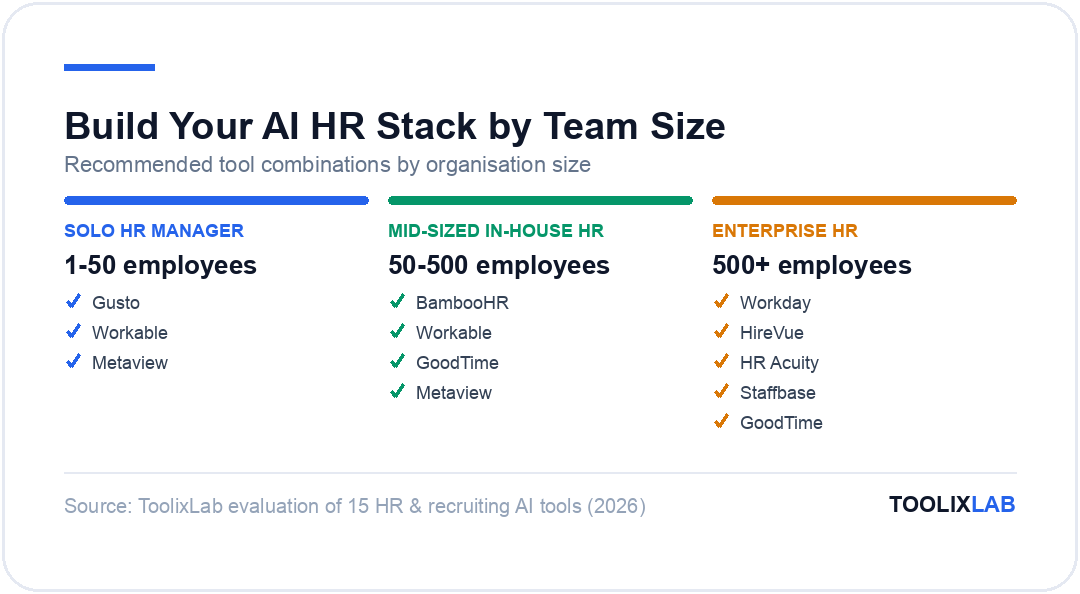
The biggest mistake HR teams make when adopting AI tools is buying a platform for its most-advertised feature without thinking about how it fits their full workflow.
👤 Solo HR Manager (1–50 employees)
Stack: Gusto + Workable + Metaview
Covers HR, payroll, recruiting, and interview notes without complexity overload.
🏢 Mid-Sized In-House HR (50–500)
Stack: BambooHR + Workable + GoodTime + Metaview
Dedicated tools for each stage, integrated together.
🔄 Recruiting/Staffing Agency
Stack: Recruiterflow + Juicebox + Metaview
Speed, client management, and submission quality.
🌐 Enterprise HR (500+ employees)
Stack: Workday + HireVue + HR Acuity + Staffbase + GoodTime
Depth, compliance, and global coverage.
Pro tip: Before buying any new tool, audit what your existing ATS or HRIS already does with AI. Platforms like Greenhouse, Lever, and BambooHR have been shipping AI features regularly — you may already have capabilities you're not using.
AI in HR Red Flags — What to Watch Out For
Not every tool that claims AI actually uses it responsibly. Here are the warning signs to watch for before signing a contract.
- Black-box AI decisions. If a vendor can't explain why their algorithm scored a candidate a certain way, that's a legal and ethical problem. Under EU AI Act provisions taking effect in 2026, employers may be required to provide explanations for automated decisions affecting candidates.
- Weak data privacy practices. HR data is among the most sensitive data your organization handles. Request a Data Processing Agreement (DPA) and confirm GDPR and CCPA compliance before committing to any tool.
- AI that auto-rejects candidates without human review. Automated screening is fine. Automated rejection without any human in the loop is where bias compounds and legal exposure increases.
- Vague model training explanations. Ask every vendor: "What data was your AI model trained on?" If the answer is evasive, the model may have been trained on historical hiring data that encodes past biases.
Frequently Asked Questions
What is the best AI tool for small business HR?
Gusto is the top pick for most small businesses. It covers payroll, benefits, onboarding, compliance, and an AI assistant ("Gus") for employee self-service — all in one platform. For recruiting specifically, pair it with Workable or Manatal for ATS functionality.
Can AI replace HR managers?
No — and the better AI HR tools aren't designed to. They automate administrative tasks so HR professionals can focus on strategic work: culture, talent development, complex employee relations, and organizational design. The judgment calls still require humans.
Are AI recruiting tools biased?
They can be, if trained on historical hiring data that reflects past biases. The best tools build in bias mitigation — diversity filters, blind screening options, and explainable AI scoring. Always ask vendors how their models are trained and what bias testing they've conducted.
How much do AI HR tools cost?
The range is wide. Entry-level tools like Manatal start around $15/user/month. Mid-market platforms like Gusto start around $40/month plus a per-employee fee. Enterprise tools like Workday and HireVue use custom pricing. Budget $50–150/employee/year for a solid mid-market AI HR stack.
Verdict: The HR AI Stack for 2026
The best AI HR teams in 2026 share one philosophy: use AI for the admin, humans for the judgment. No tool on this list should be making final hiring or firing decisions autonomously. What they should be doing — and what the best of them do extremely well — is removing the friction that stops HR professionals from doing meaningful work.
Top 3 overall picks:
- Metaview — If you do nothing else, stop writing interview notes manually. Metaview pays for itself in the first week.
- Workable — The best balance of recruiting capability, AI features, and ease of use for teams that aren't ready for enterprise-grade complexity.
- Gusto — For small businesses that want HR, payroll, and AI self-service in one place without a dedicated HR tech team to manage it.
If you're also looking to automate beyond HR, our guide on How to Build an AI Workflow in 2026 shows how to connect your HR tools into a broader automation stack. And if you're evaluating AI tools for other parts of your business, check out our roundups on 25 Best AI Tools for Sales in 2026 and 20 Best AI Tools for Small Business.