
By ToolixLab Research Team · Last updated: July 2026
Quick Answer
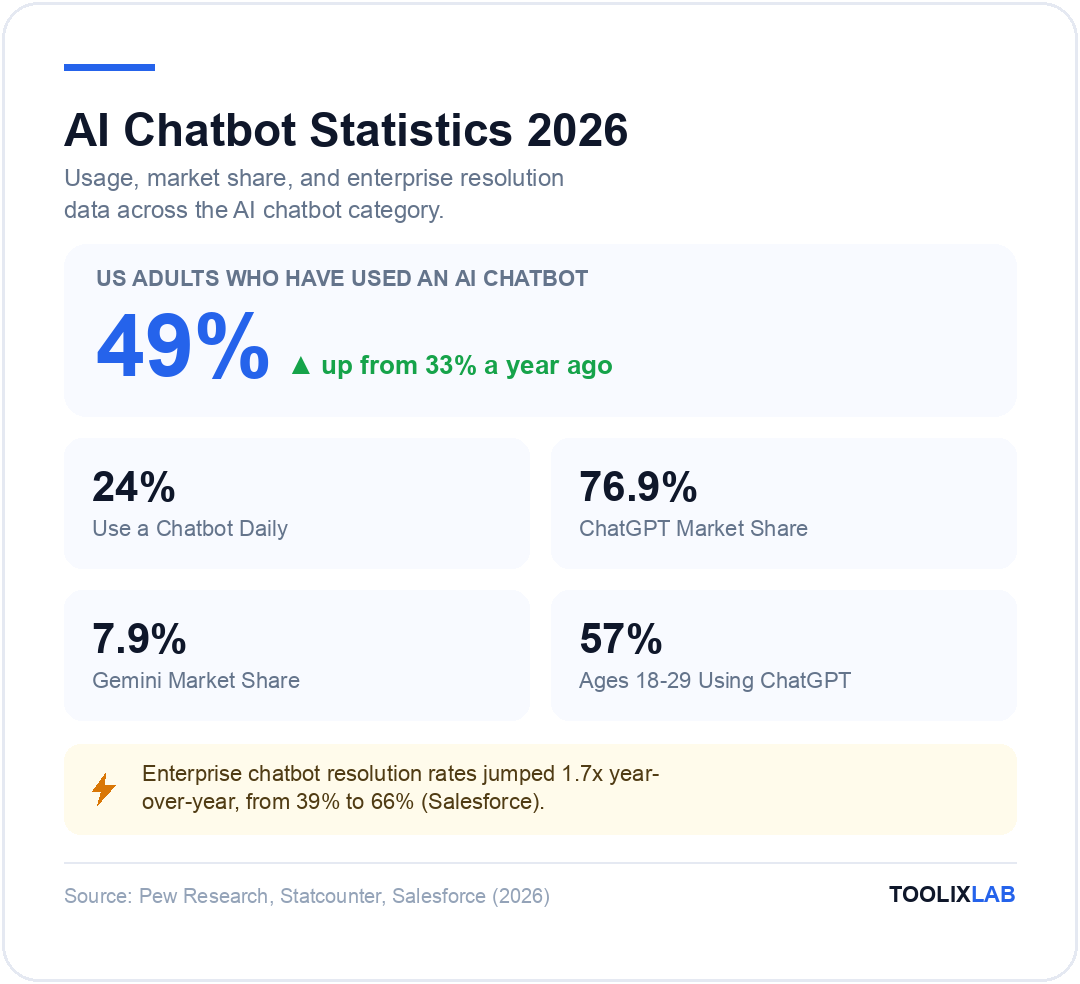
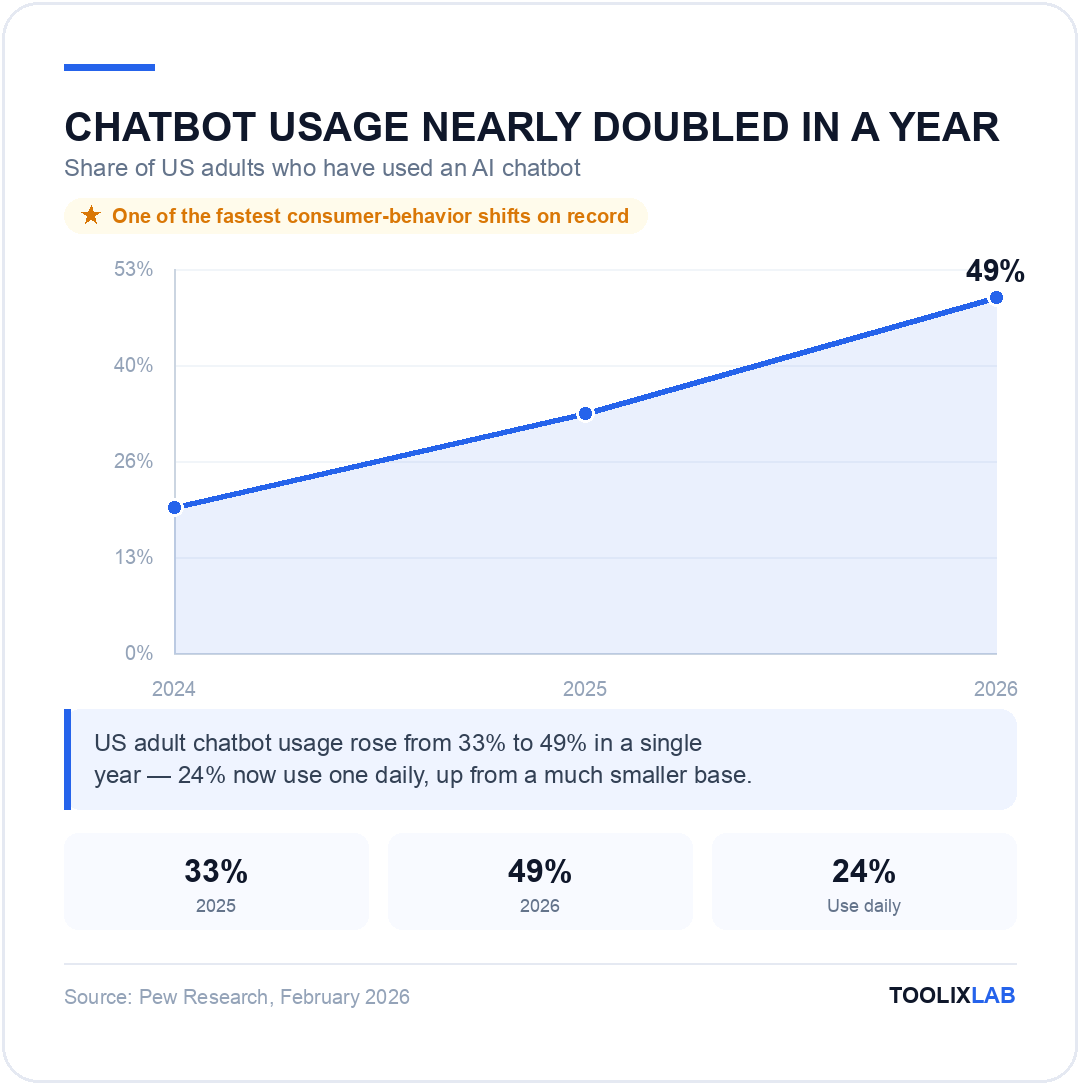
49% of US adults have used an AI chatbot as of February 2026, up from 33% in 2024, per Pew Research. By worldwide referral traffic, ChatGPT holds 76.87% market share, down from over 84% a year ago as Gemini and Perplexity gain ground. Enterprise adoption of AI agents in customer service jumped 1.7x year-over-year — from 39% to 66% — according to Salesforce, with customer satisfaction (not cost-cutting) the top-ranked improved metric. Real-world resolution rates, however, tend to run well below vendor headline figures.
"AI chatbot adoption has plateaued" and "AI chatbots are eating customer service" are both being said about 2026, and both are defensible depending on which number you pull. Consumer usage is genuinely mainstream now — roughly half of US adults use one. But ChatGPT's dominance of that usage is eroding month over month, enterprise resolution-rate claims routinely overstate production reality, and a widely-cited $80 billion cost-savings prediction traces back to a four-year-old forecast that nobody has gone back to verify.
We pulled the primary sources behind the most-cited AI chatbot figures — Pew Research's 2026 usage survey, Statcounter's live referral-traffic market share data, Salesforce's State of Service research, Gartner's original 2022 forecast, and both major market-sizing firms — to show exactly what each number measures and where the headline claims diverge from what vendors and researchers can actually verify.
This piece focuses on chatbot usage, market share, and business deployment; for the generational trust gap behind who actually uses these tools, see our Gen Z trust in AI statistics, and for the broader enterprise adoption curve these chatbot deployments sit inside, our AI adoption statistics breaks down formal adoption versus scaled deployment. For the ROI math behind customer-facing AI specifically, see our AI CRM ROI statistics.
AI Chatbot Statistics: The Key Numbers
- 📊 49% — share of US adults who have used an AI chatbot as of February 2026, up from 33% in 2024 (Pew Research)
- 📊 24% — share of US adults who use an AI chatbot on a daily basis (Pew Research)
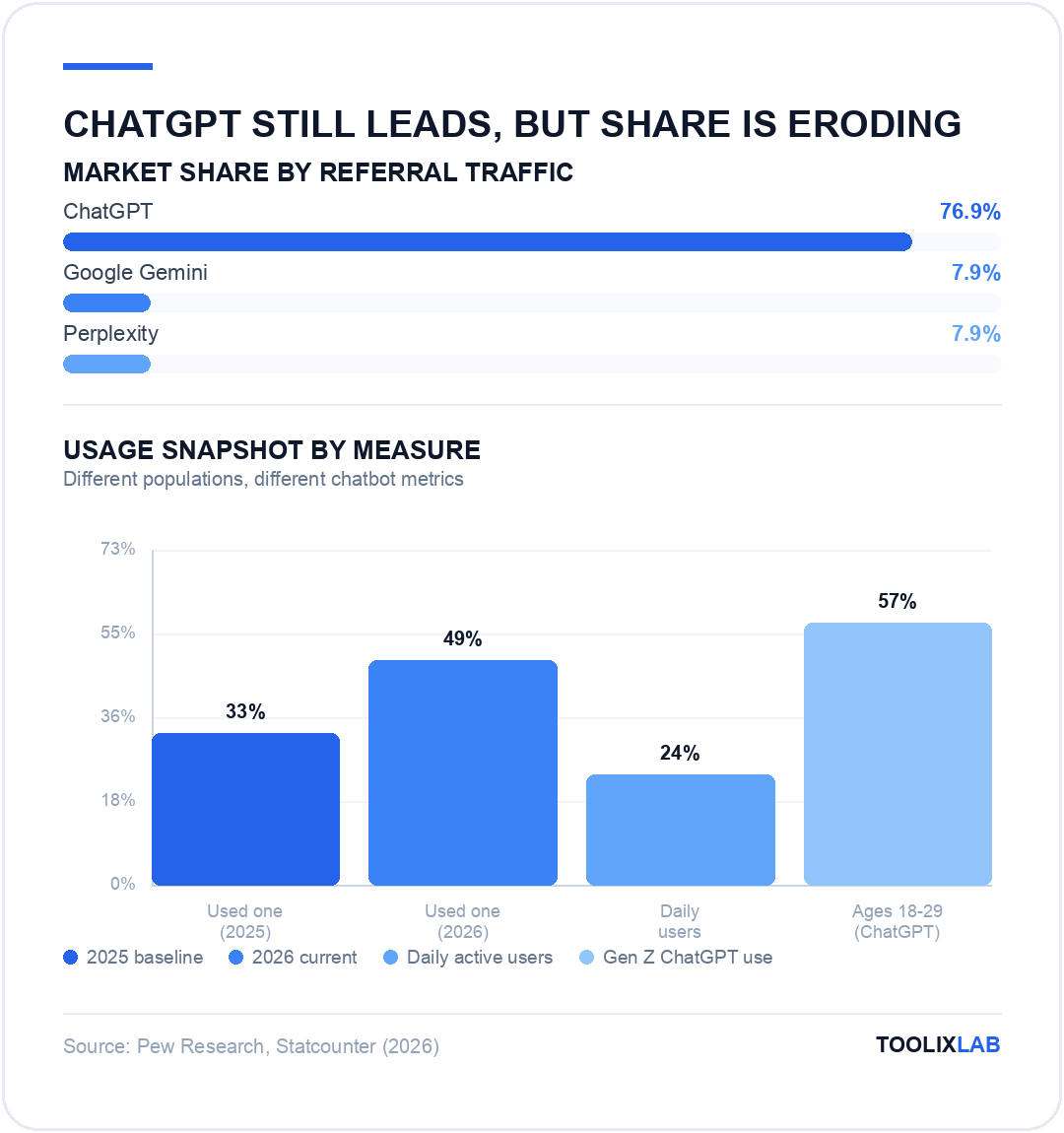
- 📊 76.87% — ChatGPT's worldwide AI chatbot market share by referral traffic as of June 2026, down from over 84% a year earlier (Statcounter)
- 📊 7.94% / 7.91% — Google Gemini and Perplexity's near-tied second-place market share, as ChatGPT's dominance fragments (Statcounter)
- 📊 57% — share of US adults ages 18-29 who use ChatGPT specifically, versus 28% of adults 50 and older (Pew Research)
- 📊 1.7x — year-over-year growth in AI agent adoption among customer service organizations, from 39% to 66% (Salesforce, n=3,075)
- 📊 70% — share of customer service organizations that see measurable value from AI agents within 60 days of deployment (Salesforce)
- 📊 $11.8 billion → $41.2 billion — Grand View Research's chatbot market sizing for 2026 through 2033, a 19.6% CAGR
- 📊 42-53% — independently reported real-world production resolution rate range for a leading AI customer service agent, versus a ~67% figure commonly cited from vendor dashboards
- 📊 71% — share of US adults who believe AI will make their personal information less secure, versus just 3% who think it will improve security (Pew Research)
Feel free to cite any statistic on this page — we ask only for a link back to this article as the source.
Methodology: Where This Data Comes From
This is a curated compilation of primary-source research and platform-disclosed data, not a survey we ran ourselves. Every figure traces back to one of the following:
- Pew Research Center, "Americans and AI 2026" (June 2026) — a nationally representative survey of 5,119 US adults conducted February 17-23, 2026 via Pew's American Trends Panel.
- Statcounter Global Stats, "AI Chatbot Market Share Worldwide" — live referral-traffic tracking across more than 1 million websites, updated monthly; we use the June 2026 snapshot.
- Salesforce, "State of Service: AI Agents Edition" (2026) — a survey of 3,075 customer service professionals worldwide, corroborated via independent coverage (CX Today, CMSWire) after the official page returned an access error on automated fetch.
- Gartner press release (August 2022) — the original forecast predicting conversational AI's $80 billion contact-center labor savings for the year 2026, still widely cited without noting its age.
- Grand View Research and Precedence Research — two independent market-research firms' chatbot market-sizing reports, cross-referenced to show where their scope diverges.
- Intercom's official Fin AI Agent documentation — the vendor's own definition of a "resolution," cross-checked against independently reported production case-study rates.
- Zendesk CX Trends 2026 — survey of 11,000+ consumers and CX leaders across 22 countries, used for the human-vs-bot preference data.
Limitations: Statcounter measures referral traffic, not total users, so it undercounts app-only or API-only usage. Market-sizing figures from research firms use different scope definitions and are not independently audited. Vendor-reported resolution rates are self-disclosed and typically represent a ceiling, not a typical-case baseline — we've flagged that gap explicitly below.
Finding #1: Consumer Chatbot Usage Crossed the Halfway Mark in 2026
Half of America now talks to an AI chatbot at least occasionally. Pew Research's February 2026 survey of 5,119 US adults found 49% have used an AI chatbot, up sharply from 33% in 2024 — a 16-percentage-point jump in two years. Roughly a quarter of adults (24%) use one daily, split between 12% who use one several times a day, 8% about once a day, and 4% who describe usage as almost constant.
Adoption is heavily age-skewed: 57% of adults 18-29 use ChatGPT specifically, compared with just 28% of adults 50 and older — almost exactly the same generational split our Gen Z trust in AI research found on the trust side of the ledger. Platform breakdown among all chatbot users: ChatGPT at 44%, Gemini at 24%, Copilot at 17%, Meta AI at 14%, Grok at 8%, Claude at 6%, and Character.ai at 3% (users can and do use multiple platforms, so these figures don't sum to 100%). One consistent finding across the survey: usage is accelerating faster than trust — 71% of respondents believe AI will make their personal information less secure, and only 3% think it will improve security, a gap that hasn't meaningfully narrowed even as usage climbs.
Finding #2: ChatGPT's Market Dominance Is Eroding, Not Growing
Despite consumer usage climbing overall, the competitive picture inside that usage is shifting fast. Statcounter's referral-traffic tracking — based on data from more than 1 million websites — put ChatGPT at 76.87% worldwide market share as of June 2026, down from a peak above 84% roughly a year earlier. That's still commanding, but the trend line is one-directional: down.
| Platform | Market share (June 2026) | Approx. 1-year change |
|---|---|---|
| ChatGPT | 76.87% | Down from ~84%+ |
| Google Gemini | 7.94% | Up sharply |
| Perplexity | 7.91% | Up sharply |
| Claude | 3.74% | Roughly flat |
| Microsoft Copilot | 3.49% | Roughly flat |
Gemini and Perplexity are now essentially tied for second place, each capturing single-digit but growing shares as ChatGPT's referral traffic fragments across a widening field of competitors. It's worth noting Statcounter measures referral traffic to websites, not total users or app opens — so it systematically undercounts usage that stays inside a chatbot's own app or happens via API integration, meaning ChatGPT's real usage lead may be understated or overstated relative to this specific metric depending on how each platform's traffic behaves. Still, directionally, the trend of a fragmenting market matches Pew's platform-usage data above, where ChatGPT's 44% adult-usage share is well below its referral-traffic share, and Gemini (24% adult usage) punches well above its 7.94% referral share.
Finding #3: The Chatbot Market's Size Depends Entirely on Definition
Ask "how big is the chatbot market" and you'll get wildly different answers depending on who you ask — and the disagreement is about scope, not accuracy. Grand View Research values the global chatbot market at $11.8 billion in 2026, projecting growth to $41.2 billion by 2033 at a 19.6% CAGR, with North America holding roughly 31.3% share and the "solution" segment (as opposed to services) accounting for over 61.8% of revenue. Precedence Research, by contrast, sizes the market at just $1.70 billion in 2026, growing to $7.96 billion by 2035 at an 18.81% CAGR.
| Firm | 2026 market size | Forecast endpoint | CAGR |
|---|---|---|---|
| Grand View Research | $11.8B | $41.2B by 2033 | 19.6% |
| Precedence Research | $1.70B | $7.96B by 2035 | 18.81% |
The nearly 7x gap isn't an error in either report — it reflects different scoping. Broader definitions (Grand View Research's) fold in the full solution-and-services spend around chatbot platforms, including implementation, customization, and managed services layered on top. Narrower definitions (Precedence Research's) isolate spend on the chatbot software or platform itself. Both firms show similar growth rates (19.6% vs. 18.81% CAGR), which is the more reliable signal here — the market's trajectory is consistent even when its absolute size isn't. Treat any single "chatbot market size" headline as meaningless without checking which scope it's using, the same caution our generative AI statistics piece raises about the much larger genAI market-sizing spread.
Finding #4: Enterprise Adoption Nearly Doubled, and a Four-Year-Old Prediction Is Coming Due
On the business side, deployment moved from pilot to mainstream fast. Salesforce's State of Service: AI Agents Edition research, surveying 3,075 customer service professionals worldwide, found AI agent adoption in customer service organizations grew 1.7x year-over-year — from 39% in 2025 to 66% in 2026. Seventy percent of organizations that adopt AI agents report measurable value within 60 days, and notably, the top-ranked improved metric is customer satisfaction — ahead of service rep productivity, average handle time, customer retention, and first-response time. That ordering matters: it suggests 2026 deployments are being judged on experience quality rather than pure cost-cutting, a reframe from earlier "chatbots as cost center" narratives. Separately, 77% of businesses using AI agents now deploy them across both customer-facing and internal workflows, not customer service alone.
This is also the year a much older, frequently-recycled prediction was supposed to land. Back in August 2022, Gartner forecast that conversational AI deployments in contact centers would reduce agent labor costs by $80 billion in 2026, driven by automating 1 in 10 agent interactions (up from an estimated 1.6% at the time, across roughly 17 million contact center agents worldwide). Gartner has not published a formal 2026 verification of that $80 billion figure, and it's frequently cited by third-party blogs as if it were a confirmed 2026 result rather than a four-year-old projection. What we can say is that the underlying automation trend appears directionally correct — Salesforce's independently measured 66% agentic-adoption rate for 2026 is consistent with conversational AI having moved well past the "measured adoption" Gartner itself predicted back in 2022 — but the specific dollar figure remains unverified against real 2026 data.
Finding #5: Vendor Resolution-Rate Claims Run Well Ahead of Production Reality
The gap between marketed and measured performance is sharpest on resolution rates — the percentage of customer inquiries an AI agent closes without human escalation. Intercom's own Fin AI Agent documentation defines a "resolution" as a conversation where, after Fin's last answer, the customer either explicitly confirms it was satisfactory or simply exits without asking for more help — a fairly generous definition, since an "assumed resolution" requires no confirmation at all. Fin is commonly cited around a 67% trailing-30-day resolution rate based on vendor dashboard aggregates across its full customer base.
Independently reported production case studies tell a more modest story: coverage tracking real deployments puts Fin's actual production resolution rate closer to 42-53%, roughly 15-25 percentage points below the commonly cited headline figure. The gap is explained by how the metric gets constructed in practice — programs advertising resolution rates above 70% typically either route aggressively at the triage layer (filtering out harder tickets before the AI agent ever sees them) or count "assumed resolution" (no explicit confirmation, just no follow-up message) as a full success. Enterprise vendors increasingly backstop this uncertainty with financial guarantees rather than raw promises — Intercom, for instance, offers a $1 million performance guarantee tied to a 65% resolution floor for qualifying enterprise accounts, which is itself a useful signal of where a vendor's confidence in "typical" performance actually sits versus its marketing headline.
What This Data Means in Practice
Consumer usage and platform loyalty are two different curves — track them separately. Total AI chatbot usage keeps climbing (49% of US adults), but any single platform's share of that usage is now actively fragmenting. Building strategy around "ChatGPT owns the market" is already stale by mid-2026.
Don't cite a chatbot market-size figure without checking its scope. A nearly 7x gap between two reputable research firms isn't a data error — Grand View Research and Precedence Research are simply measuring different things (broad solution-and-services spend versus narrow platform-only spend). Always check the underlying definition before comparing numbers across sources.
Treat vendor-reported resolution rates as a ceiling, not an expectation. The 67%-vs-42-53% gap in Intercom's own case is not unusual in the industry — assume any headline AI resolution-rate claim reflects favorable routing conditions or a generous "resolution" definition, and ask for the underlying methodology before budgeting around it.
Old predictions keep getting recycled as current fact. Gartner's $80 billion figure is a 2022 forecast for 2026, not a verified 2026 result — a pattern worth watching for across AI statistics generally, since forecasts age into the current year and lose their "predicted" framing along the way.
Human-vs-bot preference is a routing question, not a binary. Zendesk's 2026 CX Trends research found 51% of consumers prefer bots specifically when they want immediate service — the practical implication is to route by urgency and complexity rather than defaulting every interaction to either channel.
Frequently Asked Questions
How many people use AI chatbots in 2026?
49% of US adults have used an AI chatbot as of February 2026, up from 33% in 2024, according to Pew Research. About 24% use one daily. ChatGPT is the most-used platform at 44% of adults, followed by Gemini (24%), Copilot (17%), and Meta AI (14%).
What is the AI chatbot market share breakdown in 2026?
By worldwide referral traffic, ChatGPT holds 76.87% market share as of June 2026 per Statcounter, down from over 84% a year earlier. Google Gemini (7.94%) and Perplexity (7.91%) are essentially tied for second, followed by Claude (3.74%) and Microsoft Copilot (3.49%).
How big is the AI chatbot market?
It depends heavily on scope. Grand View Research values the chatbot market at $11.8 billion in 2026, growing to $41.2 billion by 2033 (19.6% CAGR) using a broad solution-and-services definition. Precedence Research puts 2026 at just $1.70 billion, growing to $7.96 billion by 2035 (18.81% CAGR), using a narrower chatbot-platform-only scope — the two aren't contradictory, they're measuring different markets.
How fast is enterprise AI chatbot adoption growing?
Adoption of AI agents in customer service organizations grew 1.7x year-over-year, from 39% in 2025 to 66% in 2026, according to Salesforce's State of Service research (n=3,075 service professionals). 70% of adopters report measurable value within 60 days, and customer satisfaction — not cost or handle time — is the top-ranked improved KPI.
What percentage of customer service inquiries can AI chatbots actually resolve?
Vendor-reported resolution rates and independently verified production rates diverge substantially. Intercom's Fin AI Agent is commonly cited around a 67% trailing resolution rate on its own dashboards, but independent case-study and production coverage puts real-world resolution closer to 42-53% — before excluding aggressive intent-routing that filters out harder tickets at triage.
Did Gartner's prediction that AI chatbots would save $80 billion in contact center labor costs by 2026 come true?
That figure comes from a 2022 Gartner forecast for the year 2026, predicting 1 in 10 agent interactions would be automated (up from 1.6% at the time). Gartner has not published a 2026 confirmation of the $80 billion figure; Salesforce's independently measured 2026 data shows agentic adoption reaching 66% of service organizations, suggesting the underlying automation trend materialized even if the exact dollar figure is unverified.
Do most people prefer chatbots or human customer service agents?
Preference is split and context-dependent. Zendesk's 2026 CX Trends research found 51% of consumers prefer bots for immediate service needs, while separate consumer research has found majorities still trust human agents more for complex or high-stakes issues. The consistent finding across studies is that speed favors bots and complexity favors humans.
Can I cite these statistics?
Yes. These are third-party primary-source and corporate-disclosure statistics compiled and sourced by ToolixLab — cite the original source (Pew Research, Statcounter, Salesforce, Gartner, Grand View Research, Precedence Research, or Intercom) where possible, and feel free to link to this page as your source for the compilation.
🔑 Key Takeaways
- ✓49% of US adults use AI chatbots in 2026, up from 33% in 2024 — but ChatGPT's market share is falling (76.87%, down from 84%+) as Gemini and Perplexity gain ground
- ✓Chatbot market-size estimates range from $1.70B to $11.8B for 2026 depending entirely on scope definition — check methodology before comparing figures
- ✓Enterprise AI agent adoption in customer service grew 1.7x year-over-year (39% to 66%), with customer satisfaction — not cost-cutting — the top improved metric
- ✓Vendor-reported resolution rates (~67%) run well ahead of independently verified production rates (42-53%) — treat headline resolution claims as a ceiling, not a baseline
- ✓Gartner's widely-cited $80B contact-center savings figure for 2026 is a four-year-old 2022 forecast that has never been formally verified against real 2026 results
Related Guides
- Gen Z Trust in AI Statistics 2026 — the generational usage-vs-trust gap behind who's actually driving chatbot adoption.
- AI Adoption Statistics 2026 — the broader enterprise adoption curve these chatbot deployments sit inside.
- Generative AI Statistics 2026 — investment and adoption-maturity data for the wider generative AI market.
- AI CRM ROI Statistics 2026 — the productivity and ROI math behind customer-facing AI deployments.
- How to Use Claude AI for Business 2026 — a practical guide to deploying a conversational AI assistant.