
Quick Answer
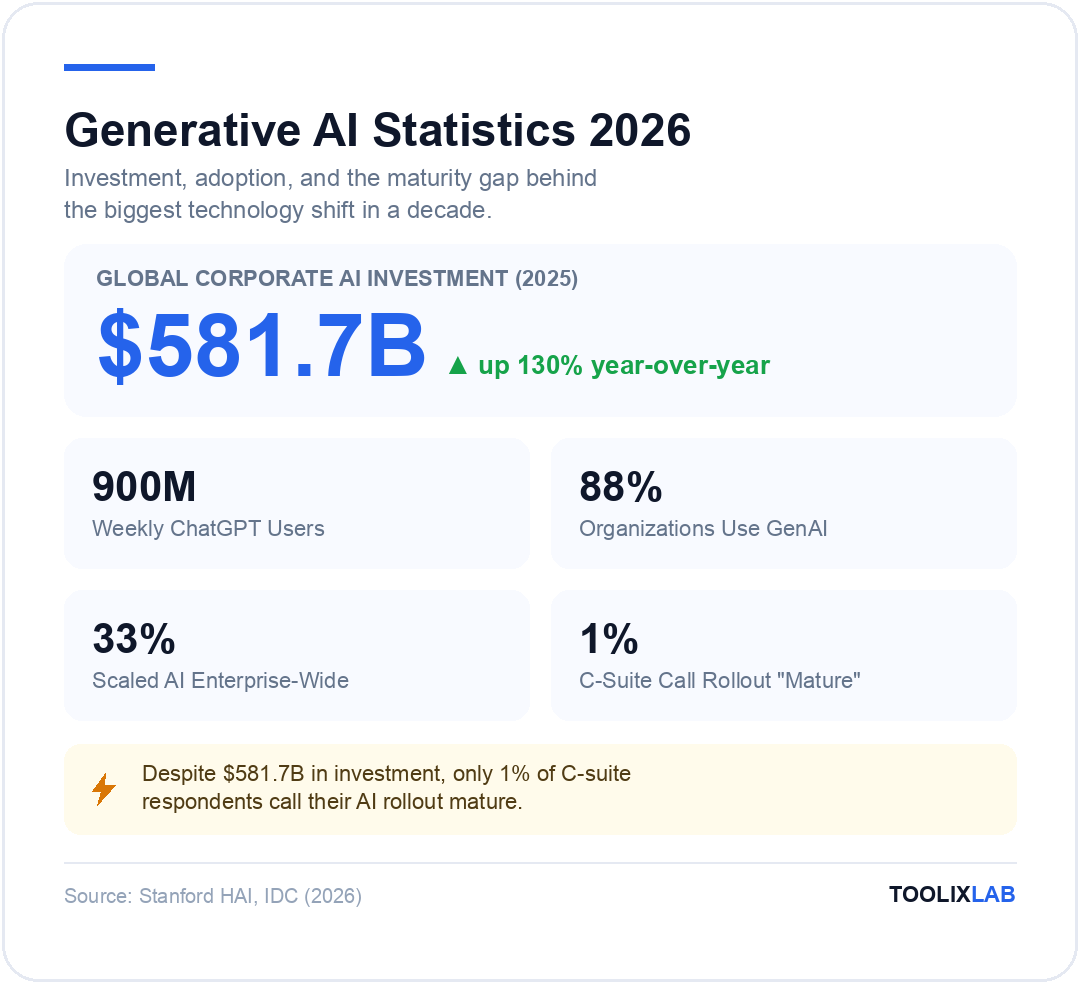
Generative AI statistics 2026: global corporate AI investment hit $581.7 billion in 2025 (up 130% year-over-year), ChatGPT reached 900 million weekly active users, and generative AI reached 53% population adoption in three years — faster than the PC or the internet, per Stanford HAI. AI-generated content now makes up roughly half of new web articles, and 88% of organizations use AI somewhere in the business, though McKinsey found only 1% of C-suite leaders call their generative AI rollout mature. Every number below is sourced to its original report.
"Generative AI statistics" now spans two very different stories that get told with the same numbers. One story is investment and adoption, and by that measure 2026 looks like an inflection point: $581.7 billion in corporate AI investment, 900 million weekly ChatGPT users, and generative AI use crossing 88% of organizations. The other story is maturity, and by that measure the picture is far less settled — McKinsey finds nearly two-thirds of adopting organizations are still experimenting rather than scaling, and just 1% of C-suite respondents call their rollout mature. This piece separates the two, sourcing every figure to Stanford HAI, McKinsey, Gartner, OpenAI, and independent content-research firm Graphite rather than to aggregator blogs that blend market-size estimates with adoption surveys as if they measured the same thing.
⚡ Quick Summary
Investment: $581.7B in global corporate AI investment in 2025 (+130% YoY); generative AI alone grew 200%+ and now captures nearly half of private AI funding.
Adoption: 88% of organizations use AI in at least one function; generative AI specifically reached 53% population adoption in three years.
The gap: Only ~1 in 3 adopting organizations have scaled AI enterprise-wide, and just 1% of C-suite leaders call their generative AI deployment mature.
Jump to: Investment | Adoption | Consumer Usage | Content Volume
Key Stats at a Glance
🔑 60+ Generative AI Statistics
- 📊 $581.7 billion in global corporate AI investment in 2025, up 130% year-over-year (Stanford HAI 2026 AI Index)
- 📊 $344.7 billion in private AI investment in 2025, up 127.5% — generative AI alone grew over 200% and captured nearly half of that total
- 📊 U.S. private AI investment ($285.9 billion) was 23.1 times China's ($12.4 billion) in 2025
- 📊 Newly funded AI companies rose 71% year-over-year
- 📊 Gartner forecasts total worldwide AI spending at $2.59 trillion in 2026, up 47% year-over-year, with AI infrastructure over 45% of that total
- 📊 Generative AI reached 53% population adoption within three years — faster than the PC or the internet (Stanford HAI)
- 📊 88% of organizations use AI in at least one business function, up from 78% a year earlier; generative AI specifically is in use at 70% of organizations (McKinsey / Stanford HAI)
- 📊 Only about 1 in 3 adopting organizations have scaled AI across the enterprise; just 1% of C-suite respondents call their generative AI rollout mature (McKinsey)
- 📊 47% of organizations report already experiencing at least one negative consequence from generative AI use (McKinsey)
- 📊 ChatGPT reached 900 million weekly active users in February 2026, up from 800 million in October 2025, with 50 million paying subscribers (OpenAI)
- 📊 The estimated value of generative AI tools to U.S. consumers reached $172 billion annually by early 2026, up from $112 billion — a 54% increase; median value per user tripled (Stanford HAI)
- 📊 49.9% of new web articles were primarily AI-generated in Q1 2026, essentially flat with 50.9% in Q4 2025 (Graphite / Common Crawl analysis)
- 📊 Marketing output up 50%, software development productivity up 26%, customer support productivity up 14–15%, and physician clinical-note time down up to 83% with AI assistance (Stanford HAI)
📚 Sources & Methodology
Every statistic below is attributed to its original report. We prioritized primary research institutions, official vendor disclosures, and independent data studies over aggregator blog posts:
- Stanford HAI — 2026 AI Index Report, ninth annual edition, published April 2026, including the dedicated Economy chapter.
- McKinsey — The State of AI: Global Survey 2025, 1,993 respondents across 105 nations, fielded June–July 2025.
- Gartner — "Gartner Forecasts Worldwide AI Spending to Grow 47% in 2026" official press release, May 2026.
- OpenAI — 900 million weekly active user disclosure, covered by TechCrunch, February 2026.
- Graphite — ongoing Common Crawl content-origin study using three independent AI detectors (Pangram, Copyleaks, GPTZero).
- Grand View Research — Generative AI Market Report, 2026–2033 forecast.
Finding #1: $581.7 Billion in Corporate AI Investment
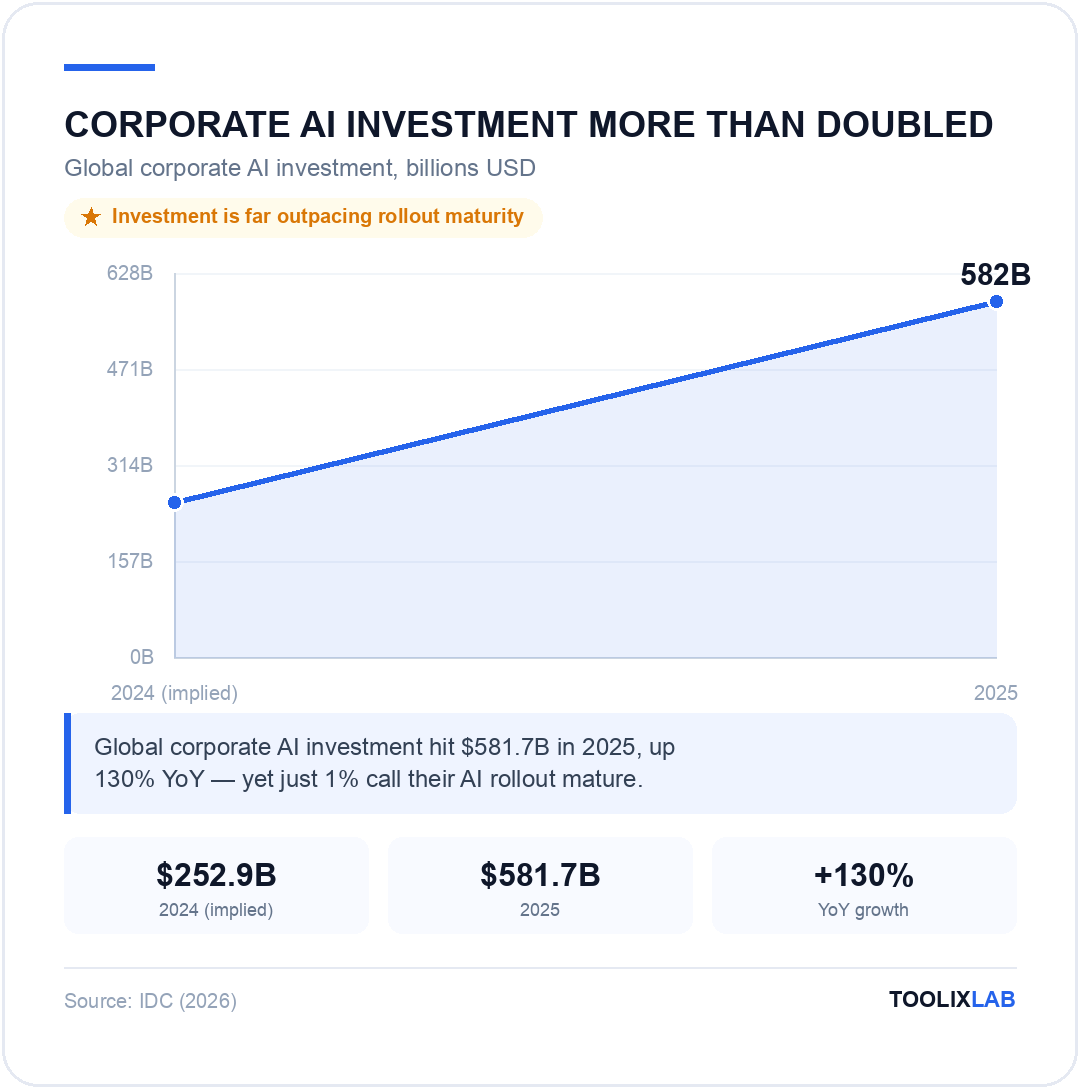
Stanford HAI's 2026 AI Index puts a hard number on what "AI investment boom" actually means: global corporate AI investment reached $581.7 billion in 2025, up 130% from the year before. Private investment — venture and corporate funding into AI companies specifically, excluding internal corporate AI budgets — hit $344.7 billion, up 127.5%, and now represents 60% of total AI investment tracked. Generative AI is the growth engine inside that total: generative-AI-specific private funding grew more than 200% and now captures nearly half of all private AI investment, up from a smaller share the year before.
The geographic concentration is stark. U.S. private AI investment reached $285.9 billion in 2025 — 23.1 times China's $12.4 billion and roughly 48.5 times the UK's total. The number of newly funded AI companies rose 71% year-over-year, meaning the surge isn't just larger checks to existing frontier labs — it's a broadening base of funded startups underneath them.
This is the same investment surge that shows up in adjacent infrastructure spending — the GPU clusters and data centers absorbing a large share of that capital are covered in more depth in our AI GPU cluster deployment statistics, which tracks the hardware side of the same money.
Finding #2: Market Size Depends Entirely on What You Count
Ask "how big is the generative AI market" and you'll get wildly different answers, not because researchers disagree on the facts but because they're measuring different things. Grand View Research values the pure generative AI software and API market at $29.6 billion in 2026, projecting growth to $324.7 billion by 2033 at a 40.8% compound annual growth rate. Bloomberg Intelligence's forecast is an order of magnitude larger — a $2.3 trillion generative AI market by 2032, representing roughly 22% of total technology spending — because it includes hardware, infrastructure, and adjacent services, not just software licenses and API calls.
Gartner's number is different again: total worldwide AI spending (not generative-AI-specific, and including all AI categories) is forecast at $2.59 trillion in 2026, up 47% year-over-year, with AI infrastructure — optimized IaaS, servers, network fabric, and processing semiconductors — accounting for over 45% of that spending. Gartner's own analysis notes enterprises "have yet to really flex their spending potential," with 2026 positioned as the inflection year where enterprise budgets, not just hyperscaler capex, start driving the total.
Read market-size headlines by scope, not just by number. A "$29.6 billion" figure and a "$2.3 trillion" figure can both be accurate at the same time if one counts software/API revenue and the other counts the full infrastructure stack behind it. Treat any single market-size number as meaningless without checking what it includes.
Finding #3: 88% Adoption, But a Maturity Gap Underneath
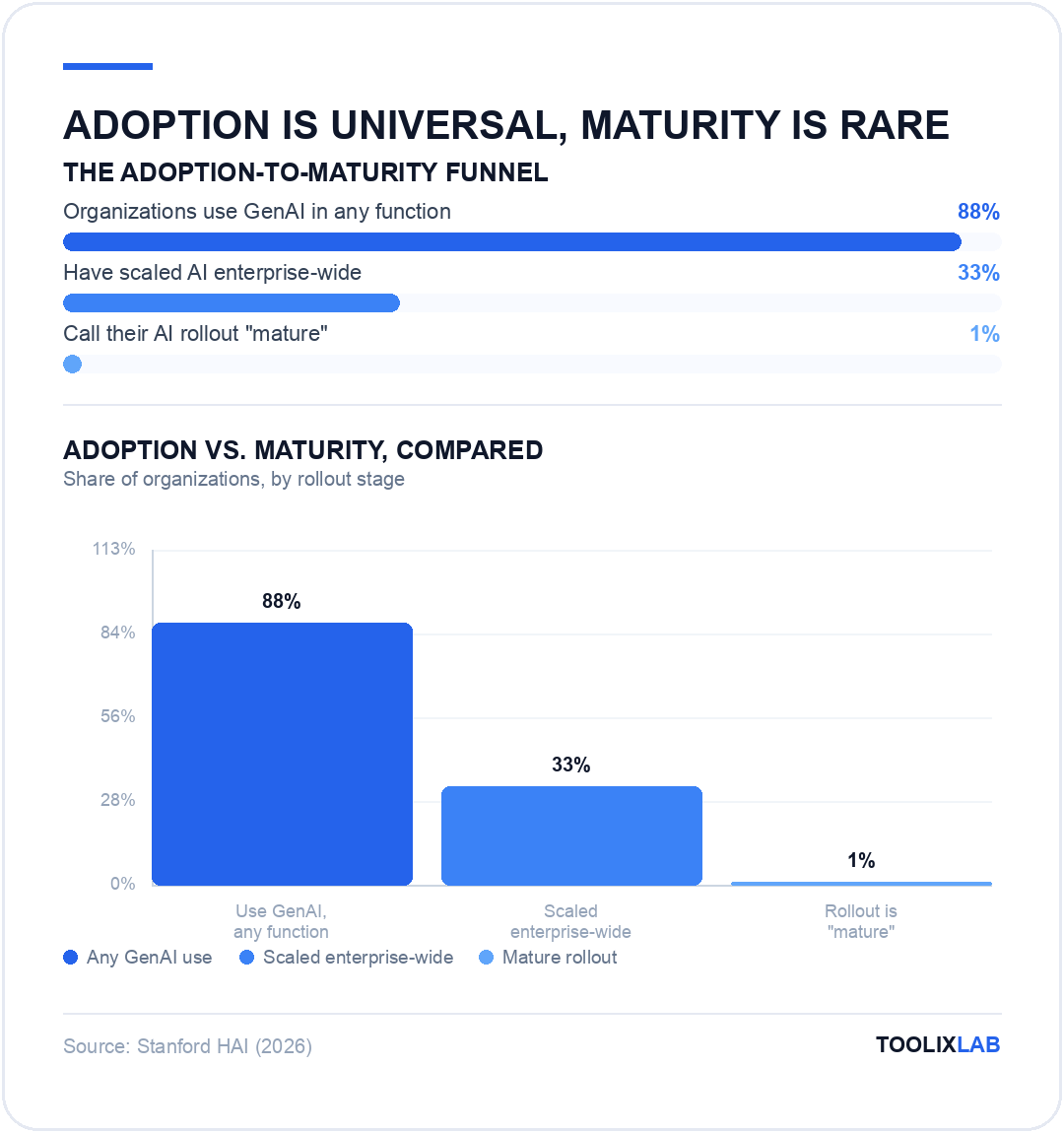
McKinsey's State of AI 2025 survey — 1,993 respondents across 105 countries, fielded June–July 2025 — found 88% of organizations now use AI in at least one business function, up from 78% the year before. Stanford HAI's separate analysis narrows that to generative AI specifically: deployed in at least one function at 70% of organizations, with overall organizational AI adoption at 88% (matching McKinsey's figure independently).
The adoption number is the one that gets quoted. The maturity number underneath it tells a different story: McKinsey found nearly two-thirds of adopting organizations are still in the "experiment or pilot" phase rather than having scaled AI across the enterprise, and only about a third report having genuinely scaled it. Most strikingly, just 1% of C-suite respondents describe their generative AI rollout as mature. AI agent deployment specifically remains in the single digits across nearly all business functions, per Stanford HAI — meaning the "AI agents" conversation is still mostly aspirational at the deployment level, even as 62% of organizations report at least experimenting with them.
Risk data complicates the adoption story further: 47% of organizations in McKinsey's survey report having already experienced at least one negative consequence from generative AI use — a figure close to the 51% "negative consequences" finding in separate industry surveys, suggesting the number is a consistent floor rather than an outlier from one methodology.
- ✓ 88% of organizations use AI in at least one function (McKinsey, Stanford HAI — independently confirmed)
- ✓ 70% of organizations use generative AI specifically in at least one function (Stanford HAI)
- ✓ ~2/3 of adopting organizations remain in experiment/pilot mode rather than enterprise-wide scale (McKinsey)
- ✓ 1% of C-suite respondents call their generative AI deployment mature (McKinsey)
- ✓ 62% of organizations are at least experimenting with AI agents, but actual agent deployment sits in the single digits by function (McKinsey / Stanford HAI)
- ✓ 47% of organizations report at least one negative consequence already experienced from generative AI (McKinsey)
Finding #4: 900 Million Weekly ChatGPT Users
On the consumer and knowledge-worker side, OpenAI disclosed that ChatGPT reached 900 million weekly active users as of February 2026 — up from 800 million in October 2025 — alongside 50 million paying subscribers. The company shared those figures alongside news of a $110 billion private funding round, one of the largest in history. Google's Gemini app separately reported 900 million monthly users, putting the two largest consumer generative AI products within range of a billion users each.
Stanford HAI's population-level analysis gives that scale context: generative AI reached 53% adoption among the population within three years of ChatGPT's public launch — a faster climb than the personal computer or the internet took to reach the same penetration. Adoption is far from uniform globally: Singapore (61%) and the UAE (54%) outpace expectations, while the U.S. ranks 24th globally at just 28.3% adoption by Stanford HAI's specific survey methodology — a reminder that "adoption" figures vary enormously depending on which population and which usage definition a given study measures.
The economic value of that usage is measurable, not just anecdotal. Stanford HAI estimates the value generative AI tools deliver to U.S. consumers reached $172 billion annually by early 2026, up from $112 billion — a 54% increase — with the median value per user roughly tripling over the same period, even as most consumer-facing tools remain free or near-free.
Finding #5: Productivity Gains Vary Sharply by Function
Where generative AI is actually measured against task output — not surveyed as a general sentiment — the productivity gains are real but uneven. Stanford HAI's 2026 AI Index reports marketing output up 50%, software development productivity up 26%, and customer support productivity up 14–15% in studies measuring AI-assisted versus unassisted task completion. In healthcare specifically, physicians using AI-generated clinical documentation tools reported spending up to 83% less time writing notes — one of the largest single-function gains recorded in the report.
These function-specific gains track the same pattern we found researching AI CRM ROI and productivity statistics: the highest, most-quoted percentage gains cluster in content-heavy, judgment-light tasks (marketing copy, note-taking, routine support replies), while gains shrink — or the data goes quiet — for judgment-heavy, ambiguous work. Treat any single "AI boosts productivity by X%" headline as function-specific, not universal.
Finding #6: AI Now Writes About Half the Web
Graphite's ongoing analysis of Common Crawl data — using three independent AI detectors (Pangram, Copyleaks, GPTZero) rather than relying on any single tool's accuracy — found that 49.9% of new web articles were primarily AI-generated in Q1 2026, essentially flat with 50.9% in Q4 2025. That's a meaningful plateau: growth surged after ChatGPT's November 2022 launch, but the proportion of AI-generated articles has "remained relatively stable, near 50%, over the last five quarters," per Graphite's researchers.
The plateau has a specific explanation, not a mysterious one: Graphite's companion research found primarily AI-generated articles "do not perform well in search" — meaning publishers who scaled pure AI-generated content aggressively in 2023–2024 largely stopped seeing it convert to rankings or traffic, capping further growth in that segment even as AI tools themselves keep improving. That mirrors what we found researching how AI is reshaping search rankings: volume of AI content and visibility of AI content are two different metrics, and conflating them overstates how much unedited AI output is actually reaching readers through organic search.
Investment vs. Maturity: Side-by-Side
| Metric | Headline Number | Underlying Caveat | Source |
|---|---|---|---|
| Corporate AI investment | $581.7B (+130%) | Concentrated 23:1 in U.S. vs. China | Stanford HAI |
| Organizational AI adoption | 88% | Only ~1/3 scaled enterprise-wide | McKinsey |
| Genuinely "mature" deployments | — | 1% of C-suite say mature | McKinsey |
| ChatGPT weekly users | 900 million | 50 million paying (5.6% conversion) | OpenAI |
| AI agent experimentation | 62% experimenting | Single-digit actual deployment | McKinsey / Stanford HAI |
| Generative AI market size | $29.6B–$2.3T range | Depends entirely on scope counted | Grand View / Bloomberg |
What This Means If You're Deploying Generative AI
Three practical conclusions fall out of this data set, independent of which headline number you find most compelling:
Adoption is no longer the interesting question — maturity is. With 88% of organizations already using AI somewhere, "does your company use AI?" has become close to a universal yes. The number that actually differentiates organizations now is McKinsey's 1% mature-rollout figure: nearly everyone has started, almost no one has finished scaling, and that gap — not raw adoption — is where competitive advantage sits in 2026.
Function-specific productivity data beats aggregate claims. A 50% marketing-output gain and a 14–15% customer-support gain are both true simultaneously, and neither one generalizes to "AI makes work 30% faster" as a blanket claim. Teams evaluating generative AI ROI should look for task-level studies in their own function rather than aggregate percentages — the same discipline we apply across our broader AI tools adoption research.
Market-size and content-volume numbers need their scope checked before you repeat them. A market-size figure without its included categories, or a "% of the internet is AI-written" figure without its detector methodology, is not comparable to a differently scoped number that happens to use the same units. The 4.67x spread between two respected market-research firms measuring "generative AI market size" in the same year is the clearest evidence that scope, not disagreement about facts, drives most of the variance in numbers you'll see repeated online.
None of this data supports either extreme — "generative AI adoption has stalled" or "generative AI has already transformed every organization that uses it." What it supports is a market where investment, consumer usage, and stated adoption have all scaled dramatically faster than operational maturity, which is exactly the kind of gap that tends to close unevenly: fast for well-resourced early movers, slower for everyone else. The tools and workflows covered in our AI stack research for startups and our guide to using Claude for business are aimed squarely at that maturity gap — moving past pilot-stage usage toward the scaled deployment that, per McKinsey, 99% of organizations haven't reached yet.
🔑 Key Takeaways
- ✓ Corporate AI investment hit $581.7 billion in 2025 (+130% YoY), with generative AI capturing nearly half of all private AI funding
- ✓ 88% of organizations use AI somewhere, but only ~1/3 have scaled it enterprise-wide and just 1% of C-suite leaders call it mature
- ✓ ChatGPT reached 900 million weekly users and 50 million paying subscribers; generative AI hit 53% population adoption faster than the PC or internet
- ✓ Productivity gains are function-specific: 50% in marketing output, 26% in software development, 14–15% in customer support — not one universal number
- ✓ AI now writes roughly half of new web articles, a figure that's plateaued because purely AI-generated content underperforms in search rankings