
Quick Answer
70% of healthcare and life sciences organizations now actively use AI, up from 63% in 2024, and the FDA has authorized more than 1,400 AI-enabled medical devices since 1995 — including a record 331 in 2025 alone. Physician adoption has more than doubled since 2023, with 81% of U.S. doctors now using AI in practice. But the picture isn't uniformly rosy: only 52% of health systems that are running AI projects feel operationally ready to deploy them at scale, and rigorous studies show AI scribes save far less documentation time (13–16 minutes daily) than the 40–45% figures common in vendor marketing.
Healthcare AI crossed from pilot to production in 2026. NVIDIA's annual survey found 70% of healthcare and life sciences organizations are now actively using AI — up from 63% just a year earlier — and the FDA authorized more AI-enabled medical devices in 2025 than in any prior year on record. Physician adoption has more than doubled since 2023. But the numbers that get repeated most in marketing content — "$3.20 ROI per dollar," "40% documentation time savings" — often trace back to vendor surveys or unattributed aggregator claims rather than the peer-reviewed and regulatory data underneath them. This piece separates the two: what NVIDIA, the FDA, the AMA, and JAMA-published studies actually measured, versus the rounder, more dramatic numbers that circulate without a clean source.
⚡ Quick Summary
Adoption: 70% of healthcare organizations use AI (NVIDIA); 81% of physicians use AI in practice, more than double the 2023 rate (AMA).
Regulatory: 1,400+ FDA-authorized AI medical devices since 1995, with a record 331 authorized in 2025.
The gap: 78% of health systems run AI projects, but only 52% feel ready to deploy at scale — and real documentation-time savings (13–16 min/day) run well below vendor claims.
Jump to: Organizational Adoption | FDA Devices | Physician Adoption | The Documentation-Time Reality Check
Key Stats at a Glance
🔑 40+ AI in Healthcare Statistics
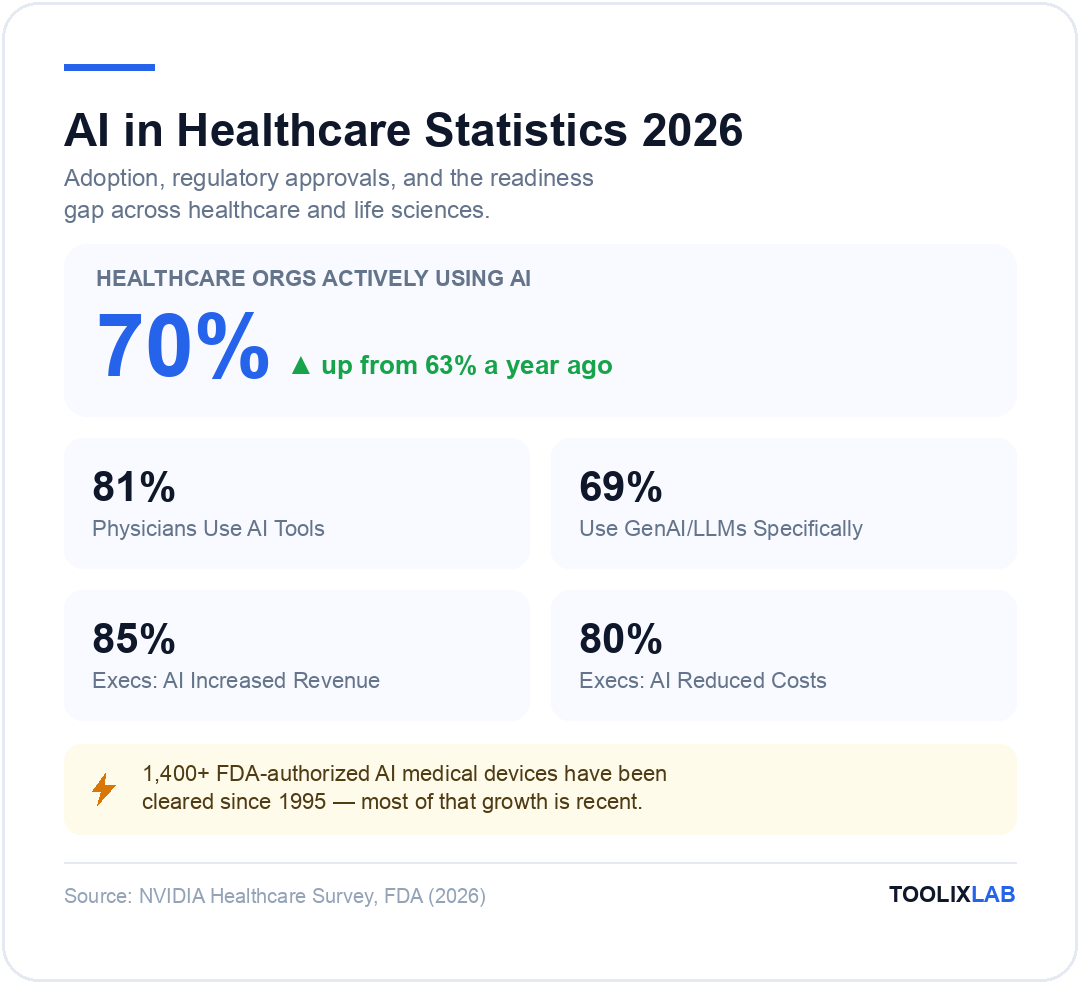
- 📊 70% of healthcare and life sciences organizations actively use AI in 2026, up from 63% in 2024 (NVIDIA)
- 📊 69% of organizations use generative AI/LLMs, up sharply from 54% the year before (NVIDIA)
- 📊 85% of healthcare executives say AI has increased annual revenue; 80% say it has reduced operational costs (NVIDIA)
- 📊 1,400+ AI-enabled medical devices authorized by the FDA since 1995, with a record 331 authorized in 2025 alone (FDA)
- 📊 Radiology accounts for the large majority of FDA AI-device authorizations, followed by cardiology and neurology (FDA)
- 📊 The global AI-in-healthcare market: $36.7B (2025) → $50.7B (2026) → a projected $505.6B by 2033, a 38.9% CAGR (Grand View Research)
- 📊 81% of U.S. physicians use AI in practice, more than double the 38% recorded in 2023 (AMA)
- 📊 Physicians average 2.3 distinct AI use cases each in 2026, up from 1.1 in 2023 (AMA)
- 📊 76%+ of physicians believe AI improves their ability to care for patients, up from 65% in 2023 (AMA)
- 📊 88% of physicians worry AI reliance will erode clinical skills, especially for residents (AMA)
- 📊 Mass General Brigham burnout prevalence fell from 52.6% to 30.7% (a 21.2-point drop) after 84 days of ambient AI scribe use (JAMA Network Open)
- 📊 A separate 5-hospital JAMA study found only a 13–16-minute daily documentation-time reduction for typical AI scribe users — 3–10% relative, not the 40–45% figures common in marketing
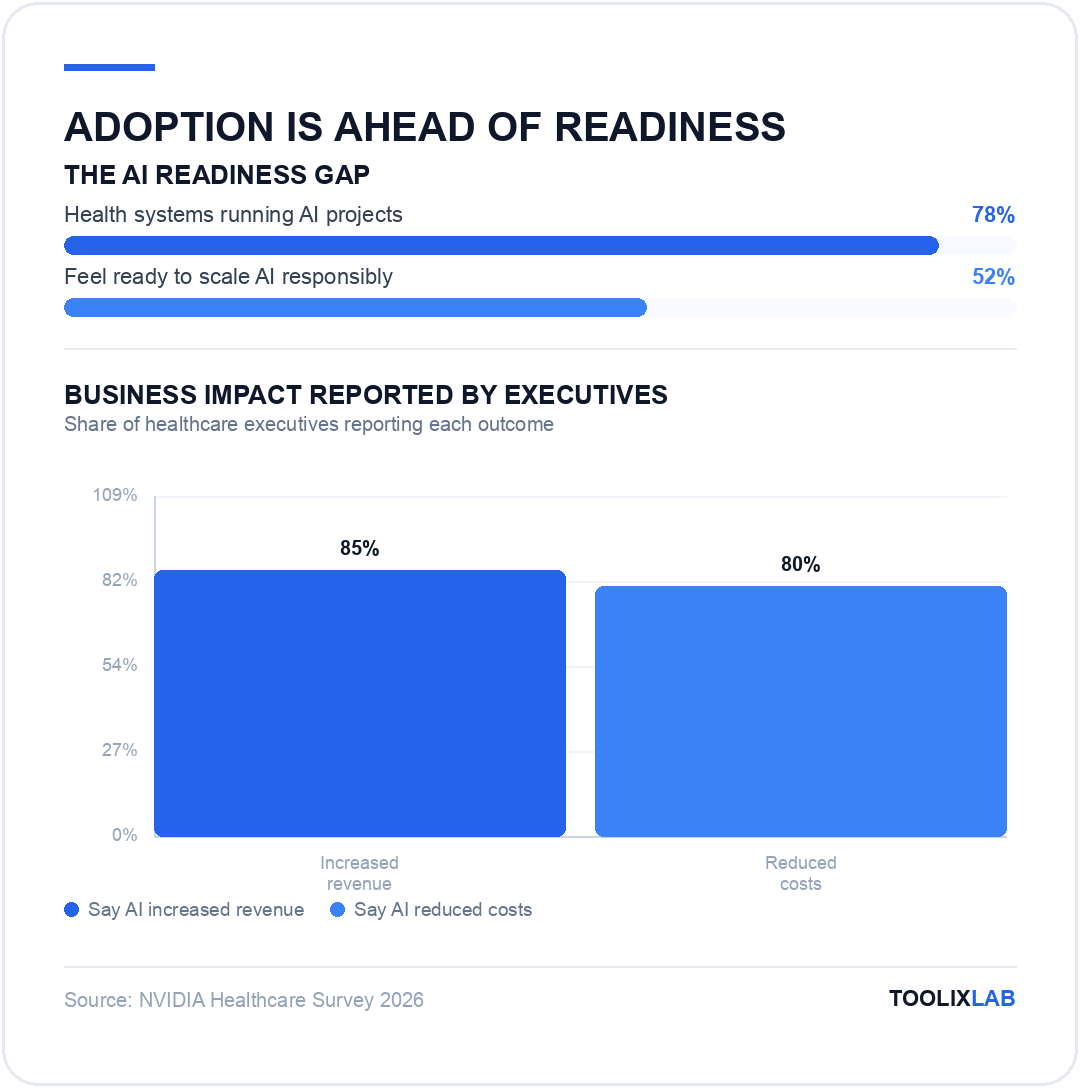
- 📊 78% of health systems are engaged in AI projects, but only 52% feel operationally ready to deploy at scale (HIMSS/Guidehouse)
📚 Sources & Methodology
Every statistic below is attributed to its original report. We prioritized the FDA's own device list, peer-reviewed JAMA Network Open studies, and named industry/professional-association surveys over aggregator blog posts — and we explicitly flag figures (like the "$3.20 ROI" claim) that circulate widely without a traceable primary source:
- NVIDIA — State of AI in Healthcare and Life Sciences 2026 Trends Survey, published February 24, 2026.
- U.S. FDA — official Artificial Intelligence-Enabled Medical Devices list, updated March 2026.
- American Medical Association — 2026 Physician Survey on Augmented Intelligence, fielded January 15–February 2, 2026.
- Mass General Brigham / JAMA Network Open — ambient documentation and physician burnout study, published August 21, 2025.
- Grand View Research — Artificial Intelligence in Healthcare Market Report, 2026–2033.
- HIMSS / Guidehouse — 2026 Healthcare AI Trends survey on organizational readiness.
Finding #1: 70% of Healthcare Organizations Now Use AI
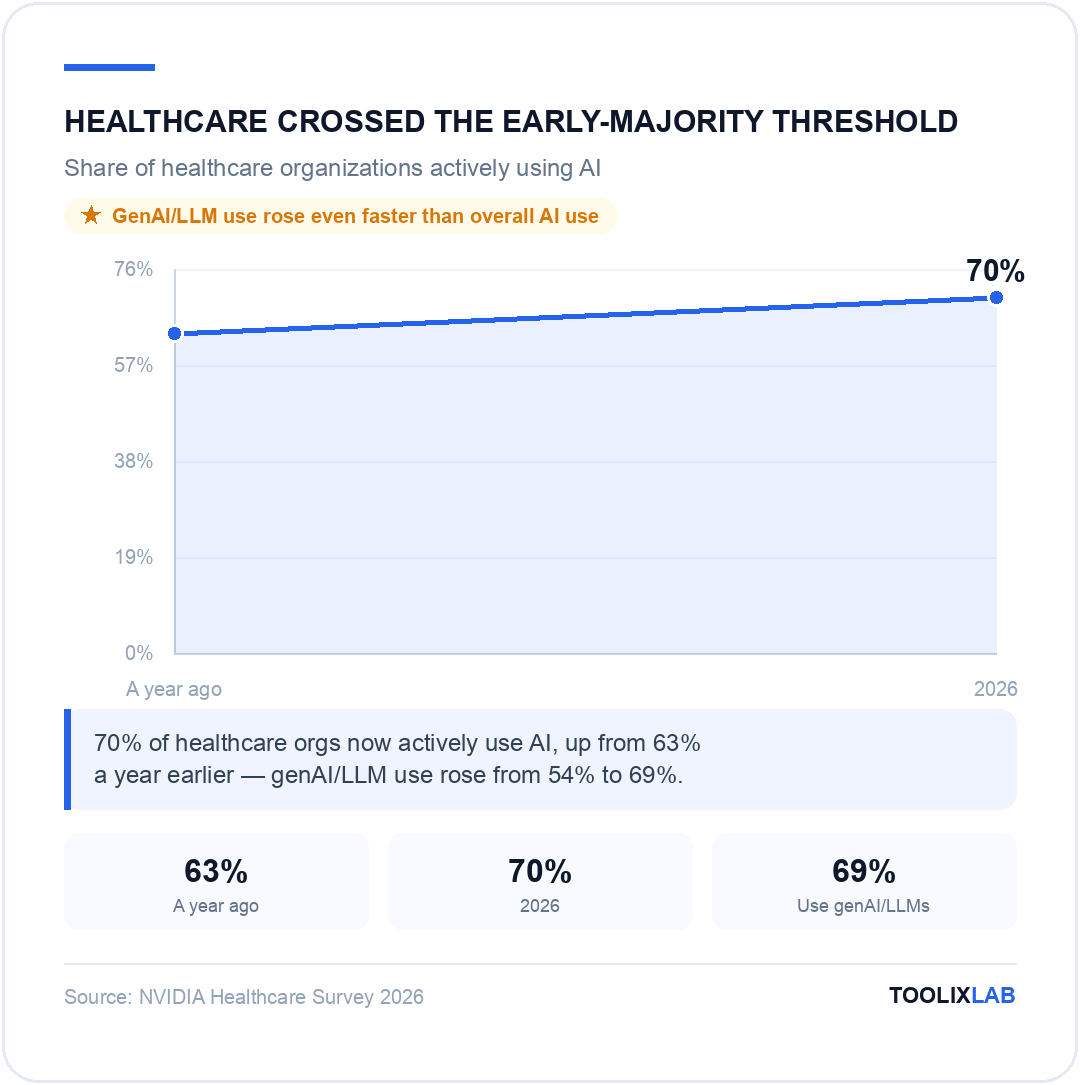
NVIDIA's second annual State of AI in Healthcare and Life Sciences survey, published February 2026, found 70% of healthcare and life sciences organizations are now actively using AI — up from 63% in 2024. Generative AI and large language models specifically jumped from 54% to 69% of respondents year-over-year, making it the most-cited workload category in the survey. Agentic AI — AI systems that can take multi-step actions rather than just generate text — is newer but already at 47% of organizations either using or actively assessing it.
Adoption isn't uniform across the industry. Digital healthcare providers report the highest engagement at 78%, followed by medical technology companies at 74%. On the financial side, 85% of executives report AI has increased annual revenue and 80% say it has reduced operational costs, with 85% planning to increase AI spending further — 46% of those by more than 10%. The clearest ROI use cases split by segment: medical technology companies see the strongest returns in medical imaging (61%), pharma and biotech in drug discovery (57%), and payers/providers in administrative workflow optimization (39%).
A commonly repeated figure — "AI returns $3.20 for every $1 invested in healthcare" — appears across dozens of marketing and aggregator sites, sometimes attributed to NVIDIA, sometimes to Microsoft-IDC. NVIDIA's own 2026 report, read directly, reports revenue and cost-reduction percentages, not that dollar multiplier. We report the NVIDIA-verified figures above and treat the $3.20 claim as unverified rather than repeating it as fact.
Finding #2: The FDA Has Authorized 1,400+ AI Medical Devices
The FDA's official AI-Enabled Medical Devices list — which the agency has maintained since 1995 — shows more than 1,400 authorizations as of its March 2026 update, with a record 331 devices authorized in 2025 alone, the most in the agency's history. Radiology remains the dominant specialty by a wide margin, with cardiology and neurology following as the next-largest categories. The vast majority of these clearances move through the FDA's 510(k) pathway (demonstrating substantial equivalence to an already-cleared device) rather than the more rigorous De Novo or full Premarket Approval routes.
Two things are worth separating here. First, "FDA-authorized" describes a regulatory clearance to market a device — it does not by itself certify clinical superiority over existing standards of care, and our AI medical diagnosis accuracy research covers what independent accuracy studies actually found once these tools are deployed. Second, the FDA has not yet authorized a fully generative-AI-enabled device for marketing as of early 2026, though it granted breakthrough-device designation to a patient-facing generative AI application in March 2026 — a signal that the next wave of authorizations may look structurally different from the imaging-classifier devices that dominate the list today.
Finding #3: A Market Growing Roughly 39% a Year
Grand View Research values the global AI-in-healthcare market at $36.7 billion in 2025, growing to $50.7 billion in 2026, and projects it will reach $505.6 billion by 2033 — a compound annual growth rate of 38.9%. Other research firms, including Precedence Research, publish similar trajectories with different end-year assumptions (their estimate runs to $613.81 billion by 2034), which is typical for fast-moving market-sizing research: the underlying growth rate is broadly consistent across firms even when the specific dollar endpoint varies by methodology and forecast horizon.
The growth is not evenly distributed across use cases. Diagnostics and medical imaging remain the largest deployed category by revenue today, but administrative and operational automation — documentation, billing, scheduling, prior authorization — is the fastest-growing segment, consistent with NVIDIA's finding that payers and providers see their strongest ROI from workflow optimization rather than clinical use cases.
Finding #4: Physician AI Use Has More Than Doubled Since 2023
The American Medical Association's 2026 Physician Survey on Augmented Intelligence, fielded January 15–February 2, 2026, found 81% of physicians now use AI in their practice — more than double the 38% who said the same in 2023. The average physician reports 2.3 distinct AI use cases, up from 1.1 three years earlier. The most common applications are summarizing medical research and standards of care (39%), drafting discharge instructions and care plans (30%), and documenting billing codes and medical charts (28%) — administrative and research-support tasks, not autonomous diagnosis.
Confidence has grown alongside adoption: more than three-quarters of physicians now believe AI improves their ability to care for patients, up from 65% in 2023. But confidence and concern coexist rather than trade off. 88% of physicians report some level of concern that AI reliance will erode clinical skills — particularly for residents and physicians with 10 years or less experience — and 86% cite data privacy as critical to wider adoption. Physicians also draw a sharp line on patient-facing use: nearly half strongly oppose patients using AI alone to interpret their own radiology or pathology results, even while broadly supporting AI for general health questions.
Finding #5: Ambient Scribes and the Burnout Data
A JAMA Network Open study tracking ambient AI documentation tools at Mass General Brigham and Emory Healthcare — published August 21, 2025, and still the most-cited peer-reviewed burnout dataset heading into 2026 — found burnout prevalence at Mass General Brigham fell from 52.6% to 30.7%, a 21.2-percentage-point absolute reduction, after 84 days of ambient scribe use among 873 surveyed physicians and advanced practice providers (response rates 30% at 42 days, declining to 22% at 84 days). Emory Healthcare's parallel pilot of 557 users saw documentation-related wellbeing rise from 1.6% positive before adoption to 32.3% after 60 days.
The program's scale-up trajectory is itself informative: Mass General Brigham began with an 18-physician pilot in July 2023, expanded to 800+ providers by July 2024, and reached system-wide availability with 3,000+ routine users by April 2025 — a roughly three-year path from pilot to broad adoption, not an overnight rollout.
Finding #6: The Documentation-Time Reality Check
Here's where the marketing numbers and the peer-reviewed numbers diverge sharply. Vendor materials and aggregator content commonly cite "40–45% reductions" in physician documentation time from AI scribes. A separate, larger JAMA-published study — tracking more than 1,800 AI-scribe users against 6,770 matched controls across five U.S. hospitals — measured something much smaller for typical users: a 13–16-minute daily reduction in documentation and EHR time, representing just a 3–10% relative decrease, alongside 0.5 additional patient visits per week.
The gap has a specific, measurable explanation rather than being a simple contradiction: only 32% of users in that study adopted the AI scribe for more than half of their visits, and that high-usage subgroup saw two to three times the time savings of typical users. In other words, the 40–45% figures aren't fabricated — they likely describe the top usage tier, or a different, smaller pilot population — but they get generalized to "AI scribes save 40% of documentation time" without the usage-intensity qualifier that makes them true only for the minority of clinicians using the tool most heavily.
Why this matters for buyers: if a health system budgets for a 40% documentation-time reduction across its entire clinician base and only the top third of users hit anywhere near that number, the ROI case built on the average will fall short. The burnout improvement (Finding #5) and the time-savings improvement (this finding) are also two different outcomes measured by two different studies — a tool can meaningfully reduce burnout without producing the dramatic time-savings percentage often quoted alongside it.
Finding #7: The Readiness Gap Between Activity and Deployment
A 2026 HIMSS/Guidehouse Healthcare AI Trends survey found 78% of health systems are actively engaged in AI projects — but only 52% feel operationally ready to implement them at scale, a 26-point gap the report labels "execution paralysis." The gap tracks closely with NVIDIA's finding that generative AI and agentic AI are growing the fastest even as more foundational infrastructure and governance work lags behind — organizations are experimenting broadly while a smaller subset has actually solved integration with legacy EHR systems, staffing, and governance.
This is consistent with what shows up across other AI-adoption research we've tracked, including our broader state-of-AI-tools statistics: pilot-stage engagement consistently outpaces production-scale deployment across industries, and healthcare's regulatory and liability constraints make that gap wider than in most other sectors.
Claim vs. Measured Reality: Side-by-Side
| Metric | Common Marketing Claim | Measured / Primary-Sourced Figure | Source |
|---|---|---|---|
| Documentation time saved | "40–45% reduction" | 13–16 min/day (3–10%) for typical users | JAMA (5-hospital study) |
| Healthcare AI ROI | "$3.20 per $1 invested" | 85% report revenue increase, 80% report cost reduction | NVIDIA 2026 Survey |
| Physician AI use | "AI is everywhere in medicine" | 81% use it; mostly for research summaries & documentation, not diagnosis | AMA 2026 Survey |
| FDA "AI-approved" devices | Implied clinical superiority | Regulatory clearance (mostly 510(k)), not a superiority claim | FDA official list |
| Health-system AI readiness | "Healthcare is deploying AI at scale" | 78% engaged, only 52% feel scale-ready | HIMSS/Guidehouse 2026 |
What This Means If You Work in Healthcare
Three practical takeaways fall out of this data, whether you're evaluating a vendor pitch or planning an internal rollout:
Adoption is real and accelerating, but concentrated in support work, not autonomous clinical decisions. The 81% physician-adoption figure and 70% organizational-adoption figure are both genuine, but the dominant use cases underneath them — documentation, research summarization, administrative workflow — are augmentation tools, not replacements for clinical judgment. That distinction matters when reading any "AI is transforming medicine" headline: transformation of paperwork and transformation of diagnosis are different claims with very different evidence bases, which is exactly why we cover diagnostic accuracy separately in our AI medical diagnosis accuracy statistics research.
Vendor ROI and time-savings figures need a usage-intensity qualifier before you budget against them. The gap between "40–45% documentation time saved" and the measured 13–16-minute, 3–10% reduction for typical users isn't a case of dishonest marketing so much as selective reporting of best-case usage tiers. Any healthcare organization building a business case around AI documentation tools should ask vendors specifically what usage rate their headline figure assumes, the same way our AI CRM ROI research found vendor-sourced adoption numbers need to be separated from independently measured ones.
The readiness gap is the real bottleneck, not enthusiasm. With 78% of health systems already running AI projects, the constraint on 2026's growth isn't whether healthcare organizations want to adopt AI — it's whether they can integrate it with legacy EHR systems, governance, and staffing fast enough to convert pilots into system-wide deployment. Closing that 26-point gap between engagement and readiness, more than any single new model or device approval, is what determines how much of this year's growth trajectory actually gets realized.
🔑 Key Takeaways
- ✓ 70% of healthcare organizations now use AI (up from 63% in 2024), and 81% of physicians use it in practice (up from 38% in 2023)
- ✓ The FDA has authorized 1,400+ AI medical devices since 1995, with a record 331 in 2025 — mostly imaging-classifier devices via the 510(k) pathway, not generative AI
- ✓ The global AI-in-healthcare market is growing roughly 39% a year, from $50.7B in 2026 toward a projected $505.6B by 2033
- ✓ Ambient AI scribes measurably cut burnout (52.6%→30.7% at Mass General Brigham) but real documentation-time savings (13–16 min/day) run well below the 40–45% figures common in marketing
- ✓ 78% of health systems are engaged in AI projects, but only 52% feel operationally ready to deploy at scale — that gap, not lack of interest, is the industry's real bottleneck