
By ToolixLab Research Team · Last updated: July 2026
Quick Answer
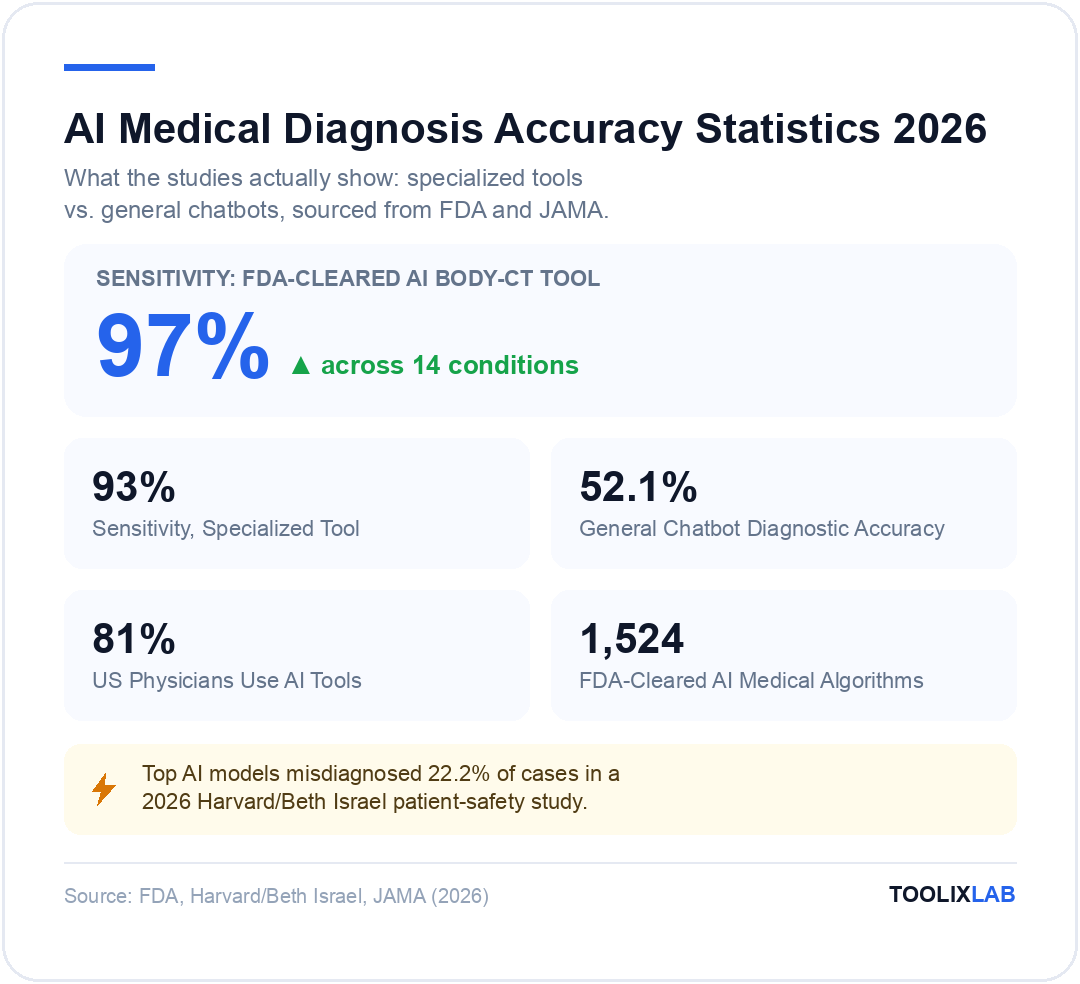
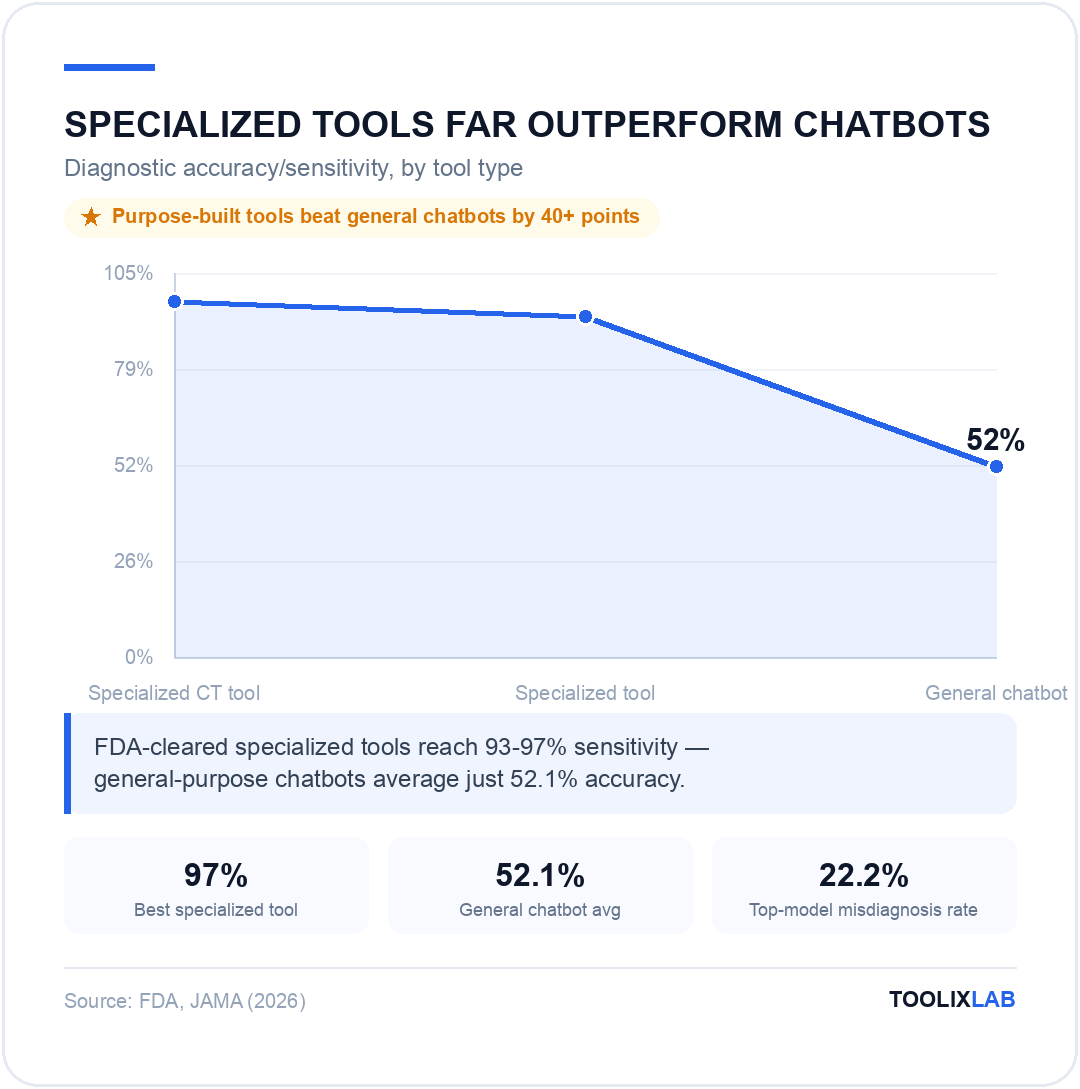
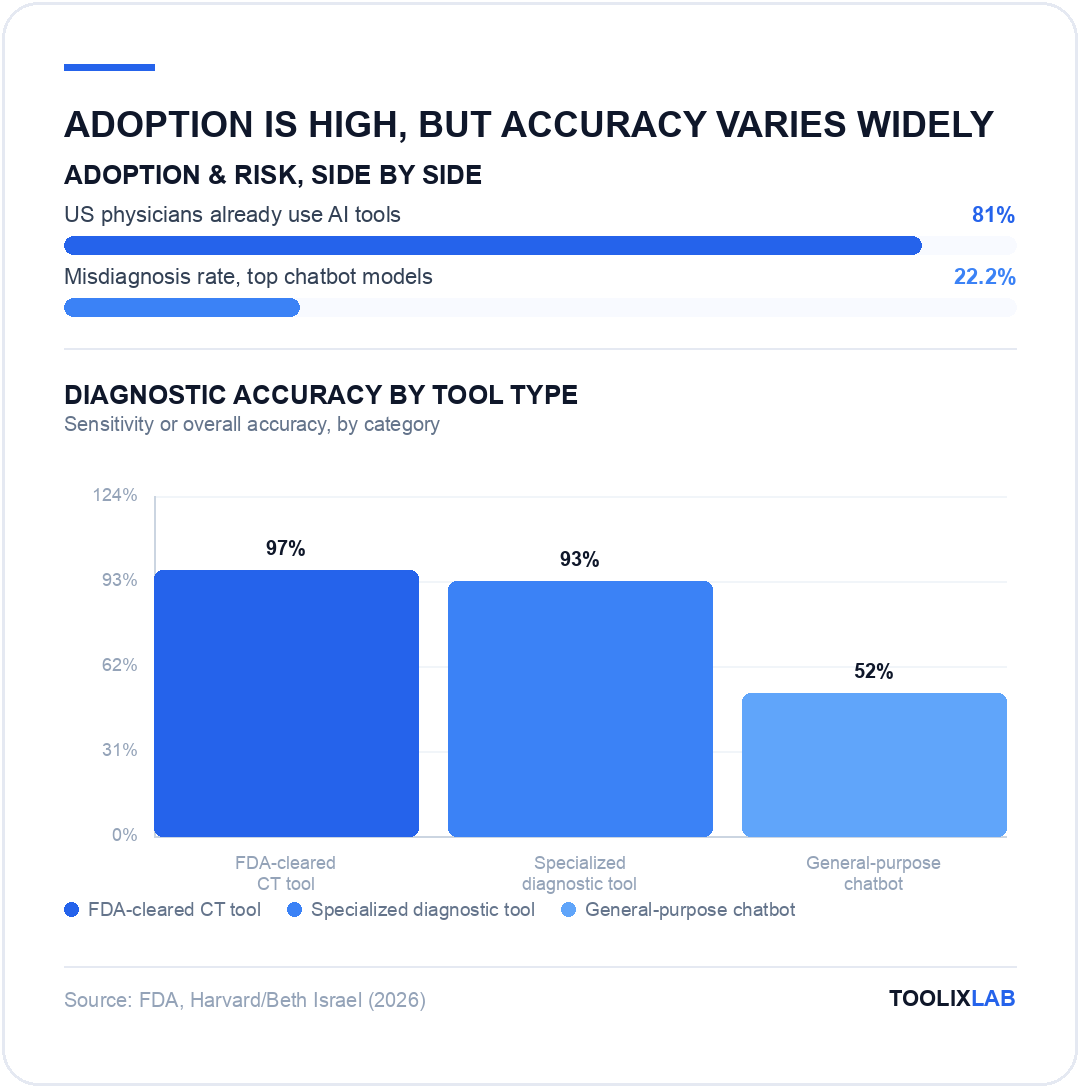
AI medical diagnosis accuracy in 2026 depends entirely on which "AI" you mean. Narrow, purpose-built imaging models are already outperforming or matching specialists — diabetic retinopathy screening hits 93% sensitivity, and an FDA-cleared body-CT tool reached 97% sensitivity across 14 conditions. General-purpose chatbots are far less reliable: a broad meta-analysis of 83 studies puts generative AI's overall diagnostic accuracy at just 52.1%, and a 2026 Stanford/Harvard safety study found top AI models still produce severely harmful clinical recommendations in up to 22.2% of cases. Meanwhile a May 2026 Harvard/Beth Israel study published in Science found OpenAI's o1 model matched or beat two attending physicians at emergency-room triage — 67% exact-or-close diagnoses vs. 55% and 50%. The FDA has now cleared 1,524 AI medical algorithms, and 81% of U.S. physicians already use AI in practice.
"Is AI accurate enough to diagnose me?" doesn't have one answer in 2026 — it has at least three, depending on whether you're asking about a narrow FDA-cleared imaging model, a general-purpose chatbot, or a frontier reasoning model used as a physician's second opinion. Headlines tend to flatten all three into a single "AI beats doctors" or "AI is dangerous" narrative. The actual research is far more specific, and far more useful, than either headline.
We pulled together the most rigorous primary-source studies on AI diagnostic accuracy published in 2025–2026 — peer-reviewed meta-analyses, a Harvard Medical School trial published in Science, a Stanford/Harvard clinical-safety benchmark, and the FDA's own device-clearance data — so you can see exactly where AI already outperforms clinicians, where it still lags, and where the two together beat either alone.
For the broader picture of how AI is performing across every category — not just healthcare — see our State of AI Tools 2026 statistics roundup, and for how general-purpose chatbots handle factual accuracy outside medicine, our piece on what AI chatbots get wrong is a useful companion.
AI Medical Diagnosis Accuracy: The Key Numbers
- 📊 52.1% — overall diagnostic accuracy of generative AI (chatbots) across a meta-analysis of 83 studies
- 📊 Generative AI trails expert specialist physicians by 15.8 percentage points, but shows no significant gap versus non-expert physicians
- 📊 67% — OpenAI's o1 model's exact-or-close diagnosis rate at ER triage, vs 55% and 50% for two attending physicians (Harvard/Beth Israel, Science, May 2026)
- 📊 22.2% — the share of cases in which top AI models still produced severely harmful clinical recommendations (Stanford/Harvard NOHARM safety benchmark, Jan 2026)
- 📊 93% sensitivity / 90% specificity — pooled accuracy of FDA-cleared diabetic retinopathy screening AI (npj Digital Medicine meta-analysis)
- 📊 97% sensitivity / 98% specificity — Aidoc's FDA-cleared body-CT AI across 14 conditions (Jan 2026 clearance)
- 📊 87% sensitivity / 77.1% specificity — AI skin cancer detection, vs 79.8%/73.6% for clinicians (53-study meta-analysis)
- 📊 1,524 — total FDA-cleared AI medical algorithms as of March 2026; radiology accounts for 76.3% of them
- 📊 795,000 — Americans harmed annually by human diagnostic error (Johns Hopkins), the baseline AI is being measured against
- 📊 81% of U.S. physicians now use AI in their practice, more than double the 38% rate in 2023 (AMA, March 2026)
Feel free to cite any statistic on this page — we ask only for a link back to this article as the source.
Methodology: Where This Data Comes From
This is a curated compilation of primary-source clinical research, not a survey we ran ourselves. Every figure traces back to one of the following studies:
- A 2025 systematic review and meta-analysis of 83 studies comparing generative AI's diagnostic performance against physicians, published via PMC/medRxiv.
- Harvard Medical School / Beth Israel Deaconess Medical Center, with Stanford collaborators — a study published in Science (May 3, 2026) comparing OpenAI's o1 and 4o models against two attending physicians on 76 real emergency-room patient cases.
- Stanford University and Harvard Medical School's NOHARM safety benchmark (January 2, 2026) — 31 leading LLMs evaluated against 100 real primary-care-to-specialist consultation cases, rated by 29 board-certified physicians across 12,747 individual clinical-action ratings.
- npj Digital Medicine pooled meta-analyses on FDA-cleared diabetic retinopathy screening AI and AI skin-cancer detection systems.
- Aidoc FDA clearance data (January 2026) for its body-CT triage algorithm, and a 2025 prospective multicenter diagnostic-accuracy study on AI-assisted intracranial hemorrhage (ICH) detection.
- Johns Hopkins Medicine research on the annual burden of human diagnostic error in the United States.
- FDA AI/ML medical device tracking (via Innolitics' quarterly clearance reports) for the total count and pace of AI diagnostic device clearances.
- American Medical Association 2026 Physician Survey on Augmented Intelligence (March 2026).
Limitations: "AI diagnostic accuracy" spans wildly different technologies — narrow imaging classifiers, general chatbots, and frontier reasoning models — with different validation standards. We've specified which type of AI and which study each figure comes from so you don't compare a narrow imaging model's sensitivity against a chatbot's overall accuracy as if they were the same claim.
Finding #1: There Isn't One "AI Diagnostic Accuracy" — There Are Three
The single most important thing to understand before citing any AI-diagnosis statistic is that "AI" in this research covers three genuinely different categories of technology, and conflating them is the most common way these statistics get misused:
| Category | What it does | Typical accuracy |
|---|---|---|
| Narrow imaging AI | Single-task classifiers (retinopathy screening, chest CT, mammography) — the majority of FDA-cleared tools | 87–98% sensitivity/specificity |
| Frontier reasoning models | General LLMs (o1, GPT-5, Claude, Gemini) used for differential diagnosis and triage support | 52–67% (highly variable) |
| Consumer chatbot self-diagnosis | Patients querying general chatbots directly, unsupervised | No better than search (Oxford, 2026) |
Narrow imaging AI is, in effect, a mature technology at this point — it's been trained on one visual task, validated against thousands of labeled cases, and cleared by a regulator. Frontier reasoning models are a much younger and more variable category: capable of matching skilled physicians in a controlled trial, and capable of a nearly 1-in-4 severe error rate in a different, adversarially designed one. Consumer self-diagnosis via chatbot is the least validated use case of the three, and the one regulators and physicians are most consistently cautious about.
Finding #2: In a Controlled Harvard Trial, AI Matched or Beat Two Attending Physicians
The most-cited 2026 result in this space comes from a Harvard Medical School / Beth Israel Deaconess Medical Center study, run with Stanford collaborators and published in Science on May 3, 2026. Researchers gave OpenAI's o1 and 4o models the same real electronic-medical-record data as two internal medicine attending physicians for 76 real emergency-room patient cases, then had independent physicians (blinded to the source) score the diagnoses:
The head-to-head result
OpenAI's o1 model produced an exact or very close diagnosis in 67% of cases, compared to 55% and 50% for the two attending physicians. The gap was largest at the initial triage stage, when information was most limited — exactly the moment a fast, broad differential is most valuable.
The researchers were careful to caveat their own result: they explicitly stated this does not mean AI is ready for unsupervised clinical decisions, and called for prospective real-world trials before drawing that conclusion. The study's real contribution is narrower and more useful than "AI beats doctors" — it shows that at the specific task of generating a broad differential diagnosis from limited information, a frontier model can out-hypothesize two trained physicians working from the same data. What it doesn't test is judgment under uncertainty, bedside risk-tolerance, or the hundreds of small clinical decisions a physician makes that never show up in a case-file comparison.
Finding #3: The Same AI Models Also Produce Severe Errors in Up to 1-in-5 Cases
Two months before the Harvard result was published, a separate Stanford University / Harvard Medical School team ran a very different kind of test — not "can AI generate a plausible diagnosis," but "how often does AI recommend something that would actively harm a patient." The NOHARM benchmark (Numerous Options Harm Assessment for Risk in Medicine), published January 2, 2026, evaluated 31 leading LLMs — including GPT-5, o3/o4-mini, Gemini, Claude Sonnet 4.5, Llama 4, and two specialized medical platforms — against 100 real Stanford Health Care primary-care-to-specialist referral cases, scored by 29 board-certified physicians across 12,747 individual clinical-action ratings.
- The most sophisticated models still produced severely harmful clinical recommendations in up to 22.2% of cases
- Top-performing models: 11.8–14.6 severe errors per 100 cases
- Worst-performing models: 39.9–40.1 severe errors per 100 cases — more than 1 in 3
- The 10 board-certified human internists in the comparison group outperformed the worst AI models but underperformed the top-tier ones on the same safety metric
Read together, the Harvard and Stanford studies aren't a contradiction — they're measuring different things on different model sets under different conditions, and both are true simultaneously. A frontier model can generate a more accurate initial differential than a tired physician working a busy ER shift, and the same category of model can still recommend a specific action that a specialist would immediately flag as dangerous. This is precisely why every credible study in this space — including both cited here — concludes with a version of "not yet ready for unsupervised use," not "replace physicians now."
Finding #4: Where AI Already Reliably Beats or Matches Specialists — Narrow Imaging Models
The clearest, least-contested wins for AI in medicine aren't the general chatbots — they're single-task imaging classifiers that have been narrowly trained and clinically validated for years:
| Application | AI performance | Source |
|---|---|---|
| Diabetic retinopathy screening | 93% sensitivity / 90% specificity | npj Digital Medicine pooled meta-analysis |
| Aidoc body-CT (14 conditions) | 97% sensitivity / 98% specificity | FDA clearance, Jan 2026 |
| Intracranial hemorrhage (ICH) detection | 98.91% sensitivity / 99.83% specificity | Prospective multicenter study, 2025 |
| Skin cancer detection (vs. 79.8%/73.6% for clinicians) | 87% sensitivity / 77.1% specificity | 53-study meta-analysis, npj Digital Medicine |
| Early-stage breast cancer screening | 90–92% sensitivity | Multiple screening-AI validation studies |
The pattern across all five is the same: performance is highest when the task is narrow, the input is a single image modality, and the training set is large and well-labeled. This is also why radiology dominates FDA clearances (see below) — it's the specialty where "AI diagnostic accuracy" has the most rigorous, reproducible evidence behind it, in sharp contrast to the much noisier evidence for general-purpose reasoning models covered above.
Finding #5: The FDA Has Cleared 1,524 AI Medical Algorithms — and the Pace Is Accelerating
Regulatory clearance data is a useful proxy for how much of this technology has moved from research paper to deployed clinical tool:
- 1,524 total FDA-cleared AI/ML medical algorithms as of March 30, 2026
- 1,163 of those (76.3%) are radiology algorithms — by far the dominant specialty
- 68 new radiology algorithms were cleared in just the first three months of 2026 alone
- The FDA is now clearing roughly 30 AI devices per month, up from an average of 21/month in 2024
- ~95–97% of clearances use the faster 510(k) pathway (demonstrating substantial equivalence to an existing device) rather than the more rigorous De Novo or full PMA review
The 510(k)-pathway concentration is worth flagging: most AI medical devices reach the market by demonstrating they're substantially equivalent to something already cleared, not by running a full independent clinical trial. That's standard practice for incremental medical device innovation generally, but it means the sensitivity/specificity figures cited in this article — which mostly come from academic validation studies, not the clearance filings themselves — are the more rigorous number to anchor on if you're evaluating a specific tool.
Finding #6: The Baseline AI Is Actually Being Measured Against Is Worse Than People Assume
Every AI-diagnosis statistic implicitly compares against a human baseline — and that baseline has real, well-documented error rates that predate AI entirely. Johns Hopkins Medicine's research on diagnostic error puts hard numbers on it:
- 795,000 Americans are seriously harmed by diagnostic errors every year
- The overall diagnostic error rate across all care settings sits at 10–15% of medical encounters
- 20% of serious conditions are misdiagnosed on first presentation; the average error rate across all diseases is just over 11%
- The "Big Three" — vascular events, infections, and cancers — account for 75% of all serious misdiagnosis-related harms, with a weighted mean error rate of 11.1% and serious-harm rate of 4.4% per case
- Diagnostic error is now recognized as the leading cause of serious medical error in the U.S. — ahead of surgical mistakes, medication errors, and hospital-acquired infections
This context matters because it reframes the right comparison. The question isn't "is AI perfect" — no diagnostic system, human or machine, is — it's "does AI, used correctly, reduce the 10–15% baseline error rate." The Harvard study's finding that a frontier model out-hypothesized two attending physicians on limited information is meaningful specifically because those physicians represent the real, imperfect baseline AI has to beat, not an idealized one.
Finding #7: Physicians Are Adopting AI Faster Than the Accuracy Debate Is Being Settled
Regardless of where the research lands, physicians are already integrating AI into practice at a pace that's outrunning the safety literature:
- 81% of U.S. physicians now use AI in their practice, more than double the 38% rate in 2023 (AMA, March 2026)
- The average number of AI use cases per physician rose from 1.1 in 2023 to 2.3 in 2026
- Among healthcare professionals using AI, 48% use it specifically for clinical decision support — not just documentation or research summarization
- More than three-quarters of physicians now say AI improves their ability to care for patients, up from 65% in 2023
The most common current uses skew toward augmentation rather than autonomous diagnosis: medical research summarization, clinical documentation, and differential-diagnosis brainstorming where a physician remains the final decision-maker. That's consistent with what the accuracy research actually supports — AI as a second opinion and hypothesis-generator, not (yet) an unsupervised diagnostician.
What This Data Means in Practice
Trust narrow, FDA-cleared imaging AI for its specific validated task. Retinopathy screening, CT triage, and dermatology-assist tools have years of large-sample validation behind them and consistently match or beat human specialists at their one job. This is the least controversial use of AI in medicine today.
Treat general-purpose chatbot diagnosis as a second opinion, not a source of truth. With generative AI's overall accuracy sitting near 52% in the broadest meta-analysis, and a 2026 Oxford study finding patient chatbot self-diagnosis performed no better than a Google search, unsupervised consumer use remains genuinely risky — a pattern consistent with broader findings about where AI chatbots get things wrong outside medicine too.
Frontier reasoning models are improving fast but remain inconsistent on safety. The same class of model that beat two physicians on differential diagnosis in one trial produced severely harmful recommendations in up to 22% of cases in another. Both results are current and both are real — which is the honest state of the technology in mid-2026, not a settled verdict either direction.
The relevant baseline is real physicians, not a perfect standard. With human diagnostic error already running 10–15% and causing roughly 795,000 serious harms annually in the U.S. alone, the right question for any AI diagnostic tool isn't "is it flawless" — it's "does it measurably reduce that baseline, with a human still in the loop."
Frequently Asked Questions
Is AI more accurate than doctors at diagnosis?
It depends on the task and the AI. Narrow imaging AI (retinopathy, CT, skin cancer screening) already matches or beats specialists at single tasks with 87–98% sensitivity/specificity. General-purpose chatbots average around 52% overall diagnostic accuracy across a broad meta-analysis, though a 2026 Harvard trial found OpenAI's o1 model beat two attending physicians (67% vs. 55%/50%) at ER triage specifically.
How often do AI medical models make dangerous mistakes?
A January 2026 Stanford/Harvard safety benchmark (NOHARM) found the most sophisticated AI models still produced severely harmful clinical recommendations in up to 22.2% of tested cases, with top models averaging 11.8–14.6 severe errors per 100 cases and the worst models nearly 40 per 100.
How many AI medical devices has the FDA approved?
1,524 AI/ML medical algorithms had been FDA-cleared as of March 30, 2026, with radiology accounting for 76.3% of all clearances. The FDA is now clearing roughly 30 new AI devices per month, up from 21/month in 2024.
How accurate is human diagnosis, for comparison?
Johns Hopkins research puts the overall diagnostic error rate at 10–15% of medical encounters, with roughly 795,000 Americans seriously harmed by diagnostic errors annually. Diagnostic error is the leading cause of serious medical error in the U.S., ahead of surgical mistakes and medication errors.
How many doctors actually use AI in 2026?
81% of U.S. physicians report using AI in their practice as of the AMA's March 2026 survey, more than double the 38% rate in 2023. Nearly half (48%) of AI-using healthcare professionals use it specifically for clinical decision support.
Can I cite these statistics?
Yes. These are third-party primary-source statistics compiled and sourced by ToolixLab — cite the original researcher (Harvard/Science, Stanford NOHARM, Johns Hopkins, AMA, or the relevant journal) where possible, and feel free to link to this page as your source for the compilation.
🔑 Key Takeaways
- ✓"AI diagnostic accuracy" isn't one number — narrow imaging AI (87–98%) vastly outperforms general chatbots (~52%) at diagnosis
- ✓A Harvard/Science trial found OpenAI's o1 beat two attending physicians at ER triage (67% vs. 55%/50%) — but a separate Stanford safety study found the same model class still makes severely harmful recommendations in up to 22% of cases
- ✓The FDA has cleared 1,524 AI medical algorithms, 76% of them in radiology, at a pace of roughly 30/month in 2026
- ✓Human diagnostic error already runs 10–15% and harms ~795,000 Americans annually — the real baseline AI has to improve on, not a perfect standard
- ✓81% of U.S. physicians now use AI in practice, mostly as decision support alongside a human, not as an autonomous diagnostician
Related Guides
- AI's Impact on SEO Rankings: 50+ Statistics for 2026 — how the same generative-AI accuracy questions play out in search.
- State of AI Tools 2026: 50+ Key Statistics — the broader adoption picture this healthcare data sits inside.
- AI Tool Pricing Statistics 2026 — original data on what AI tools across categories actually cost.
- What AI Chatbots Get Wrong — the accuracy limitations of general-purpose AI outside medicine.
- Claude vs GPT-5 2026 — how the models behind these medical reasoning benchmarks compare generally.