
By ToolixLab Research Team · Last updated: July 2026
Quick Answer
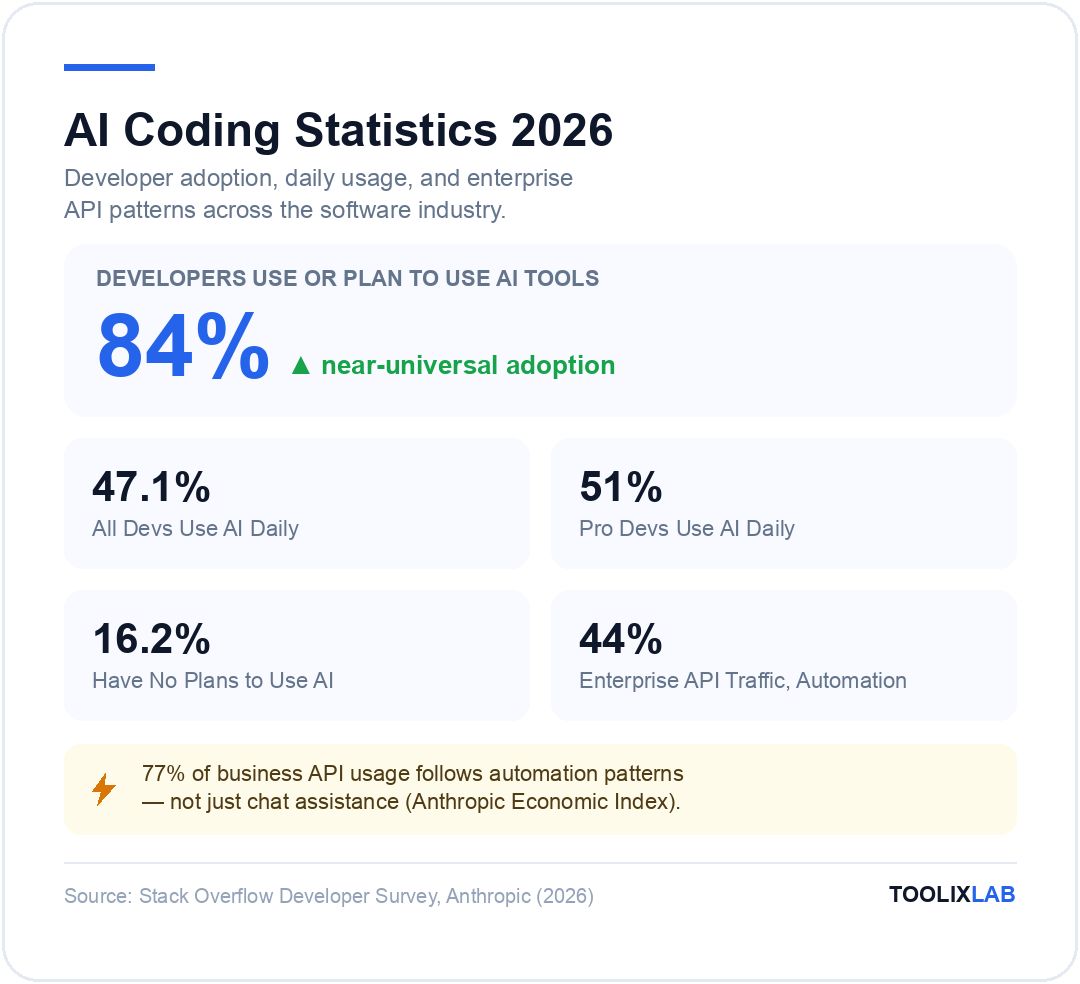
AI coding assistance is now the default, not the exception: 84% of developers use or plan to use AI tools in their workflow, roughly half of professional developers use them daily, and coding is the single largest use case for AI models overall — about 36% of all Claude usage and ~44% of enterprise API traffic. Meanwhile the cost of AI assistance has collapsed (GPT-3.5-class inference fell over 280-fold in two years) and the entry price for a professional AI coding tool sits at just $10–20/month.
AI Coding Statistics 2026: The Key Numbers
- 📊 84% of developers use or plan to use AI tools in their development process, up from 76% a year earlier (Stack Overflow Developer Survey 2025)
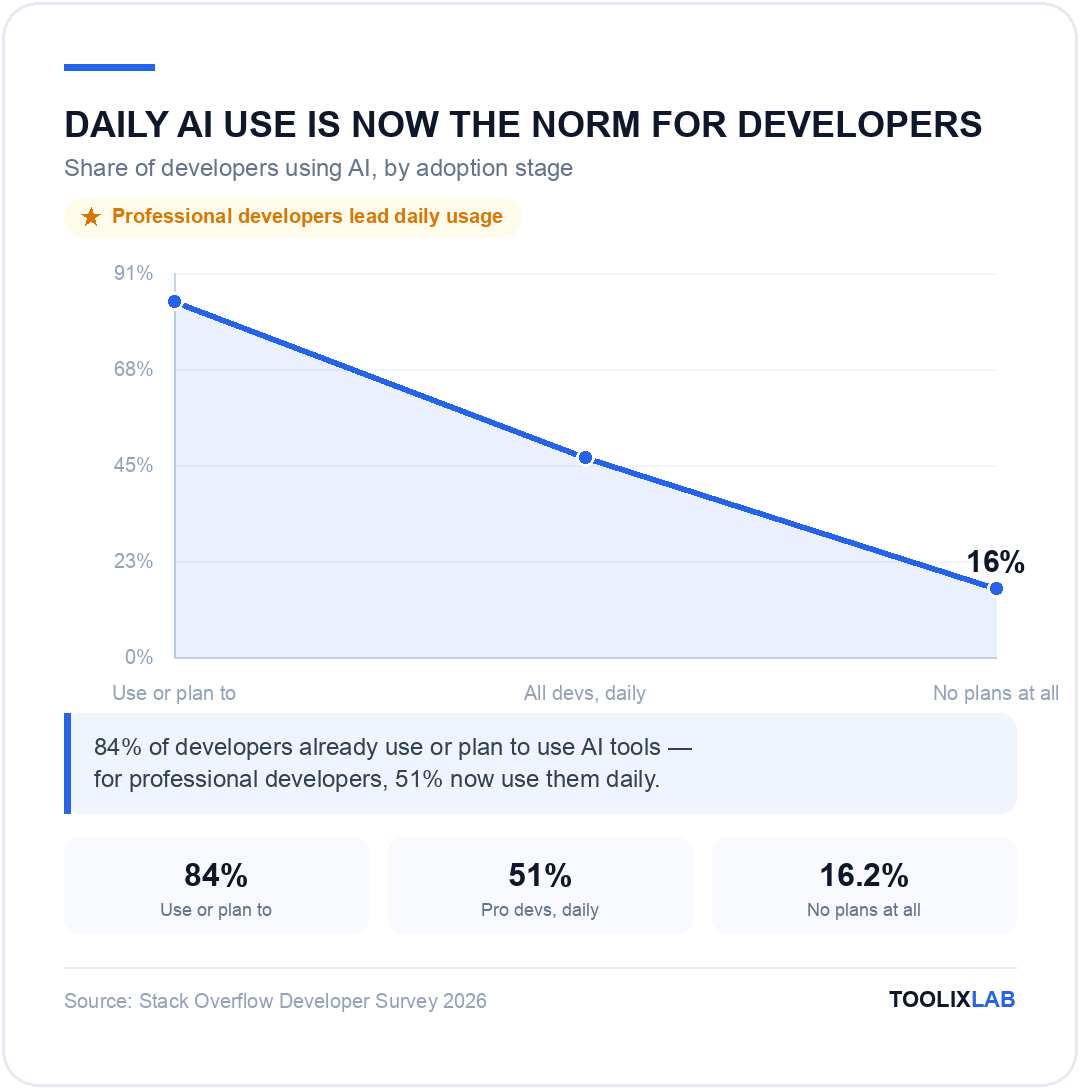
- 📊 47.1% of all developers use AI tools daily — rising to 51% among professional developers
- 📊 Only 16.2% of developers say they don't plan to use AI tools at all
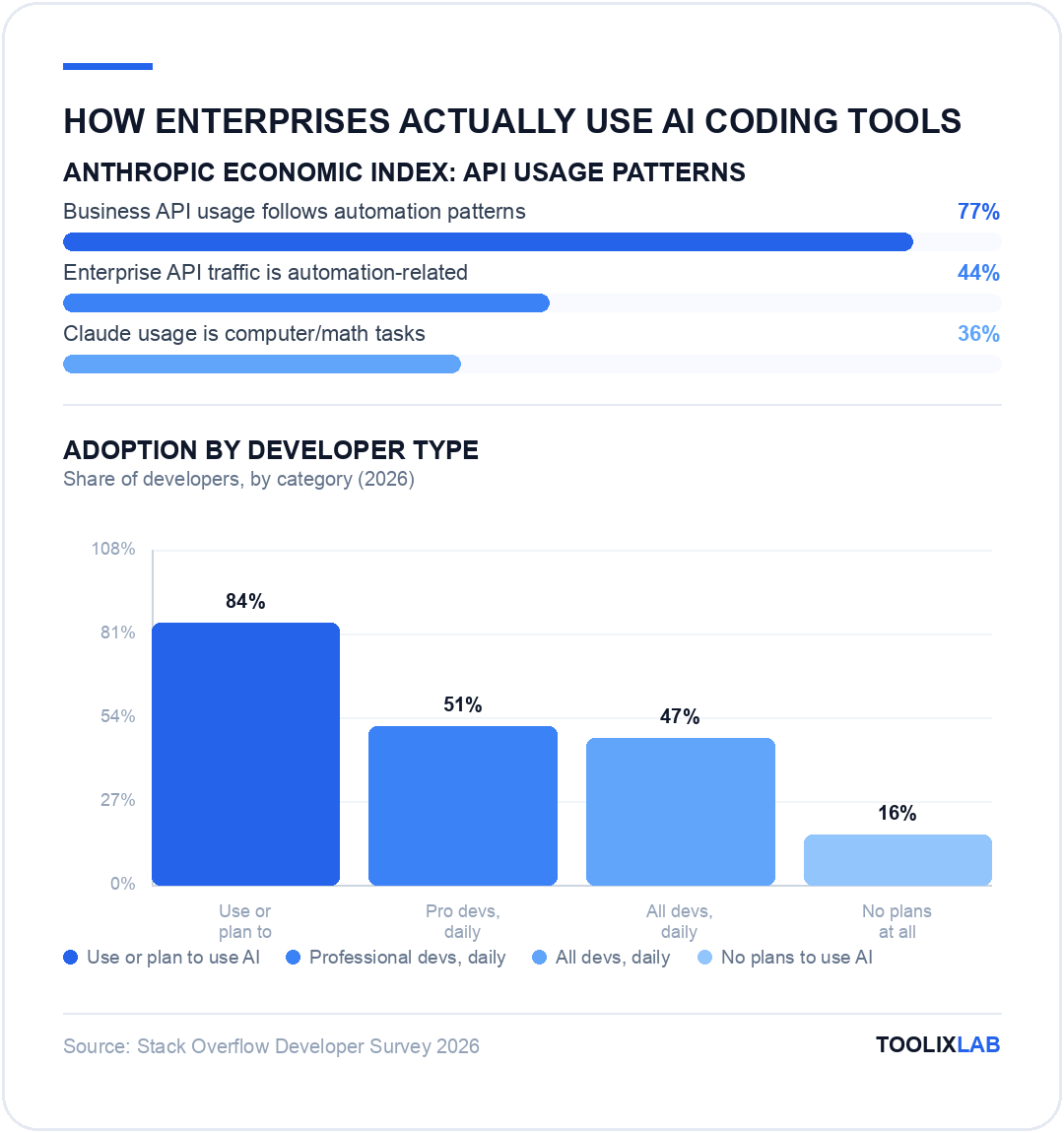
- 📊 36% of all Claude usage is computer and mathematical tasks — the largest single category — rising to roughly 44% of enterprise API traffic (Anthropic Economic Index, Sept 2025)
- 📊 77% of business API usage follows automation patterns (delegating complete tasks), versus about 50% for consumer chat usage
- 📊 Directive "do it for me" usage jumped from 27% to 39% of conversations in under a year — automation now exceeds augmentation
- 📊 Inference cost for a GPT-3.5-class system dropped over 280-fold between November 2022 and October 2024 (Stanford AI Index 2025)
- 📊 78% of organizations used AI in 2024, up from 55% the year before
- 📊 $10–20/month — the entry price band for professional AI coding tools (GitHub Copilot $10, Cursor Pro $20), from our own AI tool pricing study
- 📊 Only 3.1% of developers highly trust AI output accuracy — while 66% cite "almost right, but not quite" solutions as their top frustration
- 📊 45.2% say debugging AI-generated code is more time-consuming than expected
All statistics are drawn from primary sources — vendor research, the Stack Overflow survey, and the Stanford AI Index — linked in each section below. Feel free to cite any figure with a link back to this page.
Finding #1: AI Coding Adoption Has Crossed the Default Threshold
The 2025 Stack Overflow Developer Survey puts developer AI adoption at 84% (using or planning to use), up from 76% the previous year. The breakdown matters more than the headline:
| Usage frequency | Share of developers |
|---|---|
| Daily | 47.1% |
| Weekly | 17.7% |
| Monthly or infrequently | 13.7% |
| Plan to use soon | 5.3% |
| Don't plan to use | 16.2% |
Two readings of this table are worth calling out. First, daily use is the modal behavior — the largest single group of developers doesn't just have access to AI tools, they touch them every working day, and among professional developers daily use crosses the majority line at 51%. Second, the holdout population is shrinking but real: roughly one in six developers still opts out entirely. In our own testing across developer AI tools, the opt-out pattern usually traces to two legitimate concerns — code quality on unfamiliar codebases and confidentiality policies — rather than blanket skepticism.
Finding #2: Coding Is AI's Biggest Job
It's easy to assume chatbots are mostly answering homework questions and drafting emails. The usage data says otherwise. According to the Anthropic Economic Index (September 2025), computer and mathematical tasks are the single largest category of Claude usage at 36% of all conversations — and the concentration is even higher in enterprise API traffic, at roughly 44%.
In other words: the most valuable general-purpose AI models are, in practice, substantially coding machines. This explains a pattern we see across the tool market — why coding assistants like Cursor reached the $20 flagship price band alongside general assistants, why every major model release leads with coding benchmarks, and why the fiercest model competition (covered in our ChatGPT vs Claude comparison) is fought hardest over developer workloads.
Finding #3: The Automation Shift — From Pair Programmer to Delegate
The same Anthropic report documents the most important behavioral change in how developers use AI: the move from augmentation (iterating on code with the model) to automation (handing the model a task and accepting the output). Directive conversations jumped from 27% of usage in late 2024 to 39% less than a year later — the first period in which automation exceeded augmentation.
The enterprise picture is starker still: 77% of business API usage follows automation patterns, versus about 50% for consumer chat. Businesses aren't buying AI to brainstorm with — they're embedding it in pipelines to complete work end to end.
This is the statistical backdrop to the agentic-coding wave. Tools have followed the behavior: what began as autocomplete (Copilot's original mode) became chat-in-IDE, and is now delegation — agents that take a ticket, modify a codebase, run the tests, and open a pull request. Our Cursor vs Copilot vs Codeium comparison tracks how each tool has repositioned around this shift.
Finding #4: The Cost of AI Assistance Has Collapsed
Underneath the adoption numbers sits an economic driver that rarely gets headline treatment. Per the Stanford HAI AI Index 2025, the inference cost of a system performing at GPT-3.5 level dropped more than 280-fold between November 2022 and October 2024. Capability that once justified enterprise procurement now fits inside a $10 subscription's margins.
That collapse shows up directly in what developers pay. From our own 50-plan pricing analysis:
- GitHub Copilot Individual: $10/month (free tier available)
- Cursor Pro: $20/month (free Hobby tier available)
- GitHub Copilot Business: $19/user/month
- Median across the AI coding category: $19/month — under the price of most single developer-tool licenses of the pre-AI era
At typical loaded engineering costs, a daily-use coding assistant needs to save a developer minutes per week to break even. This is why adoption debates inside teams have largely ended: the price of being wrong about a $10–20 tool is trivial, and the free tiers make even that optional. Budget-constrained developers can now also route heavy work through open-weight models — our DeepSeek review covers frontier-class coding reasoning at zero subscription cost.
Finding #5: Organizations Followed Developers, Not the Other Way Around
Organizational AI adoption reached 78% in 2024, up from 55% the year before (Stanford AI Index 2025). Set that against the developer numbers and the sequence is clear: individual developers adopted AI tools bottom-up first, and organizational policy caught up afterward. The 2025–2026 phase — visible in the Anthropic enterprise data above — is organizations moving beyond sanctioned chat access toward embedded, automated AI in their engineering pipelines.
For engineering leaders, the practical questions have shifted accordingly. The 2024 question was "should we allow AI tools?" The 2026 questions are operational: which tasks get delegated to agents versus reviewed line-by-line, how AI-generated code is attributed and tested, and how to keep proprietary code out of consumer tools — the same concerns that drive the local-deployment patterns we describe in our startup AI stack guide.
Finding #6: The Trust Paradox — Everyone Uses It, Nobody Fully Trusts It
Here is the strangest pair of statistics in developer AI: 84% adoption, and just 3.1% of developers who "highly trust" AI output accuracy. The same 2025 Stack Overflow survey that documents near-universal usage also documents deep, growing skepticism:
| Trust in AI output accuracy | Share of developers |
|---|---|
| Highly trust | 3.1% |
| Somewhat trust | 29.6% |
| Somewhat distrust | 26.1% |
| Highly distrust | 19.6% |
Distrust now outweighs trust (45.7% vs 32.7%), professional developers trust least (2.7% high trust), and overall favorability has slid from 70%+ in 2023–2024 to 60%. The frustrations are specific and consistent: 66% cite "AI solutions that are almost right, but not quite" as their top complaint, and 45.2% say debugging AI-generated code is more time-consuming than expected.
Read alongside the adoption data, this isn't a contradiction — it's professionalization. Developers have stopped treating AI output as an answer and started treating it as a draft from a fast, tireless, occasionally wrong junior colleague. Usage went up while trust went down because the industry learned the correct posture: delegate freely, verify always. It's also the strongest argument in the data for why review gates and test coverage — not tool selection — determine whether AI adoption helps or hurts a codebase. The "almost right" failure mode is precisely the kind that sails through a rubber-stamp review and fails in production.
How We Got Here: The Five-Year Arc Behind the Numbers
The 84%-adoption figure looks sudden only if you missed the compounding. The arc from novelty to norm took roughly five years, and each phase is visible in today's statistics:
2021 — Autocomplete era. GitHub Copilot launches as a technical preview: AI as a smarter tab-complete. Adoption is enthusiast-only, and the dominant question is whether generated code is even usable.
2022–2023 — The chat shock. ChatGPT's launch in November 2022 makes AI assistance universal overnight; within months, pasting a stack trace into a chatbot is a normal debugging step. This is when the survey lines start their steep climb — and when the $20 subscription anchor is set.
2024 — In-IDE consolidation. The action moves back into the editor. AI-native editors and chat-in-IDE make context the battleground: tools that can see your repository beat tools that can't. Developer adoption reaches the mid-70s; organizational adoption jumps from 55% to 78% in a single year as policy catches up to practice.
2025 — The agentic turn. Delegation overtakes collaboration for the first time — the 27%→39% directive-share jump lands here, driven by tools that can edit multiple files, run tests, and iterate without supervision. Enterprise API traffic hits 77% automation patterns.
2026 — Default status. Daily use is the professional norm at 51%; the interesting questions are no longer about adoption but about governance, review capacity, and how much autonomy to grant. The statistics in this article are the measurement of that settling.
The Tool Market Behind the Statistics
Adoption numbers describe behavior; the tool market shows where that behavior concentrates. From our hands-on reviews across the category, the 2026 developer AI market has stratified into four layers, each mapping to a segment of the survey data:
The AI-native editor layer (Cursor, $20/month). The daily-use majority increasingly lives here. In our Cursor review, the decisive feature wasn't generation quality but repository-wide context — the ability to reason about an entire codebase rather than a single open file. This is the layer where the automation-share statistics are being generated: multi-file agent edits are an editor-level capability.
The incumbent-integration layer (GitHub Copilot, $10–39/user). Copilot's advantage is distribution: it lives inside the tools and platform teams already use, which makes it the default choice for the organizational 78%. Our GitHub Copilot review found it the lowest-friction path to team-wide adoption even where individual power users prefer AI-native editors.
The general-assistant layer (Claude, ChatGPT, $0–20/month). A large share of "AI coding" never touches an IDE plugin at all — architecture reasoning, code review, debugging unfamiliar errors, and learning new stacks happen in chat. The 36%-of-usage figure counts exactly this behavior.
The open-weight layer (DeepSeek and local models, ~$0). The confidentiality objection that keeps 16% of developers out of consumer tools is increasingly answered here: frontier-class coding models running locally or in private clouds, at token prices ~95% below Western APIs. This layer is growing fastest among the very holdouts the surveys count as non-adopters — they're not avoiding AI, they're avoiding hosted AI.
What These Statistics Mean for Your Team
If you're an individual developer: daily AI use is now the professional norm (51%), and the tools cost $0–20/month. The competitive question isn't whether to use AI but whether your prompting and delegation skills match the median — our AI prompts for developers guide is the fastest way to close that gap.
If you lead a team: the automation-share data (27%→39%, 77% in enterprise) says your developers will increasingly delegate whole tasks, not just accept completions. That makes review process, test coverage, and CI quality gates the binding constraint on how much value AI adds — invest there before buying more seats.
If you're budgeting: the coding-tools category median is $19/month per developer. If a vendor quote is a large multiple of that, you're paying for something other than AI assistance — verify what.
A 2026 Adoption Playbook, Sized to the Data
Translating the statistics into a concrete rollout sequence we'd recommend to an engineering team starting (or restarting) today:
Weeks 1–2: match the norm, cheaply. Give every developer one in-IDE assistant (Copilot for lowest friction, Cursor for power users) and one chat assistant. Cost: $10–40/developer/month, mostly coverable by free tiers during evaluation. Measure baseline: PR throughput, review turnaround, and time-to-first-commit on unfamiliar code.
Weeks 3–6: harden the review gate before raising autonomy. The automation statistics are a warning as much as a promise: if 39% of usage is "do it for me," your review process is about to absorb output produced faster than humans write it. Before enabling agentic workflows, ensure test coverage on critical paths, CI that fails loudly, and an explicit norm that AI-generated changes get the same review depth as human ones.
Weeks 7–12: delegate deliberately. Introduce agent-mode work on a bounded task class first — test generation, dependency upgrades, well-specified bug fixes — and expand by evidence. Teams that skip straight to open-ended agent delegation consistently report the same failure mode: review capacity, not model capability, becomes the bottleneck.
Ongoing: solve confidentiality structurally, not by prohibition. If proprietary code is the blocker, the answer in 2026 is deployment choice — business tiers with training opt-outs, private-cloud endpoints, or local open-weight models — rather than banning tools your developers will use anyway. Prohibition without alternative is how shadow AI usage happens; the survey data's 84% will route around policy.
The meta-lesson across all four phases: every statistic in this article describes a workflow change, not a purchase. Budgets are trivial at $19/month; the real investments are review discipline, testing infrastructure, and prompt/delegation skill — none of which appear on an invoice.
Frequently Asked Questions
What percentage of developers use AI coding tools in 2026?
84% of developers use or plan to use AI tools in their development process according to the 2025 Stack Overflow Developer Survey (up from 76% a year earlier). 47.1% of all developers — and 51% of professional developers — use them daily.
What is the biggest use case for AI models?
Coding. Computer and mathematical tasks are the largest single category of Claude usage at 36% of conversations, rising to roughly 44% of enterprise API traffic per the Anthropic Economic Index (September 2025).
Are developers using AI as an assistant or delegating work to it?
Increasingly delegating. Directive "complete this task" usage grew from 27% to 39% of conversations in under a year, and 77% of enterprise API usage follows automation patterns — the model completes work rather than collaborating on it.
How much do AI coding tools cost?
The entry band is $10–20/month: GitHub Copilot Individual at $10, Cursor Pro at $20, with capable free tiers on both. The category median in our 50-plan pricing study is $19/month — team tiers run $19–39/user/month.
How much cheaper has AI gotten?
Inference cost for a GPT-3.5-class system fell more than 280-fold between November 2022 and October 2024, per the Stanford AI Index 2025. That collapse is what makes $10/month professional coding tools — and free tiers — economically possible.
Do any developers still avoid AI tools?
Yes — 16.2% say they don't plan to use them. In practice the durable objections are confidentiality (proprietary code in consumer tools) and quality control on unfamiliar codebases, both of which have technical answers: private/local deployments and stronger review gates.
Can I cite these statistics?
Yes. Third-party figures should be credited to their primary sources (linked throughout); our pricing figures are original ToolixLab research and free to cite with a link back to this page.
🔑 Key Takeaways
- ✓Daily AI use is the professional developer norm — 51% and climbing, with only 16% opting out
- ✓Coding is the #1 use case for AI models overall — the model wars are substantially fought over developer workloads
- ✓Usage is shifting from augmentation to automation (27%→39%, 77% in enterprise) — review process and test quality are now the binding constraint
- ✓A 280-fold inference cost collapse put professional AI coding assistance at $10–20/month — price is no longer a meaningful adoption barrier
Related Guides
- AI Tool Pricing Statistics 2026 — our original 50-plan pricing study cited above.
- Best AI Tools for Developers in 2026 — the tools behind these adoption numbers, tested.
- Cursor vs GitHub Copilot vs Codeium — the head-to-head for the two most-adopted paid tools.
- 50+ AI Prompts for Developers — close the skills gap the daily-use statistics imply.