
By ToolixLab Research Team · Last updated: July 2026
Quick Answer
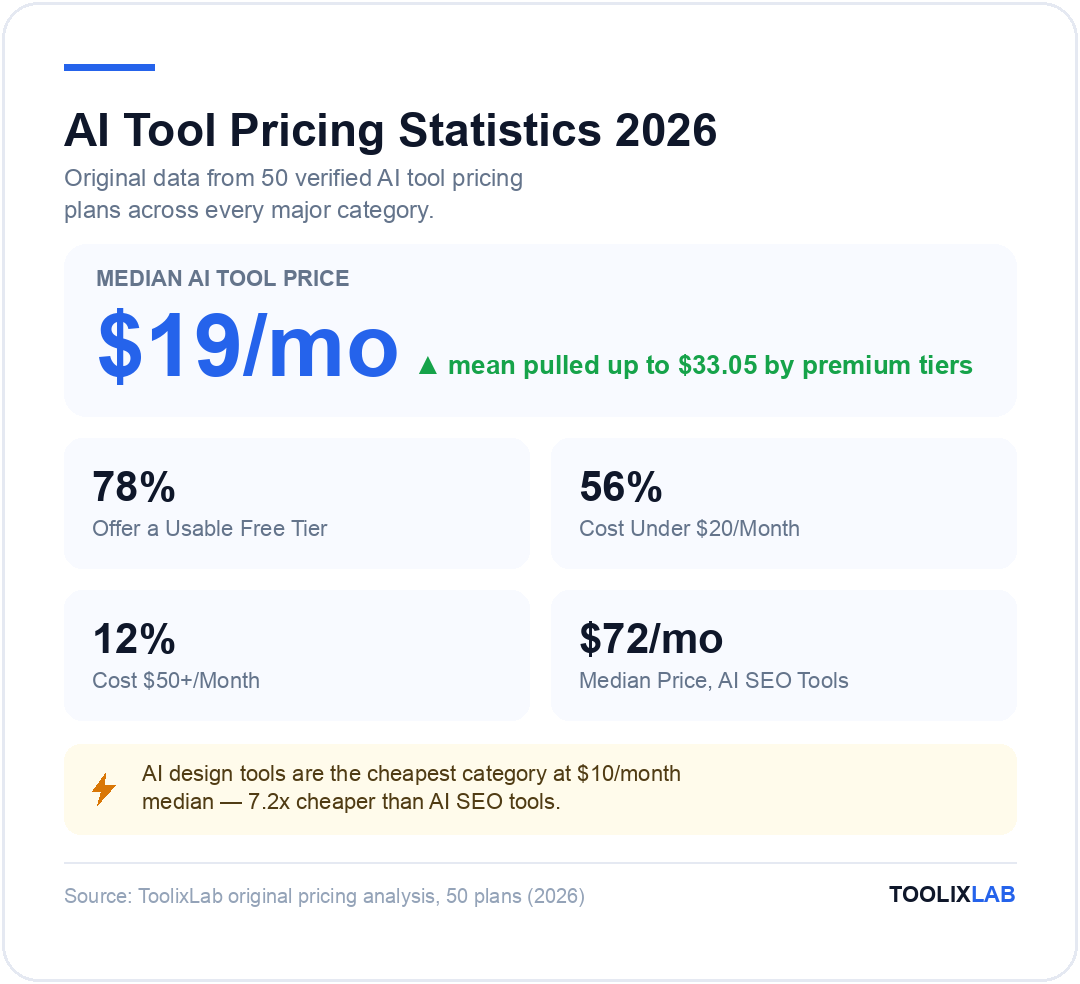
We analyzed the pricing of 50 AI tool plans we've reviewed and verified in 2026. The median entry-level paid plan costs $19/month, 78% of tools offer a free tier, and seven of the most important tools in the industry have converged on the same $20/month price point. SEO tools are the most expensive category (median $72/month); design and meeting tools are the cheapest (median $10–12/month). A capable full AI stack for a solo professional now runs $40–75/month.
AI Tool Pricing Statistics 2026: The Key Numbers
- 📊 $19/month — median entry-level paid plan across 50 verified AI tool plans
- 📊 $33.05/month — mean price, pulled upward by a new class of $100–250 premium tiers
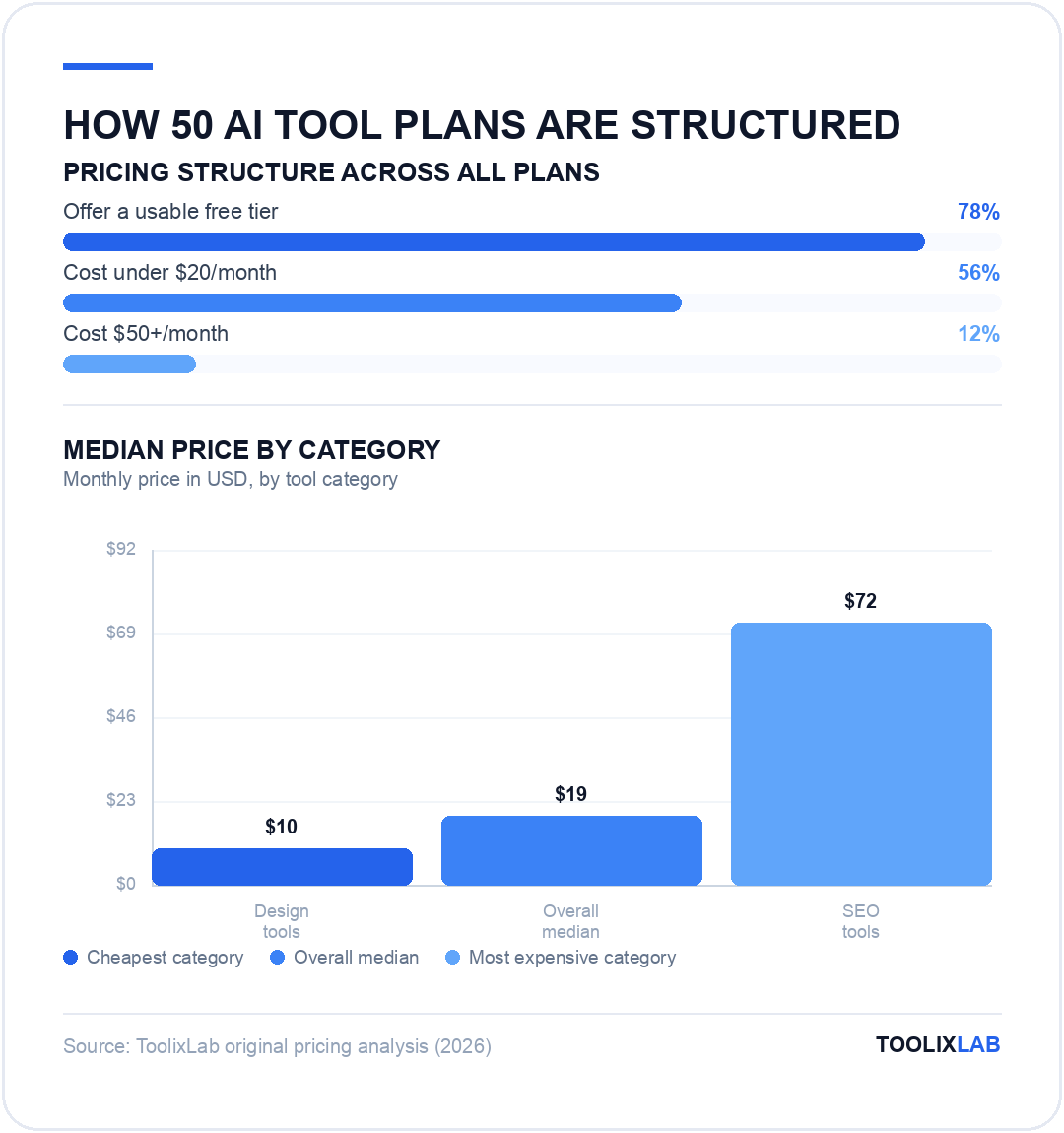
- 📊 78% of AI tools offer a usable free tier
- 📊 56% of plans cost less than $20/month; only 12% cost $50 or more
- 📊 7 major tools — ChatGPT Plus, Claude Pro, Gemini Advanced, Perplexity Pro, Cursor Pro, Zapier, and n8n Cloud — are priced at exactly $19.99–20/month
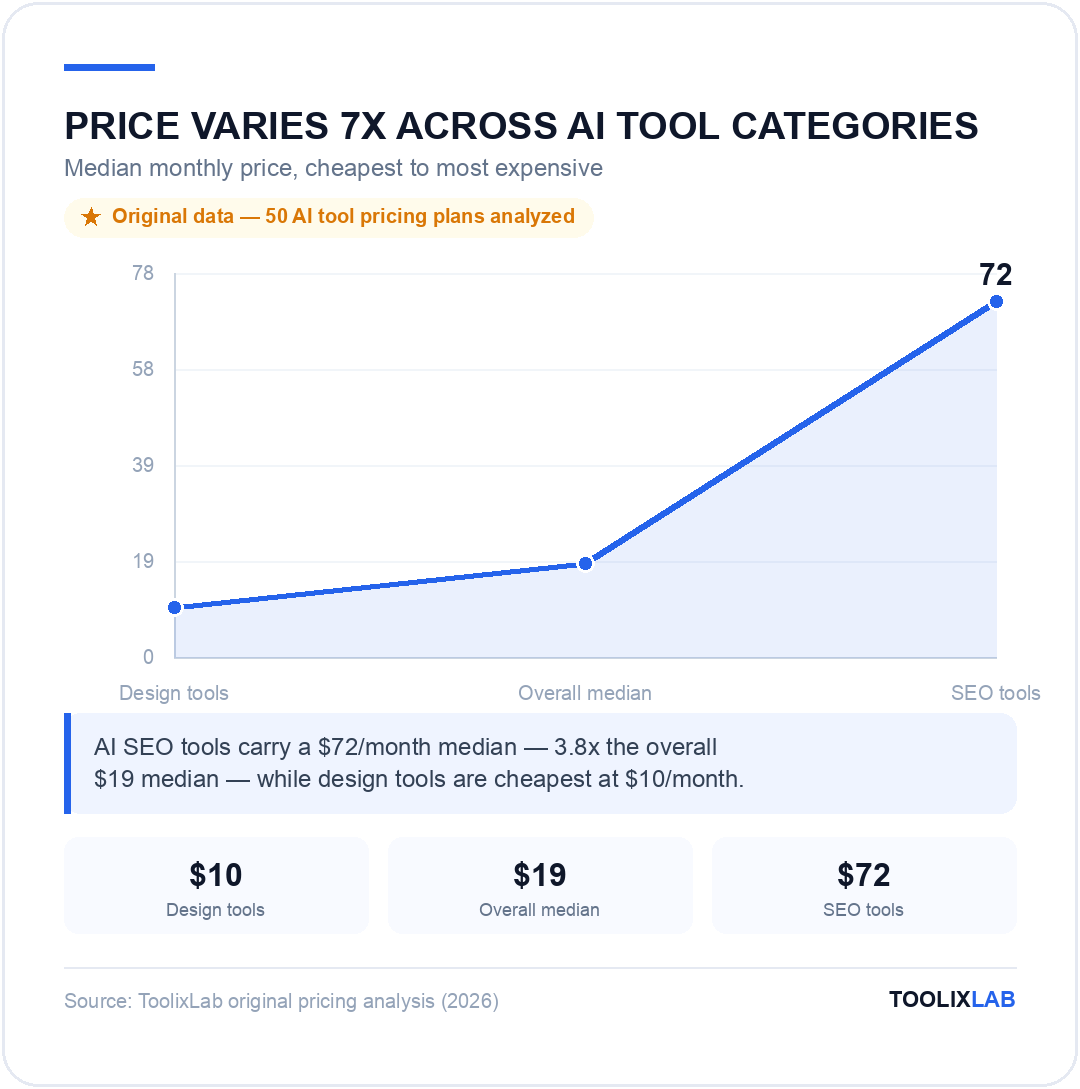
- 📊 $72/month — median price of AI SEO tools, 3.8× the overall median and the most expensive category we track
- 📊 $10/month — median price of AI design tools, the cheapest category
- 📊 $100–250/month — the new "power user" tier band (ChatGPT Pro $200, Claude Max from $100, Google AI Ultra $249.99)
- 📊 $40–75/month — realistic total cost of a complete solo-professional AI stack in 2026
Feel free to cite any statistic on this page — we ask only for a link back to this article as the source.
Methodology: Where This Data Comes From
This is original ToolixLab research, not an aggregation of third-party surveys. Our dataset is the pricing we verify while producing our tool reviews and comparisons:
- Sample: 50 paid plans across 40+ AI tools in 14 categories — assistants, writing, SEO, coding, meetings, design, video, project management, automation, email, social, sales, audio, and coaching.
- Source: every price was checked against the vendor's official pricing page at the time we reviewed the tool on ToolixLab (reviews are re-verified on our refresh cycle; this analysis uses figures current as of July 2026).
- Definition: "entry price" means the cheapest individual paid tier at monthly billing unless a tool is only sold annually. Add-on pricing (e.g., Notion AI, ClickUp AI) is counted at the add-on price. Enterprise/custom-quote tiers are excluded.
- Analysis: medians are reported alongside means because premium tiers ($100+) skew averages upward.
Limitations: 50 plans is a curated sample of the tools professionals actually shortlist, not a census of the thousands of AI products on the market. Prices change frequently — check the linked official pages before purchasing.
Finding #1: The Median AI Tool Costs $19/Month — But the Average Is $33
Half of all AI tool plans we track cost less than $19/month. That number has become remarkably stable: vendors have learned that individual professionals mentally budget AI subscriptions the way they budget streaming services, and price accordingly.
The mean, however, sits much higher at $33.05 — a 74% premium over the median. That gap is the single most important structural fact about AI pricing in 2026: the market is no longer one price band but two. The bulk of tools cluster between $10 and $20, while a small set of premium tiers ($60–250/month) stretches the distribution's tail. Here's the full spread:
| Price band (per month) | Plans | Share of sample |
|---|---|---|
| Under $10 | 6 | 12% |
| $10 – $19.98 | 22 | 44% |
| $19.99 – $20 (the "$20 club") | 7 | 14% |
| $20.01 – $49 | 9 | 18% |
| $50 – $99 | 3 | 6% |
| $100+ | 3 | 6% |
Finding #2: The $20 Club — Seven Flagships, One Price
The most striking pattern in the dataset is price convergence at the top of the market. Seven of the most strategically important tools in the industry charge effectively the same $20/month for their flagship individual plan:
- ChatGPT Plus — $20/month
- Claude Pro — $20/month
- Gemini Advanced — $19.99/month
- Perplexity Pro — $20/month
- Cursor Pro — $20/month
- Zapier (entry paid) — $19.99/month
- n8n Cloud Starter — $20/month
This is not coincidence — it's anchoring. ChatGPT Plus set the reference price for "serious AI subscription" in 2023, and every direct competitor has since matched it rather than compete on price. The result is that AI assistants compete almost entirely on capability, not cost — which is why our comparisons like ChatGPT vs Claude focus on task-level performance: at identical prices, fit is the only variable that matters.
The strategic consequence for buyers: switching between flagship assistants is cost-neutral. The real pricing decisions have moved elsewhere — to category tools, premium tiers, and stack composition.
Finding #3: Category Pricing — SEO Costs 7× More Than Design
Median entry price by category tells you where vendors believe measurable ROI lives:
| Category | Median entry price | Representative tools |
|---|---|---|
| AI SEO tools | $72/mo | Surfer ($99), Frase ($45) |
| Sales intelligence | $49/mo | Apollo.io ($49) |
| Coaching platforms | $47.50/mo | Paperbell ($47.50) |
| AI writing platforms | $39/mo | Jasper ($49), Writesonic ($49), Copy.ai ($29) |
| AI assistants | $20/mo | ChatGPT, Claude, Gemini, Perplexity |
| Automation platforms | $19.99/mo | Zapier ($19.99), Make ($10.59), n8n ($20) |
| AI coding tools | $19/mo | Cursor ($20), GitHub Copilot ($10) |
| AI video tools | $16/mo | Runway ($15), Descript ($16), Kling ($6.99) |
| Project management AI | $12/mo | ClickUp AI (+$7), Motion ($12), Asana Advanced ($24.99) |
| Meeting AI / note-takers | $12/mo | Otter ($8.33), Fireflies ($10), Granola ($14) |
| AI design tools | $10/mo | Midjourney ($10), Recraft ($10), Canva Pro ($15) |
The pattern is unmistakable: tools price against the revenue they touch, not the compute they consume. An SEO platform that helps a business capture organic leads charges $72+; an image generator producing the same volume of GPU output charges $10. Sales and SEO tools sit at the top because their output maps directly to revenue attribution. Design, notes, and video sit at the bottom because they compete with abundant alternatives and price against consumer expectations.
For buyers, this creates a practical rule we now use in every stack recommendation: expect to pay $10–20 per "productivity" tool and $45–100 per "revenue" tool — and demand direct revenue evidence before paying revenue-tool prices.
Finding #4: The Free Tier Is Now Standard — 78% Offer One
Thirty-nine of the fifty plans in our sample sit atop a functional free tier. This is a meaningful shift from the SaaS era, where free trials (time-limited) dominated over free tiers (permanent). Three forces drive it:
Inference costs collapsed. Models that cost dollars per million tokens in 2023 cost cents in 2026 — a trend accelerated by efficient open-weight models like DeepSeek (see our DeepSeek review for how a frontier-class model can be free at the point of use). Serving a free tier now costs vendors very little.
Free tiers are the acquisition channel. With paid advertising costs rising, the free tier is the marketing budget. The playbook: generous free tier → daily habit → capacity ceiling → $10–20 upgrade.
Competition removed the choice. When Gemini offers a generous free tier, ChatGPT and Claude cannot not offer one. The categories where free tiers remain rare — SEO ($72 median) and dedicated writing platforms ($39 median) — are precisely the ones selling to businesses with attributable ROI, where a 7-day trial converts well enough.
The practical takeaway (covered in depth in our free AI tools guide): a $0/month AI stack is genuinely viable in 2026 for light use, and the honest reason to upgrade is capacity, not capability.
Finding #5: The Rise of the $100–250 Power Tier
The newest structural change in AI pricing is the emergence of a tier that didn't exist two years ago: the individual power-user plan priced at 5–12× the standard subscription. Our dataset includes three: ChatGPT Pro at $200/month, Claude Max from $100/month, and Google AI Ultra at $249.99/month.
These tiers exist because heavy users hit the ceiling of $20 plans — rate limits, model access, and compute-intensive features like extended reasoning, video generation, and agentic tasks. Vendors discovered a segment of professionals whose AI usage is so central to their output that a $200 subscription is trivially justified: developers running agent workflows all day, creators generating video at volume, researchers processing large document sets.
Two things are worth watching here. First, the premium tiers are where frontier capability lands first — the $20 tier increasingly gets features some months after the $100+ tier. Second, this is the segment where per-seat pricing is quietly giving way to usage-based hybrids, following the API market's lead. Our advice as of mid-2026: upgrade to a power tier only after you've hit rate limits on the standard plan during real work at least weekly — the upgrade is a response to a measured constraint, not aspiration.
Finding #6: What a Full AI Stack Actually Costs in 2026
Individual tool prices matter less than what a working professional actually spends across their stack. Combining the medians above with the stack patterns from our role-specific guides:
| Profile | Typical stack | Monthly cost |
|---|---|---|
| Budget solo / student | Free tiers rotated by task | $0 |
| Solo professional | One $20 assistant + one note-taker + Canva Pro | $40–55 |
| Freelance creator | Assistant + design + video tool + scheduler | $60–75 |
| Small team (5 seats) | Team-tier assistant + office AI + 1–2 category tools | $150–400 |
| Content-led business | Above + SEO platform + writing platform | $300–600 |
The notable number is the first paid row: a complete, professional-grade AI stack costs less per month than a single seat of most legacy enterprise software. The barrier to AI adoption in 2026 is not price — it's selection and habit formation, which is exactly why our guides like best AI tools for small business emphasize adoption sequencing over tool count.
How AI Pricing Compares to Classic SaaS Pricing
Put the $19 median next to the traditional B2B SaaS market and the difference in pricing philosophy is stark. Classic SaaS priced per seat, sold annually, gated demos behind sales calls, and pushed decisions up to managers. AI tools inverted every one of those defaults: monthly billing, self-serve signup, permanent free tiers, and pricing aimed at an individual's personal card rather than a department budget.
The reason is go-to-market, not generosity. AI tools spread bottom-up — one developer, marketer, or coach adopts a tool, demonstrates the output, and the team follows. That motion requires a price an individual will pay without asking permission, which in practice means the streaming-subscription band: $10–20. The category exceptions prove the rule — SEO and sales tools still sell top-down to budget owners, and their $49–99 pricing looks exactly like classic SaaS because their buyers are classic SaaS buyers.
There is one place the old model is reasserting itself: team tiers. Once a tool crosses from personal use to company deployment, per-seat pricing returns (Claude Team at $25/user, ChatGPT Team at $25/user, Copilot Business at $19/user) and annual contracts follow. Expect the individual tier to stay cheap indefinitely — it's the acquisition funnel — while the money migrates to seats, premium tiers, and usage credits.
The Full Dataset: All 50 Plans
For transparency — and so you can run your own analysis — here is the complete dataset behind every statistic above. Prices are the entry-level individual paid tier at monthly billing, as verified in our reviews (July 2026):
| Tool / Plan | Category | Entry price/mo | Free tier |
|---|---|---|---|
| ElevenLabs | Audio | $5 | ✅ |
| Kling AI | Video | $6.99 | ✅ |
| ClickUp AI (add-on) | Project Mgmt | $7 | ✅ |
| Gamma Plus | Design | $8 | ✅ |
| Otter.ai Pro (annual) | Meetings | $8.33 | ✅ |
| Remove.bg | Design | $9 | ✅ |
| GitHub Copilot | Coding | $10 | ✅ |
| Midjourney Basic | Design | $10 | — |
| Recraft | Design | $10 | ✅ |
| Notion AI (add-on) | AI Assistant | $10 | ✅ |
| Mem Pro | AI Assistant | $10 | ✅ |
| Fireflies.ai Pro | Meetings | $10 | ✅ |
| Make | Automation | $10.59 | ✅ |
| Grammarly Pro | Writing | $12 | ✅ |
| Motion | Project Mgmt | $12 | — |
| Mailchimp | $13 | ✅ | |
| Granola | Meetings | $14 | — |
| Canva Pro | Design | $15 | ✅ |
| Runway Standard | Video | $15 | ✅ |
| Opus Clip | Video | $15 | ✅ |
| Buffer | Social | $15 | ✅ |
| Grammarly Business | Writing | $15 | — |
| Kling Standard | Video | $15.99 | ✅ |
| Descript Hobbyist | Video | $16 | ✅ |
| Fireflies Business | Meetings | $19 | ✅ |
| GitHub Copilot Business | Coding | $19 | — |
| Gemini Advanced | AI Assistant | $19.99 | ✅ |
| Zapier Starter | Automation | $19.99 | ✅ |
| ChatGPT Plus | AI Assistant | $20 | ✅ |
| Claude Pro | AI Assistant | $20 | ✅ |
| Perplexity Pro | AI Assistant | $20 | ✅ |
| Cursor Pro | Coding | $20 | ✅ |
| n8n Cloud Starter | Automation | $20 | ✅ |
| Descript Creator | Video | $24 | ✅ |
| Asana Advanced (AI) | Project Mgmt | $24.99 | ✅ |
| Runway Pro | Video | $28 | ✅ |
| Copy.ai Chat | Writing | $29 | ✅ |
| HeyGen Creator | Video | $29 | ✅ |
| Frase | SEO | $45 | — |
| Paperbell | Coaching | $47.50 | — |
| Jasper Creator | Writing | $49 | — |
| Writesonic Lite | Writing | $49 | ✅ |
| Apollo.io | Sales | $49 | ✅ |
| Zapier Professional | Automation | $49 | ✅ |
| Midjourney Pro | Design | $60 | — |
| Jasper Pro | Writing | $69 | — |
| Surfer Essential | SEO | $99 | — |
| Claude Max | AI Assistant | $100 | ✅ |
| ChatGPT Pro | AI Assistant | $200 | ✅ |
| Google AI Ultra | AI Assistant | $249.99 | ✅ |
How to Use This Data When Buying AI Tools
Benchmark against the category median, not the overall median. A $45 writing tool is priced normally for its category; a $45 note-taker is 3.7× its category median and needs to justify the gap. The category table above is your negotiating reference.
Check the annual-billing discount before comparing anything. Most tools in our sample discount 15–20% for annual commitment, and several advertise the annual-equivalent monthly price by default — the number you see on a pricing page is frequently not the number your card gets charged monthly. Normalize to monthly billing before comparing two tools.
Watch for the add-on pattern. A growing share of "AI pricing" is actually an AI add-on stacked on a base subscription: Notion AI on Notion, ClickUp AI on ClickUp, Copilot on Microsoft 365. The advertised add-on price understates true cost if you don't already pay for the base product — always compute the full stacked price.
Let the free tier do the evaluation. With 78% of tools offering free tiers, paying to evaluate is almost never necessary. Our standard advice: run any tool's free tier against real work for two weeks; upgrade only when you hit its limits during work that mattered.
Where AI Pricing Goes Next: Three Predictions
1. The $20 anchor holds; the premium band grows. The flagship $20 price point is now so entrenched that raising it would be a competitive gift to rivals. Expect vendors to monetize heavy users through the $100–250 band and usage add-ons instead of raising the anchor.
2. Usage-based hybrids spread from APIs to apps. Credit systems (already standard in video tools like Runway) will spread to agentic features across categories, because agent workloads vary too wildly per user for flat pricing to survive.
3. Category consolidation compresses mid-market prices. As assistants absorb adjacent features (notes, search, light design), standalone tools in the $29–49 band face the hardest squeeze — they're priced above the bundle but below the specialists with attributable ROI. We expect the $20.01–49 band, currently 18% of the sample, to shrink fastest.
Frequently Asked Questions
How much does the average AI tool cost in 2026?
The median entry-level paid plan costs $19/month across the 50 plans we track; the mean is $33.05 because a small number of premium tiers ($100–250/month) pull the average up. Most professionals should expect $10–20 per productivity tool and $45–100 per revenue-focused tool (SEO, sales).
Why do ChatGPT, Claude, and Gemini all cost $20/month?
Price anchoring. ChatGPT Plus established $20 as the reference price for an AI subscription in 2023, and competitors matched it to keep the comparison about capability rather than cost. Seven major tools now share the $19.99–20 price point.
What percentage of AI tools have a free tier?
78% of the plans in our sample sit on top of a permanent free tier. The exceptions cluster in business-ROI categories — SEO and dedicated writing platforms — which favor short trials instead.
What is the most expensive category of AI tools?
AI SEO tools, with a median entry price of $72/month (Surfer at $99, Frase at $45) — 3.8× the overall median. Sales intelligence ($49) and AI writing platforms ($39 median) follow. These categories price against attributable revenue rather than compute cost.
How much should a full AI stack cost?
A solo professional's complete stack runs $40–75/month (one $20 assistant plus two or three category tools). Five-person teams typically land between $150–400/month. If your stack costs more, audit for overlapping tools before assuming you need a bigger budget.
Are AI tool prices going up or down?
Both, at different ends. The $20 flagship anchor has held stable for three years and shows no sign of moving. Meanwhile vendors are adding premium tiers above it ($100–250/month) and usage-based credits for compute-heavy features — so the median holds steady while spending by heavy users rises.
Can I cite these statistics?
Yes — every statistic on this page is original ToolixLab research and free to cite with a link back to this article as the source.
🔑 Key Takeaways
- ✓The AI tool market has settled into two bands: a stable $10–20 mainstream (56% of plans) and a fast-growing $100–250 power tier
- ✓Seven flagship tools share the $20 price point — so choose assistants on task fit, never on price
- ✓Tools price against the revenue they touch: budget $10–20 for productivity tools, $45–100 for SEO/sales tools
- ✓With 78% of tools offering free tiers, upgrade decisions should be triggered by hitting capacity limits, not by feature marketing
Related Guides
- State of AI Tools 2026: Adoption Statistics — the usage-side companion to this pricing analysis.
- Best Free AI Tools in 2026 — the 78% in practice: which free tiers are actually usable.
- Best AI Tools for Small Business — stack recommendations with the budget tiers from this study.
- ChatGPT vs Claude — deciding inside the $20 club on capability, not cost.