
By ToolixLab Research Team · Last updated: July 2026
Quick Answer
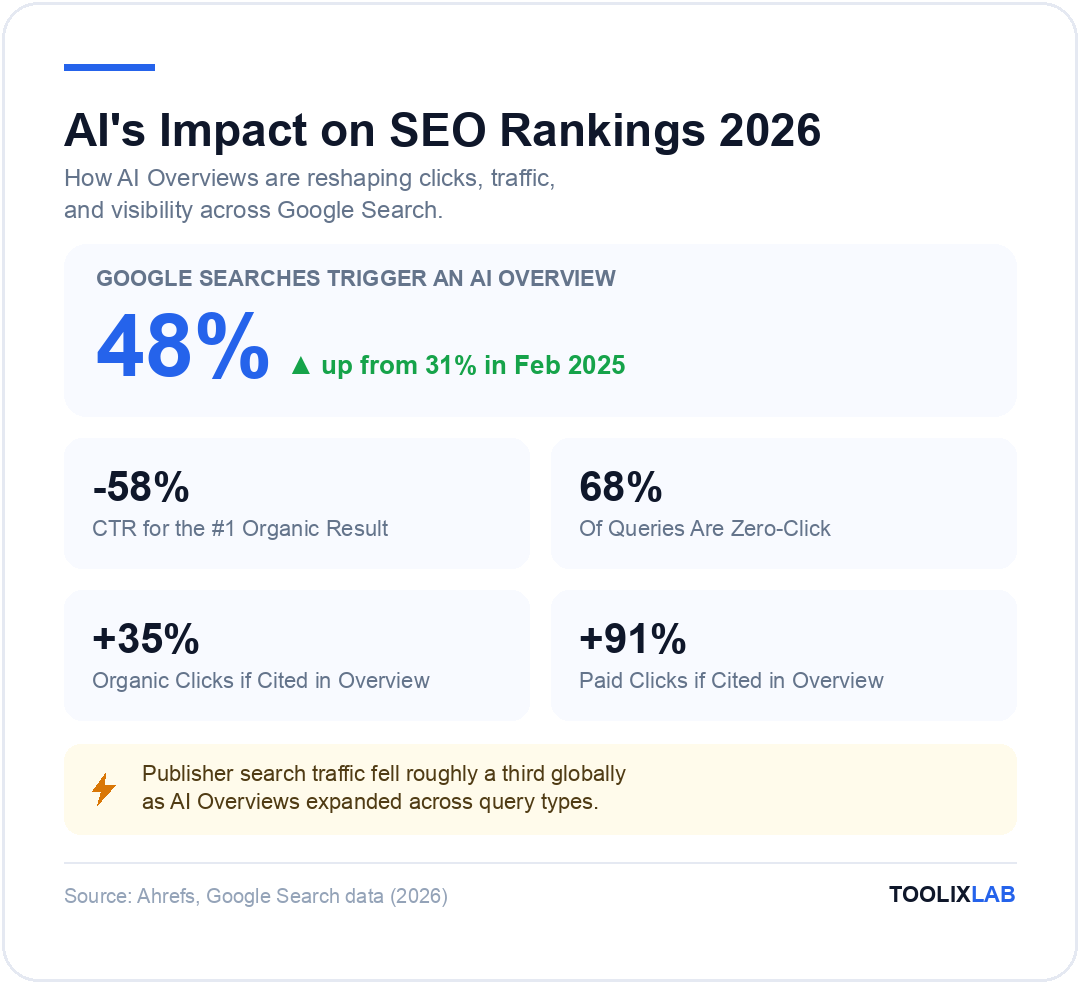
AI is reshaping Google rankings faster than any algorithm update in the platform's history. AI Overviews now appear on 48% of Google searches (up from 31% in February 2025) and correlate with a 58% drop in click-through rate for the #1 organic result, according to Ahrefs' February 2026 study of 300,000 keywords. A separate randomized field experiment found removing AI Overviews increased clicks by 60%. Zero-click searches now account for 68% of all U.S. Google queries, and publisher search traffic fell roughly a third globally in the year to November 2025 — but brands cited inside an AI Overview earn 35% more organic clicks and 91% more paid clicks than brands left out entirely.
Every SEO conversation in 2026 eventually arrives at the same question: is AI killing organic search, or just changing who wins it? The data says both things are true at once. Total click volume to publishers is genuinely down — sharply, in some cases catastrophically. But the pages that do get clicked increasingly are the ones cited by name inside an AI Overview or AI chat answer, not just the ones ranking #1 in the traditional blue links.
We pulled together the most rigorous, primary-source research available on how AI is impacting search rankings, click-through rates, and organic traffic — peer-submitted academic studies, large-sample Ahrefs and Seer Interactive research, Pew Research Center's panel data, and SparkToro's clickstream analysis. Every statistic below links to its original source so you can verify it yourself or cite it directly.
If you're deciding how to prioritize your 2026 SEO roadmap, this is the data to build it on. And if you want the tools, not just the numbers, our best AI SEO tools guide and Ahrefs vs Semrush AI features comparison cover what to actually do with it.
AI's Impact on SEO Rankings: The Key Numbers
- 📊 48% of Google searches now trigger an AI Overview, up from 31% in February 2025 (Ahrefs, March 2026)
- 📊 58% lower average click-through rate for the #1 organic result when an AI Overview is present (Ahrefs, Feb 2026, 300,000-keyword study)
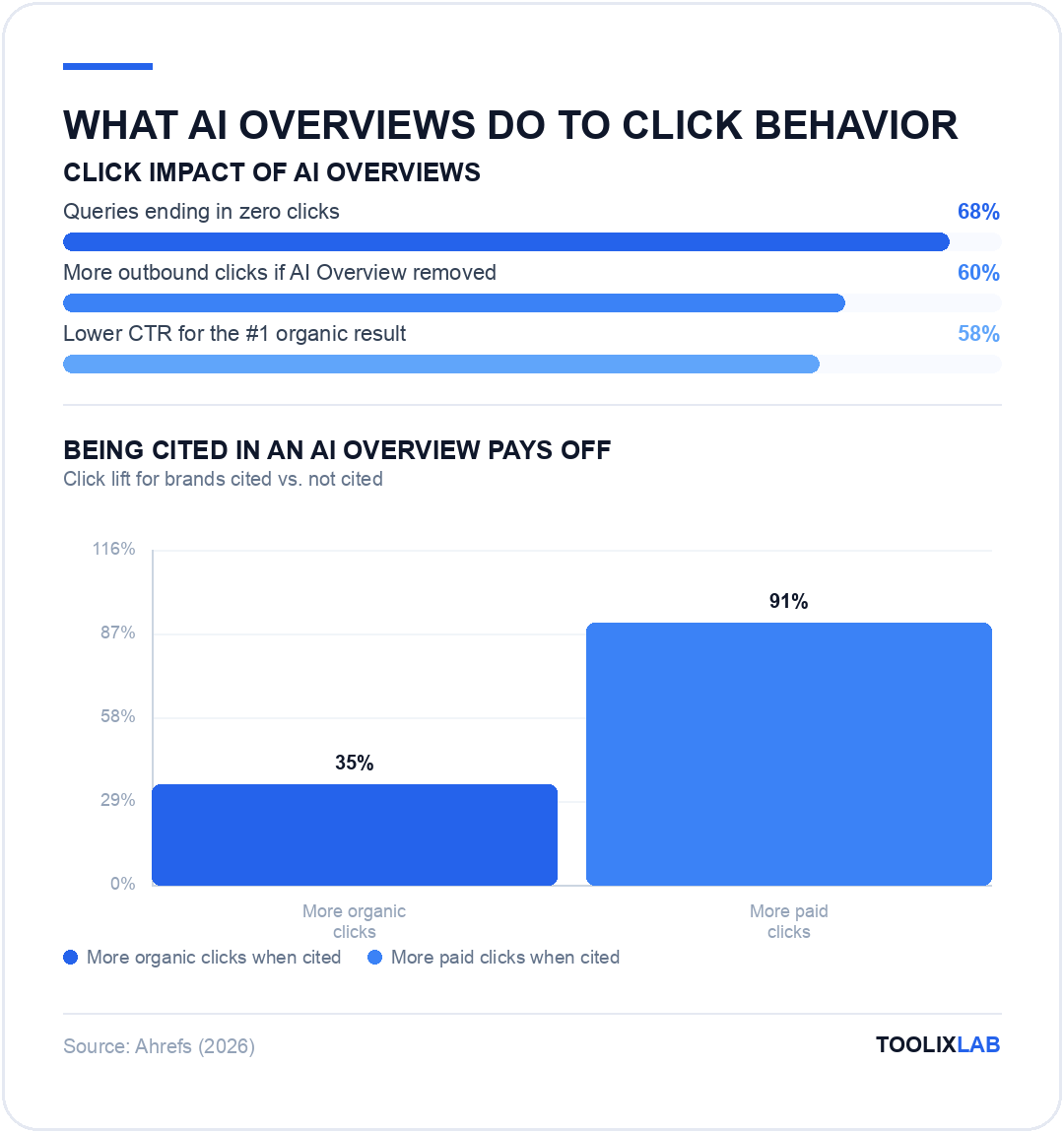
- 📊 60% more outbound clicks per search when AI Overviews are removed — 0.38 → 0.61 clicks (Agarwal & Sen, ISB/Carnegie Mellon RCT, April 2026)
- 📊 8% — the share of AI-summary searches where users click an organic link, vs 15% with no AI summary (Pew Research Center)
- 📊 68.01% of U.S. Google searches ended with zero clicks in the first four months of 2026 (SparkToro/Similarweb)
- 📊 83% average zero-click rate specifically on AI-Overview-triggered queries, vs ~60% on standard queries
- 📊 33% global decline in Google search traffic to publishers in the year to November 2025; U.S. publishers fell 38%
- 📊 35% more organic clicks and 91% more paid clicks for brands cited inside an AI Overview vs brands left out (Seer Interactive, 25.1M impressions across 42 organizations)
- 📊 95.4% of "X vs Y" comparison queries trigger an AI Overview — the single highest-triggering query format tracked
- 📊 65% of marketers name AI-driven search changes as their single biggest SEO challenge in 2026
Feel free to cite any statistic on this page — we ask only for a link back to this article as the source.
Methodology: Where This Data Comes From
This is a curated compilation of primary-source research, not a survey we ran ourselves. Every figure on this page traces back to one of the following original studies, all published or updated within the current data cycle:
- Ahrefs — "AI Overviews Reduce Clicks" study and February 2026 update, analyzing 300,000 keywords (150,000 with AI Overviews, 150,000 without) using Google Search Console desktop CTR data from December 2023 vs December 2025.
- Agarwal & Sen (Indian School of Business / Carnegie Mellon University) — a pre-registered randomized field experiment (SSRN, April 2026) with 1,065 U.S. participants, using a Chrome extension to toggle AI Overviews on and off in real search sessions over two weeks.
- Pew Research Center — panel study of 900 U.S. adults covering 68,879 real Google searches, of which 12,593 produced an AI summary.
- SparkToro, using Similarweb clickstream data covering U.S. Google searches from January–April 2026.
- Seer Interactive — September 2025 analysis of 25.1 million organic search impressions across 42 client organizations, isolating the effect of AI Overview citation on click behavior.
- Goodfirms 2026 SEO practitioner survey (100 marketers, 20+ countries, Jan–Feb 2026) on how marketing teams are adapting strategy to AI-driven search.
Limitations: methodologies differ across studies (aggregated GSC data vs. randomized experiments vs. self-reported survey data), which is why headline percentages vary between sources (38%–61% CTR decline, depending on measurement window and query set). We've noted the source and sample size next to every figure so you can weigh it appropriately.
Finding #1: AI Overviews Now Appear on Nearly Half of All Searches
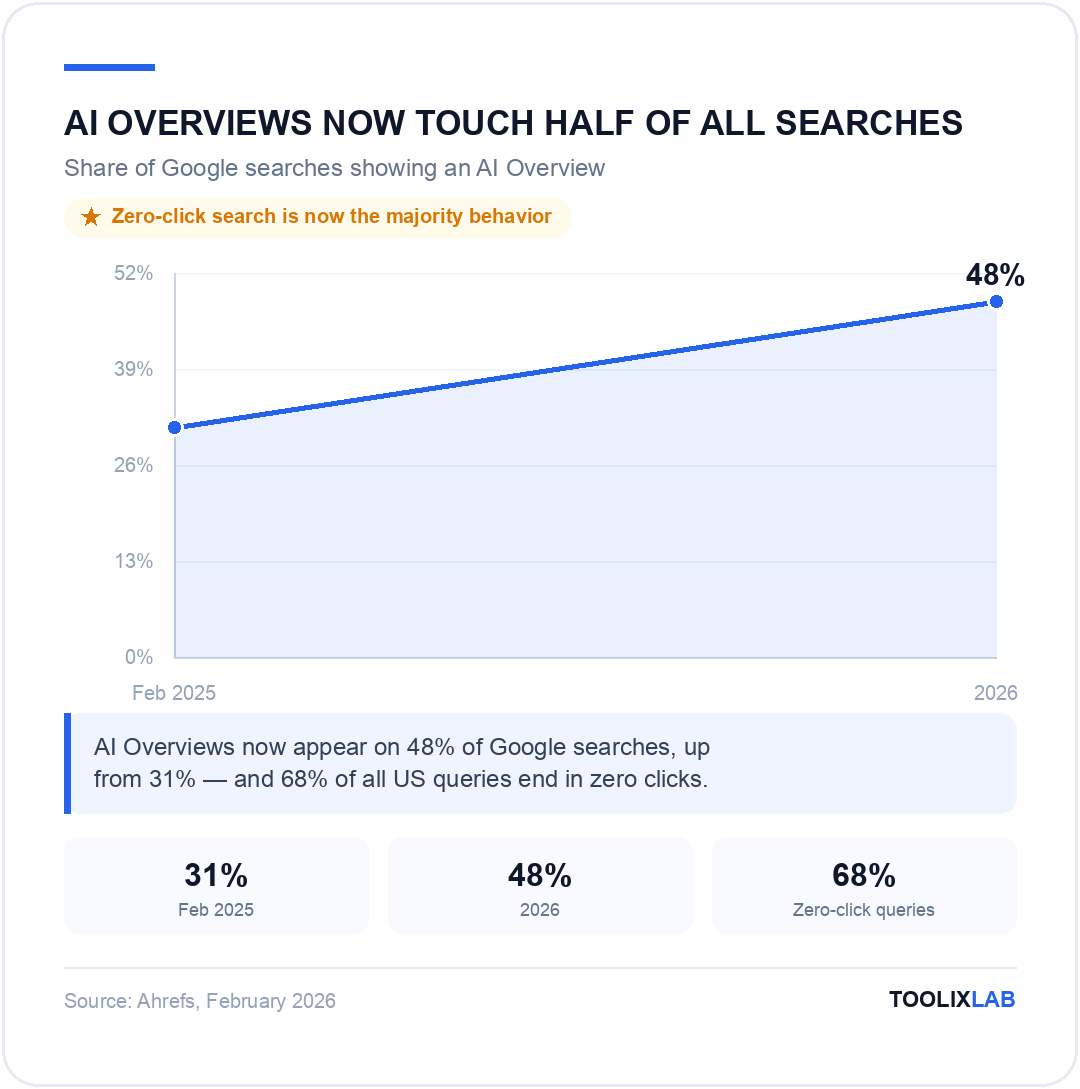
The clearest trend in the data is speed. AI Overview coverage has roughly doubled inside 14 months: 31% of U.S. queries in February 2025 → 34.5% in December 2025 → 48% in March 2026, per Ahrefs' rolling tracking panel. Google itself has stated AI Overviews now appear on "roughly 50% of U.S. queries" — corroborating the third-party figure.
But the average masks enormous variation by query type and topic. Some categories are saturated with AI Overviews; others barely trigger them at all:
| Query type / topic | AI Overview trigger rate |
|---|---|
| "X vs Y" comparison queries | 95.4% |
| Healthcare queries | 88% |
| Education queries | 83% |
| Informational queries (overall) | 36% |
| Entertainment queries | 37% |
| Single-word queries | 27.3% |
| Commercial queries | 8% |
| Transactional queries | 5% |
AI Overview trigger rate by query type
The pattern is a near-perfect map of "how much does the searcher need a synthesized answer rather than a place to complete a task." Comparison and informational queries are exactly the kind of research-phase content this site and most B2B/SaaS blogs are built around — which is why the ranking impact below hits content marketers harder than e-commerce or local-service sites, where transactional and commercial intent still dominates.
Finding #2: The Click-Through-Rate Collapse — 38% to 61%, Depending on How You Measure It
This is the statistic every SEO wants a single clean number for, and the honest answer is that there isn't one — different studies report different declines because they measure different things. Here's every major figure, with its source and what exactly it measured:
| Study | Reported decline | What it measured |
|---|---|---|
| Ahrefs (Feb 2026) | 58% | Avg CTR for #1 ranking page, 300K-keyword sample, Dec 2023 vs Dec 2025 GSC data |
| Seer Interactive | 61% | Organic CTR on AI-Overview queries, 5.47M-query panel, Jan 2025–Feb 2026 (1.76% → 0.61%) |
| Agarwal & Sen (RCT) | 38% | Randomized field experiment; clicks per search fell when AI Overviews were shown vs hidden |
| Pew Research Center | ~47% | Organic click rate 8% (with AI summary) vs 15% (without), 68,879-search panel |
The Ahrefs breakdown is the most granular by ranking position: position 1's actual desktop CTR fell from 7.6% (Dec 2023, pre-AI-Overviews) to 1.6% (Dec 2025) — with a forecasted CTR of 3.7% had AI Overviews never launched. That means roughly half of the position-1 decline is attributable to AI Overviews specifically, and the rest to broader search behavior shifts. Position 2 fared similarly badly, down 50.8%.
The Agarwal & Sen study is the most methodologically rigorous of the four because it's a true randomized experiment, not an observational comparison: the same 1,065 people, split into groups, one seeing AI Overviews and one not, over the same two-week window in January–February 2026. Outbound clicks per search rose from 0.38 to 0.61 — a 60% increase — the moment AI Overviews were removed from view. Critically, the researchers found user satisfaction ratings were statistically unchanged between groups, undercutting Google's stated rationale that AI Overviews improve the search experience enough to justify the traffic cost to publishers.
Pew's panel data adds the abandonment angle: users were more likely to leave the search page entirely — no click at all, no follow-up query — after seeing an AI summary (26% abandonment) than without one (16%). And of the small share of users who did click something inside an AI summary itself, only 1% of all searches resulted in a citation-link click. If you're auditing why a page's high-impression, low-click pattern has gotten worse in 2026, this is very likely the mechanism.
Finding #3: Zero-Click Search Is Now the Default Outcome
Zero-click search — a Google query that ends without the user clicking any result — has been rising for years, but 2026 is the year it crossed into "default outcome" territory for U.S. search:
- 68.01% of U.S. Google searches produced zero clicks in the first four months of 2026 (SparkToro, using Similarweb clickstream data)
- That's up from 60.45% in 2024 — a 7.56-percentage-point jump in roughly a year
- On queries that specifically trigger an AI Overview, the zero-click rate rises to ~83%
- On queries without an AI Overview, zero-click sits closer to ~60% — still high, but meaningfully lower
- Mobile search is 77% zero-click; desktop is 46.5% zero-click — the device gap is nearly 30 points
- By intent: informational queries are 74% zero-click; transactional queries are only 31% zero-click — commercial intent still reliably sends a visit
- Dedicated AI chat platforms (ChatGPT Search, Perplexity, Google AI Mode) run even higher: 60–93% zero-click, because the product is designed to resolve the query on-platform
The intent split is the most actionable number here. If your content strategy leans informational — "what is," "how to," "best," "vs" — you are disproportionately exposed to zero-click loss. If it leans transactional — pricing pages, product pages, comparison-to-purchase — the damage is real but far smaller. This is one reason our own content strategy pairs tool roundups with action-oriented prompt libraries rather than pure informational explainers.
Finding #4: Publisher Traffic Is Down Roughly a Third — and Small Sites Are Losing the Most
Aggregate publisher-level data confirms the click-through numbers are translating into real traffic loss, not just a measurement artifact:
- Google search traffic to publishers fell 33% globally in the year to November 2025
- U.S. publishers were hit harder, down 38% over the same period
- Google AI Overviews specifically correlate with a 25% drop in publisher referral traffic, isolated from other search-behavior changes
- News publishers saw a 26% cut to Google-driven traffic; the median news publisher now forecasts a further 43% decline in search traffic by 2029, and roughly 1 in 5 expect declines greater than 75%
- Google Discover referrals — a separate but related traffic source — fell 21%
- Smaller publishers lost 60% of search referral traffic over two years, versus 22% for large publishers — scale is now a meaningful defensive moat
- The most extreme individual case documented: one mid-size publisher's monthly organic clicks collapsed from 8.5 million to 264,861 between March 2024 and January 2026 — a 97% decline
The size gap is the statistic worth internalizing if you run a smaller site. Large publishers have brand recognition that AI systems already "know" and cite by name; smaller, niche publishers depend more heavily on being the specific page a user clicks to verify a claim — the exact behavior AI Overviews are designed to short-circuit. This is precisely why building topical authority and earning direct citations matters more than chasing raw keyword volume in 2026.
Finding #5: Being Cited Inside an AI Overview Is Worth More Than Ranking #1
The single most important strategic finding in this dataset comes from Seer Interactive's analysis of 25.1 million organic search impressions across 42 client organizations. They isolated three outcomes for the same set of pages: no AI Overview present, AI Overview present but the brand not cited, and AI Overview present with the brand specifically cited as a source.
The citation gap
Brands cited by name inside an AI Overview earned 35% more organic clicks and 91% more paid clicks than brands whose page appeared on the same results page but was not cited inside the AI Overview itself. Being present is not the same as being cited — and only citation carries a measurable click premium.
This reframes the entire ranking conversation. Historically, position #1 in the traditional ten blue links was the whole game. In 2026, there's a second, parallel competition happening above it: which sources Google's AI Overview chooses to cite by name. A page can rank #3 organically and still win the visit if it's the one cited inside the AI Overview — and a page ranking #1 organically that isn't cited is now competing for a shrinking pool of clicks that make it past the AI summary at all.
Google Overviews cite an average of 3+ sources on 88% of the summaries they generate (per Pew's data), which means citation slots are genuinely competitive real estate, not a rare bonus. Structuring content so it's easy for an LLM to extract, attribute, and quote — clear claims, named sources, direct answers near the top of a section — is now a distinct optimization target from traditional keyword-and-backlink SEO. It's also the exact discipline behind GEO (Generative Engine Optimization), which is quickly becoming table stakes alongside classic SEO rather than a nice-to-have.
Finding #6: How the SEO Industry Is Actually Adapting
Practitioner survey data (Goodfirms, 2026) shows the industry has recognized the shift, but execution is lagging awareness:
- 65% of marketers name AI-driven search changes as their single biggest SEO challenge of 2026
- 43% now name AI/LLM optimization as a core named strategy — up from effectively 0% a year earlier
- But only 14% actually track AI citation visibility as a measured KPI — a substantial say-do gap between strategy and measurement
- 100% of surveyed practitioners agree E-E-A-T (Experience, Expertise, Authoritativeness, Trustworthiness) signals will matter more, not less, in an AI-mediated search landscape
- 54% name "content quality and search intent match" as their #1 active strategy — ahead of any technical-SEO tactic
The strategic read: AI hasn't eliminated SEO, it's split it into two disciplines that increasingly run in parallel — classic ranking optimization for the shrinking pool of clicks that bypass AI summaries entirely, and citation/visibility optimization for the AI Overview and AI-chat layer sitting above it. Teams still measuring only rankings and organic sessions are, per the 14% figure above, mostly flying blind on the second discipline.
What This Data Means for Your SEO Strategy
Prioritize comparison and informational content for citation optimization, not just ranking. With 95.4% of "X vs Y" queries and 83–88% of healthcare/education queries triggering AI Overviews, ranking #1 on these query types increasingly means competing to be cited, not just competing to be listed. Structure comparison content with clear, extractable verdicts — see how we approach it in Ahrefs vs Semrush or Grammarly vs Jasper.
Protect transactional and commercial content — it's still relatively AI-Overview-resistant. At 5–8% trigger rates and 31% zero-click, transactional pages remain the most reliable traffic and conversion source. Don't let AI-anxiety pull resources away from bottom-funnel content that's still performing close to historical norms.
Start tracking AI citation visibility now — most competitors aren't. With only 14% of practitioners measuring this, adding AI Overview citation tracking to your reporting is a genuine, low-competition differentiator in 2026, not table stakes yet.
Invest in E-E-A-T signals that AI systems can verify off-page. Named authors, cited credentials, third-party mentions, and consistent factual accuracy across your site are the raw material AI systems use to decide who to trust enough to cite. This is a slower-moving, harder-to-fake lever than keyword optimization — which is exactly why 100% of surveyed practitioners rank it as increasingly important.
Diversify beyond Google traffic where your audience already is. With publisher traffic down roughly a third and smaller sites losing disproportionately, treating organic search as your only distribution channel is now a structurally riskier bet than it was three years ago. Our AI workflow templates guide covers automating multi-channel distribution without adding headcount.
Frequently Asked Questions
How much does an AI Overview reduce click-through rate?
Estimates range from 38% to 61% depending on methodology. Ahrefs' 300,000-keyword study found a 58% average CTR decline for the #1 organic result; a randomized field experiment (Agarwal & Sen, 2026) found a 38% decline attributable specifically to the AI Overview itself, with all other factors controlled.
What percentage of Google searches now show an AI Overview?
48% of U.S. Google searches triggered an AI Overview as of March 2026, up from 31% in February 2025 and 34.5% in December 2025 — roughly doubling in just over a year.
What is the zero-click search rate in 2026?
68.01% of U.S. Google searches ended with zero clicks in the first four months of 2026 (SparkToro/Similarweb), up from 60.45% in 2024. On queries that specifically trigger an AI Overview, the zero-click rate rises to roughly 83%.
Has AI actually hurt publisher search traffic, or just clicks?
Both, and aggregate traffic data confirms the CTR studies aren't just a measurement artifact. Google search traffic to publishers fell 33% globally in the year to November 2025 (38% in the U.S.), with AI Overviews specifically correlating with a 25% drop in referral traffic and news publishers losing 26%.
Does it matter if my page is cited inside an AI Overview?
Yes, significantly. Seer Interactive's analysis of 25.1 million impressions found brands cited by name inside an AI Overview earn 35% more organic clicks and 91% more paid clicks than brands whose page appears on the results page but isn't cited in the summary itself.
Which types of search queries are least affected by AI Overviews?
Transactional (5% trigger rate) and commercial (8% trigger rate) queries are the least affected. Comparison queries ("X vs Y," 95.4%), healthcare (88%), and education (83%) are the most saturated with AI Overviews.
Can I cite these statistics?
Yes. These are third-party primary-source statistics compiled and sourced by ToolixLab — cite the original researcher (Ahrefs, Pew Research Center, SparkToro, Seer Interactive, or Agarwal & Sen) where possible, and feel free to link to this page as your source for the compilation.
🔑 Key Takeaways
- ✓AI Overviews now appear on 48% of Google searches and correlate with a 38–61% CTR decline for the top organic result, depending on methodology
- ✓Zero-click search is now the default U.S. outcome (68.01%), rising to ~83% on AI-Overview-triggered queries specifically
- ✓Publisher search traffic fell roughly a third globally in the past year, with smaller sites losing nearly 3× more than large publishers
- ✓Being cited inside an AI Overview beats simply ranking #1 — cited brands earn 35% more organic clicks and 91% more paid clicks
- ✓Transactional and commercial queries remain comparatively AI-Overview-resistant (5–8% trigger rate) — don't let AI anxiety pull focus off bottom-funnel content
Related Guides
- State of AI Tools 2026: 50+ Key Statistics — the adoption-side companion to this SEO-ranking analysis.
- AI Tool Pricing Statistics 2026 — original data on what the AI tools behind this shift actually cost.
- Best AI SEO Tools 2026 — the tools built for tracking and adapting to exactly this data.
- Ahrefs vs Semrush 2026 — which platform's AI features actually help you track AI Overview visibility.
- ChatGPT vs Google Search 2026 — how the AI-chat side of this shift compares to Google's own AI Overviews.
- Best AI SEO Prompts 2026 — prompt frameworks for auditing content against these exact ranking shifts.
- AI Search Visibility Metrics & KPIs Guide — the specific numbers to track once you've confirmed rankings alone no longer tell the full story.