
Quick Answer
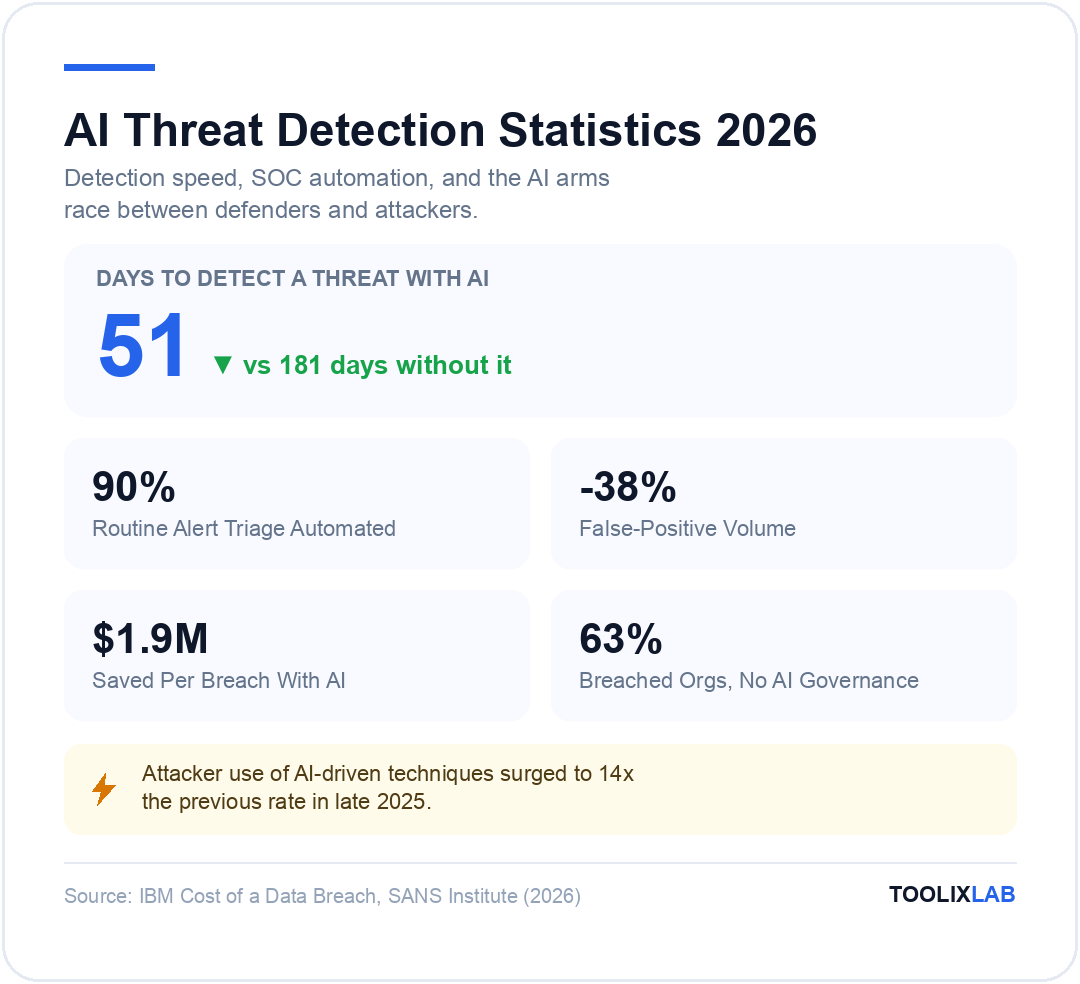
AI and machine learning cut average cyber-threat detection time from 181 days (signature-based) to 51 days, and organizations using AI and automation "extensively" save an average of $1.9 million per breach and contain incidents 80 days faster, per IBM's 2025 Cost of a Data Breach Report. But the same technology cuts both ways: AI-generated phishing now makes up 82.6% of detected phishing emails, and 63% of breached organizations still have no AI governance policy in place.
AI threat detection is no longer an emerging capability bolted onto legacy SIEM tools — it's the default architecture security operations centers are built around in 2026. The data shows a real, measurable performance gap between AI-driven and signature-based detection: 51 days to detect a threat with AI versus 181 days without it, SOC teams automating 90% of routine alert triage, and false-positive volume dropping as much as 38%. At the same time, attackers are using the exact same technology — AI-generated phishing attacks bypassed email filters at 14x the previous rate in late 2025, and 68% of threat analysts say AI-generated attacks are harder to catch than anything they saw a year earlier. This piece pulls every verifiable number together, sourced to the original reports, so you can see where AI is actually winning in security operations and where the arms race still favors attackers.
⚡ Quick Summary
Detection speed: AI-driven detection averages 51 days vs. 181 days for signature-based tools alone (IBM/industry benchmarks).
Cost impact: Extensive AI + automation use saves $1.9M per breach and shortens the breach lifecycle by 80 days (IBM Cost of a Data Breach 2025).
The catch: 63% of breached organizations have no AI governance policy, and AI-written phishing now accounts for the majority of attacks reaching inboxes.
Jump to: Detection Speed | Cost Impact | AI-Powered Attacks | Governance Gap
Key Stats at a Glance
🔑 45+ AI Threat Detection Statistics
- 📊 51 days average threat detection time with AI-driven tools, vs. 181 days for signature-based detection alone
- 📊 90% of routine SOC alert triage now handled by AI, cutting analyst workload by 60% (Vectra AI, State of Threat Detection 2026)
- 📊 38% reduction in false positives when AI-based detection replaces purely signature-based rules
- 📊 $1.9 million average breach-cost savings for organizations using AI and automation "extensively" (IBM Cost of a Data Breach Report 2025)
- 📊 80 days faster breach containment for heavy AI/automation adopters; the overall breach lifecycle fell to 241 days, a nine-year low
- 📊 55% of companies now run at least one AI-driven cybersecurity tool in production
- 📊 82.6% of detected phishing emails in late 2025 showed signs of AI generation, up from a small fraction two years earlier
- 📊 14x surge in AI-generated phishing emails that bypassed filters and reached inboxes between Q4 2025 and year-end
- 📊 63% of breached organizations had no AI governance policy in place at the time of the incident
- 📊 $670,000 higher average breach cost at organizations with high levels of unsanctioned "shadow AI" use
📚 Sources & Methodology
Every statistic below is attributed to its original report. We prioritized vendor and research-firm studies with disclosed sample sizes over aggregator blog posts:
- IBM — Cost of a Data Breach Report 2025, based on breach data from 600+ organizations across 17 countries and industries, analysis conducted by the Ponemon Institute.
- Vectra AI — State of Threat Detection in the AI Era (2026), survey of practicing SOC analysts and security leaders.
- Darktrace — State of AI Cybersecurity 2026, global survey of security professionals on AI-driven threats and readiness.
- Hoxhunt — Phishing Trends Report, analysis of AI-generated phishing volume and filter-bypass rates across enterprise inboxes.
- Ponemon Institute — independent security-tooling research on false-positive alert volume, cited via industry SOC benchmarking studies.
Finding #1: AI Cuts Threat Detection Time by 72%
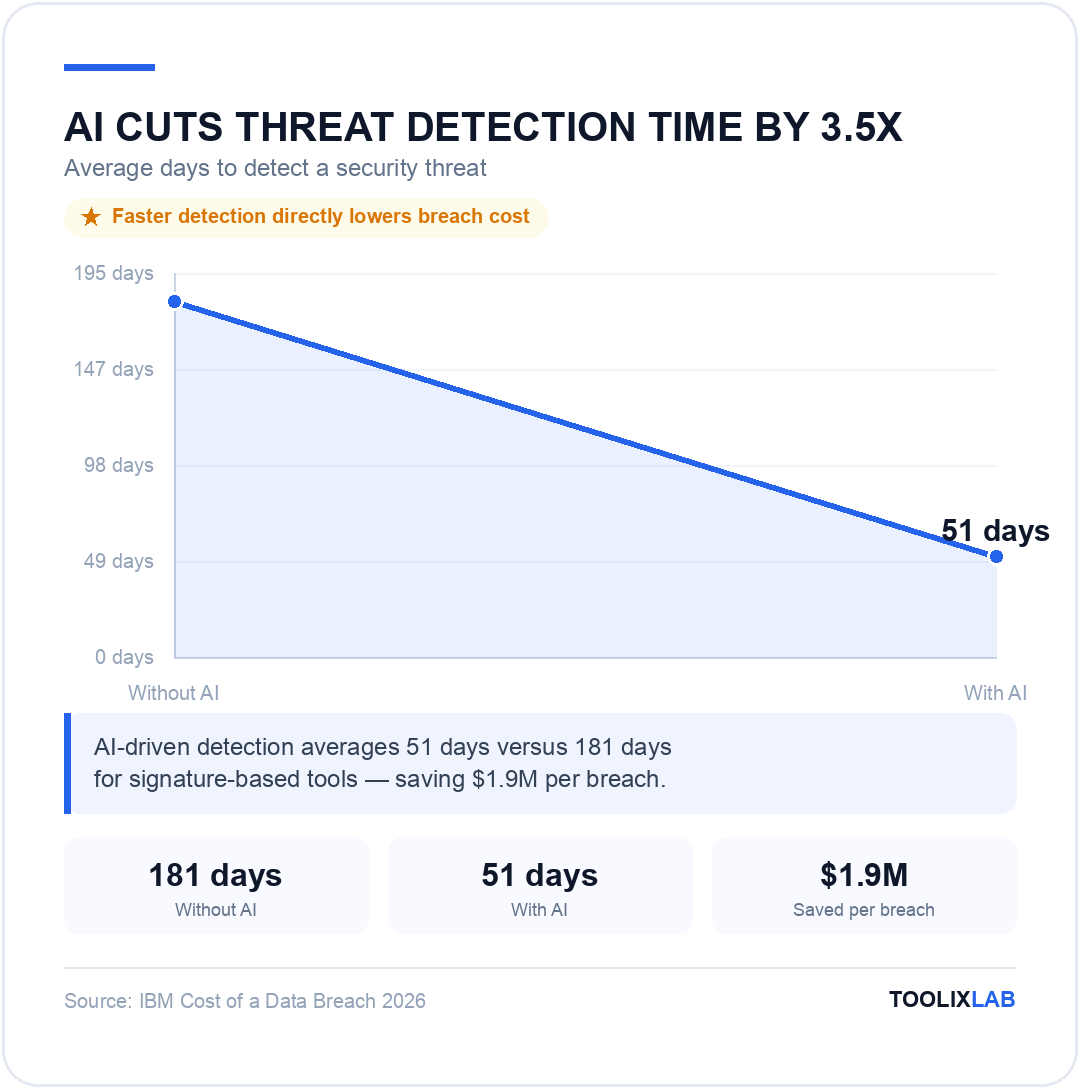
The single clearest performance gap in the data is speed. Organizations relying primarily on signature-based detection — matching known malware fingerprints against a database — average 181 days to identify a breach. Organizations layering AI and machine-learning-based anomaly detection on top of that average 51 days, a 72% reduction. That gap compounds: faster detection means a shorter window for attackers to move laterally, exfiltrate data, or deploy ransomware before anyone notices.
Detection accuracy tells a similar story. Neural-network-based detection systems report accuracy in the 96–98% range in controlled benchmarks, and large-language-model-based alert classifiers achieve roughly 94% precision when triaging which flagged events are genuine threats versus noise. None of these numbers mean AI is infallible — see the false-positive caveat below — but the direction of the trend is consistent across every vendor study we reviewed: AI-augmented detection outperforms rule-based detection on both speed and accuracy, without exception.
Why the gap is so large: signature-based tools can only catch what they already have a fingerprint for. AI/ML models trained on behavioral baselines can flag anomalies — an account logging in from an unusual location, a process spawning an unexpected child process — even when the specific attack technique has never been seen before. That's the entire premise behind modern AI-driven operational tooling extending into security: pattern recognition scales in a way manual rule-writing never could.
Finding #2: SOC Teams Now Automate 90% of Routine Triage
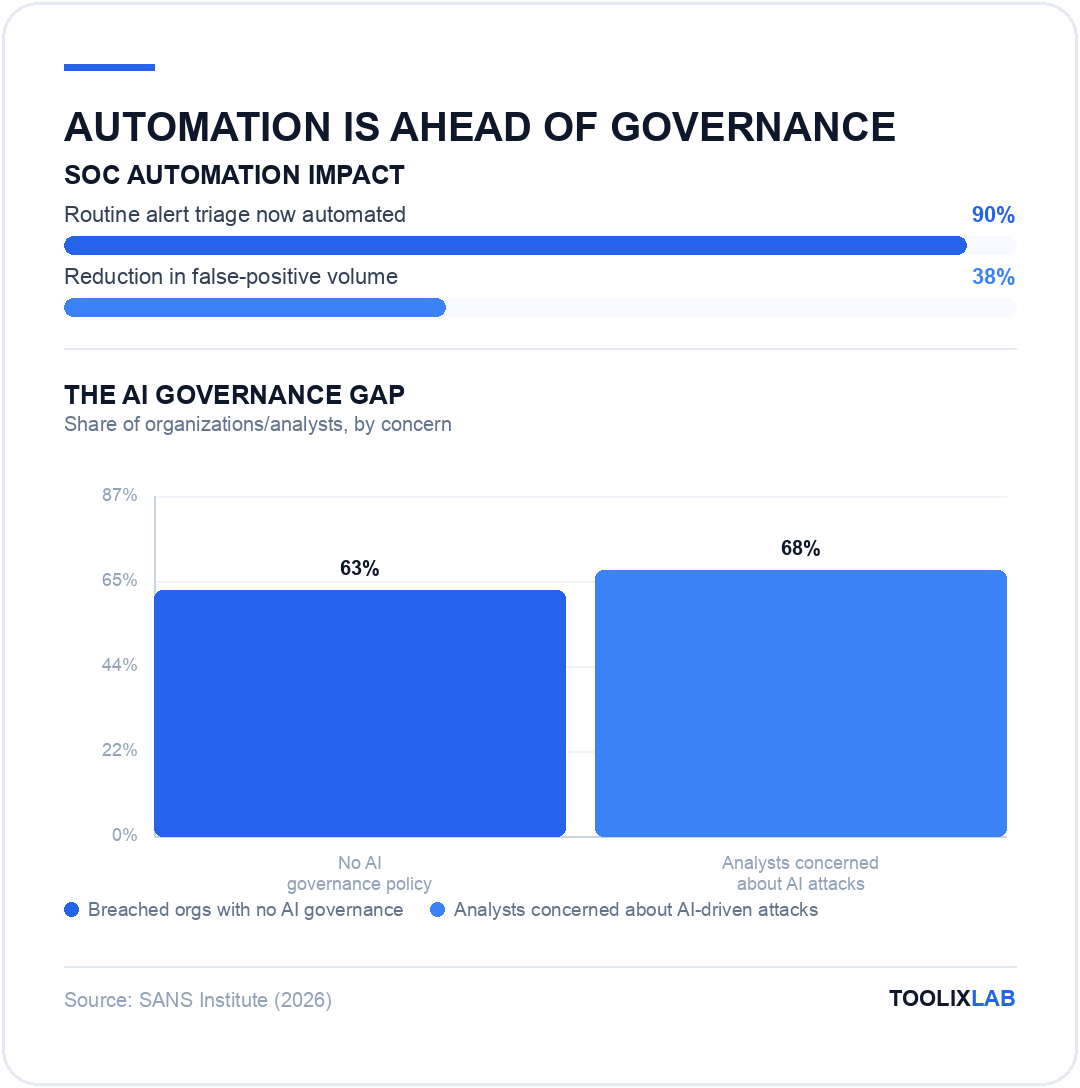
The practical effect of faster, more accurate detection shows up in how security operations centers allocate human attention. Per Vectra AI's 2026 State of Threat Detection survey, AI now handles roughly 90% of routine alert triage — the first-pass sorting of "is this worth a human looking at" — which translates into a 60% reduction in analyst workload for that category of task. Detection speed for AI-augmented SOCs runs 50% faster than teams still triaging manually.
False positives are the other side of the automation story, and the baseline is worse than most teams assume. Ponemon Institute research on SOC tooling found security teams field an average of 9,854 false-positive alerts per week — a volume no human team can meaningfully review. AI-based prioritization models cut that noise by roughly 38%, which is meaningful but not a solved problem; alert fatigue remains one of the top reasons real incidents get missed, AI-assisted or not.
- ✓ 90% of routine SOC triage automated by AI (Vectra AI, 2026)
- ✓ 60% reduction in analyst workload for triage-category tasks
- ✓ 50% faster threat detection for AI-augmented SOCs vs. traditional teams
- ✓ 9,854 average false-positive alerts per week before AI filtering (Ponemon)
- ✓ 38% reduction in false positives after introducing AI-based prioritization
Finding #3: AI and Automation Save $1.9 Million Per Breach
IBM's Cost of a Data Breach Report 2025 — based on data from over 600 breached organizations across 17 countries, analyzed by the Ponemon Institute — puts a concrete dollar figure on the detection-speed advantage. Organizations that deployed AI and security automation extensively saved an average of $1.9 million per breach compared to organizations with no AI/automation deployment, and cut the breach lifecycle (time to identify plus time to contain) by 80 days.
Across the full sample, the average global breach lifecycle fell to 241 days — the lowest figure IBM has recorded in nine years of running the study — and the average global cost of a data breach dropped to $4.44 million, down 9% year over year. IBM attributes the decline directly to faster containment enabled by AI-powered defenses, calling security AI and automation the single largest cost-reduction factor in the entire report.
The budget case in one line: $1.9M in avoided breach costs plus an 80-day-shorter incident lifecycle is the kind of ROI that justifies AI security tooling on its own, independent of any productivity argument — a pattern that echoes what we found in our AI CRM ROI statistics research: the financial case for AI tools increasingly rests on risk reduction, not just speed.
Finding #4: Attackers Are Using the Same Technology — and Winning Some Rounds
AI threat detection doesn't exist in a vacuum; it's an arms race, and attackers adopted generative AI for offense faster than most defenders adopted it for detection. 82.6% of phishing emails detected in late 2025 showed indicators of AI generation, and Hoxhunt's phishing-trend tracking recorded a 14x surge in AI-generated phishing emails that successfully bypassed email filters and landed in inboxes within a single quarter. AI-generated phishing content now achieves roughly a 54% click rate — matching or exceeding hand-crafted campaigns from experienced human social engineers, at a fraction of the cost and time to produce.
Practitioners feel the shift directly: 68% of cyber-threat analysts report that AI-generated attacks were harder to detect in the most recent year than in any prior year, and Darktrace's 2026 global survey found 87% of security professionals are seeing more AI-driven threats than a year earlier — while a much smaller share feel adequately prepared to stop them. Credential-theft attempts specifically attributed to AI tooling rose an estimated 160% year over year, and December 2025 alone saw AI-assisted phishing indicators jump from 4% to 56% of all reported phishing emails in a single month, per Hoxhunt's tracking panel — the fastest month-over-month escalation recorded since the firm began publishing the metric.
The uncomfortable takeaway: AI is making both sides faster at the same time. Detection speed improved 72% industry-wide, but attack sophistication and volume grew right alongside it — which is why raw detection statistics alone don't tell you whether an organization is actually safer than it was two years ago.
Finding #5: The AI Governance Gap Is Where the Real Risk Lives
The most consistent finding across every 2026 report we reviewed isn't about detection technology at all — it's about governance failing to keep pace with adoption. IBM found 63% of breached organizations had no formal AI governance policy at the time of their incident, and only 37% had any approval process or oversight mechanism for AI tool deployment. Among organizations that specifically reported a breach involving an AI model or AI application, 97% said they lacked proper AI access controls.
"Shadow AI" — employees using AI tools without security team knowledge or sanction — carries a measurable cost premium: organizations with high shadow-AI usage reported breach costs averaging $670,000 higher than organizations with low or no shadow AI. Meanwhile, the AI-in-cybersecurity market itself is projected to grow from roughly $29.6 billion in 2025 to $93.75 billion by 2030 — a 24.4% CAGR — meaning the governance gap is widening at the same time spend is accelerating, not narrowing as the category matures.
Where the Money Is Going: AI Security Budget Allocation
Spend is following the detection-speed data. AI-enhanced SIEM and XDR platforms — the tools doing the heavy lifting on the 51-day detection average — now command roughly 31% of the average cybersecurity budget, the single largest line item, with AI-augmented Endpoint Detection and Response (EDR) taking another 19%. Together, those two categories account for exactly half of what organizations spend on security tooling, a sharp reallocation from five years ago when perimeter firewalls and antivirus dominated budget lines.
The financial stakes of getting this wrong keep climbing on the attacker side too. Global phishing-related losses are projected to exceed $25 billion in 2026, and Business Email Compromise (BEC) — the fraud category most supercharged by AI-written, contextually convincing emails — remains the single costliest attack type at an average of $4.67 million per successful attack, according to phishing-incident cost tracking. That figure alone explains why AI-augmented email security is absorbing a growing share of the SIEM/XDR budget line rather than sitting in its own separate bucket.
IBM's newsroom disclosure adds one more data point worth flagging for any team currently building or deploying an in-house AI model rather than just buying AI-powered security tools: 13% of organizations surveyed reported a breach of an AI model or AI application specifically (not just AI-assisted intrusion into traditional systems), and 97% of those organizations admitted they lacked proper AI access controls at the time. That's a distinct risk category from "using AI to detect threats" — it's AI infrastructure itself becoming the attack surface, and it's the fastest-growing line item in next year's threat model for any company shipping its own models.
AI vs. Signature-Based Detection: Side-by-Side
| Metric | Signature-Based | AI/ML-Based | Source |
|---|---|---|---|
| Avg. detection time | 181 days | 51 days | Industry SOC benchmarks |
| Detection accuracy | Known threats only | 96–98% | Vendor benchmark studies |
| Weekly false positives | 9,854 (baseline) | ~38% fewer | Ponemon Institute |
| Routine triage automated | Manual | 90% | Vectra AI, 2026 |
| Avg. breach cost savings | Baseline | $1.9M (extensive use) | IBM, 2025 |
| Breach containment | Baseline | 80 days faster | IBM, 2025 |
What This Means for Your Security Stack
Three practical conclusions fall out of this data set for teams evaluating or already running AI-based security tooling in 2026:
Governance has to ship alongside the tool, not after it. With 63% of breached organizations lacking an AI governance policy and shadow AI adding $670K to average breach costs, the ROI case for AI detection tooling only holds if access controls and usage policy are in place from day one — not retrofitted after adoption. Teams building any kind of AI-powered customer-facing tooling should treat this as a prerequisite, not an afterthought.
Detection speed is now a competitive baseline, not a differentiator. A 51-day average detection time for AI-equipped organizations means that number is quickly becoming the market standard rather than a leading edge — teams still running purely signature-based detection are, per this data, taking roughly 3.5x longer to catch an active breach than the field average.
Assume your attackers already have the same AI capability you do. With AI-generated phishing making up over 80% of detected phishing volume and bypassing filters at 14x the prior rate, defensive AI adoption is closing a gap attackers opened first, not creating a new advantage from scratch. Budget and training decisions should reflect that the arms race, not a one-sided upgrade.
Smaller teams without a dedicated SOC shouldn't read the 51-day and $1.9M figures as enterprise-only numbers. Most of the detection-speed gain comes from AI-native tooling built into modern email security, identity, and endpoint platforms — not from custom-built detection models that require a security-engineering headcount to run. The governance gap is actually easier to close at small-company scale: a documented policy on which AI tools are approved for company data, plus basic access-control review, addresses the specific failure mode behind 63% of the AI-related breaches in this data set, without needing enterprise budget to do it.
🔑 Key Takeaways
- ✓ AI-driven detection is 3.5x faster than signature-based detection alone (51 vs. 181 days)
- ✓ SOC teams now automate 90% of routine triage, cutting analyst workload 60%
- ✓ Extensive AI/automation use saves $1.9M per breach and shortens containment by 80 days (IBM)
- ✓ AI-generated phishing now makes up 82.6% of detected phishing emails — the arms race cuts both ways
- ✓ 63% of breached organizations had zero AI governance policy in place — the real risk is process, not the model
AI hasn't eliminated the threat-detection problem, but the 2026 data is unambiguous on direction: organizations pairing AI/ML detection with real governance detect faster, spend less on breach recovery, and free analyst time for the incidents that actually need human judgment. The organizations still losing ground are the ones adopting the detection technology without adopting the governance that has to come with it — the same access-control and oversight discipline that shows up across every AI deployment we've tracked, from startup AI stacks to enterprise SOCs.