
By ToolixLab Research Team · Last updated: July 2026
Quick Answer
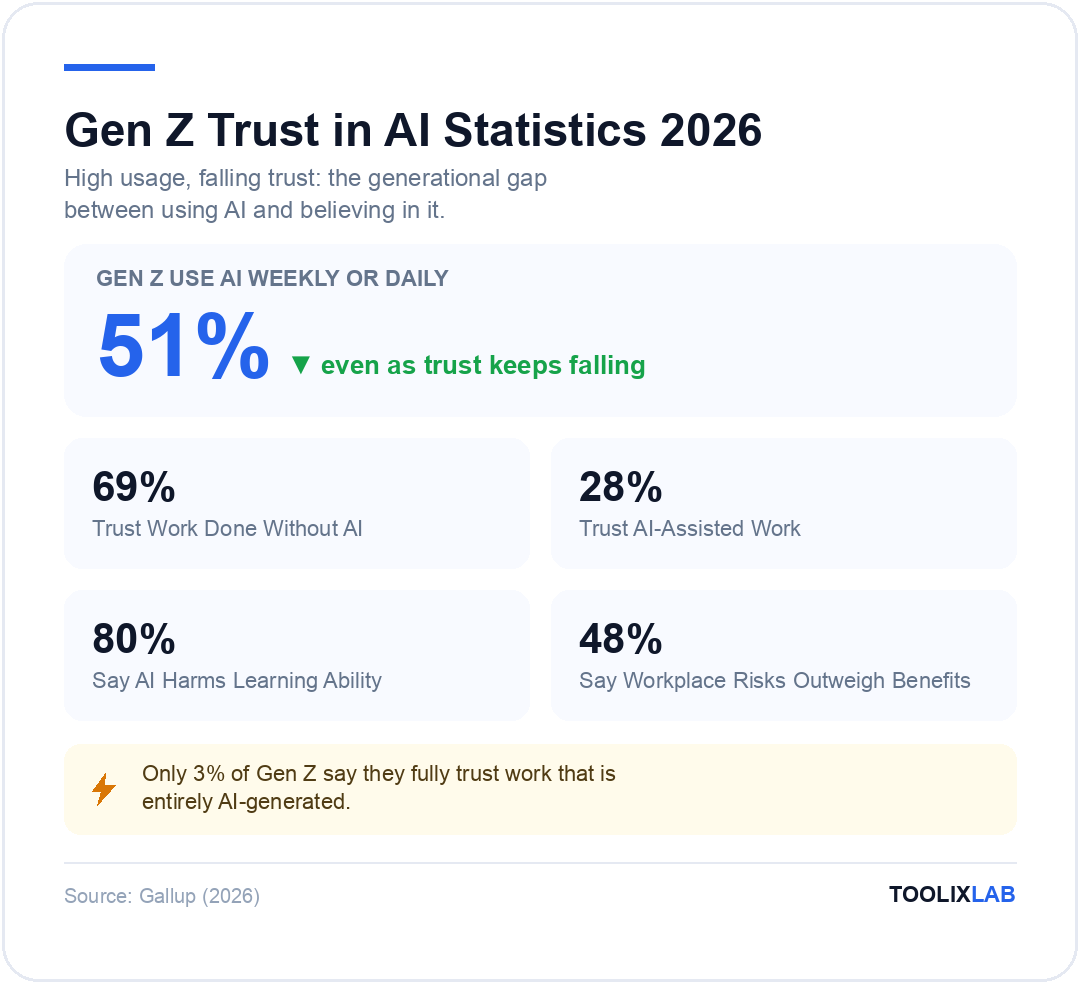
Gen Z uses AI more than any other generation but trusts it the least. 51% of 14-29-year-olds use AI weekly or daily (Gallup, 2026), yet the same cohort trusts human-only work at 69% versus AI-assisted work at just 28%. Excitement about AI has dropped 14 points to 22% year-over-year while anger has risen 9 points to 31%. 80% of Gen Z believe AI use harms their future learning ability, and 48% say AI's workplace risks outweigh its benefits — even as 74% of them already use it at work daily.
Gen Z is simultaneously AI's heaviest user base and its harshest critic — a pattern researchers keep independently confirming rather than a one-off finding. Gallup's 2026 panel survey, Pew Research's parallel studies of teens and adults, and Deloitte's 22,500-person global Gen Z survey all land on the same shape: usage climbing or holding steady, trust and enthusiasm falling.
We pulled the primary data behind every commonly cited "Gen Z and AI" statistic — Gallup's dedicated Gen Z tracking survey, Pew Research's 2026 adult and teen AI reports, Deloitte's global Gen Z and Millennial Survey, and the Match/Kinsey Institute Singles in America study — so the numbers below are attributed to the actual study that produced them, not a secondhand aggregator.
For the adjacent consumer-trust picture, see our consumer trust in AI video statistics, and for the workplace productivity numbers behind Gen Z's daily AI use, our AI CRM ROI and productivity statistics roundup.
Gen Z Trust in AI: The Key Numbers
- 📊 51% of 14-29-year-olds use AI weekly (29%) or daily (22%) — usage has held roughly steady since March 2025 (Gallup, April 2026)
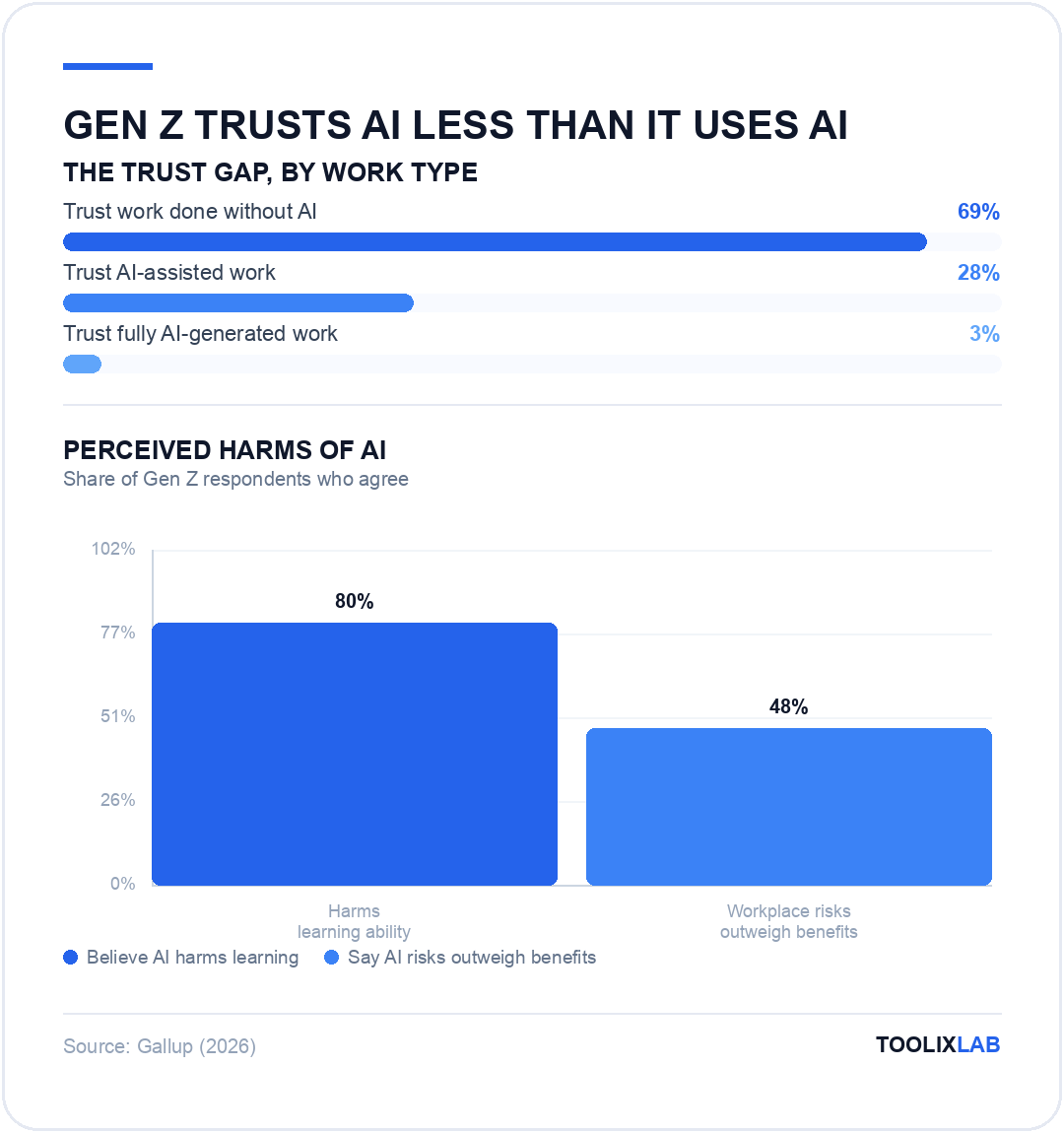
- 📊 69% vs. 28% — Gen Z trusts work completed without AI far more than AI-assisted work; only 3% trust fully AI-generated work
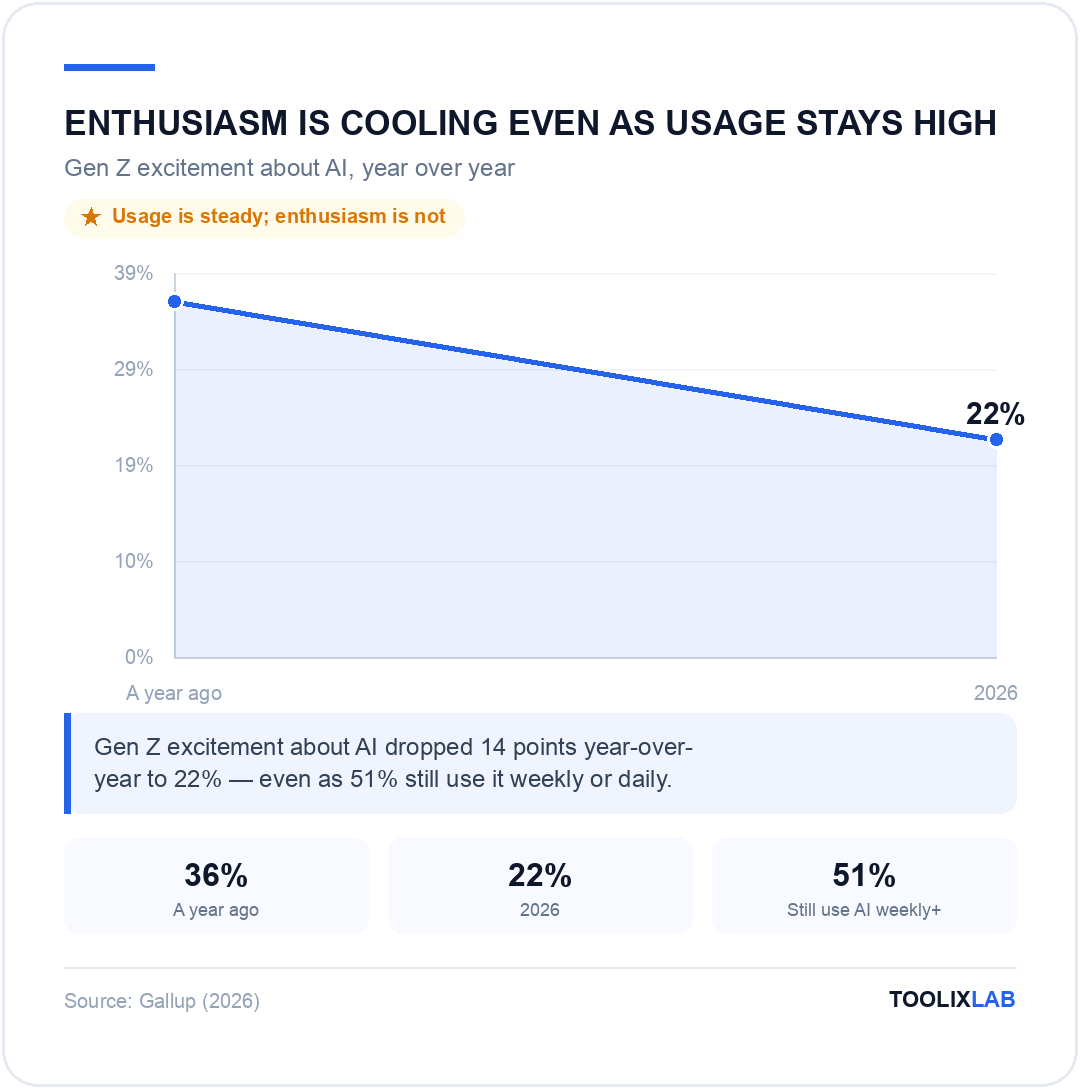
- 📊 22% report feeling excited about AI, down 14 percentage points year-over-year; 31% report anger, up 9 points
- 📊 80% of Gen Z believe using AI harms their future ability to learn; 42% say it hurts critical thinking specifically
- 📊 48% of employed Gen Z say AI's workplace risks outweigh its benefits — more than 3x the 15% who say benefits win
- 📊 48% of 18-29-year-olds predict AI will have a negative impact on society overall, the most pessimistic of any adult age group (Pew, June 2026)
- 📊 64% of US teens (13-17) have used an AI chatbot; 28% use one daily, and 16% use one "almost constantly" (Pew, February 2026)
- 📊 74% of Gen Z and Millennial workers report using AI to some extent in their day-to-day jobs (Deloitte, May 2026, 44-country survey)
- 📊 29% of chatbot users overall say they trust the information chatbots provide "a lot" or "some" — meaning roughly 7 in 10 users hold little to no trust in the output (Pew, June 2026)
- 📊 333% year-over-year jump in singles using AI for dating, with nearly half of Gen Z now using it to improve their dating profiles (Match/Kinsey Institute, June 2026)
Feel free to cite any statistic on this page — we ask only for a link back to this article as the source.
Methodology: Where This Data Comes From
This is a curated compilation of primary survey research, not a study we ran ourselves. Every figure traces back to one of the following:
- Gallup, "Gen Z's AI Adoption Steady, but Skepticism Climbs" (published April 8, 2026) — a probability-based Gallup Panel web survey of 1,572 respondents aged 14-29, conducted February 24-March 4, 2026, margin of error ±3.6 points.
- Pew Research Center, "Americans and AI 2026" (published June 17, 2026) — a survey of 5,119 US adults conducted February 17-23, 2026.
- Pew Research Center, "How Teens Use and View AI" (published February 24, 2026) — a survey of 1,458 US teens aged 13-17, conducted online September 25-October 9, 2025.
- Deloitte Global Gen Z and Millennial Survey 2026 (published May 13, 2026) — over 22,500 Gen Z and Millennial respondents across 44 countries.
- Match / The Kinsey Institute, Singles in America 2026 — a Dynata-conducted survey of 5,001 US singles aged 18-98.
Limitations: age-cohort definitions vary slightly by study (Gallup surveys 14-29; Pew's adult report surveys 18-29 as its youngest bracket; Deloitte defines Gen Z as born 1995-2006). We've kept each study's own age range attached to its statistic rather than blending them into a single "Gen Z" figure.
How Many Gen Z Actually Use AI, and How Often?
Usage is not the part of this story that's declining. Gallup's dedicated Gen Z tracking survey found 51% of 14-29-year-olds use AI weekly (29%) or daily (22%), a figure that has been largely stable since March 2025 even as sentiment has shifted underneath it. Among Gen Z K-12 students specifically, weekly-or-more usage runs even higher at 56%, compared with 48% for adults generally. On the older end of the same generation, Pew found 58% of US adults under 30 have used ChatGPT specifically — up from 43% in 2024 and just 33% in 2023, and adults under 50 overall are roughly twice as likely as those 50+ to have used it (57% vs. 28%).
Do Gen Z Actually Trust AI? The Trust-Usage Gap, Quantified
This is the statistic that defines the entire cohort's relationship with the technology. Gallup asked Gen Z workers directly how much they trust work completed with AI versus without it, and the gap is stark: 69% trust work done without AI assistance, versus only 28% for AI-assisted work and just 3% for fully AI-generated work. Pew's broader adult data shows the same pattern at the population level — only 29% of chatbot users say they trust the information chatbots provide "a lot" or "some," meaning roughly seven in ten regular users hold little to no trust in the exact tool they're actively using daily.
| Work type | Gen Z trust level |
|---|---|
| Completed without AI | 69% |
| Completed with AI assistance | 28% |
| Fully AI-generated | 3% |
Source: Gallup, "Gen Z's AI Adoption Steady, but Skepticism Climbs" (April 2026)
Why Is Gen Z's Enthusiasm for AI Declining Year-Over-Year?
Usage holding steady while sentiment sours is the pattern Gallup's year-over-year tracking captures most clearly. Excitement about AI among Gen Z fell 14 percentage points to 22%, hopefulness dropped 9 points to 18%, and anger climbed 9 points to 31% compared with the prior year. Anxiety held roughly steady at 42%, and curiosity — a newly tracked metric — sits at 49%, the single most common emotional response. Among the subset of Gen Z who use AI daily, the sentiment decline is sharper still: excitement down 18 points and hopefulness down 11 points, suggesting the people using the technology most are cooling on it fastest, not warming to it with familiarity.
What Does Gen Z Worry About? Cognitive Skills and Workplace Risk
The specificity of Gen Z's concerns is what separates this from generic tech skepticism. A full 80% believe AI use harms their future ability to learn, and when broken into specific skill areas, 42% say AI is harmful to critical thinking (versus 25% who say it's helpful) and 38% say it's harmful to creativity (versus 31% helpful). At work, employed Gen Z are roughly 3x more likely to believe AI's risks outweigh its benefits (48%) than to believe the reverse (15%), with 37% seeing the two as roughly equal. These are the workers already using AI daily — the skepticism is informed by hands-on use, not distance from the technology.
How Does Gen Z's AI Trust Compare to Older Generations?
Pew's 2026 adult survey confirms Gen Z isn't an outlier reacting emotionally where older generations stay neutral — it's the most pessimistic age bracket on record, and the gap widens with youth. 48% of 18-29-year-olds predict AI will have a negative impact on society overall, compared with 39% of 30-49-year-olds and 37% of those 50 and older. The same ordering holds for personal impact: 37% of 18-29-year-olds expect AI to affect them negatively, versus 30% of 30-49s and 28% of those 50+. Younger age brackets are both the heaviest adopters and the most convinced the technology will make things worse — a combination that doesn't fit the usual assumption that skepticism comes from unfamiliarity.
How Fast Did Gen Z's ChatGPT Adoption Actually Grow?
The under-30 adoption curve is one of the steepest Pew has tracked for any consumer technology. ChatGPT use among US adults under 30 went from 33% in 2023 to 43% in 2024 to 58% in 2026 — nearly doubling in three years while sentiment moved in the opposite direction over the same window. That combination is worth naming explicitly: this isn't a cohort still ramping up toward eventual trust as familiarity grows. Usage grew fastest in the exact period sentiment declined fastest, which is the strongest evidence that Gen Z's skepticism is a direct product of hands-on use rather than distance from the tools.
| Year | Under-30 ChatGPT usage |
|---|---|
| 2023 | 33% |
| 2024 | 43% |
| 2026 | 58% |
Source: Pew Research Center, "Americans and AI 2026"
Teens Specifically: What Pew's 13-17 Data Shows
Pew's dedicated teen survey — the youngest cohort measured in any of these studies — shows the adoption curve extending even younger. 64% of US teens aged 13-17 have used an AI chatbot, with 28% using one daily and 16% engaging "several times a day or almost constantly." Usage varies notably by demographic: 35% of Black teens and 33% of Hispanic teens report daily use, compared with 22% of white teens, and older teens (15-17) are more likely to be daily users than younger teens. On use cases, information-seeking (57%) and schoolwork help (54%) top the list, with 47% using chatbots purely for fun or entertainment — evidence that "for school" is not the primary driver Pew's data would suggest at first glance.
Gen Z at Work: Adoption Outpaces Employer Readiness
Deloitte's 44-country, 22,500-respondent Gen Z and Millennial survey found 74% of both generations now use AI to some extent in their day-to-day work — framed by respondents largely in positive terms, expected to free up time and open new paths for entry-level growth. But Deloitte's researchers note a consistent theme running through the qualitative responses: young workers report adapting to AI faster than their own organizations, meaning the adoption-outpacing-trust pattern from the personal-use data repeats at the institutional level — Gen Z is ready to use the tools well before their employers have built the policies, training, or guardrails to support that use responsibly.
The Outlier: Gen Z's Warm Embrace of AI in Dating
Not every domain fits the skepticism pattern. The Match/Kinsey Institute Singles in America study — a Dynata-run survey of 5,001 US singles aged 18-98 — found AI use in dating jumped 333% year-over-year, and Gen Z (defined here as ages 18-27) was the heaviest-adopting cohort of any generation measured, ahead of Millennials and Gen X. Nearly half of Gen Z singles now use AI to help craft their dating profile, and 33% of Gen Z have engaged with an AI chatbot as a romantic companion, roughly double the 16% rate across all single respondents. The pattern here inverts the workplace-trust story: in a low-stakes, high-anxiety domain like dating, Gen Z appears more willing to lean on AI assistance than in domains — work output, learning, critical thinking — where the personal cost of getting it wrong feels higher.
What This Data Means in Practice
Don't treat "Gen Z uses AI more" and "Gen Z trusts AI" as the same claim. Every study cited here measures usage rising or holding steady while trust and enthusiasm decline — the two metrics move in opposite directions for this cohort specifically, unlike the pattern typically assumed for younger users adopting new technology.
The trust deficit is informed skepticism, not unfamiliarity. The people expressing the most concern about AI's effect on critical thinking and workplace output are disproportionately the same people using it daily. A business case that assumes distrust will fade with more exposure is working against the data, not with it.
Context matters more than generation when predicting AI trust. The same cohort that trusts AI-assisted work at only 28% embraces AI for dating profiles at nearly 50%. Low-stakes, socially awkward domains see far higher AI acceptance than high-stakes domains tied to competence or learning.
Employer AI policy is lagging employee adoption, not the reverse. Deloitte's finding that young workers adapt faster than their organizations suggests the operational risk in 2026 isn't getting Gen Z to use AI tools — it's the absence of institutional guardrails for tools employees have already adopted on their own.
Frequently Asked Questions
Does Gen Z trust AI more or less than older generations?
Less. 48% of 18-29-year-olds predict AI will negatively impact society, versus 39% of 30-49-year-olds and 37% of those 50+ (Pew, June 2026) — the youngest adult bracket is the most pessimistic despite being the heaviest adopter.
What percentage of Gen Z uses AI regularly?
51% of 14-29-year-olds use AI weekly (29%) or daily (22%), per Gallup's April 2026 survey — usage has held roughly steady since March 2025 even as sentiment has declined.
Why doesn't Gen Z trust AI-assisted work?
Gallup found Gen Z trusts human-only work at 69% versus AI-assisted work at just 28%, and fully AI-generated work at only 3%. 80% also believe AI use harms their own future learning ability — the skepticism is tied to specific, named concerns rather than general unfamiliarity.
How many teenagers use AI chatbots?
64% of US teens aged 13-17 have used an AI chatbot, with 28% using one daily and 16% using one almost constantly (Pew Research, February 2026, surveying 1,458 teens).
Is Gen Z's AI enthusiasm rising or falling?
Falling. Excitement dropped 14 percentage points to 22% year-over-year, and anger rose 9 points to 31% (Gallup, April 2026) — even though usage rates held steady over the same period.
Does Gen Z use AI at work?
Yes — 74% of Gen Z and Millennial workers report using AI to some extent in their day-to-day jobs (Deloitte, May 2026, 22,500+ respondents across 44 countries), and many report adapting to AI faster than their own employers.
Are there areas where Gen Z trusts AI more, not less?
Yes — dating. AI use in dating jumped 333% year-over-year, and nearly half of Gen Z singles now use AI to help craft their dating profile, with 33% having used an AI chatbot as a romantic companion (Match/Kinsey Institute, June 2026).
Can I cite these statistics?
Yes. These are third-party primary survey statistics compiled and sourced by ToolixLab — cite the original source (Gallup, Pew Research Center, Deloitte, or Match/Kinsey Institute) where possible, and feel free to link to this page as your source for the compilation.
🔑 Key Takeaways
- ✓51% of 14-29-year-olds use AI weekly or daily, but Gen Z trusts human-only work (69%) far more than AI-assisted work (28%) or fully AI-generated work (3%)
- ✓Excitement about AI fell 14 points to 22% year-over-year while anger rose 9 points to 31% — usage stayed steady as sentiment soured
- ✓80% of Gen Z believe AI harms their future learning ability, and 48% say workplace risks outweigh benefits — more than 3x the 15% who disagree
- ✓18-29-year-olds are the most pessimistic adult age bracket on AI's societal impact (48% negative), ahead of 30-49s (39%) and 50+ (37%)
- ✓64% of teens 13-17 have used an AI chatbot; 74% of Gen Z workers already use AI on the job, often faster than their employers can build policy around it
- ✓Dating is the exception: AI use in dating jumped 333% year-over-year, with Gen Z the heaviest-adopting generation of any measured
Related Guides
- Consumer Trust in AI Video: 77% Still Distrust It — another primary-source study on where AI trust is breaking down, in a different domain.
- AI CRM ROI Statistics 2026 — the productivity data behind why Gen Z workers are adopting AI at work despite the trust gap.
- AI's Impact on SEO Rankings: 50+ Statistics for 2026 — another primary-source statistics compilation on how AI is reshaping a specific behavior.
- State of AI Tools 2026: 50+ Key Statistics — the broader adoption picture this generational data sits inside.
- How to Use Claude AI for Business — a practical guide for the workplace AI adoption covered above.