
Quick Answer
AI has been cited in 101,743 U.S. job-cut announcements through June 2026 — about 23% of all layoffs tracked by Challenger, Gray & Christmas — and Goldman Sachs estimates a net 16,000 U.S. jobs are being lost to AI substitution every month. Globally, the World Economic Forum projects 92 million roles displaced by 2030 against 170 million created, and the IMF finds nearly 40% of jobs worldwide are exposed to AI-driven change. The clearest early casualty: software-developer employment for workers aged 22–25 has fallen almost 20% since 2024, per Stanford HAI.
"AI job displacement" stopped being a hypothetical sometime in 2026. Challenger, Gray & Christmas has now tracked AI as the leading stated reason for layoffs for four consecutive months, Goldman Sachs is publishing monthly payroll estimates of net AI-driven job loss, and Stanford's AI Index found the first white-collar job category — entry-level software developers — with employment that has measurably contracted since generative AI tools went mainstream. At the same time, the picture is not simply "AI destroys jobs": PwC's 2026 Global AI Jobs Barometer finds companies most exposed to AI are growing headcount faster than the least-exposed ones, and paying AI-skilled workers a 62% wage premium. This piece pulls every verifiable number together — sourced to the original report, not an aggregator blog — so you can see where displacement is real, where it's still projection, and where the data actually points the other way.
⚡ Quick Summary
Measured today: 101,743 AI-cited U.S. layoffs YTD through June 2026 (23% of all cuts); Goldman Sachs estimates ~16,000 net U.S. jobs lost to AI per month.
Projected by 2030: WEF projects 92 million roles displaced globally vs. 170 million created (net +78 million, but different workers on each side).
The split: Entry-level software developers (22–25) down almost 20% in employment since 2024, while AI-skilled workers earn a 62% wage premium and AI-exposed firms grow headcount faster.
Jump to: Measured Layoffs | Global Projections | Entry-Level Impact | The Two-Track Market
Key Stats at a Glance
🔑 50+ AI Job Displacement Statistics
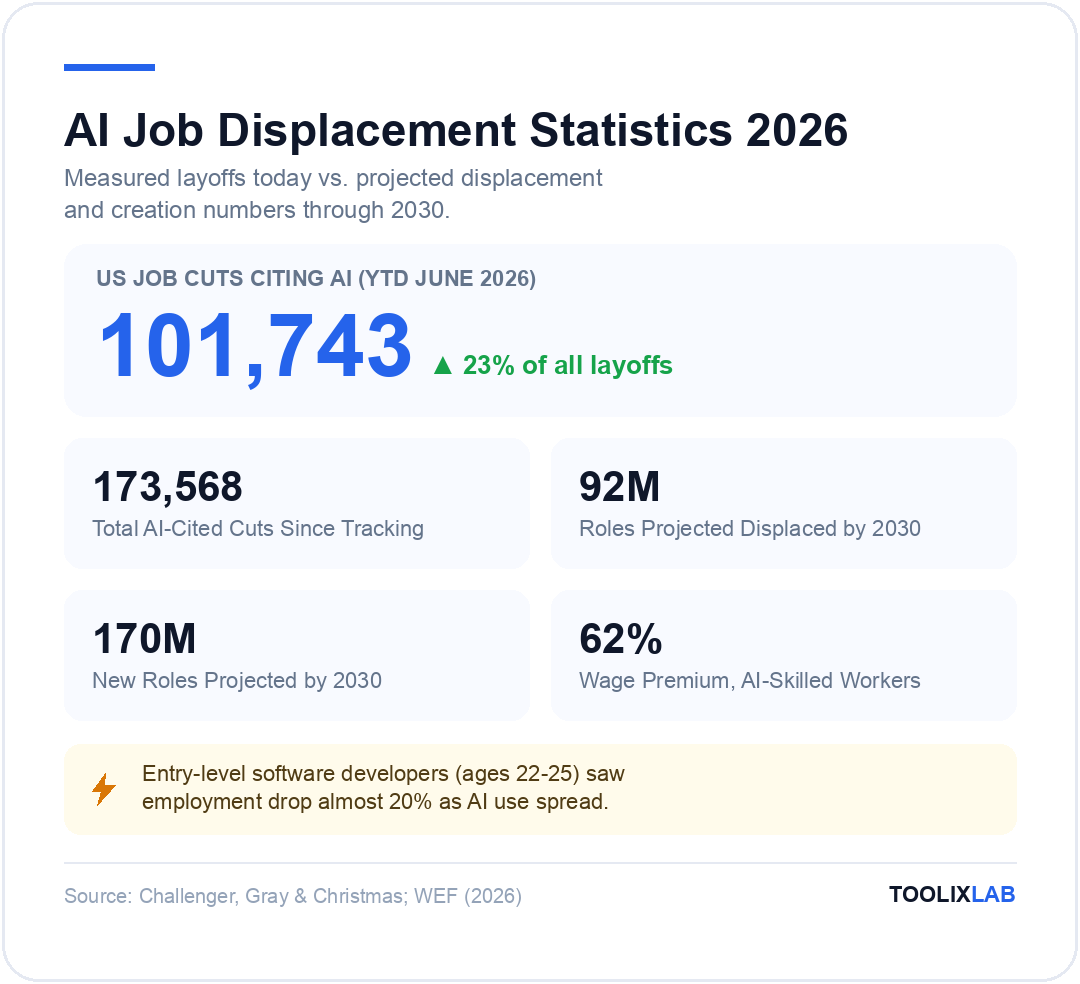
- 📊 101,743 U.S. job cuts cited AI as a reason through June 2026 — 23% of all announced cuts (Challenger, Gray & Christmas)
- 📊 173,568 total AI-cited job cuts announced since Challenger began tracking the category in 2023
- 📊 AI led stated layoff reasons for four consecutive months through June 2026, with 14,029 AI-cited cuts (31% of the monthly total) in June alone
- 📊 ~16,000 net U.S. jobs lost to AI per month, per Goldman Sachs (25,000 eliminated by substitution, partly offset by 9,000 added via augmentation)
- 📊 92 million roles projected to be displaced globally by 2030, against 170 million created — a net +78 million, per the World Economic Forum's Future of Jobs Report
- 📊 Entry-level (ages 22–25) software developer employment down nearly 20% since 2024, while employment for developers 30+ kept growing (Stanford HAI, 2026 AI Index)
- 📊 ~40% of jobs worldwide are exposed to AI-driven change, rising to roughly 60% in advanced economies (IMF, January 2026)
- 📊 37% of U.S. business leaders expect to have replaced jobs with AI by the end of 2026; 48% say high-salary employees are most at risk (ResumeTemplates.com survey of 1,000 leaders)
- 📊 20% of large organizations are projected to use AI to eliminate more than half of current middle-management roles by 2026 (Gartner)
- 📊 AI-skilled workers command a 62% wage premium globally, up from 57% a year earlier (PwC 2026 Global AI Jobs Barometer)
- 📊 Headcount at the most AI-exposed companies grew 52% since 2018 versus 36% at the least AI-exposed companies (PwC)
- 📊 Technology-sector layoffs reached 139,156 through H1 2026 — up 83% year-over-year — as companies restructure around AI (Challenger)
📚 Sources & Methodology
Every statistic below is attributed to its original report. We prioritized government data, central-bank/IMF research, and primary employer-survey or payroll-tracking firms over aggregator blog posts:
- Challenger, Gray & Christmas — monthly U.S. Job Cut Announcement Report, tracking employer-stated layoff reasons since 1993 (AI as a tracked category since 2023).
- Goldman Sachs Research — "How Will AI Affect the US Labor Market," proprietary payroll and task-exposure analysis.
- World Economic Forum — Future of Jobs Report, survey of 1,000+ employers across 22 industry clusters and 55 economies.
- Stanford HAI — 2026 AI Index Report, ninth annual edition, published April 2026.
- International Monetary Fund — "New Jobs Creation in the AI Age" Staff Discussion Note, January 2026.
- PwC — 2026 Global AI Jobs Barometer, analysis of over one billion job advertisements across 27 countries.
Finding #1: 101,743 AI-Cited Layoffs So Far in 2026
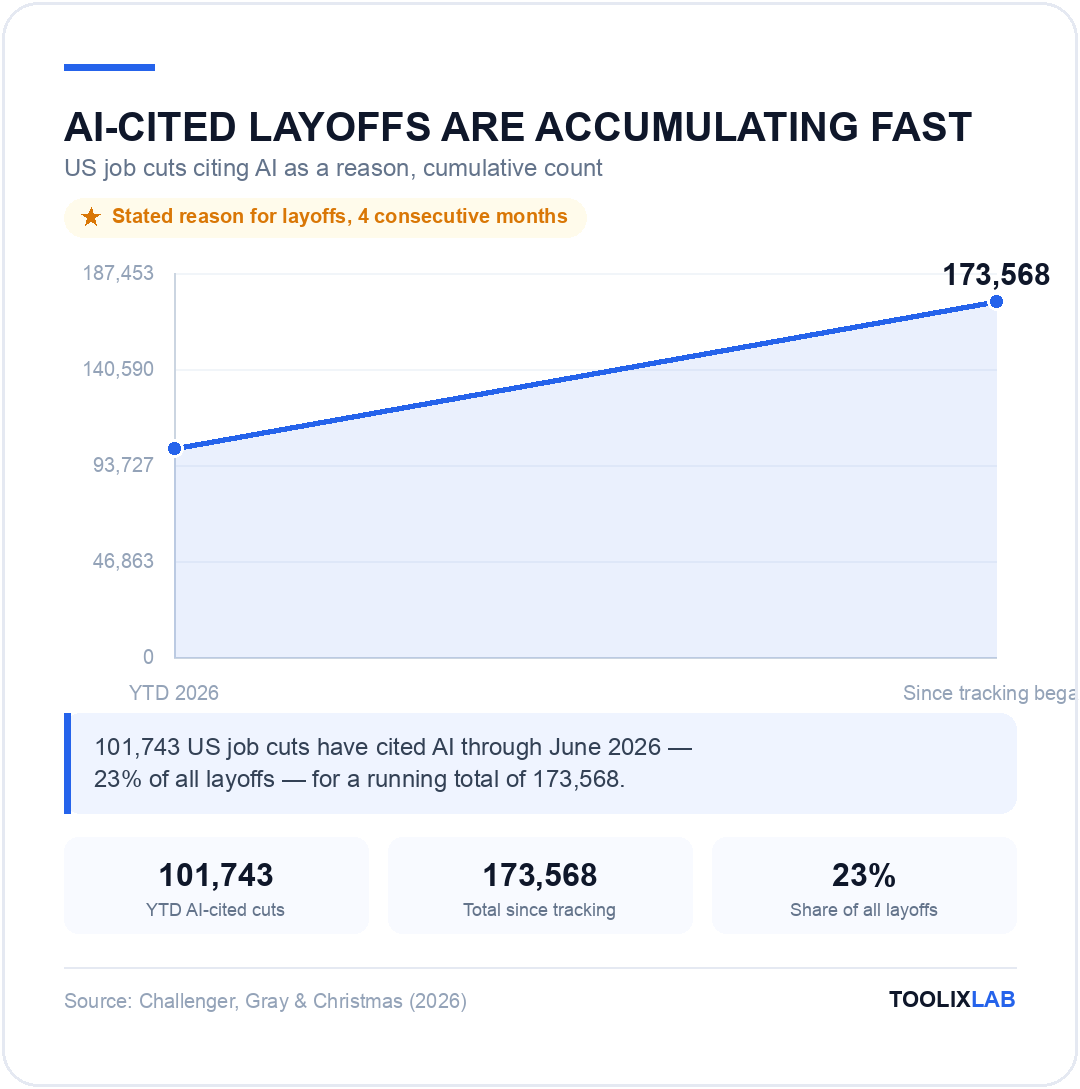
The most concrete number in this data set comes from Challenger, Gray & Christmas, the outplacement firm that has tracked employer-announced layoff reasons since 1993. Through June 2026, employers cited AI as a factor in 101,743 job cuts — roughly 23% of all announced cuts for the year. AI has now led all stated layoff reasons for four consecutive months, and in June alone it accounted for 14,029 cuts, or 31% of that month's total. Since Challenger started tracking the category in 2023, employers have cited AI in 173,568 total job-cut announcements.
Two pieces of context matter for reading that number correctly. First, total U.S. layoffs are actually down in 2026 — 443,604 cuts through June, a 40% drop from the 744,308 announced over the same period in 2025 — so AI's rising share reflects a growing slice of a shrinking pie, not runaway job destruction economy-wide. Second, the technology sector is where the pain concentrates: tech announced 139,156 cuts through H1 2026, up 83% year-over-year, and now accounts for nearly a third of all layoffs tracked. Challenger's own researchers also flag a self-reporting caveat worth taking seriously: nearly 6 in 10 companies admit in surveys that they frame layoffs as "AI-driven" even when the underlying reason is financial — meaning the true AI-attributable share is probably lower than the headline 23% figure, not higher.
Why this matters more than the projections below: this is observed employer behavior, not a model of what might happen by 2030. It's the same distinction we drew in our AI CRM ROI statistics research — vendor-sourced projections and independently observed data tell different stories, and this piece keeps them separated rather than blending them into one number.
Finding #2: Goldman's Net Payroll Estimate — and Its Own Caveat
Goldman Sachs Research publishes a monthly estimate of AI's net effect on U.S. payrolls: roughly 25,000 positions eliminated per month through direct AI substitution, partially offset by about 9,000 positions added through AI augmentation (new roles built around deploying and managing AI systems), for a net loss of roughly 16,000 jobs per month — annualizing to somewhere in the range of 190,000–200,000 net positions over a 12-month period.
Goldman's own economists add an important qualifier that gets dropped in most secondhand coverage of this figure: as of their most recent published analysis, "no significant AI-led changes in the employment mix" have shown up in the broad, economy-wide labor data yet. The effect remains concentrated in specific tech, knowledge-work, and creative sectors rather than visible across the whole economy. Over a full 10-year adoption cycle, Goldman's separate long-run modeling estimates AI could ultimately displace tasks equivalent to 6–7% of the workforce and add roughly 0.6 percentage points to the unemployment rate if the transition plays out over a decade — a materially different (and slower-moving) claim than the monthly headline number implies.
- ✓ ~25,000 U.S. jobs/month eliminated via AI substitution (Goldman Sachs)
- ✓ ~9,000 U.S. jobs/month added via AI augmentation, partially offsetting losses
- ✓ ~16,000 net monthly job loss, concentrated in tech/knowledge-work/creative sectors
- ✓ 6–7% of the workforce potentially displaced over a full 10-year AI adoption cycle
- ✓ +0.6 pp projected addition to the U.S. unemployment rate if that 10-year transition plays out
- ✓ 216,000 new construction jobs added since 2022 for AI data-center buildout — a counter-current job-creation effect in the same economy
Finding #3: WEF Projects 92 Million Roles Displaced Globally by 2030
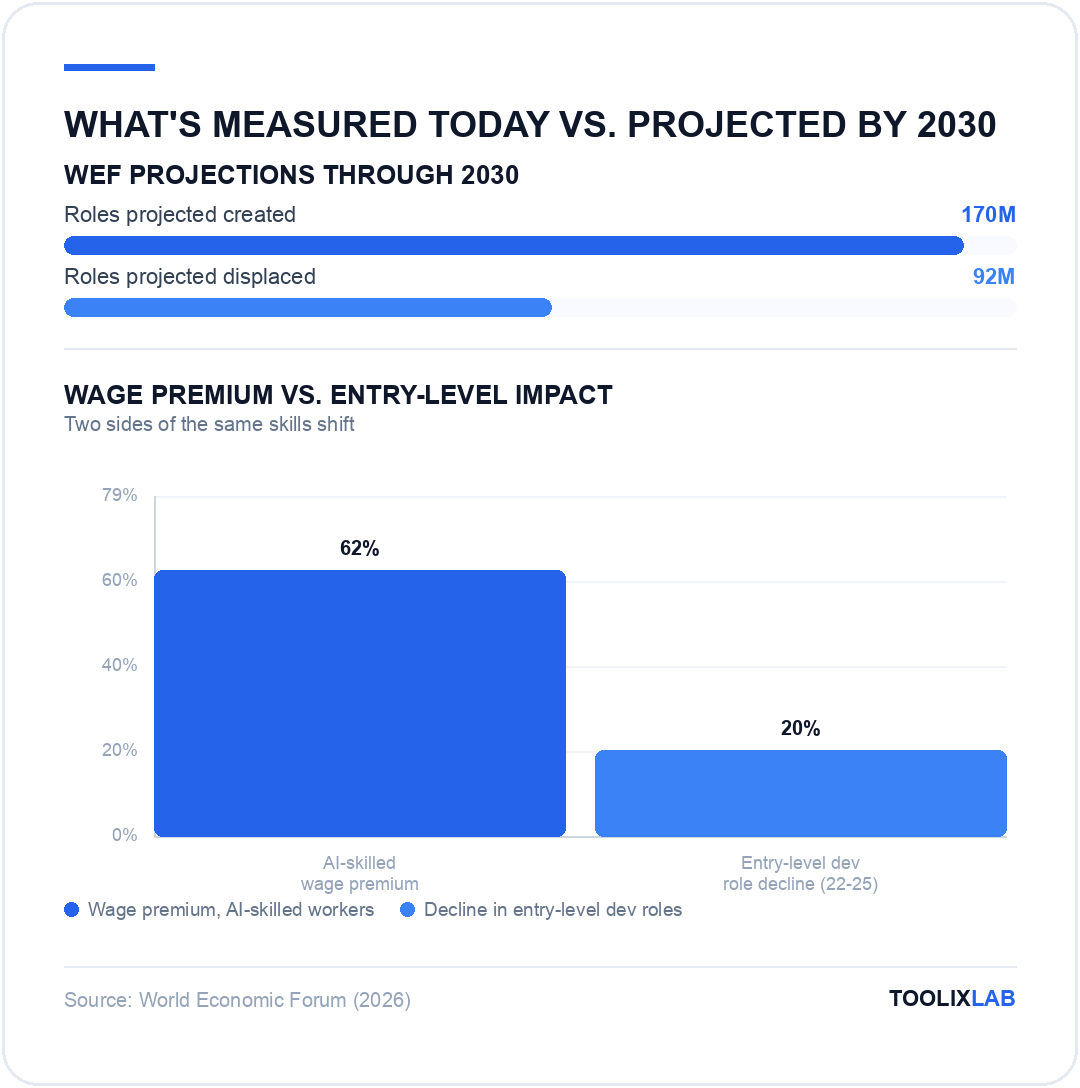
The World Economic Forum's Future of Jobs Report — based on a survey of more than 1,000 employers spanning 22 industry clusters and 55 economies — projects that structural shifts including AI will displace 92 million existing roles globally by 2030 while creating 170 million new ones, for a headline net gain of 78 million jobs.
The net-positive framing is the number that gets quoted; it's also the most misleading one if taken at face value. The 92 million roles being displaced skew heavily toward clerical, administrative, and routine data-entry work — categories with limited direct reskilling paths into the 170 million roles being created, which skew toward technical, AI, and data roles requiring substantially different training. WEF's own survey data underscores the disconnect: 63% of employers cite the skills gap as the single biggest barrier to workforce transformation, and more than half of executives surveyed expect AI to displace existing jobs at their own company, compared with only 24% who expect it to primarily create new ones there.
Read the net number carefully: "78 million more jobs" describes two different populations of workers — it is not a claim that the people losing clerical roles today will simply move into the AI and data roles being created. That reskilling gap, not the raw headcount math, is what WEF calls the central operational challenge for employers through 2030.
Finding #4: Entry-Level Developers Are the First Measurable Casualty
Stanford HAI's 2026 AI Index — the ninth annual edition, published April 2026 — documents what its authors call the first white-collar job category with employment that has measurably contracted since generative AI coding tools went mainstream: employment for U.S. software developers aged 22–25 has fallen nearly 20% since 2024, while employment for developers aged 30 and older kept growing over the same period.
The mechanism is straightforward rather than mysterious: entry-level developers are disproportionately assigned the exact tasks current AI code-generation tools handle best — boilerplate, unit tests, well-specified feature implementation — while the judgment-heavy, ambiguous, cross-system work that falls to senior engineers remains much harder for AI to fully automate. At the same time, demand for AI-specific skills within the information sector grew from 7.8% to 13.2% of postings in a single year, so companies are simultaneously cutting entry-level generalist headcount and increasing demand for a different, AI-fluent kind of technical worker — a substitution, not a simple contraction of tech hiring overall.
Finding #5: Nearly 40% of Global Jobs Are AI-Exposed
The IMF's January 2026 Staff Discussion Note, "New Jobs Creation in the AI Age," estimates that almost 40% of jobs worldwide are exposed to AI-driven change, with exposure rising to roughly 60% in advanced economies and falling to about 40% in emerging markets and 26% in low-income countries. The IMF's distributional finding is the more surprising part: in advanced economies, exposure is highest among higher-wage knowledge workers rather than the lowest-paid — an inversion of most prior automation waves, which hit manual and lower-wage roles hardest first.
Exposure is not the same as displacement, and the IMF is explicit about that distinction. Under its accelerated-adoption scenario, roughly half of exposed workers in advanced economies would see "significant labor displacement," while the other half would see AI mainly augment their productivity rather than replace their role outright — the same roughly 50/50 split shows up in how the IMF frames risk across its exposure estimates generally.
Finding #6: What Employers Say They'll Do Next
Forward-looking survey data from employers themselves adds another layer. A September 2025 survey of 1,000 U.S. business leaders (screened for management-level hiring authority) found 37% expect to have replaced jobs with AI by the end of 2026, with roughly 3 in 10 saying they'd already done so at the time of the survey. Employers ranked high-salary employees (48%) and staff lacking AI skills (46%) as most at risk, ahead of recently hired workers (42%) and entry-level employees (41%) — a ranking that cuts against the assumption that AI risk is purely a junior-employee problem.
Middle management is a specific, named target in employer planning. Gartner projects that by 2026, 20% of large organizations will use AI to eliminate more than half of their current middle-management headcount, reallocating scheduling, reporting, and performance-monitoring work that has traditionally sat with first-line managers. The prediction is already visible in practice — Amazon's 2026 cut of roughly 14,000 corporate roles was explicitly attributed to "AI enabling leaner structures" rather than a revenue-driven downsizing.
Finding #7: The Two-Track Labor Market
The data that complicates a pure "AI destroys jobs" narrative comes from PwC's 2026 Global AI Jobs Barometer, built from analysis of over one billion job advertisements across 27 countries. AI-skilled workers now command a 62% wage premium globally, up from 57% the year before — as high as 118% in consumer markets, as low as 16% in the public sector. Productivity growth at the most AI-exposed companies runs 40% higher than at the least-exposed firms, and the top 20% most AI-exposed companies have seen labor productivity grow 163% relative to 2018 — nearly five times the average for AI-exposed firms overall.
Headcount tells a similarly split story: companies most exposed to AI grew headcount 52% since 2018, versus 36% at the least AI-exposed companies — meaning the firms adopting AI most aggressively are, on average, hiring more, not less. PwC also finds jobs requiring specific AI skills are growing almost eight times faster (69%) than the overall jobs market (9%), and that entry-level roles most exposed to AI are now roughly seven times more likely to require traditionally senior "human" skills — leadership, creative judgment, face-to-face negotiation — than they were before. PwC frames this as a market splitting into two tracks: jobs "professionalized" by AI, which are growing fast and paying more, and jobs "democratized" by AI, where AI lowers the skill bar and wage growth lags.
Why both findings are true at once: aggregate headcount and wage data at AI-adopting companies can grow even while specific job categories inside those same companies — entry-level coding, routine clerical work, first-line middle management — shrink. The Stanford, Challenger, and PwC data sets aren't contradicting each other; they're describing different layers of the same labor market, which is exactly why single top-line numbers ("net +78 million jobs," "23% of layoffs") are misleading without the category-level detail underneath them.
Displacement vs. Creation: Side-by-Side
| Metric | Displacement Signal | Creation / Offset Signal | Source |
|---|---|---|---|
| U.S. monthly payroll | ~25,000 lost | ~9,000 added | Goldman Sachs |
| Global roles by 2030 | 92 million | 170 million | WEF Future of Jobs |
| Entry-level dev employment (22–25) | −20% since 2024 | Devs 30+: growing | Stanford HAI |
| 2026 U.S. job cuts | 101,743 AI-cited | Total cuts down 40% YoY | Challenger, Gray & Christmas |
| Headcount growth since 2018 | Least AI-exposed: 36% | Most AI-exposed: 52% | PwC AI Jobs Barometer |
| Wage premium, AI skills | Non-AI roles: baseline | +62% for AI-skilled | PwC AI Jobs Barometer |
What This Means If You're Job Hunting or Hiring
Three practical conclusions fall out of this data set, independent of which top-line headline you find most compelling:
The risk is real but narrower than the scariest headlines suggest. Measured, observed displacement in 2026 is concentrated in specific categories — entry-level coding, routine clerical and administrative work, first-line middle management — not a broad economy-wide contraction. Total U.S. layoffs are down 40% year-over-year even as AI's share of stated layoff reasons climbs, which only makes sense if AI-attributed cuts are a growing slice of a smaller overall total.
Skills, not seniority alone, now determine which side of the two-track market you're on. PwC's 62% wage premium and 52%-vs-36% headcount-growth gap both track AI-skill possession, not job title or years of experience. A 24-year-old with strong AI-tooling fluency is, per this data, better positioned than a 24-year-old writing boilerplate the old way — which is a different risk factor than age itself, even though the Stanford developer data is easy to misread as purely an age effect. The same skills-first pattern shows up in how businesses are integrating tools like Claude into day-to-day workflows rather than replacing whole functions outright.
Employer self-reporting on "AI layoffs" deserves skepticism. With nearly 6 in 10 companies admitting they label layoffs "AI-driven" even when the real cause is financial, both the 23% Challenger figure and any single company's stated reason for a specific cut should be read as a floor on plausible explanations, not a precise causal attribution. That caveat cuts in both directions — it means AI-driven displacement could be somewhat overstated in press coverage of individual layoffs, even as the aggregate trend (rising AI citation share, falling entry-level dev employment, growing wage premium for AI skills) points in a consistent direction across five independent data sources.
None of this data supports either extreme position — "AI is about to eliminate most jobs" or "AI job loss is media hype with no basis in reality." What it supports is a labor market bifurcating faster than most individual career plans account for: a real, measurable contraction in specific entry-level and routine-task categories, alongside real, measurable wage and headcount growth for workers and companies that adopt AI skills fastest. The organizations and workers treating 2026 as the year to build AI fluency — the same theme that shows up across our AI stack research for startups — are the ones showing up on the growth side of PwC's numbers rather than the displacement side of Challenger's.
🔑 Key Takeaways
- ✓ AI was cited in 101,743 U.S. layoffs through June 2026 (23% of all cuts) — but total layoffs are down 40% year-over-year
- ✓ Goldman Sachs estimates a net 16,000 U.S. jobs lost to AI per month, while cautioning the effect hasn't shown up broadly in economy-wide data yet
- ✓ WEF projects 92 million roles displaced globally by 2030 against 170 million created — different workers on each side of that math
- ✓ Entry-level software developers (22–25) are the first white-collar category with measurably falling employment, down almost 20% since 2024
- ✓ AI-skilled workers earn a 62% wage premium and AI-exposed companies grow headcount faster — the labor market is splitting into two tracks, not shrinking uniformly