
By ToolixLab Research Team · Last updated: July 2026
Quick Answer
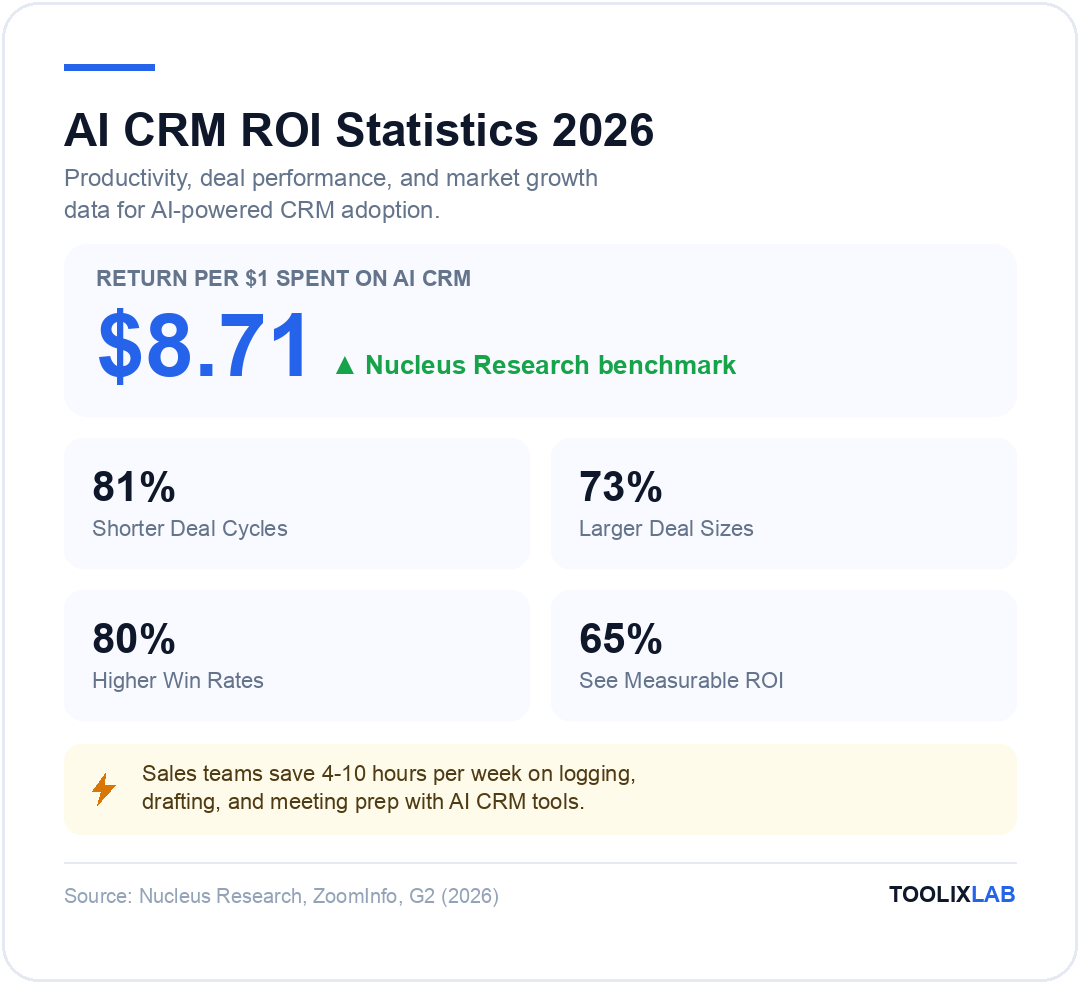
CRM still returns roughly $8.71 for every $1 spent (Nucleus Research), and adding AI on top compounds that. Sales reps using AI-powered CRM tools reclaim 4-10 hours per week on logging, drafting, and meeting prep, and teams report 81% shorter deal cycles, 73% larger deal sizes, and 80% higher win rates (ZoomInfo, via G2's 2026 State of AI in CRM report). The AI-in-CRM market itself is growing from $11.04 billion in 2025 to a projected $48.4 billion by 2033 — but only 65% of businesses have actually turned generative AI on inside their CRM so far.
"AI CRM ROI" gets thrown around as a single number, but it's really three separate questions with three separate answers: what does CRM itself return, what does AI specifically add on top of that baseline, and how much of the gain is time saved versus deals actually won. Most roundups blend all three into one headline stat, which is how you end up with a $8.71-per-dollar figure from 2014 sitting next to a 2026 AI adoption survey as if they measured the same thing.
We pulled the primary research behind every commonly cited AI-CRM statistic — Nucleus Research's original ROI study, G2's 2026 State of AI in CRM report, Outreach's Agent Productivity Impact Report, Salesmate's 2026 CRM benchmark, and McKinsey's generative-AI-in-sales research — and separated what each one actually measured, so the numbers below are attributable and comparable rather than mixed together.
For the tools behind these numbers, see our AI sales coaching tools comparison, and for the broader adoption picture this sits inside, our State of AI Tools 2026 statistics roundup.
AI CRM ROI and Productivity: The Key Numbers
- 📊 $8.71 return per $1 spent — the most-cited CRM ROI benchmark, from Nucleus Research (originally 2014, still the standard reference figure)
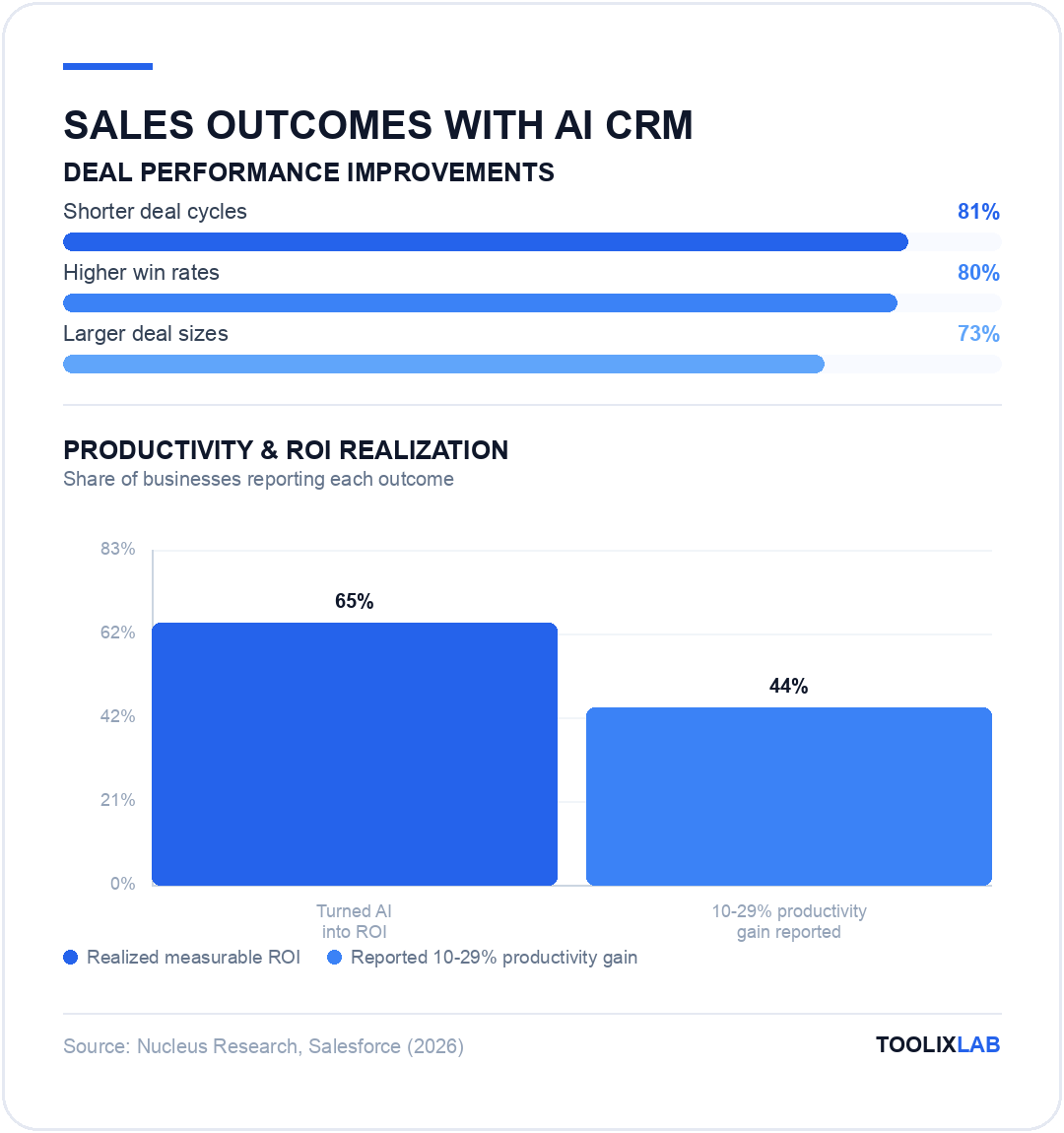
- 📊 44% of businesses report productivity gains of 10-29% after adopting CRM (Salesmate 2026 CRM Report)
- 📊 81% shorter deal cycles, 73% larger deal sizes, and 80% higher win rates reported by teams using AI in their sales process (ZoomInfo, cited in G2's 2026 State of AI in CRM)
- 📊 10 hours per rep per week reclaimed by the typical revenue team using AI tools across the full workflow — more than 60 selling days per rep per year (Outreach 2026 Agent Productivity Impact Report)
- 📊 4-7 hours per week saved by reps using AI-powered tools generally; 15-18 hours for reps running the full AI stack (notes, CRM, scheduling, research, follow-ups)
- 📊 ~6 hours per week recovered specifically from automated CRM logging and note-taking — the single biggest individual time-saving category (Revenue Velocity Lab benchmark, N=938 reps)
- 📊 65% of businesses now run CRM systems with generative AI built in, but only 21% of commercial leaders had adopted genAI across B2B sales as recently as 2024 — adoption roughly tripled in two years
- 📊 83% more likely to exceed sales goals for businesses using CRM with generative AI versus those without it
- 📊 73% of users say AI-powered CRM makes their team more productive overall (HubSpot, via G2)
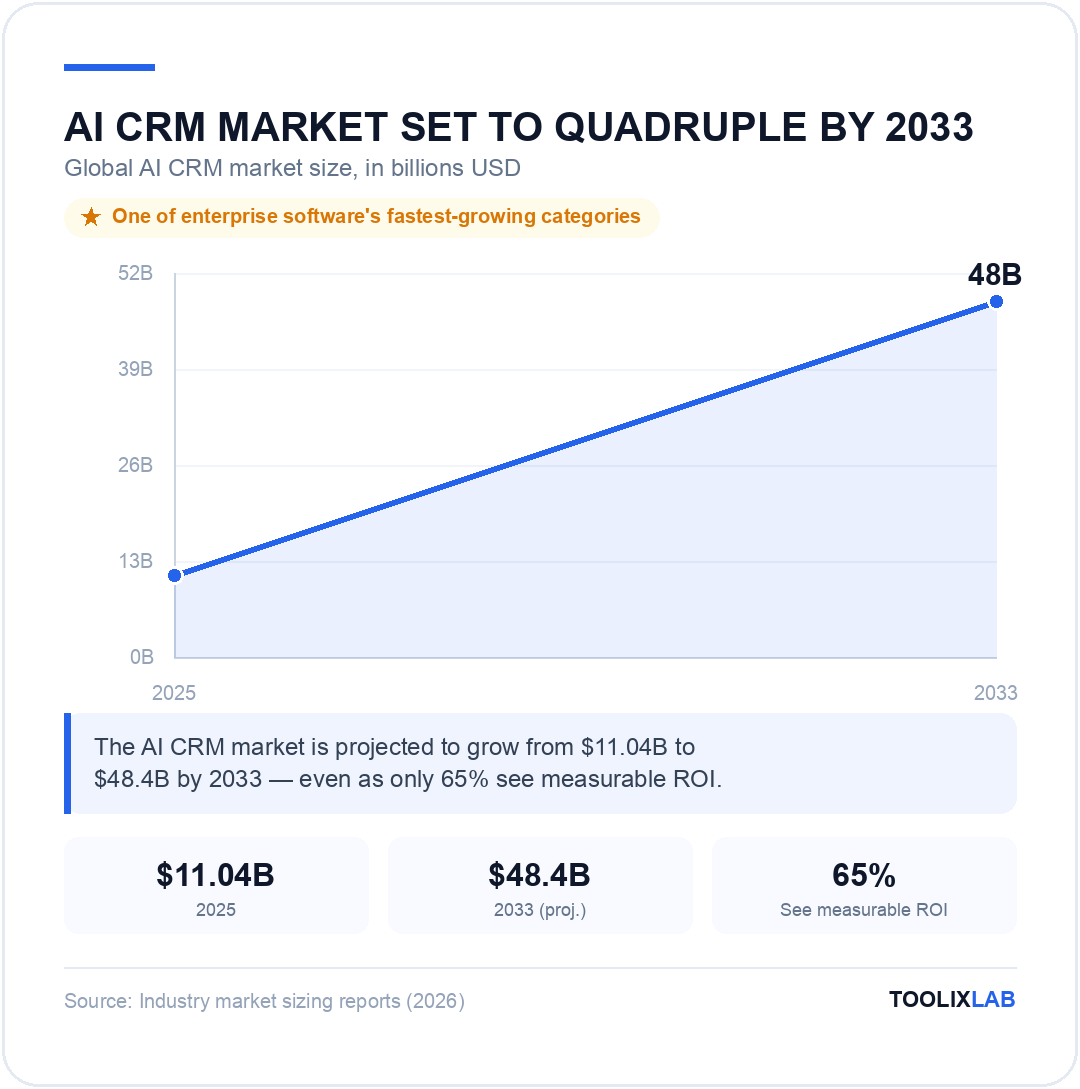
- 📊 $11.04 billion → $48.4 billion — the global AI-in-CRM market, 2025 to a projected 2033, a roughly 36% compound annual growth rate
- 📊 59% of salespeople report being concerned about AI-driven job displacement, and 44% say they're considering a career change because of it (HubSpot)
Feel free to cite any statistic on this page — we ask only for a link back to this article as the source.
Methodology: Where This Data Comes From
This is a curated compilation of primary and vendor-published research, not a survey we ran ourselves. Every figure traces back to one of the following:
- Nucleus Research, "CRM Pays Back $8.71 for Every Dollar Spent" — the original CRM ROI study, first published 2014 and still the industry's standard reference figure. It predates modern AI-CRM features and has not been independently re-run at the same rigor since.
- G2, "The State of AI in CRM: A Sneak Peek Into 2026" (published April 2026) — aggregates and cites adoption, win-rate, and deal-cycle data originally sourced from ZoomInfo and HubSpot surveys.
- Outreach, 2026 Agent Productivity Impact Report — time-savings data aggregated by the Outreach Insights Group from business-intelligence and engagement telemetry across its customer base, plus survey-based time tracking.
- Salesmate, 50+ CRM Statistics for 2026 — Salesmate's own 2026 CRM and sales report, covering productivity, sales-cycle, and forecast data from its customer base.
- McKinsey, "The Economic Potential of Generative AI" (June 2023) and McKinsey's B2B sales research — macro estimates of generative AI's productivity impact on sales functions specifically.
- Market.us, AI in CRM Market Report — third-party market-sizing and forecast data for the AI-in-CRM software category.
Limitations: several vendor-published figures (Salesmate, HubSpot, Outreach) come from each company's own customer base rather than an independent random sample, and none disclose confidence intervals. The $8.71 ROI figure is the most frequently cited number in the industry but is more than a decade old and was not measured against AI-specific CRM features. We've flagged each of these explicitly rather than presenting vendor and independent data as equivalent.
What Is the ROI of AI-Powered CRM in 2026?
The baseline number every CRM vendor still quotes is Nucleus Research's $8.71 return per $1 spent — a figure old enough that it predates generative AI entirely, but still the closest thing the industry has to a standard benchmark, largely because no comparably rigorous independent study has replaced it. On top of that CRM baseline, adding AI specifically compounds the return rather than replacing it: Salesmate's 2026 CRM Report found that 44% of businesses using AI-enhanced CRM features report productivity gains of 10-29%, and 94% of surveyed businesses reported some surge in sales productivity after adoption. Companies running generative AI inside their CRM are 83% more likely to exceed their sales goals than those running CRM without it — the clearest single data point tying the AI layer, specifically, to outcomes rather than just activity.
| Metric | Figure | Source |
|---|---|---|
| Base CRM ROI | $8.71 per $1 | Nucleus Research |
| Productivity gain, AI-CRM users | 10-29% | Salesmate 2026 |
| Businesses reporting productivity surge | 94% | Salesmate 2026 |
| More likely to exceed sales goals (genAI CRM) | 83% | Salesmate 2026 |
| Sales cycle shortened 8-14 days | 34% of teams | Salesmate 2026 |
How Much Time Does AI Actually Save Sales Reps?
Time savings is where the AI-CRM ROI story is most concretely measured, because it's the easiest thing to track directly against activity logs rather than self-reported sentiment. Outreach's 2026 Agent Productivity Impact Report found the typical revenue team reclaims 10 hours per rep per week — more than a full workday, and over 60 days of selling time per rep per year — when AI is applied across the core workflow. That average masks a wide range depending on how much of the stack is actually AI-enabled: reps using AI for a single task like email drafting save 4-7 hours per week, while reps running AI across notes, CRM logging, scheduling, research, enrichment, and follow-ups hit 15-18 hours per week.
Broken down by task, CRM logging and administrative data entry is consistently the single biggest recoverable category — not email or research, which get more attention in vendor marketing. The Revenue Velocity Lab benchmark (N=938 reps), cited by Outreach, found roughly 6 hours per rep per week recovered when note-taking and CRM data entry are fully automated, versus 15-21 minutes per day (7-8 hours per month) in more conservative estimates. Email and message personalization accounts for another 30-45 minutes daily (~17 hours monthly), and AI-assisted meeting preparation cuts prep time by roughly 50%, saving 23-26 minutes per meeting.
- CRM logging / data entry: ~6 hours/week (Revenue Velocity Lab) — the single largest recoverable category
- Email drafting and personalization: 30-45 min/day, ~17 hours/month
- Meeting preparation: 23-26 minutes saved per meeting, roughly a 50% reduction
- Full-stack AI users (notes + CRM + scheduling + research + follow-ups): 15-18 hours/week total
- Team-wide automation average: 12 hours/week saved per team, per Outreach's broader benchmark set
Do AI-Powered CRMs Actually Increase Win Rates and Deal Size?
Time saved only matters commercially if it converts into deals won, and this is the statistic set most roundups skip because it requires outcome data rather than activity data. ZoomInfo's research, cited in G2's 2026 State of AI in CRM report, found teams using AI in their sales process reported 81% shorter deal cycles, 73% larger deal sizes, and 80% higher win rates compared to teams not using it. Those are self-reported comparative figures rather than a controlled study, but they're consistent in direction with Salesmate's independently sourced finding that 34% of CRM users saw their sales cycle shorten by 8-14 days after adoption, and with claims of conversion-rate increases as high as 300% in top-performing implementations — a ceiling figure, not a typical outcome, and one worth treating as best-case rather than average.
McKinsey's macro research puts a dollar figure on the same trend at the industry level: generative AI could increase sales productivity by 3-5% of current global sales expenditures, and combined with marketing, could unlock an incremental $0.8-1.2 trillion in productivity gains — separate from, and additive to, productivity increases already realized from earlier-generation analytics and automation tools.
What Percentage of Sales Teams Use AI in Their CRM in 2026?
Adoption has moved fast but is still short of universal. 65% of businesses now run CRM systems with generative AI features enabled, up sharply from 21% of commercial leaders who had adopted genAI across B2B sales as recently as 2024 — roughly a threefold increase in two years. At the individual level, 45% of sales professionals report using AI tools weekly. 97% of sales teams in the US and Canada consider CRM itself essential to closing deals, which sets the ceiling for how much further AI-CRM adoption realistically has to climb — the software category is already near-universal; it's the AI layer specifically that's still mid-rollout.
85% of commercial leaders say they're excited about deployed generative AI in their sales organization, and 44% report being more likely to choose a CRM specifically because it has AI integrations built in — adoption enthusiasm is running well ahead of full deployment.
How Big Is the AI-in-CRM Market in 2026?
The AI-in-CRM software category itself is growing faster than CRM adoption broadly. Market.us puts the global AI-in-CRM market at $11.04 billion in 2025, projected to reach $15.06 billion in 2026 and $48.4 billion by 2033 — a compound annual growth rate of roughly 36%. That growth rate significantly outpaces overall CRM software market growth, reflecting that the AI layer, not core CRM functionality, is where new spending is concentrated. Salesforce alone holds a 23.9% share of the broader global CRM market — larger than Microsoft, Oracle, SAP, and Adobe's CRM offerings combined — which matters for context: AI-CRM adoption data skews toward what happens inside the market's dominant platforms.
Are There Downsides? The Adoption Numbers Vendors Don't Lead With
Every AI-CRM statistic above comes from a vendor or vendor-adjacent research report, which is worth naming explicitly rather than glossing over. The workforce-sentiment data tells a more complicated story than the ROI numbers alone: 59% of salespeople report concern about AI-driven job displacement, 44% say they're considering a career change specifically because of AI's impact on their role, and 39% report the AI shift has already had a negative personal impact on their day-to-day work (versus 38% reporting no impact either way). None of that contradicts the productivity and ROI data above — time saved and jobs feeling threatened can both be true simultaneously — but it's the part of the AI-CRM story that gets left out of vendor case studies, and it's a legitimate input if you're building an internal adoption or change-management plan rather than just a business case for the software spend.
What This Data Means in Practice
Separate the CRM baseline from the AI-specific lift. The $8.71-per-dollar figure measures CRM broadly, not AI features specifically — don't cite it as an "AI CRM" statistic without that caveat, since it predates the technology by roughly a decade.
Time savings and revenue impact are two different claims — cite the one you actually mean. "Reps save 10 hours a week" (Outreach) and "teams see 80% higher win rates" (ZoomInfo/G2) are both real findings, but they measure different things and come from different studies. A business case built on time savings alone understates the argument if the win-rate data applies too, and vice versa.
CRM logging automation is the highest-leverage single feature, not the flashiest one. At roughly 6 hours per rep per week, automated data entry and note-taking outweighs AI email drafting or research assistance individually — worth prioritizing in a rollout sequence over more visible but lower-impact AI features.
Treat vendor-sourced adoption figures as directionally reliable, not precise. Salesmate, HubSpot, and Outreach numbers come from each company's own customer base, which self-selects for people already invested in the category. The direction (adoption rising fast, ROI positive) is consistent across independent sources; the exact percentages should be read as ranges, not precise industry-wide figures.
Frequently Asked Questions
What is the ROI of AI-powered CRM in 2026?
The baseline CRM ROI benchmark is $8.71 returned per $1 spent (Nucleus Research). On top of that, businesses using generative-AI CRM features are 83% more likely to exceed their sales goals, and 44% report productivity gains of 10-29% specifically attributable to the AI layer (Salesmate 2026).
How much time does AI save sales reps using a CRM?
The typical rep reclaims about 10 hours per week using AI across the core sales workflow (Outreach 2026), with CRM logging and data entry alone accounting for roughly 6 hours of that. Reps using AI for a single task save 4-7 hours weekly; reps running the full AI stack save 15-18 hours weekly.
Do AI-powered CRMs actually increase win rates and deal size?
Teams using AI in their sales process report 81% shorter deal cycles, 73% larger deal sizes, and 80% higher win rates versus teams not using it (ZoomInfo, via G2's 2026 State of AI in CRM report). These are self-reported comparative figures, not a controlled study, but they're directionally consistent with independent CRM-adoption data.
What percentage of sales teams use AI in their CRM in 2026?
65% of businesses now run CRM systems with generative AI enabled, up from 21% of commercial leaders who had adopted genAI across B2B sales as recently as 2024 — roughly tripling in two years. 45% of individual sales professionals report using AI weekly.
How big is the AI-in-CRM market in 2026?
The global AI-in-CRM software market is projected at $15.06 billion in 2026, up from $11.04 billion in 2025, and is expected to reach $48.4 billion by 2033 — a roughly 36% compound annual growth rate (Market.us).
Which CRM tasks does AI automate most effectively?
CRM logging and data entry deliver the largest measured time savings — roughly 6 hours per rep per week when fully automated — ahead of email drafting (~17 hours/month) and meeting preparation (23-26 minutes per meeting, about a 50% reduction).
Are there downsides to AI CRM adoption?
Yes — the productivity data coexists with real workforce concern. 59% of salespeople report worry about AI-driven job displacement, and 44% say they're considering a career change because of it (HubSpot). Time savings and job-security anxiety are both accurate findings, not contradictory ones.
Can I cite these statistics?
Yes. These are third-party primary and vendor-published statistics compiled and sourced by ToolixLab — cite the original source (Nucleus Research, G2, Outreach, Salesmate, McKinsey, or Market.us) where possible, and feel free to link to this page as your source for the compilation.
🔑 Key Takeaways
- ✓CRM's baseline ROI is $8.71 per $1 spent (Nucleus Research); AI-specific features add 10-29% productivity on top, and 83% higher odds of exceeding sales goals (Salesmate 2026)
- ✓Reps reclaim roughly 10 hours per week using AI across the core workflow, with CRM logging automation alone accounting for ~6 hours — the single highest-leverage feature
- ✓Teams using AI report 81% shorter deal cycles, 73% larger deals, and 80% higher win rates versus teams that don't (ZoomInfo/G2 2026)
- ✓AI-CRM adoption roughly tripled in two years — 21% of commercial leaders in 2024 to 65% of businesses running genAI-enabled CRM in 2026
- ✓The AI-in-CRM market is growing at a ~36% CAGR, from $11.04B (2025) toward a projected $48.4B (2033) — far outpacing core CRM software growth
- ✓Productivity gains coexist with real workforce anxiety: 59% of salespeople worry about displacement even as the same tools save them hours each week
Related Guides
- AI Sales Coaching Tools 2026: Best Platforms Compared — the tools behind the productivity numbers in this report.
- Free AI Workflow Templates for Small Business — ready-to-use automations for the CRM and follow-up tasks covered above.
- AI Financial Reporting Workflow — how the same AI-productivity gains apply on the finance side of the business.
- AI's Impact on SEO Rankings: 50+ Statistics for 2026 — another primary-source statistics compilation on how AI is reshaping a specific business function.
- State of AI Tools 2026: 50+ Key Statistics — the broader adoption picture this CRM data sits inside.
- How to Use Claude AI for Business — applying the same AI-productivity principles beyond CRM specifically.