
By ToolixLab Research Team · Last updated: July 2026
Quick Answer
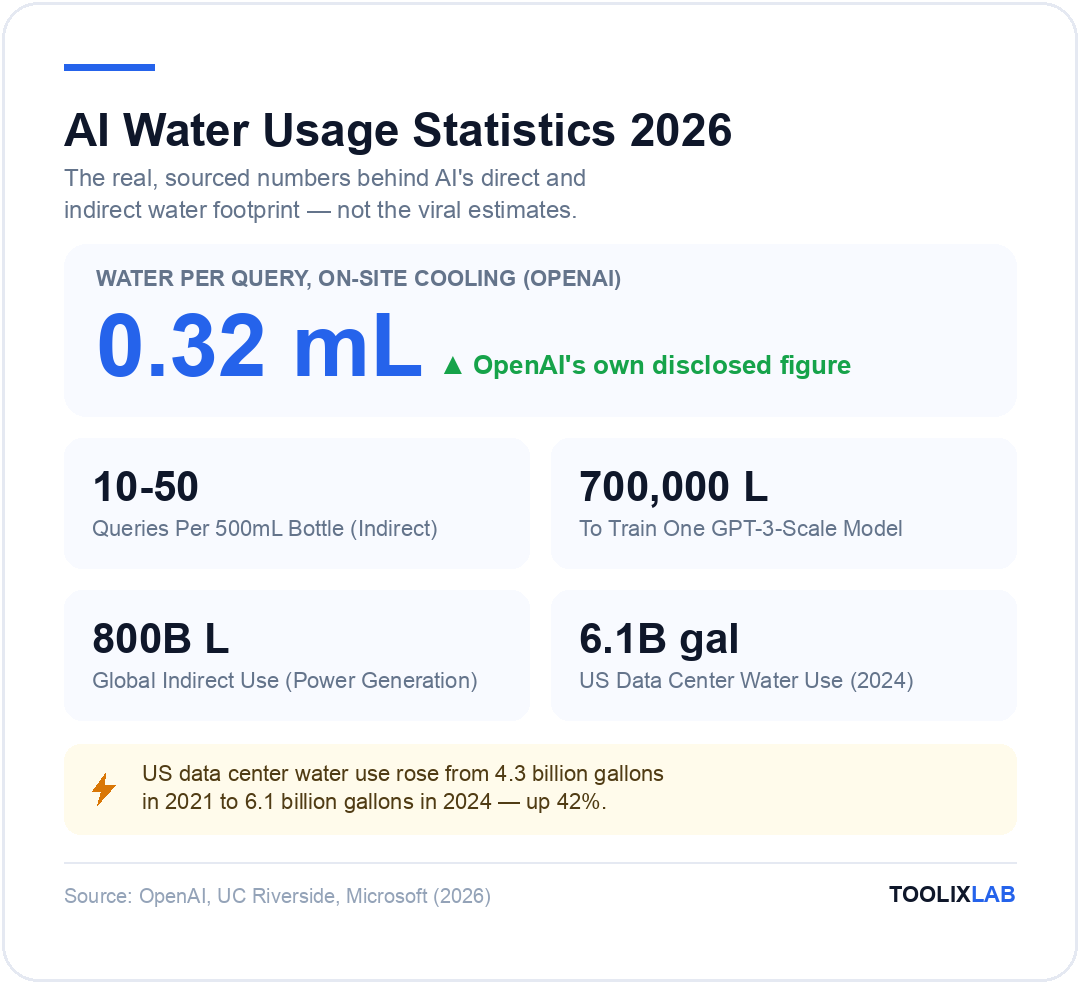
AI water usage statistics vary by roughly 6,000× depending on what's actually being measured. OpenAI's own disclosed figure puts a single ChatGPT query at 0.000085 gallons (about 0.32 mL) of on-site cooling water. UC Riverside researchers, accounting for the water used to generate the electricity an AI model consumes, estimate 10–50 medium-length replies "drink" about 500 mL — a full bottle. Training GPT-3-scale models directly consumed roughly 700,000 liters of freshwater in Microsoft's U.S. data centers. At the industry level, U.S. data centers' electricity use alone required an estimated 800 billion liters of water consumed indirectly through power generation in 2023, and Google's own reporting shows data center water consumption rising from 4.3 billion gallons (2021) to 6.1 billion gallons (2024).
Every "AI uses X water" headline is really answering one of three very different questions: how much water cools the servers on-site, how much water was used to generate the electricity those servers drew from the grid, or how much water a full model's training run consumed once. Conflating these — which most viral statistics do — is why you'll see numbers for "one ChatGPT query" that range from a fraction of a milliliter to half a liter.
We pulled together the primary sources behind every commonly cited AI water statistic — the original UC Riverside academic paper, OpenAI's own disclosed figures, Google and Microsoft's corporate sustainability reports, and the Department of Energy's Lawrence Berkeley National Laboratory data center report to Congress — so you can see exactly what each number measures and why they disagree.
For the broader environmental and adoption picture, see our State of AI Tools 2026 statistics roundup, and for how AI's infrastructure costs compare across categories, our AI tool pricing statistics piece covers the dollar side of the same buildout.
AI Water Usage: The Key Numbers
- 📊 0.000085 gallons (~0.32 mL) — OpenAI's own disclosed on-site cooling water per average ChatGPT query, plus 0.34 watt-hours of electricity (June 2025)
- 📊 10–50 queries per 500 mL bottle — UC Riverside's academic estimate when indirect grid-electricity water is included, roughly 10–50× higher than OpenAI's on-site-only figure
- 📊 ~700,000 liters of freshwater consumed directly on-site training a GPT-3-scale model in Microsoft's U.S. data centers; roughly 3× higher in less water-efficient regions
- 📊 800 billion liters — water consumed indirectly through U.S. data center electricity generation in 2023 alone (Lawrence Berkeley National Laboratory / DOE)
- 📊 176 TWh — total U.S. data center electricity use in 2023 (4.4% of all U.S. electricity), the figure behind that indirect water number
- 📊 Up to 85% of the water data centers use directly for cooling evaporates and does not return to the local water supply
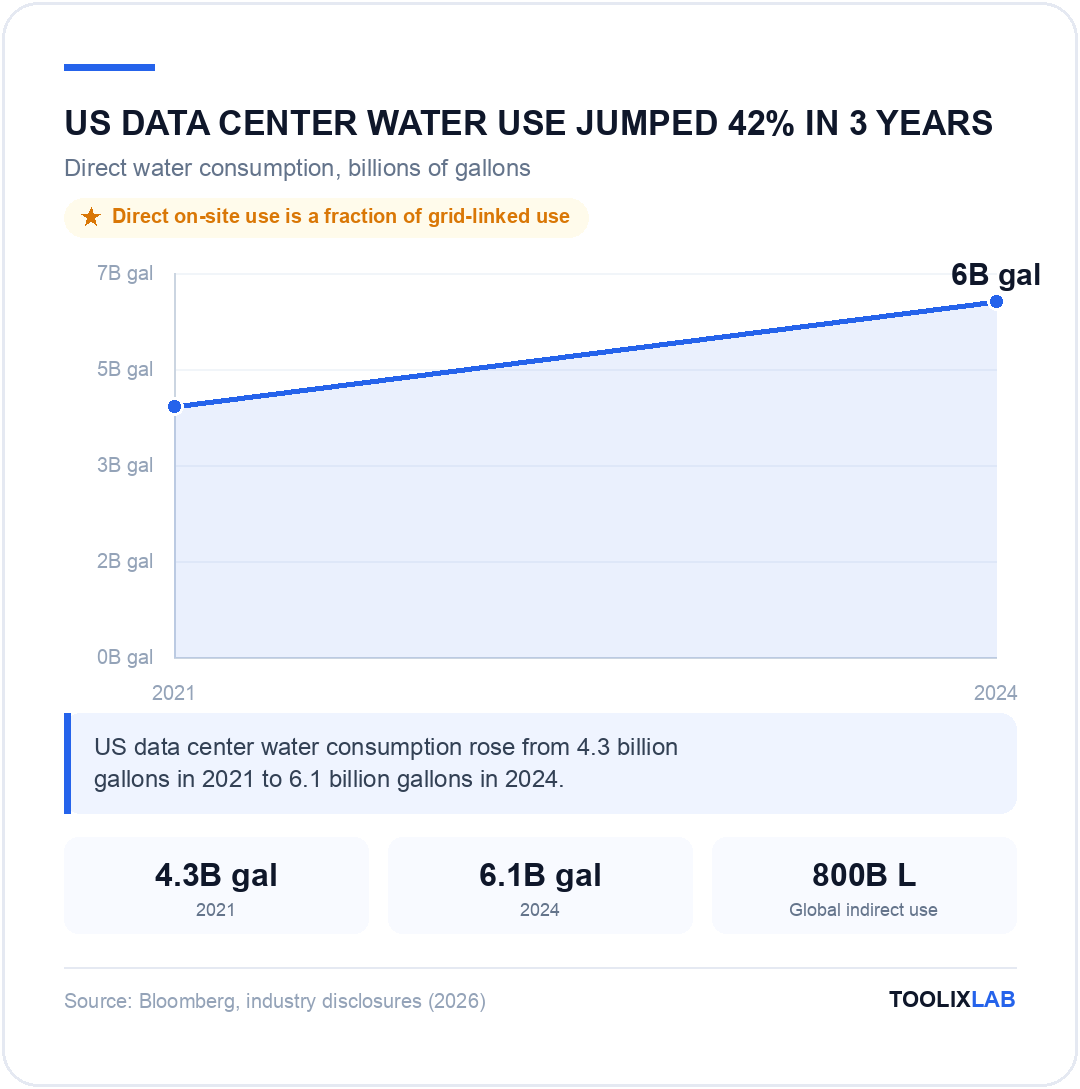
- 📊 6.1 billion gallons — Google's data center water consumption in 2024, up from 4.3 billion gallons in 2021
- 📊 64% — the share of its 2024 freshwater consumption Google says it replenished through water-stewardship projects (target: 120% by 2030)
- 📊 17.4 billion gallons — direct U.S. data center water consumption in 2023, projected to reach 38–73 billion gallons by 2028
- 📊 49 billion → up to 399 billion gallons — projected water use by Texas data centers, 2025 to 2030 (HARC / University of Houston)
Feel free to cite any statistic on this page — we ask only for a link back to this article as the source.
Methodology: Where This Data Comes From
This is a curated compilation of primary-source research and corporate/federal disclosures, not a survey we ran ourselves. Every figure traces back to one of the following:
- "Making AI Less Thirsty" (Li, Yang, Islam & Ren, UC Riverside, first posted April 2023, later published in Communications of the ACM) — the original peer-reviewed estimate of AI models' water footprint, covering both on-site cooling and indirect power-plant water use.
- OpenAI / Sam Altman — the company's first disclosed per-query water and energy figures, published June 2025. Not independently peer-reviewed, and OpenAI has not published the full methodology or confirmed whether the figure includes indirect grid water.
- Google's 2025 Environmental Report — the company's own disclosed data center and total water consumption figures for 2021–2024.
- Microsoft's 2025 Sustainability Report and related corporate disclosures — water use effectiveness (WUE) metrics and the company's most recent full water-consumption disclosure (2022).
- Lawrence Berkeley National Laboratory's 2024 United States Data Center Energy Usage Report, prepared for the U.S. Department of Energy under a Congressional mandate (Energy Act of 2020), published December 2024.
- Houston Advanced Research Center (HARC) and University of Houston regional water-stress projections for Texas data centers.
Limitations: corporate water disclosures are self-reported and inconsistent in scope — Microsoft, for instance, has not published a full-fleet total-gallons figure since 2022, reporting efficiency ratios (WUE) instead. Where a company reports only an efficiency metric rather than an absolute figure, we've noted that explicitly rather than estimating a total on their behalf.
Finding #1: Why "Water Per AI Query" Estimates Vary by 6,000×
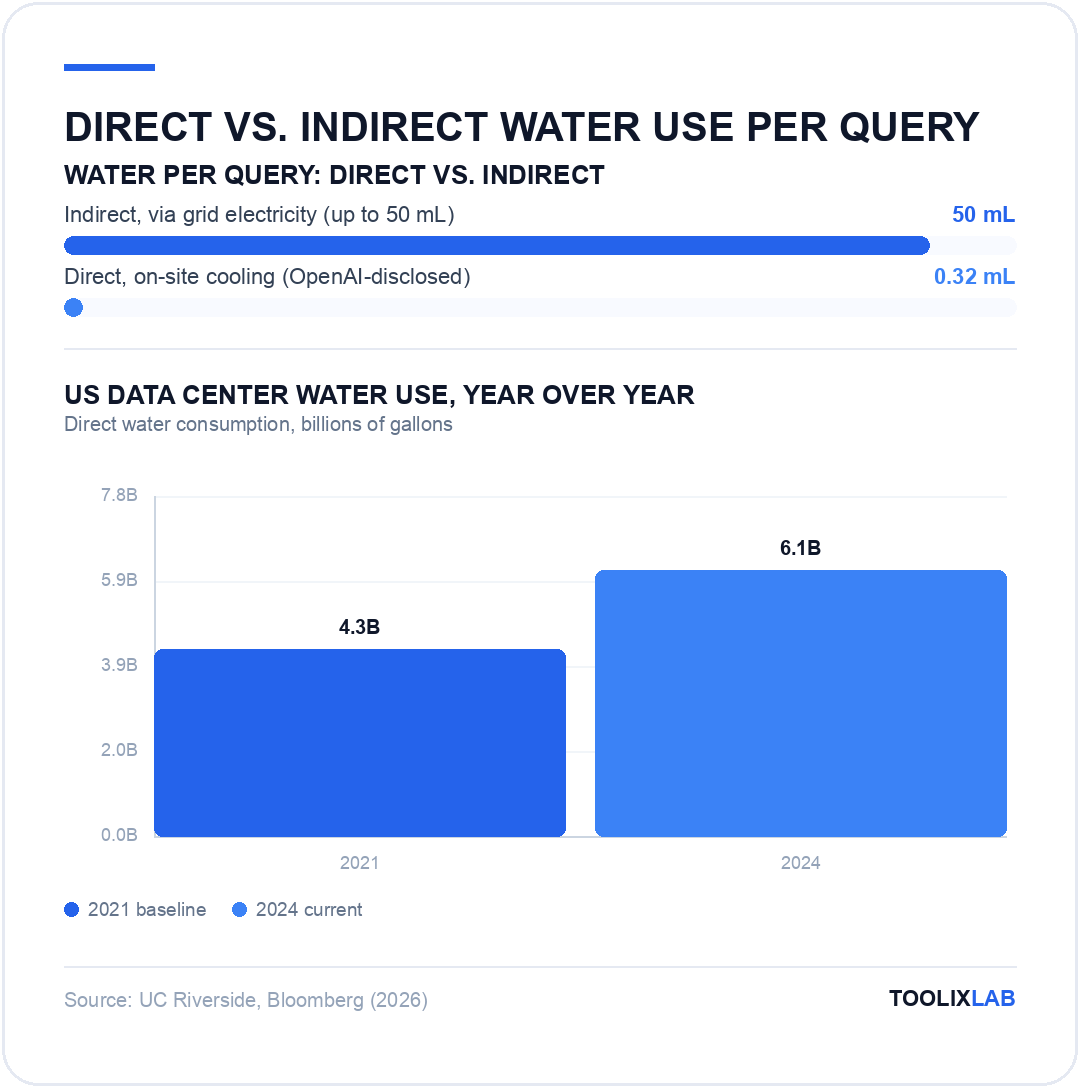
The most-cited AI water statistics disagree wildly because they're measuring different things. There are two distinct water flows involved in running an AI query, and headlines routinely cite one while implying the other:
| Water flow | What it is | Who discloses it |
|---|---|---|
| Direct / on-site | Water evaporated in the data center's own cooling towers to keep servers from overheating | OpenAI's 0.000085-gallon figure covers only this |
| Indirect / grid | Water consumed at the power plants generating the electricity the data center draws from the grid | UC Riverside's 500 mL-per-10–50-queries figure includes both |
Thermoelectric power generation — including natural gas and nuclear, which supply much of the U.S. grid — is itself water-intensive, mostly for cooling turbines. That means a data center with excellent on-site water efficiency can still have a large total water footprint if it draws power from a water-intensive regional grid. This is exactly why Lawrence Berkeley National Laboratory's federal report treats the two as separate line items: 176 TWh of U.S. data center electricity use in 2023 required an estimated 800 billion liters of water consumed indirectly through generation — a number roughly 47× larger than what most on-site-only corporate disclosures report.
The practical takeaway: when you see a per-query water figure, check whether it's a direct-only number (small, often company-disclosed) or a direct-plus-indirect number (much larger, usually from independent academic estimates). Neither is "wrong" — they're answering different questions, and the honest comprehensive figure for a single conversational query on modern infrastructure most likely sits somewhere in the low single-digit milliliters once both are combined.
Finding #2: Training a Frontier Model Is a One-Time Water Cost in the Hundreds of Thousands of Liters
Separate from the ongoing cost of answering queries, training a large model is itself a substantial one-time water draw. The UC Riverside team's original analysis estimated that training GPT-3 in Microsoft's state-of-the-art U.S. data centers directly consumed roughly 700,000 liters of clean freshwater on-site — and that the same training run in a less water-efficient Asian data center would have used roughly 3× more, illustrating how much regional infrastructure and climate affect the footprint of the exact same workload.
The researchers explicitly flagged their per-query estimate as conservative, noting real-world figures could run several times higher depending on server utilization, cooling technology, and local climate at the time of the query. Frontier models have grown substantially larger since GPT-3, and while modern hardware and cooling are meaningfully more efficient per unit of compute, total training-run water consumption for today's largest models is understood to be higher in absolute terms — companies have not published updated per-model training figures with the same academic rigor as the original 2023 study.
Finding #3: What the Big Cloud Providers Actually Report
Google is the most transparent of the major hyperscalers on absolute water figures, publishing year-over-year totals in its annual Environmental Report:
- Google's data center water consumption rose from 4.3 billion gallons in 2021 to 6.1 billion gallons in 2024
- Total company water consumption (including offices) reached roughly 8.1 billion gallons in 2024, a 28% jump from 2023 — driven substantially by AI-workload growth
- Google says it replenished 64% of its freshwater consumption in 2024 (about 4.5 billion gallons) through water-stewardship projects, with a stated goal of replenishing 120% by 2030
- 72% of Google's freshwater withdrawals came from sources the company classifies as low risk of depletion or scarcity
Microsoft has taken a different disclosure approach — reporting efficiency ratios rather than absolute totals in its most recent sustainability report:
- Microsoft's fleet-wide water use effectiveness (WUE) improved to 0.30 L/kWh in FY2025, a 39% improvement over 2021
- 90% of its 2025 data center fleet now uses low-water or zero-water cooling systems; the remaining 10% are legacy facilities still using cooling towers
- Microsoft says it reached a "water positive" milestone in FY2025 — replenishing more water than it withdrew across its operations for the year
- The last time Microsoft disclosed a full absolute-gallons figure was 2022, at 1.69 billion gallons — it has not published an updated total-consumption number since, making direct year-over-year comparison to Google's disclosures impossible
The disclosure gap matters for anyone trying to size the industry's real footprint: efficiency is improving at both companies, but efficiency ratios alone don't tell you whether total consumption is rising or falling as data center footprints scale up for AI workloads specifically — which is exactly what an absolute figure would show.
Finding #4: The Real Risk Isn't the Global Total — It's Regional Concentration
Global and national aggregate figures understate the practical problem, because AI data centers cluster heavily in specific regions — often ones already under water stress. Texas is the starkest documented case: a joint study by the Houston Advanced Research Center (HARC) and the University of Houston found data centers in Texas used an estimated 49 billion gallons of water in 2025, a figure projected to reach as much as 399 billion gallons by 2030 — an 8× increase in five years, concentrated in a state that already faces recurring drought and grid strain. Texas is an especially instructive case study because it combines three risk factors simultaneously: an independent power grid with limited interconnection to neighboring states, some of the most aggressive data center tax incentives in the country, and a water supply already stretched by agricultural and municipal demand — meaning the same site-selection factors that make Texas attractive for hyperscale AI buildout are the ones that make its water and grid capacity most exposed to that buildout.
At the national level, direct U.S. data center water consumption was 17.4 billion gallons in 2023, with projections putting annual direct consumption at 38–73 billion gallons by 2028 — a near-tripling to near-quadrupling in five years, driven overwhelmingly by AI-specific buildout rather than traditional enterprise computing, which has plateaued.
Finding #5: The Industry Is Racing to Decouple AI Growth From Water Growth
Every major cloud provider is now investing heavily in cooling technology specifically to break the link between more AI compute and more water consumption:
- Microsoft's zero-water-evaporation cooling technology, launched for new data centers, is designed to avoid more than 125 million liters of evaporated water per data center per year compared to traditional evaporative cooling
- Liquid and direct-to-chip cooling — increasingly standard for AI-specific GPU clusters — uses substantially less water per unit of heat removed than traditional evaporative cooling towers, though it typically increases electricity demand for pumping and heat exchange
- Both Google and Microsoft have set public "water positive" commitments for 2030 (replenishing more freshwater than they consume), though neither company's current trajectory has closed that gap yet on an absolute-consumption basis
The honest 2026 picture is a genuine race: per-unit-of-compute water efficiency is improving meaningfully year over year at every major provider, but total AI compute deployed is growing faster than efficiency gains are shrinking the per-unit footprint — which is why absolute consumption figures (Google's 6.1B gallons, Texas's 49B gallons) keep rising even as efficiency ratios (Microsoft's 0.30 L/kWh) keep falling. Both trends are real and not contradictory.
What This Data Means in Practice
Don't cite a single "water per query" number without its scope. If you're writing about AI's water footprint, specify whether your figure is direct-only (OpenAI's ~0.32 mL) or direct-plus-indirect (UC Riverside's higher estimate). The two numbers differ by roughly an order of magnitude and answer genuinely different questions.
Absolute consumption and efficiency ratios can both be true at once. A company can legitimately improve its water-per-kilowatt-hour ratio every year while its total water consumption still rises, simply because it's running far more compute. Don't let an efficiency-improvement headline imply falling total consumption unless the absolute figure is stated explicitly.
Regional water stress is the more urgent practical risk than the global total. The Texas projections (49B → up to 399B gallons by 2030) matter more for local water policy than the global aggregate, because data center siting decisions concentrate demand in specific watersheds and grids, often ones already stretched.
Corporate disclosure gaps are themselves a data point. Microsoft's shift from absolute-gallons reporting (last published 2022) to efficiency-ratio-only reporting makes independent verification of its total water trend impossible — worth noting explicitly if you're comparing providers rather than assuming the gap is neutral.
Frequently Asked Questions
How much water does one ChatGPT query actually use?
OpenAI's own disclosed figure (June 2025) is 0.000085 gallons, or about 0.32 mL, covering on-site cooling water only. Academic estimates from UC Riverside that also include the water used to generate the query's electricity put the comprehensive figure roughly 10–50× higher — around 10–25 mL per query.
How much water did it take to train GPT-3?
UC Riverside researchers estimated training GPT-3 in Microsoft's U.S. data centers directly consumed roughly 700,000 liters of freshwater on-site — and that the same training run in a less water-efficient region could have used roughly 3× more.
How much water do U.S. data centers use in total?
Direct water consumption was 17.4 billion gallons in 2023, projected to reach 38–73 billion gallons by 2028. Including indirect water from electricity generation, Lawrence Berkeley National Laboratory estimates an additional 800 billion liters were consumed in 2023 alone.
Which tech company discloses the most water data?
Google publishes the most complete absolute figures, reporting data center water consumption rose from 4.3 billion gallons (2021) to 6.1 billion gallons (2024) in its annual Environmental Report. Microsoft has not published a full-fleet absolute total since 2022 (1.69 billion gallons), reporting efficiency ratios instead in more recent reports.
Is AI's water usage a bigger problem in some regions than others?
Yes, significantly. Texas data centers alone used an estimated 49 billion gallons in 2025, projected to reach as much as 399 billion gallons by 2030 (HARC/University of Houston) — an 8× increase concentrated in a state already prone to drought, illustrating that regional water stress is a bigger near-term risk than the global aggregate figure.
Can I cite these statistics?
Yes. These are third-party primary-source and corporate-disclosure statistics compiled and sourced by ToolixLab — cite the original source (UC Riverside/arXiv, OpenAI, Google, Microsoft, or Lawrence Berkeley National Laboratory) where possible, and feel free to link to this page as your source for the compilation.
🔑 Key Takeaways
- ✓"Water per AI query" figures vary by roughly 6,000× depending on whether they include only on-site cooling (OpenAI: 0.32 mL) or also indirect grid electricity water (UC Riverside: 10–25 mL)
- ✓Training a GPT-3-scale model consumed roughly 700,000 liters of freshwater directly on-site — a one-time cost separate from ongoing query water use
- ✓U.S. data center electricity generation alone required an estimated 800 billion liters of indirect water consumption in 2023 — often larger than the direct figures most headlines cite
- ✓Efficiency ratios are improving industry-wide even as absolute consumption keeps rising — both trends are real and coexist because total AI compute is growing faster than per-unit efficiency gains
- ✓Regional concentration (Texas: 49B → up to 399B gallons by 2030) is the more urgent practical risk than the global aggregate figure
Related Guides
- AI's Impact on SEO Rankings: 50+ Statistics for 2026 — another primary-source statistics compilation on how AI is reshaping a specific industry.
- AI Medical Diagnosis Accuracy Statistics 2026 — where AI already matches specialists, and where it still falls short.
- State of AI Tools 2026: 50+ Key Statistics — the broader adoption picture this infrastructure data sits inside.
- AI Tool Pricing Statistics 2026 — original data on what AI tools across categories actually cost.