
Quick Answer
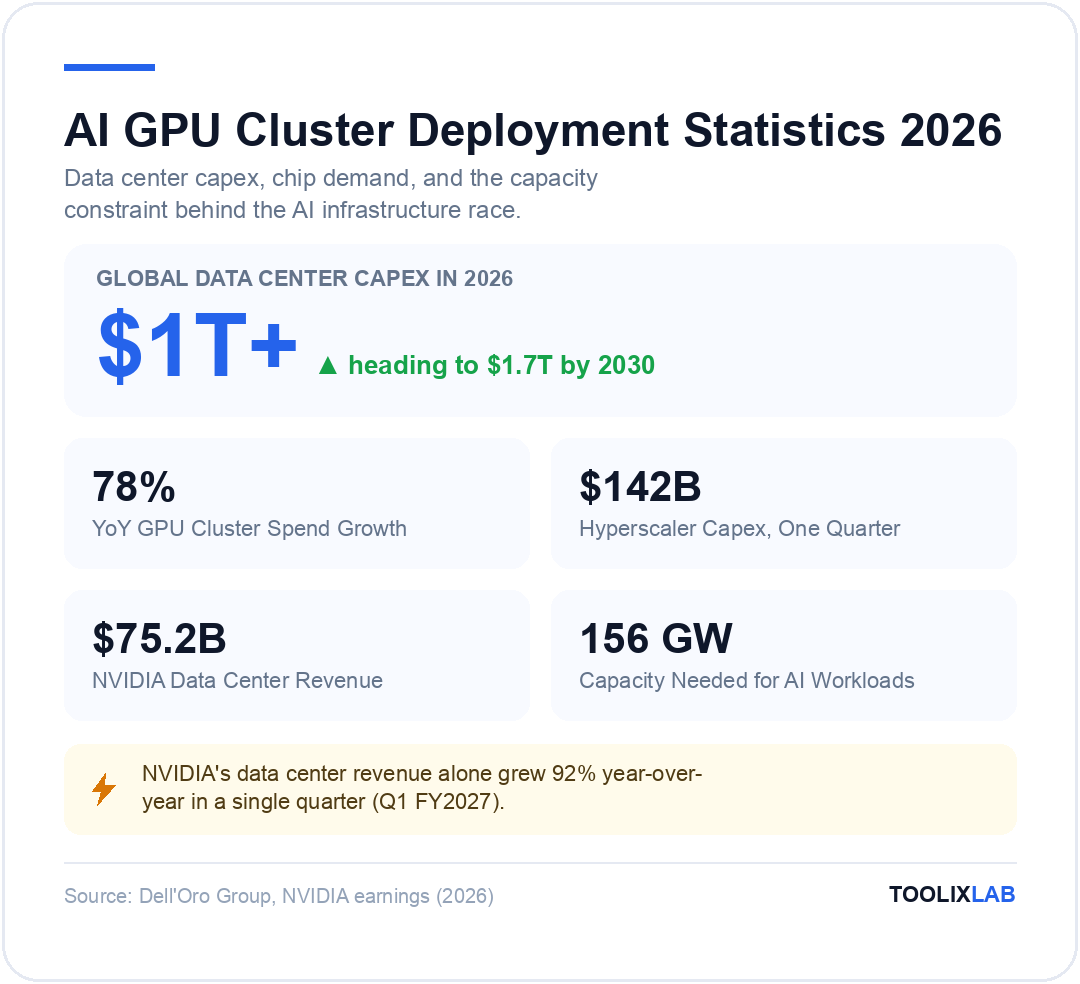
Global data center capex is on pace to top $1 trillion in 2026, according to Dell'Oro Group, and NVIDIA's Data Center segment alone reported $75.2 billion in quarterly revenue in Q1 FY2027 — up 92% year-over-year. The bottleneck has shifted from chip supply to power and cooling: a single NVIDIA GB200 NVL72 rack draws 120–140 kW, and McKinsey estimates the world needs 156 gigawatts of AI-ready data center capacity by 2030, requiring roughly $5.2 trillion in cumulative investment.
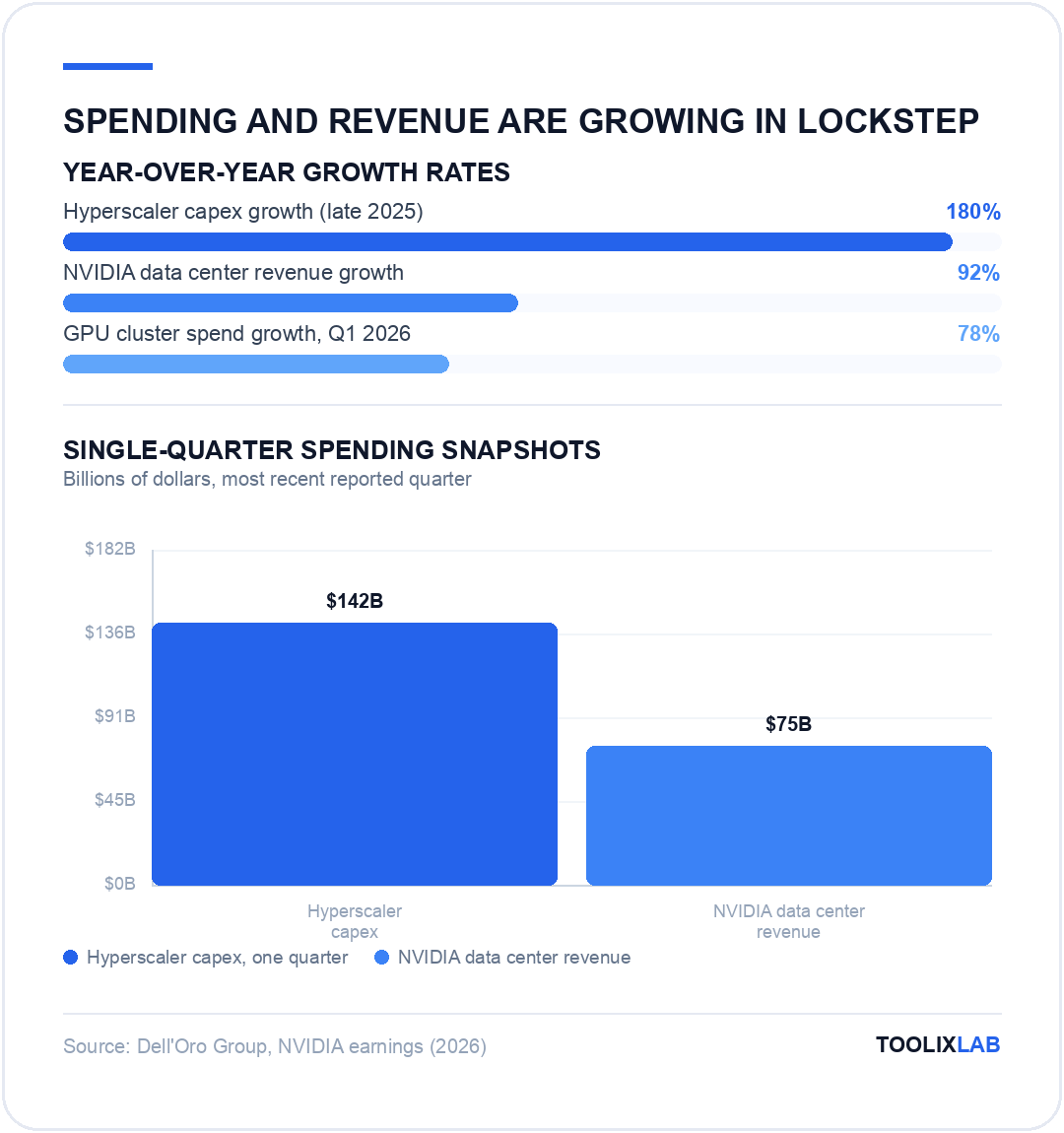
AI GPU cluster deployment moved from a supply-chain story to a power-grid story in 2026. The numbers back that up: the four largest US cloud providers raised combined data center capex 78% year-over-year in Q1 2026, hyperscale operator capex hit $142 billion in a single quarter in late 2025 — up nearly 180% year-over-year — and NVIDIA's Blackwell rack-scale systems remain, in the company's own words, "sold out." At the same time, AI-focused data center electricity consumption is growing faster than the 17% overall data center growth rate the IEA recorded in 2025, and rack power density has climbed 3–5x since 2022. This piece pulls together the sourced numbers on spend, shipments, power, and cooling — attributed to primary reports, not aggregator estimates — so you can see exactly where the AI infrastructure buildout stands in 2026.
⚡ Quick Summary
Spending: Global data center capex will exceed $1 trillion in 2026 (Dell'Oro Group), up from roughly $650 billion in 2025.
Chip demand: NVIDIA Data Center revenue hit $75.2B in Q1 FY2027, up 92% YoY, and GPUs still account for 69.7% of AI server shipments in 2026 (TrendForce).
The real constraint: AI workloads need an estimated 156 GW of data center capacity by 2030 (McKinsey) — power and cooling, not GPU supply, are now the binding limit on new cluster deployment.
Jump to: Capex Growth | NVIDIA & GPU Shipments | Power & Cooling | 2030 Outlook
Key Stats at a Glance
🔑 40+ AI GPU Cluster Deployment Statistics
- 📊 Global data center capex forecast to exceed $1 trillion in 2026, projected to reach $1.7 trillion by 2030 (Dell'Oro Group)
- 📊 Top 4 US cloud providers raised data center capex 78% year-over-year in Q1 2026 (Dell'Oro Group)
- 📊 NVIDIA Data Center revenue: $75.2 billion in Q1 FY2027, up 92% YoY and 21% sequentially
- 📊 Hyperscale operator capex hit $142 billion in a single quarter (Q3 2025), up almost 180% YoY (Synergy Research Group)
- 📊 Combined hyperscaler capex (Microsoft, Amazon, Google, Meta) projected at roughly $725 billion in 2026, up ~77% from 2025
- 📊 A single NVIDIA GB200 NVL72 rack draws 120–140 kW — 3–5x the power density of a 2022-era server rack
- 📊 AI-focused data center electricity consumption grew faster than the overall 17% data center demand increase recorded in 2025 (IEA)
- 📊 Total data center electricity consumption projected to nearly double from 485 TWh (2025) to 950 TWh (2030), with AI-specific consumption tripling (IEA)
- 📊 AI workloads will require an estimated 156 gigawatts of data center capacity by 2030 — about 70% of total global demand (McKinsey)
- 📊 Meeting AI data center demand through 2030 requires an estimated $5.2 trillion in cumulative capital investment (McKinsey)
- 📊 Global AI server shipments forecast to grow more than 28% year-over-year in 2026 (TrendForce)
- 📊 GPU-based systems still account for 69.7% of AI server shipments in 2026; ASIC-based systems climb to 27.8% (TrendForce)
- 📊 Roughly 22% of data center operators had adopted direct liquid cooling as of 2024, concentrated almost entirely in AI training deployments (Uptime Institute)
📚 Sources & Methodology
Every statistic below is attributed to its original report. We prioritized official financial disclosures, research-firm market trackers, and primary energy-agency data over aggregator blog posts:
- NVIDIA — Official Q1 FY2027 financial results press release (quarter ended April 2026), Data Center segment revenue and growth figures.
- Dell'Oro Group — Data Center IT Capex market tracker, 1Q 2026 report and full-year 2026/2030 forecasts.
- Synergy Research Group — Hyperscale Market Tracker, quarterly capex data across 21 hyperscale operators including AWS, Azure, and Google Cloud.
- International Energy Agency (IEA) — Energy and AI research program, global data center electricity demand data and 2030 projections.
- McKinsey — "The cost of compute" data center capacity and capital investment research, gigawatt demand modeling through 2030.
- TrendForce — Global AI Server Market and Supply Chain Trends report, 2026 shipment and GPU/ASIC market-share forecasts.
- Uptime Institute — Global Data Center Survey and cooling-system adoption research.
Finding #1: Data Center Capex Is on Pace to Top $1 Trillion in 2026
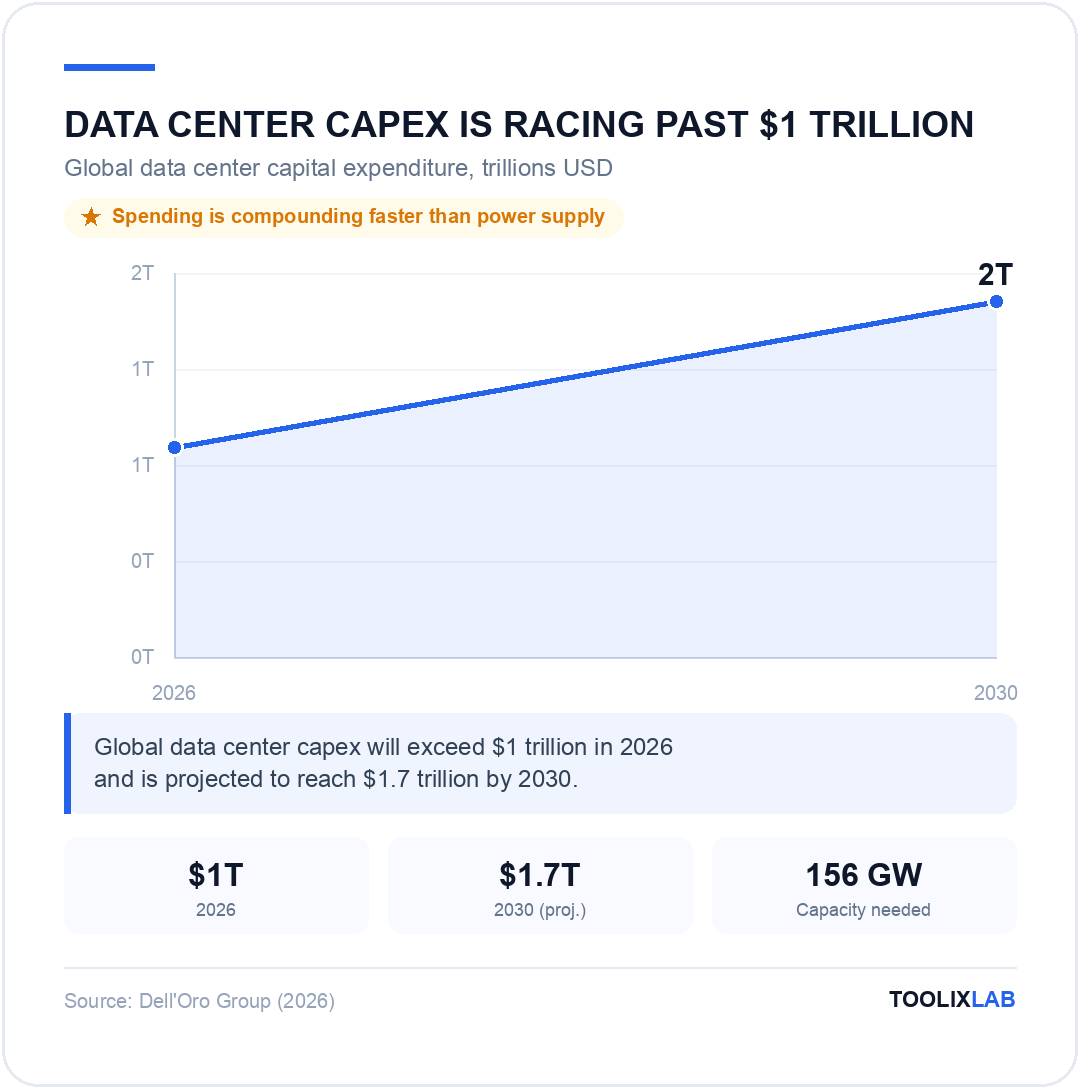
The clearest single number in the 2026 AI infrastructure story is capital expenditure. Dell'Oro Group now forecasts global data center capex will exceed $1 trillion in 2026 — a milestone the firm previously expected further out — and projects the multi-year AI buildout will push that figure to $1.7 trillion by 2030. The top four US cloud providers (Amazon, Google, Meta, and Microsoft) increased data center capex a combined 78% year-over-year in Q1 2026 alone, driven by AI infrastructure buildouts and, notably, memory and storage price inflation stacking on top of already-elevated GPU costs.
That acceleration shows up independently in Synergy Research Group's hyperscale tracker, which follows 21 global operators including AWS, Azure, and Google Cloud: quarterly hyperscale capex hit $142 billion in Q3 2025 — up almost 180% year-over-year — with trailing four-quarter capex crossing $150 billion for the first time. Separately, combined 2026 capex guidance across Microsoft, Amazon, Google, and Meta points to roughly $725 billion for the year, up about 77% from 2025's roughly $410 billion, according to public earnings disclosures compiled across all four companies' investor materials.
Why the growth rate matters more than the raw dollar figure: these aren't discretionary marketing budgets. Executives on multiple 2026 earnings calls described their capex commitments as binding GPU purchase agreements and data-center construction timelines already underway — not aspirational targets that can be pulled back quickly if demand softens. That's part of why the same infrastructure math shows up across enterprise AI adoption research: enterprise AI adoption and hyperscaler infrastructure spend are now two sides of the same growth curve.
Finding #2: NVIDIA's Data Center Business Nearly Doubled Year-Over-Year
NVIDIA's own financial disclosures are the cleanest proxy for actual GPU cluster demand, since the company sits at the center of nearly every hyperscale deployment. Per NVIDIA's official Q1 FY2027 results (the quarter ended late April 2026), Data Center revenue reached a record $75.2 billion — up 92% year-over-year and 21% sequentially. Within that total, Data Center Compute revenue was $60.4 billion (+77% YoY) and Data Center Networking revenue — InfiniBand, Spectrum-X Ethernet, and NVLink interconnects that stitch individual GPUs into a single cluster — was $14.8 billion, up a sharper 199% YoY, reflecting how much of 2026 deployment growth is about connecting GPUs at rack and cluster scale rather than just adding individual chips.
The prior quarter (Q3 FY2026) told the same story: Data Center revenue of $51.2 billion, up 66% year-over-year, with the newer Blackwell GB300 already accounting for roughly two-thirds of Blackwell-family revenue — evidence of how fast the product cycle turns over inside a single fiscal year. NVIDIA has stated that its Grace Blackwell rack-scale systems have been "sold out" for multiple consecutive quarters, and roughly half of Data Center revenue now comes from customers outside the largest hyperscalers — AI clouds, sovereign AI programs, and enterprise buyers — a broadening of the customer base beyond the handful of companies that dominated cluster deployment in 2023–2024.
- ✓ $75.2B NVIDIA Data Center revenue, Q1 FY2027 (record, +92% YoY)
- ✓ $60.4B Data Center Compute revenue (+77% YoY)
- ✓ $14.8B Data Center Networking revenue (+199% YoY) — the interconnect layer that turns individual GPUs into a cluster
- ✓ ~50% of Data Center revenue now comes from customers outside the largest hyperscalers
- ✓ Grace Blackwell rack-scale systems described as "sold out" across multiple consecutive quarters
Finding #3: Power Density Has Become the Real Deployment Bottleneck
GPU supply was the binding constraint on cluster deployment through 2024. By 2026, the constraint has shifted to power and physical infrastructure. A single NVIDIA GB200 NVL72 rack — 72 Blackwell GPUs and 36 Grace CPUs, liquid-cooled, in one cabinet — draws an estimated 120–140 kW, roughly 3–5x the power density of a typical 2022-era air-cooled server rack. At that density, a 100 MW facility with a modest 1.1 power usage effectiveness (PUE) ratio can support on the order of 650 NVL72 racks — a scale that simply did not exist in commercial data center design five years ago.
That density shift explains why data center electricity demand is now growing faster than the buildings themselves. The International Energy Agency reported that global data center electricity demand grew 17% in 2025 — far outpacing the roughly 3% growth in overall global electricity demand that same year — with electricity consumption specifically from AI-focused data centers climbing even faster than that overall 17% figure. The IEA also noted that even as total demand surges, power consumption per individual AI task is falling "at a rate unprecedented in energy history," meaning the growth is coming from scale and utilization, not from AI getting less efficient per query.
The practical implication: new GPU cluster deployments are now gated by grid interconnect timelines and power-purchase agreements as often as by chip allocation. Multiple hyperscalers have publicly cited power availability — not GPU supply — as the limiting factor on how fast they can bring new capacity online in 2026, a reversal from the chip-shortage narrative that dominated 2023.
Finding #4: Liquid Cooling Goes From Niche to Necessity for Frontier Clusters
Rack power density above roughly 100 kW makes conventional air cooling impractical, which is why direct liquid cooling (DLC) — cold-plate or immersion systems that remove heat directly from the chip rather than the room — has become the default architecture for frontier-scale GPU clusters even though it remains far from universal across the broader data center industry. Uptime Institute research found roughly 22% of data center operators had adopted direct liquid cooling as of 2024, and even within that group, liquid cooling is typically deployed to a minority of racks rather than facility-wide — concentrated almost entirely in AI training deployments where the alternative (air cooling) simply cannot keep up with heat output.
Uptime Institute's analysts describe this as a bypass pattern rather than a gradual industry-wide transition: liquid cooling is moving fastest in AI training infrastructure specifically, "where liquid cooling is practical and profitable," while broader enterprise IT — running lower-density, general-purpose workloads — is expected to lag adoption by years. That divergence matters for anyone evaluating AI infrastructure vendors or colocation partners: a facility's liquid-cooling readiness is now a reasonable proxy for whether it can actually host current-generation GPU clusters at all, not just an efficiency nice-to-have.
Finding #5: GPUs Still Dominate Cluster Deployments, but Custom Silicon Is Gaining Share
TrendForce forecasts global AI server shipments will grow more than 28% year-over-year in 2026, with NVIDIA's GB300 systems driving the majority of GPU-based shipments and newer VR200-based platforms gradually ramping through the second half of the year. GPU-based systems remain the leading category at 69.7% of AI server shipments — but that share is eroding: ASIC-based systems (Google's TPUs, Amazon's Trainium, Meta's MTIA) are projected to reach 27.8% of shipments in 2026, the highest ASIC share TrendForce has recorded since 2023, with ASIC shipment growth outpacing GPU-based system growth for the year.
The diversification is strategic as much as it is cost-driven: Google is reportedly investing more heavily in its own TPU silicon than most competing cloud providers invest in custom accelerators, and is increasingly selling TPU capacity to external AI labs rather than reserving it purely for internal workloads — a sign that the "GPU cluster" framing is starting to broaden into a wider category of AI accelerator clusters, even though NVIDIA GPUs remain the deployment majority for the foreseeable future.
Finding #6: The Real Gap Is Between 2026 Capacity and 2030 Demand
McKinsey's data center capacity modeling puts the scale of the remaining buildout in context: total global data center demand could reach 171 to 219 gigawatts by 2030 (McKinsey's midrange scenario), with AI workloads alone accounting for an estimated 156 gigawatts of that figure — meaning roughly 70% of all data center capacity in 2030 will need to be AI-ready. McKinsey estimates that hitting that AI capacity target requires 124 incremental gigawatts added between 2025 and 2030, growing from about 13 GW added in 2025 to roughly 31 GW added annually by 2030, and that meeting the full 2030 AI capacity target requires an estimated $5.2 trillion in cumulative capital investment across the compute supply chain.
The IEA's electricity projections track the same trajectory from the power-grid side: total data center electricity consumption is projected to nearly double, from 485 TWh in 2025 to 950 TWh by 2030 — roughly 3% of projected global electricity demand at that point — with AI-focused data center consumption growing faster than the overall category and roughly tripling over the same window. Both firms are converging on the same conclusion from different data: the 2026 buildout, however large it looks in year-over-year terms, is still the early middle of a multi-year capacity expansion, not the peak.
2025 vs. 2026 AI Infrastructure Snapshot
| Metric | 2025 | 2026 | Source |
|---|---|---|---|
| Global data center capex | ~$650B | $1T+ (forecast) | Dell'Oro Group |
| Top-4 cloud provider capex growth | Baseline | +78% YoY (Q1) | Dell'Oro Group |
| NVIDIA Data Center revenue (quarterly) | ~$39B | $75.2B (+92% YoY) | NVIDIA, official results |
| AI server shipment growth | Baseline | +28% YoY | TrendForce |
| Data center electricity demand growth | +17% (2025) | Faster still for AI-focused facilities | IEA |
| Direct liquid cooling adoption | ~22% of operators (2024 baseline) | Standard for frontier clusters | Uptime Institute |
What This Means for Teams Building on AI Infrastructure
Three practical takeaways fall out of this data set for anyone tracking AI infrastructure trends or making buying/build decisions in 2026:
Power availability, not GPU allocation, is the new lead-time driver. With hyperscalers publicly citing grid interconnects and power-purchase timelines as their binding constraint, "when can I get GPUs" is increasingly the wrong question compared to "when can this facility get power." Teams evaluating AI infrastructure for a startup stack should weight cloud-provider power commitments as heavily as raw GPU pricing.
The spending trajectory has not peaked. McKinsey's $5.2 trillion 2030 estimate and the IEA's near-doubling of data center electricity demand both point to 2026 as a mid-cycle year, not a top. That has direct implications for anyone forecasting AI compute costs: the current era of GPU scarcity pricing is a multi-year condition tied to physical buildout timelines, not a temporary supply-chain hiccup that resolves within a few quarters.
Custom silicon is a real diversification trend, not a rounding error. ASIC-based AI servers climbing to 27.8% of shipments — and growing faster than GPU-based shipments — means teams building AI-dependent products should expect more heterogeneous infrastructure over the next few years, not a GPU-only world. That mirrors the diversification we've tracked across AI tool adoption more broadly: no single vendor or architecture stays the default indefinitely once a category matures.
None of this changes the underlying economics for teams several layers removed from raw infrastructure — the same way AI CRM ROI economics play out at the application layer regardless of what's happening in the data center, GPU cluster buildout is the physical substrate underneath nearly every AI product statistic on this site. The infrastructure numbers explain why AI tool pricing and capability keep improving even as demand keeps climbing: the capacity is arriving, just not as fast as demand for it, a dynamic we track alongside broader AI adoption statistics.
🔑 Key Takeaways
- ✓ Global data center capex is forecast to exceed $1 trillion in 2026, on pace for $1.7 trillion by 2030 (Dell'Oro Group)
- ✓ NVIDIA's Data Center revenue hit a record $75.2B in Q1 FY2027, up 92% year-over-year
- ✓ A single GB200 NVL72 rack draws 120–140 kW — 3–5x 2022-era density — making power, not chip supply, the new bottleneck
- ✓ McKinsey estimates 156 GW of AI data center capacity is needed by 2030, requiring $5.2 trillion in cumulative investment
- ✓ GPUs still lead AI server shipments (69.7%) but ASIC-based systems are gaining share fast (27.8%, TrendForce)
AI GPU cluster deployment in 2026 is defined less by chip scarcity than it was in 2023–2024 and more by the physical limits of power, cooling, and construction timelines. The spending figures — a trillion-dollar capex year, a 92%-growth quarter for the industry's dominant GPU vendor, hyperscale capex records breaking every quarter — describe an industry still in the acceleration phase of its buildout, with primary-source forecasts from McKinsey and the IEA both pointing to several more years of expansion before AI-ready capacity catches up with AI-ready demand.