
Quick Answer
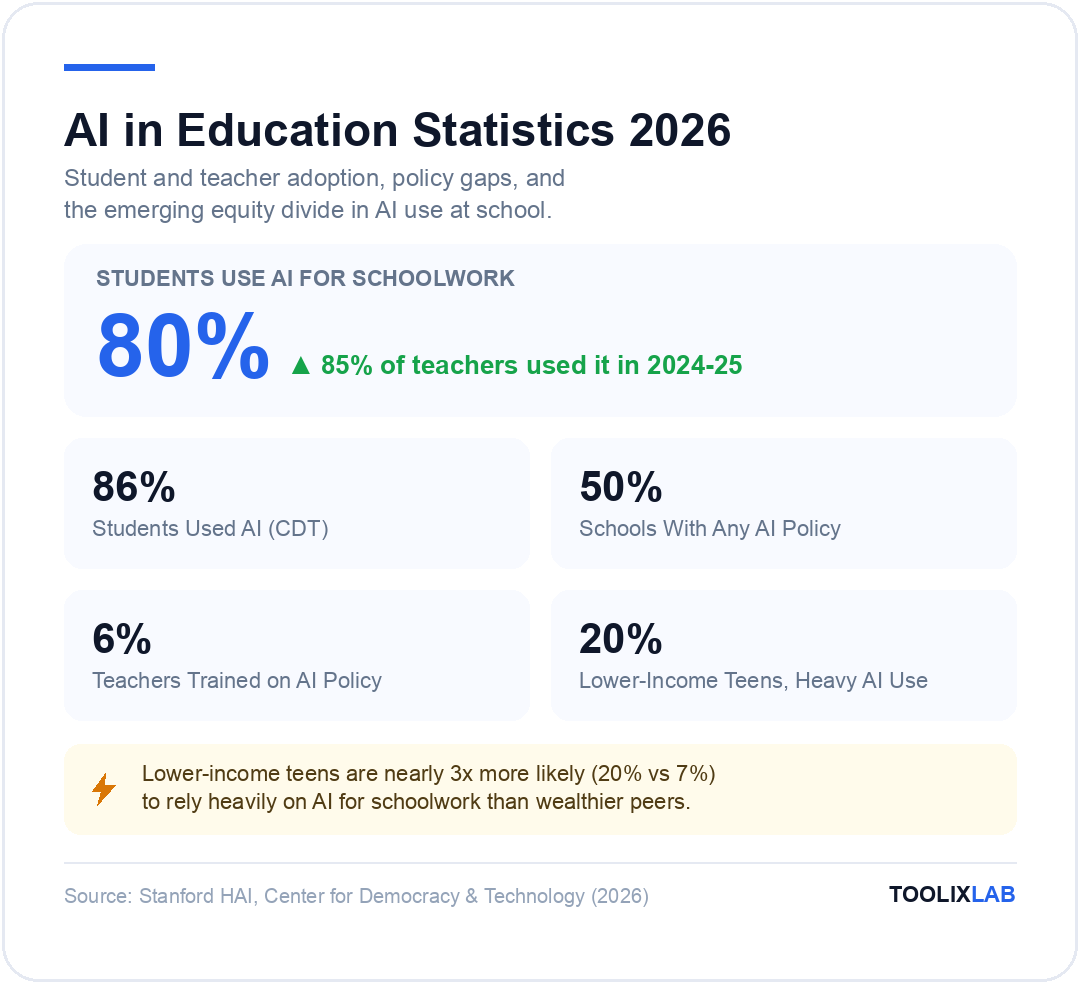
80% of U.S. high school and college students now use AI for schoolwork, and 85% of teachers used AI during the 2024–25 school year — but only 50% of schools have any AI policy, and just 6% of teachers call it clear. Globally, fewer than 10% of schools and universities have formal generative-AI guidance. The global AI-in-education market is worth roughly $11.4 billion in 2026 and compounding at 26–35% a year depending on the research firm, while a real equity gap has opened: lower-income teens are nearly three times more likely to do "all or most" schoolwork with AI than higher-income teens.
AI adoption in education moved faster than the policies meant to govern it in 2026. Stanford HAI's AI Index found 80% of U.S. high school and college students now use AI for schoolwork, and the Center for Democracy and Technology found 85% of teachers used it during the 2024–25 school year — yet only half of schools have written an AI policy, and almost none of those policies are described as clear. This piece pulls together what Stanford, Pew Research, CDT, UNESCO, and two independent market-research firms actually measured, rather than repeating the rounder, more dramatic numbers that circulate without a traceable source.
⚡ Quick Summary
Adoption: 80% of students use AI for schoolwork (Stanford HAI); 85% of teachers and 86% of students used AI in 2024–25 (CDT).
Policy gap: only 50% of schools have any AI policy, and just 6% of teachers call it clear; globally, under 10% of institutions have formal guidance (UNESCO).
The equity gap: lower-income teens (20%) are nearly 3x more likely than higher-income teens (7%) to do most schoolwork with AI.
Jump to: Student & Teacher Adoption | The Policy Gap | The Equity Gap | Cheating Perceptions
Key Stats at a Glance
🔑 50+ AI in Education Statistics
- 📊 80% of U.S. high school and college students use AI for schoolwork (Stanford HAI 2026 AI Index)
- 📊 85% of teachers and 86% of students used AI during the 2024–25 school year (CDT)
- 📊 54% of U.S. teens have used AI chatbots for schoolwork help; 64% use AI chatbots for any purpose (Pew Research)
- 📊 10% of teens do "all or most" of their schoolwork with chatbot assistance; 21% do "some," 23% "a little" (Pew Research)
- 📊 Only 50% of middle and high schools have any AI policy; just 6% of teachers call it clear (Stanford HAI)
- 📊 Fewer than 10% of schools and universities worldwide have formal generative-AI guidance (UNESCO, 450+ institutions surveyed)
- 📊 In higher ed specifically, 19% of institutions have a formal AI policy and 42% are developing one (UNESCO)
- 📊 Global AI-in-education market: $11.4B (2026) → projected $57.2B by 2033, a 25.9% CAGR (Grand View Research)
- 📊 Precedence Research's competing estimate: $9.58B (2026) → $136.79B by 2035, a 34.52% CAGR
- 📊 Lower-income teens (<$30K household income) are 20% likely to do most schoolwork with AI vs. 7% for teens in $75K+ households (Pew Research)
- 📊 Roughly 60% of Black and Hispanic teens have used chatbots for schoolwork help vs. roughly 50% of white teens (Pew Research)
- 📊 7 in 10 teachers worry AI use weakens skills students need to learn; half of students feel less connected to their teacher when AI is used in class (CDT)
- 📊 AI-related master's degrees rose 17% from 2023–2024; AI PhDs in the U.S. and Canada rose 22% from 2022–2024, despite an 11% decline in general CS enrollment (Stanford HAI)
- 📊 59% of teens believe AI-assisted cheating happens at their school "at least sometimes"; that rises to 76% among teens who've used AI for schoolwork themselves (Pew Research)
- 📊 China and the UAE both mandated AI education starting with the 2025–26 school year; 30 U.S. states had issued AI-in-education guidance as of January 2026 (Stanford HAI)
📚 Sources & Methodology
Every statistic below is attributed to its original report. We prioritized Stanford's peer-reviewed AI Index, nationally representative surveys from Pew Research and the Center for Democracy and Technology, and UNESCO's global institutional survey over aggregator blog posts, and we cross-check market-sizing figures against two independent research firms rather than repeating a single number as consensus:
- Stanford HAI — 2026 AI Index Report, Education chapter, published April 2026.
- Pew Research Center — "How Teens Use and View AI," fielded Sept. 25–Oct. 9, 2025 (N=1,458 U.S. teens ages 13–17, ±3.3pp margin), published February 24, 2026.
- Center for Democracy and Technology — "Hand in Hand: Schools' Embrace of AI Connected to Increased Risks to Students," surveyed June–August 2025 (N=1,030 students, 806 teachers, 1,018 parents), published October 2025.
- UNESCO — global survey of 450+ schools and universities, released during Digital Learning Week, September 2025.
- Grand View Research — Artificial Intelligence in Education Market Report, 2026–2033.
- Precedence Research — AI in Education Market report, 2026–2035.
Finding #1: 80% of Students, 85% of Teachers Now Use AI
Stanford HAI's 2026 AI Index found 80% of U.S. high school and college students now use AI for schoolwork — research, essay editing, and brainstorming are the most common uses. The Center for Democracy and Technology's independent, nationally representative survey found an even tighter adoption picture at the K-12 level specifically: 85% of middle and high school teachers and 86% of students report using AI during the 2024–25 school year, based on responses from 806 teachers and 1,030 students surveyed between June and August 2025.
Pew Research's teen-focused survey, fielded a few months later (September–October 2025) among 1,458 U.S. teens ages 13–17, found a somewhat narrower figure for schoolwork specifically: 54% of teens have used an AI chatbot for schoolwork help, while 64% use AI chatbots for any purpose at all — searching for information (57%), entertainment (47%), casual conversation (16%), or emotional support (12%). Within the schoolwork figure, usage intensity varies sharply: 10% of teens say they complete "all or most" of their schoolwork with AI assistance, 21% do "some," and 23% do "a little."
These figures aren't contradictory — they measure different things. Stanford's 80% and CDT's 85–86% describe broad AI usage across an entire school year and a wide range of use cases (including outside schoolwork). Pew's 54% isolates chatbot use specifically for schoolwork help among teens, a narrower and more conservative question. Read together, the range tells you adoption is high by any measure, but the specific number depends heavily on what's being asked and who's answering.
Finding #2: Policy Adoption Is Lagging Far Behind Usage
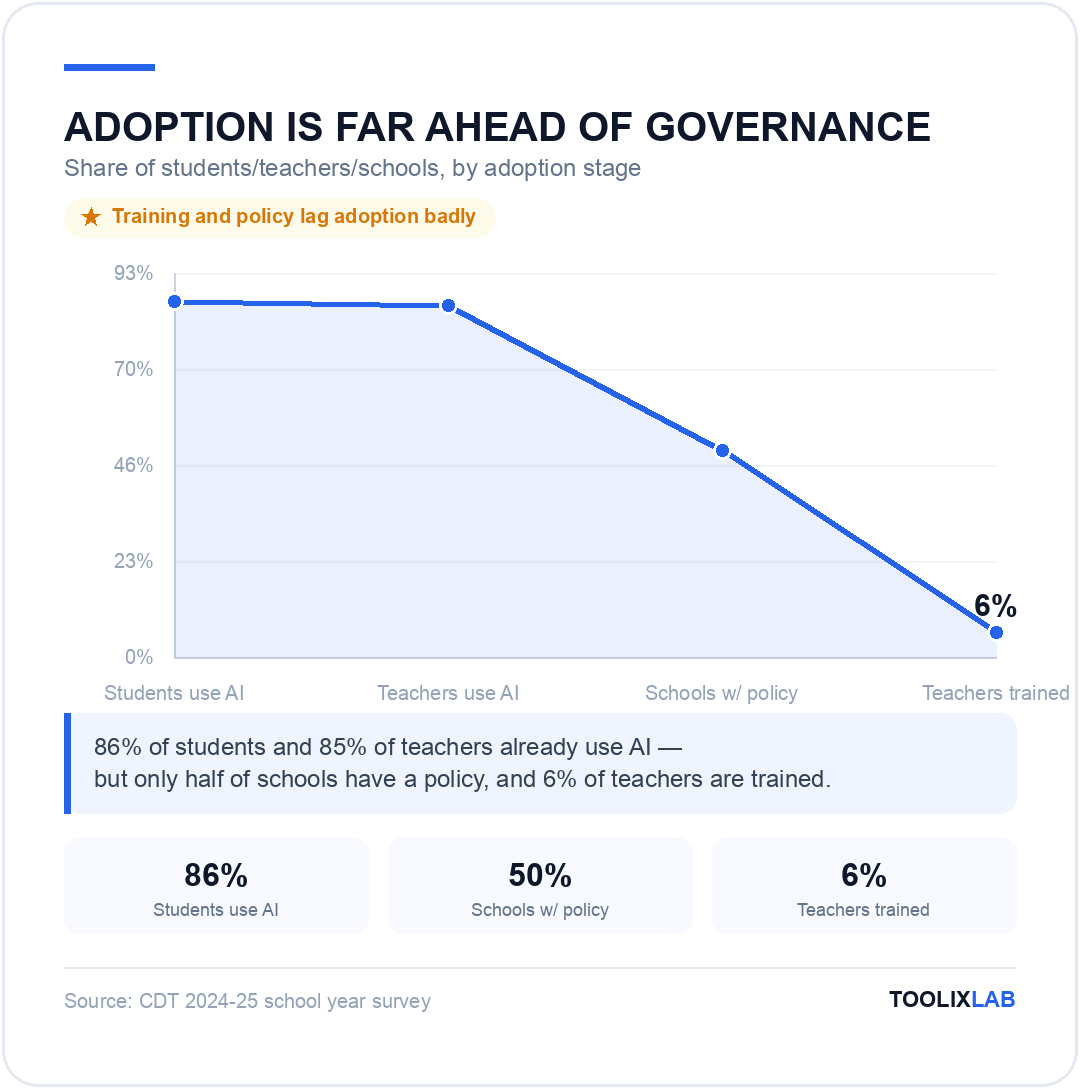
Usage outpaced governance by a wide margin in 2026. Stanford HAI found only 50% of U.S. middle and high schools have any written AI policy at all, and among schools that do, just 6% of teachers describe that policy as clear. UNESCO's global survey of more than 450 schools and universities found an even starker gap: fewer than 10% of institutions worldwide have formal guidance on generative AI use.
Higher education fares somewhat better than K-12, but still trails usage substantially. UNESCO's same survey found 19% of higher-education institutions have a formal AI policy already in place, with a further 42% actively developing one — meaning roughly 6 in 10 universities have either a policy or one in progress, versus fewer than 1 in 10 at the K-12 level globally. That split tracks with our AI in healthcare statistics research, where a similar pattern showed up: organizations adopt AI tools faster than they build the governance structures to manage them responsibly.
Finding #3: A Market Growing 26–35% a Year
Grand View Research values the global AI-in-education market at $11.4 billion in 2026 (up from an estimated $8.3 billion in 2025), projecting growth to $57.2 billion by 2033 — a 25.9% compound annual growth rate. Precedence Research publishes a more aggressive trajectory covering a longer window: $9.58 billion in 2026 growing to $136.79 billion by 2035, a 34.52% CAGR.
The two firms disagree on the exact dollar figures and forecast horizons — typical for fast-moving market-sizing research — but they agree on the underlying trend: the market is compounding at roughly a quarter to a third of its value every year. Adaptive learning platforms, AI tutoring tools, and administrative automation (grading, scheduling, enrollment management) are the fastest-growing segments in both firms' breakdowns, while North America holds the largest current regional share.
Finding #4: The Equity Gap Runs Backward From Expectations
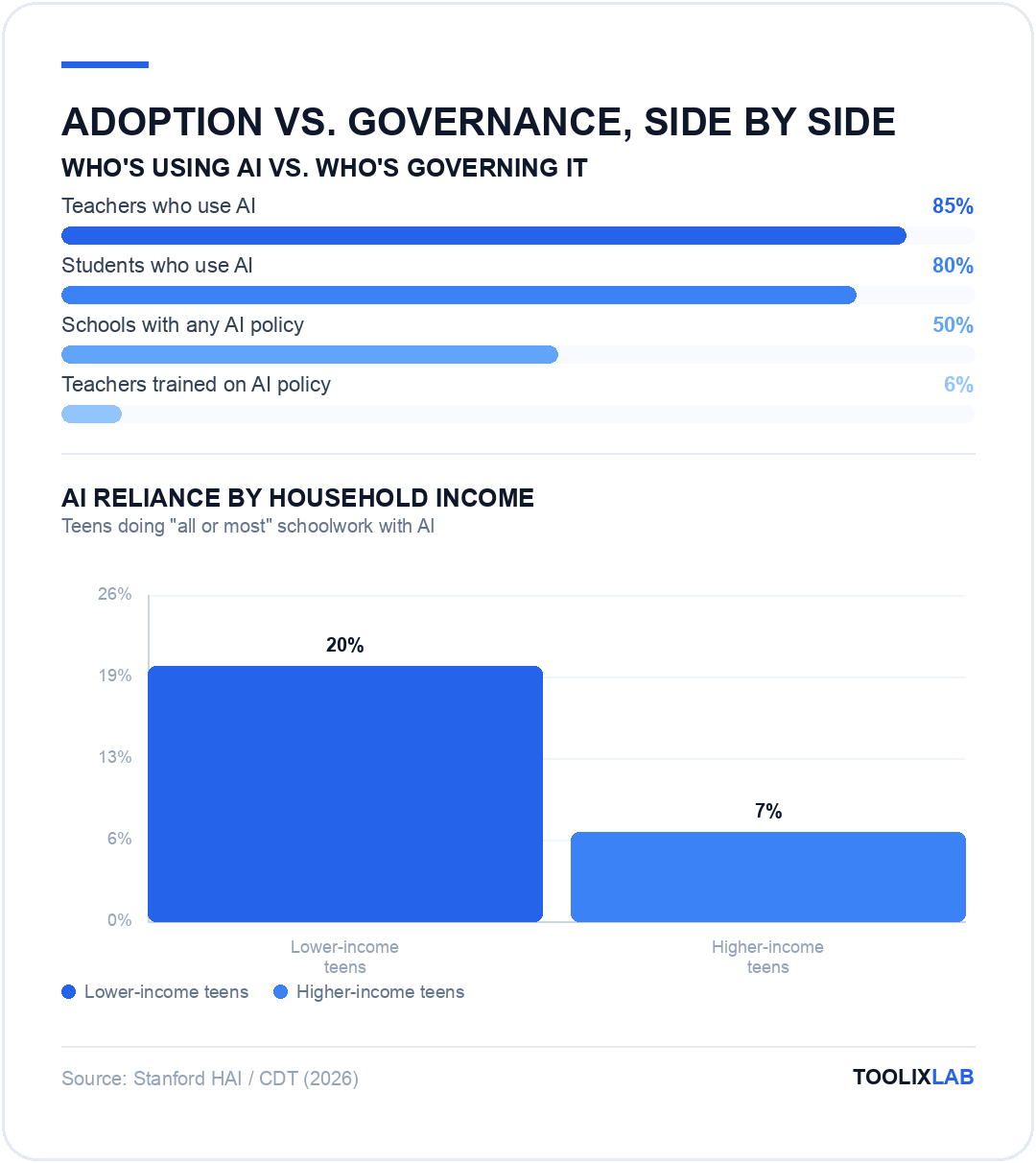
Pew Research's income breakdown produced a counterintuitive result. Teens in households earning under $30,000 a year are 20% likely to complete "all or most" of their schoolwork with AI — nearly identical to the 20% figure for households earning $30,000–$75,000 — while teens in households earning over $75,000 a year report just 7%. That's the opposite of the pattern typically seen in technology-access research, where higher-income households usually show higher usage of new tools.
A similar pattern shows up along racial lines: roughly 60% of Black and Hispanic teens report having used AI chatbots for schoolwork help, compared with roughly 50% of white teens, and about 40% of Black teens rate chatbots as "extremely or very helpful" — a higher share than reported by white teens. Pew's data doesn't establish why the gap runs this direction, but it complicates any assumption that AI-in-education adoption simply mirrors existing digital-divide patterns — our Gen Z trust in AI research found comparable demographic nuance in how younger users engage with AI more broadly.
Finding #5: More AI Use Correlates With More Risk
CDT's "Hand in Hand" report frames its central finding carefully: schools that embrace AI more heavily also report higher exposure to AI-related risks — including data breaches or ransomware attacks, tech-enabled sexual harassment and bullying, AI systems that don't work as intended, and troubling interactions between students and AI tools. That's a correlation the report documents, not necessarily a simple cause-and-effect claim, but it's consistent across the surveyed population.
On the classroom experience itself, the numbers cut both ways. 55% of teachers in earlier 2025 surveys reported improved student outcomes when using AI tools, and 51% of teachers feel AI's overall impact on education will be positive versus 21% negative. But CDT found 7 in 10 teachers worry AI use weakens skills students need to learn, and half of students agree that using AI in class makes them feel less connected to their teacher — a tension between measured benefit and reported cost that shows up consistently across the surveyed sample.
Finding #6: Higher Ed Is Quietly Shifting Toward AI Specialization
While general computer science enrollment cooled — down 11% at U.S. four-year universities between the 2024–25 academic years, per Stanford HAI's 2026 AI Index — AI-specific graduate programs kept growing. AI-related master's degrees rose 17% from 2023 to 2024, and AI PhDs awarded in the U.S. and Canada rose 22% from 2022 to 2024, with nearly all of that PhD growth directed toward academic careers rather than industry — reversing a decade-long trend of AI PhDs flowing predominantly into private-sector jobs.
That academic-specialization trend sits alongside a separate labor-market signal worth reading together: our AI job displacement research found entry-level software developer employment down nearly 20% since 2024. Universities appear to be responding to AI's disruption of entry-level technical work by producing more specialized AI researchers and educators, even as the broader pipeline of general CS graduates narrows — a bet that deep AI expertise, not general coding ability, is where the durable value sits.
Finding #7: Most Students Think AI Cheating Is Common
Pew Research found 59% of teens believe students at their school use AI chatbots to cheat "at least sometimes," with about a third saying it happens "extremely or very often." That perception climbs sharply among teens who've personally used AI for schoolwork: 76% of that group believes AI-assisted cheating is common, versus a lower rate among teens who haven't used AI for schoolwork themselves — suggesting familiarity with the tools correlates with a more, not less, skeptical view of how classmates use them.
There's also a visibility gap between generations: Pew found roughly half of parents say their teen uses AI chatbots, well below the 64% of teens who report using them personally. That 14-point-plus gap suggests a meaningful share of teen AI use — for schoolwork or otherwise — is happening without parental awareness, which has implications for how schools communicate AI policy to families, not just to students and staff.
Finding #8: National Mandates Are Starting to Arrive
Formal AI-education mandates moved from proposal to policy in 2025–26. China and the United Arab Emirates both mandated AI education starting with the 2025–26 school year, per Stanford HAI's 2026 AI Index — the first national governments to require AI instruction rather than merely encourage it. In the U.S., the response has been more decentralized: 30 states had issued some form of AI-in-education guidance as of January 2026, 17 had formally clarified that computer science is foundational to AI instruction, and 5 states had allocated specific professional-development funding for AI education.
That state-by-state variation helps explain the policy-gap numbers in Finding #2: even where state-level guidance exists, it doesn't automatically translate into a clear, adopted policy at the individual school level — the 6% "clear policy" figure suggests most schools are still working out how to turn state guidance into classroom-level rules.
Narrative vs. Measured Reality: Side-by-Side
| Metric | Common Narrative | Measured / Primary-Sourced Figure | Source |
|---|---|---|---|
| Student AI adoption | "Every student uses AI now" | 80% students (Stanford); 54% teens for schoolwork specifically (Pew) | Stanford HAI / Pew |
| School AI policy | "Schools have adapted their rules" | 50% have any policy; only 6% call it clear | Stanford HAI |
| Tech-access equity | Higher income = higher AI use | Lower-income teens (20%) use AI more heavily than higher-income teens (7%) | Pew Research |
| Market size (2026) | A single "market size" number | $11.4B (Grand View) vs. $9.58B (Precedence) — both agree on 25%+ CAGR | Grand View / Precedence |
| University AI guidance | "Universities have figured this out" | 19% have a formal policy; 42% still developing one | UNESCO 2025 survey |
What This Means If You Work in Education
Three practical takeaways fall out of this data, whether you're a teacher, an administrator, or building tools for schools:
The adoption-policy gap is the defining fact of AI in education right now, more than any single usage statistic. With 80–86% of students and teachers already using AI and only 6% of teachers describing their school's policy as clear, most classrooms are operating with de facto rules set by individual teachers rather than institutional guidance. That gap — not the adoption rate itself — is what CDT's risk-correlation findings and UNESCO's governance data both point to as the near-term priority.
The equity story is more complicated than a simple access gap. Lower-income and Black/Hispanic teens report higher AI usage for schoolwork than their higher-income and white peers — the reverse of typical technology-adoption patterns. Any equity intervention built on the assumption that AI access needs to be expanded to underserved students should instead ask what's driving heavier reliance among students who already use it more, and whether that reliance reflects genuine learning support or a different kind of gap.
Higher education's specialization bet is worth watching alongside the labor-market data. AI-related master's and PhD production is growing even as general CS enrollment declines and entry-level developer employment contracts (see our AI job displacement statistics). That's a coherent response to a changing labor market, but it also means the next several years of graduate output will be more concentrated in AI-specific skills — worth tracking for anyone hiring or building education products aimed at that population, alongside the broader adoption trends in our state of AI tools statistics hub and the developer-specific findings in our AI coding statistics research.
🔑 Key Takeaways
- ✓ 80% of students and 85% of teachers now use AI in education, but only 50% of schools have any AI policy and just 6% of teachers call it clear
- ✓ Globally, fewer than 10% of schools and universities have formal generative-AI guidance; higher ed is further along at 19% formal + 42% in progress
- ✓ The AI-in-education market is worth roughly $11.4B in 2026, compounding at 26–35% a year depending on the research firm
- ✓ The equity gap runs backward from expectations: lower-income and Black/Hispanic teens report heavier AI use for schoolwork than higher-income and white teens
- ✓ AI-related master's and PhD production is growing (+17% and +22%) even as general CS enrollment declines 11% — a specialization bet worth watching alongside entry-level developer job contraction