
By ToolixLab Research Team · Last updated: July 2026
Quick Answer
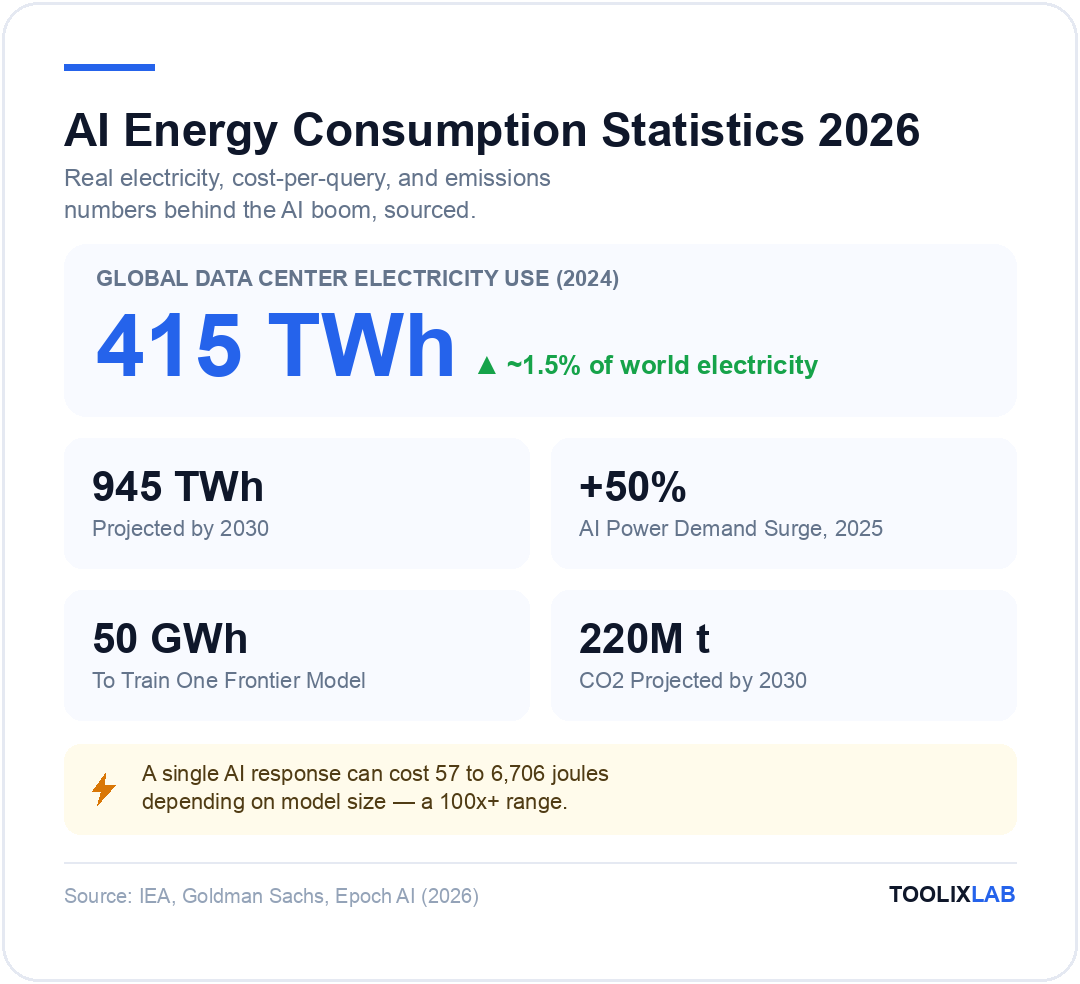
Global data center electricity demand hit an estimated 415 TWh in 2024 (about 1.5% of world electricity) and is projected by the International Energy Agency to roughly double to 945 TWh by 2030, with AI-accelerated servers driving almost half of that net increase. AI-focused data center electricity demand specifically surged 50% in 2025 alone. A single AI text response can cost anywhere from 57 joules (a small model, roughly six feet on an e-bike) to 6,706 joules (a large frontier model), while training a GPT-4-class model consumed an estimated 50 gigawatt-hours — enough to power San Francisco for three days. Goldman Sachs projects the resulting emissions increase could add 215–220 million tons of CO2 by 2030.
"AI is an environmental disaster" and "AI's energy footprint is overblown" are both defensible headlines depending on which number you cite — global aggregate electricity demand, per-query energy cost, one-time training cost, or projected emissions growth. Each tells a real but partial story, and the gap between "0.34 watt-hours per ChatGPT query" and "945 TWh of data center demand by 2030" is exactly why AI energy statistics get weaponized in both directions.
We pulled the primary sources behind the most-cited AI energy figures — the IEA's Energy and AI research program, MIT Technology Review's per-model energy audit, Goldman Sachs Research's power-demand forecasts, and the corporate sustainability disclosures from Microsoft and Google — so you can see exactly what each number measures and where they agree or contradict each other.
This piece focuses on electricity and carbon; for the closely related water-cooling side of AI's environmental footprint, see our AI water usage statistics breakdown, and for the capital spend building all this infrastructure, our AI GPU cluster deployment statistics covers the dollar side of the same buildout. For the broader adoption picture driving this demand, see our State of AI Tools 2026 statistics roundup.
AI Energy Consumption: The Key Numbers
- 📊 415 TWh — global data center electricity consumption in 2024, about 1.5% of world electricity (IEA)
- 📊 945 TWh — IEA's projected global data center electricity consumption by 2030, just under 3% of global demand
- 📊 17% — data center electricity demand growth in 2025 alone, more than 5x the 3% growth rate of overall global electricity demand (IEA)
- 📊 50% — the surge in electricity consumption specifically from AI-focused data centers in 2025 (IEA)
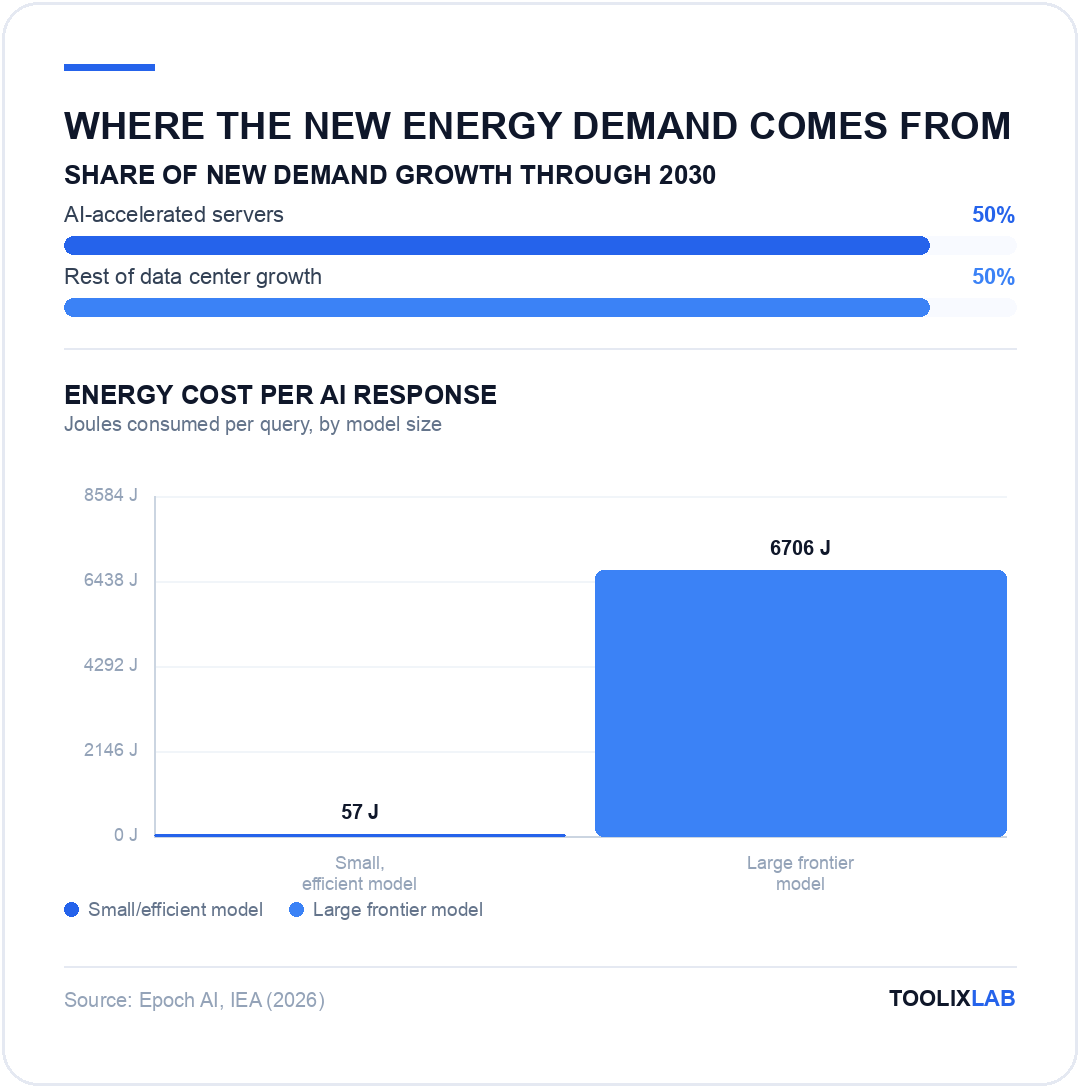
- 📊 30% per year — projected annual growth rate of electricity use in AI-accelerated servers through 2030, nearly half of the entire net increase in global data center demand (IEA)
- 📊 57–6,706 joules — energy per single AI text response, ranging from a small model (Llama 3.1 8B) to a large frontier model (Llama 3.1 405B), before cooling overhead (MIT Technology Review / Epoch AI audit)
- 📊 3.4 million joules — energy to generate one 5-second AI video clip, over 700x the energy of a single AI image
- 📊 50 GWh — estimated electricity to train a GPT-4-class model, enough to power San Francisco for roughly three days, at a compute cost exceeding $100 million
- 📊 215–220 million tons of CO2 — Goldman Sachs' projected additional emissions from data center power demand through 2030
- 📊 25% — the year-over-year rise in Microsoft's gross greenhouse gas emissions in fiscal year 2025, driven largely by AI data center expansion
- 📊 $400 billion+ — combined 2025 capital expenditure of five major tech companies on data center buildout, set to rise a further 75% in 2026 (IEA)
Feel free to cite any statistic on this page — we ask only for a link back to this article as the source.
Methodology: Where This Data Comes From
This is a curated compilation of primary-source research and corporate/institutional disclosures, not a survey we ran ourselves. Every figure traces back to one of the following:
- International Energy Agency, "Energy and AI" — the IEA's flagship research program on AI's electricity demand, including its April 2025 report and 2026 follow-up analysis, "Key Questions on Energy and AI."
- IEA, "Electricity 2026" — the agency's 2025 year-in-review data on global data center and AI-specific electricity growth.
- MIT Technology Review, "We did the math on AI's energy footprint" (May 2025) — an independent per-model energy audit run in partnership with researchers, measuring joules-per-response across text, image, and video models on real hardware.
- Goldman Sachs Research — the bank's published forecasts on data center power demand growth and associated emissions through 2030.
- Microsoft's FY2025 Environmental Sustainability Report and subsequent corporate disclosures — the company's own gross and net greenhouse gas emissions figures.
- Google's 2026 Environmental Report — the company's disclosed emissions and carbon-free energy target data.
Limitations: corporate emissions disclosures are self-reported, use different accounting boundaries (gross vs. net of carbon credits), and are not independently audited to a common standard. Where a company reports only a net figure after purchased carbon removal credits, we've noted the gross figure separately rather than treating them as equivalent.
Finding #1: AI Is Now the Primary Driver of Data Center Electricity Growth
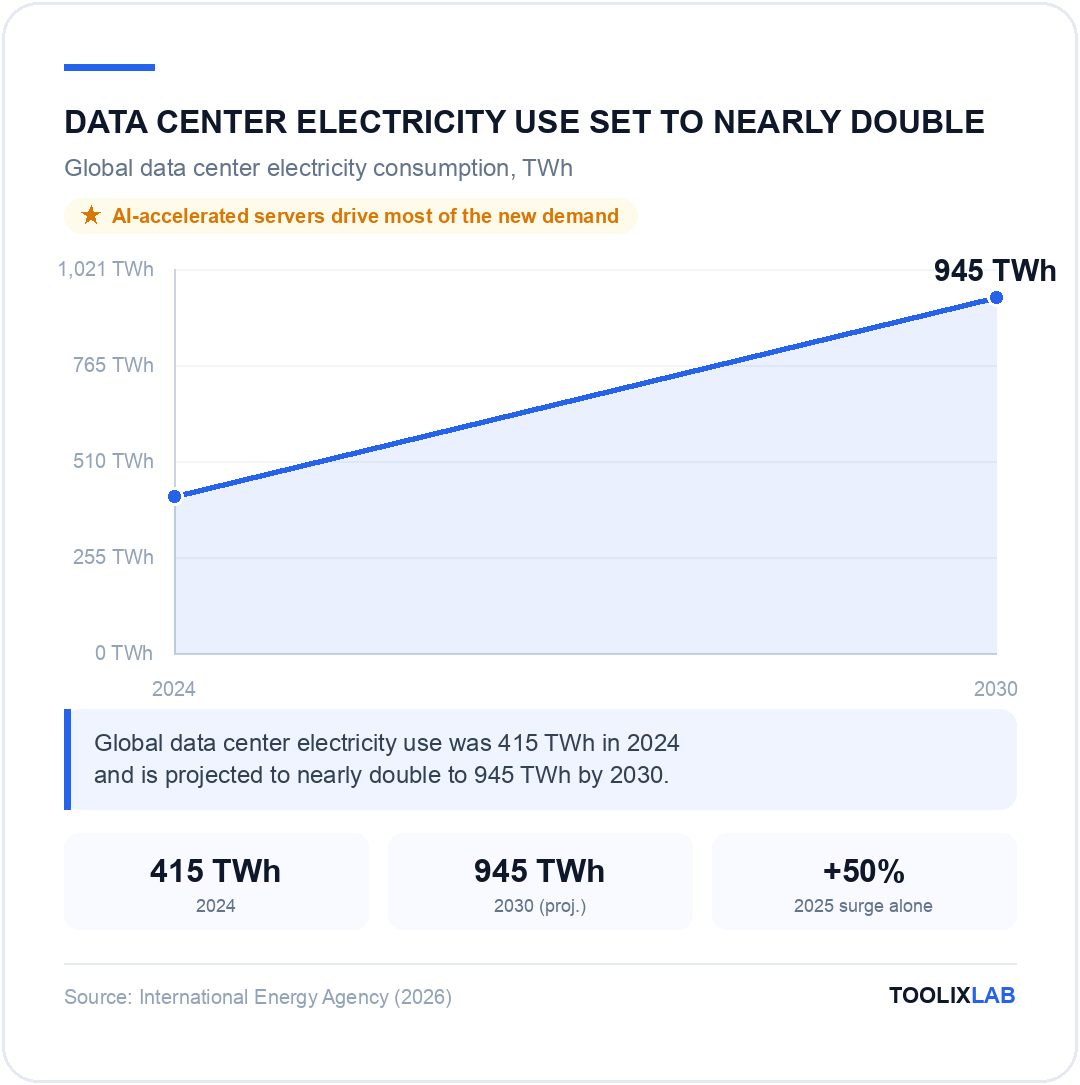
Global data center electricity consumption reached an estimated 415 TWh in 2024 — about 1.5% of total global electricity use — after expanding at roughly 12% annually over the preceding five years, according to the IEA's Energy and AI report. That growth accelerated sharply in 2025: data center electricity demand soared 17% year-over-year, more than five times the 3% growth rate of global electricity demand overall, while electricity consumption from AI-focused data centers specifically surged 50% in the same period.
The IEA's base-case projection has total data center electricity consumption roughly doubling to around 945 TWh by 2030 — just under 3% of global electricity demand at that point. Critically, the agency attributes almost half of that entire net increase to a single category: accelerated servers (the GPU- and AI-chip-heavy machines that run AI training and inference), which it projects will grow electricity consumption by around 30% per year through the decade, far outpacing traditional server growth. Regionally, the United States is projected to add roughly 240 TWh of data center demand by 2030 (130% growth), China roughly 175 TWh (170% growth), and Europe more than 45 TWh (70% growth) — meaning AI-driven electricity growth is a global phenomenon, not a U.S.-specific one.
Finding #2: Energy Per AI Task Varies by Three Orders of Magnitude Depending on Task Type
Unlike the aggregate industry numbers, per-task energy costs are measurable and show enormous variance depending on what kind of content is being generated. In an independent audit run in partnership with MIT Technology Review, researchers measured real energy draw across models on actual hardware rather than relying on vendor-disclosed estimates:
| Task type | Model example | Energy per output | Rough equivalent |
|---|---|---|---|
| Short text response | Llama 3.1 8B | ~114 joules (incl. cooling) | 6 feet on an e-bike |
| Long text response | Llama 3.1 405B | ~6,706 joules (incl. cooling) | 400 feet on an e-bike |
| Image (1024×1024) | Stable Diffusion 3 Medium | ~2,282 joules | 250 feet on an e-bike |
| 5-second video | CogVideoX | ~3.4 million joules | 38 miles on an e-bike |
The pattern is consistent: response length and modality matter far more than which company built the model. A large model's long response can use nearly 60x more energy than a small model's short one, and video generation dwarfs every other modality — a single 5-second clip uses more than 700x the energy of one still image. Put together, the researchers estimated a person making 15 text queries, 10 image attempts, and 3 video attempts in a day would consume roughly 2.9 kilowatt-hours — comparable to running a microwave for about 3.5 hours. The practical takeaway for anyone citing a "per AI query" energy figure: specify the task type and model size, because a single number without that context is close to meaningless given the spread.
Finding #3: Training a Frontier Model Is a One-Time Cost in the Tens of Gigawatt-Hours
Separate from the ongoing cost of answering queries, training a frontier model is itself a massive one-time energy draw. GPT-4's training run consumed an estimated 50 gigawatt-hours of electricity — enough to power the city of San Francisco for roughly three days — at a compute cost exceeding $100 million, according to figures compiled by MIT Technology Review. That figure covers the compute-electricity cost alone, not the embodied energy of manufacturing the GPUs or the water used for cooling during the run.
Training energy scales with model size and data volume, and next-generation frontier models developed in 2025–2026 are estimated to require training runs exceeding 100+ gigawatt-hours — roughly double GPT-4's footprint — reflecting both larger parameter counts and longer training schedules on more GPUs. This is a genuinely different category of energy cost from per-query inference: it's paid once per model release rather than once per user interaction, but as companies release new frontier models more frequently, the cumulative training energy across an industry training dozens of large models per year compounds quickly.
Finding #4: Emissions Are Rising Despite Efficiency Gains and Renewable Commitments
The industry's public position is that renewable energy procurement and efficiency improvements are decoupling AI growth from emissions growth. The actual 2025 disclosures tell a more complicated story. Microsoft's gross greenhouse gas emissions rose 25% in fiscal year 2025, reaching 34 million metric tons of CO2 equivalent, driven by rapid data center expansion and a decision to stop purchasing certain types of renewable energy certificates. After factoring in purchased carbon removal credits, the company's net figure was 20 million metric tons — still up from 16 million metric tons the prior year. Microsoft has stated it matched 100% of its annual global electricity consumption with renewable energy and now holds 40 gigawatts of clean power purchase agreements across 26 countries (19 gigawatts of which are already online), but its absolute emissions are climbing regardless.
Google disclosed a similar pattern in its 2026 Environmental Report: supply chain emissions — which include the embodied carbon of AI data center construction and chip manufacturing — jumped 25% year-over-year. Google's stated target is to match its electricity consumption with carbon-free energy every hour, in every region, by 2030, a substantially harder standard than the annual-average matching most companies (including Microsoft) currently use.
At the industry level, Goldman Sachs Research projects that data center power demand will grow 175% by 2030 versus 2023, with AI comprising an estimated 39% of that demand. The bank forecasts roughly 40% of the added power will come from renewables and nuclear, but the remaining 60% will lean heavily on natural gas — adding an estimated 215–220 million tons of CO2 through 2030, which Goldman values at a "social cost" of $125–140 billion in present-value terms. The honest summary: efficiency per unit of AI compute is genuinely improving at every major provider, but total compute deployed is growing so much faster that absolute emissions are rising anyway — the same dynamic documented in the water-usage data linked above.
What This Data Means in Practice
Don't cite a "per AI query" energy number without its task type and model size. A short response from a small model and a long response from a frontier model can differ in energy cost by nearly two orders of magnitude — and video generation is a different category entirely, using hundreds of times more energy than a still image.
Aggregate demand growth and per-task efficiency gains are both real and not contradictory. Per-unit-of-compute efficiency keeps improving industry-wide, yet total electricity demand and absolute emissions keep rising, because deployed AI compute is growing faster than efficiency gains shrink the per-task footprint — exactly the pattern Microsoft's 25% emissions jump illustrates despite its renewable energy matching claims.
Training cost and inference cost are different categories that shouldn't be added carelessly. A model's ~50-100 GWh training run is a one-time cost amortized across however many queries it eventually serves; a single query's joule cost is a recurring, per-interaction cost. Confusing the two produces misleading "AI query costs as much energy as X" comparisons.
Corporate accounting boundaries matter as much as the headline number. Gross emissions figures (Microsoft's 34 million tons) and net figures after purchased carbon credits (20 million tons) tell different stories — always check which one a company is citing before comparing it to a competitor's disclosure.
Frequently Asked Questions
How much energy does AI actually use globally?
Global data center electricity consumption reached an estimated 415 TWh in 2024 (about 1.5% of world electricity), and the IEA projects it will roughly double to 945 TWh by 2030. AI-accelerated servers are projected to drive nearly half of that entire net increase, growing electricity use around 30% per year.
How much energy does a single AI query use?
It depends heavily on model size and response length. An independent MIT Technology Review audit measured 57-114 joules for a short response from a small model versus 3,353-6,706 joules for a long response from a large frontier model - nearly a 60x difference. Image generation costs roughly 2,282 joules, and video generation costs over 700x more energy than a single image.
How much energy does it take to train a model like GPT-4?
GPT-4's training run is estimated to have consumed roughly 50 gigawatt-hours of electricity, enough to power San Francisco for about three days, at a compute cost exceeding $100 million. Next-generation frontier models developed in 2025-2026 are estimated to require training runs exceeding 100+ gigawatt-hours.
How fast is data center electricity demand growing because of AI?
Data center electricity demand grew 17% in 2025 alone, more than five times the 3% growth rate of overall global electricity demand, according to the IEA. Electricity consumption specifically from AI-focused data centers surged 50% in the same year.
Is AI's carbon footprint actually rising or falling?
Rising in absolute terms, despite efficiency improvements. Microsoft's gross emissions rose 25% in fiscal year 2025 to 34 million metric tons of CO2 equivalent, and Google disclosed a 25% jump in supply chain emissions in its 2026 report. Goldman Sachs projects data center power demand will add 215-220 million tons of CO2 through 2030.
What share of data center electricity does AI use?
AI-accelerated servers are projected to drive close to half of the entire net increase in global data center electricity consumption through 2030, per the IEA, and Goldman Sachs estimates AI will comprise 39% of total data center power demand growth by 2030.
Can I cite these statistics?
Yes. These are third-party primary-source and corporate-disclosure statistics compiled and sourced by ToolixLab - cite the original source (IEA, MIT Technology Review, Goldman Sachs, Microsoft, or Google) where possible, and feel free to link to this page as your source for the compilation.
🔑 Key Takeaways
- ✓Global data center electricity demand hit 415 TWh in 2024 and is projected to nearly double to 945 TWh by 2030, with AI-accelerated servers driving almost half of that increase
- ✓Per-query energy cost varies by nearly two orders of magnitude depending on model size, response length, and modality - video generation uses over 700x the energy of a single image
- ✓Training a GPT-4-class model consumed an estimated 50 gigawatt-hours - a one-time cost separate from ongoing per-query energy use
- ✓Microsoft's gross emissions rose 25% in FY2025 and Google's supply chain emissions rose 25% in 2026, despite both companies' renewable energy commitments - efficiency gains and rising absolute emissions coexist
- ✓Goldman Sachs projects data center emissions will add 215-220 million tons of CO2 by 2030, valued at a $125-140 billion social cost
Related Guides
- AI Water Usage Statistics 2026 — the water-cooling side of the same data center buildout, sourced from Google, Microsoft, and DOE data.
- AI GPU Cluster Deployment Statistics 2026 — the capital spend building the infrastructure behind these energy numbers.
- Generative AI Statistics 2026 — the adoption and usage scale driving this energy demand.
- AI Adoption Statistics 2026 — how fast businesses are deploying the AI workloads behind this power growth.