
Quick Answer
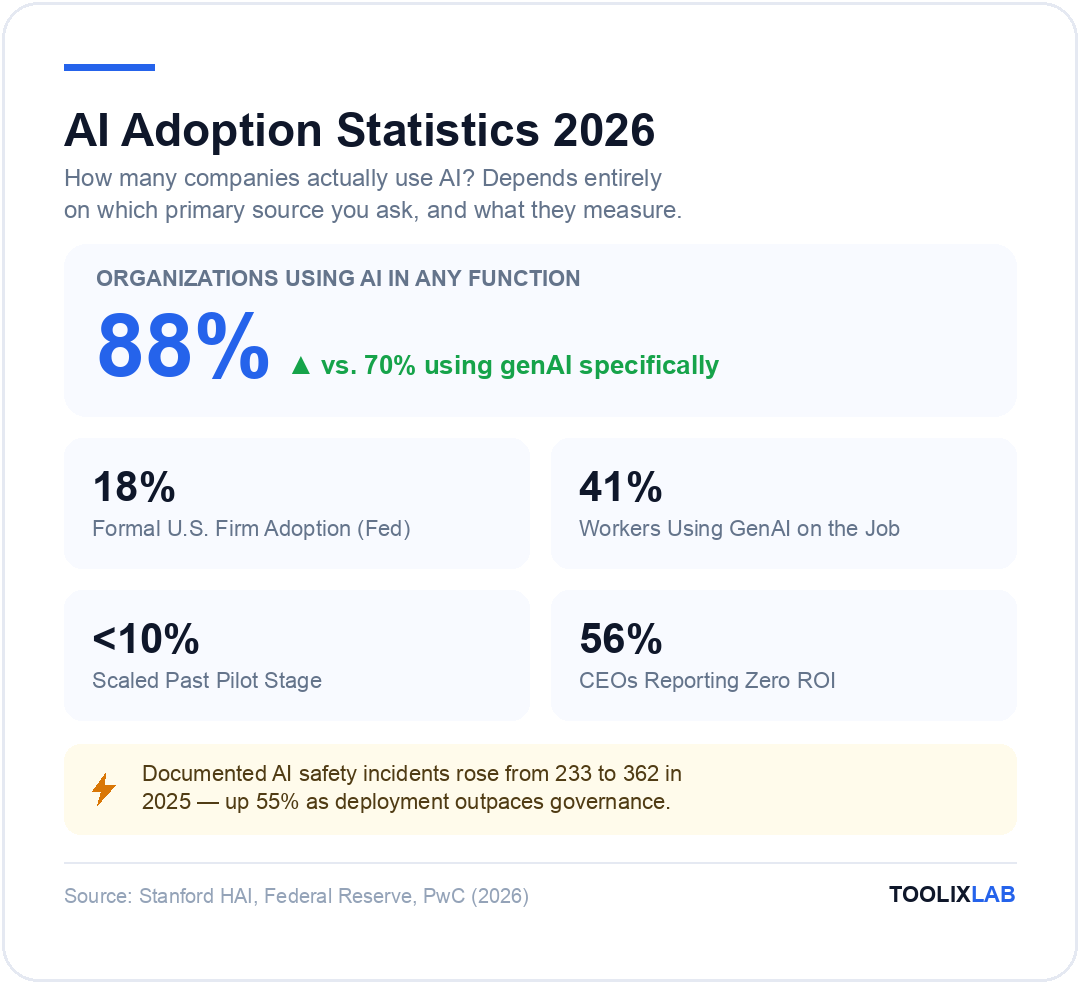
Stanford HAI's 2026 AI Index finds 88% of organizations now use AI in at least one business function, but fewer than 10% have scaled it beyond pilots. U.S. government data tells a more conservative story: only about 18% of firms had formally adopted AI by year-end 2025 (Federal Reserve BTOS), even though 78% of the labor force works at firms using it in some capacity. Worker-level usage is growing fastest — 41% of U.S. workers now use generative AI on the job — while PwC finds 56% of CEOs still report zero measurable revenue or cost benefit from their AI investments after 12 months. Adoption is real and broad; scaled, ROI-positive deployment is still the exception.
Ask "how many companies use AI in 2026?" and you'll get wildly different answers depending on which survey you read — anywhere from 18% to 91%. That's not one number being wrong; it's different methodologies measuring different things. Stanford HAI counts any organization using AI in any business function and gets 88%. The Federal Reserve counts only formal, sustained firm-level adoption in its biweekly Business Trends and Outlook Survey and gets 18%. Deloitte surveys enterprise leaders and finds 25% now call AI's impact "transformative" — double the year before. This piece pulls every major primary source together, keeps each one's own definition attached to its number, and shows you exactly where the adoption curve actually sits: broad access, shallow scaling, and a real gap between the two.
⚡ Quick Summary
Broadest measure: 88% of organizations use AI in at least one business function (Stanford HAI); 91% report some AI use in at least one capacity (industry survey aggregation).
Strictest measure: Only ~18% of U.S. firms had formally adopted AI as of year-end 2025, per the Federal Reserve's Business Trends and Outlook Survey.
The scaling gap: Fewer than 10% of enterprises have scaled AI past pilot stage, and 56% of CEOs report zero measurable ROI after 12 months (PwC, n=4,454).
Jump to: The Adoption Gap | Federal Reserve Data | Worker-Level Usage | The ROI Gap
Key Stats at a Glance
🔑 50+ AI Adoption Statistics
- 📊 88% of organizations use AI in at least one business function, per Stanford HAI's 2026 AI Index — but fewer than 10% have scaled it beyond pilots
- 📊 70% of organizations have implemented generative AI in at least one business operation (Stanford HAI)
- 📊 Only ~18% of U.S. firms had formally adopted AI as of year-end 2025, per the Federal Reserve's Business Trends and Outlook Survey (BTOS)
- 📊 78% of the U.S. labor force works at a firm that has adopted AI in some form; 54% works at a firm using LLMs specifically (Fed Survey of Business Uncertainty, employment-weighted)
- 📊 41% of U.S. workers used generative AI for work as of November 2025, up from a much smaller base a year earlier (Fed Real-Time Population Survey)
- 📊 12% of U.S. workers use generative AI daily for work; 35.2% use it at least weekly (Fed RPS)
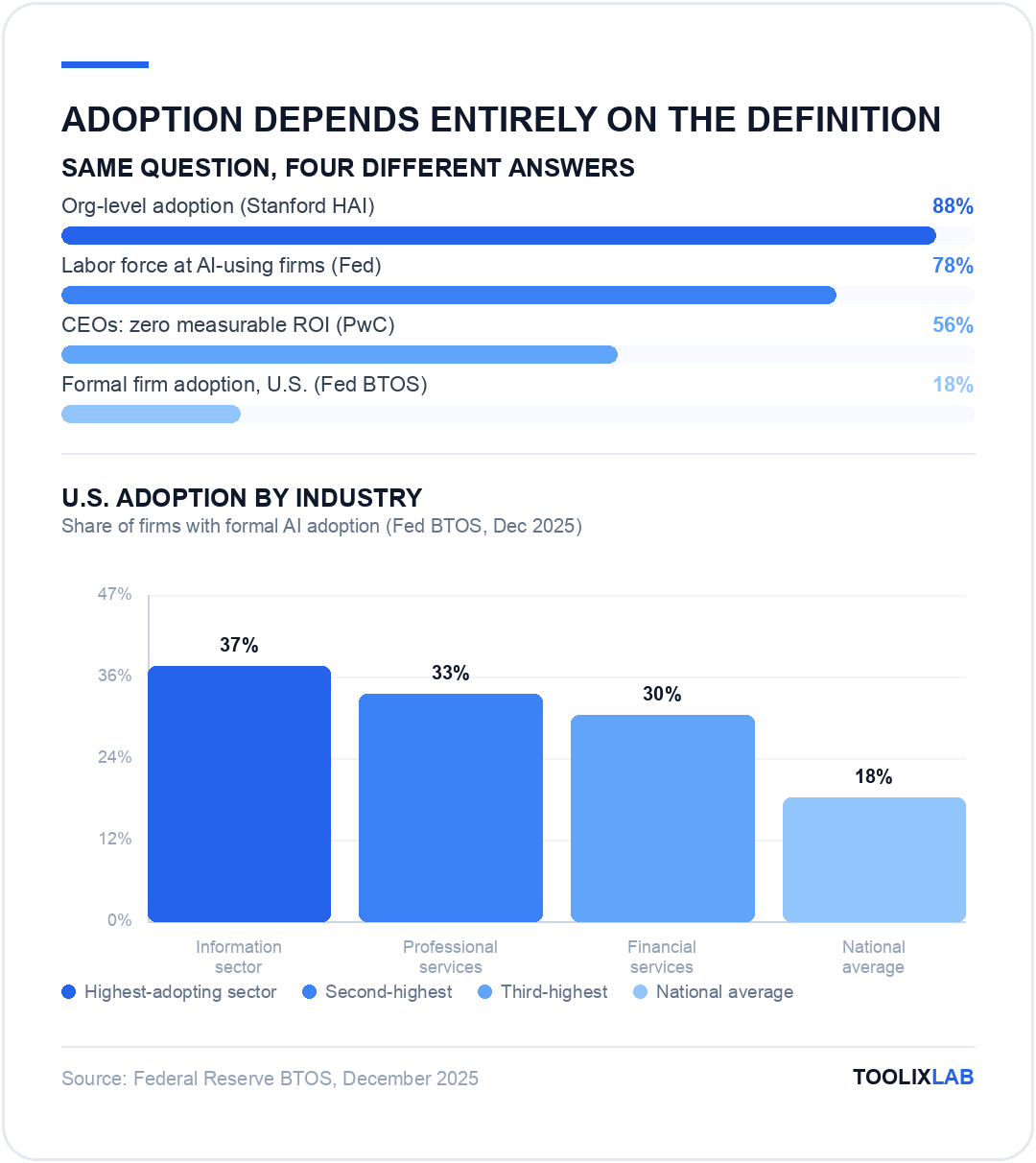
- 📊 Information-sector AI adoption reached 37% of firms, the highest of any measured U.S. industry, followed by professional services (~33%) and financial services (~30%) (Fed BTOS, Dec. 2025)
- 📊 25% of Deloitte-surveyed enterprise leaders report AI having a "transformative" effect on their company — more than double the 12% who said so a year earlier (Deloitte, n=3,235, 24 countries)
- 📊 The share of workers with access to sanctioned AI tools jumped from under 40% to roughly 60% in one year, but only 25% of employees granted access use AI regularly — an "adoption gap" IBM's 2026 CEO Study pegs at 85% access vs. 25% regular use
- 📊 56% of CEOs report neither increased revenue nor reduced cost from AI in the past 12 months (PwC 29th Global CEO Survey, n=4,454, 95 countries)
- 📊 Only 25% of enterprises have moved 40% or more of their AI pilots into production; another 54% expect to cross that threshold within 3–6 months (Deloitte)
- 📊 23% of enterprises currently use agentic AI at least moderately; that figure is projected to reach 74% within two years, but only 21% report having mature governance models for it (Deloitte)
- 📊 Generative AI reached 53% population-level adoption within three years — faster than the PC or the internet (Stanford HAI, citing global diffusion data)
- 📊 Global consumer AI usage rose from 16.3% to 17.8% of the world's working-age population in Q1 2026 alone — a 1.5-point quarterly jump (Microsoft Global AI Diffusion Report)
- 📊 The UAE leads global AI diffusion at 70.1% of its working-age population; the U.S. ranks outside the top 20 despite leading in AI investment and model development
- 📊 87% of marketers report using generative AI in at least one workflow — among the most-saturated professional categories measured
- 📊 Healthcare crossed the "early majority" adoption threshold, with 63% of physicians using AI tools and 80% of hospitals deploying AI in at least one function
📚 Sources & Methodology
Every statistic below is attributed to its original report. We prioritized government economic data, central-bank research, and named primary surveys over aggregator blog posts, and we keep each source's own definition of "adoption" attached to its number rather than blending incompatible methodologies:
- Stanford HAI — 2026 AI Index Report, ninth annual edition, Economy chapter on enterprise and consumer adoption.
- Federal Reserve — "Monitoring AI Adoption in the U.S. Economy" (April 2026), combining the Business Trends and Outlook Survey (~1.2 million-firm panel), Real-Time Population Survey, and Survey of Business Uncertainty (1,032 executives).
- Deloitte — "The State of AI in the Enterprise," survey of 3,235 business and IT leaders across 24 countries and 6 industries, fielded August–September 2025.
- PwC — 29th Global CEO Survey, 4,454 CEOs across 95 countries, fielded September 30–November 10, 2025.
- McKinsey — "The State of Organizations 2026," survey of more than 10,000 senior executives across 15 countries and 16 industries.
- IBM — 2026 Global CEO Study, on the gap between AI tool access and regular employee use.
- Microsoft — Global AI Diffusion Report, Q1 2026, built from aggregated and anonymized Microsoft telemetry across markets.
Finding #1: 88% Use AI, Fewer Than 10% Have Scaled It
Stanford HAI's 2026 AI Index — the field's most-cited annual benchmark — finds that 88% of surveyed organizations now use AI in at least one business capacity, and 70% have implemented generative AI specifically in at least one business function. Both figures moved up meaningfully year-over-year, with China and Europe posting the strongest gains.
The number that matters more than the headline, though, is the gap right behind it: fewer than 10% of those same enterprises have scaled AI past pilot projects into full production use. AI agent deployment specifically remains in the single digits across nearly all business functions — meaning the technology getting the most hype (autonomous agents) is also the least actually deployed at scale. Stanford's own framing is blunt about what this implies: model benchmarks are improving faster than real-world validation, and documented AI incidents — cases where systems caused harm or failed in production — rose to 362 in 2025, up from 233 in 2024, as deployment volume increases faster than governance maturity.
Why the 88%/10% split matters: it's the single best explanation for why so many "adoption" statistics contradict each other. A survey asking "does your organization use AI anywhere?" and a survey asking "has AI been scaled into core production workflows?" are measuring genuinely different things, and reporting them as the same number is where most confusion in this space comes from — the same distinction we drew when separating measured vs. projected numbers in our AI job displacement statistics research.
Finding #2: The Federal Reserve's More Conservative 18%
Set against Stanford's 88%, the U.S. Federal Reserve's own economic research paints a noticeably more conservative picture — and it's worth taking seriously precisely because it isn't a vendor-funded or consulting-firm survey. The Fed's Business Trends and Outlook Survey (BTOS), a biweekly panel drawing on roughly 1.2 million U.S. businesses, found that only about 18% of firms had formally adopted AI as of year-end 2025.
The gap between 18% and 88% isn't a contradiction — it's a difference in what counts as "adoption." BTOS asks firms whether they've formally adopted AI as a business practice; Stanford HAI counts any use of any AI tool in any function, including employees independently using consumer chatbots without a formal company policy. By industry, BTOS found information-sector firms leading U.S. adoption at 37%, followed by professional services (~33%) and financial services (~30%), with manufacturing trailing. Firm size mattered less than expected: the smallest firms (1–49 employees) showed unexpectedly strong adoption relative to their size, while firms with 250+ employees still posted the single highest adoption rates overall.
A separate Fed instrument, the Survey of Business Uncertainty (SBU, 1,032 executives, employment-weighted), reframes the same data through workers rather than firms: 78% of the U.S. labor force works at a company that has adopted AI in some form, and 54% works at a firm using large language models specifically. That figure is much closer to Stanford's number because employment-weighting favors large firms, which adopt AI at far higher rates than small ones — a reminder that "percent of firms" and "percent of workers" are two more distinct metrics inside the same underlying data.
Finding #3: 41% of U.S. Workers Now Use Generative AI on the Job
The Fed's Real-Time Population Survey (RPS) — a nationally representative panel of 5,000–6,000 quarterly respondents — measures something neither BTOS nor Stanford captures directly: individual worker behavior, independent of formal company policy. As of November 2025, 41% of U.S. workers reported using generative AI for work, with 12% using it daily and 35.2% using it at least weekly.
Usage skews heavily by industry: financial-services workers report 63% generative-AI usage and professional-services workers 62%, both far above the 41% national average — meaning knowledge-work sectors are already well past the "early majority" threshold even while national firm-level adoption (per BTOS) sits at only 18%. That combination — high individual worker usage, lower formal firm adoption — points to a specific pattern: employees in knowledge-work roles are frequently using generative AI tools on their own initiative faster than their employers are formally sanctioning, budgeting for, or governing that use.
Finding #4: What Enterprise Leaders Report (Deloitte)
Deloitte's "State of AI in the Enterprise" survey — 3,235 business and IT leaders across 24 countries and 6 industries, fielded August–September 2025 — offers the clearest leadership-level view of where AI actually sits inside large organizations. 25% of leaders now describe AI's effect on their company as "transformative," more than double the 12% who said so the year prior. The share of the workforce equipped with sanctioned AI tools jumped from under 40% to roughly 60% in a single year — a 50% relative increase.
But access outran integration: 37% of leaders describe their organization's AI use as "surface level," with minimal change to actual business processes, while only 30% report meaningfully redesigning key processes around AI. On the emerging frontier of agentic AI, close to 75% of companies plan agentic AI deployment within two years, and 85% expect to need custom-built agents for their specific business needs — but only 21% report having mature governance models for autonomous agents already in place, a gap that mirrors Stanford HAI's finding on rising AI incident counts.
- ✓ 25% of leaders call AI's impact "transformative" — up from 12% a year earlier
- ✓ AI tool access jumped from <40% to ~60% of the workforce in one year
- ✓ Only 25% of enterprises have moved 40%+ of AI pilots into production; 54% expect to within 3–6 months
- ✓ 23% use agentic AI at least moderately today, projected to reach 74% within two years
- ✓ Only 21% report mature governance models for autonomous AI agents
Finding #5: 56% of CEOs See Zero ROI
PwC's 29th Global CEO Survey — 4,454 CEOs across 95 countries, fielded September 30–November 10, 2025 — delivers the statistic that most complicates the "AI adoption is booming" narrative: 56% of CEOs report neither increased revenue nor reduced costs from their AI implementations over the past 12 months. Only 12% of organizations report achieving both revenue gains and cost reductions from AI simultaneously.
Read alongside Stanford's 88% adoption figure and Deloitte's 60% tool-access figure, the PwC number completes the picture rather than contradicting it: broad access and widespread pilot usage are not the same as measurable financial return, and for a majority of large organizations surveyed, that return simply hasn't materialized yet after a full year. This is consistent with the same access-vs-scaling gap Stanford HAI documents — most organizations are somewhere in the "using AI" stage, not the "AI is driving the P&L" stage, and the CEO-level ROI data is the clearest confirmation of that at the executive level. It's a pattern that echoes what we found digging into AI CRM ROI statistics, where vendor-sourced ROI claims consistently outpaced independently measured returns.
Finding #6: The Access-vs-Use Gap
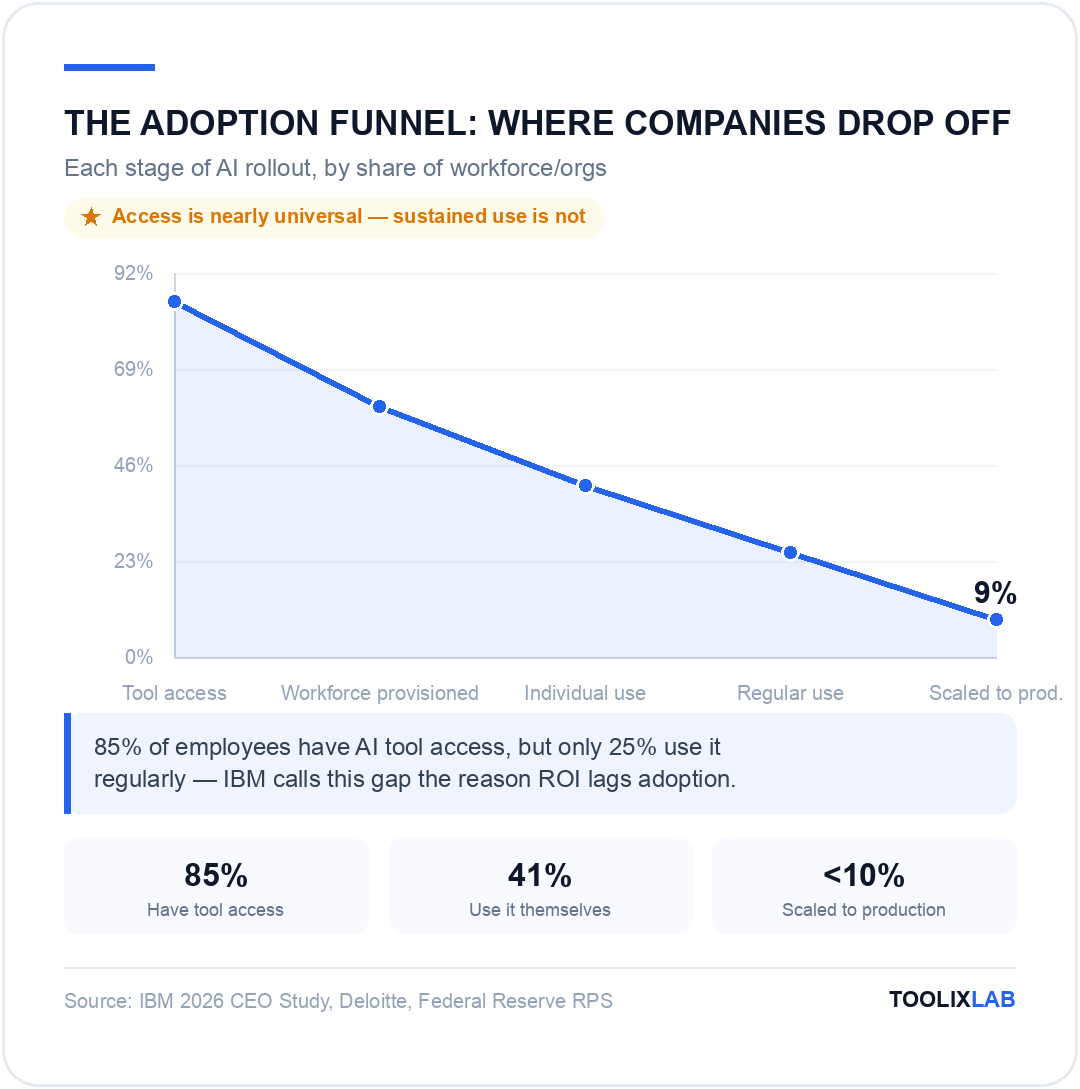
IBM's 2026 Global CEO Study surfaces a specific, named phenomenon inside the broader adoption numbers: 85% of employees now have access to AI tools at work, but only 25% use them regularly — a 60-point gap IBM calls the "AI adoption gap." Companies have already spent heavily on licenses, platforms, and infrastructure to provide that access; the shortfall is behavioral, not technical.
This matters directly for how the other statistics in this piece should be read. When Stanford HAI reports 88% organizational adoption, that number can be true simultaneously with IBM's finding that most individual employees inside those adopting organizations aren't using the tools they've been given. "The company adopted AI" and "employees use AI daily" are compatible facts describing different layers of the same rollout — access is a necessary but not sufficient condition for the productivity gains executives are actually hoping to see, which helps explain why PwC's ROI numbers lag so far behind the headline adoption rate.
The pattern across every finding in this piece: access (85%) > org-level adoption (88%) > workforce tool provisioning (60%) > regular individual use (25%) > scaled production deployment (<10%) > measurable financial ROI (44%, the inverse of PwC's 56% zero-ROI figure). Each stage of that funnel loses a large share of the organizations counted in the stage before it.
Finding #7: Global Consumer Diffusion
Outside the enterprise, consumer-level generative AI adoption is moving faster than any prior technology at a comparable stage: Stanford HAI cites 53% population-level adoption within three years of ChatGPT's public release — faster than the PC or the internet reached the same milestone. Microsoft's Global AI Diffusion Report, built from aggregated and anonymized telemetry rather than self-reported survey data, measured a 1.5 percentage-point jump in a single quarter (Q1 2026), from 16.3% to 17.8% of the world's working-age population using a generative AI product.
Adoption is highly uneven by country. The UAE leads globally at 70.1% of its working-age population, and 26 economies now exceed 30% adoption — but the United States, despite leading in AI investment and frontier model development, ranks outside the top 20 globally by this consumer-usage measure. Microsoft's data also shows a widening gap between the Global North (27.5% usage) and Global South (15.4%), meaning consumer AI diffusion — like enterprise adoption — is uneven rather than uniform, concentrating fastest where digital infrastructure, device penetration, and multilingual model support are already strongest.
Adoption by Definition: Side-by-Side
| Metric | Figure | What It Actually Measures | Source |
|---|---|---|---|
| Org-level adoption | 88% | Any AI use in any business function | Stanford HAI |
| Formal firm adoption (U.S.) | 18% | Firm formally adopted AI as business practice | Federal Reserve BTOS |
| Labor force at AI-using firms | 78% | Employment-weighted, any AI use | Federal Reserve SBU |
| Individual worker GenAI use | 41% | Workers personally using GenAI for work | Federal Reserve RPS |
| Tool access provisioned | 85% | Employees given sanctioned AI tool access | IBM 2026 CEO Study |
| Regular individual use | 25% | Employees who use provisioned AI regularly | IBM 2026 CEO Study |
| Scaled beyond pilot | <10% | AI deployed at production scale, not pilot | Stanford HAI |
| Zero measurable ROI | 56% | CEOs reporting no revenue/cost benefit in 12mo | PwC CEO Survey |
What This Means If You're Deciding Whether to Invest
Three practical conclusions fall out of this data set, regardless of which single headline number you find most persuasive:
"Is AI adoption real?" and "is AI adoption profitable?" are different questions with different answers. The adoption question is settled — 88% organizational use, 41% individual worker use, 53% consumer adoption in three years all point the same direction. The profitability question is not — 56% of CEOs report zero ROI, and fewer than 10% of enterprises have scaled past pilots. Budgeting decisions should be made on the second number, not the first.
The access-vs-use gap is where most wasted AI spend is hiding. IBM's 85%-access-vs-25%-use finding, combined with Deloitte's 37%-surface-level-usage figure, suggests the bottleneck for most organizations isn't tool availability anymore — it's training, workflow redesign, and management follow-through. Companies further along that curve, the kind we cover in our guide to using Claude for business workflows, tend to treat adoption as a change-management problem first and a procurement problem second.
Governance maturity is lagging deployment speed, and that gap is where risk concentrates. Only 21% of enterprises report mature agentic-AI governance despite 74% projected adoption within two years, and Stanford HAI's tracked AI-incident count rose 55% year-over-year. Organizations racing to adopt without building matching governance are the ones most likely to end up inside next year's incident count rather than next year's ROI statistics — a tension we also see playing out in AI threat detection data, where deployment speed and security maturity show a similar mismatch.
None of this data supports either extreme — "AI adoption is mostly hype" or "every company has already captured the AI opportunity." What it supports is a market in the messy middle of a genuine technology shift: access is nearly universal, usage is broad but shallow, and the organizations separating themselves from the pack are the ones closing the specific gaps this data identifies — access to use, pilot to scale, and deployment to governance — rather than the ones simply buying more licenses.
🔑 Key Takeaways
- ✓ 88% of organizations use AI somewhere (Stanford HAI), but fewer than 10% have scaled it past pilots — and the U.S. Federal Reserve's stricter "formal adoption" measure puts firm-level adoption at only 18%
- ✓ 41% of U.S. workers personally use generative AI on the job, often ahead of formal company policy — usage is highest in financial services (63%) and professional services (62%)
- ✓ 25% of Deloitte-surveyed leaders call AI's impact "transformative," but only 30% have actually redesigned processes around it — most usage remains surface-level
- ✓ 56% of CEOs report zero measurable revenue or cost benefit from AI after 12 months (PwC, n=4,454) — adoption and ROI are running on very different timelines
- ✓ IBM's "AI adoption gap" — 85% tool access vs. 25% regular use — is the single best explanation for why adoption stats look so much bigger than ROI stats across every source in this piece