
⚡ TL;DR — Quick Verdict
Ecommerce is one of the most AI-transformed industries of 2026. The combination of abundant customer data, high-volume repetitive operations, and intense competition has made AI not just useful but essential for online stores that want to grow efficiently. According to McKinsey's 2025 ecommerce AI report, online retailers using AI across their operations report 15–35% higher revenue per visitor and up to 50% reduction in customer acquisition costs versus non-AI-enabled competitors.
The challenge for most ecommerce operators isn't finding AI tools — it's knowing which ones solve real problems and deliver genuine ROI versus those that add complexity without results. In 2026, the market is flooded with AI tools making extravagant claims, while a smaller number of genuinely effective tools are quietly driving meaningful revenue impact for the stores using them.
This guide covers the 12 best AI tools for ecommerce businesses in 2026, tested across the highest-impact workflows: product listing optimization, customer personalization, email and SMS marketing, customer support, inventory forecasting, ad creative, SEO, and pricing. Each tool includes current pricing, honest pros and cons, and a clear verdict on which store type and size it serves best.
How AI Is Transforming Ecommerce in 2026
The AI transformation of ecommerce is happening across five distinct dimensions, each with measurable revenue impact:
- →Hyper-personalization at scale — AI analyzes individual customer behavior — browse history, purchase patterns, price sensitivity, channel preferences — and personalizes every touchpoint in real time. What used to require enterprise-level investment now runs on mid-market marketing budgets.
- →Predictive inventory and demand forecasting — AI models incorporating seasonality, external market signals, and historical sales data reduce stockouts and overstock by 20–40%, directly improving cash flow and margins.
- →Automated content creation — Product descriptions, ad copy, email campaigns, and SEO content that previously required a full content team can be generated at scale with AI, dramatically reducing content production costs.
- →Conversational commerce — AI chat tools handle customer inquiries, order status, returns, and product recommendations 24/7, resolving 60–80% of customer contacts without human intervention and improving response times from hours to seconds.
- →Dynamic pricing optimization — AI pricing tools continuously adjust prices based on demand signals, competitor pricing, inventory levels, and customer segments — improving both conversion rates and margins simultaneously.
Understanding which of these dimensions represents your biggest opportunity is the starting point for building an effective ecommerce AI stack.
What to Look for in Ecommerce AI Tools
1. Integration with your platform. An AI tool that doesn't integrate natively with Shopify, WooCommerce, BigCommerce, or your specific platform creates manual data transfer work that negates much of the time savings. Always verify platform compatibility before purchasing.
2. Data requirements and ramp-up time. Many AI personalization and forecasting tools need a minimum amount of historical data to work effectively — typically 3–6 months of transaction history and at least several thousand customers. Understand the data requirements before expecting results from a new tool.
3. Attribution and measurable ROI. Ecommerce tools should be held to revenue metrics. Look for tools that provide clear attribution — revenue generated by AI recommendations, tickets resolved by AI without escalation, conversion lift from personalized experiences — not just usage statistics.
4. Pricing model fit. Some tools charge per seat, others per revenue percentage, others per email sent or per API call. Model your expected usage carefully — a tool that seems affordable at your current scale may become expensive as you grow.
5. Support for your primary traffic channels. An AI email tool is less valuable if email drives only 10% of your revenue. Match AI investment to your highest-traffic, highest-revenue channels first.
The 12 Best AI Tools for Ecommerce in 2026
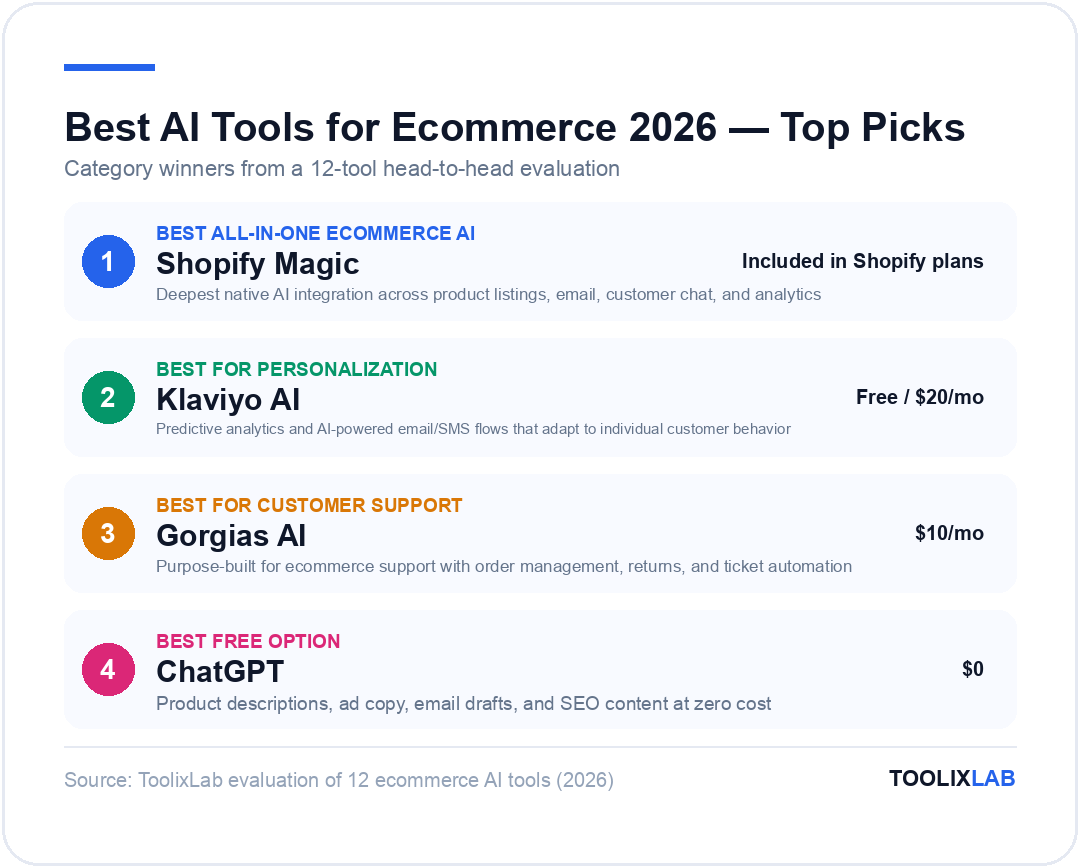
1. Shopify Magic — Best Native AI Suite for Shopify Stores
Shopify Magic is Shopify's native AI product suite, embedded throughout the Shopify platform for merchants on all plans. Unlike third-party tools that integrate via API, Shopify Magic has direct access to your store data — products, orders, customers, analytics — enabling AI features that feel seamlessly integrated rather than bolted on.
The most impactful Shopify Magic features in 2026 are: AI product description generation (writes compelling, SEO-optimized descriptions from product attributes in seconds), AI Inbox (responds to customer chat inquiries automatically with order-specific context), AI email subject line optimization, AI-generated store FAQs, and Shopify Sidekick — an AI business assistant that answers questions about your store data conversationally ("What were my top 5 products by revenue last month?" or "Which customer segments have the highest repeat purchase rate?").
For Shopify merchants, Shopify Magic represents exceptional value because most features are included in existing plan pricing. There's no separate subscription required for core AI features — they're available to all merchants, with more advanced capabilities on higher-tier plans.
| Plan | Price | AI Features Included |
|---|---|---|
| Basic Shopify | $39/month | Product descriptions, Inbox AI, email subject optimization |
| Shopify | $105/month | All above + Sidekick business assistant, advanced analytics AI |
| Advanced | $399/month | Full suite + custom reports, predictive analytics, priority support |
- • Included in Shopify plans — no extra subscription
- • Deep native integration with full store data
- • Sidekick business assistant is genuinely useful for data queries
- • Product description AI saves significant catalog management time
- • AI Inbox resolves customer queries with order-specific context
- • Shopify-only — not available for WooCommerce or BigCommerce
- • Best features require higher-tier plans
- • Less sophisticated than dedicated third-party marketing AI tools
- • Limited customization of AI outputs for brand voice
Best for: Every Shopify merchant — the AI features are included in your existing plan and require zero additional setup. Start with the product description generator and Sidekick; both deliver immediate time savings with no learning curve.
2. Klaviyo AI — Best AI Tool for Email & SMS Personalization
Klaviyo is the dominant email and SMS marketing platform for ecommerce, and its AI features have made the personalization capabilities that were once available only to enterprise retailers accessible to stores of any size. Klaviyo AI analyzes each customer's purchase history, browse behavior, engagement patterns, and predicted lifetime value to personalize every email and SMS touchpoint automatically.
The most impactful Klaviyo AI features are: Predictive Analytics (predicts each customer's next purchase date, predicted lifetime value, and churn risk), Smart Send Time (sends each email when that specific recipient is most likely to open it), AI-powered product recommendations (generates personalized product blocks in emails based on individual customer behavior), and AI subject line and content generation.
What makes Klaviyo AI particularly powerful is that it operates across the entire customer lifecycle — acquisition, activation, retention, win-back — with AI optimizing each stage. A customer who buys running shoes sees an AI-timed, AI-personalized email recommending running socks at the moment they're statistically most likely to buy. A customer showing churn signals receives a personalized retention offer before they leave.
| Plan | Price | Key Features |
|---|---|---|
| Free | $0 | Up to 500 contacts, 500 email sends/month, basic AI features |
| From $20/month | Full AI features, predictive analytics, Smart Send Time, product recs (scales with list size) | |
| Email + SMS | From $45/month | All email AI + SMS AI personalization, conversational SMS |
- • Industry-leading ecommerce email AI with deep Shopify/WooCommerce integration
- • Predictive CLV and churn risk scores genuinely useful for segmentation
- • Smart Send Time measurably improves open rates
- • AI product recommendations increase average order value
- • Large ecosystem of pre-built ecommerce flows and templates
- • Pricing scales steeply with list size — expensive for large lists
- • AI features need 3–6 months of data to reach full accuracy
- • Complex platform — significant learning curve for full utilization
- • Predictive analytics less reliable for stores with low order frequency
Best for: Ecommerce stores with email lists of 1,000+ contacts who want to move beyond broadcast emails to genuinely personalized, behavior-triggered campaigns. Klaviyo's AI delivers clear, measurable revenue uplift for stores that invest in setting it up properly. Our guide on automating email marketing with AI covers complementary strategies for getting the most from Klaviyo.
3. Gorgias AI — Best AI Tool for Ecommerce Customer Support
Gorgias is the leading helpdesk platform built specifically for ecommerce, and its AI automation layer handles the vast majority of routine customer support tickets without human intervention. Unlike generic customer support tools, Gorgias AI is trained on ecommerce-specific scenarios — order status inquiries, shipping delays, return requests, discount code issues, product questions — and has native access to your order management system data.
The AI can handle complete support conversations end-to-end for common ecommerce scenarios: a customer asking "Where is my order?" gets an AI response with their real tracking data and an estimated delivery date, resolved in seconds without agent involvement. Return requests trigger the AI to check eligibility, generate a return label, and update the customer — all automatically. Gorgias reports that stores using AI automation resolve 60% of tickets without any human involvement.
The AI also performs revenue-generating actions during support conversations — offering order upsells, suggesting related products, and applying discount codes to convert fence-sitting customers, turning customer support from a cost center into a revenue channel.
| Plan | Price | Key Features |
|---|---|---|
| Starter | $10/month | 3 agents, 50 tickets/month, basic AI responses |
| Basic | $60/month | Unlimited agents, 300 tickets/month, full AI automation, order management integration |
| Pro | $360/month | 2,000 tickets/month, revenue stats, advanced automation, Shopify integration depth |
- • Purpose-built for ecommerce — handles order-specific scenarios natively
- • 60%+ ticket automation rate once fully configured
- • Revenue-generating AI during support conversations
- • Deep Shopify/WooCommerce/BigCommerce integration
- • Centralizes all support channels (email, chat, SMS, social) in one inbox
- • Ticket-based pricing becomes expensive at high volumes
- • Initial setup and AI training requires significant time investment
- • AI can handle complex edge cases poorly — requires human fallback rules
- • Per-ticket overage fees can create billing surprises during peak periods
Best for: Ecommerce stores handling 300+ customer support tickets per month who are spending disproportionate staff time on routine order status and returns inquiries. The ROI becomes clear when AI automation replaces the need for 1–2 full-time support agents.
4. Jasper AI — Best AI Tool for Ecommerce Content & Product Copy
Jasper AI is the leading AI writing tool for marketing teams, and for ecommerce businesses it excels at the high-volume content creation tasks that drive traffic and conversion: product descriptions, category page copy, ad creative, email campaigns, blog posts for SEO, and social media content. Unlike general AI tools, Jasper's Brand Voice feature allows you to train the AI on your specific brand tone, vocabulary, and messaging — so product descriptions for a luxury skincare brand sound fundamentally different from those for a budget outdoor gear retailer.
For ecommerce stores with large catalogs, Jasper's batch content generation capability is particularly valuable. Rather than writing 500 product descriptions one by one, you can generate them in batch from product attribute spreadsheets, review for accuracy, and push to your catalog at scale. The time savings for catalog-intensive operations are substantial.
| Plan | Price | Key Features |
|---|---|---|
| Creator | $49/month | 1 Brand Voice, unlimited words, 50+ templates |
| Pro | $69/month | 3 Brand Voices, SEO mode with Surfer integration, 3 seats |
| Business | Custom | Unlimited Brand Voices, API access, custom workflows, SSO |
Best for: Ecommerce stores with 100+ SKUs needing consistent, on-brand product copy at scale, and marketing teams producing high-volume ad creative and email content. For a deeper look at Jasper's capabilities, see our Jasper AI review.
5. Nosto — Best AI Tool for Onsite Personalization
Nosto is an AI-powered ecommerce personalization platform that dynamically personalizes every visitor's onsite experience — product recommendations, category page sorting, search results, banners, and pop-ups — based on real-time behavioral data. Unlike email personalization that operates between sessions, Nosto operates during the session itself, adjusting what each visitor sees in real time based on their browse behavior, purchase history, and predictive affinity scores.
The product recommendation engine is Nosto's core capability: on a product page, it dynamically generates "Customers Also Bought," "You May Also Like," and "Recently Viewed" sections personalized to each visitor rather than showing static best-sellers. Studies consistently show that AI-personalized product recommendations increase average order value by 10–30% versus static recommendations.
Nosto also personalizes search results, category page product ordering, and merchandising rules — ensuring that each visitor sees the products most relevant to them at the top of every page they visit.
| Plan | Price | Key Features |
|---|---|---|
| Essential | From ~$99/month | AI product recommendations, behavioral segmentation, A/B testing |
| Advanced | Custom (typically % of influenced revenue) | Full onsite personalization, category/search personalization, advanced analytics |
Best for: Mid-to-large ecommerce stores (typically $1M+ annual revenue) with broad product catalogs where personalized recommendations can meaningfully improve average order value and conversion rate. ROI becomes measurable within 60–90 days of proper implementation.
6. Triple Whale — Best AI Tool for Ecommerce Analytics & Attribution
Triple Whale is an AI-powered ecommerce analytics and attribution platform built specifically for direct-to-consumer brands. As third-party cookies have degraded and iOS privacy changes have made Facebook and Google attribution increasingly unreliable, Triple Whale's first-party data approach and AI attribution modeling have become essential for understanding which marketing channels actually drive revenue.
Triple Whale's AI features include: Moby (an AI analytics assistant that answers questions about your store data in natural language), creative analytics (AI analysis of which ad creatives drive the best ROAS by cohort), predictive ROAS modeling, and AI-powered customer journey mapping that traces the actual path from first touch to purchase across channels.
For ecommerce brands spending significantly on paid social and search, understanding true ROAS with reliable attribution is the foundation of efficient scaling. Triple Whale's AI provides this clarity in a way that platform-native analytics (Facebook Ads Manager, Google Analytics) cannot.
| Plan | Price | Key Features |
|---|---|---|
| Founders Dash | Free | Core store analytics, basic attribution, summary dashboard |
| Growth | From $129/month | Full AI attribution, Moby AI assistant, creative analytics, cohort analysis |
| Pro | From $279/month | Predictive analytics, advanced modeling, custom integrations |
Best for: DTC brands spending $10,000+/month on paid social (Meta, TikTok) and search who need reliable attribution to make scaling decisions. If you're flying blind on ROAS due to iOS attribution issues, Triple Whale's AI modeling is the clearest path to understanding your real marketing efficiency.
7. Octane AI — Best AI Tool for Ecommerce Quizzes & Zero-Party Data
Octane AI is a specialized ecommerce AI platform built around product recommendation quizzes and zero-party data collection. A product quiz — "Find Your Perfect Skincare Routine" or "Which Running Shoe Is Right for You?" — guides customers through their preferences and needs, then recommends the most relevant products with a personalized explanation.
Product recommendation quizzes built with Octane AI consistently deliver 5–15x higher conversion rates versus standard browse-and-buy experiences, because customers arrive at a specific product recommendation that feels personally selected rather than browsing a generic catalog. The quiz responses also build a rich zero-party data profile for each customer that powers personalized email and SMS follow-up sequences.
In a landscape where third-party data is increasingly restricted, Octane AI's zero-party data approach — customers voluntarily sharing preferences in exchange for personalized recommendations — is one of the highest-quality data collection methods available to ecommerce brands.
| Plan | Price | Key Features |
|---|---|---|
| Basic | $50/month | 1 quiz, unlimited responses, Klaviyo/email integration |
| Growth | $200/month | Unlimited quizzes, AI quiz builder, advanced segmentation, Shopify sync |
Best for: Ecommerce brands with products that benefit from personalized matching — skincare, supplements, apparel, footwear, home goods, pet products. Particularly effective for acquisition campaigns where quiz completion replaces traditional lead capture and delivers warmer, more qualified traffic into the funnel.
8. Yotpo AI — Best AI Tool for Reviews, Loyalty & UGC
Yotpo is the leading AI-powered platform for ecommerce social proof — reviews, ratings, loyalty programs, and user-generated content (UGC). Its AI features in 2026 include: automated review request timing (AI determines when each customer is most likely to respond to a review request based on purchase satisfaction signals), AI review sentiment analysis (automatically categorizes themes across thousands of reviews), AI-powered loyalty program personalization, and UGC rights management automation.
The AI review analysis capability is particularly valuable for merchandising and product development decisions. Rather than reading thousands of individual reviews, Yotpo AI surfaces the most common themes — "mentions fast shipping," "frequently references size running small," "high praise for packaging" — giving you actionable product and operational insights at scale.
| Plan | Price | Key Features |
|---|---|---|
| Free | $0 | 50 orders/month review requests, basic widgets |
| Starter | From $79/month | Unlimited reviews, AI sentiment analysis, Google Shopping syndication |
| Pro | Custom | Full AI suite, loyalty + reviews + UGC, SMS integration |
Best for: Ecommerce brands for whom social proof is a primary conversion driver — particularly beauty, health, apparel, and consumer goods categories where reviews heavily influence purchase decisions. The AI review analysis provides product development insights that extend well beyond marketing value.
9. Alli AI — Best AI Tool for Ecommerce SEO
Alli AI is an AI-powered SEO automation platform that handles large-scale on-page SEO optimization — the kind of work that's critical for ecommerce stores with thousands of product and category pages but impossible to execute manually at that scale. Alli AI deploys directly to your site and makes bulk SEO changes — meta titles, descriptions, heading structures, schema markup, internal linking — automatically based on its AI recommendations, without requiring developer involvement for each change.
For ecommerce stores, the highest-impact Alli AI applications are: bulk product page meta optimization (generates and deploys SEO-optimized title tags and meta descriptions for every product page), category page heading optimization, schema markup deployment for product rich results, and internal linking automation that builds contextual links across your catalog at scale.
| Plan | Price | Key Features |
|---|---|---|
| Accelerate | $299/month | 1 site, bulk meta optimization, live editor, basic automation |
| Scale | $599/month | 3 sites, schema automation, internal linking AI, A/B testing |
Best for: Ecommerce stores with 500+ product pages whose organic traffic is significantly limited by poor on-page SEO rather than by link authority. The ability to deploy bulk SEO changes without developer resources is especially valuable for Shopify and WooCommerce stores without in-house technical SEO capability.
10. Repricer.com — Best AI Tool for Dynamic Pricing
Repricer.com is an AI-powered dynamic pricing tool primarily for marketplace sellers (Amazon, eBay, Walmart) that continuously monitors competitor pricing and adjusts your prices automatically to maintain competitive positioning while protecting margins. The AI sets repricing rules that balance competitive price position against your minimum acceptable margin, winning the Buy Box on Amazon without racing to the bottom on price.
The AI learns which price points maximize your sales velocity and margin simultaneously — recognizing, for example, that pricing 2% below the Buy Box winner outperforms matching their price, or that premium positioning 5% above competitors on certain SKUs actually improves conversion due to quality perception. This intelligence compounds over time as the AI accumulates data on your specific products and competitive landscape.
| Plan | Price | Key Features |
|---|---|---|
| Starter | $79/month | 1 marketplace, up to 2,500 SKUs, AI repricing rules |
| Business | $199/month | Multiple marketplaces, unlimited SKUs, advanced AI strategies |
Best for: Amazon and marketplace sellers competing in price-sensitive categories. If you're losing Buy Box share to competitors with marginally lower prices, AI repricing typically pays for itself within days through improved sales velocity.
11. AdCreative.ai — Best AI Tool for Ecommerce Ad Creative
AdCreative.ai generates conversion-optimized ad creatives — static images, video scripts, and copy — for ecommerce brands running paid social and search campaigns. The AI analyzes top-performing ad creative patterns across thousands of campaigns and generates new creative variants calibrated to your product category, audience, and platform (Facebook, Instagram, Google Display, TikTok).
The platform generates a complete set of ad creatives — multiple aspect ratios, multiple headline/body copy variants, multiple visual compositions — from a single product image and brief description. For ecommerce brands running continuous paid acquisition, the ability to generate a week's worth of fresh creative variants in minutes rather than days dramatically reduces creative fatigue and testing cycles.
| Plan | Price | Key Features |
|---|---|---|
| Starter | $29/month | 10 credits/month, static ads, copy generation |
| Professional | $141/month | Unlimited credits, video scripts, competitor analysis, API access |
Best for: Ecommerce brands running paid social campaigns who struggle with creative production volume and testing cadence. The cost of a month's unlimited creative generation is typically less than a single hour of freelance creative work.
12. Zapier — Best AI Workflow Automation for Ecommerce Operations
As with every industry, Zapier multiplies the value of every other tool in your ecommerce stack by automating the data handoffs between them. Common ecommerce automations: new Shopify order → create fulfillment task in project management tool → send personalized confirmation in Klaviyo → update inventory spreadsheet. Abandoned cart in Shopify → trigger Klaviyo abandoned cart sequence → notify sales rep if cart value exceeds threshold. New 1-star review in Yotpo → alert customer success team in Slack → create support ticket in Gorgias.
The AI actions in Zapier's current platform allow you to add intelligence to these automations — classifying inbound customer inquiries, extracting data from unstructured email content, generating personalized responses from templates, and making routing decisions based on content analysis. For ecommerce operators managing complex multi-tool stacks, Zapier is the connective tissue that makes everything work together. See our deep dive on workflow automation tools for small business for more automation strategies applicable to ecommerce operations.
| Plan | Price | Key Features |
|---|---|---|
| Free | $0 | 100 tasks/month, 5 Zaps, single-step automations |
| Professional | $19.99/month | 750 tasks, multi-step Zaps, AI steps, filters, paths |
| Team | $69/month | 2,000 tasks, shared workspace, premium app connections |
Best for: Any ecommerce operation using 3+ tools that currently transfers data manually between them. Start free, build your highest-value automation first, then expand.
Complete Comparison: All 12 Ecommerce AI Tools
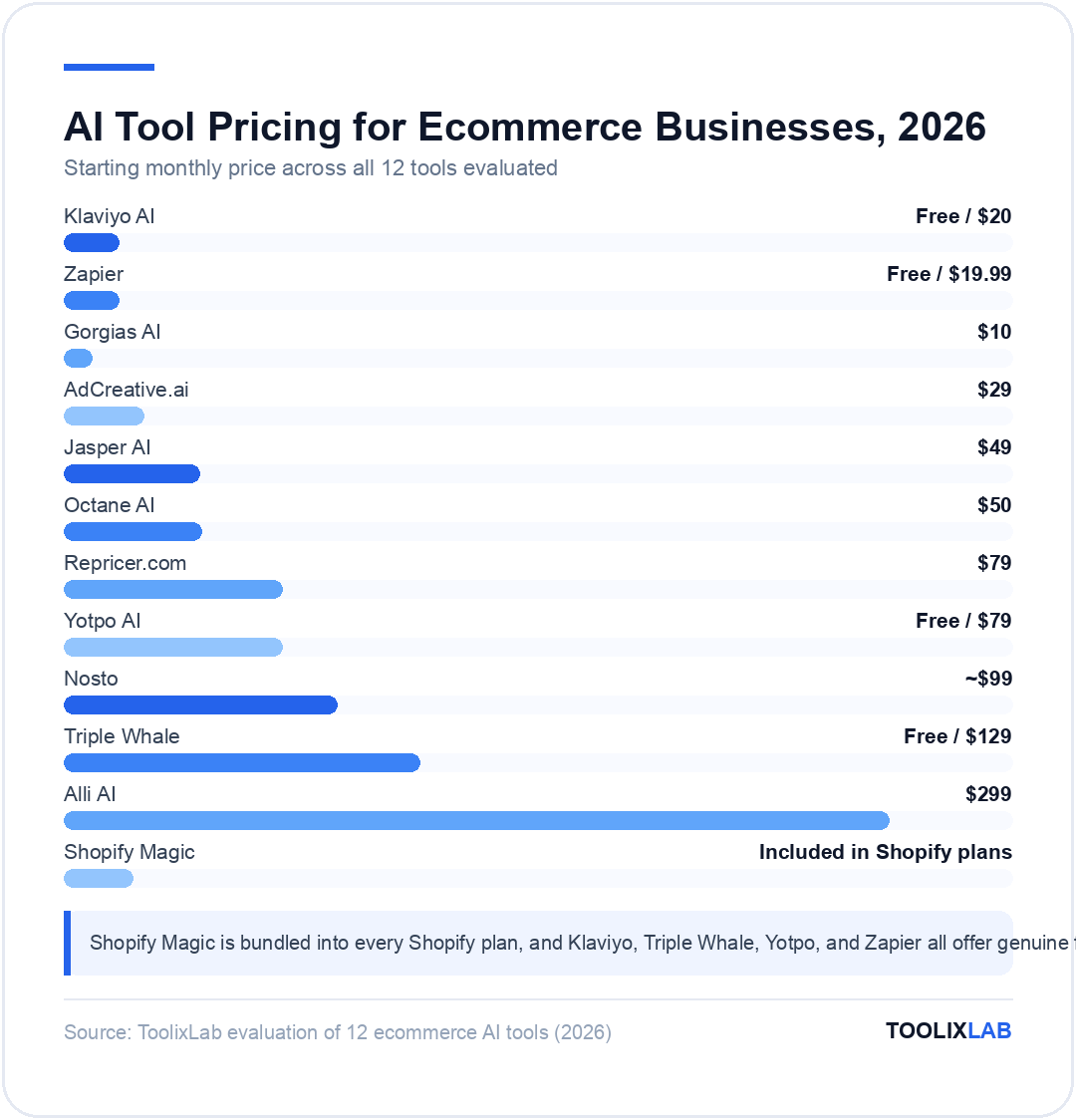
| Tool | Primary Use Case | Starting Price | Free Plan | Best For |
|---|---|---|---|---|
| Shopify Magic | Native AI suite | Included in Shopify plans | ✅ | All Shopify merchants |
| Klaviyo AI | Email/SMS personalization | Free / $20/month | ✅ | All ecommerce stores |
| Gorgias AI | Customer support | $10/month | ❌ | 300+ tickets/month stores |
| Jasper AI | Content & product copy | $49/month | ❌ | Large catalog stores |
| Nosto | Onsite personalization | ~$99/month | ❌ | $1M+ revenue stores |
| Triple Whale | Analytics & attribution | Free / $129/month | ✅ | DTC paid social spenders |
| Octane AI | Quizzes & zero-party data | $50/month | ❌ | Personalizable product brands |
| Yotpo AI | Reviews, loyalty & UGC | Free / $79/month | ✅ | Social proof-driven stores |
| Alli AI | Ecommerce SEO | $299/month | ❌ | 500+ page stores |
| Repricer.com | Dynamic pricing | $79/month | ❌ | Amazon/marketplace sellers |
| AdCreative.ai | Ad creative generation | $29/month | ❌ | Paid social advertisers |
| Zapier | Workflow automation | Free / $19.99/month | ✅ | Multi-tool operators |
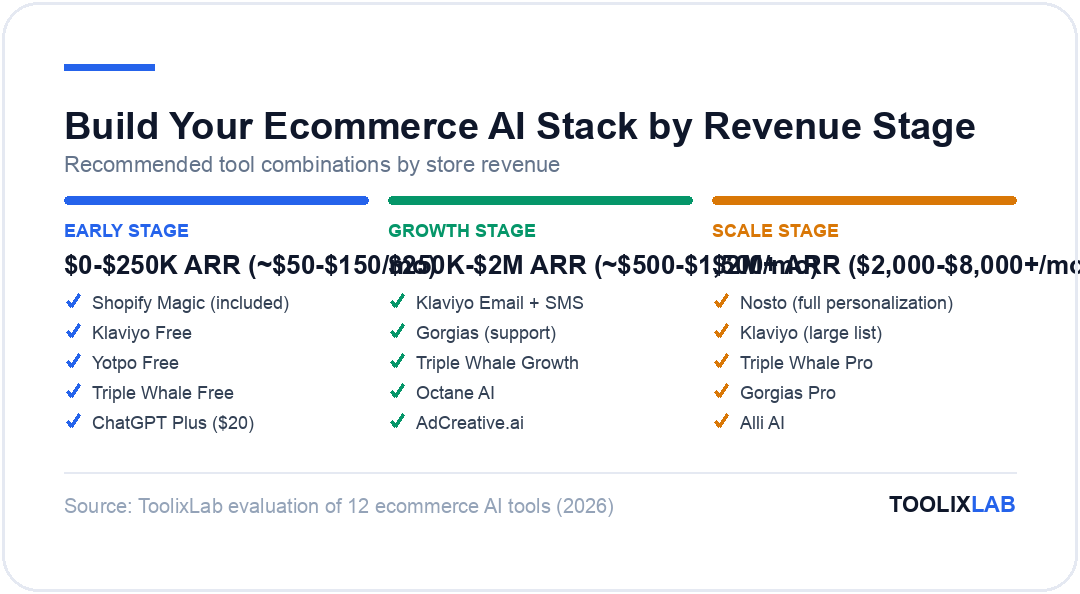
Building Your Ecommerce AI Stack by Revenue Stage
- ✓ Shopify Magic (included)
- ✓ Klaviyo Free → paid as list grows
- ✓ Yotpo Free (reviews)
- ✓ Triple Whale Free (analytics)
- ✓ ChatGPT Plus ($20) for content
- ✓ Zapier Free (basic automation)
- ✓ Klaviyo Email + SMS
- ✓ Gorgias (support automation)
- ✓ Triple Whale Growth (attribution)
- ✓ Octane AI (quiz personalization)
- ✓ Yotpo Starter (reviews + loyalty)
- ✓ AdCreative.ai
- ✓ Nosto (full personalization)
- ✓ Klaviyo (large list)
- ✓ Triple Whale Pro
- ✓ Gorgias Pro
- ✓ Alli AI (SEO at scale)
- ✓ Jasper Business (content)
The Most Common Ecommerce AI Mistakes
After working with ecommerce brands adopting AI tools, several patterns of underperformance emerge consistently:
Mistake 1: Buying personalization AI before you have enough data. AI personalization tools need sufficient purchase history — typically 10,000+ transactions — to generate meaningful predictions. Deploying Nosto or a sophisticated personalization tool on a store with 500 orders produces random-feeling recommendations, not intelligent ones. Match your tool sophistication to your data maturity.
Mistake 2: Automating customer support before configuring it properly. Poorly configured support AI sends wrong tracking information, misapplies discount codes, or gives incorrect return policy answers. A bad AI support experience is worse than a slow human one. Invest the setup time to get Gorgias or similar tools properly configured before enabling full automation.
Mistake 3: Using AI for product descriptions without brand voice training. Generic AI product descriptions feel generic. The value of tools like Jasper's Brand Voice or custom ChatGPT instructions is that they produce output that sounds like your brand. Invest 30 minutes training the AI on your tone and vocabulary — the output quality difference is significant.
Mistake 4: Measuring AI tools by activity metrics instead of revenue metrics. An AI email tool that sends 100,000 emails per month is only valuable if those emails drive revenue. Measure AI marketing tools by revenue per email sent, not by email volume or open rates alone. Measure AI support tools by ticket deflection rate and customer satisfaction, not just tickets closed.
Which Ecommerce AI Tools Should You Start With?
Our Recommendation by Priority
AI won't fix a product people don't want or a broken customer experience — but for ecommerce businesses with genuine product-market fit, the right AI tools compress the time between product launch and profitable scale. The brands winning in 2026 are those who treat AI as operational infrastructure, not a marketing buzzword, and systematically eliminate the inefficiencies that slow growth at every stage.
🔑 Key Takeaways
- ✓Shopify Magic + Klaviyo Free is the highest-value zero-incremental-cost AI stack for any Shopify store — activate both before purchasing any paid AI tools
- ✓Match AI tool sophistication to your data maturity — personalization AI underperforms without sufficient purchase history, typically 10,000+ transactions
- ✓Gorgias AI support automation delivers clear, measurable ROI once you're handling 300+ monthly tickets — the labor cost savings are immediate and quantifiable
- ✓Measure AI tools by revenue metrics, not activity metrics — revenue per email, ticket deflection rate, conversion lift from personalization
- ✓For paid social spenders, reliable AI attribution (Triple Whale) is the foundation — you can't scale efficiently if you don't know which channels actually work
Related Guides
- Best AI Tools for Customer Support in 2026 — a deeper dive into the support automation layer, beyond Gorgias.
- Best AI Marketing Tools in 2026 — the full marketing stack that pairs with your store's AI tooling.
- How to Automate Social Media with AI — turn product launches into a repeatable social pipeline.