
The legal profession is one of the industries where billing by the hour still dominates — which makes AI an uncomfortable but unavoidable conversation. Adoption is accelerating, especially in research, drafting, knowledge management, and matter support workflows. The firms that adopted AI early aren't just saving time on drafts and research. They're handling higher caseloads, reducing write-offs, and winning more clients. The ones that haven't are falling behind.
This guide covers the best AI tools for lawyers and solicitors in 2026 — whether you're a solo practitioner, a boutique firm, or part of a large practice. We've reviewed tools across legal research, contract drafting, practice management, and eDiscovery, so you can skip the noise and pick what actually fits your work.
⚡ Quick Summary
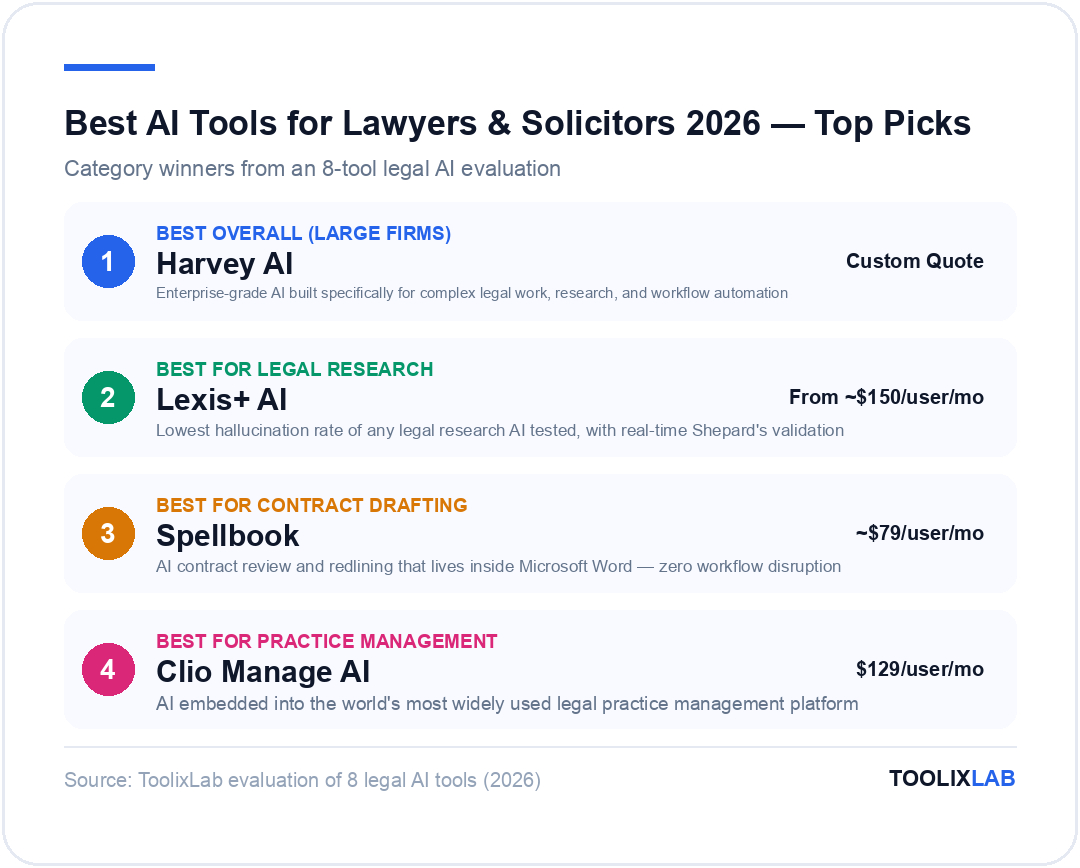
Best overall (large firms): Harvey AI
Best for legal research: Lexis+ AI
Best for contract drafting: Spellbook
Best for practice management: Clio Manage AI
Best for small/boutique firms: Smokeball + Archie AI
Best free starting point: ChatGPT
Jump to: Tool Reviews | Comparison Table | Which Tool Should You Choose?
What to Look for in a Legal AI Tool
Not all AI tools are built for legal work, and the wrong choice can create more problems than it solves. Before shortlisting anything, you need to be clear on what your practice actually needs:
- →Accuracy and citation quality. Legal AI that hallucinates case references is worse than useless. Prioritise tools that ground answers in verified databases with proper citations.
- →Jurisdiction coverage. A US-first tool may be limited for UK solicitors. Check whether the tool covers your jurisdiction before committing.
- →Data security and confidentiality. Your client data cannot be used to train external AI models. Look for strong security documentation, customer data isolation, and clear data processing agreements.
- →Workflow fit. The best tool is the one that fits inside how you already work — whether that's Microsoft Word, a case management system, or a browser interface.
- →Practice area specificity. A litigator needs different AI capabilities than a conveyancing solicitor. Generalist tools are a starting point; specialist tools deliver better ROI.
With those criteria in mind, here are the best AI tools for lawyers and solicitors in 2026.
Best AI Tools for Lawyers & Solicitors in 2026
1. Harvey AI — Best for Large Law Firms
Enterprise-grade AI built specifically for complex legal work
Harvey AI has become one of the most visible names in enterprise legal AI. Built on top of advanced language models and fine-tuned for legal workflows, it is aimed squarely at large firms and in-house legal teams that need research, drafting, document analysis, and controlled internal workflows in one environment.
Harvey handles research, contract analysis, due diligence, drafting, and workflow automation. Its Knowledge module delivers grounded legal research with accurate citations, while Vault lets firms securely upload and interrogate large document sets. The Workflow Builder is particularly powerful — firms can design repeatable AI workflows for contract review or due diligence, embedding firm-specific expertise directly into the process. Recent updates have also brought deeper integrations with practice management and billing platforms via partnerships with companies like Aderant.
Key Features
- • Harvey Assistant: tuned for legal, regulatory, and tax domains
- • Knowledge module: rapid research with grounded citations
- • Vault: secure upload and analysis of large document volumes
- • Workflow Builder: design repeatable AI workflows for high-volume work
- • Deep integrations with billing and practice management platforms
- • Multi-jurisdiction and language support should be confirmed during procurement
| Plan | Price | Key Features |
|---|---|---|
| Enterprise | Custom Quote | Full platform, custom workflows, dedicated support, Vault, integrations |
✅ Pros
- • Purpose-built for complex, high-volume legal work
- • Exceptional document analysis and contract review capabilities
- • Workflow automation that embeds firm-specific expertise
- • Strong security and enterprise compliance standards
❌ Cons
- • Pricing is enterprise-only — not for small firms or solo practitioners
- • Requires dedicated onboarding and IT involvement
- • Overkill for mixed boutique practices
🎯 Best for: Large firms and in-house legal teams with complex, high-volume workflows
2. Lexis+ AI — Best for Legal Research
The most trusted AI-powered research platform, grounded in verified legal databases
For legal research, Lexis+ AI is the benchmark. It combines LexisNexis's vast proprietary legal database — including Halsbury's Laws and All England Law Reports for UK solicitors — with a conversational AI interface powered by Protege, its personalised AI assistant. Every answer is validated in real time using Shepard's Citations (US) or the equivalent UK standards, which matters enormously when your research needs to hold up in court.
A Stanford Law School study found Lexis+ AI had a 17% hallucination rate, compared to 34% for Westlaw's AI-Assisted Research — a meaningful accuracy edge in a profession where one bad citation can cost a client their case. The platform also includes a Brief Analysis tool that reviews legal documents in minutes, surfaces missing precedents, and validates citations. Judicial Analytics adds another layer of value: it profiles judges' ruling patterns so you can craft more targeted arguments.
Key Features
- • Conversational legal research with real-time Shepard's validation
- • Brief Analysis tool — identifies missing precedents and validates citations
- • Judicial Analytics — profiles judges' ruling patterns and preferences
- • Protege AI assistant for document drafting and analysis
- • Full UK legal database coverage including Halsbury's Laws
- • Jurisdiction-specific compliance checking
| Plan | Price | Key Features |
|---|---|---|
| Lexis+ AI (base) | From ~$150/user/mo | Conversational research, Shepard's validation, document drafting |
| Enterprise / Firm | Custom Quote | Full database access, Judicial Analytics, Brief Analysis, integrations |
✅ Pros
- • Lowest hallucination rate of any legal research AI tested
- • Comprehensive UK and US database coverage
- • Judicial Analytics is genuinely differentiated — no competitor has this
- • Trusted brand in legal — minimal internal pushback from senior lawyers
❌ Cons
- • Expensive — pricing not transparent for solo/small firms
- • Primarily a research tool; limited practice management features
- • UI is more functional than intuitive for non-research tasks
🎯 Best for: Litigators, barristers, research-heavy practices, any firm where citation accuracy is non-negotiable
3. Spellbook — Best for Contract Drafting & Review
AI contract review that lives inside Microsoft Word — zero workflow disruption
If transactional work — M&A, commercial contracts, employment agreements, leases — makes up a significant chunk of your practice, Spellbook is the most frictionless AI upgrade you can make. It operates as a Microsoft Word add-in, meaning it lives in the sidebar of the tool you're already using. There's no new platform to learn, no copy-pasting between interfaces, and no disruption to your existing document management setup.
Powered by advanced AI, Spellbook drafts, reviews, and redlines contracts, suggests relevant clauses, flags non-standard terms, and benchmarks agreements against market standards. Over 4,000 legal teams across 80+ countries use the platform, and it has reviewed more than 10 million contracts since launch — that's a meaningful training signal for the suggestions it makes. For solicitors doing commercial or residential property work, employment law, or M&A advisory, the productivity gains are immediate.
Key Features
- • Microsoft Word add-in — no platform switching required
- • Automated redlines and clause suggestions powered by advanced AI
- • Market benchmarking — flags non-standard or unusual terms
- • Frequently-used clause library for fast retrieval
- • Risk flagging with explanatory notes for client communication
- • Available across 80+ countries with localised contract context
| Plan | Price | Key Features |
|---|---|---|
| Starter | Free trial available | Core drafting and review, Word add-in, basic clause library |
| Professional | ~$79/user/mo | Unlimited reviews, market benchmarking, redlines, priority support |
| Enterprise | Custom Quote | Custom clause libraries, team workflows, admin controls, SSO |
✅ Pros
- • Minimal workflow disruption — works inside Word
- • Fast ROI for high-volume contract practices
- • Accessible pricing for small and mid-size firms
- • Free trial with no credit card required
❌ Cons
- • Only covers transactional work — no litigation or research support
- • No post-signature contract management
- • Won't help with practice management, scheduling, or billing
Spellbook — AI Contract Review in Microsoft Word
Trusted by 4,000+ legal teams worldwide. Draft, redline, and review contracts without leaving Word.
🎁 Free trial available — no credit card required
🎯 Best for: Commercial solicitors, transactional lawyers, employment law, property/conveyancing practices
4. Clio Manage AI — Best for Practice Management
AI embedded into the world's most widely used legal practice management platform
Clio Manage AI (formerly Clio Duo) is the AI layer built directly into Clio Manage — the most widely used cloud practice management platform in the legal sector, with over 150,000 legal professionals across 130+ countries. What makes this different from most legal AI is that it's embedded into the workflows you already use for scheduling, billing, client communication, and case management. You're not adding a new tool. You're making your existing tool smarter.
Manage AI goes well beyond summarisation. It extracts deadlines from documents and converts them into calendar items automatically, generates invoices from activity data, drafts client updates, and surfaces matter-relevant information when you need it. For firms that have been running on Clio for years, the AI integration feels native — because it is. If you're not already on Clio, the combined platform is one of the most complete legal practice + AI stacks available for small to mid-size firms.
Key Features
- • AI embedded into scheduling, billing, and case management
- • Automatic deadline extraction and calendar creation from documents
- • Invoice generation from activity data
- • AI-drafted client updates and correspondence
- • Clio Work: research and drafting workspace integrated with Manage
- • 130+ country coverage, cloud-native, SOC 2 compliant
| Plan | Price/user/mo | Key Features |
|---|---|---|
| EasyStart | $49 | Case management, document storage, basic billing |
| Essentials | $79 | + Time tracking, integrations, reporting |
| Advanced (incl. Manage AI) | $129 | + AI features, advanced automation, client portal, priority support |
✅ Pros
- • AI that enhances your existing practice management, not a separate tool
- • Excellent for small and mid-size firms with mixed practices
- • Transparent, accessible pricing
- • Strong track record and large user base
❌ Cons
- • AI features require the Advanced plan — adds cost
- • Not a standalone legal research tool
- • Platform lock-in once your firm's data is in Clio
🎯 Best for: Small to mid-size firms wanting an all-in-one practice management + AI stack
5. CoCounsel (Thomson Reuters) — Best for Research & Case Prep
AI legal assistant trained specifically on legal data, backed by Thomson Reuters' content library
CoCounsel, developed by Casetext and now owned by Thomson Reuters, is an AI-powered legal tool trained on legal data and backed by Thomson Reuters' proprietary content library. Unlike ChatGPT applied to legal tasks, CoCounsel operates on dedicated servers — meaning your firm's data isn't sent to train the public model. For data-sensitive practices, that distinction matters.
Its key strengths are legal research, brief and document drafting, and document review workflows. You can ask complex legal questions in plain English, receive grounded answers with citations, and use the tool to review contracts or documents against specific checklists. For firms focused on research speed and case preparation accuracy, CoCounsel sits comfortably alongside Lexis+ AI as a top-tier option — particularly for firms already embedded in the Westlaw/Thomson Reuters ecosystem.
Key Features
- • Natural language legal research grounded in Thomson Reuters content
- • Brief and memo drafting with lawyer-controlled final edits
- • Document review against specific instructions or checklists
- • Data privacy: dedicated servers, client data not used for model training
- • Deep integration with Westlaw for firms already on that platform
- • Rigorously tested by attorneys and AI specialists before deployment
| Plan | Price | Key Features |
|---|---|---|
| CoCounsel Core | From ~$100/user/mo | Legal research, drafting, document review, dedicated data environment |
| Enterprise | Custom Quote | Full Thomson Reuters ecosystem, custom integrations, advanced analytics |
✅ Pros
- • Strong data privacy guarantees with dedicated server model
- • Excellent for firms already using Westlaw
- • Rigorous accuracy testing — purpose-built for legal professionals
- • Handles both research and document review in one platform
❌ Cons
- • Works best as part of the wider Thomson Reuters/Westlaw ecosystem
- • Less compelling as a standalone tool vs Lexis+ AI on pure research
- • Limited value for firms outside the US on lower-tier plans
🎯 Best for: Mid-size to large firms already on Westlaw, litigators, in-house teams with research-heavy workloads
6. Smokeball + Archie AI — Best for Small Firms Transitioning to AI
Practice management plus matter-aware AI in a privacy-first environment
Smokeball is a cloud-based practice management platform designed specifically for small law firms — and Archie AI is the intelligence layer that sits on top of it. What makes this combination work well for smaller practices is the privacy-first architecture: Archie AI operates in a ring-fenced environment, and client data is not shared outside Smokeball or used to train external models. For solicitors handling sensitive client matters with no dedicated IT support, that's a meaningful safeguard.
On the functionality side, Archie is matter-aware — it can answer questions about a specific case, search within documents stored in a matter, surface relevant information, and help draft client correspondence. It also adjusts tone to match the firm, client, or situation, which sounds minor but saves meaningful time when you're communicating across multiple client relationships with different registers.
Key Features
- • Matter-aware AI that answers questions about specific cases
- • Document search and summarisation within matters
- • Tone-adjustable client correspondence drafting
- • Ring-fenced data — client data stays within Smokeball
- • Time tracking, billing, and case management all in one platform
- • Designed for small firms with no dedicated IT team
| Plan | Price | Key Features |
|---|---|---|
| Smokeball Grow + Archie | Custom Quote (small firm pricing) | Full practice management + Archie AI, matter-aware assistant, privacy-first |
✅ Pros
- • Privacy-first architecture — strong data security for small firms
- • Matter-aware AI is genuinely useful on a day-to-day basis
- • Good fit for boutique and mixed practice solicitor firms
- • Designed for non-technical users with minimal onboarding
❌ Cons
- • Platform lock-in — AI only works within Smokeball
- • Not a legal research tool; limited analytical depth
- • Less feature-rich than Clio for larger teams
🎯 Best for: Solo practitioners and small solicitor firms wanting a privacy-safe all-in-one starting point
7. Lex Machina — Best for Litigation Analytics
Real court data on judges, opposing counsel, and litigation outcomes
Lex Machina occupies a narrow but high-value niche: litigation analytics. If you're in active litigation, it gives you something no research tool can — how judges actually behave in court, not just what the law says they should do. It profiles judges' ruling patterns, tracks opposing counsel's win rates and strategies, and maps outcomes by case type, jurisdiction, and party. You're not just reading case law; you're making data-driven strategic decisions.
This is primarily a US-focused tool, and pricing is premium — making it better suited for litigation-heavy practices where marginal advantages in strategy directly affect case outcomes and client retention. If intellectual property, patent disputes, or complex commercial litigation is your bread and butter, Lex Machina is a serious edge.
Key Features
- • Judge analytics — ruling patterns, tendencies, and preferences
- • Opposing counsel profiling — win rates, strategies, case history
- • Outcome predictions based on real case data
- • Visualisations for case strategy and client presentations
- • Coverage across IP, patent, antitrust, employment, and more
- • Part of the LexisNexis ecosystem
✅ Pros
- • Unique litigation intelligence — no direct competitor for judge/counsel profiling
- • Genuinely useful for pre-trial strategy and client advice
- • Visualisations make complex data accessible for partners and clients
❌ Cons
- • Primarily US-focused — limited value for UK solicitors
- • Premium pricing; not justified for low-volume litigation practices
- • Narrow use case — not a general-purpose legal AI
🎯 Best for: US litigation firms, IP lawyers, BigLaw litigation groups, firms with active court calendars
8. ChatGPT — Best Free Starting Point
The Swiss Army knife of AI — not legal-specific, but already part of every lawyer's workflow
Let's be honest: most lawyers are already using ChatGPT, even if they haven't told their managing partner. It's used for first-pass drafts, summarising long documents, rephrasing boilerplate, and generating research starting points. With over 700 million weekly active users globally, it's become the de facto AI entry point for every profession — and law is no exception.
The important caveats are real, though. ChatGPT is not trained on legal data. It has no jurisdiction-specific knowledge, no Shepard's validation, and no compliance checking. Its hallucination rate on legal citations is significantly higher than purpose-built legal tools. That said, for solo practitioners with limited budgets, for non-sensitive internal tasks (first drafts, internal memos, client email rewrites), or for exploring AI before committing to a specialist platform, it's an entirely valid starting point. Just never file anything it writes without checking it against primary sources.
| Plan | Price | Key Features |
|---|---|---|
| Free | $0 | GPT-5.4 mini, drafting, summarisation, general tasks |
| Plus | $20/mo | GPT-5.4, Advanced Voice, file uploads, custom GPTs |
| Team / Enterprise | From $25/user/mo | Data privacy guarantees, admin controls, extended context, no training on your data |
✅ Pros
- • Free tier is genuinely capable for non-sensitive legal tasks
- • Best interface for document summarisation and first drafts
- • Custom GPTs can be configured with firm-specific instructions
- • Enterprise plan ensures client data isn't used for training
❌ Cons
- • High hallucination rate on legal citations — never use without verification
- • No jurisdiction-specific knowledge or compliance checking
- • Not built for legal workflows; lacks matter management and billing
- • Free tier: client data may be used for training — use Enterprise for client work
🎯 Best for: Solo practitioners on a tight budget, early AI exploration, internal non-sensitive tasks, first-draft writing
Comparison Table: Best AI Tools for Lawyers in 2026
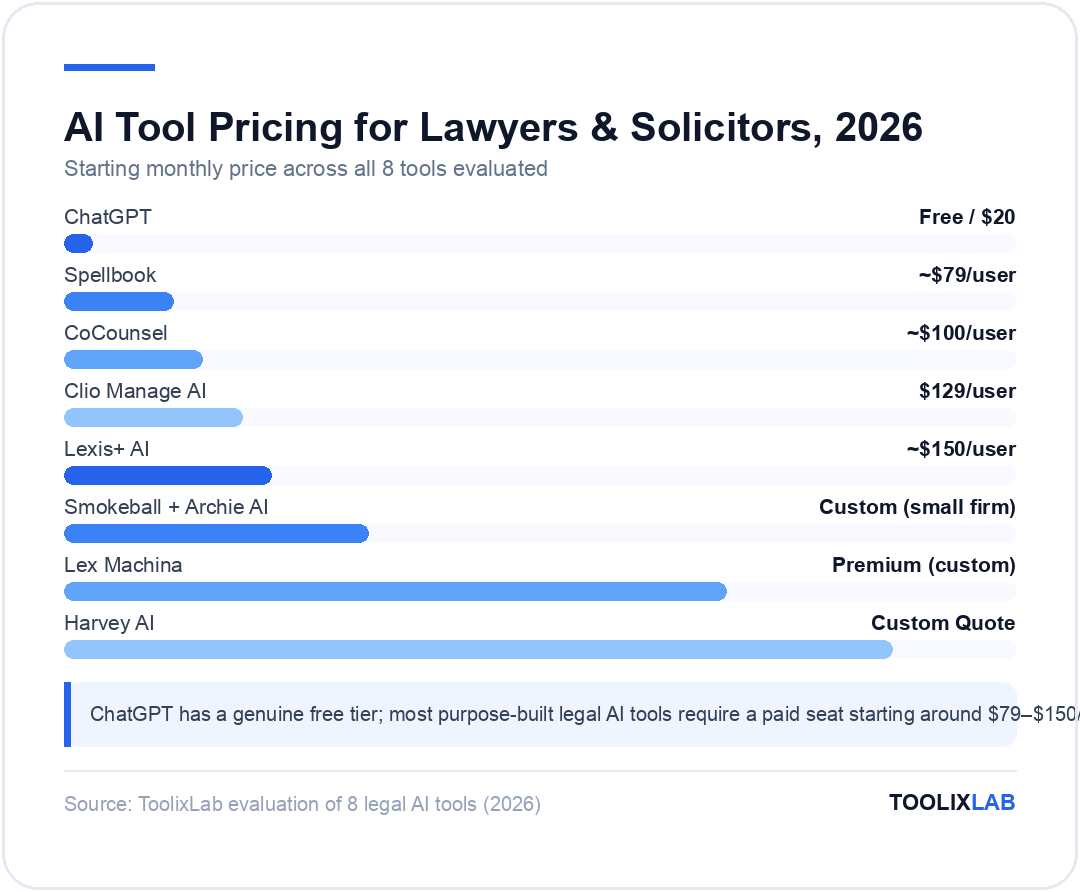
| Tool | Best For | Starting Price | Free Plan | Jurisdiction | Rating |
|---|---|---|---|---|---|
| Harvey AI | Large firms | Custom | ✗ | Multi | 9.5/10 |
| Lexis+ AI | Legal research | ~$150/user | ✗ | US + UK | 9.3/10 |
| Spellbook | Contract review | ~$79/user | Trial ✓ | 80+ countries | 9.0/10 |
| Clio Manage AI | Practice management | $129/user | Trial ✓ | 130+ countries | 8.8/10 |
| CoCounsel | Research + case prep | ~$100/user | ✗ | US + UK | 8.5/10 |
| Smokeball + Archie AI | Small firm all-in-one | Custom (small firm) | Trial ✓ | US + UK + AUS | 8.3/10 |
| Lex Machina | Litigation analytics | Premium (custom) | ✗ | US only | 8.0/10 |
| ChatGPT | First drafts / entry-level | Free | ✓ | Global | 7.5/10 |
How We Evaluated These Tools
We evaluated each tool against five criteria drawn from real legal practice requirements: accuracy (how often outputs are correct and properly cited), workflow integration (how naturally the tool fits into existing processes), data security (data handling policies and compliance standards), jurisdiction coverage (relevance for both US and UK legal practices), and value for money (ROI relative to firm size and use case). Pricing was verified against published rates and vendor confirmations as of early 2026, though legal AI pricing changes frequently — always confirm directly with vendors before purchasing.
We deliberately excluded tools we couldn't verify for data security claims, and flagged where tools are primarily US-focused in a guide intended for both lawyers and UK-based solicitors. According to the 2025 Thomson Reuters Generative AI in Professional Services Report, the share of legal organisations actively using generative AI nearly doubled in one year — the question is no longer whether to adopt AI, but which tools to adopt for which tasks.
Which AI Tool Should You Choose?
There's no single best AI tool for lawyers — the right choice depends on your firm size, practice area, and the specific bottleneck you're trying to solve. Here's a direct guide:
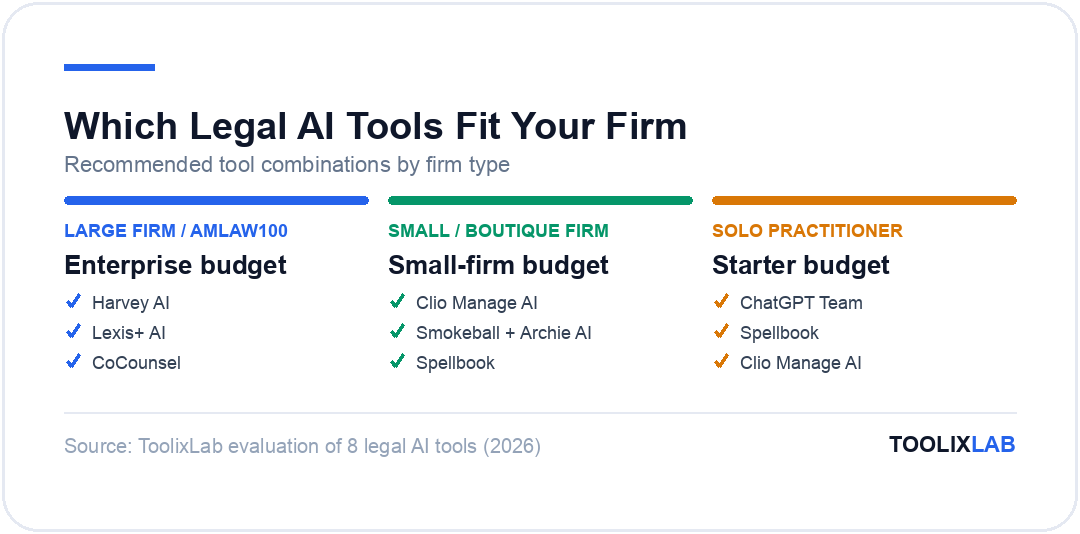
Our Verdict by Firm Type
No single tool wins across all practice types — but the right match is fairly clear once you know your primary use case.
🏢 Large firm / AmLaw100 / Magic Circle
- → Harvey AI for document-heavy, high-volume work
- → Lexis+ AI for research and litigation
- → CoCounsel if already on Westlaw
🏡 Small / boutique / mixed practice
- → Clio Manage AI for full practice management + AI
- → Smokeball + Archie AI for privacy-first smaller firms
- → Spellbook if contracts are your main work
⚖️ Litigation-focused practices
- → Lexis+ AI for research accuracy and Judicial Analytics
- → Lex Machina if US-based with high litigation volume
- → CoCounsel for brief prep and document review
💼 Solo practitioner or first-time AI adopter
- → Start with ChatGPT Team for general tasks
- → Add Spellbook if contract work justifies the cost
- → Graduate to Clio Manage AI as you scale
AI and the Solicitor's Ethical Obligations
Using AI in legal practice isn't just a technology decision — it carries professional obligations. In England and Wales, the SRA Code of Conduct requires solicitors to maintain competence and ensure the quality of their work. That means you cannot delegate substantive legal judgment to an AI and present the output as your own without review. Practically speaking, this means:
- 1.Always verify citations. Any AI tool can hallucinate case references. Treat every citation as unverified until you've confirmed it against primary sources.
- 2.Never input confidential client data into non-compliant tools. If you're using ChatGPT's free tier, client information should not be included in prompts. Use the Team or Enterprise plan, which opts out of training data usage.
- 3.Maintain a duty of explanation. If AI-generated analysis underpins client advice, you should be able to explain and stand behind that reasoning independently.
- 4.Check your PI insurance. Some professional indemnity policies are beginning to include AI usage disclosures. Worth verifying with your insurer.
The Bar Council and Law Society have both issued guidance on AI usage in legal practice. The direction of travel is clear: AI use is expected to grow, and professional bodies are focusing on governance rather than restriction. You can read more on the intersection of AI and professional obligations in our guide on how professionals are integrating AI tools in 2026.
🔑 Key Takeaways
- ✓ Harvey AI dominates at the enterprise level — but it's priced for AmLaw100 and Magic Circle firms, not boutiques
- ✓ Lexis+ AI has the lowest hallucination rate of any legal research AI tested — critical for citation accuracy
- ✓ Spellbook is the highest-ROI pick for any firm with significant transactional work — it works inside Word with zero platform disruption
- ✓ Clio Manage AI and Smokeball + Archie AI are the best all-in-one options for small firms not wanting to assemble a multi-tool stack
- ✓ ChatGPT is genuinely useful for internal, non-sensitive tasks — but should never be used for client-facing work on the free tier
- ✓ UK solicitors should verify jurisdiction coverage before buying — most tools are US-first, with UK support at varying depths
Conclusion
Legal AI in 2026 is no longer experimental. It's embedded in the workflows of leading firms worldwide, and the tools have matured enough to handle serious legal tasks with meaningful accuracy. The risk of not adopting AI is now as real as the risk of adopting the wrong tool. The key is matching the tool to your actual workflow — not buying the most-marketed product or the cheapest option.
If you're a solicitor at a small firm, start with Clio Manage AI or Spellbook — both have free trials, transparent pricing, and immediate productivity impact. If you're at a larger firm evaluating enterprise legal AI, Harvey and Lexis+ AI are the two shortlist entries that justify serious evaluation time. And if you haven't yet tried any AI in your practice, ChatGPT Team is a £20/month way to start building the intuition before committing to a specialist platform.
For more on how AI is transforming professional services, see our roundup of the best AI tools for developers in 2026 and our guide to building no-code AI workflows — both of which cover productivity patterns applicable across professional practices.
Frequently Asked Questions
What is the best AI tool for lawyers in 2026?
The best AI tool for lawyers in 2026 depends on firm size and use case. For large firms, Harvey AI leads on enterprise capabilities. For legal research, Lexis+ AI has the best accuracy. For contract drafting, Spellbook's Word integration makes it the most practical choice for transactional lawyers. For all-in-one practice management, Clio Manage AI is the most widely used platform.
Is it safe to use AI tools with confidential client data?
Only with tools that provide clear contractual privacy protections and appropriate enterprise controls. If you use a general-purpose model, stick to plans with business-grade privacy terms and never assume confidentiality without checking the vendor's latest documentation and data processing agreement.
Can solicitors in the UK use legal AI tools?
Yes, but with important caveats. Most legal AI platforms are US-first, so UK solicitors should verify jurisdiction coverage before purchasing. Lexis+ AI has strong UK database coverage including Halsbury's Laws. Some practice-management vendors have UK availability, but jurisdictional fit should be confirmed before purchase. Solicitors should treat AI as an assistive tool and remain responsible for supervision, competence, confidentiality, and the accuracy of the final work product.
Does AI replace lawyers?
No — and the framing of the question misunderstands what legal AI actually does. Current legal AI tools automate time-consuming tasks like document review, research, and first drafts. They don't exercise legal judgment, advise clients, or take professional responsibility. The shift is clearly toward augmentation, not replacement: current tools speed up research, review, drafting, and internal knowledge work, but they do not replace legal judgment or professional responsibility.
What is the best free AI tool for lawyers?
General-purpose AI tools can be useful for non-sensitive drafting and summarisation, but firms should avoid client-sensitive workflows unless the product has business-grade privacy terms and firm-approved governance.
How much do legal AI tools cost in 2026?
Legal AI pricing varies enormously by tool and firm size. Enterprise research and workflow platforms usually use quote-based pricing, while lighter drafting or general-purpose tools may offer self-serve monthly plans. Always price the full stack: seats, usage, integrations, storage, and support.
What are the ethical obligations for lawyers using AI?
Lawyers must maintain competence over any AI-generated work product — meaning you cannot submit AI output without independent review and verification. You must protect client confidentiality by using tools with appropriate data processing agreements. In England and Wales, the SRA Code of Conduct applies regardless of the tools used. The Bar Council and Law Society have both issued guidance encouraging responsible AI adoption rather than outright prohibition.