
ChatGPT Trust Snapshot
Real Free Score
80/100
Lock-In Risk
Medium
Billing Friction
Low
Commercial Use
Allowed
Data Privacy
Clear
Volatility
Medium
Last checked
2026-07-22
By ToolixLab Research Team · Last updated: July 2026
Quick Answer
ChatGPT has more than 900 million weekly active users (OpenAI, February 2026) and its app crossed 1 billion monthly active users in May 2026 — the fastest app in history to hit that mark. Just 50 million of those users pay for a subscription. Its market share, however, reads anywhere from 46% to 78% depending on whether you measure referral traffic, web visits, or app-usage share — three genuinely different metrics, not a contradiction.
"ChatGPT's growth is unstoppable" and "ChatGPT is losing the AI race" have both been published as headlines in 2026, often within the same week. Both are true of different numbers. Total usage — weekly actives, monthly actives, messages sent — keeps climbing in a straight line. Competitive position — the share of the AI-chatbot market ChatGPT actually controls — is falling just as consistently, and by how much depends heavily on which firm's methodology you trust.
We pulled the primary sources behind the most-cited ChatGPT usage figures — OpenAI's own disclosures, Reuters' reporting on Sensor Tower's app-intelligence data, Pew Research's February 2026 survey, and three separate market-share trackers — to show what's actually growing, what's actually shrinking, and why three reputable firms can publish three different "ChatGPT market share" numbers in the same month without any of them being wrong.
This piece focuses specifically on ChatGPT's own growth trajectory, usage patterns, and market position. For the broader AI chatbot category — including enterprise resolution rates and cross-platform adoption — see our AI chatbot statistics, and for the wider adoption curve ChatGPT sits inside, our AI adoption statistics.
ChatGPT Usage Statistics: The Key Numbers
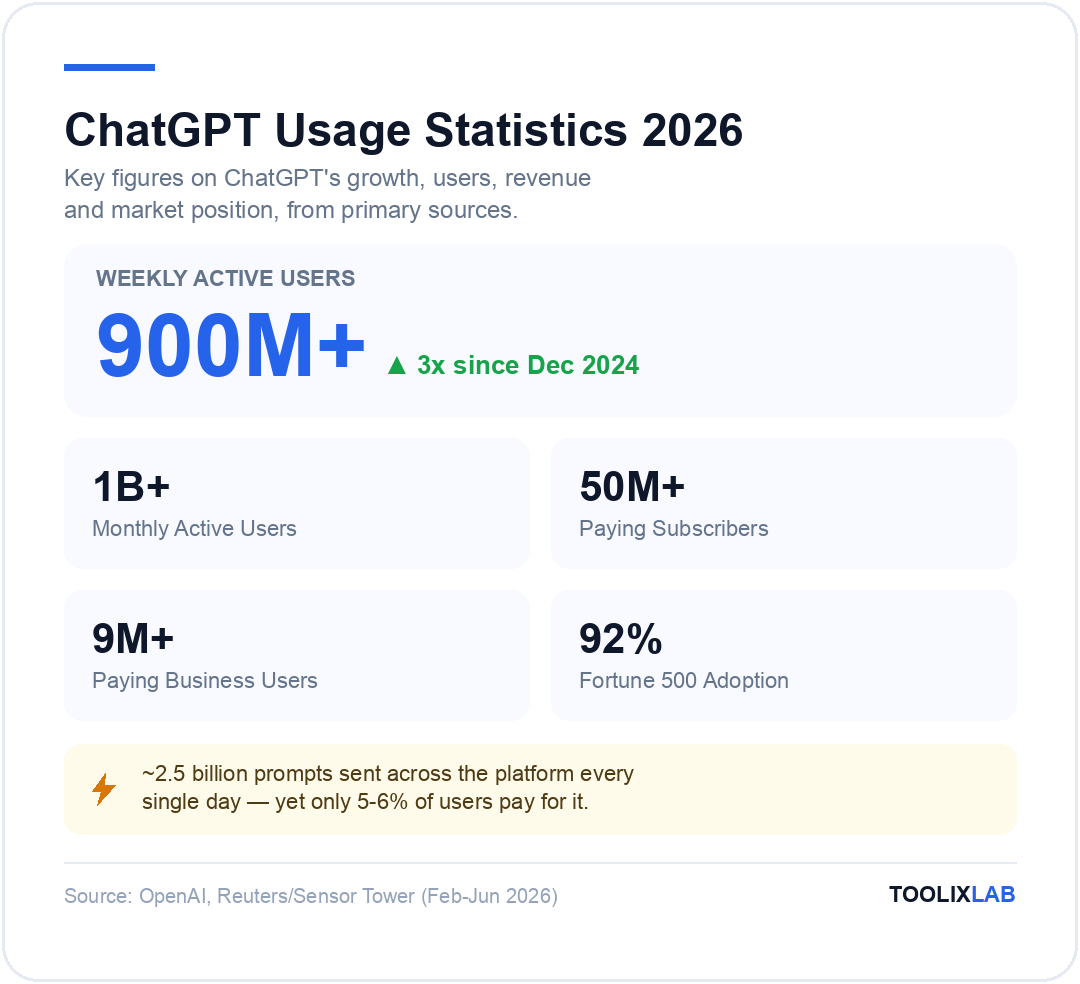
- 📊 900 million — ChatGPT's weekly active users as of February 27, 2026, OpenAI's first-ever public disclosure of that figure
- 📊 1 billion — global monthly active app users as of May 2026, per Sensor Tower data reported by Reuters — the fastest app in history to reach that milestone
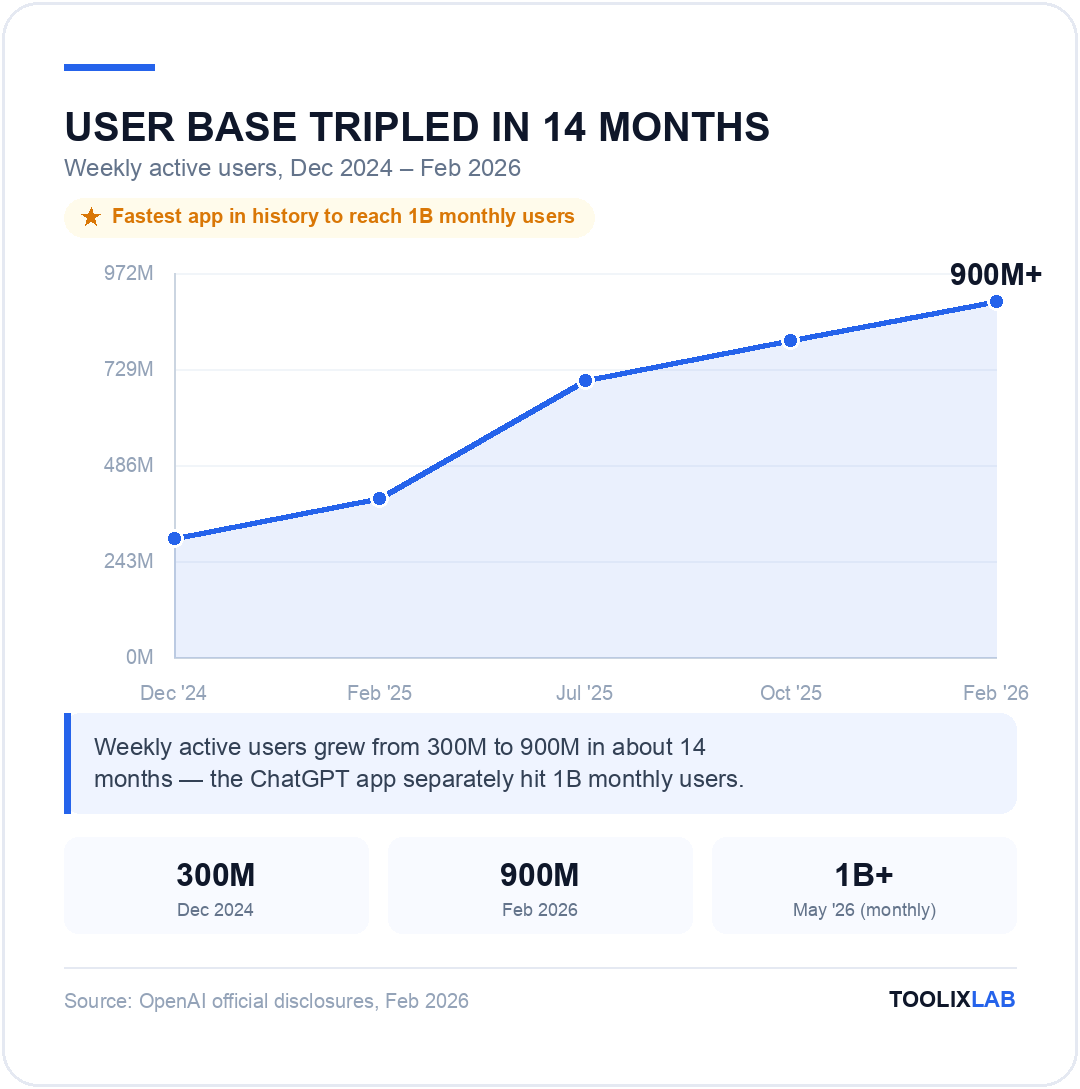
- 📊 300M → 900M — weekly active user growth from December 2024 to February 2026, tripling in roughly 14 months
- 📊 50 million — paying consumer subscribers as of February 2026, meaning roughly 5-6% of weekly users pay
- 📊 9+ million — paying business users, per OpenAI's February 2026 disclosure
- 📊 46.4% to 78.16% — the range of "ChatGPT market share" figures reported in 2026, depending on whether the metric is app-usage share, web visits, or referral traffic
- 📊 49% / 40% / 11% — the split between question-asking, practical work, and open-ended exploration in OpenAI's own usage analysis
- 📊 61% — share of US adults 18-29 who use ChatGPT, versus 19% of adults 65+ (Pew Research, February 2026)
- 📊 92% — share of Fortune 500 companies reported to be using ChatGPT in some capacity
- 📊 7 million+ — active ChatGPT Enterprise workplace seats as of December 2025, up roughly 9x year-over-year
Feel free to cite any statistic on this page — we ask only for a link back to this article as the source.
Methodology: Where This Data Comes From
This is a curated compilation of primary-source disclosures and independently tracked data, not a survey we ran ourselves. Every figure traces back to one of the following:
- OpenAI's official announcement (February 27, 2026) — the first public disclosure of 900 million weekly active users, 50+ million paying consumer subscribers, and 9+ million paying business users, made alongside a $110 billion funding round.
- Reuters, via Sensor Tower app-intelligence data (reported June 2, 2026) — the 1 billion global monthly active app user milestone, reached in May 2026.
- Pew Research Center (June 2026) — a nationally representative survey of 5,119 US adults conducted February 17-23, 2026 via Pew's American Trends Panel, used for demographic breakdowns.
- TechCrunch, citing Sensor Tower's State of AI Report (June 16, 2026) — ChatGPT's usage-share figure of 46.4% as of May 2026.
- Statcounter Global Stats — live referral-traffic tracking across more than 1 million websites; we use the March 2026 snapshot (78.16%).
- Similarweb web-visit analysis, as reported across multiple industry trackers for May 2026, putting ChatGPT at 53.9% of worldwide web visits across the seven largest chatbots.
- OpenAI's own conversation-analysis research (published May 2025, methodology still cited as current in 2026 coverage) analyzing 1.5 million ChatGPT conversations for use-case breakdown.
Limitations: the 92% Fortune 500 figure and enterprise seat counts are widely reported across industry coverage but trace back to OpenAI's own enterprise disclosures rather than an independently audited count — treat it as vendor-reported. Market-share figures are not directly comparable across sources because each firm measures a different behavior (referral clicks, web visits, or in-app usage share); we've built a dedicated comparison table below rather than picking one number as "correct."
Finding #1: ChatGPT's User Base Tripled in About 14 Months
ChatGPT's growth curve through 2025 and into 2026 is one of the steepest ever recorded for a consumer product. OpenAI's own disclosures show weekly active users climbing from 300 million in December 2024 to 400 million in February 2025, 700 million by July 2025, 800 million by October 2025, and 900 million when OpenAI made its first public disclosure of that figure on February 27, 2026, alongside news of a $110 billion funding round backed by Amazon, Nvidia, and SoftBank.
A separate measurement — global monthly active users of the ChatGPT app itself, tracked by market-intelligence firm Sensor Tower — shows the product crossing 1 billion monthly active users in May 2026, according to Reuters' June 2026 reporting. That's roughly three years after ChatGPT's public launch, and Sensor Tower's data shows it beat the pace set by Google Maps, TikTok, Instagram, and YouTube to reach the same milestone — the fastest app in history to do so. Weekly-active and monthly-active are different metrics measuring overlapping but not identical populations, so the two milestones (900M weekly, 1B monthly) aren't directly additive, but both point the same direction: ChatGPT's raw reach kept expanding through the first half of 2026 even as its competitive position (below) came under pressure.
Finding #2: Nearly Half of ChatGPT Usage Is Still Just Asking Questions
OpenAI's own research, published in 2025 and still cited as the operative breakdown in 2026 industry coverage, analyzed 1.5 million ChatGPT conversations and found usage splits into three broad categories: 49% asking questions or seeking information, 40% getting practical work done — writing, coding, editing, data analysis — and 11% open-ended exploration, self-expression, or general conversation. That distribution has shifted over time toward practical, work-oriented usage as ChatGPT has matured from a novelty chatbot into a daily-use productivity tool, a trend consistent with the enterprise-seat growth covered below.
Engagement depth is also rising: reporting in early-to-mid 2026 put average time per web session around 12-13 minutes, with total platform volume estimated at roughly 2.5 billion prompts per day. That volume estimate is a third-party calculation rather than an OpenAI-disclosed figure, so treat the precise number as directional rather than exact — but it's consistent with a user base that's both large and increasingly using the product for sustained, multi-step tasks rather than one-off questions.
Finding #3: "ChatGPT's Market Share" Depends Entirely on What You're Measuring
This is where most public reporting on ChatGPT gets confusing, because three legitimate, independently operated tracking firms published three different 2026 market-share figures — and reporters frequently cite them interchangeably as if they measured the same thing.
| Source | ChatGPT share | What it actually measures | Snapshot date |
|---|---|---|---|
| Statcounter | 78.16% | Referral traffic to websites | March 2026 |
| Similarweb | 53.9% | Web visits, top 7 chatbots | May 2026 |
| Sensor Tower (via TechCrunch) | 46.4% | In-app usage share | May 2026 |
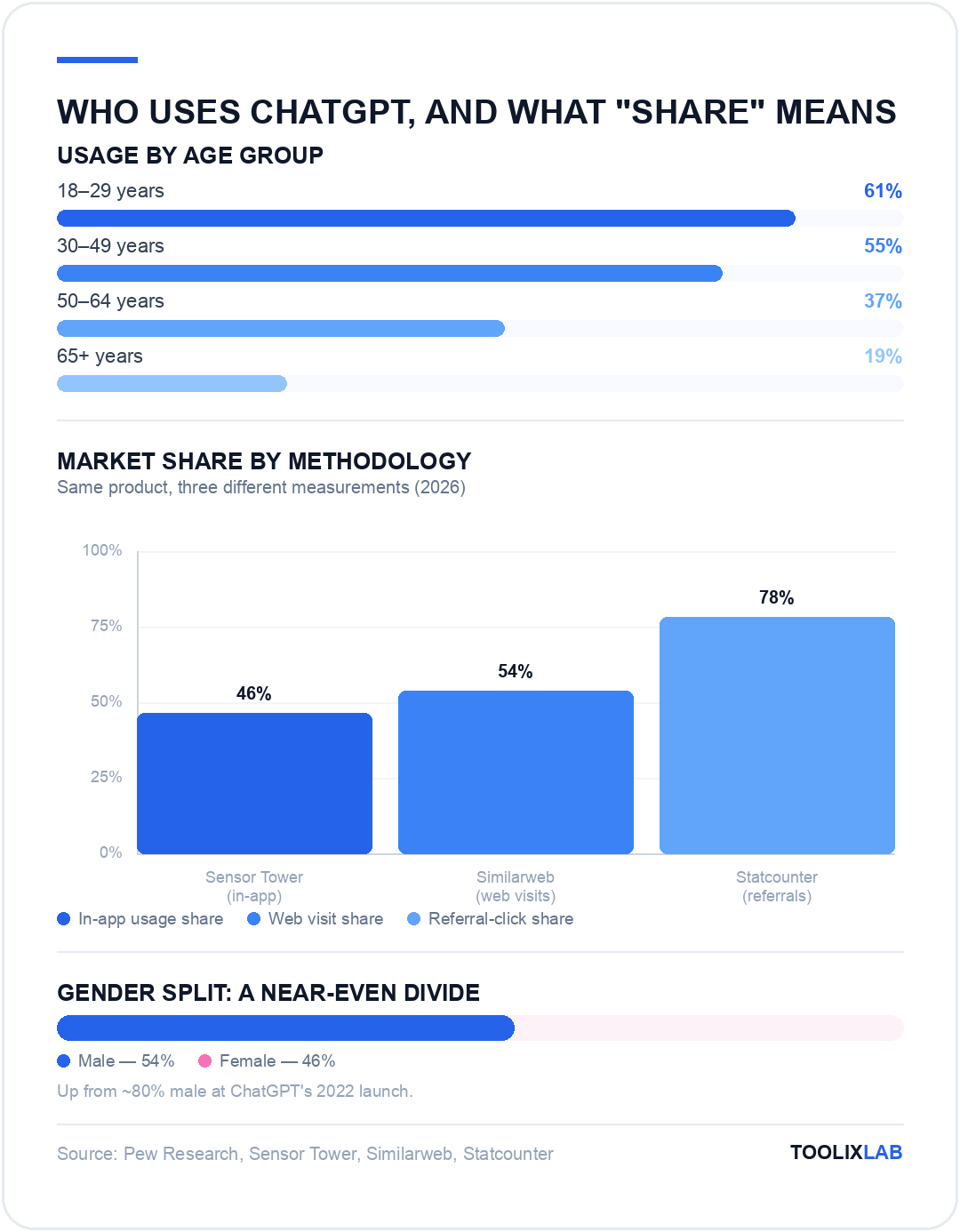
Statcounter's 78.16% figure counts referral clicks from ChatGPT to external websites — it undercounts any usage that stays entirely inside the ChatGPT app or web interface, which is most usage today given how few ChatGPT answers actually link out. Similarweb's 53.9% figure counts web-visit traffic across the seven largest chatbot products, a broader and more usage-representative slice, but still web-only — it misses native mobile app sessions. Sensor Tower's 46.4% figure, cited by TechCrunch's June 2026 report on ChatGPT's share slipping below 50% for the first time, is built from actual in-app usage data across mobile and desktop, arguably the most complete of the three — and it's also the one showing the steepest decline, down from over 50% as recently as January 2026.
None of these three numbers is wrong. They're measuring three different behaviors, and the honest takeaway is that ChatGPT's dominance looks different depending on whether you're asking "who gets clicked as a search-referral source," "who gets visited on the web," or "who actually gets used, everywhere, all the time." All three trend the same direction, though: down, as Gemini and Claude pick up share. Claude in particular grew roughly 640% year-over-year by Q2 2026 even though its absolute base (56 million monthly active users) remains far smaller than ChatGPT's — a growth-rate story, not yet a scale story, similar to the fragmentation pattern our AI chatbot statistics research found across the wider category.
Finding #4: Usage Skews Young, and the Gender Gap Has Nearly Closed
Pew Research's February 2026 survey of 5,119 US adults found ChatGPT usage is heavily age-skewed: 61% of adults 18-29 use it, compared with 55% of 30-49-year-olds, 37% of 50-64-year-olds, and just 19% of adults 65 and older. Overall US adult usage sits at 44%, up from 34% a year earlier. Daily usage follows the same age gradient: 31% of 18-29-year-olds use an AI chatbot daily versus just 7% of those 65+.
The gender split, meanwhile, has moved dramatically since launch. ChatGPT's earliest user base skewed roughly 80% male; by 2026, industry tracking puts the split closer to 54% male, 46-47% female — a near-even divide that reflects ChatGPT's move from a developer-and-early-adopter tool to a mainstream consumer product used across writing, homework help, and everyday tasks. Geographically, the United States remains ChatGPT's single largest market by traffic share (roughly 18-19%), with India the fastest-growing major market, having crossed 100 million weekly active users during 2025.
Finding #5: Business Adoption Is Where the Real Momentum Sits
Consumer growth gets the headlines, but ChatGPT's business-side numbers are arguably the more durable trend. OpenAI's February 2026 disclosure cited 9+ million paying business users, alongside industry reporting that 7 million+ active ChatGPT Enterprise workplace seats were in use by December 2025 — roughly a 9x increase year-over-year. Enterprise retention after 12 months runs around 88%, notably higher than typical consumer subscription retention, suggesting businesses that adopt ChatGPT tend to keep it rather than churn out after a pilot period.
Fortune 500 penetration is widely reported at 92% — up from roughly 80% within months of ChatGPT Enterprise's August 2023 launch — though this figure traces back to OpenAI's own enterprise-customer disclosures rather than an independently audited count, so we're flagging it as vendor-reported rather than third-party verified. On revenue, OpenAI's CFO disclosed the company exceeded $20 billion in annual recurring revenue for 2025, up from $6 billion in 2024; third-party financial trackers estimate that run rate reached roughly $25 billion by mid-2026, though that later figure is an analyst estimate rather than an OpenAI-confirmed number. Read alongside our AI adoption statistics research — which found only about 18% formal enterprise AI adoption by the Federal Reserve's stricter measure — ChatGPT's seat and revenue growth suggests it's capturing a disproportionate share of whatever formal enterprise AI budget exists today.
What This Data Means in Practice
Track reach and share separately — they're moving in opposite directions. ChatGPT's total user base (900M weekly, 1B monthly) keeps growing in a straight line. Its share of the competitive AI-chatbot field is shrinking under every measurement methodology. Both statements are true; conflating them into a single "ChatGPT is winning" or "ChatGPT is losing" narrative misses what's actually happening.
Never cite a bare "market share" number without its methodology. A 32-point spread (46.4% to 78.16%) between three legitimate trackers isn't a data error — it's three different definitions of "share." Ask whether a figure measures referral clicks, web visits, or in-app usage before comparing it to any other source's number.
The free-to-paid ratio remains extremely lopsided. At roughly 50 million paying subscribers against 900 million weekly users, more than 94% of ChatGPT's active base uses the free tier — a ratio worth keeping in mind before assuming "ChatGPT users" and "ChatGPT customers" are close to the same population.
Enterprise, not consumer, is the stickier growth story. 88% year-one enterprise retention and 9x seat growth suggest ChatGPT's business foothold is compounding even as its consumer market-share lead erodes — a divergence worth watching separately rather than reading total user growth as a single undifferentiated trend.
Frequently Asked Questions
How many people use ChatGPT in 2026?
ChatGPT has more than 900 million weekly active users, a figure OpenAI officially announced on February 27, 2026. Sensor Tower data reported by Reuters shows the ChatGPT app separately crossed 1 billion global monthly active users in May 2026, the fastest any app has reached that milestone.
How fast has ChatGPT grown in 2025 and 2026?
Weekly active users grew from 300 million (December 2024) to 400 million (February 2025), 700 million (July 2025), 800 million (October 2025), and 900 million (February 2026) — tripling in just over a year, according to OpenAI's own disclosures.
What is ChatGPT's market share in 2026?
It depends entirely on what's measured. Statcounter's referral-traffic tracking puts ChatGPT at 78.16% of worldwide AI chatbot referrals (March 2026). Similarweb's web-visit analysis shows 53.9% (May 2026). Sensor Tower's usage-share methodology has ChatGPT dipping below 50% for the first time, to 46.4% (May 2026). These aren't contradictory — they're measuring referral traffic, web visits, and app-usage share respectively, three different things.
How do people actually use ChatGPT?
OpenAI's own analysis of 1.5 million conversations found 49% of usage is asking questions or seeking information, 40% is getting practical work done (writing, coding, analysis), and 11% is open-ended exploration or self-expression. Practical, work-oriented usage has grown as a share of total activity since ChatGPT's early years.
What percentage of ChatGPT users pay for a subscription?
OpenAI disclosed more than 50 million paying consumer subscribers as of February 2026 alongside its 900 million weekly active user figure — meaning roughly 5-6% of weekly users pay, and the large majority still use the free tier.
How many businesses use ChatGPT?
OpenAI's February 2026 disclosure cited more than 9 million paying business users, and industry tracking widely cites 92% of Fortune 500 companies actively using ChatGPT in some form — up from roughly 80% within months of ChatGPT Enterprise launching in August 2023. Workplace seats passed 7 million by December 2025, up roughly 9x year-over-year.
What's the age and gender breakdown of ChatGPT users?
Pew Research's February 2026 survey (n=5,119 US adults) found 61% of adults 18-29 use ChatGPT, versus 55% of 30-49-year-olds, 37% of 50-64-year-olds, and just 19% of adults 65+. On gender, ChatGPT's user base has shifted from roughly 80% male at launch to a near-even split — around 54% male, 47% female — as of early 2026.
Can I cite these statistics?
Yes. These are primary-source and corporate-disclosure statistics compiled by ToolixLab — cite the original source (OpenAI, Pew Research, Reuters/Sensor Tower, or Statcounter) where possible, and feel free to link to this page as your source for the compilation.
🔑 Key Takeaways
- ✓ChatGPT hit 900 million weekly active users and 1 billion monthly active users in 2026 — but only about 50 million users (5-6%) actually pay for a subscription
- ✓"ChatGPT market share" ranges from 46.4% to 78.16% in 2026 depending on whether the source measures referral traffic, web visits, or in-app usage — always check the methodology
- ✓Nearly half of ChatGPT usage (49%) is still simple question-asking, with 40% practical work and 11% open-ended exploration
- ✓Usage skews young (61% of 18-29-year-olds vs. 19% of 65+) but the gender gap has nearly closed, from ~80% male at launch to a near-even split today
- ✓Business adoption is the stickier growth story: 9M+ paying business users, 92% Fortune 500 penetration, and 88% year-one enterprise retention
Related Guides
- AI Chatbot Statistics 2026 — the broader chatbot category, including enterprise resolution rates and cross-platform adoption.
- AI Adoption Statistics 2026 — the enterprise adoption curve ChatGPT's business growth sits inside.
- Generative AI Statistics 2026 — investment and market-sizing data for the wider generative AI category.
- Gen Z Trust in AI Statistics 2026 — the generational trust gap behind who's actually driving ChatGPT's youngest-skewing adoption.
- How to Use Claude AI for Business 2026 — a practical guide to deploying ChatGPT's fastest-growing competitor.