
Claude Trust Snapshot
Real Free Score
76/100
Lock-In Risk
Low
Billing Friction
Low
Commercial Use
Allowed
Data Privacy
Clear
Volatility
Medium
Last checked
2026-07-22
Two of the most capable AI assistants available today come from very different companies with very different philosophies. Claude, built by Anthropic, is designed around safety, deep reasoning, and exceptional writing quality. Google Gemini, built by the team behind AlphaCode and DeepMind, is designed around multimodal intelligence and seamless integration with the tools billions of people already use every day. Choosing between them is less about which one is "smarter" and more about which one fits how you actually work.
⚡ TL;DR — Claude vs Gemini 2026
Choose Claude if you need:
- ✦Long-form writing, editing, or content that needs a human voice
- ✦Complex reasoning chains, research summaries, or nuanced analysis
- ✦Coding help with clear explanations and idiomatic output
- ✦Safe, thoughtful outputs for sensitive topics or regulated industries
Choose Gemini if you need:
- ✦Real-time web search and up-to-date information retrieval
- ✦Deep Google Workspace integration (Gmail, Docs, Sheets, Drive)
- ✦Multimodal tasks — analyzing images, audio, or video content
- ✦Processing extremely long documents (1M+ token context)
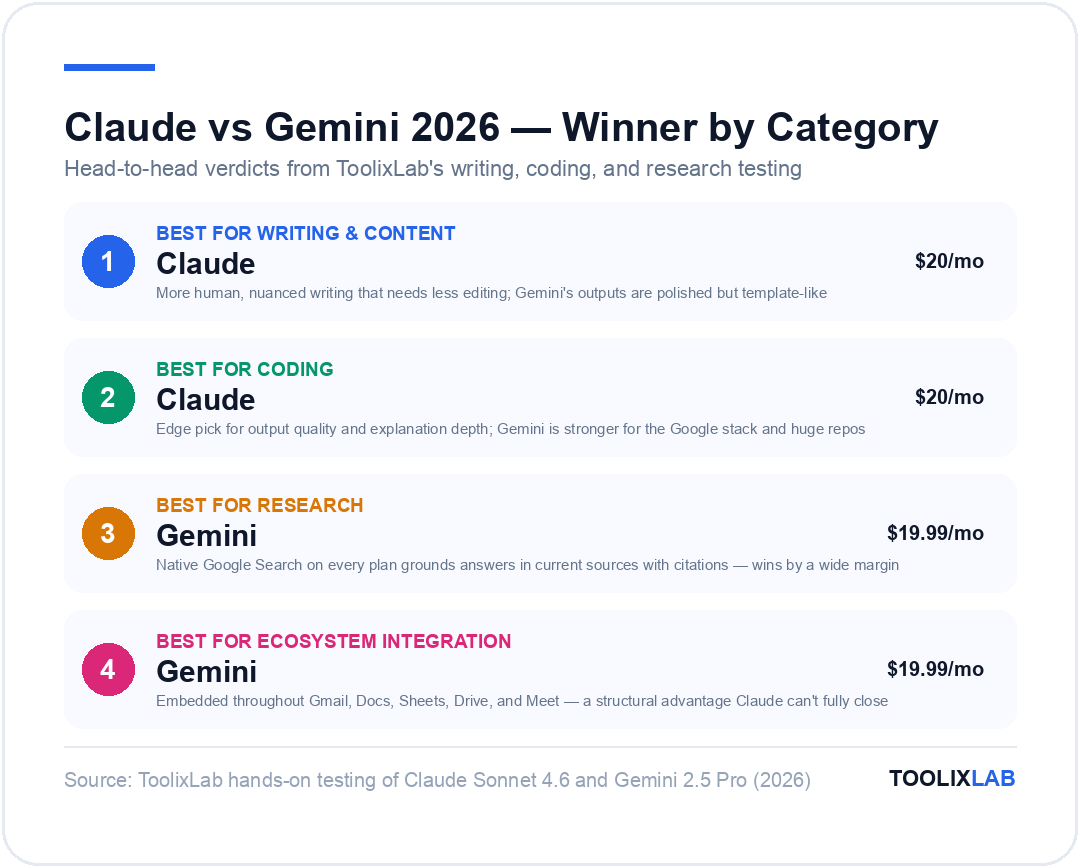
Bottom line: Claude wins on writing and reasoning quality. Gemini wins on ecosystem integration and real-time data. Most power users use both.
The 2026 AI Landscape: Why This Comparison Matters
A year ago, the AI assistant conversation was dominated by ChatGPT. In 2026, the market has fractured in the best possible way: different tools have carved out genuine areas of excellence, and the savviest users pick the right tool for each task rather than defaulting to one.
Claude and Gemini represent the two strongest alternatives to OpenAI's GPT family — and they're differentiated enough that this comparison has real stakes. Claude, built by safety-focused AI lab Anthropic, has become the go-to for professionals who need reliability, nuance, and depth. Gemini, Google's answer to the AI revolution, has the unbeatable advantage of being woven directly into the productivity tools most knowledge workers already live inside.
This comparison is based on hands-on testing across writing tasks, coding challenges, research queries, and multimodal inputs. We tested Claude Sonnet 4.6 against Gemini 2.5 Pro — the primary "working" tier for each platform — and called out differences at the premium tier (Claude Opus 4.8 vs Gemini 2.5 Pro Max configurations) where they're meaningful.
Claude vs Gemini: Key Differences at a Glance
| Feature | Claude Sonnet 4.6 | Gemini 2.5 Pro |
|---|---|---|
| Developer | Anthropic | Google DeepMind |
| Context Window | 200K tokens | 1M tokens (2M in some configs) |
| Real-Time Web Access | Limited (Pro/Max plans) | Yes — all tiers via Google Search |
| Image Understanding | Good (documents, charts, screenshots) | Excellent (native multimodal) |
| Video Understanding | Limited | Strong (native video input) |
| Writing Quality | Excellent — top-tier for long-form | Very good, slightly more formulaic |
| Coding | Excellent — clean, well-explained | Excellent — strong on Google stack |
| Google Workspace Integration | Third-party only | Native (Gmail, Docs, Sheets, Drive) |
| API Availability | Anthropic API (pay-per-use) | Google AI / Vertex AI (pay-per-use) |
| Mobile App | iOS + Android | iOS + Android (+ Google Assistant replacement) |
| Pro Price | $20/month (Claude Pro) | $19.99/month (Google AI Pro) |
Writing & Content Creation
This is where Claude and Gemini diverge most clearly. In side-by-side testing across identical writing prompts — blog posts, executive summaries, email sequences, social copy, and persuasive essays — Claude Sonnet 4.6 consistently produced output that felt more human, more nuanced, and required less editing to be usable.
Claude's writing style has a distinct quality: it varies sentence length naturally, avoids the repetitive structure that plagues AI-generated text, and picks up on tonal cues in your prompt more reliably. When you ask Claude to write something "punchy and direct," you get that. When you ask for something "warm and conversational," you get that too — without the robotic qualifier drift that most AI writing tools struggle with.
Gemini 2.5 Pro is a strong writer, but its outputs have a slightly more structured, template-like feel. It defaults to bullet-heavy formatting even when prose would serve better, and its writing can feel polished but impersonal on first draft. It's not bad — it's just a full editing pass away from great, rather than a light polish pass the way Claude's outputs often are.
Where Gemini Closes the Gap
For short-form copy — social posts, ad headlines, quick email replies — the gap between Claude and Gemini is much smaller. Gemini is also significantly better for writing tasks that benefit from real-time data, like "write a LinkedIn post about this morning's earnings release" or "draft a summary of this week's AI news." Because Gemini has live Google Search access, it can pull current facts instead of relying on training data alone.
Pro Tip: The Writing Stack
Many professional content teams use Gemini to gather current data and draft a research brief, then pass the brief to Claude for the actual writing. The combination outperforms either tool alone for factual, well-written long-form content.
Coding & Technical Tasks
Both tools are strong coders. On standard benchmarks like HumanEval and SWE-bench, Claude Sonnet 4.6 and Gemini 2.5 Pro score close to each other — within a few percentage points depending on the task category. The real differentiator isn't raw benchmark scores; it's how each tool handles the experience of coding with an AI assistant.
Claude's Coding Strengths
- ▸Explanation quality: Claude doesn't just write code — it explains what the code does and why it made specific choices. For developers learning a new language or library, this pedagogical layer is invaluable.
- ▸Idiomatic output: Claude produces code that follows language conventions. Python code from Claude reads like Python written by an experienced Python developer, not generic imperative code that happens to use Python syntax.
- ▸Debugging conversations: When you paste in an error and context, Claude is methodical and precise about narrowing down the cause. It asks clarifying questions when necessary and doesn't guess wildly.
- ▸Long context for codebases: With 200K tokens, you can paste an entire module or set of related files and have Claude reason about them holistically — catching cross-file bugs, refactoring suggestions, and architectural issues.
Gemini's Coding Strengths
- ▸Google ecosystem: If you're building on Firebase, Google Cloud, Android, or using Google's ML APIs, Gemini has deeper native knowledge of those environments and their latest SDKs.
- ▸Google Colab integration: Gemini is embedded directly into Google Colab, making it the natural choice for data science and machine learning work in Jupyter-style notebooks.
- ▸Massive context for large repos: With 1M tokens, Gemini can ingest codebases that exceed Claude's window — useful for legacy systems or monorepos with a lot of interdependence.
- ▸Real-time library docs: Gemini can search for the current version of a library's API documentation — critical when working with fast-moving frameworks where training data may be months behind.
For most general software development, Claude Sonnet 4.6 is the edge pick due to output quality and explanation depth. If you're in the Google ecosystem or working with very large codebases, Gemini 2.5 Pro is the stronger choice. If you want the best of both worlds in a dedicated coding environment, check out our Cursor vs GitHub Copilot vs Codeium comparison — both tools let you use Claude or Gemini as the underlying model.
Research & Fact-Checking
This is the starkest difference between the two tools, and it matters enormously for professional use. Gemini wins this category by a wide margin — and it's not close.
Gemini 2.5 Pro has native Google Search integration available on all plans, including the free tier. When you ask a research question, Gemini queries Google Search in real time and synthesizes the results with its own reasoning capabilities. The output is grounded in current sources, with citations. This means Gemini can accurately answer questions about events that happened last week, current pricing, new product releases, and recent research — things that are out of Claude's training data scope.
Claude's training data has a knowledge cutoff, and web search access is limited to Pro and Max plans — and even then, it's less deeply integrated than Gemini's native search. If your work involves staying current with news, markets, regulations, or fast-moving technology, Gemini's real-time grounding is a significant practical advantage.
Where Claude Still Has an Edge
For tasks that don't require real-time information — synthesizing existing knowledge, analyzing a document you provide, reasoning through a complex argument, or generating research frameworks — Claude's depth of reasoning is superior. Claude is more likely to surface non-obvious connections, challenge assumptions in your prompt, and produce analysis that reads like it was written by a thoughtful expert rather than a competent summarizer.
Claude is also more cautious about hallucination in a useful way: it's more likely to say "I'm not certain about this specific detail" rather than confidently presenting an incorrect fact. For research where accuracy matters more than completeness, this epistemic honesty is a feature, not a limitation.
Pricing Comparison: All Tiers
Claude Pricing (2026)
| Plan | Price | Model Access | Best For |
|---|---|---|---|
| Free | $0 | Claude Sonnet 4.6 (limited usage) | Casual users, evaluation |
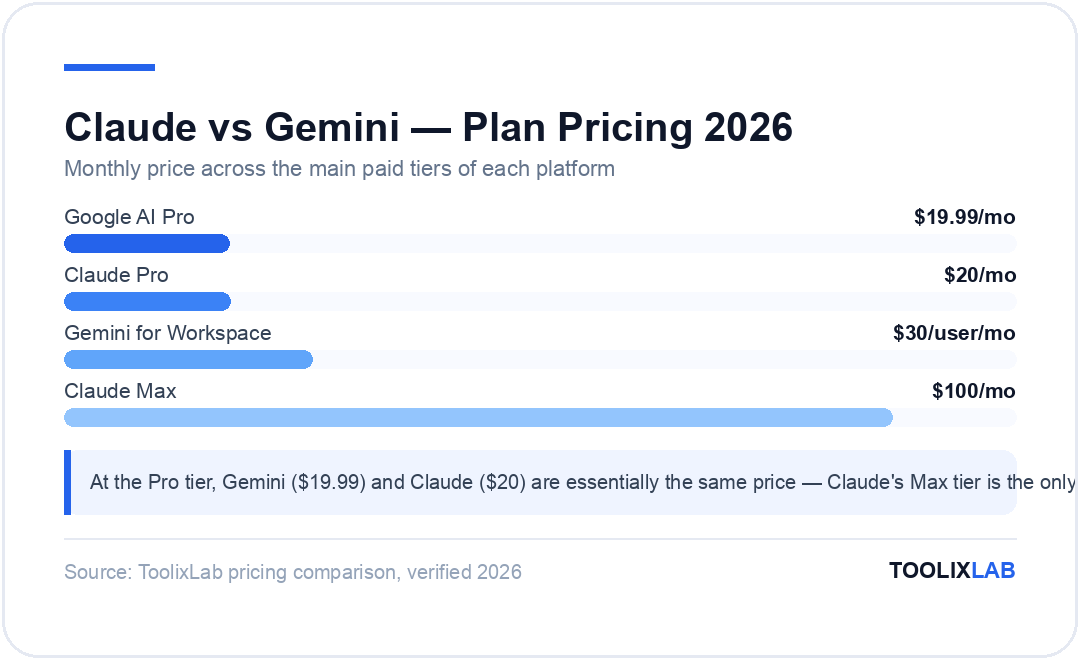
| Claude Pro | $20/month | Full Sonnet 4.6 + limited Opus 4.8 | Most professionals and content creators |
| Claude Max | $100/month | Full Opus 4.8 + 5× usage limits | Power users, researchers, developers |
| API (Haiku 4.5) | $0.80 / $4 per 1M tokens | Claude Haiku 4.5 | High-volume automated pipelines |
| API (Sonnet 4.6) | $3 / $15 per 1M tokens | Claude Sonnet 4.6 | Balanced production workloads |
Gemini Pricing (2026)
| Plan | Price | Model Access | Best For |
|---|---|---|---|
| Free | $0 | Gemini 2.5 Flash (limited) | Light users, students |
| Google AI Pro | $19.99/month | Gemini 2.5 Pro + Workspace features | Professionals using Google Workspace |
| Google One AI Premium | $19.99/month | Google AI Pro + 2TB Google Drive storage | Heavy Google Drive users |
| Gemini for Workspace | $30/user/month (add-on) | Full Gemini 2.5 Pro in all Google apps | Enterprise teams on Google Workspace |
| API (Flash 2.5) | $0.075 / $0.30 per 1M tokens | Gemini 2.5 Flash | Cost-sensitive applications |
Verdict on pricing: At the Pro tier, Gemini ($19.99) is essentially the same price as Claude ($20) — call it a draw. Gemini's advantage is the Google One bundle: if you're already paying for Google Drive storage, the AI Premium plan adds Gemini Pro access at no additional cost over your storage subscription. Claude's advantage is the Max tier, which gives you the most powerful Claude Opus 4.8 model for $100/month — there's no equivalent all-out premium offering from Gemini at that price point.
Integrations & Ecosystem
This is where Gemini has a structural advantage that no amount of model quality improvement from Anthropic can fully close — at least not in the near term.
Gemini's Ecosystem Depth
Gemini is embedded throughout Google's product suite in 2026. In Gmail, it can read your threads, draft replies, and summarize long email chains. In Google Docs, it writes, edits, and reformats inside the document. In Sheets, it generates formulas, analyzes data, and creates charts from plain language instructions. In Google Meet, it provides live meeting notes and action items. In Google Drive, it surfaces relevant files in response to natural language search.
If your work life already runs through Google Workspace — and for most knowledge workers worldwide, it does — Gemini becomes embedded assistance rather than an external tool you switch to. That integration removes friction in a meaningful way: you're not copying and pasting between applications, you're getting AI help where your work already lives.
Claude's Integration Story
Claude's native integrations are more limited, but the picture is improving. Claude integrates with Notion, GitHub, Slack, and a handful of other platforms through official connections available in the Claude.ai interface. The Claude API also makes it straightforward for developers to embed Claude in custom workflows, internal tools, and third-party platforms.
Claude is also the model powering many AI features inside products you might already use: Cursor (code editor), various writing tools, and developer platforms that have integrated Anthropic's API. So while Claude's native app integration is thinner than Gemini's, its reach through the developer ecosystem is substantial.
For enterprise deployments on AWS, Claude is available through Amazon Bedrock with enterprise security and compliance features — a consideration for organizations in regulated industries. Gemini is available through Google's Vertex AI with similar enterprise guardrails.
Which Should You Use? A Decision Framework
The honest answer for most people is: both, for different jobs. But if you're picking one primary tool, here's a direct framework.
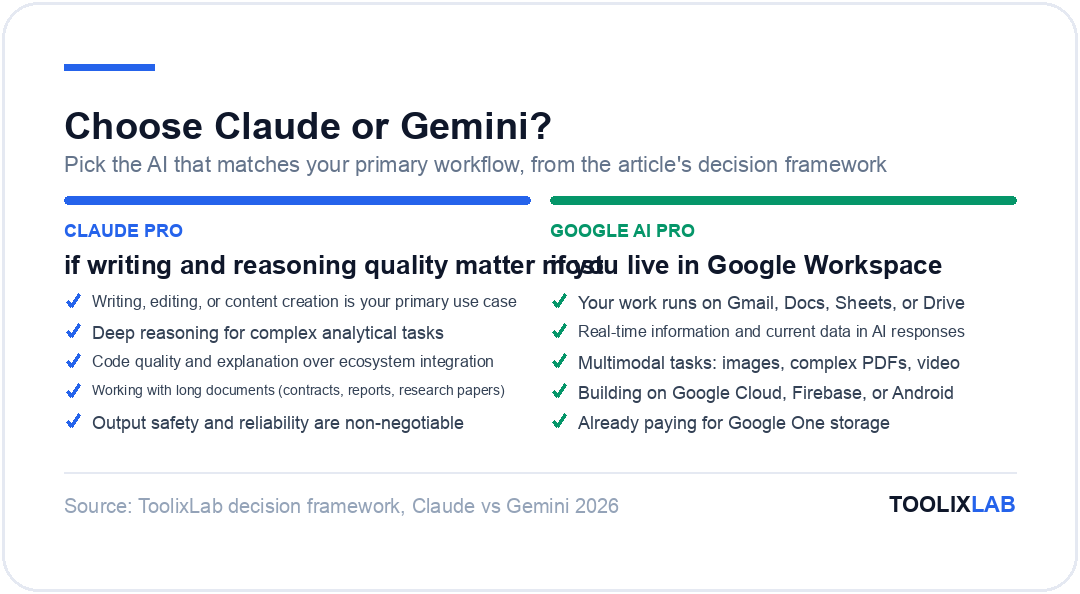
Choose Claude Pro ($20/month) if:
- Writing, editing, or content creation is your primary use case
- You need deep reasoning for complex analytical tasks
- Code quality and explanation matter more than ecosystem integration
- You work with long documents (contracts, reports, research papers)
- Output safety and reliability are non-negotiable for your industry
Choose Google AI Pro ($19.99/month) if:
- Your work runs on Gmail, Google Docs, Sheets, or Google Drive
- You need real-time information and current data in your AI responses
- Multimodal tasks (analyzing images, PDFs with complex visuals, video) are part of your work
- You're building on Google Cloud, Firebase, or Android
- You're already paying for Google One storage and want to bundle AI access
Use both if:
- You're a content marketer, researcher, or knowledge worker with varied daily tasks
- You want Gemini for research and current data, Claude for drafting and deep analysis
- You're an AI developer benchmarking multiple models for production use
- Cost isn't the primary concern and you want best-in-class for each task type
The Verdict
Claude Sonnet 4.6 is the better AI for the craft of thinking and writing. If you regularly produce long-form content, do complex analysis, or need an AI collaborator that reasons carefully and expresses ideas with nuance, Claude is the tool to invest in first. Its safety, reliability, and sheer writing quality make it the choice for professionals where output quality is directly tied to their reputation.
Gemini 2.5 Pro is the better AI for the Google-integrated knowledge worker. If your day revolves around Gmail, Docs, and Search — and you want an AI that lives inside those tools rather than alongside them — Gemini's integration advantage is real and compounds every day. Its real-time information access also makes it the clear pick any time current data matters.
Neither tool is definitively "better." They're optimized for different users. The smartest move is to try both on free tiers for a week, identify where each one saves you the most time, and then invest in whichever Pro subscription delivers the clearest return on that $20.
For a broader comparison including ChatGPT, see our ChatGPT vs Claude vs Gemini full comparison. For guides on getting the most out of either tool, see How to Use Claude AI and How to Use Gemini AI. If you're evaluating AI chatbot alternatives more broadly, our 15 Best ChatGPT Alternatives covers the full landscape.