
By ToolixLab Research Team · Last Updated: June 2026
Quick Answer
AI coaching is the use of artificial intelligence to deliver personalised coaching at scale — available 24/7, adapting to your goals and personality, costing a fraction of a human coach. In 2026, it covers everything from leadership development and sales performance to personal productivity and life goals, powered by LLMs, behavioural science, and real-time data analysis.
The global coaching platform market is valued at $4.22 billion in 2026, according to Future Market Insights, and AI is the engine driving nearly all of its growth. Two years ago, AI coaching tools were an interesting experiment. Today, 67% of Fortune 500 companies have either piloted or fully deployed AI coaching programs at scale. The question has shifted from "should we try AI coaching?" to "which platform actually delivers results?"
But if you've landed here searching for "what is AI coaching," you may be at an earlier stage — trying to understand what this category actually means, how it works under the hood, and whether it's a genuine tool or expensive noise. This guide covers all of it: the precise definition of AI coaching, the four distinct types of AI coaching platforms, an honest review of the seven best tools in 2026, real ROI data from verified sources, and a clear breakdown of who AI coaching is right for — and who should stick with a human coach.
We also cover what most competitor articles miss entirely: the critical distinction between AI coaching for coaches (tools that help coaching professionals run their practice) and AI coaching as a service (tools that replace or augment the coach themselves). Getting this wrong costs time and money.
⚡ Quick Summary
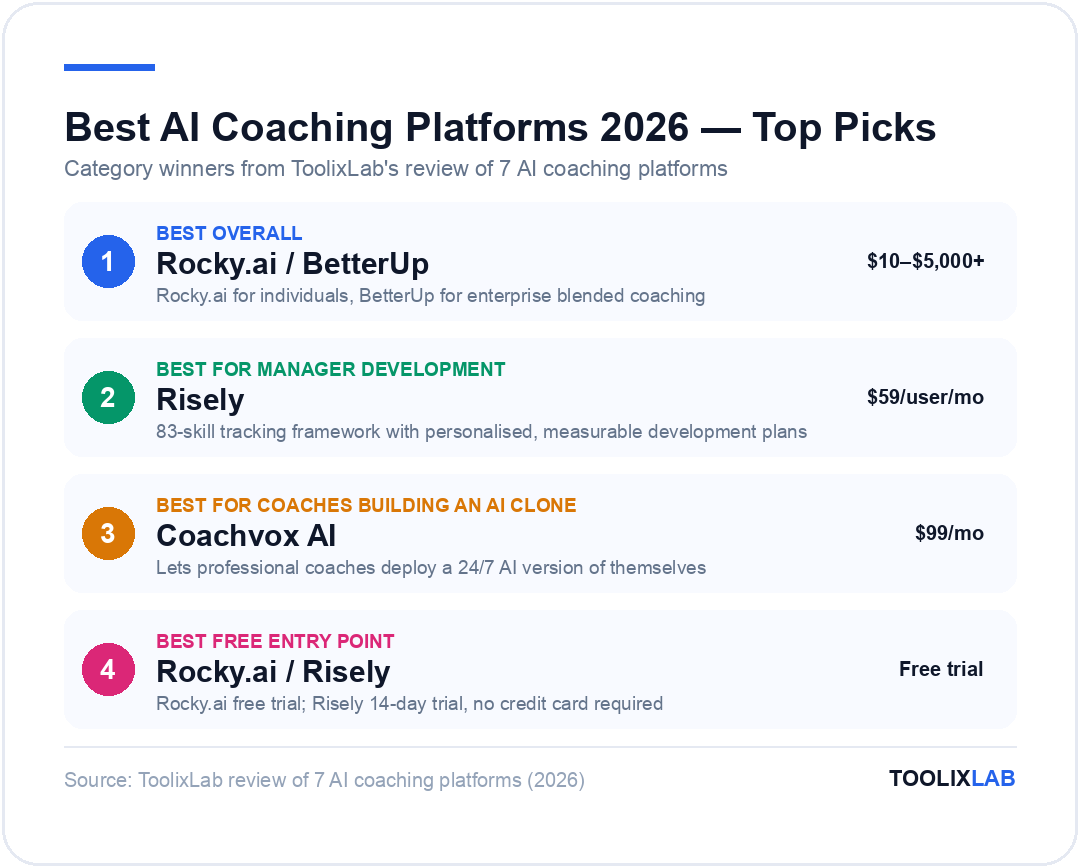
Best overall AI coaching platform: Rocky.ai (individuals) / BetterUp (enterprise)
Best for manager development: Risely — $59/user/month with 83-skill tracking
Best for coaches building an AI clone: Coachvox AI — starting at $99/month
Best free entry point: Rocky.ai free trial · Risely 14-day free trial (no credit card)
Jump to: Definition | Best Tools | Real Results | Verdict | FAQ
What Is AI Coaching?
AI coaching is the application of artificial intelligence technologies — including large language models (LLMs), natural language processing (NLP), machine learning, and behavioural science algorithms — to deliver goal-oriented coaching at scale. Unlike a simple chatbot that responds to questions, an AI coach initiates conversations, tracks your progress over time, adapts its approach based on your personality and past sessions, and holds you accountable to specific development goals.
The term "AI coaching" actually refers to two distinct categories, and most articles confusingly lump them together:
- AI coaching as a service — platforms that act as the coach themselves, delivering coaching directly to end users (employees, leaders, individuals). Examples: Rocky.ai, BetterUp, Risely, Valence.
- AI coaching tools for coaches — tools that help human coaching professionals run their practice more efficiently, scale their reach, or create an AI clone of themselves. Examples: Coachvox AI, Delenta, CoachAccountable with AI features.
This guide covers both, because knowing which bucket you're in completely changes which tool is right for you. A solopreneur coach looking to serve more clients at 2am without being awake needs Coachvox AI, not Risely. An HR director trying to scale leadership development across 5,000 employees needs BetterUp or Valence, not a coach's productivity tool.
Modern AI coaching is far removed from the early "wellness chatbot" era of 2019–2022. Today's platforms integrate personality assessments (DISC, Enneagram, CliftonStrengths), track 50–100+ measurable skills, analyse real call recordings for sales coaching, and deliver contextual nudges through Slack, Teams, email, or calendar integrations. Valence's $50 million Series B in September 2025 — and its subsequent deployment at Fortune 500 companies — signals that AI-only coaching is no longer a startup niche. It is a mainstream enterprise category.
The market data backs this up. According to CareerTrainer AI's 2026 report, the global AI coaching market is growing at 28% CAGR through 2030, with 23 million active users globally as of 2024 and the enterprise segment accounting for 67% of total market revenue. This is not a fringe category. AI coaching is where enterprise L&D budgets are going.
How Does AI Coaching Work?
The mechanics of AI coaching vary significantly between platforms, but most share a common architecture built on four layers. Understanding these layers helps you evaluate whether a platform is genuinely coaching you or just generating motivational content on demand.
Layer 1: Assessment & Profile Building
Most AI coaching platforms begin with a structured assessment. This might be a validated personality instrument (DISC, Enneagram, Big Five), a skills self-assessment, a 360-degree feedback collection, or analysis of historical work data (sales call recordings, performance reviews, calendar patterns). The richer the input, the more personalised the coaching output. Platforms like Cloverleaf aggregate results from multiple existing assessments you've already taken, while Marlee uses its own proprietary F4BE personality framework developed from 30+ years of behavioural research. Rocky.ai uses a lighter goal-setting onboarding, while enterprise platforms like Valence pull data from your HRIS and performance management system for deeper context.
Layer 2: Goal Setting & Skill Mapping
After profiling, the AI coach works with you to define specific development goals — whether that's improving active listening, closing more deals, delegating more effectively, or reducing conflict in team interactions. Risely maps your goals against a library of 83 trackable management skills and builds a personalised development plan. This is fundamentally different from searching YouTube for "how to be a better manager." The specificity of the skill mapping is what separates meaningful coaching platforms from generic content delivery systems. If a platform can't tell you exactly which 3-5 skills you're developing and how you're progressing, it is not a coaching platform.
Layer 3: Coaching Delivery
This is where the AI coach earns its keep. Delivery mechanisms in 2026 include: daily check-in questions via app or Slack, real-time conversation analysis and feedback, scenario practice and role-play simulations (particularly in sales coaching), contextual nudges delivered before a meeting based on who's attending, and structured reflection exercises. The best platforms don't wait for you to initiate — they push coaching to you at the right moment. Rocky.ai sends daily leadership questions and tracks your answers over time, building a longitudinal picture of your growth. Cloverleaf sends a coaching tip to your Slack 15 minutes before a meeting with a colleague whose personality profile suggests they communicate very differently from you.
Layer 4: Progress Tracking & Adaptation
Unlike a one-off workshop or a book, an AI coach remembers everything. It tracks which skills you're improving, which conversations you're avoiding, and where you're stalling. Over time, the coaching adapts — harder challenges as you progress, more support where you're struggling. For enterprise platforms, this data rolls up into team-level and organisational analytics that HR and L&D leaders can use to identify systemic skill gaps across a department or division. This longitudinal, data-driven visibility is something no human coaching program at scale has ever been able to deliver.
The 4 Types of AI Coaching Platforms in 2026
The AI coaching category has consolidated into four recognisable archetypes. Knowing which type you're evaluating is the fastest way to eliminate tools that don't fit your use case — and to avoid paying enterprise prices for something that's essentially a self-help app.
Type 1: Enterprise Blended (AI + Human Coach)
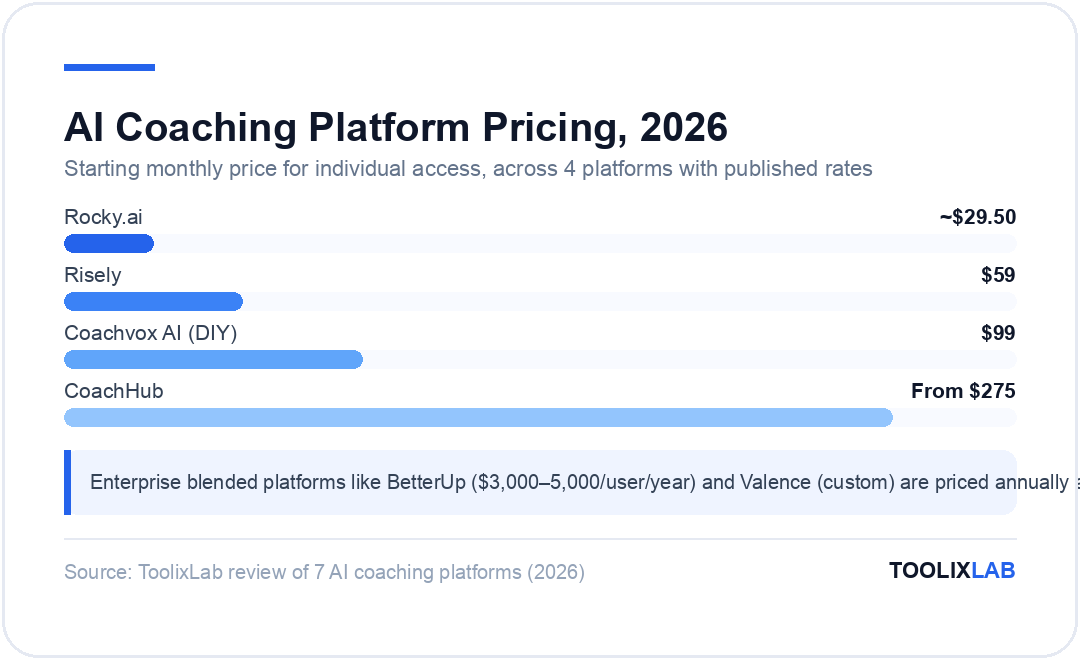
These platforms combine an AI layer (for practice, nudges, skill tracking, and between-session support) with access to a network of accredited human coaches (for deeper work, accountability, and complex challenges). BetterUp and CoachHub are the market leaders here. Enterprise blended is the dominant pattern among Fortune 500 buyers in 2026 because it delivers cost-and-scale advantages without completely sacrificing the depth of human connection. Pricing reflects the premium: $3,000–5,000/user/year for BetterUp, $275–649/month for individual CoachHub access. This is not a broad-workforce tool — it's a strategic investment in senior talent.
Type 2: AI-Native Skill Practice
These platforms are fully AI-delivered with no human coach involvement. They focus on specific, measurable skill areas — most commonly management, leadership, or sales — and use structured exercises, daily prompts, and scenario simulations to drive development. Risely (management skills), Valence (manager coaching at enterprise scale), and Cloverleaf (team dynamics, delivered through Slack and Teams) fall here. Pricing is substantially more accessible: $59/user/month for Risely, custom enterprise rates for Valence. This is where the most innovation is happening in 2026 — AI-native platforms are increasingly competitive with blended options at a fraction of the cost.
Type 3: Self-Coaching Apps
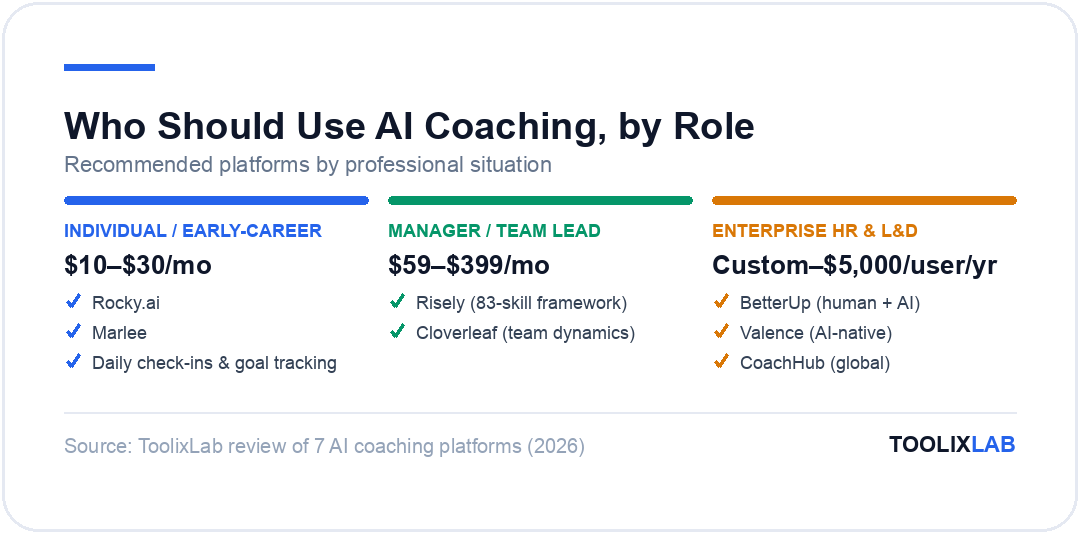
Self-coaching apps are AI coaches designed for individuals rather than organisations. They're available directly to consumers (B2C), typically at low price points ($10–30/month), and focus on personal development, goal-setting, productivity, and life coaching. Rocky.ai is the best-known example — daily leadership questions, goal tracking, and a conversational AI coach in your pocket. Marlee uses its proprietary F4BE personality framework to deliver coaching. These tools work well for self-motivated individuals who want consistent development support without corporate budget or the scheduling friction of a human coach.
Type 4: AI Coach Builders (for Coaching Professionals)
The newest and fastest-growing category. These platforms let professional coaches create an AI version of themselves — trained on their frameworks, their language, and their methodology — so their clients can get coaching support 24/7 between sessions. Coachvox AI is the market leader, allowing coaches to build and deploy an AI clone starting at $99/month. This category solves the fundamental scaling problem of coaching: one human coach can serve 10–20 clients at a time, but an AI clone has no such constraint. If you're a coach, this is the category you should be watching most closely.
What to Look for in an AI Coaching Tool
Not all AI coaching platforms are equal. The market has attracted both genuinely innovative tools and rebranded chatbots with a coaching UI overlay. Here's what separates substantive platforms from the noise:
Behavioural science foundation: The best platforms ground their coaching in validated frameworks — ICF coaching competencies, personality instruments with published psychometric reliability, or longitudinal research on skill development. Platforms that are "AI-powered" with no published methodology are often LLM wrappers with a coaching interface. When evaluating, ask vendors: "What is the scientific basis for your coaching model?" If the answer is vague, look elsewhere.
Personalisation depth: Generic AI coaching is motivational wallpaper. The platforms that deliver real results adapt to your specific personality type, role, industry, and development history. Cloverleaf's calendar integration — which provides coaching nudges before meetings based on who's attending — is a good example of contextual personalisation. Risely's 83-skill framework means your development plan is specific to your actual gaps, not generic. Platforms that offer the same daily prompt to every user are not coaching — they're publishing.
Proactive vs reactive delivery: A reactive AI coach waits for you to open the app. A proactive AI coach sends you a nudge before your difficult meeting, checks in after a challenging conversation, and surfaces a relevant exercise when your goal metrics stall. Proactive delivery dramatically increases engagement and real-world outcomes. Look for platforms with Slack or Teams integration, calendar sync, push notification workflows, or API connections to your work tools.
Measurable skill tracking: If you can't measure it, you can't manage it. The best platforms give you a clear skills dashboard showing your starting point, your trajectory, and your current level across specific competencies. Vague "coaching conversations" with no measurement component are a red flag. Ask for a demo of the analytics dashboard before committing — and ask specifically how they define and measure improvement.
Data privacy and security: Coaching conversations contain sensitive personal and professional information. Verify that the platform is GDPR-compliant (essential if you're EU-based or have EU employees), offers data encryption at rest and in transit, has clear data retention and deletion policies, and explicitly states it does not use your conversation data to train its public models without consent. Enterprise buyers should request a Data Processing Agreement (DPA) and a SOC 2 report before signing.
Trial quality: Almost every credible AI coaching platform offers a meaningful free trial — Rocky.ai, Risely (14-day, no credit card), and most enterprise platforms offer demo environments. If a vendor won't let you try the product substantively before committing, that's a signal about their confidence in the product experience. Insist on a trial that lets you experience the actual coaching interface, not just a sales demo.
7 Best AI Coaching Tools in 2026 — Reviewed
| Tool | Best For | Starting Price | Free Plan | Our Rating |
|---|---|---|---|---|
| Rocky.ai | Individual self-coaching | ~$10/mo | ✅ Trial | ⭐ 4.6 |
| Risely | Manager skill development | $59/user/mo | ✅ 14-day trial | ⭐ 4.7 |
| BetterUp | Enterprise blended coaching | $3,000+/user/yr | ❌ | ⭐ 4.8 |
| Cloverleaf | Team dynamics via Slack/Teams | Custom | ❌ | ⭐ 4.5 |
| Coachvox AI | Coaches building AI clones | $99/mo | ❌ | ⭐ 4.5 |
| Valence | Manager coaching at enterprise scale | Custom | ❌ | ⭐ 4.7 |
| CoachHub | International enterprise coaching | $275/mo (individual) | ❌ | ⭐ 4.6 |
*Prices verified June 2026 — check official pages for current rates.
1. Rocky.ai — Best AI Self-Coaching App for Individuals
Rocky.ai is the most accessible entry point into AI coaching for individuals. It works as a daily leadership coach delivered through a clean mobile app: every day, Rocky asks you a focused question tied to your leadership goals, prompts you to reflect, and tracks your answers over time. This longitudinal approach — building a record of your thinking patterns and growth across months — is where Rocky differentiates from a generic AI chat session or a productivity journaling app.
Rocky is particularly well-suited for people who are early in their leadership journey, or who want consistent daily practice without the cost or scheduling friction of a human coach. It's available in multiple languages, and the enterprise version allows managers to track team engagement with coaching activities at an aggregate level. The major limitation: Rocky's self-coaching model is only as effective as the user's self-awareness and daily commitment. It won't push back the way a skilled human coach would, and it won't identify blind spots you're not aware of. What it does exceptionally well is create daily development habits — and for most people, habit consistency is the hardest part of personal development.
✅ Pros
- • Very low cost (~$10–30/month) — genuinely accessible for individuals
- • Daily check-in format builds consistent development habits over time
- • Longitudinal tracking shows real progress across weeks and months
- • Free trial available with no credit card required
- • Enterprise team version available for L&D rollout at scale
- • Available in multiple languages
❌ Cons
- • Self-directed — won't identify or challenge blind spots like a human coach
- • Less suited for complex workplace conflicts or emotional challenges
- • Limited third-party tool integrations vs enterprise platforms
- • Individual vs enterprise pricing varies widely and can be opaque
- • Effectiveness depends heavily on daily user engagement
| Plan | Price/mo | What You Get |
|---|---|---|
| Individual | ~$29.50 | Daily AI coaching questions, goal tracking, longitudinal progress reports, mobile app |
| Team/Enterprise | From ~$10/user | Team dashboards, custom coaching programs, admin controls, volume pricing, SSO |
*Prices verified June 2026 — check rocky.ai/pricing for current rates.
Best for Individual contributors and early-career leaders who want daily development habits without a coaching budget. Also good for L&D teams wanting a high-volume, low-cost coaching layer across a large workforce.
2. Risely — Best AI Coaching Platform for Manager Development
Risely is the most comprehensive AI coaching platform specifically designed for managers and team leaders. Where Rocky.ai asks reflective questions, Risely maps your management challenges to a library of 83 specific, measurable skills — things like "giving difficult feedback," "delegating without micromanaging," or "managing a remote team across time zones" — and builds a personalised development plan around your actual gaps, not generic leadership advice.
What sets Risely apart is the specificity and the measurement rigour. You don't get generalist coaching. You get targeted exercises, nudges, and assessments tied to exactly the skill you're struggling with right now, with clear before/after tracking across each competency. Risely also includes a 14-day free trial with no credit card required, making it one of the easiest enterprise-quality platforms to evaluate before committing budget. Team plans start at $399/month for five users, making it viable for small management teams and mid-market L&D programs. For a dedicated look at management AI tools, see our guide to the best AI tools for coaches and consultants.
✅ Pros
- • 83-skill framework gives highly specific, measurable development plans
- • 14-day free trial — no credit card, genuinely easy to evaluate
- • Team plans from $399/month — viable for SMB and mid-market
- • Strong management focus vs vague "leadership" coaching
- • Clear skill progress dashboards for HR and L&D reporting
- • Comprehensive review of 15+ platforms confirms Risely as category leader for managers
❌ Cons
- • $59/user/month is steep for individual access at large scale
- • Primarily focused on managers — less useful for individual contributors
- • No human coach layer — purely AI-driven coaching
- • Mobile app experience is functional but not as polished as consumer apps like Rocky.ai
| Plan | Price/mo | What You Get |
|---|---|---|
| Individual | $59/user | 83-skill coaching library, personalised plan, daily nudges, progress tracking, 14-day free trial |
| Team (5+ users) | From $399/mo | All individual features + team skill gap reports, HR admin dashboard, cohort tracking |
| Enterprise | Custom | Custom integrations, SSO, dedicated customer success, volume pricing, HRIS connection |
*Prices verified June 2026 — check risely.me for current rates.
Best for First-time managers and experienced leaders who want measurable, skill-specific development. HR and L&D teams wanting to scale manager coaching across 10–500 people without enterprise pricing.
3. BetterUp — Best Enterprise Blended Coaching Platform
BetterUp is the market leader in enterprise blended coaching, and it has been since its launch. The platform combines access to over 5,000 credentialled human coaches with an AI layer that handles between-session support, habit nudges, progress tracking, and micro-learning content. BetterUp's coaching is research-backed — the company has published studies showing that coached employees demonstrate a 56% improvement in goal attainment and a 28% improvement in job performance relative to uncoached control groups.
The price is significant: $3,000–5,000 per user per year makes BetterUp a C-suite or high-potential talent investment, not a broad workforce tool. That's its primary limitation. For the specific use case of executive development or senior manager acceleration where the strategic value is high, BetterUp's combination of human depth and AI scale is hard to match. The platform also provides significant analytics: HR leaders get visibility into workforce-wide skill trends, coaching utilisation rates, and correlations with performance and retention data. If you're deploying across thousands of employees with a broad L&D objective, look at Valence or Risely instead.
✅ Pros
- • 5,000+ credentialled human coaches — broadest verified network in market
- • Published peer-reviewed research on coaching outcome improvements
- • Strong AI between-session layer with nudges and habit tracking
- • Enterprise-grade analytics dashboard for HR and CHRO reporting
- • Established brand — easy stakeholder buy-in from HR leadership and CEOs
- • Deep HRIS and performance system integrations
❌ Cons
- • $3,000–5,000/user/year is prohibitive for broad workforce deployment
- • Long enterprise sales cycle — not a quick buy
- • Human coach quality varies — matching process isn't always optimal
- • Overkill (and overpriced) for individual contributors and early-career employees
Best for Enterprise HR teams investing in executive or high-potential talent development where cost-per-employee is justified by strategic role value. Right tool for 10 VPs, wrong tool for 500 managers.
4. Cloverleaf — Best AI Coaching for Team Dynamics
Cloverleaf takes a fundamentally different approach to AI coaching: instead of coaching individuals in isolation, it focuses on improving team dynamics. The platform aggregates multiple existing personality assessments — DISC, Enneagram, Myers-Briggs/16 Types, CliftonStrengths, and others — into a single unified profile for each team member, then delivers personalised coaching nudges through Slack, Microsoft Teams, and email based on the relationships between team members' profiles.
The calendar integration is Cloverleaf's standout feature: it syncs with your calendar and delivers coaching tips before meetings based on the personality profiles of who's attending. If you're heading into a meeting with someone who scores high on dominance and low on influence in DISC, Cloverleaf will suggest specific communication approaches likely to land well with that person. This contextual, in-the-moment coaching is genuinely useful in a way that generic AI chat is not. Pricing is custom and requires a demo call, which is a frustration — but it's consistent with their enterprise-focused GTM model.
✅ Pros
- • Aggregates assessments your team has already taken — no new testing burden
- • Calendar integration delivers contextual pre-meeting coaching at exactly the right moment
- • Slack and Teams native — coaching delivered in tools your team already uses daily
- • Team-level view helps managers understand group dynamics, not just individual development
- • Strong for newly-formed teams, cross-functional groups, and teams with recurring friction
❌ Cons
- • No public pricing — requires demo call to get a quote
- • Less focused on individual skill development vs team relationship coaching
- • Value is diluted if your team hasn't taken validated personality assessments
- • Not a consumer or individual product — built for team or department deployment
Best for Team leaders and HR professionals who want to improve collaboration and communication within specific teams. Particularly valuable for newly-formed teams, cross-functional project groups, and teams with recurring interpersonal friction.
5. Coachvox AI — Best Tool for Coaches Building an AI Version of Themselves
Coachvox AI sits in a completely different category from the other tools on this list. Rather than coaching end-users directly, it enables professional coaches to create an AI replica of themselves — trained on their specific frameworks, language patterns, methodology, and philosophy — that their clients can access 24/7, whether that's between sessions, during a 3am anxiety spiral, or in the week after a session when insights are still processing.
For a coaching professional, this solves the fundamental scaling constraint: a human coach can only serve a finite number of clients at a rate the market will support. With Coachvox AI, clients get access to an AI version of their coach's thinking at any hour, without requiring the coach to be available. The DIY plan at $99/month lets coaches build and deploy their AI using a self-service training interface. The Done-With-You plan ($3,000 one-time) provides guided group and 1:1 setup sessions plus a year of hosting. The Done-For-You plan ($16,000) handles everything for coaches who want a fully managed build.
✅ Pros
- • Enables coaches to scale their reach without trading more hours for income
- • AI trained on YOUR specific framework and language — not generic coaching content
- • Clients get 24/7 access to between-session support in the coach's own voice
- • $99/month DIY plan is accessible for independent and solopreneur coaches
- • Embeddable in your existing website or client portal
- • Strong business model — can support more clients without increasing delivery cost
❌ Cons
- • Quality of the AI clone depends heavily on how well you train and prompt it
- • Done-For-You setup at $16,000 is a significant investment for solo coaches
- • Not a standalone product for end users — needs a human coach behind it to be meaningful
- • Raises genuine ethical questions: clients should clearly know they're talking to an AI, not the human coach
| Plan | Price | What You Get |
|---|---|---|
| Do It Yourself | $99/mo | Full training area access, hosting, data use, AI integration tools |
| Done With You | $3,000 (one-off) | Guided group + 1:1 training sessions, full build guidance, 1 year hosting included |
| Done For You | $16,000 (one-off) | Full setup and AI training handled end-to-end, all content ingested, custom deployment and hosting |
*Prices verified June 2026 — check coachvox.ai for current rates.
Best for Professional coaches, consultants, and thought leaders who want to scale their impact without scaling their hours. Particularly valuable for coaches with a distinctive methodology or established personal brand.
6. Valence — Best AI-Native Coaching for Enterprise Manager Development
Valence raised a $50 million Series B in September 2025, and the investment thesis was clear: AI-native manager coaching is now a viable alternative to legacy blended platforms at enterprise scale. Valence delivers structured, personalised coaching to managers through a conversational AI that understands your company's specific leadership competencies, your team's composition, and the context of your recent management challenges — not generic advice.
What makes Valence notable is the depth of enterprise integration. It connects with your HRIS, your performance management system, and your org chart, giving the AI coach context it needs to be genuinely useful — rather than relying entirely on self-reported data. If a manager just had a difficult performance review conversation flagged in the performance system, Valence can acknowledge that context and coach around it specifically. Pricing is custom enterprise only, which requires a sales conversation but is consistent with the platform's positioning. Valence is the strongest AI-only alternative to BetterUp for large organisations that need breadth of deployment over depth of human support.
✅ Pros
- • Deep HRIS and performance system integrations — AI coach has genuine organisational context
- • AI-native (no human coach layer needed) — more scalable unit economics than BetterUp
- • $50M Series B signals strong product investment and long-term vendor viability
- • Tailored to company-specific leadership competencies, not generic frameworks
- • Strong analytics for CHROs and L&D leaders at the workforce level
❌ Cons
- • Custom enterprise pricing only — no self-serve or SMB option
- • Requires enterprise sales cycle — not a quick buy for fast-moving teams
- • No human coach layer for complex or deeply sensitive people situations
- • Less established track record than BetterUp — still building its outcome data library
Best for Enterprise HR and L&D teams wanting to scale manager coaching across hundreds or thousands of managers with AI-native efficiency and deep system integrations. A strong BetterUp alternative for organisations ready to bet on AI-only coaching.
7. CoachHub — Best for International Enterprise Coaching Programs
CoachHub is BetterUp's most direct competitor, and its primary differentiator is global reach: the platform operates in over 70 countries and offers coaching in 60+ languages, making it the default choice for multinational organisations that need consistent coaching across geographically dispersed workforces. Like BetterUp, CoachHub uses a blended model — a network of 3,500+ accredited human coaches supported by AIMY, CoachHub's AI coaching layer — but its international network is significantly deeper than BetterUp's for non-English speaking markets.
Individual pricing for CoachHub runs $275–649/month depending on the coaching package, making it more accessible at the individual level than BetterUp. Enterprise pricing is custom and tends to run lower per-seat than BetterUp at scale, which is a meaningful consideration for large multinational deployments. The AIMY AI layer provides between-session support, nudges, and contextual micro-learning content. CoachHub is also explicitly GDPR-compliant with European data residency options, which matters significantly for EU-based enterprise buyers navigating data privacy requirements. The best AI tools for project management pair well with CoachHub for teams running structured programs across geographies.
✅ Pros
- • 70+ countries, 60+ languages — unmatched global reach for enterprise
- • Individual pricing from $275/month — more accessible than BetterUp
- • AIMY AI layer for between-session support and micro-learning
- • Explicitly GDPR-compliant with European data residency options
- • 3,500+ accredited human coaches across multiple time zones and languages
❌ Cons
- • $275+/month minimum is still expensive for individual access — not consumer-priced
- • Human coach quality varies significantly by region and language pair
- • AIMY AI layer is newer and less mature than the human coach network
- • Enterprise sales process required for most meaningful deployments
Best for Multinational organisations with employees across multiple countries and languages who need a consistent, high-quality coaching program delivered in local languages and cultural contexts. The GDPR compliance and EU data residency make it the clear choice for European enterprise buyers.
AI Coaching Use Cases: Where It Delivers Real Results
AI coaching is not a one-size-fits-all solution. The use cases where it demonstrably delivers value are specific — and the areas where it underperforms are equally specific. Here is an honest breakdown of both.
Use Case 1: Sales Performance Coaching
Sales coaching is the most mature and data-rich AI coaching use case. AI sales coaching platforms analyse real call recordings, score them against your sales methodology, identify specific skill gaps (objection handling, discovery questioning, closing techniques), and deliver targeted practice scenarios. According to data from Hyperbound AI's 2026 analysis, organisations using AI sales coaching are reporting up to 20% increases in sales productivity and up to 30% revenue growth within three years. The category has further subdivided into real-time whisper guidance (AI coaching you during a live call), post-call deal intelligence (AI debriefing you after), and agentic playbook execution (AI handling parts of the outreach workflow). For a dedicated look at sales AI tools, see our guide to the best AI tools for sales teams in 2026.
Use Case 2: Manager & Leadership Development
Leadership development is the fastest-growing enterprise AI coaching use case in 2026. The driver is simple: organisations can't afford to put every manager through BetterUp at $3,000–5,000/user/year, but they can afford Risely at $59/user/month or Valence at custom enterprise rates that are substantially lower per seat. AI coaching allows L&D budgets to stretch further while maintaining meaningful skill development at breadth. The critical caveat: AI coaching for managers works best for structured, measurable skills — delegation, feedback, running effective 1:1s, managing distributed teams — and is less effective for complex emotional intelligence development and crisis leadership scenarios.
Use Case 3: Personal Productivity & Life Coaching
Individual users are turning to AI coaching for personal development goals that would previously have required an expensive life coach: habit formation, goal accountability, decision-making frameworks, stress management, and career planning. Platforms like Rocky.ai and Marlee serve this market at $10–30/month — a price point that democratises access to quality coaching for people who couldn't previously afford it. The quality of experience varies significantly by platform, and the self-motivation required to engage consistently is substantial. AI coaching works for individuals who already have a development orientation; it won't create that orientation in people who lack it.
Use Case 4: Coach Practice Scale
Professional coaches are using AI tools to extend their reach without extending their hours. The most common applications: AI-powered between-session client support (Coachvox AI), automated session preparation and note-taking, content creation from coaching frameworks for thought leadership, and client progress tracking at scale. This is the area most competitor articles in this space miss entirely, but it's one of the highest-growth segments for the coaching profession itself. The coaches who will thrive over the next five years are the ones who deploy AI as a leverage tool, not the ones who treat it as a competitive threat.
Use Case 5: New Hire Onboarding Acceleration
AI coaching is increasingly embedded in the 90-day onboarding period for new hires, with structured coaching nudges, daily check-ins, and skill assessments helping new employees ramp faster and more consistently. Early enterprise data suggests that AI-coached onboarding cohorts reach core productivity benchmarks 15–20% faster than non-coached control groups. This is a use case where the structured, consistent, scalable nature of AI coaching is a genuine advantage over ad-hoc manager support or generic onboarding portals.
Real Results: What the Data Actually Shows
AI coaching vendors make bold claims. Here is what the independently verifiable and vendor-attributed data shows in 2026, with honest caveats about source provenance:
- Sales productivity: Organisations using AI for sales coaching report up to a 20% increase in sales productivity, according to Hyperbound AI's 2026 analysis.
- Revenue impact: Companies with AI coaching embedded in their sales function report up to 30% revenue growth within three years — a figure cited across multiple vendor sources and directionally consistent, but not independently peer-reviewed.
- Goal attainment: BetterUp's internal research shows a 56% improvement in goal attainment and a 28% improvement in job performance among coached employees versus non-coached control groups. Source is BetterUp — treat as directional.
- Enterprise adoption: According to CareerTrainer AI's 2026 report, 67% of Fortune 500 companies have piloted or deployed AI coaching programs — making this a mainstream enterprise decision, not an experimental one.
- Market growth: The coaching platform market is valued at $4.22 billion in 2026 and projected to reach $12.01 billion by 2036 at an 11.0% CAGR, per Future Market Insights. The AI coaching segment specifically is growing at 28% CAGR through 2030 (Gitnux).
The honest caveat: the majority of outcome data comes from the platforms themselves, not independent academic research. Vendor statistics should be treated as directional indicators, not definitive proof. What we can say with confidence is that enterprise adoption is accelerating rapidly (the market size data comes from multiple independent analysts), and that companies deploying AI coaching are continuing to invest and expand — which is the most reliable real-world proxy for effectiveness.
AI Coaching vs Human Coaching: An Honest Comparison
The "AI vs human" framing is increasingly a false dichotomy — most enterprise deployments use both. But when you're choosing between purely AI-delivered coaching and a human coach for your specific situation, here's an honest breakdown of where each wins:
| Dimension | AI Coaching | Human Coaching |
|---|---|---|
| Cost | ✅ $10–60/mo | $200–500+/session |
| Availability | ✅ 24/7 | Scheduled sessions only |
| Consistency | ✅ Always consistent | Varies by coach quality |
| Scale | ✅ Unlimited | ~10–20 clients per coach |
| Structured skill tracking | ✅ Automated, granular | Manual, subjective |
| Emotional depth | Limited | ✅ Strong |
| Complex challenges | Struggles | ✅ Excels |
| Blind spot identification | Limited | ✅ Key human advantage |
| Accountability | Moderate | ✅ High (relationship-based) |
| Between-session support | ✅ Continuous | Ad hoc / none |
The 2026 consensus among enterprise L&D professionals is that AI coaching and human coaching are complementary, not directly competitive. AI handles the high-frequency, structured, measurable work — daily check-ins, skill practice, progress tracking, between-session nudges. Human coaches handle the high-complexity, high-stakes, relational work — major career transitions, deep emotional challenges, executive-level strategic thinking, and the accountability that only emerges from a genuine human relationship. The best programs in 2026 deploy both, at different levels of the organisation and for different coaching objectives.
Who Should Use AI Coaching in 2026?
AI coaching delivers real value for specific profiles and use cases. Here's an honest breakdown of who will get the most out of it — and who should consider a different approach.
Individual professionals and early-career leaders who want consistent daily development without a coaching budget will find genuine value in Rocky.ai, Marlee, or similar self-coaching apps. At $10–30/month, the entry cost is negligible relative to the consistency of daily development it provides. The returns — habit formation, structured reflection, goal accountability — can be significant over 6–12 months for motivated users. If you've previously bought a leadership book, read three chapters, and abandoned it, AI coaching's daily nudge model is more likely to stick.
Managers responsible for team performance should seriously evaluate Risely or Cloverleaf. Managing people is the highest-leverage skill in most organisations, and it's systematically under-invested in. AI coaching makes targeted manager development available at a price point SMBs can actually afford. If you're a manager who struggles with delegating effectively, giving difficult feedback, or navigating team conflict, platforms like Risely will address those specific skills with measurable progress tracking — not generic leadership wisdom from a podcast.
HR and L&D leaders deploying at scale (100+ employees) should evaluate Valence, Cloverleaf, or BetterUp/CoachHub depending on budget and human coach requirements. The business case is straightforward: what's the cost of a manager who isn't developing? Poor managers drive attrition, which costs 1.5–2x annual salary per departed employee according to industry research. A $59/user/month AI coaching investment pays for itself if it prevents a single mid-level departure per year.
Professional coaches and consultants should be exploring Coachvox AI not as a competitive threat but as a leverage tool. The coaches who will struggle over the next five years are the ones competing with AI on price and availability — two dimensions where AI wins every time. The coaches who will thrive are the ones who use AI to serve more clients, create richer client experiences between sessions, and free their own time for the high-value, high-complexity work that only a human can do. See our full guide to AI tools for coaches and consultants for a comprehensive toolkit.
Who should start elsewhere: If your primary coaching need involves a major personal crisis, processing grief or trauma, navigating a high-stakes ethical dilemma, or undertaking deep psychological work — AI coaching is not the right tool, and no platform in this guide would claim otherwise. These situations require a skilled human professional. Similarly, if you're not currently self-motivated to engage with a development tool consistently, no AI coaching platform will create that motivation for you. AI coaches are powerful enablers, but they can't care about your development more than you do.
🔑 Key Takeaways
- ✓ AI coaching uses LLMs, NLP, and behavioural science to deliver personalised, goal-oriented coaching at scale — available 24/7 and costing a fraction of human coaching.
- ✓ There are 4 distinct platform types: enterprise blended (BetterUp, CoachHub), AI-native skill practice (Risely, Valence), self-coaching apps (Rocky.ai, Marlee), and AI coach builders (Coachvox AI).
- ✓ The global coaching platform market is valued at $4.22 billion in 2026, growing at 11% CAGR toward $12 billion by 2036 — primarily driven by enterprise AI adoption in L&D.
- ✓ AI coaching wins on cost, scale, consistency, and structured skill tracking. Human coaching wins on emotional depth, blind spot identification, complex relationship challenges, and relationship-based accountability.
- ✓ According to CareerTrainer AI's 2026 report, 67% of Fortune 500 companies have piloted or deployed AI coaching. This is mainstream enterprise investment, not an experiment.
- ✓ The best 2026 approach is hybrid: AI coaching for daily skill practice and broad-workforce development + human coaching for the high-complexity, high-stakes work. Pure-AI beats pure-human on cost and scale; hybrid beats both on depth and breadth combined.
Conclusion: Is AI Coaching Right for You?
AI coaching in 2026 is no longer a category to evaluate cautiously — it's a category to deploy. The tools are mature enough to deliver real results, the evidence base is growing across multiple independent data sources, and the price range genuinely spans every budget: from $10/month for individuals who want daily development consistency to $5,000/user/year for enterprises investing in executive transformation.
What is AI coaching, ultimately? It is the most scalable, always-available, data-driven development infrastructure the coaching profession has ever had access to. It democratises access to quality coaching for people who couldn't previously afford it. It gives L&D leaders workforce-wide visibility into skill development that was previously impossible to measure. And for coaching professionals, it offers a genuine path to scaling impact without scaling hours. None of this means human coaches are obsolete — the best human coaches are busier than ever, because AI has expanded awareness of what good coaching can do.
The practical starting point: if you're an individual, try Rocky.ai or Risely's 14-day free trial this week — no credit card required for either. If you're an L&D leader planning your next budget cycle, book demos with Risely and Valence before committing. If you're a coach building a scalable practice, spend an afternoon on Coachvox AI's demo. The tools are good enough now that the cost of not experimenting is higher than the cost of experimenting.
For a broader view of how AI is transforming the coaching and consulting profession, see our comprehensive guide to the best AI tools for coaches and consultants in 2026.
Our Verdict
AI coaching is no longer experimental — it's the most accessible, scalable, and data-driven development solution available in 2026. For individuals and SMB teams, Rocky.ai and Risely offer the best value. For enterprise, the choice between BetterUp's human depth and Valence's AI-native scale depends on budget and whether complex people challenges require human judgement. Our view: AI-only for broad manager populations at scale; blended for senior and executive roles where depth matters most.
✅ Choose AI coaching if...
- • You need to develop structured, measurable skills at scale
- • Budget prevents regular access to human coaching
- • You want 24/7 accountability and between-session support
- • You're an L&D leader needing to coach 50+ people on a limited budget
- • You're a coach wanting to extend your reach beyond your billable hours
✅ Keep a human coach if...
- • You're navigating a major career transition or personal crisis
- • You need someone to surface blind spots you genuinely can't see yourself
- • Your challenges are deeply relational, emotional, or ethically complex
- • You're in an executive role where stakes are high and nuance matters
Frequently Asked Questions
What is AI coaching exactly?
AI coaching is the use of artificial intelligence — including large language models, natural language processing, and behavioural science algorithms — to deliver personalised guidance, skill development, and performance feedback at scale. It operates 24/7, adapts to individual needs and personality profiles, and costs a fraction of traditional human coaching. It covers use cases from sales performance to leadership development to personal productivity.
How does AI coaching differ from a chatbot?
Unlike a generic chatbot that answers questions on demand, an AI coach proactively initiates conversations, tracks your progress over time, adapts its approach to your personality and development goals, and holds you accountable through structured check-ins. It is goal-oriented and longitudinal, not transactional. A chatbot helps you get an answer; an AI coach helps you develop over months.
Is AI coaching effective?
Research shows meaningful results: organisations using AI sales coaching report up to 20% increases in sales productivity (Hyperbound AI, 2026). BetterUp's internal data shows a 56% improvement in goal attainment among coached users. Results vary significantly by platform quality and how deeply the tool is integrated into daily workflows. Most vendor statistics are self-reported — treat them as directional rather than independently verified.
Can AI replace human coaches?
Not completely in 2026. AI handles scale, 24/7 availability, repetition, and data-driven skill tracking exceptionally well. Human coaches still outperform AI for complex emotional work, executive-level strategic thinking, blind spot identification, and the accountability that emerges from a genuine human relationship. The enterprise consensus in 2026: hybrid (AI + human) wins for senior talent; AI-only is highly effective for structured skill practice at scale.
How much does AI coaching cost?
Costs range widely: self-coaching apps like Rocky.ai start at $10–30/user/month; manager platforms like Risely charge $59/user/month with team plans from $399/month; enterprise blended platforms like BetterUp run $3,000–5,000/user/year; CoachHub charges $275–649/month for individuals. DIY coach builder Coachvox AI starts at $99/month. Most platforms offer free trials with no credit card required.
What are the best AI coaching platforms in 2026?
The top platforms by use case: Rocky.ai (best individual self-coaching), Risely (best for manager skill development at $59/user/month), BetterUp (best enterprise blended with 5,000+ credentialled human coaches), Cloverleaf (best for team dynamics via Slack and Teams), Coachvox AI (best for professional coaches building an AI clone), Valence (best AI-native enterprise manager coaching), and CoachHub (best for international and multilingual enterprise deployments).
What is the difference between AI coaching and AI mentoring?
AI coaching is forward-looking and goal-oriented — it drives specific skill development through structured practice, accountability check-ins, and measurable progress tracking. AI mentoring is more advisory and experience-sharing, providing guidance based on expertise rather than driving toward a defined outcome. Most 2026 platforms blend both approaches, but the distinction matters when choosing the right tool for your specific development objective.
Who should use AI coaching tools in 2026?
AI coaching suits individual professionals wanting 24/7 development support without high coaching fees, managers building measurable leadership skills at scale, HR and L&D leaders deploying coaching programs to large workforces on a budget, solopreneurs who want structured daily development habits, and professional coaches who want to extend their reach by creating an AI version of themselves for between-session client support.