
By ToolixLab Research Team · Last Updated: June 2026
Quick Answer
The best AI tools for executive coaches in 2026 are Claude (development plans, session prep), Granola or Fireflies.ai (confidential session notes), Paperbell (client management), and CoachHub or Valence for coaches running enterprise coaching programs. Most coaches start with Claude plus one note-taker and expand from there.
The executive coaching market is on track to reach $112.98 billion by 2026, according to Future Market Insights — and AI is doing more than changing the tools coaches use. It's changing what coaches can accomplish between sessions, how fast they can generate C-suite-calibre development plans, and how precisely they can track client progress across a twelve-month engagement.
If you coach C-suite leaders, VPs, or senior managers, the right AI tools don't just save time — they raise the quality of your work. The best AI note-taker means you stop splitting attention during sessions. The right AI writing assistant means a 360-degree feedback synthesis that would take four hours to write takes forty minutes. The right client platform means no invoice goes missing and every session package stays on track.
This guide is specifically for executive coaches as practitioners — not the AI platforms that sell to HR departments to scale coaching across an organisation, but the AI tools that make individual coaches and boutique coaching firms dramatically more effective. We evaluated 30+ tools and narrowed them down to the 12 that earn their place in a serious executive coaching practice.
⚡ Quick Summary
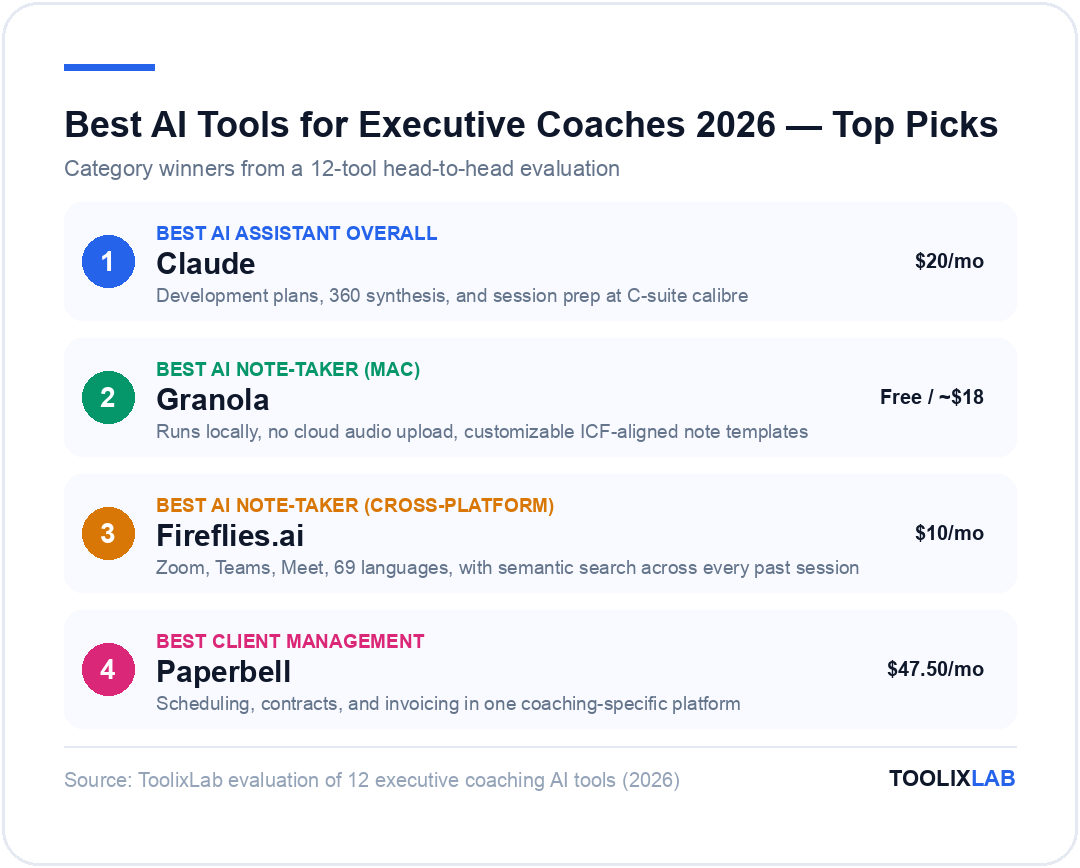
Best AI assistant overall: Claude — development plans, 360 synthesis, session prep
Best AI note-taker (Mac): Granola — runs locally, no cloud audio upload
Best AI note-taker (cross-platform): Fireflies.ai — Zoom, Teams, Meet, 69 languages
Best client management: Paperbell — scheduling + contracts + invoicing, coaching-specific
Best enterprise platform: CoachHub (global scale) or Valence (Fortune 500)
Jump to: Comparison Table | Note-Taking | Session Prep | Enterprise Platforms | Build Your Stack
What AI Tools Do Executive Coaches Actually Need in 2026?
Executive coaching is a different discipline from life coaching or solopreneur coaching. Your clients are time-poor senior leaders making high-stakes decisions. Their coaching sessions are 60-minute windows often squeezed between board meetings. Confidentiality is non-negotiable — you cannot use tools that train AI on client data. And the deliverables you produce (leadership development plans, 360-degree feedback synthesis reports, board readiness assessments) need to be polished enough to land in a C-suite inbox.
That creates a specific set of requirements. According to CareerTrainer AI's 2026 report, 75% of high-performing coaching businesses now use AI co-pilots regularly, and coaches using AI workflow tools reclaim an average of 1.75 hours per day from administrative tasks — hours that go back into client relationships and business development.
The tools executive coaches need fall into five categories:
- AI note-takers: capture sessions without recording audio to third-party clouds or derailing your presence
- AI writing assistants: generate development plans, session summaries, and feedback synthesis at C-suite quality
- Research tools: brief you on a client's industry, recent board news, or leadership framework in minutes before a session
- AI coaching platforms: relevant when deploying coaching programs for corporate clients at scale
- Business operations tools: scheduling, invoicing, client portals, and knowledge management
The key distinction from guides aimed at coaches generally: executive coaches need tools that hold up to C-suite scrutiny. Your deliverables are read by people who are paid to be critical. This raises the bar for every tool in your stack.
At a Glance: 12 Best AI Tools for Executive Coaches (2026)
Here's how the top tools stack up across the five categories an executive coaching practice actually needs:
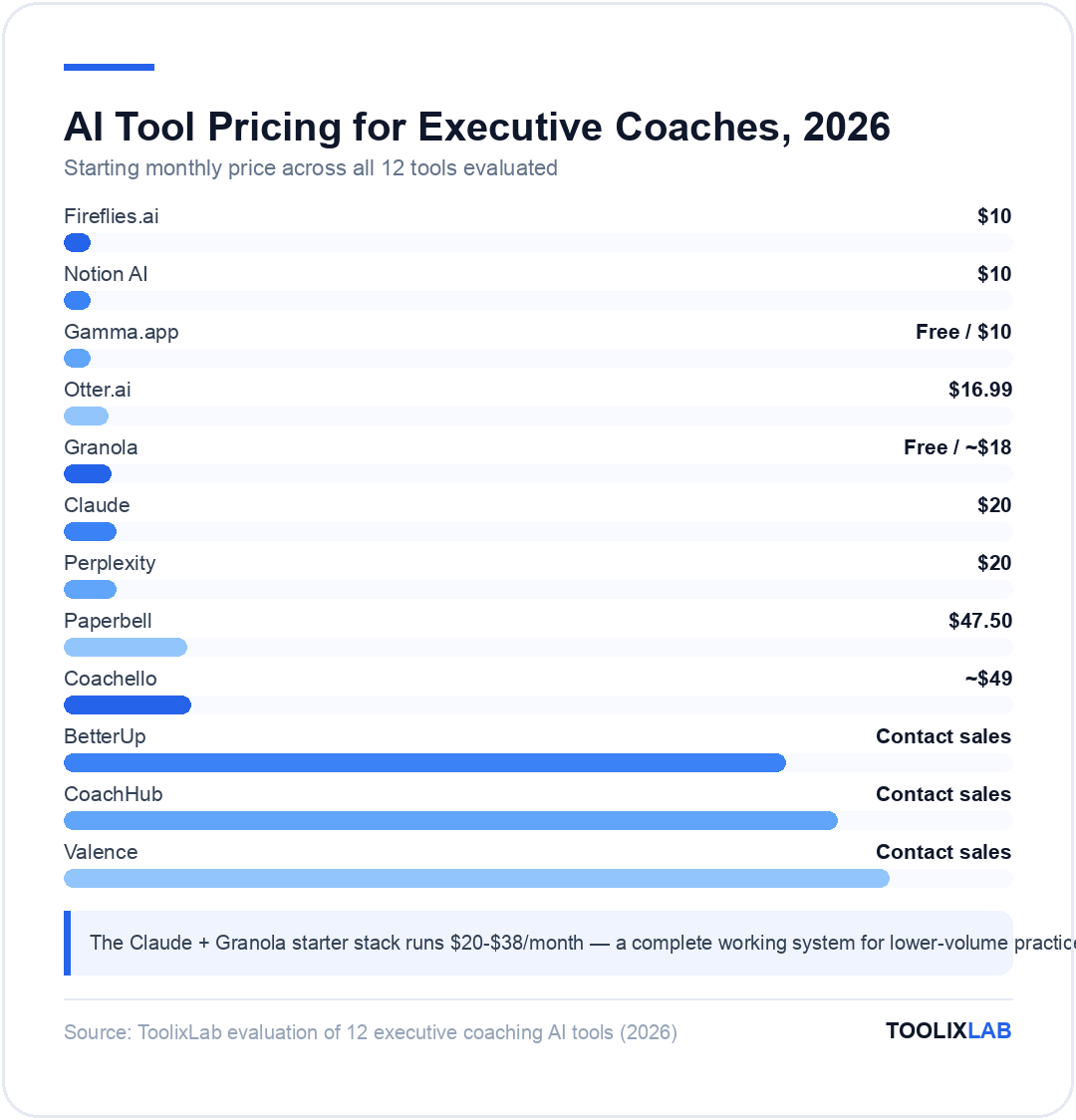
| Tool | Best For | Starting Price | Free Plan | Rating |
|---|---|---|---|---|
| Claude | Development plans & session prep | $20/mo | ✅ | ⭐ 4.9 |
| Granola | Confidential Mac note-taking | Free (5 mtgs/mo) | ✅ | ⭐ 4.8 |
| Fireflies.ai | Cross-platform transcription | $10/mo | ✅ | ⭐ 4.7 |
| CoachHub | Global enterprise coaching | Contact sales | ❌ | ⭐ 4.6 |
| Valence | Fortune 500 manager coaching | Contact sales | ❌ | ⭐ 4.7 |
| BetterUp | Hybrid human + AI coaching | Contact sales | ❌ | ⭐ 4.5 |
| Coachello | Slack/Teams roleplay coaching | ~$49/mo | ❌ | ⭐ 4.5 |
| Paperbell | Coaching CRM & scheduling | $47.50/mo | ❌ | ⭐ 4.6 |
| Perplexity | Pre-session research | $20/mo | ✅ | ⭐ 4.7 |
| Notion AI | Client knowledge base | $10/mo | ❌ | ⭐ 4.5 |
| Gamma.app | Workshop decks & coaching reports | $10/mo | ✅ | ⭐ 4.6 |
| Otter.ai | Budget-friendly transcription | $16.99/mo | ✅ | ⭐ 4.4 |
*Prices verified June 2026 — check official pages for current rates before subscribing.
Best AI Note-Taking Tools for Executive Coaching Sessions
Note-taking during a coaching session is a presence problem. The moment you shift your attention to your keyboard, your client notices — and presence is a core ICF coaching competency. AI note-takers eliminate that trade-off: they join your call, transcribe the conversation, and deliver structured summaries so you can be fully present while the transcript writes itself.
For executive coaching specifically, the confidentiality standard is non-negotiable. Your notes may contain sensitive information about board dynamics, leadership failures, or personal performance challenges. Before choosing any note-taking tool, confirm: Does it train on your transcripts? Where is audio stored and for how long? Who at the company can access it? The two tools below have clear, coaching-appropriate data policies.
1. Granola — Best AI Note-Taker for Mac
Best for ConfidentialityGranola is purpose-built for Mac users who want an AI note-taker that doesn't feel like an intrusion. It runs locally, captures audio through your Mac's built-in microphone without a bot joining your call, and generates structured session summaries including key themes, decision points, and action items. The privacy model is the clearest in the category: audio processing happens on your machine, not on a third-party server.
What sets Granola apart for executive coaches is its customisable note templates. You can configure it to produce summaries structured around ICF core coaching competencies, common frameworks (GROW model, Heron's six intervention types), or your own session structure. For coaches running multiple client engagements simultaneously, this consistency across all session records is a significant efficiency gain — every client note looks the same, making them searchable and comparable over time.
The free tier covers five meetings per month — enough to trial the tool with a handful of clients. Most active executive coaches will need the paid plan within a month of starting.
✅ Pros
- • No bot joins your call — clients never see it
- • Audio stays local on your Mac
- • Customisable note templates per coaching framework
- • Structured summaries with action items and key themes
- • Free tier for up to 5 meetings per month
❌ Cons
- • Mac-only — no Windows, iOS, or browser version
- • No native CRM or Paperbell integration
- • Paid plan required for unlimited meetings
- • Transcript search less powerful than Fireflies.ai
| Plan | Price/mo | What You Get |
|---|---|---|
| Free | $0 | 5 meetings/month, structured AI summaries, action items |
| Pro | ~$18/mo | Unlimited meetings, custom note templates, longer transcripts |
*Prices verified June 2026 — check granola.ai for current rates.
2. Fireflies.ai — Best Cross-Platform Session Transcription
Best for Windows & Multi-PlatformFireflies.ai is the cross-platform standard for coaching transcription — it supports Zoom, Google Meet, Microsoft Teams, Webex, and phone calls. Unlike Granola, Fireflies joins as a bot participant in your call, so clients will see "Fireflies Notetaker" in the participant list. For most executive coaching sessions, a brief upfront disclosure ("I use an AI note-taker so I can be fully present with you — the transcript is confidential") is both ethical and accepted without friction.
The standout feature for executive coaches is Fireflies' semantic search across all transcripts. Six months into an engagement, you can search "board presentation concerns" and pull up every session where that topic was discussed — giving you a longitudinal view of a client's development that's genuinely useful for end-of-engagement reports. According to Fireflies.ai, transcription accuracy sits above 90% across 69 supported languages, making it the right choice for coaches with international C-suite clients.
Fireflies integrates with HubSpot, Salesforce, and most calendar platforms, making it a natural fit for coaches with more complex client management setups. The Business plan adds smart search and advanced analytics — worth the upgrade if you run five or more active engagements simultaneously.
✅ Pros
- • Works on all major video platforms (Zoom, Teams, Meet, Webex)
- • Semantic search across your entire transcript history
- • 69 language support for international clients
- • CRM integrations (HubSpot, Salesforce, Notion)
- • AI summaries include action items, topics, and sentiment
❌ Cons
- • Bot joins call — visible to client as a participant
- • Audio processed on cloud servers (not local)
- • Free tier limited to 800 minutes/month
- • Smart search requires Business plan ($19/mo)
3. Otter.ai — Best Budget-Friendly Transcription Option
Otter.ai is the most accessible entry point into AI transcription, with a genuinely useful free tier and one of the lowest paid plans in the category. It's the right starting point for coaches building their first AI-enhanced workflow who aren't yet ready to commit to Granola or Fireflies.ai. Real-time transcription is accurate, meeting summaries are clean, and it integrates with Zoom natively.
The limitation for executive coaches at scale: Otter's summaries are less structured than Granola's and its search less powerful than Fireflies'. Use it while you're experimenting; upgrade once you've confirmed that AI note-taking belongs in your permanent workflow.
For a more in-depth comparison of all three tools, see our dedicated guide to AI note-taking tools for coaches in 2026, which includes head-to-head accuracy tests.
How Do Executive Coaches Use AI for Session Preparation?
Pre-session preparation is where AI provides the highest leverage for executive coaches. A well-prepared coach walks into a session knowing the client's recent wins, current blockers, and relevant industry context. Two tools dominate this use case: Claude for deep synthesis and writing, and Perplexity for real-time research.
4. Claude — Best AI Assistant for Executive Coaching Work
Editor's Top PickClaude is the AI assistant of choice for serious executive coaches because of three specific strengths: long-context retention (it can hold an entire coaching engagement history in one conversation), the Projects feature for client-separated memory, and writing quality that holds up when a C-suite executive reads it.
Here's how executive coaches use Claude day-to-day:
- Leadership Development Plans: Feed session notes and 360-degree feedback data into Claude and ask it to draft a six-month development plan with specific behavioural goals, milestones, and measurement criteria. The output is genuinely executive-calibre — specific, well-structured, and editable rather than generic.
- 360 Feedback Synthesis: Upload raw 360 data and ask Claude to identify the top three themes, surface patterns across rater groups, and highlight the gap between self-perception and how others rate the same behaviours.
- Pre-session research: "My client is a newly promoted CTO at a fintech navigating a board relationship challenge. Summarise what research says about effective CTO-to-board communication in high-growth companies, with specific frameworks and common failure modes."
- Session question design: "Based on last session's transcript and this client's goal of building executive presence, draft ten coaching questions for our next session — mix of exploratory and challenge questions."
- Quarterly progress reports: "Generate a quarterly coaching progress summary suitable for the HR sponsor. Client has given consent. Emphasise goal progress and observable behavioural changes."
Claude's Projects feature is particularly powerful for executive coaching: create a separate project per client, upload that client's assessment results and session summaries, and every AI interaction within that project has context of the full engagement. Claude does not train on uploaded data — a hard requirement for coaching confidentiality. See our broader guide on AI tools for coaches and consultants for more Claude use cases across different coaching disciplines.
✅ Pros
- • Exceptional writing quality for executive deliverables
- • Projects keep each client's context separate
- • Does not train on your data (privacy-safe)
- • Handles long documents — 360 reports, full transcripts
- • Free tier available for light use
- • Teams plan enables shared prompts across a coaching firm
❌ Cons
- • No real-time web search — use Perplexity for that
- • Requires well-crafted prompts to hit C-suite writing level
- • Teams plan ($25/user/mo) needed for firm-wide sharing
5. Perplexity — Best for Real-Time Pre-Session Research
Perplexity is a research tool, not an AI writing assistant — and that distinction matters. Fifteen minutes before a coaching session, ask Perplexity: "What has happened in UK retail banking in the last four weeks that a Head of Digital would care about?" and you get a sourced, up-to-date briefing rather than a summary of training data from a year ago.
Perplexity's focused search modes — searching only academic papers, only news sources, or only specific domains — give you a more signal-dense brief than a general web search. The Pro plan adds deeper follow-up questions and longer responses that are worth the $20/month for coaches managing active research across multiple industry sectors.
The workflow that works: Perplexity for facts and current context → Claude for synthesis and writing. Each tool does what the other cannot.
Best AI Coaching Platforms for Enterprise Clients
This section covers tools relevant when you're deploying coaching programs for corporate clients — not the tools you use in your own practice, but the platforms a client organisation buys to provide coaching at scale. If you're a solo practitioner working only with individual clients, skip to the business operations section.
The AI coaching platform market is growing at 28% CAGR through 2030, according to industry analysis, with over 340 active providers globally as of 2026. For executive coaches positioning themselves as program designers or embedded coaching leads, knowing this landscape well is a competitive advantage when clients ask for platform recommendations.
6. CoachHub — Best Global Enterprise Coaching Platform
CoachHub is the enterprise standard for organisations coaching leaders at global scale. Its AI coaching assistant AIMY supports 80+ languages, making it the only viable option for multinationals with coaching programs spanning Europe, APAC, and the Americas simultaneously. AIMY sits alongside a human coach — it supplements between-session reflection, goal check-ins, and microlearning nudges — it doesn't replace the human relationship.
For executive coaches acting as program designers or coaching lead consultants within an enterprise engagement, CoachHub's analytics dashboard provides ROI data that resonates with L&D buyers: goal completion rates, engagement metrics, 360-degree skill tracking, and session frequency data. This is the proof of impact that justifies contract renewal and program expansion.
✅ Pros
- • 80+ language support for global organisations
- • Hybrid human + AI model (AI assists, doesn't replace)
- • Strong ROI analytics and L&D reporting
- • ICF-accredited coach network for human sessions
- • Integrates with Workday, SAP SuccessFactors
❌ Cons
- • Enterprise-only pricing (minimum contract size)
- • Complex setup for smaller or shorter engagements
- • Less customisable for boutique coaching methodologies
7. Valence — Best for Fortune 500 Manager Coaching at Scale
Valence's AI coach Nadia is designed for one specific use case: providing every manager in a large organisation with personalised, contextualised coaching without requiring a human coach for each person. Nadia integrates directly with Slack and Microsoft Teams, meeting managers where they already work rather than asking them to log into a separate platform.
Unlike generic AI chatbots, Nadia is calibrated to your organisation's specific leadership competencies, values, and strategic priorities. For executive coaches with strong procurement relationships in large enterprises, recommending Valence when a client asks "How do we scale leadership coaching below the senior VP level?" is a high-value advisory service — and it doesn't compete with your individual coaching engagements.
8. Coachello — Best for Slack and Teams-Embedded Coaching Practice
Coachello combines certified human coaches with an AI coach embedded in Slack and Microsoft Teams. The AI coaching companion helps leaders prepare for difficult conversations, practice scenarios through AI avatar role-play, and reflect on critical moments between sessions — creating a continuous development loop between human coaching engagements.
For executive coaches running leadership development workshops, positioning Coachello as the between-workshop practice layer is a natural add-on that increases program ROI — clients practice the skills discussed in workshops rather than losing them by the following week.
Best AI Tools for Client Reports & Leadership Development Plans
Two deliverables separate good executive coaches from exceptional ones: the leadership development plan and the end-of-engagement progress report. Both are time-consuming to write at the level a C-suite client expects. AI handles the first draft — which should take you 30-40 minutes to review and elevate, not four hours to write from scratch.
Claude is the tool for the writing (covered above). Gamma.app is the tool that turns that writing into something a client can actually engage with visually.
9. Gamma.app — Best for Leadership Workshop Decks and Coaching Reports
Gamma.app generates professionally formatted presentations from a text brief or outline in under two minutes. For executive coaches who run leadership workshops, this eliminates the PowerPoint overhead entirely. Type: "Create a workshop deck on navigating stakeholder conflict for senior leaders — 12 slides, practical exercises, executive tone, dark zinc colour scheme" and Gamma produces a fully formatted, professional deck you can edit, brand, and deliver.
More practically for solo practitioners: use Gamma to convert Claude-written development plans into visually structured client reports. A dense Word document becomes a scannable, branded PDF that a CEO can absorb in 10 minutes rather than 40.
✅ Pros
- • Generates complete decks from a brief text prompt
- • Templates suitable for C-suite delivery
- • Exports to PDF, PowerPoint, or shareable link
- • Free tier includes 400 AI credits
- • Embeds images, charts, and interactive elements
❌ Cons
- • Less pixel-level control than PowerPoint
- • Brand colour customisation limited on lower plans
- • AI credits refresh monthly — can run out with heavy use
Best AI Tools for Running Your Coaching Business
Scheduling, contracting, invoicing, session tracking, and client knowledge management can consume 30–40% of a solo executive coach's working week. AI-enhanced tools in this category are not glamorous — but they're what makes everything else sustainable at scale.
10. Paperbell — Best Coaching-Specific Client Management Platform
Paperbell is the only client management platform built specifically for coaching businesses. It consolidates scheduling, digital contracts, invoicing, client portals, session packages, and group coaching management into a single platform — replacing the Calendly + Stripe + DocuSign + spreadsheet CRM setup that most coaches cobble together in their first year.
For executive coaches, the session package tracking is particularly useful: see at a glance how many sessions each client has used, which clients are approaching the end of their contract, and which invoices are outstanding. The client portal means clients self-serve on scheduling without email back-and-forth. Paperbell doesn't have AI features built in — it's the operational backbone that makes everything else efficient. Read our guide to AI workflow for coaches 2026 for how to wire Paperbell into a fully automated practice management system.
✅ Pros
- • Built specifically for coaching practices
- • All-in-one: scheduling + contracts + invoicing + portal
- • Session package tracking per client
- • Client portal reduces admin email volume significantly
- • Supports group coaching and mastermind programs
❌ Cons
- • No AI features built in
- • Less flexible for non-standard coaching formats
- • One flat monthly price regardless of client count
11. Notion AI — Best for Client Knowledge Management
Notion AI turns your Notion workspace into an intelligent knowledge base for your coaching practice. Each client gets a dedicated Notion space with their assessment results, session notes, development plan, and communication history — and Notion AI can query across all of it: "What progress has this client made on their executive presence goal since Q1?"
For coaches running long-term engagements (12+ months), the ability to surface patterns over time — seeing how a client's self-awareness language evolves, or tracking when a recurring theme first appeared — is genuinely useful coaching intelligence. Notion AI is the add-on layer ($10/month) that makes an existing Notion workspace significantly more powerful; it's not a standalone tool. See our full Notion AI review 2026 for a detailed evaluation of its AI features.
12. BetterUp — Best Hybrid Human + AI Coaching Solution
BetterUp sits at the intersection of human coaching and AI enablement. Its platform provides access to 4,000+ credentialed coaches alongside an AI companion called Grow that supports between-session reflection, goal tracking, and daily skill nudges. For executive coaches exploring whether to list themselves on a coaching marketplace, or for HR leaders evaluating platforms, BetterUp remains the brand recognition leader — and its published outcome data (measurable improvement in resilience, performance, and retention at the organisational level) is the strongest in the category for enterprise procurement conversations.
Which AI Coaching Platforms Work Best for Corporate Executive Coaching?
When a corporate client asks you to recommend an AI coaching platform for their organisation, the right answer depends on three factors:
- Scale: Under 100 leaders → Coachello or Risely. 100–1,000 leaders → Valence or BetterUp. 1,000+ → CoachHub.
- Architecture preference: AI-only (faster, cheaper, no coach matching) → Valence, Risely. Hybrid human + AI → CoachHub, BetterUp, Coachello.
- Existing tech stack: Microsoft 365 shop → Coachello (Teams-native) or Valence. Google Workspace shop → CoachHub or BetterUp.
One key distinction worth making explicit: the AI coaching platform your client organisation buys is separate from the AI tools you use in your practice. Recommending CoachHub to a corporate client doesn't mean you use it yourself — you're the program designer and quality assurance layer, not the end user. This distinction is also where executive coaches add positioning value: you understand both sides of the market.
For coaches working primarily with sales leaders, our dedicated guide to AI sales coaching tools 2026 covers the platform landscape from a revenue function perspective.
How to Build Your AI Executive Coaching Stack in 2026
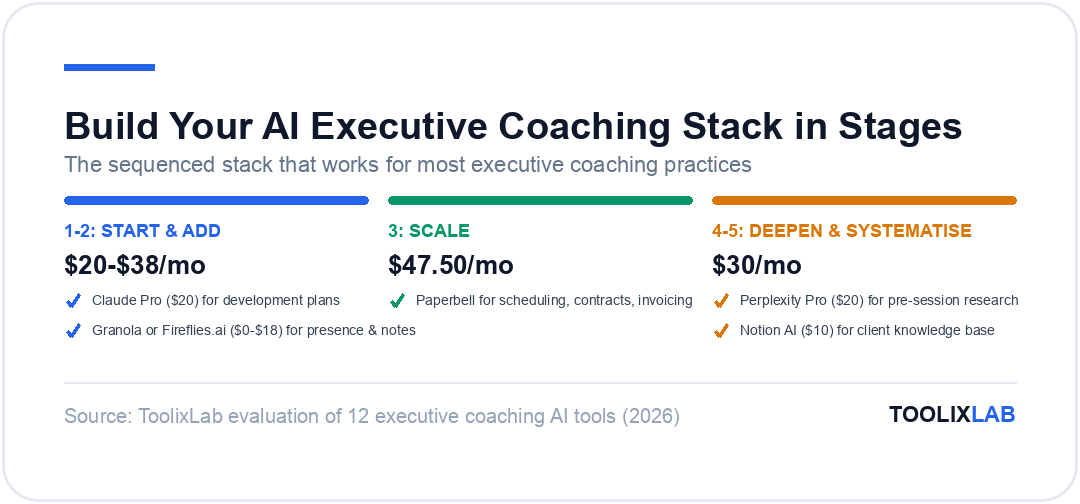
The mistake most coaches make is adding tools before they have a workflow. The right approach: identify your biggest time drain, solve that one thing, and add the next layer only once the first is embedded in your practice. Here's the sequenced stack that works for most executive coaching practices:
| Stage | Problem to Solve | Tool | Monthly Cost |
|---|---|---|---|
| 1 — Start | Writing development plans takes 4+ hours | Claude Pro | $20 |
| 2 — Add | Note-taking pulls you out of presence | Granola (Mac) / Fireflies.ai | $0–$18 |
| 3 — Scale | Admin (scheduling, contracts, invoicing) is overwhelming | Paperbell | $47.50 |
| 4 — Deepen | Pre-session research takes too long | Perplexity Pro | $20 |
| 5 — Systematise | Client knowledge scattered across files and email | Notion AI | $10 |
A fully built Stage 5 stack costs approximately $115 per month — less than the margin on a single executive coaching session at market rates. The ROI question isn't "can I afford these tools?" but "how many hours per week does this return, and what do I do with those hours?"
For coaches just starting out or running a lower-volume practice, the Stage 1 and Stage 2 stack (Claude + Granola) at $20–$38/month is a complete working system. See our guide to best AI tools for solopreneur coaches for a budget-optimised version that scales as your practice grows.
For coaches building towards life coaching and wellness-adjacent work, our guide on best AI tools for life coaches covers the overlapping but distinct tool requirements for that discipline.
Can AI Replace Executive Coaches?
No — and the research consistently supports that conclusion. A 2026 analysis found that 55% of AI coaching feedback falls in a "zone of learning" (surprising yet useful for the recipient), which is meaningful. But the same body of research shows that for C-suite level challenges — navigating board political dynamics, leading through organisational crisis, making high-stakes irreversible decisions — human executive coaches provide depth, contextual judgment, and psychological safety that AI cannot replicate.
AI handles what is scalable and routine: goal tracking, reflection prompts, conversation practice, administrative documentation, research. Human coaches handle what is irreplaceable: genuine presence, contextual judgment honed over years, and the coaching relationship that creates enough safety for a CEO to say what they're actually afraid of.
The opportunity for executive coaches in 2026 isn't to compete with AI — it's to use AI to serve clients at a level that was previously impossible without a team. One executive coach with the right AI stack can now produce the quality of work that used to require two to three support staff. That's a business model improvement, not a threat. For a balanced look at this debate from a client's perspective, our piece on AI coach vs human coach 2026 is the detailed treatment.
🔑 Key Takeaways
- ✓ Claude is the top AI tool for executive coaches — unmatched for development plans, 360 synthesis, session prep, and writing that holds up in a C-suite inbox
- ✓ Granola (Mac) and Fireflies.ai (cross-platform) are the best AI note-takers — both let you be fully present in sessions while the transcript writes itself
- ✓ Paperbell replaces the Calendly + Stripe + CRM cobble with a single coaching-specific platform covering scheduling, contracts, invoicing, and client portals
- ✓ For corporate coaching programs: CoachHub for global scale, Valence for Fortune 500 manager coaching, Coachello for Slack/Teams-embedded practice
- ✓ A full AI executive coaching stack costs ~$115/month and returns 1.75+ hours per day — less than the margin on one session at market rates
- ✓ AI does not replace executive coaches — it removes the administrative and preparatory overhead so coaches can deploy more of what only they can do
Conclusion
The best AI tools for executive coaches in 2026 aren't about replacing your expertise — they're about eliminating the friction that keeps you from fully deploying it. When you're not manually transcribing session notes, spending hours drafting a development plan, or chasing an invoice, you're doing more of the work that actually drives client outcomes.
Start with Claude. Add Granola or Fireflies.ai for your next session. Add Paperbell when the administrative load gets real. That's a complete, working AI executive coaching stack in three tools at under $40/month. The additions — Perplexity for pre-session research, Notion AI for long-term client knowledge management, Gamma for visual reports and workshop decks — add depth once the core stack is embedded and saving time reliably.
For coaches who also want to understand how AI is reshaping what their clients expect from coaching engagements — and how to position your practice as AI-enhanced rather than AI-replaced — our guide on what is AI coaching in 2026 is the natural next read.
Frequently Asked Questions
What is the best AI tool for executive coaches?
Claude is the best all-round AI assistant for executive coaches — it excels at drafting leadership development plans, analysing 360-degree feedback, and preparing session briefs, with a Projects feature that keeps each client's context separate. Pair it with Granola or Fireflies.ai for session notes and Paperbell for client management.
Can AI replace executive coaches?
No. AI coaching tools handle routine tasks — note-taking, goal tracking, conversation practice, and report generation — but executive coaches provide irreplaceable human judgment, confidentiality, and relationship depth for C-suite clients navigating complex organisational dynamics. AI augments coaches; it does not replace them.
How do executive coaches use AI in sessions?
Executive coaches use AI before sessions to research client industries and prepare talking points, during sessions via AI note-takers that transcribe without distraction, and after sessions to draft development plans, summarise progress, and generate insights from session transcripts.
What AI tool is best for coaching session notes?
Granola is the top choice for executive coaches on Mac — it runs locally, does not send audio to the cloud, and produces structured summaries with key themes and action items. Fireflies.ai is the best cross-platform option, supporting Zoom, Teams, and Google Meet with searchable transcripts across 69 languages.
How much do AI coaching tools cost?
AI tools for executive coaches range from free (Claude, Perplexity, Otter.ai basic tier) to $10–$50/month for tools like Notion AI, Gamma.app, and Paperbell. A full working five-tool stack runs around $115/month — less than the margin on a single executive coaching session at market rates.
Is AI coaching as effective as traditional executive coaching?
For behavioural practice and repetition — such as preparing for difficult conversations — AI platforms show strong results, with research finding that 55% of AI feedback falls in a zone of learning (surprising yet useful). For high-stakes strategic leadership challenges, human executive coaches remain significantly more effective than AI-only alternatives.
What is the best AI coaching platform for corporate clients?
CoachHub is the best enterprise AI coaching platform for global organisations, with AIMY supporting 80+ languages and ROI-focused analytics for L&D buyers. Valence is the top choice for Fortune 500 companies deploying manager coaching at scale without requiring a human coach-matching process.
How do I choose an AI tool for my executive coaching practice?
Ask three questions: Does it protect client confidentiality (no training on your data)? Does it integrate with your existing workflow (Zoom, calendar, email)? Will it save more than an hour per week? Begin with Claude for writing and Granola for notes — add Paperbell once you have more than ten active clients.