
By ToolixLab Research Team · Last Updated: June 2026
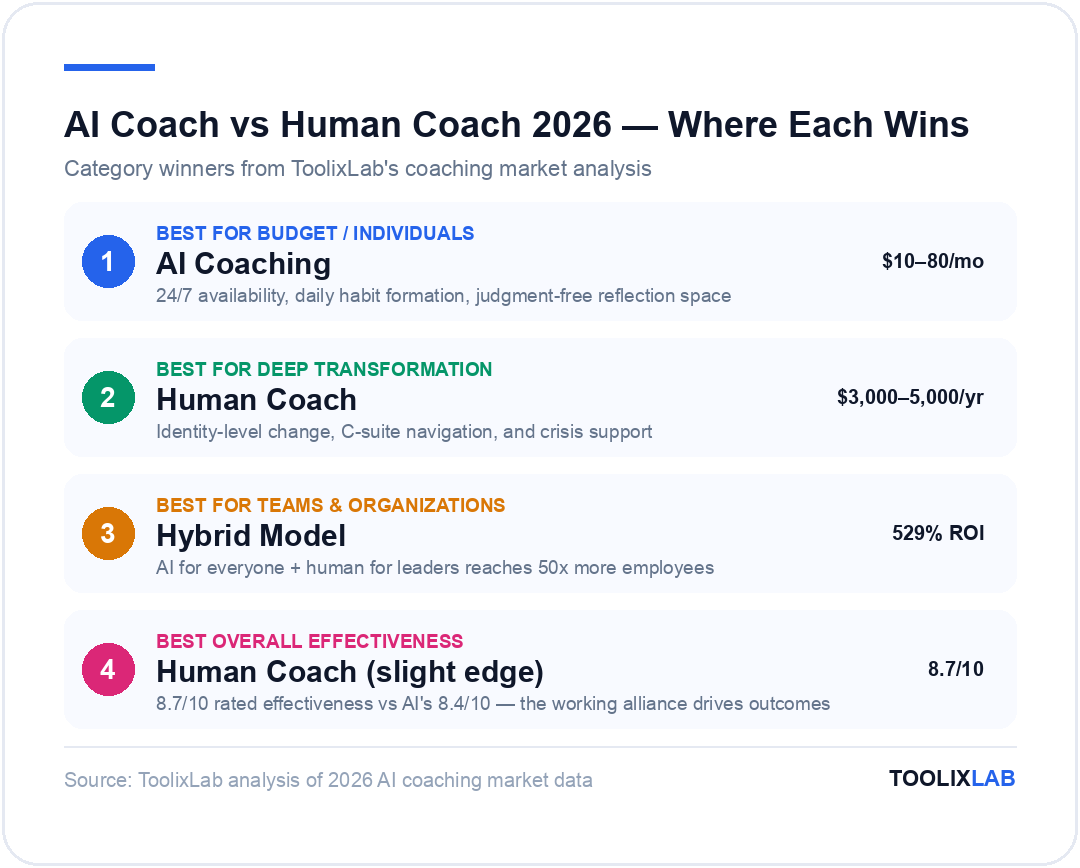
An AI coach is better when you need 24/7 availability, scale, and cost efficiency — delivering coaching to entire teams at $10–80/user/month versus $3,000–5,000/year for human coaches. A human coach is better for deep transformation, leadership pivots, and emotionally complex challenges. For most organizations in 2026, the hybrid model — AI for everyone, human for leaders — delivers the highest ROI.
The AI coach vs human coach debate has intensified in 2026. Coaching — once reserved for C-suite executives with five-figure budgets — is now available to every manager on a team for less than a Netflix subscription. AI coaching platforms like BetterUp, CoachHub, and Risely have scaled what was once a luxury into a daily habit anyone can access from their phone at 11 PM.
But here's the nuance most comparison articles miss: it's not a binary choice. The question isn't "which is better?" in the abstract — it's "which is right for this goal, at this career stage, with this budget?" According to 2026 AI coaching market data, 73% of professionals are willing to try AI-powered coaching, and corporate adoption jumped 156% year-over-year. Yet the most effective organizations are not replacing human coaches — they're supplementing them strategically.
This guide breaks down exactly where each approach wins, where each falls short, and how to build a coaching strategy that actually moves the needle — whether you're an individual professional, a manager developing your team, or an L&D leader deciding where to allocate budget. We'll also look at the hybrid model that's generating 529% ROI for forward-thinking companies.
⚡ Quick Summary
Best for individuals on a budget: AI coaching ($10–80/mo)
Best for deep transformation: Human coach
Best for teams and organizations: Hybrid model (AI + human)
Best overall ROI: Hybrid coaching (529% reported)
Jump to: Where AI Wins | Where Human Wins | Hybrid Model | How to Choose
AI Coach vs Human Coach: Head-to-Head Comparison
Before diving into the details, here's the complete breakdown across the dimensions that matter most for your decision:
| Dimension | AI Coach | Human Coach | Winner |
|---|---|---|---|
| Cost | $10–80/user/month | $3,000–5,000/person/year | 🤖 AI |
| Availability | 24/7, instant | Scheduled sessions | 🤖 AI |
| Scale | Unlimited users | Limited by time | 🤖 AI |
| Emotional Depth | Structured empathy | Genuine attunement | 👤 Human |
| Deep Transformation | Habit formation | Identity-level change | 👤 Human |
| Personalization | Data-driven patterns | Lived-experience intuition | 🤝 Tie |
| Accountability | Automated nudges | Relational stakes | 👤 Human |
| Consistency | No off days | Variable energy | 🤖 AI |
| Effectiveness Rating | 8.4 / 10 | 8.7 / 10 | 👤 Human (slight) |
| Crisis Support | Limited | Essential | 👤 Human |
| Psychological Safety | High (no judgment) | Relationship-dependent | 🤝 Context-dependent |
* Effectiveness ratings and cost data from 2026 AI coaching market reports. Individual results vary by platform and coaching goals.
What Is an AI Coach in 2026?
An AI coach is a software platform that uses large language models, behavioral science frameworks, and natural language processing to deliver personalized coaching conversations, goal-setting structures, and accountability systems. In 2026, AI coaching has matured well beyond simple chatbots — the best platforms are built on ICF (International Coaching Federation) methodologies and can identify behavioral patterns with precision that would take a human coach months to develop.
The mechanics vary by platform, but AI coaches typically deliver: structured goal-setting conversations, daily micro-interventions (often just 5–10 minutes), progress tracking against defined objectives, behavior pattern analysis across sessions, and on-demand support whenever you need it — whether that's 6 AM before a board meeting or 11 PM after a rough day.
The market has responded to this capability with remarkable speed. According to 2026 AI coaching statistics from CareerTrainer, the global AI coaching market is projected to reach $3.2 billion by 2028, growing at a 30.4% CAGR. Corporate AI coaching adoption increased 156% year-over-year, and 67% of Fortune 500 companies have now piloted or deployed AI coaching programs.
Leading platforms in 2026 include BetterUp (enterprise leadership development), CoachHub (scalable corporate coaching combining AI and human coaches), Torch (hybrid model with structured AI sessions between human coaching calls), Risely (manager-specific AI coaching), and Bunch.ai (team leadership development). If you want a deeper breakdown, our guide to the best AI tools for coaches and consultants covers the leading platforms in detail, including pricing and ideal use cases.
What AI coaches cannot do — at least not yet — is replicate the relational dimension of coaching. A platform can prompt you to reflect, track your progress, and deliver research-backed frameworks. It cannot notice that your voice changed when you mentioned your manager's name, or choose to sit in silence for 30 seconds because that's what the moment needs.
What Does a Human Coach Offer That AI Can't?
The working alliance — the quality of the relationship between coach and coachee — accounts for approximately 30% of coaching success, according to research on therapeutic and coaching outcomes. This is the dimension where human coaches hold a structural advantage that no AI system has replicated.
A skilled human coach does something AI currently cannot: they pick up on the unspoken. The micro-pause before an answer. The overly cheerful response to a difficult question. The way someone talks about their success story with none of the energy you'd expect. These cues don't show up in text or structured prompts — they surface in the live, present-moment attunement between two people sharing a conversation.
INSEAD research on coaching identifies this distinction precisely: coaching is inherently relational and "unfolds in the subtle interplay between two humans, marked by trust, emotional attunement, and presence." What AI platforms deliver is coaching-adjacent support — valuable, scalable, and often transformative for structured goals — but not the same experience as being truly seen by another person who has navigated the terrain you're trying to cross.
Human coaches also bring lived experience in ways that matter at the edges of professional life. A coach who has navigated a hostile board, restructured a team through a company crisis, or managed the political dynamics of a founder-CEO transition can pattern-match against your situation with embodied knowledge that no training data can fully replicate. This is especially true at the C-suite level, where the challenges are often more political than technical.
The distinction one researcher captured simply: AI coaching delivers information — it helps you remember what actions to take. Human coaching delivers inspiration — it makes you genuinely want to take them. For deep behavioral change, the gap between knowing and doing is where the human coach earns their fee.
For a full picture of what AI currently does well within coaching workflows, see our detailed guide to what AI coaching actually is and how it works — including where the technology is genuinely impressive and where its current limitations lie.
Where AI Coaching Clearly Wins
There are five dimensions where AI coaching has a structural, not marginal, advantage over human coaching. Understanding these helps you decide when AI is not just the cheaper option — but genuinely the better one.
1. Cost and Accessibility
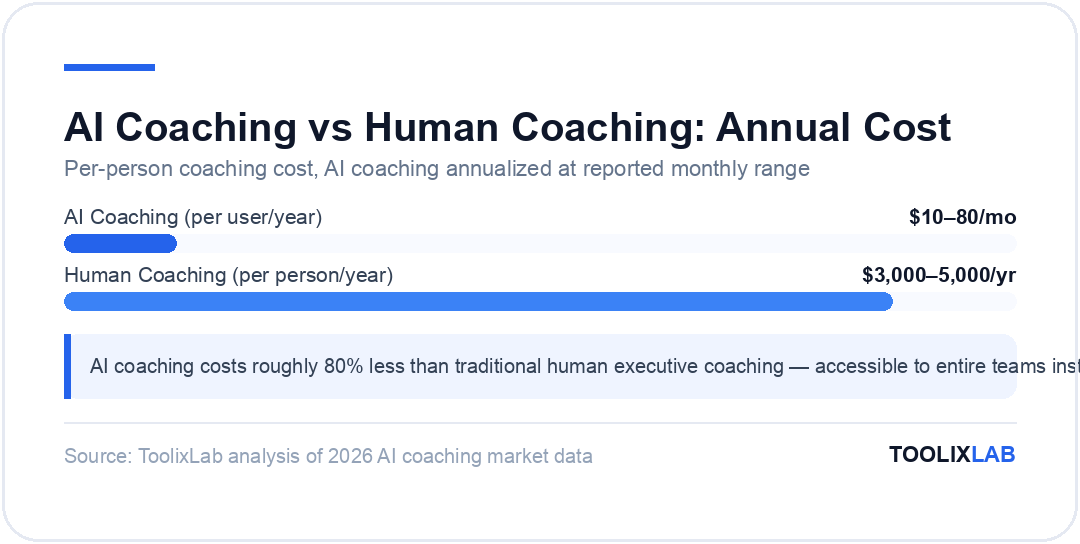
AI coaching costs 80% less than traditional human coaching. At $10–80 per user per month, a team of 50 people can all receive coaching for what a single executive coaching engagement would cost. This is not a minor cost difference — it's the difference between coaching as an elite perk and coaching as a company-wide capability.
For individuals, AI coaching at ~$10/month costs less than a single lunch and requires no business justification. Human executive coaching averages $3,000–5,000 per person per year, and quality coaches with deep specialization command significantly more. The access gap between these two is real and consequential for most working professionals.
2. 24/7 Availability and Daily Habit Formation
Human coaching happens in scheduled sessions — typically 60 minutes, once or twice a month. The gap between sessions is where habit formation either takes root or fades. AI coaching addresses this by turning coaching from a monthly event into a daily practice. A 5-minute AI check-in before your morning stand-up, or a 10-minute reflection after a difficult conversation, reinforces behavior change in the window when it matters most.
The analogy that captures this well: a monthly session with a human coach is like visiting the gym once a month and expecting to get fit. An AI coach is the daily habit of 10 push-ups before breakfast — less dramatic per session, far more impactful in aggregate. For skills like active listening, delegation, giving feedback, and managing up, daily micro-practice accelerates development faster than periodic deep dives.
You can see this habit-formation approach at work in our breakdown of an AI workflow for coaches — including how professional coaches are integrating AI tools to increase client touchpoints without burning out.
3. Scale Across Organizations
A single human coach working full-time serves 25–40 clients. An AI coaching platform serves thousands simultaneously. For L&D leaders and HR teams, this difference is the entire business case. According to 2026 data, companies using hybrid AI + human coaching reach 50 times more employees than those relying on human coaches alone — while reducing per-employee coaching costs by 60%.
This scale advantage is why 67% of Fortune 500 companies have piloted AI coaching programs. It's not because AI coaching is "good enough" — it's because reaching every manager in a global organization with any form of quality coaching was previously impossible.
4. Psychological Safety for Self-Disclosure
Here's a counterintuitive finding from recent research: some people open up more readily to AI coaches than human ones. The absence of social judgment — no concern that admitting a leadership gap might damage how a mentor sees you, or that vulnerability will change a professional relationship — creates space for honest self-reflection that can be harder to access with a person present.
A study published in PMC examining AI versus human coaching alliances found that this judgment-free environment is a genuine advantage for initial disclosure and habit formation — particularly for professionals who would otherwise not engage with coaching at all due to stigma around seeking help.
5. Consistency and Data-Driven Insight
An AI coach never has an off day, never brings its own stress into a session, and never subtly steers you toward its preferred coaching framework due to personal bias. This consistency matters for developing reliable behavioral patterns. AI platforms also surface insights across all your sessions — identifying themes, tracking progress on specific goals, and flagging when your engagement patterns suggest a challenge you haven't named yet.
Where Human Coaching Still Dominates
Despite AI's advantages in cost, scale, and consistency, there are situations where human coaching is not just preferable — it's genuinely irreplaceable. Choosing AI over human coaching in these contexts isn't "good enough"; it's the wrong tool.
1. Deep Transformation and Identity-Level Change
When the goal is not "practice this skill" but "become a different kind of leader" — the difference between behavioral coaching and developmental coaching — human coaches have a decisive advantage. Identity-level change requires confronting and reframing deeply held beliefs about yourself, often ones you don't know you have. This kind of exploration requires genuine presence, challenge, and trust that current AI systems cannot authentically provide.
2. Senior Leadership and C-Suite Coaching
At the executive level, the challenges are rarely about skills — they're about navigating complex human systems: board dynamics, founder conflicts, organizational politics, and high-stakes decisions with incomplete information. A human coach who has operated at this level, or coached others through it, brings a contextual intelligence that data-trained models cannot yet replicate. Research cited by ATD (Association for Talent Development) consistently shows that for senior leaders, the relational quality of coaching accounts for a disproportionate share of outcomes.
This is also the context where the working alliance matters most. The coach-coachee relationship — specifically the quality of trust, goal alignment, and emotional safety — accounts for approximately 30% of coaching outcomes. For leaders operating at high stakes, that relationship quality is not a nice-to-have.
3. Career Transitions Requiring Network and Contextual Navigation
Moving from individual contributor to manager, from manager to executive, or from corporate to entrepreneurship involves navigating contexts that require genuine lived knowledge — not pattern-matched advice from training data. A human coach who has made the transition you're attempting, or who has guided dozens of people through it, offers a quality of navigation that no AI system currently provides. They may also open doors: warm introductions, referrals, and access to networks that fundamentally change your options.
4. Crisis Support and Emotionally Complex Situations
When a leader is experiencing burnout, a team relationship breakdown, or a career-threatening situation, the coaching need is primarily relational — to be met by another human who can hold the weight of the situation alongside them. AI coaching's structured approach and judgment-free environment, valuable in stable contexts, becomes insufficient when what's needed is genuine human presence in a difficult moment. If there is any proximity to mental health, trauma, or clinical concerns, a licensed professional is not optional.
The Hybrid Coaching Model: The Best Strategy for 2026
The most effective coaching strategy in 2026 is not AI or human — it's both, deployed strategically. The hybrid coaching model uses AI coaching for daily skill-building, reflection, and accountability across all employees, while reserving human coaching for senior leaders, complex challenges, and high-stakes transitions.
The data on this approach is compelling. Companies using hybrid AI + human coaching report:
- 529% ROI on coaching investments, versus 200–300% for human-only programs
- 60% reduction in per-employee coaching costs
- 50x more employees reached with quality coaching
- 83% of companies using AI coaching report improved employee retention
Platforms like Torch and CoachHub have built this hybrid model into their core architecture — AI handles the between-session work (goal tracking, daily check-ins, structured reflection), while human coaches lead the deeper sessions that require relational depth. The AI primes each human session with data, making the human coach's time dramatically more effective.
For individual professionals, the hybrid approach looks like: using an AI coach daily for goal setting, habit reinforcement, and skill practice, while working with a human coach monthly or quarterly for strategy, challenge, and deeper exploration. This structure captures 90% of the benefits of human coaching at a fraction of the cost, while getting daily reinforcement that a monthly session alone cannot provide.
For solo practitioners and coaches themselves, understanding this hybrid model is increasingly important — both to position your services against AI platforms and to use AI tools to scale your own practice. Our guide to the best AI tools for solopreneur coaches covers how independent coaches are integrating AI without losing the relational quality that defines their value.
How to Choose: AI Coach, Human Coach, or Hybrid?
Use this decision framework to identify the right approach for your situation:
| Your Situation | Recommended Approach |
|---|---|
| Budget under $100/month, want daily coaching | 🤖 AI Coaching |
| Developing a specific skill (feedback, delegation, communication) | 🤖 AI Coaching |
| Scaling coaching to a team of 10+ people | 🤖 AI Coaching |
| Building daily accountability and habit systems | 🤖 AI Coaching |
| Navigating a major leadership or career transition | 👤 Human Coach |
| Managing a crisis, burnout, or relationship breakdown | 👤 Human Coach |
| C-suite leadership development or board dynamics | 👤 Human Coach |
| Deep identity-level transformation work | 👤 Human Coach |
| Organization-wide coaching program (50+ employees) | 🤝 Hybrid Model |
| Want daily practice + monthly deep-dive strategy | 🤝 Hybrid Model |
| Maximizing coaching ROI across L&D budget | 🤝 Hybrid Model |
For sales teams integrating coaching with performance tools, our guide to the best AI sales coaching platforms in 2026 covers tools that blend AI coaching with CRM data for deal-level performance coaching.
Our Verdict
AI coaching wins on cost, scale, availability, and daily habit formation — and the 8.4/10 effectiveness rating is genuinely impressive for the price. Human coaching wins on depth, transformation, and high-stakes leadership challenges where the working alliance and lived empathy are non-negotiable. The hybrid model delivers the best outcomes overall, and for most organizations in 2026, it's the right answer.
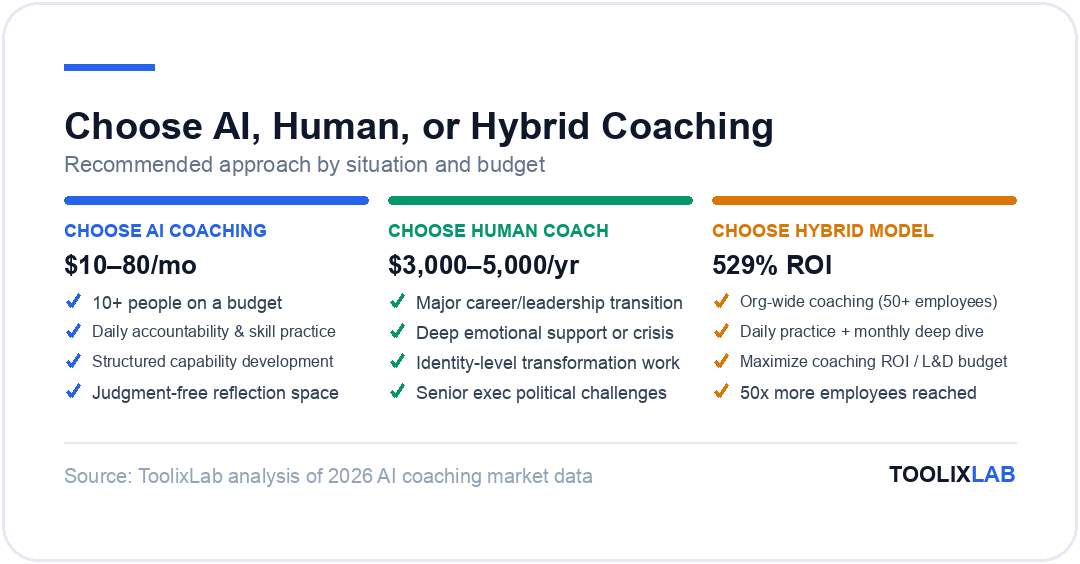
✅ Choose AI Coaching if...
- • You need coaching for 10+ people on a budget
- • You want daily accountability and skill practice
- • You're developing specific, structured capabilities
- • You prefer a judgment-free environment for reflection
✅ Choose Human Coaching if...
- • You're navigating a major career or leadership transition
- • You need deep emotional support or crisis navigation
- • You're working on identity-level transformation
- • You're a senior executive with complex political challenges
🔑 Key Takeaways
- ✓ AI coaching costs 80% less than human coaching ($10–80/mo vs $3,000–5,000/year) and delivers 8.4/10 effectiveness
- ✓ Human coaches hold a decisive advantage for deep transformation, C-suite challenges, and crisis support
- ✓ The coach-coachee relationship accounts for ~30% of coaching outcomes — AI can't replicate this yet
- ✓ The hybrid model (AI for all + human for leaders) generates 529% ROI and reaches 50x more employees
- ✓ Corporate AI coaching adoption increased 156% year-over-year — the market has validated the technology
- ✓ For most teams in 2026, the right question isn't AI vs human — it's how to deploy both strategically
The Bottom Line on AI Coach vs Human Coach in 2026
The AI coach vs human coach debate has largely resolved itself in 2026 — not with a winner, but with a recognition that the two approaches are complementary rather than competing. AI coaching has earned its place as a legitimate, effective tool for skill development, accountability, and scaled access to coaching support. Human coaching has demonstrated, through rigorous research and practitioner experience, that there are irreplaceable dimensions of the coaching relationship that algorithms cannot yet deliver.
For individuals: if you've never worked with a coach because the cost was prohibitive, an AI coaching platform is a genuine game-changer — not a consolation prize. The 8.4/10 effectiveness rating and 85% goal achievement improvement aren't marketing claims; they reflect a technology that has matured considerably. Start with AI coaching, and add a human coach when your goals demand deeper relational work.
For organizations: the hybrid model is the clear strategic play. Deploy AI coaching across your entire manager population, reserve human coaching budget for senior leaders and high-stakes development moments, and use the AI data to make every human coaching session dramatically more effective. The 529% ROI figure isn't achievable with either approach alone — it requires the combination.
The question for 2026 is no longer which is better in the abstract. It's how to architect a coaching strategy that uses each approach for what it actually does best. That's the framework this guide gives you — and the answer, for most people and most organizations, is both.
Frequently Asked Questions
Can an AI coach replace a human coach?
AI coaches handle structured skill-building, accountability check-ins, and on-demand guidance effectively. However, they cannot replace human coaches for deep emotional work, crisis navigation, or high-stakes leadership development where empathy, intuition, and real-world experience are essential. The strongest outcomes come from using both strategically.
How much does AI coaching cost compared to human coaching?
AI coaching typically costs $10–80 per user per month, while human executive coaching averages $3,000–5,000 per person per year. AI coaching costs roughly 80% less, making it accessible to entire teams rather than just senior leaders. Hybrid models that combine both reduce per-employee costs by approximately 60%.
Is AI coaching actually effective?
Yes. AI coaching is rated 8.4/10 for effectiveness by users versus 8.7/10 for human coaches (2026 data). 85% of AI coaching users report improved goal achievement, and corporate AI coaching adoption grew 156% year-over-year in 2025–2026. It is most effective for structured skill development and daily habit formation.
What is the hybrid coaching model?
The hybrid model combines AI coaching for daily check-ins, skill-building, and progress tracking with periodic human coaching sessions for deeper strategy and emotional intelligence work. Companies using both approaches report up to 529% ROI on their coaching investment and reach 50x more employees than human-only programs.
Who should choose a human coach over an AI coach?
Choose a human coach when navigating leadership transitions, deep personal transformation, C-suite political challenges, burnout recovery, or relationship-driven career pivots. Human coaches excel when empathy, lived experience, and nuanced intuition are critical to your progress — situations where the relational quality of coaching accounts for a significant share of outcomes.
What are the best AI coaching platforms in 2026?
Top AI coaching platforms in 2026 include BetterUp for enterprise leadership development, CoachHub for scalable corporate coaching that blends AI with human coaches, Torch for hybrid AI and human session structures, and Risely for manager-specific skill coaching. Each suits different budgets, team sizes, and coaching goals.
Can AI coaching help with emotional challenges?
AI coaching provides a judgment-free space for structured emotional awareness and reflection exercises. However, for clinical emotional issues, trauma, or mental health challenges, a licensed therapist or certified human coach with emotional intelligence training is far more appropriate and effective. AI coaching is not a substitute for clinical mental health support.
How is AI coaching different from therapy or mentoring?
AI coaching focuses on goal achievement and forward-looking skill development using structured frameworks. Therapy addresses past trauma and mental health with clinical methods. Mentoring is relationship-based knowledge transfer from an experienced practitioner. AI coaching occupies the performance and accountability layer between these two distinct approaches.