
By ToolixLab Research Team · Last Updated: June 2026
Quick Answer
The best AI tools for solopreneur coaches in 2026 are Fathom (free call notes), ChatGPT (session prep and copy), Dubsado (client CRM), Canva Magic Studio (content visuals), and Zapier (automation glue). A full lean stack costs $75–$120/month and saves the average solopreneur coach 15+ hours a week.
Running a one-person coaching business in 2026 means wearing every hat — lead generation, client delivery, content creation, admin, invoicing, and follow-up — all without burning out. The good news: AI tools for solopreneur coaches have finally reached the point where a single person can manage a full client roster without virtual assistants or agencies.
According to a 2026 survey by The Bootstrapped Founder, solopreneurs who adopt a structured AI tool stack reclaim an average of 15–25 hours per week previously lost to admin, note-taking, content creation, and manual follow-up. For a solopreneur coach charging $200/hour, that's $3,000–$5,000 in recovered revenue potential every single month.
The problem is most "best AI tools for solopreneurs" lists are not written for coaches specifically. They recommend generic productivity tools that miss what coaches actually need: structured client call notes, coaching-specific CRM workflows, session prep that actually works, and content that builds authority without taking all day.
This guide is different. We've organized every tool recommendation around the five core jobs of a solopreneur coach: delivering great sessions, managing clients, building your brand, filling your pipeline, and running the business admin. Each tool has been evaluated on whether it earns its place in a lean, focused stack — not whether it's impressive on paper.
We've already covered the broader best AI tools for coaches and consultants. This guide goes deeper on what specifically works for the solopreneur context — where budget, time, and cognitive load all need to stay minimal.
⚡ Quick Summary
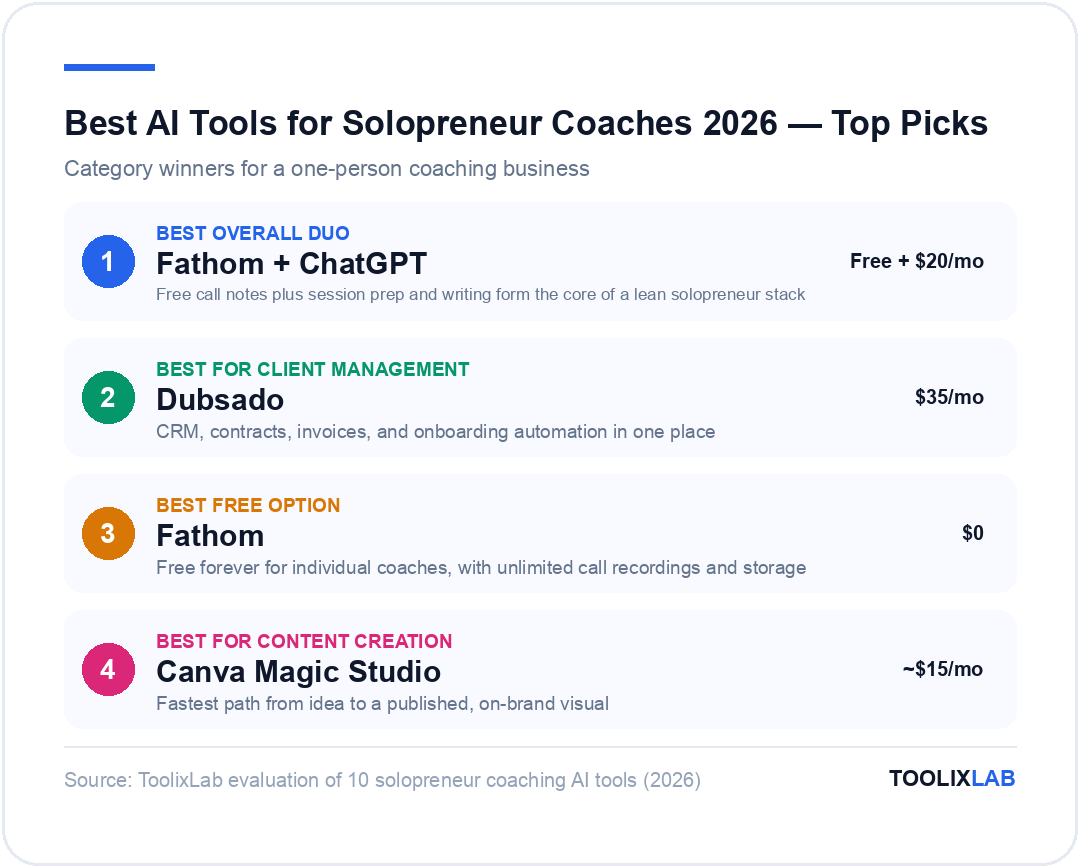
Best overall: Fathom (free call notes) + ChatGPT Plus ($20/mo) as the core duo
Best for client management: Dubsado ($35/mo) — CRM, contracts, invoices, onboarding in one place
Best free option: Fathom — free forever for individual coaches with unlimited call recordings
Best for content creation: Canva Magic Studio (~$15/mo) — fastest path from idea to published visual
Lean stack cost: $75–$120/month for everything you need
Why Do Solopreneur Coaches Need AI Tools in 2026?
A solopreneur coach's time is split across fundamentally different types of work: deep, relationship-intensive client sessions that require 100% presence, and the shallow-but-necessary admin work — scheduling, invoicing, follow-up, content — that quietly consumes 30–40% of the working week. AI tools don't improve your coaching ability. But they almost completely eliminate the second category.
The solopreneur context adds a specific pressure that agency coaches don't face: there's no team to absorb the admin overflow. Every hour spent writing a client summary, creating a social post, or chasing an invoice is an hour not spent in session or in business development. AI tools close that gap with remarkable precision in 2026.
The five core problems AI tools solve for solopreneur coaches are: (1) session notes written automatically while you stay present, (2) client proposals and frameworks drafted in minutes rather than hours, (3) CRM and onboarding workflows that run without manual input, (4) consistent content output without a content team, and (5) scheduling friction removed entirely. The tools in this guide each solve at least one of these directly.
At-a-Glance: Best AI Tools for Solopreneur Coaches 2026
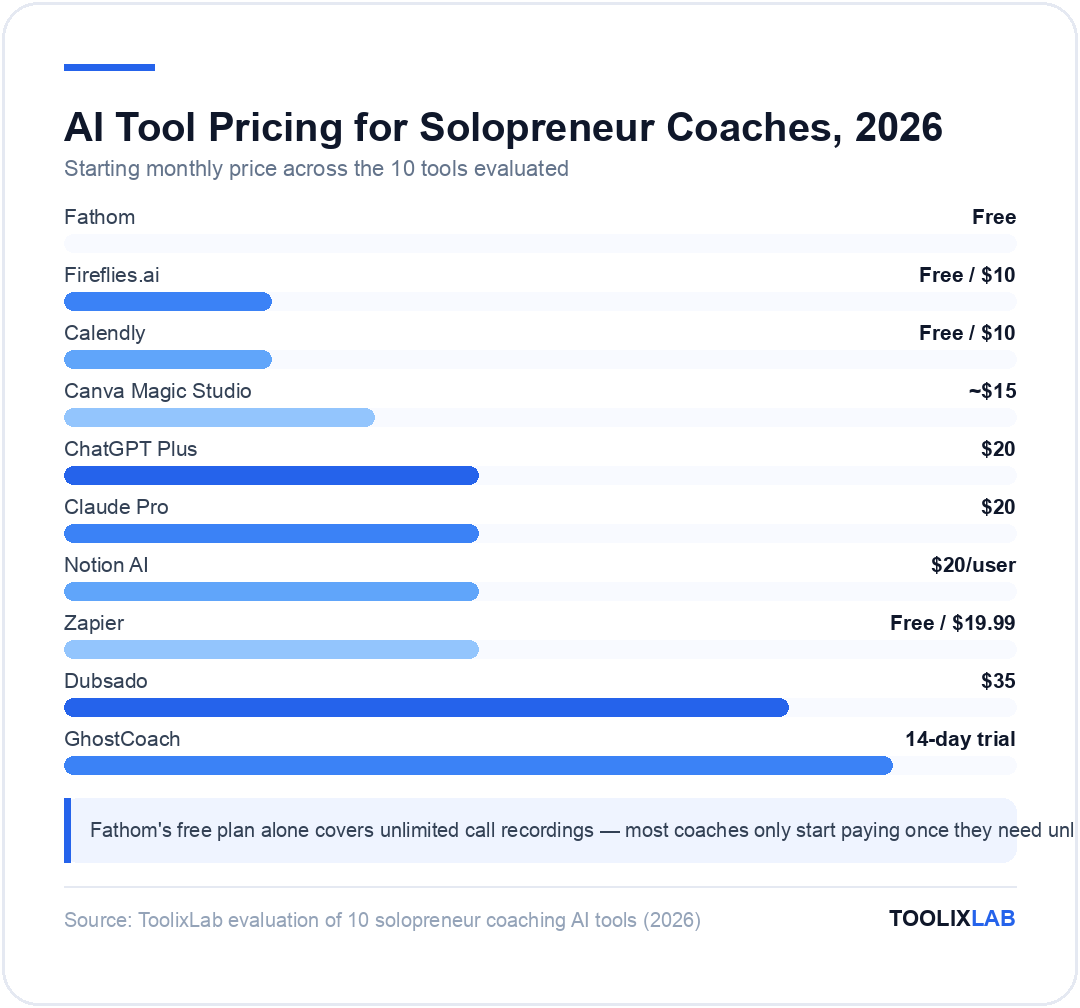
| Tool | Best For | Starting Price | Free Plan | Coach-Specific? |
|---|---|---|---|---|
| Fathom | Client call notes | Free | ✅ Generous | ✅ |
| ChatGPT Plus | Session prep, writing, research | $20/mo | ✅ Limited | Partial |
| Dubsado | Client CRM & onboarding | $35/mo | ✅ 3 clients | ✅ Built for coaches |
| Notion AI | Knowledge & client notes | $20/mo | ❌ No AI on free | Partial |
| Canva Magic Studio | Content & social visuals | ~$15/mo | ✅ Limited | Partial |
| Zapier | Workflow automation | Free / $19.99/mo | ✅ 100 tasks/mo | Partial |
| Fireflies.ai | Searchable call archive | Free / $10/mo | ✅ Limited storage | ✅ |
| Calendly | Client scheduling | Free / $10/mo | ✅ 1 event type | Partial |
| Claude | Long-form frameworks & proposals | Free / $20/mo | ✅ Limited | Partial |
| GhostCoach | AI business coach for coaches | 14-day trial | ✅ Trial | ✅ Solopreneur-specific |
*Prices verified June 2026 — check official pages for current rates.
1. Fathom — Best Free AI Notetaker for Coaching Calls
Best for: Coaches who want zero-friction call notes without paying a penny
Fathom sits in the background of your Zoom, Google Meet, or Teams call and does something deceptively simple: it listens, transcribes, and produces an AI summary the moment your call ends. No manual notes. No scrambling to type while someone is talking. You stay fully present with your client, and Fathom handles the documentation.
For solopreneur coaches specifically, Fathom's free plan is genuinely compelling. You get unlimited call recordings, unlimited storage, and five AI-powered summaries per month at no cost. For coaches running up to five client calls a week, upgrading to Premium (approximately $19/month billed monthly, or around $15–16/month annually) unlocks unlimited AI summaries, AI action items, AI follow-up email drafts, and the "Ask Fathom" feature — which lets you query any past call transcript conversationally.
The workflow most coaches land on: Fathom generates the call summary, you review it in under two minutes, paste the key client themes into ChatGPT to prep the next session, and send the AI-drafted follow-up email to the client within 10 minutes of the call ending. That entire post-session loop used to take 30–45 minutes manually.
One honest caveat: Fathom requires the Zoom or Meet bot to join your calls, which means your clients will see it. Most coaches find a simple "I use an AI notetaker so I can stay fully present with you — is that okay?" resolves any friction immediately. Very few clients object.
✅ Pros
- • Free plan is genuinely useful (5 AI summaries/month)
- • Unlimited recordings and storage on free tier
- • AI follow-up email drafts save 15–20 min per session
- • "Ask Fathom" feature lets you search across all past calls
- • Integrates with Zapier, Notion, HubSpot, Slack
❌ Cons
- • Bot joins the call — some clients find this intrusive
- • Five AI summaries/month is the free cap (fine for part-time coaches)
- • No built-in CRM — needs Zapier or manual export to connect
- • Zoom-optimized; Teams and Meet support is slightly less polished
| Plan | Price/mo | Key Features |
|---|---|---|
| Free | $0 | Unlimited recordings, 5 AI summaries/month, unlimited storage |
| Premium | ~$19/mo | Unlimited AI summaries, AI action items, follow-up emails, Ask Fathom, Zapier |
*Prices verified June 2026 — check fathom.video/pricing for current rates.
2. Is ChatGPT the Best AI Tool for Solopreneur Coach Writing & Session Prep?
Best for: Everything you write as a coach — from client proposals to LinkedIn posts
ChatGPT remains the single most versatile AI tool a solopreneur coach can own in 2026. It is not a coaching-specific tool — and that's actually why it's so useful. The breadth of use cases it covers means one $20/month subscription replaces what would otherwise require three or four separate tools.
For solopreneur coaches, the highest-ROI use cases are: (1) pre-session prep — paste the previous Fathom summary and ask for three powerful coaching questions based on the client's stated goal, (2) proposal writing — describe the client's situation and ask ChatGPT to draft a coaching proposal with outcomes and pricing, (3) framework creation — build proprietary coaching frameworks quickly by starting with a GPT outline and refining with your own IP, and (4) marketing copy — LinkedIn posts, discovery call scripts, and email nurture sequences in minutes. Looking for the best prompts to use? See our guide to the best ChatGPT prompt libraries to accelerate your workflows.
ChatGPT Plus at $20/month gives access to GPT-4o, Advanced Data Analysis, and the ability to create custom GPTs. A solopreneur coach who builds a custom GPT trained on their coaching methodology and common client archetypes will find it dramatically outperforms the generic model for coaching-specific tasks.
Where ChatGPT struggles for coaches: It cannot access the internet in real time unless you use the browsing mode, and its outputs always need a human edit for tone — especially for emotionally sensitive client communications. Never send a ChatGPT-drafted message directly to a client without reading and personalizing it.
✅ Pros
- • Most versatile AI tool available — one subscription covers many use cases
- • Custom GPTs let you train it on your coaching methodology
- • Voice mode useful for thinking through session structure on a walk
- • Free tier is usable (GPT-4o mini with daily limits)
❌ Cons
- • Outputs require human editing — never send directly to clients
- • No coaching-specific features or integrations built in
- • Prone to sycophancy — push back if an output feels too agreeable
3. Dubsado — Best CRM & Client Management Platform for Solopreneur Coaches
Best for: Coaches who want proposals, contracts, invoices, and onboarding in one place
Dubsado is not technically an AI tool — but it is the system that makes AI tools for solopreneur coaches actually work in practice. Without a proper CRM, your AI-drafted proposals live in Google Docs, your invoices go out manually, and your onboarding process depends on you remembering what step to send next. Dubsado automates the entire client lifecycle from inquiry to offboarding.
The workflow looks like this: a lead fills in a contact form on your website (Dubsado-hosted) → you send a branded proposal using a template → the client signs a contract and pays the deposit in the same portal → an automated onboarding workflow sends the welcome email, coaching agreement, intake questionnaire, and Calendly booking link in sequence — all without any manual input after the initial setup.
Dubsado received a major overhaul with its 3.0 update in 2025, improving the workflow builder significantly. As of June 2026, the main complaint in coach communities is the learning curve of the initial setup (plan 3–4 hours to build your first workflow properly) and the price increase implemented in December 2025. But coaches who push through the setup consistently report that Dubsado pays for itself within weeks by removing the manual admin overhead entirely. For a broader look at how AI enhances small business operations, see our guide to best AI tools for small businesses.
✅ Pros
- • Built specifically for coaches and service providers
- • Proposals, contracts, invoices, onboarding — all in one platform
- • Workflow automation fires without any manual triggering
- • Free trial allows up to 3 clients (no time limit)
- • Strong template library to get started fast
❌ Cons
- • Steep initial setup — plan 3–4 hours for first workflow
- • Price increased to $35–$55/month in December 2025
- • Scheduling and automation features locked to Premier plan ($55/mo)
- • Not a true AI tool — AI features are basic text generation only
| Plan | Monthly | Annual | Key Difference |
|---|---|---|---|
| Starter | $35/mo | $335/yr | Core CRM, proposals, contracts, invoices — no scheduling automation |
| Premier | $55/mo | $525/yr | Everything in Starter + scheduling, workflow automation, Zapier, multiple brands |
*Prices verified June 2026 — check dubsado.com/pricing for current rates.
4. Is Notion AI Worth It for Solopreneur Coaches in 2026?
Best for: Coaches who want a single system for client notes, frameworks, and knowledge management
Notion AI works best for solopreneur coaches who already organize their client notes, frameworks, and content in Notion — it adds an intelligent layer on top of what you've already built. The AI can summarize client progress notes, draft next-session agendas from your notes, write framework documentation, and — in the Business plan — generate meeting notes directly from calendar events.
The pricing change in early 2026 is worth flagging: Notion AI is no longer available as a standalone $10/month add-on. It's now bundled exclusively into the Business plan at $20/user/month (billed annually). Free and Plus users receive only 20 total AI responses, with no option to purchase more. If you're evaluating Notion purely for the AI features and aren't already embedded in the Notion ecosystem, the value calculation is tighter than it was in 2025.
Where Notion AI genuinely shines for coaches: building a personal knowledge base of client archetypes, common coaching challenges, and reusable frameworks that the AI can draw from when you ask it to draft content. The more you put in, the more useful it becomes — it's a compounding asset, not just a writing tool.
✅ Pros
- • AI searches across your entire Notion workspace (not just the current page)
- • AI Meeting Notes integrates with Google Calendar on Business plan
- • Excellent for building and documenting coaching frameworks
- • Compounding value — gets more useful as you add more content
❌ Cons
- • AI now requires Business plan at $20/user/month — no longer a cheap add-on
- • High setup time to build a useful coaching knowledge base
- • Overkill if you only want writing AI (ChatGPT is cheaper for that)
- • Custom Agents now charge $10 per 1,000 credits on top of the plan cost
5. Canva Magic Studio — Best for Creating Coaching Content Visuals
Best for: Coaches who need professional-looking content without a designer
Canva Magic Studio turns "I need a LinkedIn carousel, a lead magnet cover, and an Instagram quote graphic" from a half-day task into a 20-minute one. For solopreneur coaches, consistent visual content is the difference between being remembered and being invisible — but hiring a designer is not viable at the solopreneur scale. Canva bridges that gap.
The AI features in Magic Studio that coaches use most: Magic Design (generate a full presentation or social post template from a text prompt), Magic Write (AI copywriting for captions and descriptions), Magic Resize (resize any asset across all formats in one click), and Background Remover (clean product shots from iPhone photos instantly). Canva Pro also gives you Brand Kit, which locks in your fonts, colors, and logo so every piece of content looks consistent without thinking about it.
For coaches building a content-led pipeline, Canva Pro is one of the highest-ROI subscriptions available. The approximately $15/month cost produces enough visual output to fill a full week's social media calendar in a single morning sitting.
✅ Pros
- • Magic Resize saves hours when repurposing content across platforms
- • Brand Kit ensures visual consistency without design expertise
- • Magic Design generates full presentation decks from a text prompt
- • One of the best value subscriptions for solopreneurs at ~$15/mo
❌ Cons
- • AI-generated designs often need significant manual refinement
- • Not suitable for complex brand guidelines or custom illustration
- • Magic Write is outclassed by ChatGPT for serious copywriting tasks
6. Do Solopreneur Coaches Actually Need Zapier?
Best for: Coaches who want their tools to talk to each other without manual copying
Zapier is the connective tissue between every other tool in this list. On its own it does nothing — but once you build even two or three Zaps, it quietly eliminates the most tedious admin work in your coaching business. The most valuable automations for solopreneur coaches: new Fathom transcript → summarize with ChatGPT → save to Notion client page; new Calendly booking → create Dubsado project → send onboarding email; completed coaching session → trigger invoice in Dubsado.
Zapier's free plan handles 100 tasks per month across single-step Zaps, which covers a small client roster. The Professional plan at $19.99/month adds multi-step Zaps and premium app connections, which is what most coaches will need to connect Fathom, Notion, Dubsado, and their email in one workflow. If you prefer open-source, n8n is a compelling free alternative — see our comparison of Zapier vs Make vs n8n for the trade-offs.
✅ Pros
- • Connects 7,000+ apps — works with virtually every coaching tool
- • No-code interface; most coaches can build basic Zaps in under 30 minutes
- • Free plan covers low-volume coaching practices
- • AI by Zapier features allow ChatGPT steps inside your automation
❌ Cons
- • Task limits can be hit quickly with high-volume workflows
- • Pricing escalates fast for complex, multi-step automations
- • Debugging broken Zaps requires patience (error messages are vague)
7. Fireflies.ai — Best Searchable Coaching Call Archive
Best for: Coaches with large call libraries who need to search across past sessions
Fireflies.ai occupies a similar space to Fathom but with a different emphasis: where Fathom excels at per-call summaries and follow-up emails, Fireflies is stronger on search and analytics across a large call library. If you've been coaching for years and have hundreds of recorded sessions, Fireflies lets you search across all of them conversationally — asking "which clients mentioned burnout in the last six months" returns results from every transcript in your library.
The Pro plan at $10/user/month (billed annually) is reasonably priced for the features offered. One important gotcha: Fireflies has faced criticism for not including AI credits in the base subscription — you'll need to purchase additional credits ($5 for 50) for heavy AI feature usage. For coaches running three to five calls a week, this tends to be a minor cost, but it's worth factoring in. You can automate follow-up emails from Fireflies in combination with your email marketing tool — our guide to automating email marketing with AI walks through those integrations.
✅ Pros
- • Cross-call search is genuinely powerful for coaches with large libraries
- • Topic tracking identifies recurring themes across client calls
- • Works across Zoom, Meet, Teams, and phone calls
- • Pro plan is affordable at $10/seat/month (annual)
❌ Cons
- • AI credits sold separately — adds to true monthly cost
- • Free plan has limited storage and no searchable transcripts
- • Fathom is better for individual call summaries and follow-up emails
- • Interface is more complex than Fathom for new users
8. Calendly — Best AI Scheduling Tool for Solopreneur Coaches
Best for: Eliminating scheduling friction for discovery calls and client sessions
Scheduling friction is a silent revenue killer for solopreneur coaches. Every "when are you free?" email thread that goes back and forth three times is a prospect who might not convert. Calendly removes that friction entirely — prospects book directly into your calendar based on your real availability, and automated reminders fire 24 hours and 1 hour before each session.
Calendly's free plan is sufficient for most solopreneur coaches starting out — one event type (your 60-minute coaching session link) covers the core use case. The Standard plan at $10/seat/month (annually) unlocks unlimited event types (discovery call, chemistry call, group coaching session, workshop) and integrations with Stripe, PayPal, HubSpot, and Dubsado. Most coaches find the Standard plan covers everything they need for years.
9. Claude — Best for Long-Form Frameworks, Proposals & Client Deliverables
Best for: Writing that needs to sound human and handle nuance — coaching proposals, methodology docs, intake frameworks
While ChatGPT is the Swiss Army knife, Claude is the scalpel for writing tasks that require more care. Coaches consistently find Claude's output feels more human, less formulaic, and better suited to emotionally intelligent communication — which matters enormously in a coaching context. Claude's 200K token context window also means you can paste an entire client history — notes, assessments, past session summaries — and ask it to draft a comprehensive progress report or coaching methodology document without losing context.
The most coach-specific use cases: writing coaching methodology documents that reflect your real approach (not generic AI boilerplate), drafting client progress reports that sound warm rather than clinical, creating 90-day coaching roadmaps based on intake assessment responses, and building intake questionnaires that draw out the information you actually need before session one.
Claude Pro is $20/month — the same price as ChatGPT Plus. Many coaches run both: ChatGPT for volume and variety, Claude for anything that needs to read like it was written by a thoughtful human. For coaches who want a broader look at AI writing tools, see our comparison of best AI writing tools for content creators.
✅ Pros
- • 200K token context window handles entire client histories
- • Writing quality is notably more human and nuanced than ChatGPT for long-form
- • Better at maintaining a consistent, warm tone in coaching communications
- • Excellent for building structured coaching frameworks and methodology docs
❌ Cons
- • Fewer integrations and plugins than ChatGPT
- • No image generation built in
- • Can be over-cautious in sensitive coaching scenarios
10. GhostCoach — Best AI Business Coach for Solopreneur Coaches
Best for: Coaches who want structured AI guidance on growing their own coaching practice
GhostCoach takes an interesting position in this list: it's an AI tool for the coach themselves, not for serving clients. Built specifically for solopreneurs running subscription-based service businesses, GhostCoach uses a framework called the "Ghost OS" to guide you through five decisions that determine revenue: offer architecture, AI delivery stack, acquisition system, automation layer, and revenue protection.
The 14-day trial gives full Builder access with unlimited AI coaching sessions and complete business profile injection — meaning the AI understands your specific practice before giving advice. It's most useful during a growth inflection point: when you've got clients but aren't sure how to systematize delivery, raise prices, or add a group program. For ongoing strategy and accountability, it's a reasonable alternative to hiring a $500/hour business coach for your coaching business.
Honest take: GhostCoach is not a replacement for a human mentor who has built a coaching business themselves. But for a solopreneur coach who wants structured thinking on business decisions — and can't afford ongoing peer coaching — it's a credible thinking partner at a fraction of the cost. It works best alongside human mentorship, not instead of it.
What's the Best Lean AI Stack for a Solopreneur Coach in 2026?
The shiny object syndrome is real in the AI tools space, and solopreneur coaches are particularly vulnerable to it — every new tool promises to save hours. The truth is that a lean stack of four to five tools, used consistently and deeply, outperforms a sprawling twelve-tool setup every time.
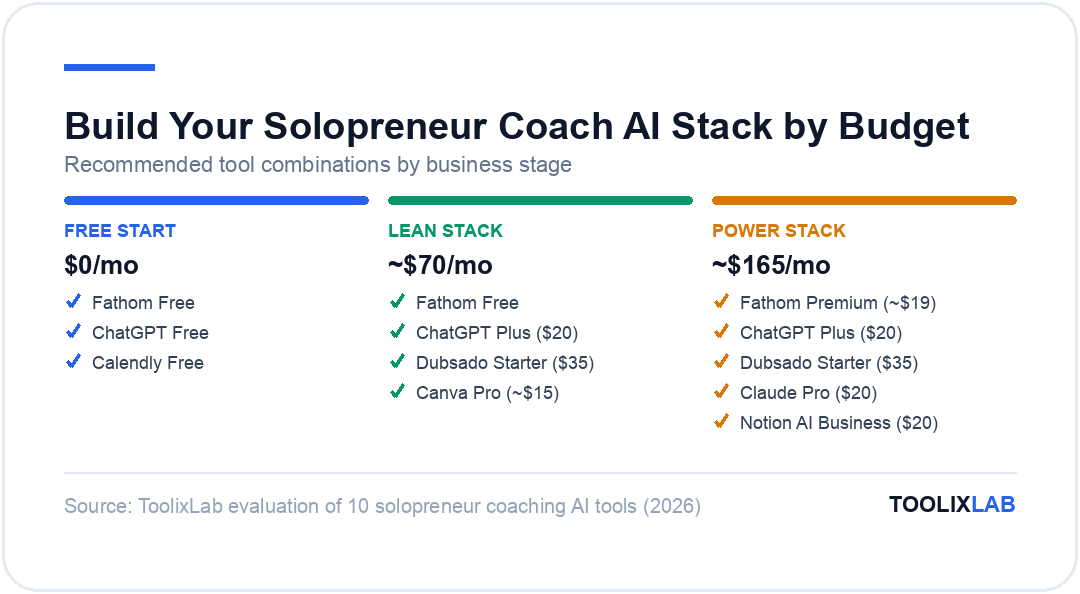
Here is the recommended lean stack for a solopreneur coach at each budget level:
| Budget | Stack | Monthly Cost |
|---|---|---|
| Free / £0 | Fathom (free) + ChatGPT free + Calendly free | $0 |
| Lean ($75/mo) | Fathom free + ChatGPT Plus + Dubsado Starter + Canva Pro | ~$70/mo |
| Complete ($120/mo) | Fathom Premium + ChatGPT Plus + Dubsado Starter + Canva Pro + Zapier Starter | ~$110/mo |
| Power ($170/mo) | Above + Claude Pro + Notion AI Business + Calendly Standard | ~$165/mo |
The "Lean" stack at $70/month is where the majority of solopreneur coaches should start. It covers the three highest-leverage problems: session documentation (Fathom), client writing and prep (ChatGPT), and client management (Dubsado). Add tools individually as specific pain points arise — not because a tool looks impressive.
One important note: connecting your tools with Zapier adds the most value when you have consistent, repeating workflows. If you're still figuring out your coaching process, automate later — premature automation of an unstable process creates fragile, hard-to-debug workflows. Build the process manually first, then automate it once it's working. Our guide on building an AI content creation workflow walks through the same principle for your content operations.
Which AI Tools Should Solopreneur Coaches Avoid?
Avoid enterprise coaching platforms (BetterUp, CoachHub, Hone) unless you're coaching for large organizations. These are $300–$1,000/employee/year platforms built for corporate buyers, not solopreneur delivery. The pricing structure and feature set assume a team of coaches, not one.
Avoid AI-generated content published without editing. Several coaches have experimented with fully automated blog posts or newsletter issues — the content reads well to a casual reader but lacks the specific insight and experience clients hire a coach for. Your content is your credibility. AI accelerates writing; it doesn't replace your perspective.
Avoid over-stacking tools before you have ten recurring clients. At the zero-to-ten-client stage, the constraint is not productivity — it's distribution and conversion. No amount of AI automation fixes a pipeline problem. Focus on Fathom plus ChatGPT and spend the remaining energy on outreach and building relationships. The best AI agents in 2026 are impressive, but they can't get clients for you.
🔑 Key Takeaways
- ✓ The best free starting point is Fathom (call notes) + ChatGPT free + Calendly free — total cost $0
- ✓ The lean paid stack costs $70–$110/month and saves 15+ hours per week for most coaches
- ✓ Fathom + ChatGPT is the highest-ROI combination for solopreneur coaches — transcription into session prep takes under 5 minutes
- ✓ Dubsado ($35/mo) automates the entire client lifecycle — proposals, contracts, invoices, onboarding
- ✓ Notion AI now requires the $20/month Business plan — only worth it if you're already in the Notion ecosystem
- ✓ Don't automate before your process is stable — build manually first, then use Zapier to systematize
- ✓ Claude outperforms ChatGPT for long-form, emotionally nuanced coaching deliverables
- ✓ Avoid enterprise platforms (BetterUp, CoachHub) — built for corporate buyers, not solopreneur coaches
Conclusion: Build the Right AI Stack for Your Coaching Stage
The best AI tools for solopreneur coaches in 2026 are not the most sophisticated tools on the market — they're the tools that solve the specific problems a one-person coaching business actually faces: staying present in sessions while capturing everything, onboarding clients without hours of admin, creating consistent content without a team, and scaling delivery without adding headcount.
Start with Fathom and ChatGPT. Those two tools alone will return more value than any other AI investment at the early stage. When you have recurring clients and a repeating workflow, add Dubsado for client management. When you're producing consistent content, add Canva Magic Studio. Add Zapier when you're manually copying information between tools more than twice a week. Build the power stack incrementally as each layer earns its place.
The solopreneur coaches who win with AI in 2026 are not the ones with the most tools — they're the ones who go deep on fewer tools and build real workflows around them. Pick your stack, learn it properly, and direct the time you save back into the work only you can do: being exceptional in the room with your clients.
For the broader landscape of coaching tools, explore our guide to the best AI tools for coaches and consultants in 2026, which covers enterprise coaching platforms, team coaching tools, and advanced automation options beyond the solopreneur stack.
Frequently Asked Questions
What is the best AI tool for solopreneur coaches in 2026?
Fathom is the single best starting point — it's free, transcribes every client call, and generates AI summaries automatically. Pair it with ChatGPT for session prep and Dubsado for client management and you have 80% of what most solopreneur coaches need for under $55/month.
Can AI replace a human business coach for solopreneurs?
Not meaningfully. AI tools like GhostCoach and Rocky.ai are useful for structured accountability and quick answers, but they lack the judgment, intuition, and relational depth of an experienced human coach. Think of AI as a productivity layer on top of your coaching practice, not a replacement for it.
What's the best free AI notetaker for coaching calls?
Fathom is the best free AI notetaker for coaching calls in 2026. The free plan gives you unlimited recordings and unlimited storage, with AI-powered summaries for up to five calls per month. Otter.ai and Fireflies.ai both have free tiers, but Fathom's free offering is significantly more generous for individual coaches.
How much should a solopreneur coach spend on AI tools per month?
A lean, effective AI stack for solopreneur coaches costs $75–$120 per month: Fathom free, ChatGPT Plus ($20), Dubsado Starter ($35), and Canva Pro (approximately $15). Add Zapier Starter ($19.99) only if you need automation glue. You do not need to spend more than this to get serious productivity gains.
Is Notion AI worth it for solopreneur coaches in 2026?
Notion AI is worth it if you already use Notion heavily for client notes and knowledge management. The catch: AI is now bundled only into the Business plan at $20/user/month. If you're starting fresh, Notion Business is a solid all-in-one. If you only need writing AI, ChatGPT Plus at $20/month gives you more flexibility.
What AI tools help solopreneur coaches get more clients?
ChatGPT and Claude help coaches write better discovery call scripts, case studies, and LinkedIn content. Canva Magic Studio handles visual content at speed. Calendly removes friction from booking. For visibility in AI-generated answers (GEO), Otterly.ai lets you track whether your coaching brand appears when someone asks ChatGPT or Perplexity to recommend coaches.
How do solopreneur coaches use AI for session prep?
The most effective approach: review the Fathom or Fireflies summary from the previous session, then ask ChatGPT to identify the client's core blocker, suggest three powerful coaching questions based on the transcript, and draft a pre-session check-in email. This takes under five minutes and dramatically improves session quality.
What is the best AI CRM for solopreneur coaches?
Dubsado is the best AI-assisted CRM built specifically for coaches and service providers. It handles proposals, contracts, invoices, onboarding workflows, and scheduling in one place. HoneyBook is a strong alternative with a cleaner UI. For coaches who want minimal overhead, even a well-structured Notion database with AI can replace a dedicated CRM at the very early stage.